
1 Chronicles 15:28

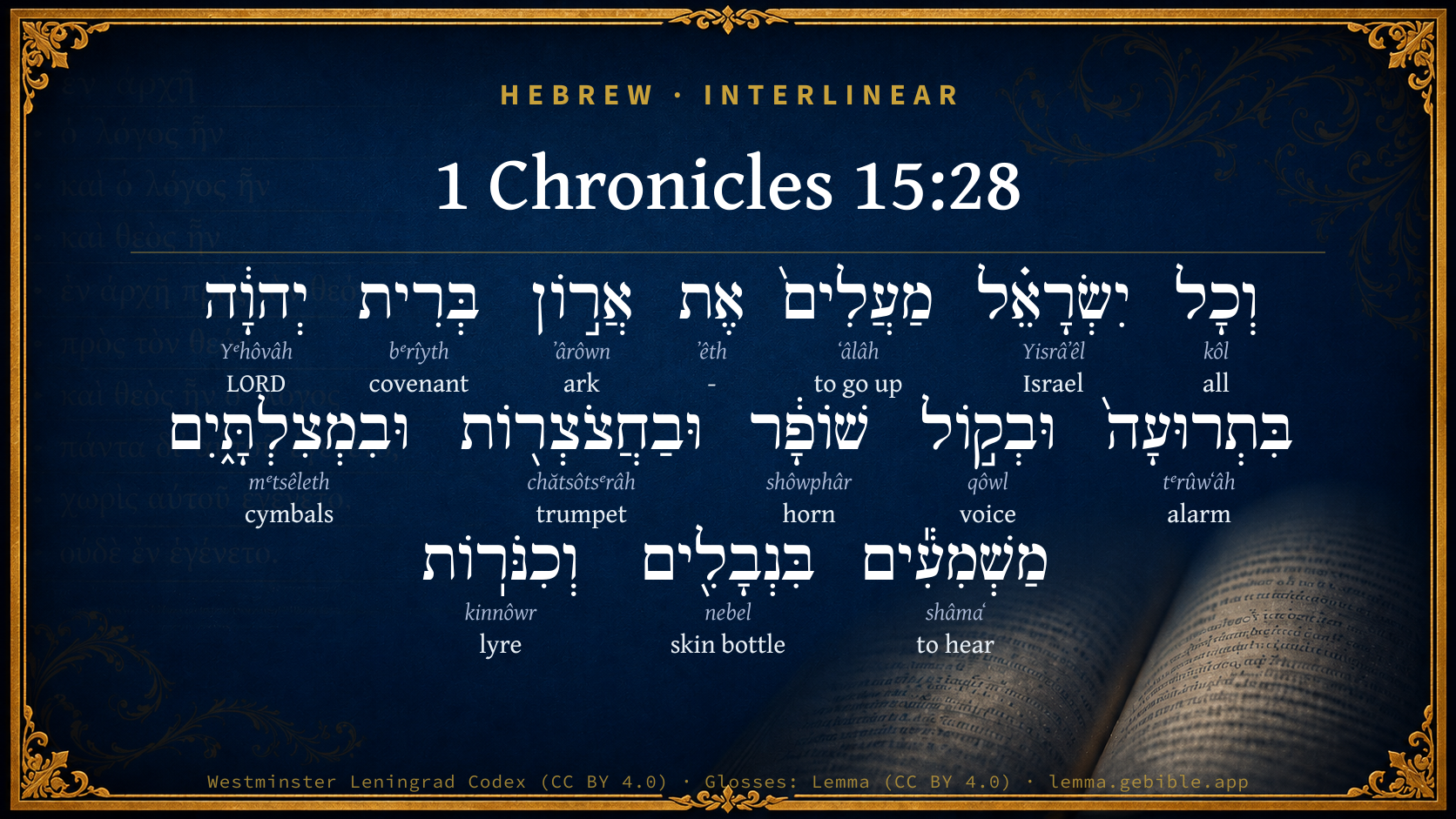
Hebrew (Westminster Leningrad Codex) 1 Chronicles 15:28 appears in the Hebrew Old Testament. The text above is from the Westminster Leningrad Codex. Each word links to its Strong’s number, a concise gloss, and parsing drawn from the Open Scriptures Hebrew Bible morphology. Click any word for its full Brown-Driver-Briggs (BDB) entry.
Download image
Cite this verse

1 Chronicles 15:28 (World English Bible). Public Domain. Lemma interlinear Bible study tool, https://lemma.gebible.app/v/1-chronicles/15/28.

Show BibTeX & RIS
BibTeX
RIS
English Translation
Thus all Israel brought up the ark of the covenant of Yahweh with shouting, and with sound of the cornet, and with trumpets, and with cymbals, sounding aloud with psalteries and harps.
World English Bible · Public Domain
Download a study sheet

One document with this verse’s original text, its word-by-word gloss line, the meaning frame, cross-references with their text, attributed commentary, and full source and license credits — printable, and it pastes into notes with its structure intact.

This verse Autodidact and up

Study sheet (.html) Plain text (.txt)

A passage Seminary Student

Up to 50 verses in one chapter. A passage sheet keeps up to 6 commentary sources and 12 cross-references per verse, in the order this page ranks them, and says so on the sheet whenever that leaves anything out. Ask for a single verse and you get the Autodidact verse sheet above.

Everything on this page stays free to read, with no account — the sheet is a download of what is already on screen, not access to it.

Want to remove ads? Support Godless Engineer
Compare translations 3

The same verse in 3 English versions, stacked beneath the original-language interlinear above. Click any original word for its lexicon entry.

Each is an independent rendering of the whole verse — the interlinear is not word-aligned to these translations.

Highlighted words mark where these versions differ — a whole-verse word diff, not a word-by-word alignment.

  • World English Bible Public Domain
    Thus all Israel brought up the ark of the covenant of Yahweh with shouting, and with sound of the cornet, and with trumpets, and with cymbals, sounding aloud with psalteries and harps.
  • King James Version Public Domain
    Thus all Israel brought up the ark of the covenant of the LORD with shouting, and with sound of the cornet, and with trumpets, and with cymbals, making a noise with psalteries and harps.
  • unfoldingWord Literal Text CC BY-SA 4.0
    And all of Israel was bringing up the Box of the Covenant of Yahweh with shouting and with the sound of the shofar and with trumpets and with cymbals, playing on lyres and harps.

unfoldingWord Literal Text — © unfoldingWord, licensed CC BY-SA 4.0. Word-aligned USFM3 via Door43 (git.door43.org/unfoldingWord/en_ult).

Versions to compare (up to 4)

3 of 4 selected

Show all 18 translations

Every available English version of this verse, each an independent rendering of the whole verse.

  • World English Bible Public Domain
    Thus all Israel brought up the ark of the covenant of Yahweh with shouting, and with sound of the cornet, and with trumpets, and with cymbals, sounding aloud with psalteries and harps.
  • Berean Standard Bible Public Domain
    So all Israel brought up the ark of the covenant of the LORD with shouting, with the sounding of rams’ horns and trumpets, and with cymbals and the music of harps and lyres.
  • Majority Standard Bible Public Domain
    So all Israel brought up the ark of the covenant of the LORD with shouting, with the sounding of rams’ horns and trumpets, and with cymbals and the music of harps and lyres.
  • King James Version Public Domain
    Thus all Israel brought up the ark of the covenant of the LORD with shouting, and with sound of the cornet, and with trumpets, and with cymbals, making a noise with psalteries and harps.
  • American Standard Version (1901) Public Domain
    Thus all Israel brought up the ark of the covenant of Jehovah with shouting, and with sound of the cornet, and with trumpets, and with cymbals, sounding aloud with psalteries and harps.
  • Revised Version (1885) Public Domain
    Thus all Israel brought up the ark of the covenant of the LORD with shouting, and with sound of the cornet, and with trumpets, and with cymbals, sounding aloud with psalteries and harps.
  • Geneva Bible (1599) Public Domain
    Thus all Israel brought vp the Arke of the Lordes couenant with shouting and sounde of cornet, and with trumpets, and with cymbales, making a sound with violes and with harpes.
  • Douay-Rheims (1899) Public Domain
    And all Israel brought the ark of the covenant of the Lord with joyful shouting, and sounding with the sound of the comet, and with trumpets, and cymbals, and psalteries, and harps.
  • Young's Literal Translation Public Domain
    And all Israel are bringing up the ark of the covenant of Jehovah with shouting, and with the sound of a cornet, and with trumpets, and with cymbals, sounding with psalteries and harps,
  • Literal Standard Version CC BY-SA 4.0
    And all of Israel is bringing up the Ark of the Covenant of YHWH with shouting, and with the sound of a horn, and with trumpets, and with cymbals, sounding with psalteries and harps,
  • Unlocked Literal Bible CC BY-SA 4.0
    So all Israel brought up the ark of the covenant of Yahweh with joyful shouting, and with the sound of horns and trumpets, with cymbals, and with stringed instruments and harps.
  • unfoldingWord Literal Text CC BY-SA 4.0
    And all of Israel was bringing up the Box of the Covenant of Yahweh with shouting and with the sound of the shofar and with trumpets and with cymbals, playing on lyres and harps.
  • Darby Bible Public Domain
    And all Israel brought up the ark of the covenant of Jehovah with shouting, and with sound of the trumpet, and with clarions, and with cymbals, playing aloud with lutes and harps.
  • World Messianic Bible Public Domain
    Thus all Israel brought the ark of the LORD’s covenant up with shouting, with sound of the cornet, with shofars, and with cymbals, sounding aloud with stringed instruments and harps.
  • Webster's Bible Public Domain
    Thus all Israel brought up the ark of the covenant of the LORD with shouting, and with sound of the cornet, and with trumpets, and with cymbals, making a noise with psalteries and harps.
  • Free Bible Version CC BY-SA 4.0
    So all of Israel brought back the Ark of the Lord's Agreement with a lot of shouting, accompanied by horns, trumpets, and cymbals, and music played on harps and lyres.
  • Bible in Basic English Public Domain
    So all Israel took up the ark of the agreement of the Lord, with loud cries and with horns and brass and corded instruments sounding loudly.
  • JPS Tanakh (1917) Public Domain
    Thus all Israel brought up the ark of the covenant of the LORD with shouting, and with sound of the horn, and with trumpets, and with cymbals, sounding aloud with psalteries and harps.

Literal Standard Version (2020), Covenant Press — licensed CC BY-SA 4.0. Text via the HelloAO Bible API (eBible.org). Unlocked Literal Bible (unfoldingWord) — licensed CC BY-SA 4.0. Text via the HelloAO Bible API (eBible.org). unfoldingWord Literal Text — © unfoldingWord, licensed CC BY-SA 4.0. Word-aligned USFM3 via Door43 (git.door43.org/unfoldingWord/en_ult). Free Bible Version, Dr. Jonathan Gallagher — licensed CC BY-SA 4.0. Text via the HelloAO Bible API (eBible.org).

Word by word

More ways to search: Search by grammar → Find every occurrence → Compare this word →

Practice this passage: Drill this verse → Learn its vocabulary →

וּבִמְצִלְתָּ֑יִם
mᵉtsêleth
H4700
“and · in/at · cymbals”
Conjunction + Preposition + Noun, Common, Feminine, Dual, Absolute
Part of Speech
Conjunction + Preposition + Noun
Type
Common
Gender
Feminine
Number
Dual
State
Absolute
Full BDB Definition

Origin: from H6750

TWOT: 1919f

cymbals
  1. וְכָל kôl H3605 “and · all of” Conjunction + Noun, Common, Masculine, Singular, Construct
  2. יִשְׂרָאֵ֗ל Yisrâʼêl H3478 “Israel” Noun, Proper
  3. מַעֲלִים֙ ʻâlâh H5927 “going up” Verb, Hiphil, Participle Active, Masculine, Plural, Absolute
  4. אֶת ʼêth H853 “-” Particle, Direct Object
  5. אֲר֣וֹן ʼârôwn H727 “ark of” Noun, Common, Both, Singular, Construct
  6. בְּרִית bᵉrîyth H1285 “covenant of” Noun, Common, Feminine, Singular, Construct
  7. יְהוָ֔ה Yᵉhôvâh H3068 “LORD” Noun, Proper
  8. בִּתְרוּעָה֙ tᵉrûwʻâh H8643 “in/at · alarm” Preposition + Noun, Common, Feminine, Singular, Absolute
  9. וּבְק֣וֹל qôwl H6963 “and · in/at · voice of” Conjunction + Preposition + Noun, Common, Masculine, Singular, Construct
  10. שׁוֹפָ֔ר shôwphâr H7782 “horn” Noun, Common, Masculine, Singular, Absolute
  11. וּבַחֲצֹצְר֖וֹת chătsôtsᵉrâh H2689 “and · in/at · trumpets” Conjunction + Preposition + Noun, Common, Feminine, Plural, Absolute
  12. מַשְׁמִעִ֕ים shâmaʻ H8085 “hearing” Verb, Hiphil, Participle Active, Masculine, Plural, Absolute
  13. בִּנְבָלִ֖ים nebel H5035 “in/at · skin bottles” Preposition + Noun, Common, Masculine, Plural, Absolute
  14. וְכִנֹּרֽוֹת kinnôwr H3658 “and · lyres” Conjunction + Noun, Common, Masculine, Plural, Absolute

About this verse

These counts appear in no published source. They are computed here, from the morphology-tagged text and Lemma’s own curated glosses. What Lemma adds →

15
words
15
distinct lemmas
Historical
section

Notable vocabulary

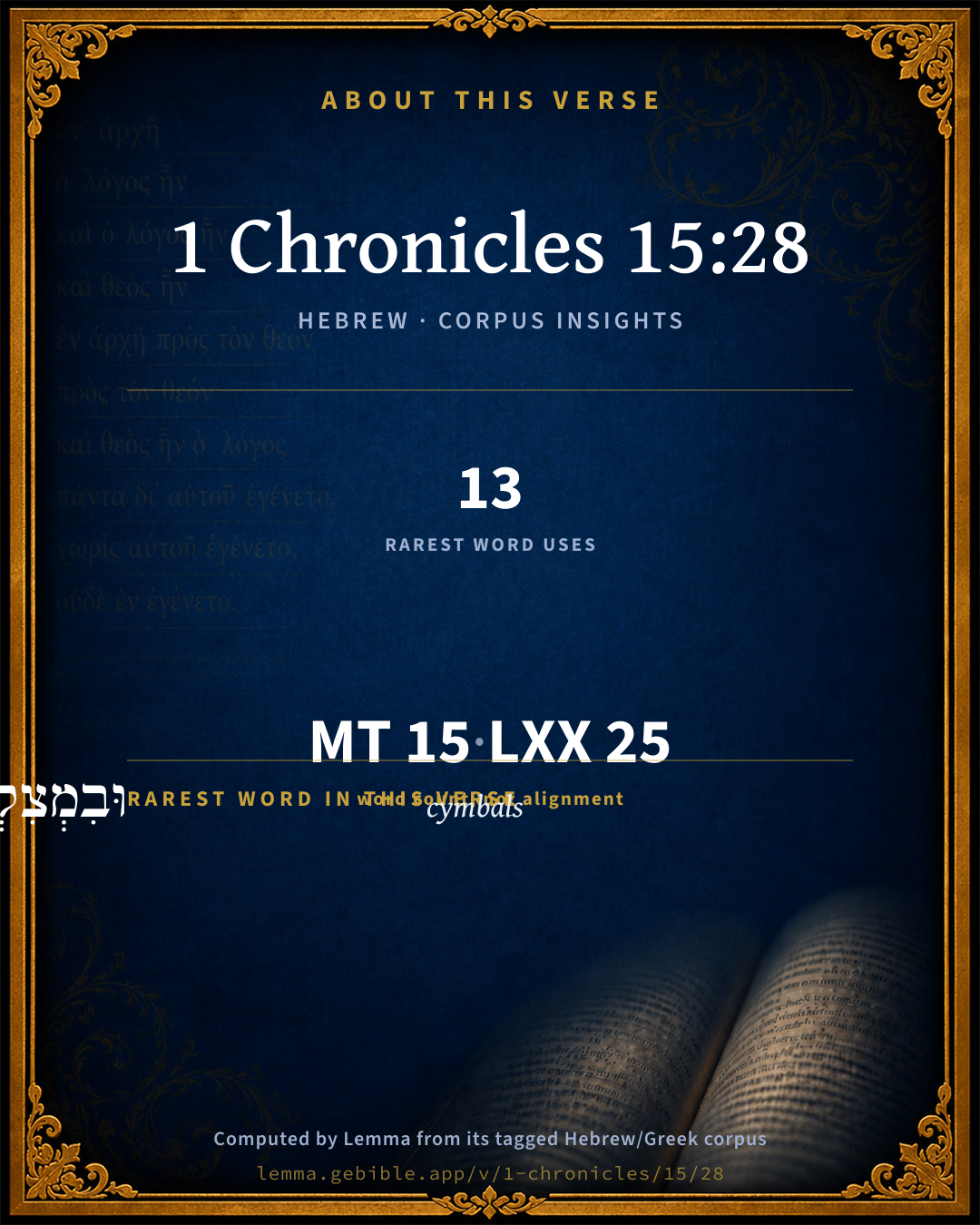
The rarest word here is וּבִמְצִלְתָּ֑יִם cymbals H4700 — appearing just 13 times in the whole Hebrew Bible.

Shared distinctive vocabulary

וּבִמְצִלְתָּ֑יִם cymbals H4700 occurs in 13 verses of the Hebrew Bible. Also found in:

Grammatical profile

  • 2 verbs
  • 12 nouns
  • 1 particle

Verb forms

  • מַעֲלִים֙ Hiphil · Participle Active
  • מַשְׁמִעִ֕ים Hiphil · Participle Active

Hebrew & Septuagint length

In English translation the verse runs 32 words from the Hebrew and 34 from the Septuagint (LXX English) — closely comparable.

A rough comparison of the two English renderings, which tokenize alike — not a word-level alignment.

Word counts can differ between the Hebrew and the Greek without any difference in meaning — e.g. the Hebrew direct-object marker אֵת has no separate Greek word, and Greek often adds the article ὁ.

In the original languages it is 15 Hebrew tokens and 25 Greek tokens — but the two are counted differently (Hebrew bundles its prefixes and suffixes into one token; the Greek is in lemma form), so that isn’t a like-for-like length.

Cross-references

9

Topical passages linked to 1 Chronicles 15:28 in the Treasury of Scripture Knowledge — connected by theme and wording, ordered by reader-vote popularity; previews shown in the World English Bible.

  • 1 Chronicles 13:8 David and all Israel played before God with all their might, even with songs, and with harps, and with psalteries, and with tambourines, and with cymbals, and with trumpets.
  • 1 Chronicles 15:16 David spoke to the chief of the Levites to appoint their brothers the singers, with instruments of music, psalteries and harps and cymbals, sounding aloud and lifting up the voice with joy.
  • 2 Samuel 6:15 So David and all the house of Israel brought up the ark of Yahweh with shouting, and with the sound of the trumpet.
  • 2 Chronicles 5:12–13 also the Levites who were the singers, all of them, even Asaph, Heman, Jeduthun, and their sons and their brothers, arrayed in fine linen, with cymbals and psalteries and harps, stood at the east end of the altar, and with them one hundred twenty priests sounding with trumpets;)
  • Ezra 3:10–11 When the builders laid the foundation of the temple of Yahweh, they set the priests in their clothing with trumpets, and the Levites the sons of Asaph with cymbals, to praise Yahweh, after the order of David king of Israel.
  • Psalms 47:1–5 Oh clap your hands, all you nations. Shout to God with the voice of triumph!
  • Psalms 68:25 The singers went before, the minstrels followed after, In the midst of the ladies playing with tambourines,
  • Psalms 98:4–6 Make a joyful noise to Yahweh, all the earth! Burst out and sing for joy, yes, sing praises!
  • Psalms 150:3–5 Praise him with the sounding of the trumpet! Praise him with harp and lyre!

Cross-references courtesy of OpenBible.info (CC BY 4.0).

Hebrew and Greek witnesses Masoretic Hebrew ↔ Greek Septuagint

The same verse in the two great witnesses to the Old Testament, shown verse-for-verse.

These are two independent witnesses, not word-aligned to each other, and the Septuagint is shown in lemma (dictionary) form.

Hebrew 1 Chronicles 15:28 Masoretic · Westminster Leningrad Codex

וְכָל יִשְׂרָאֵ֗ל מַעֲלִים֙ אֶת אֲר֣וֹן בְּרִית יְהוָ֔ה בִּתְרוּעָה֙ וּבְק֣וֹל שׁוֹפָ֔ר וּבַחֲצֹצְר֖וֹת וּבִמְצִלְתָּ֑יִם מַשְׁמִעִ֕ים בִּנְבָלִ֖ים וְכִנֹּרֽוֹת

Thus all Israel brought up the ark of the covenant of Yahweh with shouting, and with sound of the cornet, and with trumpets, and with cymbals, sounding aloud with psalteries and harps.

World English Bible · Public Domain

Greek LXX 1 Chronicles 15:28 Septuagint · lemma form

καί πᾶς ἰσραήλ ἀναἄγω ὁ κιβωτός διαθήκη κύριος ἐν σημασία καί ἐν φωνή σωφερ καί ἐν σάλπιγξ καί ἐν κύμβαλον ἀναφωνέω νάβλα καί ἐν κινύρα

And all Israel brought up the ark of the covenant of the Lord with shouting, and with the sound of a horn, and with trumpets, and with cymbals, playing loudly on lutes and harps.

LXX2012 (modern English Septuagint) · Public Domain

Hebrew: Westminster Leningrad Codex (CC BY 4.0). Greek: Septuagint (public domain); English from LXX2012 (modern English Septuagint) (Public Domain). How the Septuagint differs from the Hebrew →

Commentary

Notes on 1 Chronicles 15:28 from classic Christian and Jewish commentators (each source and its license shown beneath its notes). The classic Christian expositions comment on the surrounding passage and are grouped to its opening verse, so a note may address several verses; the Jewish commentaries on the Tanakh (Rashi and others) are per-verse, so they appear only where the commentator wrote on this verse.

Lemma curates 59 commentaries, every one of them public domain or Creative Commons licensed, each selected and text-cleaned for this edition rather than reprinted as found. About our sources →

Ellicott's Commentary for English Readers

(28) Thus all Israel brought.—And all Israel were bringing. Samuel has “and David and all the house of Israel,” and “ark of the Lord.”

Cornet.—Rather, trumpet.

The rest of this verse is wanting in Samuel, but all the additional instruments have already been mentioned (1Ch_15:16-21).

Trumpets.—Clarions, or straight trumpets.

The last clause should be rendered, “and with clanging cymbals, with harps and lutes.” (Comp. Psa_150:3-4.)

A Bible Commentary for English Readers, edited by Charles John Ellicott (1878–1897) — public domain. Text from a community e-Sword module.

The Cambridge Bible for Schools and Colleges

gen. ed. J. J. S. Perowne

28. with shouting] The Heb. word (tĕrû‘ah) is technical in the sense of a blast with the festal trumpets (Num_10:1-10), and in this sense it should be taken here, since the Chronicler has expanded the account given in Samuel by introducing a mention of these trumpets.

The Cambridge Bible for Schools and Colleges (gen. ed. J. J. S. Perowne; Cambridge University Press, 1878–1918) — public domain. Text from a community e-Sword module.

The Pulpit Commentary

Making a noise. This description qualifies the cymbals alone, and should rather appear in our translation as "noise-making cymbals."

The Pulpit Commentary (1880–1919), ed. H.D.M. Spence-Jones & Joseph S. Exell — public domain. Text from a community e-Sword module.

Lesson kit

Teaching starters — assembled from the data on this page, not authored interpretation. Every prompt links to the verse data it draws on. Edit before teaching.

1 Chronicles, in the Historical, opens this verse with 15 words (15 distinct Hebrew lemmas). Its most distinctive word is mᵉtsêleth (“cymbals”). A historical commentator’s framing appears above. Read the whole chapter for the surrounding context.

Discussion questions

  1. What does “cymbals” (mᵉtsêleth) contribute to the verse as a whole?
  2. How does 1 Chronicles 13:8, which shares the word «cymbals», read alongside this verse?
  3. These translations render this verse differently. What is at stake in choosing one wording over another?
  4. «מַעֲלִים֙» is a Hiphil Participle Active verb. How does that grammatical form shape the action described?
  5. Compare how Ellicott's Commentary for English Readers and The Cambridge Bible for Schools and Colleges read this verse. Where do they agree or differ?

Things to notice

Reading settings

Reading text

Shown beneath each verse's original-language words.

Old Testament
Old Testament edition

Read the OT as the Masoretic Hebrew (MT) or the Greek Septuagint (LXX).

English shown for the Greek Septuagint (in the Hebrew ↔ Greek comparison).

Comparing translations? Open the Compare panel on any verse page to stack up to four side by side.