
Ezra 3:13

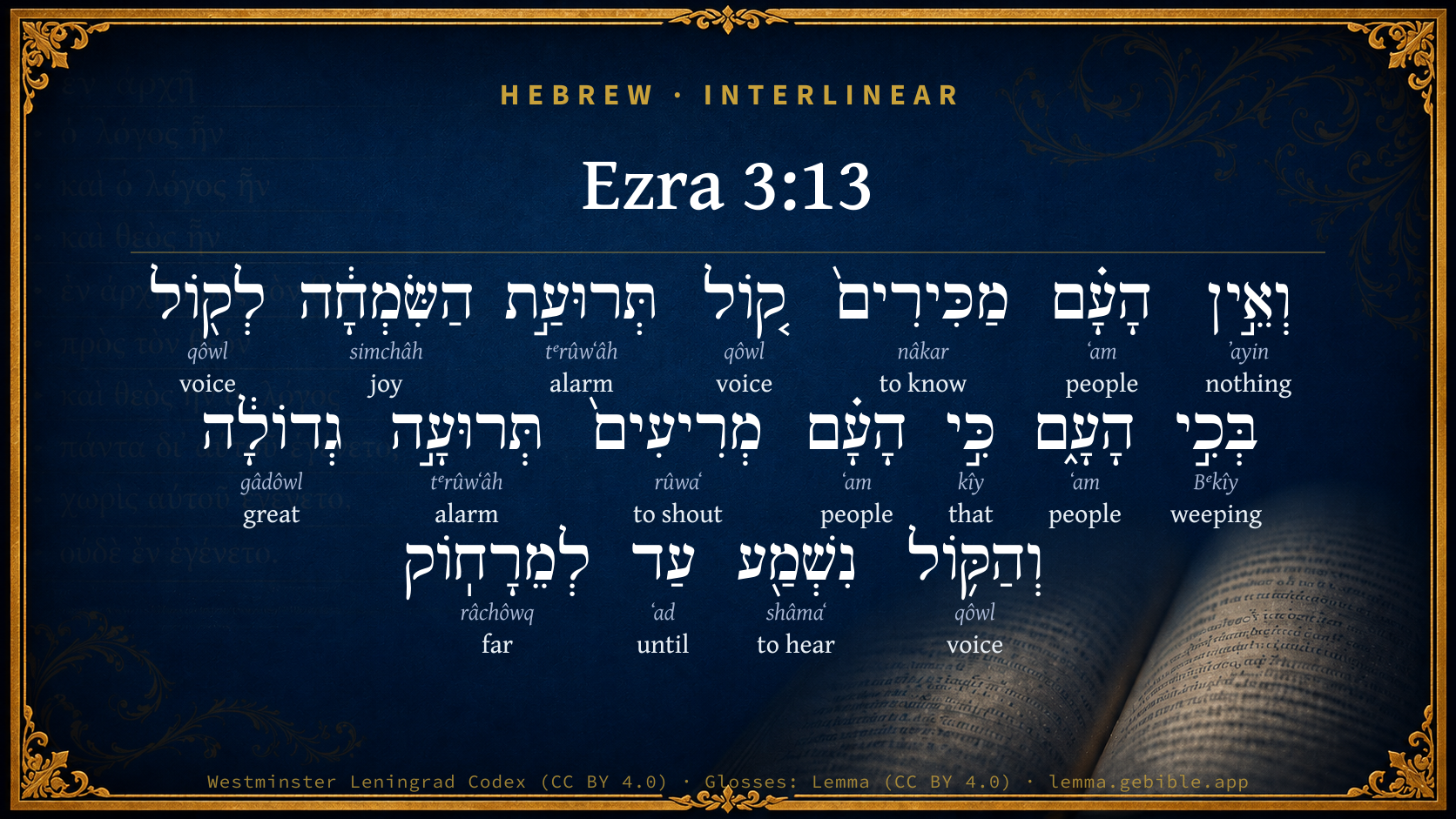
Hebrew (Westminster Leningrad Codex) Ezra 3:13 appears in the Hebrew Old Testament. The text above is from the Westminster Leningrad Codex. Each word links to its Strong’s number, a concise gloss, and parsing drawn from the Open Scriptures Hebrew Bible morphology. Click any word for its full Brown-Driver-Briggs (BDB) entry.
Download image
Cite this verse

Ezra 3:13 (World English Bible). Public Domain. Lemma interlinear Bible study tool, https://lemma.gebible.app/v/ezra/3/13.

Show BibTeX & RIS
BibTeX
RIS
English Translation
so that the people could not discern the noise of the shout of joy from the noise of the weeping of the people; for the people shouted with a loud shout, and the noise was heard afar off.
World English Bible · Public Domain
Download a study sheet

One document with this verse’s original text, its word-by-word gloss line, the meaning frame, cross-references with their text, attributed commentary, and full source and license credits — printable, and it pastes into notes with its structure intact.

This verse Autodidact and up

Study sheet (.html) Plain text (.txt)

A passage Seminary Student

Up to 50 verses in one chapter. A passage sheet keeps up to 6 commentary sources and 12 cross-references per verse, in the order this page ranks them, and says so on the sheet whenever that leaves anything out. Ask for a single verse and you get the Autodidact verse sheet above.

Everything on this page stays free to read, with no account — the sheet is a download of what is already on screen, not access to it.

Want to remove ads? Support Godless Engineer
Compare translations 3

The same verse in 3 English versions, stacked beneath the original-language interlinear above. Click any original word for its lexicon entry.

Each is an independent rendering of the whole verse — the interlinear is not word-aligned to these translations.

Highlighted words mark where these versions differ — a whole-verse word diff, not a word-by-word alignment.

  • World English Bible Public Domain
    so that the people could not discern the noise of the shout of joy from the noise of the weeping of the people; for the people shouted with a loud shout, and the noise was heard afar off.
  • King James Version Public Domain
    So that the people could not discern the noise of the shout of joy from the noise of the weeping of the people: for the people shouted with a loud shout, and the noise was heard afar off.
  • unfoldingWord Literal Text CC BY-SA 4.0
    So the people could not differentiate the sound of the shout of joy from the sound of the weeping of the people. For the people were shouting a great shout, and the sound was heard as far as from a remote place.

unfoldingWord Literal Text — © unfoldingWord, licensed CC BY-SA 4.0. Word-aligned USFM3 via Door43 (git.door43.org/unfoldingWord/en_ult).

Versions to compare (up to 4)

3 of 4 selected

Show all 18 translations

Every available English version of this verse, each an independent rendering of the whole verse.

  • World English Bible Public Domain
    so that the people could not discern the noise of the shout of joy from the noise of the weeping of the people; for the people shouted with a loud shout, and the noise was heard afar off.
  • Berean Standard Bible Public Domain
    The people could not distinguish the shouts of joy from the sound of weeping, because the people were making so much noise. And the sound was heard from afar.
  • Majority Standard Bible Public Domain
    The people could not distinguish the shouts of joy from the sound of weeping, because the people were making so much noise. And the sound was heard from afar.
  • King James Version Public Domain
    So that the people could not discern the noise of the shout of joy from the noise of the weeping of the people: for the people shouted with a loud shout, and the noise was heard afar off.
  • American Standard Version (1901) Public Domain
    so that the people could not discern the noise of the shout of joy from the noise of the weeping of the people; for the people shouted with a loud shout, and the noise was heard afar off.
  • Revised Version (1885) Public Domain
    so that the people could not discern the noise of the shout of joy from the noise of the weeping of the people: for the people shouted with a loud shout, and the noise was heard afar off.
  • Geneva Bible (1599) Public Domain
    So that the people coulde not discerne the sound of the shoute for ioy, from the noyse of the weeping of the people: for the people shouted with a loude crie, and the noyse was heard farre off.
  • Douay-Rheims (1899) Public Domain
    So that one could not distinguish the voice of the shout of joy, from the noise of the weeping of the people: for one with another the people shouted with a loud shout, and the voice was heard afar off.
  • Young's Literal Translation Public Domain
    and the people are not discerning the noise of the shout of joy from the noise of the weeping of the people, for the people are shouting -- a great shout -- and the noise hath been heard unto a distance.
  • Literal Standard Version CC BY-SA 4.0
    and the people are not discerning the noise of the shout of joy from the noise of the weeping of the people, for the people are shouting [with] a great shout, and the noise has been heard to a distance.
  • Unlocked Literal Bible CC BY-SA 4.0
    As a result, people were not able to distinguish the joyful and glad sounds from the sound of people weeping, for the people were crying out with great joy, and the sound was heard from far away.
  • unfoldingWord Literal Text CC BY-SA 4.0
    So the people could not differentiate the sound of the shout of joy from the sound of the weeping of the people. For the people were shouting a great shout, and the sound was heard as far as from a remote place.
  • Darby Bible Public Domain
    And the people could not discern the noise of the shout of joy from the noise of the weeping of the people; for the people shouted with a great shout, and the noise was heard afar off.
  • World Messianic Bible Public Domain
    so that the people could not discern the noise of the shout of joy from the noise of the weeping of the people; for the people shouted with a loud shout, and the noise was heard far away.
  • Webster's Bible Public Domain
    So that the people could not discern the noise of the shout of the joy from the noise of the weeping of the people: for the people shouted with a loud shout, and the noise was heard afar off.
  • Free Bible Version CC BY-SA 4.0
    However, nobody could tell the shouts of joy from the cries of weeping, because everyone was making so much noise—so much so it could be heard a long way away.
  • Bible in Basic English Public Domain
    So that in the ears of the people the cry of joy was mixed with the sound of weeping; for the cries of the people were loud and came to the ears of those who were a long way off.
  • JPS Tanakh (1917) Public Domain
    so that the people could not discern the noise of the shout of joy from the noise of the weeping of the people; for the people shouted with a loud shout, and the noise was heard afar off.

Literal Standard Version (2020), Covenant Press — licensed CC BY-SA 4.0. Text via the HelloAO Bible API (eBible.org). Unlocked Literal Bible (unfoldingWord) — licensed CC BY-SA 4.0. Text via the HelloAO Bible API (eBible.org). unfoldingWord Literal Text — © unfoldingWord, licensed CC BY-SA 4.0. Word-aligned USFM3 via Door43 (git.door43.org/unfoldingWord/en_ult). Free Bible Version, Dr. Jonathan Gallagher — licensed CC BY-SA 4.0. Text via the HelloAO Bible API (eBible.org).

Word by word

More ways to search: Search by grammar → Find every occurrence → Compare this word →

Practice this passage: Drill this verse → Learn its vocabulary →

בְּכִ֣י
Bᵉkîy
H1065
“weeping of”
Noun, Common, Masculine, Singular, Construct
Part of Speech
Noun
Type
Common
Gender
Masculine
Number
Singular
State
Construct
Full BDB Definition

Origin: from H1058

TWOT: 243b

a weeping, weeping
  1. וְאֵ֣ין ʼayin H369 “and · nothing” Conjunction + Particle, Negative
  2. הָעָ֗ם ʻam H5971 “the · people” Particle, Definite Article + Noun, Common, Masculine, Singular, Absolute
  3. מַכִּירִים֙ nâkar H5234 “knowing” Verb, Hiphil, Participle Active, Masculine, Plural, Absolute
  4. ק֚וֹל qôwl H6963 “voice of” Noun, Common, Masculine, Singular, Construct
  5. תְּרוּעַ֣ת tᵉrûwʻâh H8643 “alarm of” Noun, Common, Feminine, Singular, Construct
  6. הַשִּׂמְחָ֔ה simchâh H8057 “the · joy” Particle, Definite Article + Noun, Common, Feminine, Singular, Absolute
  7. לְק֖וֹל qôwl H6963 “to/for · voice of” Preposition + Noun, Common, Masculine, Singular, Construct
  8. הָעָ֑ם ʻam H5971 “the · people” Particle, Definite Article + Noun, Common, Masculine, Singular, Absolute
  9. כִּ֣י kîy H3588 “that” Conjunction
  10. הָעָ֗ם ʻam H5971 “the · people” Particle, Definite Article + Noun, Common, Masculine, Singular, Absolute
  11. מְרִיעִים֙ rûwaʻ H7321 “shouting” Verb, Hiphil, Participle Active, Masculine, Plural, Absolute
  12. תְּרוּעָ֣ה tᵉrûwʻâh H8643 “alarm” Noun, Common, Feminine, Singular, Absolute
  13. גְדוֹלָ֔ה gâdôwl H1419 “great” Adjective, Adjective, Feminine, Singular, Absolute
  14. וְהַקּ֥וֹל qôwl H6963 “and · the · voice” Conjunction + Particle, Definite Article + Noun, Common, Masculine, Singular, Absolute
  15. נִשְׁמַ֖ע shâmaʻ H8085 “to hear” Verb, Niphal, Perfect, 3rd Person, Masculine, Singular
  16. עַד ʻad H5704 “until” Preposition
  17. לְמֵרָחֽוֹק râchôwq H7350 “to/for · from · far” Preposition + Preposition + Adjective, Adjective, Masculine, Singular, Absolute

About this verse

These counts appear in no published source. They are computed here, from the morphology-tagged text and Lemma’s own curated glosses. What Lemma adds →

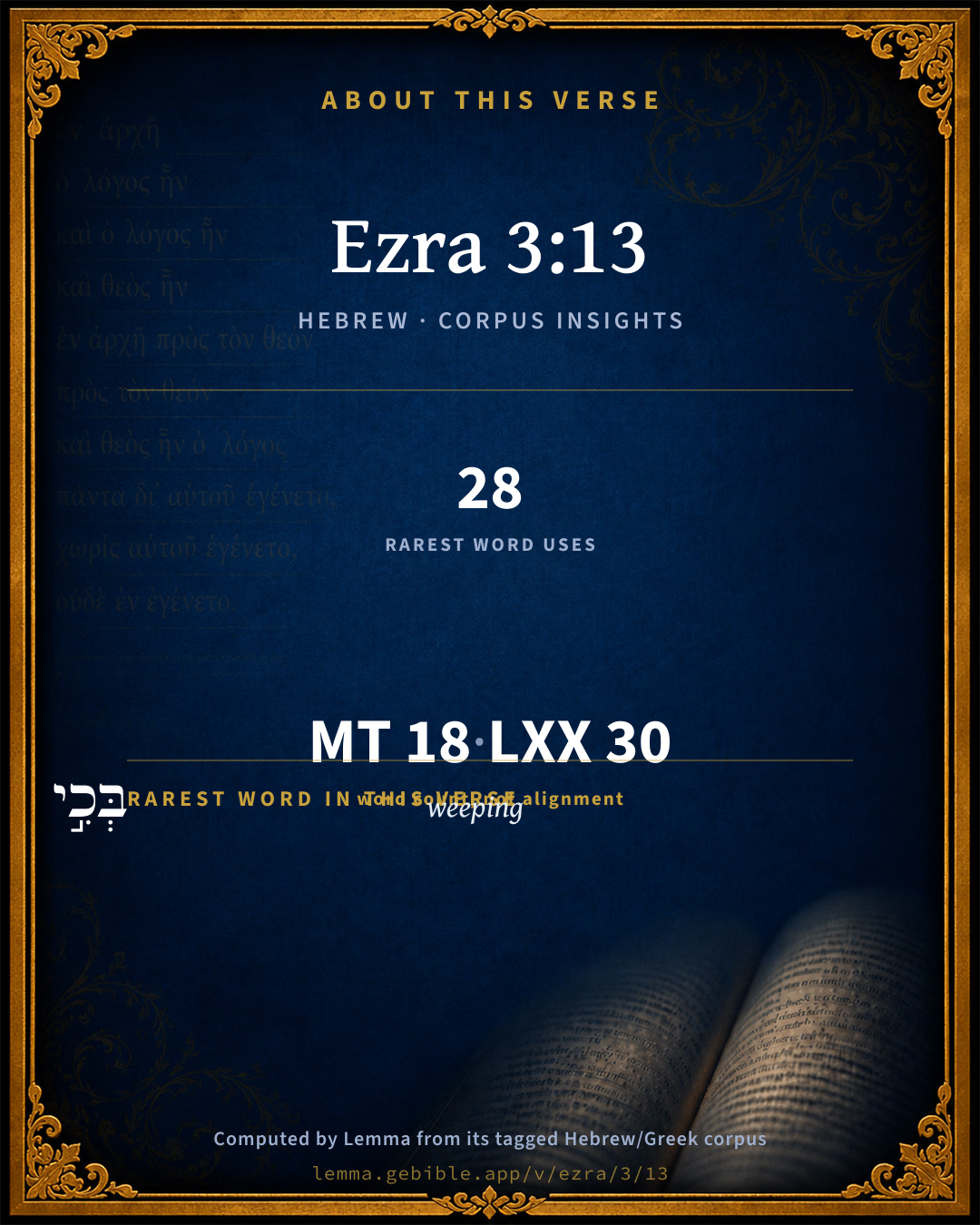
18
words
13
distinct lemmas
Historical
section

Shared distinctive vocabulary

בְּכִ֣י weeping H1065 occurs in 27 verses of the Hebrew Bible. Also found in:

Grammatical profile

  • 3 verbs
  • 10 nouns
  • 2 adjectives
  • 1 preposition
  • 1 conjunction
  • 1 particle

Verb forms

  • מַכִּירִים֙ Hiphil · Participle Active
  • מְרִיעִים֙ Hiphil · Participle Active
  • נִשְׁמַ֖ע Niphal · Perfect

Repetition

Words recur within this verse — often emphatic in Hebrew:

  • הָעָ֗ם people H5971 ×3
  • ק֚וֹל voice H6963 ×3
  • תְּרוּעַ֣ת alarm H8643 ×2

Hebrew & Septuagint length

In English translation the verse runs 38 words from the Hebrew and 38 from the Septuagint (LXX English) — the same length.

A rough comparison of the two English renderings, which tokenize alike — not a word-level alignment.

Word counts can differ between the Hebrew and the Greek without any difference in meaning — e.g. the Hebrew direct-object marker אֵת has no separate Greek word, and Greek often adds the article ὁ.

In the original languages it is 18 Hebrew tokens and 30 Greek tokens — but the two are counted differently (Hebrew bundles its prefixes and suffixes into one token; the Greek is in lemma form), so that isn’t a like-for-like length.

Cross-references

11

Topical passages linked to Ezra 3:13 in the Treasury of Scripture Knowledge — connected by theme and wording, ordered by reader-vote popularity; previews shown in the World English Bible.

  • 1 Samuel 4:5 When the ark of the covenant of Yahweh came into the camp, all Israel shouted with a great shout, so that the earth rang again.
  • Luke 19:37–40 As he was now getting near, at the descent of the Mount of Olives, the whole multitude of the disciples began to rejoice and praise God with a loud voice for all the mighty works which they had seen,
  • 1 Kings 1:40 All the people came up after him, and the people piped with pipes, and rejoiced with great joy, so that the earth shook with the sound of them.
  • 1 Kings 1:45 and Zadok the priest and Nathan the prophet have anointed him king in Gihon; and they are come up from there rejoicing, so that the city rang again. This is the noise that you have heard.
  • Nehemiah 12:43 They offered great sacrifices that day, and rejoiced; for God had made them rejoice with great joy; and the women also and the children rejoiced: so that the joy of Jerusalem was heard even afar off.
  • Psalms 5:11 But let all those who take refuge in you rejoice, Let them always shout for joy, because you defend them. Let them also who love your name be joyful in you.
  • Psalms 100:1–2 Shout for joy to Yahweh, all you lands!
  • Jeremiah 33:11 the voice of joy and the voice of gladness, the voice of the bridegroom and the voice of the bride, the voice of those who say, Give thanks to Yahweh of Hosts, for Yahweh is good, for his loving kindness endures forever; [and of them] who bring [sacrifices of] thanksgiving into the house of Yahweh. For I will cause the captivity of the land to return as at the first, says Yahweh.
  • Zechariah 4:7 Who are you, great mountain? Before Zerubbabel you are a plain; and he will bring out the capstone with shouts of 'Grace, grace, to it!'"
  • Exodus 32:17–18 When Joshua heard the noise of the people as they shouted, he said to Moses, "There is the noise of war in the camp."
  • Judges 2:5 They called the name of that place Bochim: and they sacrificed there to Yahweh.

Cross-references courtesy of OpenBible.info (CC BY 4.0).

Hebrew and Greek witnesses Masoretic Hebrew ↔ Greek Septuagint

The same verse in the two great witnesses to the Old Testament, shown verse-for-verse.

These are two independent witnesses, not word-aligned to each other, and the Septuagint is shown in lemma (dictionary) form.

Hebrew Ezra 3:13 Masoretic · Westminster Leningrad Codex

וְאֵ֣ין הָעָ֗ם מַכִּירִים֙ ק֚וֹל תְּרוּעַ֣ת הַשִּׂמְחָ֔ה לְק֖וֹל בְּכִ֣י הָעָ֑ם כִּ֣י הָעָ֗ם מְרִיעִים֙ תְּרוּעָ֣ה גְדוֹלָ֔ה וְהַקּ֥וֹל נִשְׁמַ֖ע עַד לְמֵרָחֽוֹק

so that the people could not discern the noise of the shout of joy from the noise of the weeping of the people; for the people shouted with a loud shout, and the noise was heard afar off.

World English Bible · Public Domain

Greek LXX Ezra 3:13 Septuagint · lemma form

καί οὐ εἰμί ὁ λαός ἐπιγιγνώσκω φωνή σημασία ὁ εὐφροσύνη ἀπό ὁ φωνή ὁ κλαυθμός ὁ λαός ὅτι ὁ λαός κραυγάζω φωνή μέγας καί ὁ φωνή ἀκούω ἕως ἀπό μακρόθεν

And the people did not distinguish the voice of the glad shout from the voice of the weeping of the people: for the people shouted with a loud voice, and the voice was heard even from afar off.

LXX2012 (modern English Septuagint) · Public Domain

In the Septuagint this is one book — Esdras B (2 Esdras): Ezra is chapters 1–10, Nehemiah 11–23.

Hebrew: Westminster Leningrad Codex (CC BY 4.0). Greek: Septuagint (public domain); English from LXX2012 (modern English Septuagint) (Public Domain). How the Septuagint differs from the Hebrew →

Commentary

Notes on Ezra 3:13 from classic Christian and Jewish commentators (each source and its license shown beneath its notes). The classic Christian expositions comment on the surrounding passage and are grouped to its opening verse, so a note may address several verses; the Jewish commentaries on the Tanakh (Rashi and others) are per-verse, so they appear only where the commentator wrote on this verse.

Lemma curates 59 commentaries, every one of them public domain or Creative Commons licensed, each selected and text-cleaned for this edition rather than reprinted as found. About our sources →

Trapp's Complete Commentary

John Trapp

Ezr 3:13 So that the people could not discern the noise of the shout of joy from the noise of the weeping of the people: for the people shouted with a loud shout, and the noise was heard afar off.

Ver. 13. The noise of the shout of joy from the noise, &c.] Nam partim iubilabant, partim eiulabant. Our joys, while we are here, will be mixed joys. Let those that would have joys unspeakable stir up sighs unutterable.

John Trapp, A Commentary or Exposition upon All the Books of the Old and New Testament (1647–1656) — public domain. Text from a community e-Sword module.

Joseph Benson's Commentary

Ezr 3:13. So that the people could not discern, &c. — The mixture of sorrow and joy here is a representation of this world. In heaven all are singing and none sighing; in hell all are wailing and none rejoicing: but here on earth we can scarce discern the shouts of joy from the noise of the weeping; let us learn to rejoice with them that rejoice, and weep with them that weep. Meantime, let us ourselves rejoice as though we rejoiced not, and weep as though we wept not.

Joseph Benson's Commentary on the Old and New Testaments (1811–1818) — public domain. Text from a community e-Sword module.

Jamieson, Fausset & Brown

Robert Jamieson, A. R. Fausset & David Brown

the people could not discern the shout of joy from the noise of the weeping of the people--Among Eastern people, expressions of sorrow are always very loud and vehement. It is indicated by wailing, the howl of which is sometimes not easily distinguishable from joyful acclamations.

Next: Ezra Chapter 4

Jamieson, Fausset & Brown — Commentary Critical and Explanatory on the Whole Bible (1871) — public domain (CC PDM 1.0). Text via the HelloAO Bible API.

Ellicott's Commentary for English Readers

(13) The noise was heard afar off.—The people also mingled in the weeping, which was with shrill cries. The rejoicing and the sorrow were blended, and the common sound was heard from far. All here has the stamp of truth.

A Bible Commentary for English Readers, edited by Charles John Ellicott (1878–1897) — public domain. Text from a community e-Sword module.

The Cambridge Bible for Schools and Colleges

gen. ed. J. J. S. Perowne

13. So that the people could not discern] literally, ‘And the people &c.’ The people generally, not merely the leaders, were of two minds. The sounds were mingled together; the weeping near at hand was as loud as the shouting. And the confused sound was audible a long way off.

The Cambridge Bible for Schools and Colleges (gen. ed. J. J. S. Perowne; Cambridge University Press, 1878–1918) — public domain. Text from a community e-Sword module.

John Gill's Exposition

So that the people could not discern the noise of the shout of joy from the noise of the weeping of the people,.... That is, not clearly and distinctly, they were so mixed and confounded together, and made such a jarring and discord:

for the people shouted with a loud shout, and the noise was heard afar off; the shouting being of young people, whose voice was strongest, and they the most numerous, the noise of shouting prevailed over the noise of weeping; and it was heard further, and at a distance appeared more distinctly to be the noise of shouting, that of weeping not reaching so far; though Jarchi is of opinion that the noise of weeping was heard further than the noise of shouting, which is not likely.

Next: Ezra Chapter 4

John Gill's Exposition of the Whole Bible (1746–1763) — public domain (CC PDM 1.0). Text via the HelloAO Bible API.

The Pulpit Commentary

The people could not discern the noise of the shout of joy from the noise of the weeping. One, it would seem, was as loud as the other; neither predominated. This, which would scarcely be possible among ourselves, was not unnatural in the East, where those who lament utter shrill cries, instead of weeping silently. Herodotus describes the lament of the Persians for a lost general as "resounding throughout all Boeotia". (Ezr_9:2-4)

The Pulpit Commentary (1880–1919), ed. H.D.M. Spence-Jones & Joseph S. Exell — public domain. Text from a community e-Sword module.

John Wesley's Explanatory Notes

Could not discern - The mixture of sorrow and joy here, is a representation of this world. In heaven all are singing and none sighing; in hell all are wailing, and none rejoicing: but here on earth we can scarce discern the shouts of joy from the noise of the weeping, let us learn to rejoice with them that rejoice, and weep with them that weep. Meantime let us ourselves rejoice as though we rejoiced not, and weep as though we wept not.

John Wesley, Explanatory Notes Upon the Whole Bible (1754–1765) — public domain. Text via the GEBible commentary corpus.

Rashi

Rabbi Shlomo Yitzchaki (Rashi)

And the people did not recognize Those listeners did not recognize the voice of the shout of joy, because of the voice of the people’s weeping, for the rejoicing people were shouting with a great shout, and the voice of weeping was heard farther and farther away.

Rashi on the Tanakh — English translations: “The Judaica Press complete Tanach with Rashi, translated by A. J. Rosenberg” (CC BY 4.0); “Pentateuch with Rashi's commentary by M. Rosenbaum and A.M. Silbermann, 1929-1934” (public domain); “The Metsudah Tanach series, Lakewood, N.J” (CC BY 4.0); and “The Book of Joshua, Metsudah Publications, 1997” (CC BY 4.0). Text via Sefaria.

Lesson kit

Teaching starters — assembled from the data on this page, not authored interpretation. Every prompt links to the verse data it draws on. Edit before teaching.

Ezra, in the Historical, opens this verse with 18 words (13 distinct Hebrew lemmas). Its most distinctive word is Bᵉkîy (“weeping”). A historical commentator’s framing appears above. Read the whole chapter for the surrounding context.

Discussion questions

  1. What does “weeping” (Bᵉkîy) contribute to the verse as a whole?
  2. How does Genesis 45:2, which shares the word «weeping», read alongside this verse?
  3. What does the repetition of “people” (3× in this one verse) do in this verse?
  4. These translations render this verse differently; the difference is in the English rendering, not the original. What questions does that raise?
  5. «מַכִּירִים֙» is a Hiphil Participle Active verb. How does that grammatical form shape the action described?
  6. Compare how Trapp's Complete Commentary and Joseph Benson's Commentary read this verse. Where do they agree or differ?

Things to notice

Reading settings

Reading text

Shown beneath each verse's original-language words.

Old Testament
Old Testament edition

Read the OT as the Masoretic Hebrew (MT) or the Greek Septuagint (LXX).

English shown for the Greek Septuagint (in the Hebrew ↔ Greek comparison).

Comparing translations? Open the Compare panel on any verse page to stack up to four side by side.