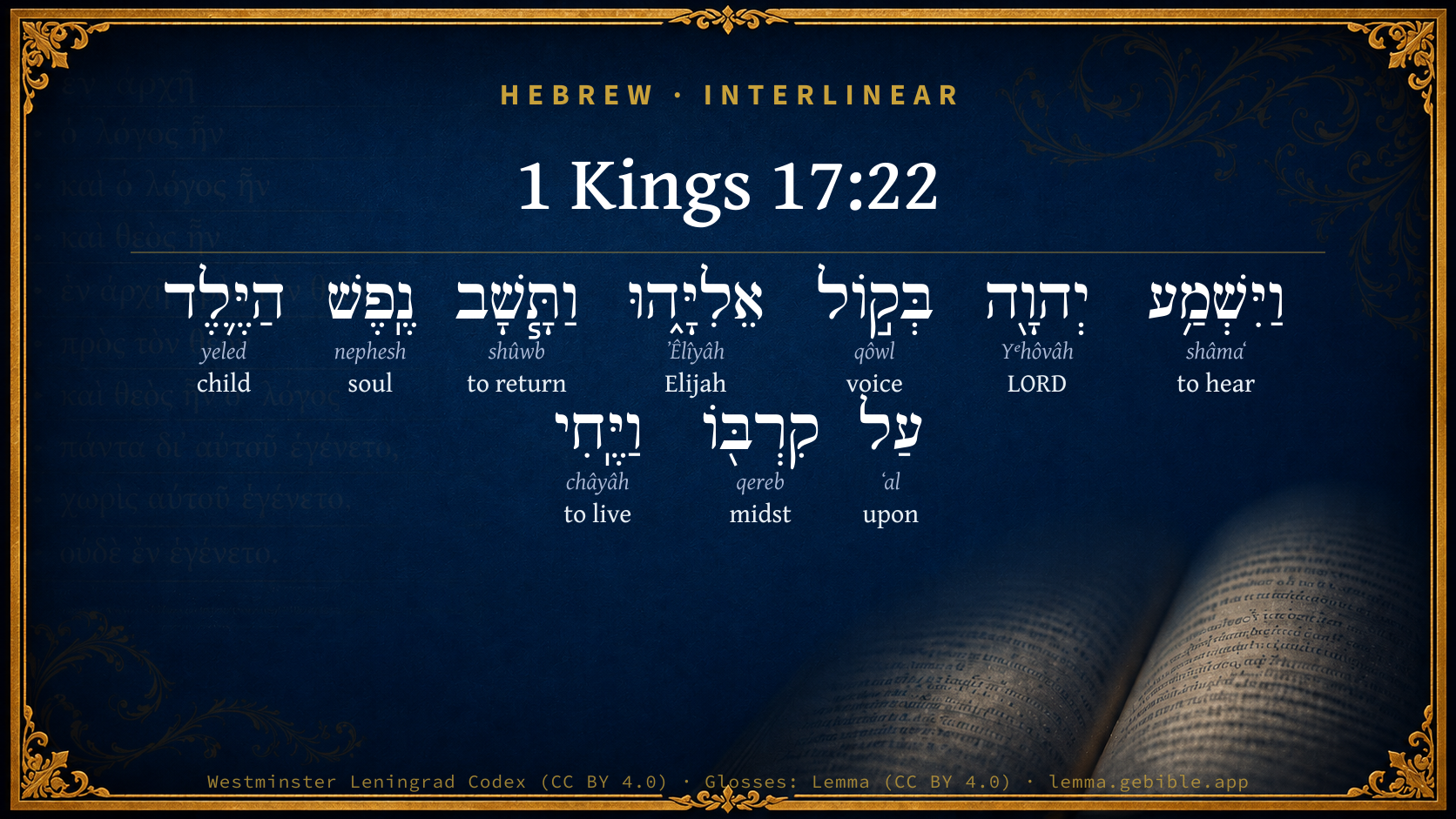
1 Kings 17:22

Hebrew (Westminster Leningrad Codex) 1 Kings 17:22 appears in the Hebrew Old Testament. The text above is from the Westminster Leningrad Codex. Each word links to its Strong’s number, a concise gloss, and parsing drawn from the Open Scriptures Hebrew Bible morphology. Click any word for its full Brown-Driver-Briggs (BDB) entry.
Download image
Cite this verse

1 Kings 17:22 (World English Bible). Public Domain. Lemma interlinear Bible study tool, https://lemma.gebible.app/v/1-kings/17/22.

Show BibTeX & RIS
BibTeX
RIS
English Translation
Yahweh listened to the voice of Elijah; and the soul of the child came into him again, and he revived.
World English Bible · Public Domain
Download a study sheet

One document with this verse’s original text, its word-by-word gloss line, the meaning frame, cross-references with their text, attributed commentary, and full source and license credits — printable, and it pastes into notes with its structure intact.

This verse Autodidact and up

Study sheet (.html) Plain text (.txt)

A passage Seminary Student

Up to 50 verses in one chapter. A passage sheet keeps up to 6 commentary sources and 12 cross-references per verse, in the order this page ranks them, and says so on the sheet whenever that leaves anything out. Ask for a single verse and you get the Autodidact verse sheet above.

Everything on this page stays free to read, with no account — the sheet is a download of what is already on screen, not access to it.

Want to remove ads? Support Godless Engineer
Compare translations 3

The same verse in 3 English versions, stacked beneath the original-language interlinear above. Click any original word for its lexicon entry.

Each is an independent rendering of the whole verse — the interlinear is not word-aligned to these translations.

Highlighted words mark where these versions differ — a whole-verse word diff, not a word-by-word alignment.

  • World English Bible Public Domain
    Yahweh listened to the voice of Elijah; and the soul of the child came into him again, and he revived.
  • King James Version Public Domain
    And the LORD heard the voice of Elijah; and the soul of the child came into him again, and he revived.
  • unfoldingWord Literal Text CC BY-SA 4.0
    And Yahweh heard the voice of Elijah. And the life of the child returned into his midst, and he lived.

unfoldingWord Literal Text — © unfoldingWord, licensed CC BY-SA 4.0. Word-aligned USFM3 via Door43 (git.door43.org/unfoldingWord/en_ult).

Versions to compare (up to 4)

3 of 4 selected

Show all 18 translations

Every available English version of this verse, each an independent rendering of the whole verse.

  • World English Bible Public Domain
    Yahweh listened to the voice of Elijah; and the soul of the child came into him again, and he revived.
  • Berean Standard Bible Public Domain
    And the LORD listened to the voice of Elijah, and the child’s life returned to him, and he lived.
  • Majority Standard Bible Public Domain
    And the LORD listened to the voice of Elijah, and the child’s life returned to him, and he lived.
  • King James Version Public Domain
    And the LORD heard the voice of Elijah; and the soul of the child came into him again, and he revived.
  • American Standard Version (1901) Public Domain
    And Jehovah hearkened unto the voice of Elijah; and the soul of the child came into him again, and he revived.
  • Revised Version (1885) Public Domain
    And the LORD hearkened unto the voice of Elijah; and the soul of the child came into him again, and he revived.
  • Geneva Bible (1599) Public Domain
    Then the Lord heard the voyce of Eliiah, and the soule of the child came into him againe, and he reuiued.
  • Douay-Rheims (1899) Public Domain
    And the Lord heard the voice of Elias: and the soul of the child returned into him, and he revived.
  • Young's Literal Translation Public Domain
    and Jehovah hearkeneth to the voice of Elijah, and the soul of the lad turneth back into his midst, and he liveth.
  • Literal Standard Version CC BY-SA 4.0
    and YHWH listens to the voice of Elijah, and the soul of the boy turns back into his midst, and he lives.
  • Unlocked Literal Bible CC BY-SA 4.0
    Yahweh listened to the voice of Elijah; the life of the child returned to him, and he revived.
  • unfoldingWord Literal Text CC BY-SA 4.0
    And Yahweh heard the voice of Elijah. And the life of the child returned into his midst, and he lived.
  • Darby Bible Public Domain
    And Jehovah heard the voice of Elijah, and the soul of the child came into him again, and he lived.
  • World Messianic Bible Public Domain
    The LORD listened to the voice of Elijah; and the soul of the child came into him again, and he revived.
  • Webster's Bible Public Domain
    And the LORD heard the voice of Elijah; and the soul of the child came into him again, and he revived.
  • Free Bible Version CC BY-SA 4.0
    The Lord responded to Elijah's cry. The boy's life returned to him, and he lived!
  • Bible in Basic English Public Domain
    And the Lord gave ear to the voice of Elijah, and the child's spirit came into him again, and he came back to life.
  • JPS Tanakh (1917) Public Domain
    And the LORD hearkened unto the voice of Elijah; and the soul of the child came back into him, and he revived.

Literal Standard Version (2020), Covenant Press — licensed CC BY-SA 4.0. Text via the HelloAO Bible API (eBible.org). Unlocked Literal Bible (unfoldingWord) — licensed CC BY-SA 4.0. Text via the HelloAO Bible API (eBible.org). unfoldingWord Literal Text — © unfoldingWord, licensed CC BY-SA 4.0. Word-aligned USFM3 via Door43 (git.door43.org/unfoldingWord/en_ult). Free Bible Version, Dr. Jonathan Gallagher — licensed CC BY-SA 4.0. Text via the HelloAO Bible API (eBible.org).

Word by word

More ways to search: Search by grammar → Find every occurrence → Compare this word →

Practice this passage: Drill this verse → Learn its vocabulary →

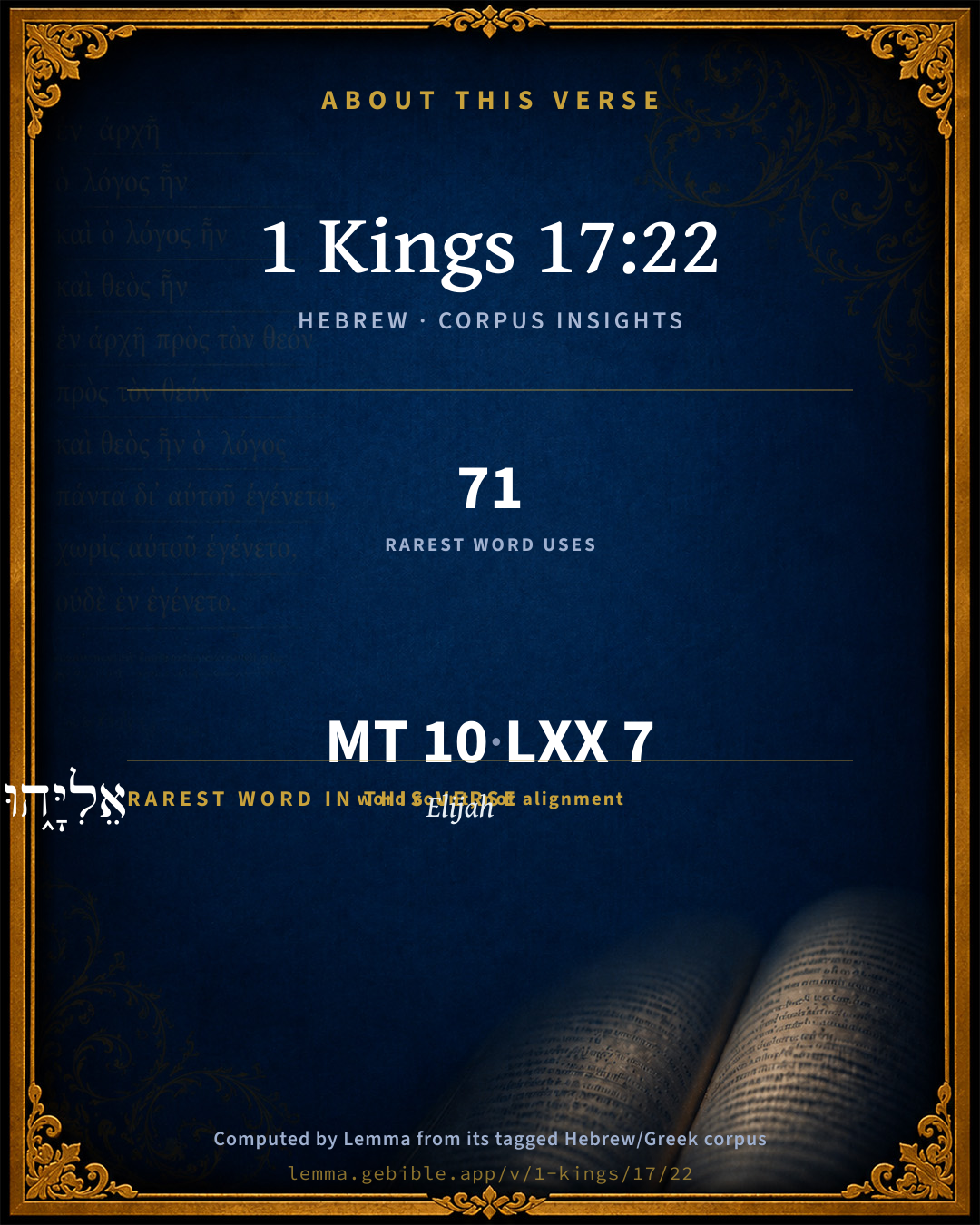
אֵלִיָּ֑הוּ
ʼÊlîyâh
H452
“Elijah”
Noun, Proper
Part of Speech
Noun
Type
Proper
Full BDB Definition

Origin: from H410 and H3050

TWOT: None

Elijah or Eliah = "my God is Jehovah" or " Yah(u) is God" - the great prophet of the reign of Ahab - Benjamite son of Jeroham - a son of Elam with foreign wife during exile - a son of Harim, and priest, with foreign wife during exile
  1. וַיִּשְׁמַ֥ע shâmaʻ H8085 “and · to hear” Conjunction + Verb, Qal, Sequential Imperfect, 3rd Person, Masculine, Singular
  2. יְהוָ֖ה Yᵉhôvâh H3068 “LORD” Noun, Proper
  3. בְּק֣וֹל qôwl H6963 “in/at · voice of” Preposition + Noun, Common, Masculine, Singular, Construct
  4. וַתָּ֧שָׁב shûwb H7725 “and · to return” Conjunction + Verb, Qal, Sequential Imperfect, 3rd Person, Feminine, Singular
  5. נֶֽפֶשׁ nephesh H5315 “soul of” Noun, Common, Both, Singular, Construct
  6. הַיֶּ֛לֶד yeled H3206 “the · child” Particle, Definite Article + Noun, Common, Masculine, Singular, Absolute
  7. עַל ʻal H5921 “upon” Preposition
  8. קִרְבּ֖וֹ qereb H7130 “midst · his” Noun, Common, Masculine, Singular, Construct + Suffix, Personal, 3rd Person, Masculine, Singular
  9. וַיֶּֽחִי châyâh H2421 “and · to live” Conjunction + Verb, Qal, Sequential Imperfect, 3rd Person, Masculine, Singular

About this verse

These counts appear in no published source. They are computed here, from the morphology-tagged text and Lemma’s own curated glosses. What Lemma adds →

10
words
10
distinct lemmas
Historical
section

Grammatical profile

  • 3 verbs
  • 6 nouns
  • 1 preposition

Verb forms

  • וַיִּשְׁמַ֥ע Qal · Sequential Imperfect
  • וַתָּ֧שָׁב Qal · Sequential Imperfect
  • וַיֶּֽחִי Qal · Sequential Imperfect

Hebrew & Septuagint length

In English translation the verse runs 20 words from the Hebrew and 9 from the Septuagint (LXX English) — the Septuagint runs noticeably shorter here. See the side-by-side →

A rough comparison of the two English renderings, which tokenize alike — not a word-level alignment.

Word counts can differ between the Hebrew and the Greek without any difference in meaning — e.g. the Hebrew direct-object marker אֵת has no separate Greek word, and Greek often adds the article ὁ.

In the original languages it is 10 Hebrew tokens and 7 Greek tokens — but the two are counted differently (Hebrew bundles its prefixes and suffixes into one token; the Greek is in lemma form), so that isn’t a like-for-like length.

Cross-references

10

Topical passages linked to 1 Kings 17:22 in the Treasury of Scripture Knowledge — connected by theme and wording, ordered by reader-vote popularity; previews shown in the World English Bible.

  • Deuteronomy 32:39 See now that I, even I, am he, There is no god with me: I kill, and I make alive; I wound, and I heal; There is none who can deliver out of my hand.
  • Revelation 11:11 After the three and a half days, the breath of life from God entered into them, and they stood on their feet. Great fear fell on those who saw them.
  • John 5:28–29 Don't marvel at this, for the hour comes, in which all that are in the tombs will hear his voice,
  • Romans 14:9 For to this end Christ died, rose, and lived again, that he might be Lord of both the dead and the living.
  • Hebrews 11:35 Women received their dead by resurrection. Others were tortured, not accepting their deliverance, that they might obtain a better resurrection.
  • 1 Samuel 2:6 Yahweh kills, and makes alive: He brings down to Sheol, and brings up.
  • 2 Kings 13:21 It happened, as they were burying a man, that behold, they spied a band; and they cast the man into the tomb of Elisha: and as soon as the man touched the bones of Elisha, he revived, and stood up on his feet.
  • John 11:43 When he had said this, he cried with a loud voice, "Lazarus, come out!"
  • Luke 8:54 But he put them all outside, and taking her by the hand, he called, saying, "Child, arise!"
  • Acts 20:12 They brought the boy in alive, and were greatly comforted.

Cross-references courtesy of OpenBible.info (CC BY 4.0).

Hebrew and Greek witnesses Masoretic Hebrew ↔ Greek Septuagint

The same verse in the two great witnesses to the Old Testament, shown verse-for-verse.

Here the Septuagint runs noticeably shorter than the Hebrew — LXX2012 (modern English Septuagint) 9 words vs World English Bible 20. A rough length comparison of the two English translations, not a word-level alignment — read both below.

These are two independent witnesses, not word-aligned to each other, and the Septuagint is shown in lemma (dictionary) form.

Hebrew 1 Kings 17:22 Masoretic · Westminster Leningrad Codex

וַיִּשְׁמַ֥ע יְהוָ֖ה בְּק֣וֹל אֵלִיָּ֑הוּ וַתָּ֧שָׁב נֶֽפֶשׁ הַיֶּ֛לֶד עַל קִרְבּ֖וֹ וַיֶּֽחִי

Yahweh listened to the voice of Elijah; and the soul of the child came into him again, and he revived.

World English Bible · Public Domain

Greek LXX 1 Kings 17:22 Septuagint · lemma form

καί γίγνομαι οὕτως καί ἀναβοάω ὁ παιδάριον

And it was so, and the child cried out,

LXX2012 (modern English Septuagint) · Public Domain

On this verse, The Cambridge Bible for Schools and Colleges discusses the Septuagint’s reading. Read the note in Commentary ↓

Hebrew: Westminster Leningrad Codex (CC BY 4.0). Greek: Septuagint (public domain); English from LXX2012 (modern English Septuagint) (Public Domain). How the Septuagint differs from the Hebrew →

Targum (Aramaic paraphrase)

1

The Targum is the ancient Jewish Aramaic paraphrase of the Hebrew Scriptures — an interpretive translation, not the Hebrew text itself. Onkelos (literal) and Pseudo-Jonathan (expansive) render the Torah, and Jonathan the Prophets. Coverage is partial: where no permissively-licensed English translation exists for a verse, only the Aramaic is shown. This is verse-level text, not a word-by-word alignment to the Hebrew.

  1. Targum Jonathan Prophets (Joshua–Malachi)
    וְקַבֵּיל יְיָ צְלוֹתָא דְאֵלִיָהוּ וְתָבַת נַפְשָׁא דְרַבְיָא לִמְעוֹהִי וַחֲיָא:

    (no public-domain English translation for this verse)

    Targum Jonathan — Aramaic: “Mikraot Gedolot” (public domain). English: “Sefaria Community Translation” (CC0 1.0 (public-domain dedication)); “London "Chaldee Paraphrase," 1871” (public domain). Text via Sefaria.

Commentary

Notes on 1 Kings 17:22 from classic Christian and Jewish commentators (each source and its license shown beneath its notes). The classic Christian expositions comment on the surrounding passage and are grouped to its opening verse, so a note may address several verses; the Jewish commentaries on the Tanakh (Rashi and others) are per-verse, so they appear only where the commentator wrote on this verse.

Lemma curates 59 commentaries, every one of them public domain or Creative Commons licensed, each selected and text-cleaned for this edition rather than reprinted as found. About our sources →

Trapp's Complete Commentary

John Trapp

1Ki 17:22 And the LORD heard the voice of Elijah; and the soul of the child came into him again, and he revived.

Ver. 22. And the Lord heard.] The effectual fervent prayer of the righteous man availed much. {Jas 5:16}

John Trapp, A Commentary or Exposition upon All the Books of the Old and New Testament (1647–1656) — public domain. Text from a community e-Sword module.

Joseph Benson's Commentary

1Ki 17:22. The soul of the child came into him again — The reader will easily observe, that this phraseology of the sacred historian, like that of the prophet in the former verse, (and they both spoke by inspiration of God,) plainly signifies the distinction between the rational soul and earthly body to be as real as that between the house and its inhabitant, and supposes the existence of the former in a state of separation from the body, and consequently its immortality: and, probably, as Grotius thinks, God might design by this miracle to give an evidence hereof for the encouragement of his suffering people. And he revived — As by an extraordinary and supernatural stroke of affliction, God had taken away the child’s life for the trial of the faith, both of the prophet and the woman; so, to strengthen the faith of both, as well as for the vindication of the true religion, and the manifestation of his own glory in opposition to idols, in that most dark and degenerate age, he restored the child to life, and thereby answered the prayer which he himself had inspired.

Joseph Benson's Commentary on the Old and New Testaments (1811–1818) — public domain. Text from a community e-Sword module.

Tyndale Open Study Notes

Tyndale Open Resources

17:22-24 The miracle of the child’s raising rewarded the faith of Elijah and confirmed the mother’s initial confidence in God’s prophet. Her testimony may indicate that she put her faith in the Lord. Jesus cited her as an example of God’s concern for non-Israelites and as an indication that God’s messengers are often more easily received by others than by their own countrymen (Luke 4:24-26). The Scriptures repeatedly mention God’s care of widows as illustrating his care for needy people (Exod 22:21; Deut 10:18; 27:19; Ps 68:5; Isa 1:17; Jas 1:27).

Tyndale Open Study Notes — © Tyndale Open Resources, licensed CC BY-SA 4.0. Text via the HelloAO Bible API.

Adam Clarke's Commentary

Verse 22. And the soul] נפש nephesh, of the child came into him again, על קרבו al kirbo, into the midst of him; and he revived, ויח vaiyechi, and he became alive. Did he not become alive from the circumstance of the immaterial principle coming again into him?

Although רוח ruach is sometimes put for the breath, yet נפש generally means the immortal spirit, and where it seems to refer to animal life alone, it is only such a life as is the immediate and necessary effect of the presence of the immortal spirit.

The words and mode of expression here appear to me a strong proof, not only of the existence of an immortal and immaterial spirit in man, but also that that spirit can and does exist in a separate state from the body. It is here represented as being in the midst of the child, like a spring in the centre of a machine, which gives motion to every part, and without which the whole would stand still.

Adam Clarke's Commentary on the Bible (1810–1826) — public domain. Text from a community e-Sword/MySword module.

The Cambridge Bible for Schools and Colleges

gen. ed. J. J. S. Perowne

22. And the Lord heard [R.V. hearkened unto] the voice of Elijah] This is the more usual rendering of the verb followed by a preposition as here. Instead of this verse the LXX. (Vat.) has ‘and it was so, and the child cried out.’ The following words also, in 1Ki_17:23 ‘and Elijah took the child,’ are omitted in that version.

The Cambridge Bible for Schools and Colleges (gen. ed. J. J. S. Perowne; Cambridge University Press, 1878–1918) — public domain. Text from a community e-Sword module.

John Gill's Exposition

And Elijah took the child, and brought him down out of the chamber into the house,.... Being come to life, he took it off of the bed in his bedchamber, and brought it down to the lower part of the house, where the woman was:

and delivered him unto his mother: and Elijah said, see, thy son liveth; which no doubt was to her great surprise, and was a wonderful instance of divine power and goodness, and to which the apostle may have respect, Heb 11:35, Bunting (l) says, the inhabitants of this place now take upon them to show the chamber wherein the prophet Elias lived, when he raised the widow's child to life.

(l) Travels, &c. p. 205.

John Gill's Exposition of the Whole Bible (1746–1763) — public domain (CC PDM 1.0). Text via the HelloAO Bible API.

Whedon's Commentary on the Bible

Daniel D. Whedon

22. The soul of the child came into him again — That which leaves the body when it dies is sometimes called the soul (Gen_35:18) and sometimes the spirit, (Ecc_12:7,) and hence we may argue that, according to biblical psychology, soul and spirit are never separated from each other, though as regards their essential nature they may be distinguished. The question of the separate conscious existence and immortality of the disembodied soul is not involved in this text, but the distinction between soul and body is plainly recognised. More minute is the distinction between soul and spirit, the latter being the deathless, God-like principle in man, that distinguishes him from the whole irrational creation; the soul, the lower principle, the seat of the animal life and feeling, intermediate between spirit and body, and by the agency of which the spirit is able to control the movements of the body. “Plainly,” says Delitzsch, “according to Scripture, soul and spirit outlast the corruption of the body. Nevertheless, it is true of the soul, in a certain sense, that it dies. It dies so far as it was wont to centralize in itself the natural powers of the body, and to pervade the organs of the body with its own spirit-like life. It does not die, so far as it is of the spirit, (Mat_10:28;) but it dies, so far as it has become of the body. Its life that has emanated from the spirit endures; but its life that is immanent in the body perishes with the body itself.” — Biblical Psychology, p. 469.

Daniel D. Whedon (gen. ed.), Commentary on the Old and New Testaments (1874–1909) — public domain. Text from a community e-Sword module.

The Pulpit Commentary

And the Lord heard the voice of Elijah; and the soul of the child came into him again and he revived or recovered. (Cf. 2Ki_1:2 2Ki_8:8)

The Pulpit Commentary (1880–1919), ed. H.D.M. Spence-Jones & Joseph S. Exell — public domain. Text from a community e-Sword module.

John Wesley's Explanatory Notes

Into him again - This plainly supposes the existence of the soul in a state of separation, and consequently its immortality: probably God might design by this miracle to give an evidence hereof, for the encouragement of his suffering people.

John Wesley, Explanatory Notes Upon the Whole Bible (1754–1765) — public domain. Text via the GEBible commentary corpus.

unfoldingWord translationNotes

Door43 World Missions Community

Yahweh listened to the voice of Elijah

Here "voice" represents what Elijah prayed. AT: "Yahweh answered Elijah's prayer" (See: Metonymy)

the life of the child returned to him, and he revived

These two phrases mean basically the same thing. AT: "the child came back to life" or "the child lived again" (See: Parallelism)

his room

Here "his" refers to Elijah.

See, your son is alive

The word "See" here alerts us to pay attention to the surprising information that follows.

the word of Yahweh in your mouth is true

"the message of Yahweh in your mouth is true." The word "mouth" represents what Elijah said. AT: "the message that you spoke from Yahweh is true" (See: Metonymy)

translationWords

voice

know

word of God

true

unfoldingWord translationNotes — © Distant Shores Media and the Door43 World Missions Community, licensed CC BY-SA 4.0. Source: git.door43.org/Door43/en_tn.

Lesson kit

Teaching starters — assembled from the data on this page, not authored interpretation. Every prompt links to the verse data it draws on. Edit before teaching.

1 Kings, in the Historical, opens this verse with 10 words (10 distinct Hebrew lemmas). Its most distinctive word is ʼÊlîyâh (“Elijah”). The Greek Septuagint runs shorter here. A historical commentator’s framing appears above. Read the whole chapter for the surrounding context.

Discussion questions

  1. The word ʼÊlîyâh carries the sense “Elijah.” How does it shape the verse?
  2. How does Deuteronomy 32:39, which shares this passage’s theme, read alongside this verse?
  3. The Septuagint runs shorter here than the Hebrew. What might account for the difference?
  4. These translations render this verse differently; the difference is in the English rendering, not the original. What questions does that raise?
  5. «וַיִּשְׁמַ֥ע» is a Qal Sequential Imperfect verb. How does that grammatical form shape the action described?
  6. Compare how Trapp's Complete Commentary and Joseph Benson's Commentary read this verse. Where do they agree or differ?

Things to notice

Reading settings

Reading text

Shown beneath each verse's original-language words.

Old Testament
Old Testament edition

Read the OT as the Masoretic Hebrew (MT) or the Greek Septuagint (LXX).

English shown for the Greek Septuagint (in the Hebrew ↔ Greek comparison).

Comparing translations? Open the Compare panel on any verse page to stack up to four side by side.