
Deuteronomy 4:36

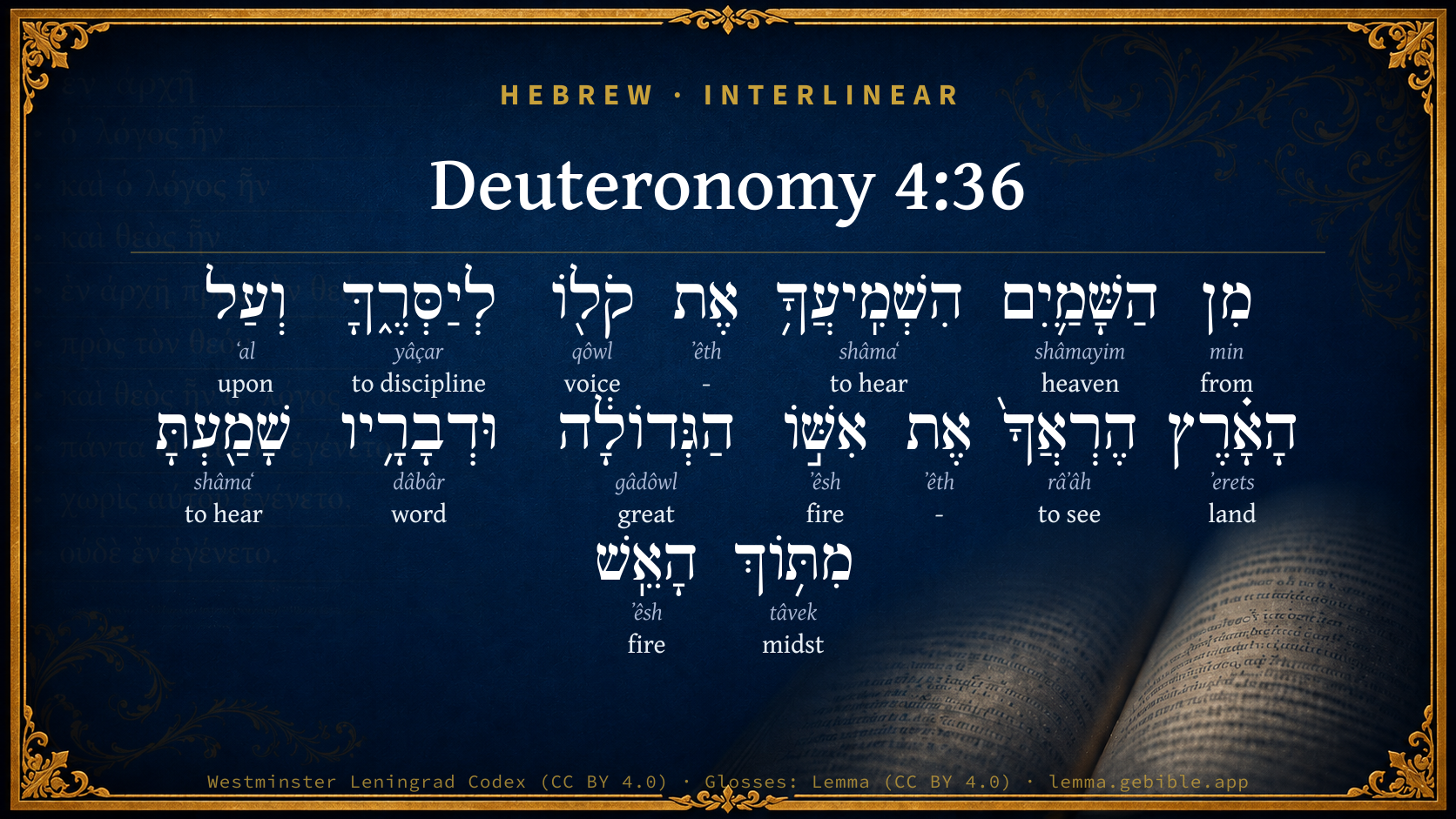
Hebrew (Westminster Leningrad Codex) Deuteronomy 4:36 appears in the Hebrew Old Testament. The text above is from the Westminster Leningrad Codex. Each word links to its Strong’s number, a concise gloss, and parsing drawn from the Open Scriptures Hebrew Bible morphology. Click any word for its full Brown-Driver-Briggs (BDB) entry.
Download image
Cite this verse

Deuteronomy 4:36 (World English Bible). Public Domain. Lemma interlinear Bible study tool, https://lemma.gebible.app/v/deuteronomy/4/36.

Show BibTeX & RIS
BibTeX
RIS
English Translation
Out of heaven he made you to hear his voice, that he might instruct you: and on earth he made you to see his great fire; and you heard his words out of the midst of the fire.
World English Bible · Public Domain
Download a study sheet

One document with this verse’s original text, its word-by-word gloss line, the meaning frame, cross-references with their text, attributed commentary, and full source and license credits — printable, and it pastes into notes with its structure intact.

This verse Autodidact and up

Study sheet (.html) Plain text (.txt)

A passage Seminary Student

Up to 50 verses in one chapter. A passage sheet keeps up to 6 commentary sources and 12 cross-references per verse, in the order this page ranks them, and says so on the sheet whenever that leaves anything out. Ask for a single verse and you get the Autodidact verse sheet above.

Everything on this page stays free to read, with no account — the sheet is a download of what is already on screen, not access to it.

Want to remove ads? Support Godless Engineer
Compare translations 3

The same verse in 3 English versions, stacked beneath the original-language interlinear above. Click any original word for its lexicon entry.

Each is an independent rendering of the whole verse — the interlinear is not word-aligned to these translations.

Highlighted words mark where these versions differ — a whole-verse word diff, not a word-by-word alignment.

  • World English Bible Public Domain
    Out of heaven he made you to hear his voice, that he might instruct you: and on earth he made you to see his great fire; and you heard his words out of the midst of the fire.
  • King James Version Public Domain
    Out of heaven he made thee to hear his voice, that he might instruct thee: and upon earth he showed thee his great fire; and thou heardest his words out of the midst of the fire.
  • unfoldingWord Literal Text CC BY-SA 4.0
    From the heavens he caused you to hear his voice, to instruct you. And on the earth he caused you to see his great fire, and you heard his words from the midst of the fire.

unfoldingWord Literal Text — © unfoldingWord, licensed CC BY-SA 4.0. Word-aligned USFM3 via Door43 (git.door43.org/unfoldingWord/en_ult).

Versions to compare (up to 4)

3 of 4 selected

Show all 18 translations

Every available English version of this verse, each an independent rendering of the whole verse.

  • World English Bible Public Domain
    Out of heaven he made you to hear his voice, that he might instruct you: and on earth he made you to see his great fire; and you heard his words out of the midst of the fire.
  • Berean Standard Bible Public Domain
    He let you hear His voice from heaven to discipline you, and on earth He showed you His great fire, and you heard His words out of the fire.
  • Majority Standard Bible Public Domain
    He let you hear His voice from heaven to discipline you, and on earth He showed you His great fire, and you heard His words out of the fire.
  • King James Version Public Domain
    Out of heaven he made thee to hear his voice, that he might instruct thee: and upon earth he showed thee his great fire; and thou heardest his words out of the midst of the fire.
  • American Standard Version (1901) Public Domain
    Out of heaven he made thee to hear his voice, that he might instruct thee: and upon earth he made thee to see his great fire; and thou heardest his words out of the midst of the fire.
  • Revised Version (1885) Public Domain
    Out of heaven he made thee to hear his voice, that he might instruct thee: and upon earth he made thee to see his great fire; and thou heardest his words out of the midst of the fire.
  • Geneva Bible (1599) Public Domain
    Out of heauen hee made thee heare his voyce to instruct thee, and vpon earth he shewed thee his great fire, and thou heardest his voyce out of the middes of the fire.
  • Douay-Rheims (1899) Public Domain
    From heaven he made thee to hear his voice, that he might teach thee. And upon earth he shewed thee his exceeding great fire, and thou didst hear his words out of the midst of the fire,
  • Young's Literal Translation Public Domain
    `From the heavens He hath caused thee to hear His voice, to instruct thee, and on earth He hath shewed thee His great fire, and His words thou hast heard out of the midst of the fire.
  • Literal Standard Version CC BY-SA 4.0
    He has caused you to hear His voice from the heavens, to instruct you; and on earth He has showed you His great fire, and you have heard His words out of the midst of the fire.
  • Unlocked Literal Bible CC BY-SA 4.0
    Out of heaven he made you to hear his voice, so that he might instruct you; on earth he made you see his great fire; you heard his words out of the midst of the fire.
  • unfoldingWord Literal Text CC BY-SA 4.0
    From the heavens he caused you to hear his voice, to instruct you. And on the earth he caused you to see his great fire, and you heard his words from the midst of the fire.
  • Darby Bible Public Domain
    From the heavens he made thee hear his voice, that he might instruct thee; and on the earth he shewed thee his great fire; and thou heardest his words from the midst of the fire.
  • World Messianic Bible Public Domain
    Out of heaven he made you to hear his voice, that he might instruct you. On earth he made you to see his great fire; and you heard his words out of the middle of the fire.
  • Webster's Bible Public Domain
    Out of heaven he made thee to hear his voice, that he might instruct thee; and upon earth he showed thee his great fire; and thou heardst his words from the midst of the fire.
  • Free Bible Version CC BY-SA 4.0
    He made you hear his voice from heaven so you would obey him. On earth he revealed himself through blazing fire, and you heard him speak to you from the fire.
  • Bible in Basic English Public Domain
    Out of heaven itself his voice came to you, teaching you; and on earth he let you see his great fire; and his words came to your ears out of the heart of the fire.
  • JPS Tanakh (1917) Public Domain
    Out of heaven He made thee to hear His voice, that He might instruct thee; and upon earth He made thee to see His great fire; and thou didst hear His words out of the midst of the fire.

Literal Standard Version (2020), Covenant Press — licensed CC BY-SA 4.0. Text via the HelloAO Bible API (eBible.org). Unlocked Literal Bible (unfoldingWord) — licensed CC BY-SA 4.0. Text via the HelloAO Bible API (eBible.org). unfoldingWord Literal Text — © unfoldingWord, licensed CC BY-SA 4.0. Word-aligned USFM3 via Door43 (git.door43.org/unfoldingWord/en_ult). Free Bible Version, Dr. Jonathan Gallagher — licensed CC BY-SA 4.0. Text via the HelloAO Bible API (eBible.org).

Word by word

More ways to search: Search by grammar → Find every occurrence → Compare this word →

Practice this passage: Drill this verse → Learn its vocabulary →

לְיַסְּרֶ֑ךָּ
yâçar
H3256
“to discipline · you”
Preposition + Verb, Piel, Infinitive Construct + Suffix, Personal, 2nd Person, Masculine, Singular
Part of Speech
Preposition + Verb
Stem
Piel
Form
Infinitive Construct
Full BDB Definition

Origin: a primitive root

TWOT: 877

to chasten, discipline, instruct, admonish - (Qal) - to chasten, admonish - to instruct - to discipline - (Niphal) to let oneself be chastened or corrected or admonished - (Piel) - to discipline, correct - to chasten, chastise - (Hiphil) to chasten - (Nithpael) to teach
  1. מִן min H4480 “from” Preposition
  2. הַשָּׁמַ֛יִם shâmayim H8064 “the · heaven(s)” Particle, Definite Article + Noun, Common, Masculine, Plural, Absolute
  3. הִשְׁמִֽיעֲךָ֥ shâmaʻ H8085 “to hear · you” Verb, Hiphil, Perfect, 3rd Person, Masculine, Singular + Suffix, Personal, 2nd Person, Masculine, Singular
  4. אֶת ʼêth H853 “-” Particle, Direct Object
  5. קֹל֖וֹ qôwl H6963 “voice · his” Noun, Common, Masculine, Singular, Construct + Suffix, Personal, 3rd Person, Masculine, Singular
  6. וְעַל ʻal H5921 “and · upon” Conjunction + Preposition
  7. הָאָ֗רֶץ ʼerets H776 “the · land” Particle, Definite Article + Noun, Common, Both, Singular, Absolute
  8. הֶרְאֲךָ֙ râʼâh H7200 “to see · you” Verb, Hiphil, Perfect, 3rd Person, Masculine, Singular + Suffix, Personal, 2nd Person, Masculine, Singular
  9. אֶת ʼêth H853 “-” Particle, Direct Object
  10. אִשּׁ֣וֹ ʼêsh H784 “fire · his” Noun, Common, Both, Singular, Construct + Suffix, Personal, 3rd Person, Masculine, Singular
  11. הַגְּדוֹלָ֔ה gâdôwl H1419 “the · great” Particle, Definite Article + Adjective, Adjective, Feminine, Singular, Absolute
  12. וּדְבָרָ֥יו dâbâr H1697 “and · words · his” Conjunction + Noun, Common, Masculine, Plural, Construct + Suffix, Personal, 3rd Person, Masculine, Singular
  13. שָׁמַ֖עְתָּ shâmaʻ H8085 “to hear” Verb, Qal, Perfect, 2nd Person, Masculine, Singular
  14. מִתּ֥וֹךְ tâvek H8432 “from · midst of” Preposition + Noun, Common, Masculine, Singular, Construct
  15. הָאֵֽשׁ ʼêsh H784 “the · fire” Particle, Definite Article + Noun, Common, Both, Singular, Absolute

About this verse

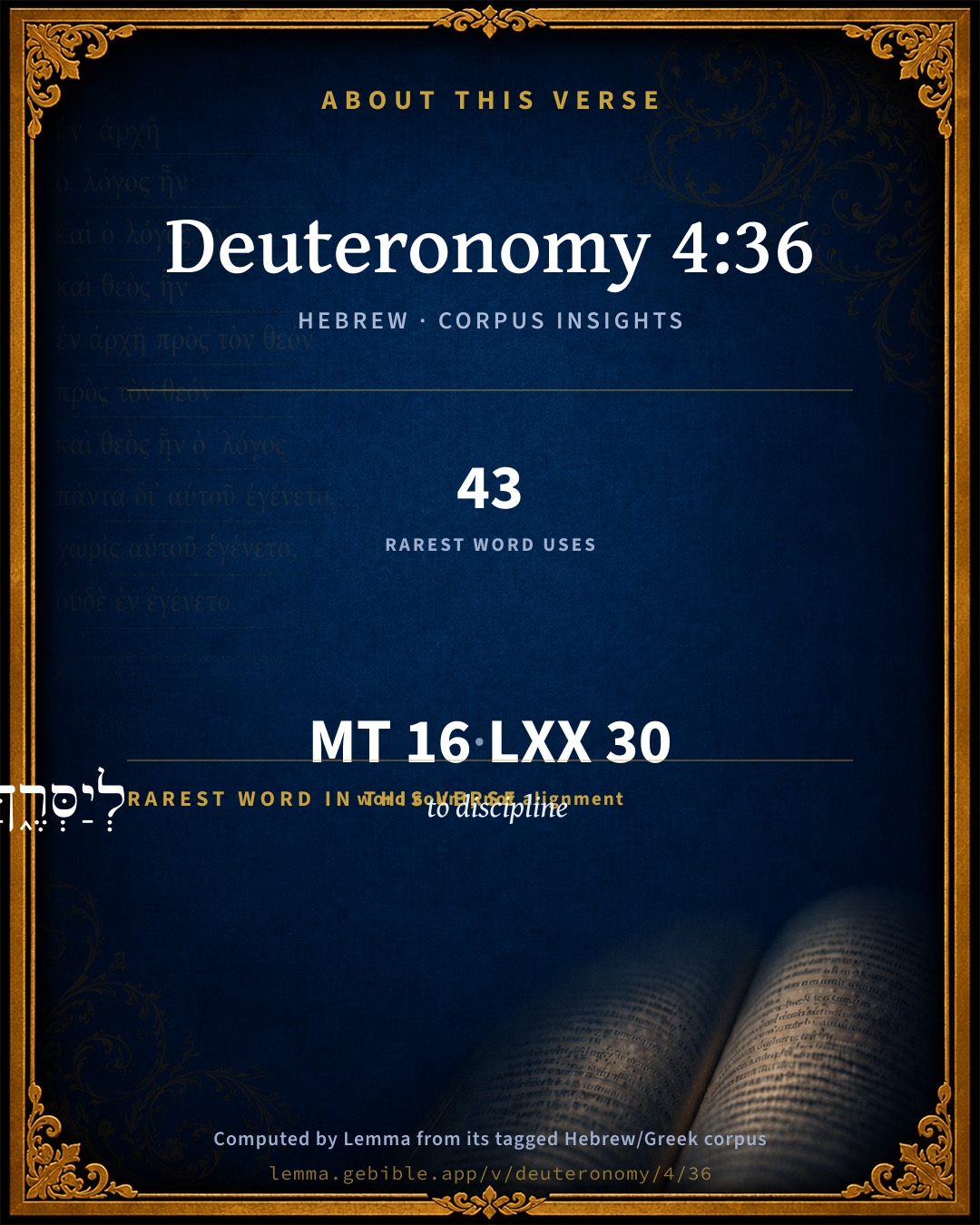
These counts appear in no published source. They are computed here, from the morphology-tagged text and Lemma’s own curated glosses. What Lemma adds →

16
words
13
distinct lemmas
Pentateuch
section

Shared distinctive vocabulary

לְיַסְּרֶ֑ךָּ to discipline H3256 occurs in 38 verses of the Hebrew Bible. Also found in:

Grammatical profile

  • 4 verbs
  • 7 nouns
  • 1 adjective
  • 2 prepositions
  • 2 particles

Verb forms

  • הִשְׁמִֽיעֲךָ֥ Hiphil · Perfect
  • לְיַסְּרֶ֑ךָּ Piel · Infinitive Construct
  • הֶרְאֲךָ֙ Hiphil · Perfect
  • שָׁמַ֖עְתָּ Qal · Perfect

Repetition

Words recur within this verse — often emphatic in Hebrew:

  • הִשְׁמִֽיעֲךָ֥ to hear H8085 ×2
  • אִשּׁ֣וֹ fire H784 ×2

Hebrew & Septuagint length

In English translation the verse runs 38 words from the Hebrew and 32 from the Septuagint (LXX English) — closely comparable.

A rough comparison of the two English renderings, which tokenize alike — not a word-level alignment.

Word counts can differ between the Hebrew and the Greek without any difference in meaning — e.g. the Hebrew direct-object marker אֵת has no separate Greek word, and Greek often adds the article ὁ.

In the original languages it is 16 Hebrew tokens and 30 Greek tokens — but the two are counted differently (Hebrew bundles its prefixes and suffixes into one token; the Greek is in lemma form), so that isn’t a like-for-like length.

Cross-references

8

Topical passages linked to Deuteronomy 4:36 in the Treasury of Scripture Knowledge — connected by theme and wording, ordered by reader-vote popularity; previews shown in the World English Bible.

  • Exodus 19:9 Yahweh said to Moses, "Behold, I come to you in a thick cloud, that the people may hear when I speak with you, and may also believe you forever." Moses told the words of the people to Yahweh.
  • Exodus 19:19 When the sound of the trumpet grew louder and louder, Moses spoke, and God answered him by a voice.
  • Deuteronomy 4:33 Did ever a people hear the voice of God speaking out of the midst of the fire, as you have heard, and live?
  • Nehemiah 9:13 You came down also on Mount Sinai, and spoke with them from heaven, and gave them right ordinances and true laws, good statutes and commandments,
  • Exodus 20:18–22 All the people perceived the thunderings, the lightnings, the sound of the trumpet, and the mountain smoking. When the people saw it, they trembled, and stayed at a distance.
  • Hebrews 12:25 See that you don't refuse him who speaks. For if they didn't escape when they refused him who warned on the Earth, how much more will we not escape who turn away from him who warns from heaven,
  • Exodus 24:16 The glory of Yahweh settled on Mount Sinai, and the cloud covered it six days. The seventh day he called to Moses out of the midst of the cloud.
  • Hebrews 12:18 For you have not come to a mountain that might be touched, and that burned with fire, and to blackness, darkness, tempest,

Cross-references courtesy of OpenBible.info (CC BY 4.0).

Hebrew and Greek witnesses Masoretic Hebrew ↔ Greek Septuagint

The same verse in the two great witnesses to the Old Testament, shown verse-for-verse.

These are two independent witnesses, not word-aligned to each other, and the Septuagint is shown in lemma (dictionary) form.

Hebrew Deuteronomy 4:36 Masoretic · Westminster Leningrad Codex

מִן הַשָּׁמַ֛יִם הִשְׁמִֽיעֲךָ֥ אֶת קֹל֖וֹ לְיַסְּרֶ֑ךָּ וְעַל הָאָ֗רֶץ הֶרְאֲךָ֙ אֶת אִשּׁ֣וֹ הַגְּדוֹלָ֔ה וּדְבָרָ֥יו שָׁמַ֖עְתָּ מִתּ֥וֹךְ הָאֵֽשׁ

Out of heaven he made you to hear his voice, that he might instruct you: and on earth he made you to see his great fire; and you heard his words out of the midst of the fire.

World English Bible · Public Domain

Greek LXX Deuteronomy 4:36 Septuagint · lemma form

ἐκ ὁ οὐρανός ἀκουστός γίγνομαι ὁ φωνή αὐτός παιδεύω σύ καί ἐπί ὁ γῆ δεικνύω σύ ὁ πῦρ αὐτός ὁ μέγας καί ὁ ῥῆμα αὐτός ἀκούω ἐκ μέσος ὁ πῦρ

His voice was made audible from heaven to instruct you, and he showed you upon the earth his great fire, and you heard his words out of the midst of the fire.

LXX2012 (modern English Septuagint) · Public Domain

Hebrew: Westminster Leningrad Codex (CC BY 4.0). Greek: Septuagint (public domain); English from LXX2012 (modern English Septuagint) (Public Domain). How the Septuagint differs from the Hebrew →

Targum (Aramaic paraphrase)

2

The Targum is the ancient Jewish Aramaic paraphrase of the Hebrew Scriptures — an interpretive translation, not the Hebrew text itself. Onkelos (literal) and Pseudo-Jonathan (expansive) render the Torah, and Jonathan the Prophets. Coverage is partial: where no permissively-licensed English translation exists for a verse, only the Aramaic is shown. This is verse-level text, not a word-by-word alignment to the Hebrew.

  1. Targum Onkelos Torah (Genesis–Deuteronomy)
    מִן שְׁמַיָא אַשְׁמְעָךְ יָת קָל מֵימְרֵהּ לְאַלָפוּתָךְ וְעַל אַרְעָא אַחְזְיָךְ יָת אֶשָׁתֵהּ רַבְּתָא וּפִתְגָמוֹהִי שְׁמַעַתְּ מִגוֹ אֶשָׁתָא

    (no public-domain English translation for this verse)

    Targum Onkelos — Aramaic: “Onkelos Genesis” (public domain); “Onkelos Exodus” (public domain); “Onkelos Leviticus” (public domain); “Onkelos Numbers” (public domain); “Onkelos Deuteronomy” (public domain). English: “Sefaria Community Translation” (CC0 1.0 (public-domain dedication)); “J.W. Etheridge. The Targums of Onkelos and Jonathan Ben Uzziel on the Pentateuch. London: Longmans, Green, 1862” (public domain). Text via Sefaria.

  2. Targum Pseudo-Jonathan Torah (Genesis–Deuteronomy)
    מִשְׁמֵי מְרוֹמָא אַשְׁמָעִינְכוֹן יַת קַל מֵימְרֵיהּ לִמְכַסְנָא יַתְכוֹן בְּאוּלְפָנֵיהּ וְעִילַוֵי אַרְעָא אַחֲמִינְכוֹן יַת אֵישָׁתֵיהּ רַבְּתָא וּפִתְגָמוֹי שְׁמַעְתּוּן מִגּוֹ אֵישָׁתָא

    He made you hear the voice of His Word from the heavens on high, to give you discipline by His doctrine, and showed thee upon earth His great fire, and made thee hear His words from the midst of the flame.

    Targum Pseudo-Jonathan — Aramaic: “Targum Jonathan on Genesis” (public domain); “Targum Jonathan on Exodus” (public domain); “Targum Jonathan on Leviticus” (public domain); “Targum Jonathan on Numbers” (public domain); “Targum Jonathan on Deuteronomy” (public domain). English: “The Targum of Jonathan ben Uzziel, trans. J. W. Etheridge, London, 1862” (public domain). Text via Sefaria.

Commentary

Notes on Deuteronomy 4:36 from classic Christian and Jewish commentators (each source and its license shown beneath its notes). The classic Christian expositions comment on the surrounding passage and are grouped to its opening verse, so a note may address several verses; the Jewish commentaries on the Tanakh (Rashi and others) are per-verse, so they appear only where the commentator wrote on this verse.

Lemma curates 59 commentaries, every one of them public domain or Creative Commons licensed, each selected and text-cleaned for this edition rather than reprinted as found. About our sources →

Tyndale Open Study Notes

Tyndale Open Resources

4:36 great fire: God revealed the covenant law at Mount Sinai with a magnificent and terrifying display of power and glory comparable to the eruption of a great volcano (see study note on 1:33; see Exod 3:1-4; 24:16-18).

Tyndale Open Study Notes — © Tyndale Open Resources, licensed CC BY-SA 4.0. Text via the HelloAO Bible API.

The Cambridge Bible for Schools and Colleges

gen. ed. J. J. S. Perowne

36. See on Deu_4:15.

that he might instruct thee] discipline thee, ‘that the people might be brought to a temper of becoming reverence’ (Driver).

The Cambridge Bible for Schools and Colleges (gen. ed. J. J. S. Perowne; Cambridge University Press, 1878–1918) — public domain. Text from a community e-Sword module.

John Gill's Exposition

Out of heaven he made thee to hear his voice, that he might instruct thee,.... Thunder is the voice of God, and by which he instructs men in the greatness of his power, Job 26:14, &c. unless his voice in giving the law, which was for the instruction of Israel, is meant; for that was heard on earth, on Mount Sinai, to which the following refers:

and upon earth he showed thee his great fire; on Mount Sinai, which burned with it:

and thou heardest his words out of the midst of the fire; the ten commands, and therefore may well be called, a fiery law; see Deu 4:12.

John Gill's Exposition of the Whole Bible (1746–1763) — public domain (CC PDM 1.0). Text via the HelloAO Bible API.

Matthew Poole's English Annotations

Out of heaven, i.e. out of the air, above Mount Sinai. See Exo 19:9; 20:18,22. Upon earth; at the top of Mount Sinai.

Matthew Poole's English Annotations on the Holy Bible (1683–1685) — public domain. Text from a community e-Sword/MySword module.

The Pulpit Commentary

cf. Exo_20:18-22. To indicate still further the preeminence of Israel, Moses emphasizes the supernatural character of the revelation God had given to them, and the awful manner of its delivery; God spake to them with audible voice, out of heaven, amidst fire, and they heard his words out of the fire. To instruct thee. The verb here used (dsy) means primarily to bind and thence to correct, to chasten, which meaning some interpreters would give here. But the word means also to correct by instruction, to instruct or persuade (cf. Isa_8:11 Isa_28:26; Psa_16:7) and the connection, both with what precedes and with what follows, requires this meaning here.

The Pulpit Commentary (1880–1919), ed. H.D.M. Spence-Jones & Joseph S. Exell — public domain. Text from a community e-Sword module.

Keil & Delitzsch

C. F. Keil & F. Delitzsch

But the Lord had spoken to Israel chiefly down from heaven (cf. Exo 20:19 [22]), and that out of the great fire, in which He had come down upon Sinai, to chastise it. יסּר does not mean "to instruct the people with regard to His truth and sovereignty," as Schultz thinks, but "to take them under holy discipline" (Knobel), to inspire them with a salutary fear of the holiness of His ways and of His judgments by the awful phenomena which accompanied His descent, and shadowed forth the sublime and holy majesty of His nature.

Keil & Delitzsch — Biblical Commentary on the Old Testament (1861–1891) — public domain (CC PDM 1.0). Text via the HelloAO Bible API. (Old Testament only.)

Lesson kit

Teaching starters — assembled from the data on this page, not authored interpretation. Every prompt links to the verse data it draws on. Edit before teaching.

Deuteronomy, in the Pentateuch, opens this verse with 16 words (13 distinct Hebrew lemmas). Its most distinctive word is yâçar (“to discipline”). A historical commentator’s framing appears above. Read the whole chapter for the surrounding context.

Discussion questions

  1. The word yâçar carries the sense “to discipline.” How does it shape the verse?
  2. Leviticus 26:18 shares the word «to discipline» with this verse. How do the two illuminate each other?
  3. “to hear” occurs 2× in this one verse. What is the effect of the repetition?
  4. These translations render this verse differently. What is at stake in choosing one wording over another?
  5. The verb «הִשְׁמִֽיעֲךָ֥» is Hiphil Perfect. How does its form color the action?
  6. Reading how Tyndale Open Study Notes and The Cambridge Bible for Schools and Colleges read this verse, where do the two commentators agree and where do they part?

Things to notice

Reading settings

Reading text

Shown beneath each verse's original-language words.

Old Testament
Old Testament edition

Read the OT as the Masoretic Hebrew (MT) or the Greek Septuagint (LXX).

English shown for the Greek Septuagint (in the Hebrew ↔ Greek comparison).

Comparing translations? Open the Compare panel on any verse page to stack up to four side by side.