
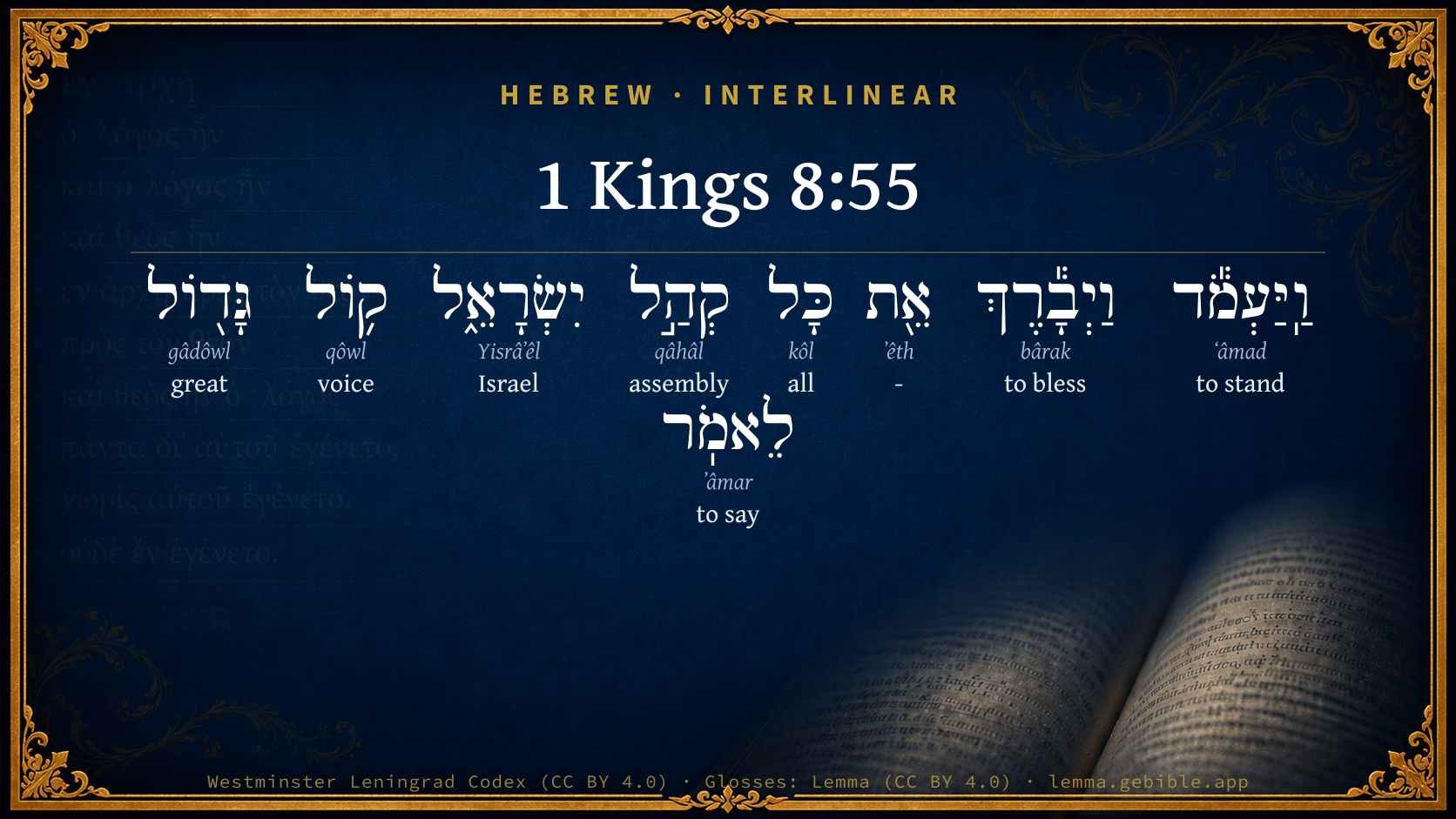
1 Kings 8:55

Hebrew (Westminster Leningrad Codex) 1 Kings 8:55 appears in the Hebrew Old Testament. The text above is from the Westminster Leningrad Codex. Each word links to its Strong’s number, a concise gloss, and parsing drawn from the Open Scriptures Hebrew Bible morphology. Click any word for its full Brown-Driver-Briggs (BDB) entry.
Download image
Cite this verse

1 Kings 8:55 (World English Bible). Public Domain. Lemma interlinear Bible study tool, https://lemma.gebible.app/v/1-kings/8/55.

Show BibTeX & RIS
BibTeX
RIS
English Translation
He stood, and blessed all the assembly of Israel with a loud voice, saying,
World English Bible · Public Domain
Download a study sheet

One document with this verse’s original text, its word-by-word gloss line, the meaning frame, cross-references with their text, attributed commentary, and full source and license credits — printable, and it pastes into notes with its structure intact.

This verse Autodidact and up

Study sheet (.html) Plain text (.txt)

A passage Seminary Student

Up to 50 verses in one chapter. A passage sheet keeps up to 6 commentary sources and 12 cross-references per verse, in the order this page ranks them, and says so on the sheet whenever that leaves anything out. Ask for a single verse and you get the Autodidact verse sheet above.

Everything on this page stays free to read, with no account — the sheet is a download of what is already on screen, not access to it.

Want to remove ads? Support Godless Engineer
Compare translations 3

The same verse in 3 English versions, stacked beneath the original-language interlinear above. Click any original word for its lexicon entry.

Each is an independent rendering of the whole verse — the interlinear is not word-aligned to these translations.

Highlighted words mark where these versions differ — a whole-verse word diff, not a word-by-word alignment.

  • World English Bible Public Domain
    He stood, and blessed all the assembly of Israel with a loud voice, saying,
  • King James Version Public Domain
    And he stood, and blessed all the congregation of Israel with a loud voice, saying,
  • unfoldingWord Literal Text CC BY-SA 4.0
    And he stood, and he blessed all of the assembly of Israel a great voice, saying,

unfoldingWord Literal Text — © unfoldingWord, licensed CC BY-SA 4.0. Word-aligned USFM3 via Door43 (git.door43.org/unfoldingWord/en_ult).

Versions to compare (up to 4)

3 of 4 selected

Show all 18 translations

Every available English version of this verse, each an independent rendering of the whole verse.

  • World English Bible Public Domain
    He stood, and blessed all the assembly of Israel with a loud voice, saying,
  • Berean Standard Bible Public Domain
    And he stood and blessed the whole assembly of Israel in a loud voice, saying:
  • Majority Standard Bible Public Domain
    And he stood and blessed the whole assembly of Israel in a loud voice, saying:
  • King James Version Public Domain
    And he stood, and blessed all the congregation of Israel with a loud voice, saying,
  • American Standard Version (1901) Public Domain
    And he stood, and blessed all the assembly of Israel with a loud voice, saying,
  • Revised Version (1885) Public Domain
    And he stood, and blessed all the congregation of Israel with a loud voice, saying,
  • Geneva Bible (1599) Public Domain
    And stoode and blessed all the Congregation of Israel with a loud voyce, saying,
  • Douay-Rheims (1899) Public Domain
    And he stood and blessed all the assembly of Israel with a, loud voice, saying:
  • Young's Literal Translation Public Domain
    and he standeth and blesseth all the assembly of Israel `with' a loud voice, saying,
  • Literal Standard Version CC BY-SA 4.0
    and he stands and blesses all the assembly of Israel [with] a loud voice, saying,
  • Unlocked Literal Bible CC BY-SA 4.0
    He stood and blessed all the assembly of Israel in a loud voice, saying,
  • unfoldingWord Literal Text CC BY-SA 4.0
    And he stood, and he blessed all of the assembly of Israel a great voice, saying,
  • Darby Bible Public Domain
    and he stood and blessed the whole congregation of Israel with a loud voice, saying,
  • World Messianic Bible Public Domain
    He stood and blessed all the assembly of Israel with a loud voice, saying,
  • Webster's Bible Public Domain
    And he stood, and blessed all the congregation of Israel with a loud voice, saying,
  • Free Bible Version CC BY-SA 4.0
    Solomon stood, and in a loud voice he blessed the whole assembly of Israel, saying,
  • Bible in Basic English Public Domain
    And, getting on his feet, he gave a blessing to all the men of Israel, saying with a loud voice,
  • JPS Tanakh (1917) Public Domain
    And he stood, and blessed all the congregation of Israel with a loud voice, saying:

Literal Standard Version (2020), Covenant Press — licensed CC BY-SA 4.0. Text via the HelloAO Bible API (eBible.org). Unlocked Literal Bible (unfoldingWord) — licensed CC BY-SA 4.0. Text via the HelloAO Bible API (eBible.org). unfoldingWord Literal Text — © unfoldingWord, licensed CC BY-SA 4.0. Word-aligned USFM3 via Door43 (git.door43.org/unfoldingWord/en_ult). Free Bible Version, Dr. Jonathan Gallagher — licensed CC BY-SA 4.0. Text via the HelloAO Bible API (eBible.org).

Word by word

More ways to search: Search by grammar → Find every occurrence → Compare this word →

Practice this passage: Drill this verse → Learn its vocabulary →

About this verse

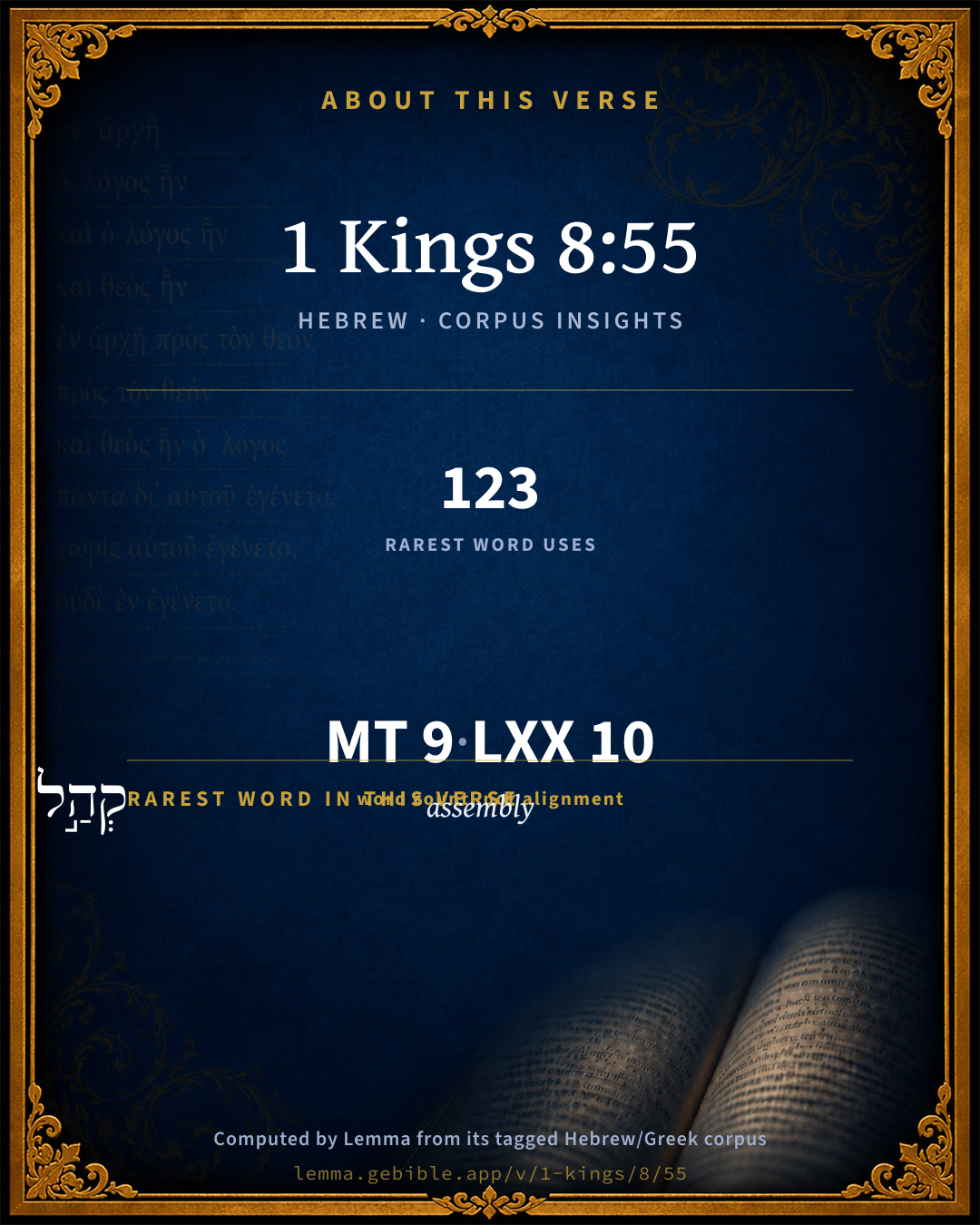
These counts appear in no published source. They are computed here, from the morphology-tagged text and Lemma’s own curated glosses. What Lemma adds →

9
words
9
distinct lemmas
Historical
section

Grammatical profile

  • 3 verbs
  • 4 nouns
  • 1 adjective
  • 1 particle

Verb forms

  • וַֽיַּעְמֹ֕ד Qal · Sequential Imperfect
  • וַיְבָ֕רֶךְ Piel · Sequential Imperfect
  • לֵאמֹֽר Qal · Infinitive Construct

Hebrew & Septuagint length

In English translation the verse runs 14 words from the Hebrew and 15 from the Septuagint (LXX English) — closely comparable.

A rough comparison of the two English renderings, which tokenize alike — not a word-level alignment.

Word counts can differ between the Hebrew and the Greek without any difference in meaning — e.g. the Hebrew direct-object marker אֵת has no separate Greek word, and Greek often adds the article ὁ.

In the original languages it is 9 Hebrew tokens and 10 Greek tokens — but the two are counted differently (Hebrew bundles its prefixes and suffixes into one token; the Greek is in lemma form), so that isn’t a like-for-like length.

Cross-references

4

Topical passages linked to 1 Kings 8:55 in the Treasury of Scripture Knowledge — connected by theme and wording, ordered by reader-vote popularity; previews shown in the World English Bible.

  • 1 Kings 8:14 The king turned his face about, and blessed all the assembly of Israel: and all the assembly of Israel stood.
  • 2 Samuel 6:18 When David had made an end of offering the burnt offering and the peace-offerings, he blessed the people in the name of Yahweh of Hosts.
  • Numbers 6:23–26 "Speak to Aaron and to his sons, saying, 'This is how you shall bless the children of Israel.' You shall tell them,
  • 1 Chronicles 16:2 When David had made an end of offering the burnt offering and the peace-offerings, he blessed the people in the name of Yahweh.

Cross-references courtesy of OpenBible.info (CC BY 4.0).

Hebrew and Greek witnesses Masoretic Hebrew ↔ Greek Septuagint

The same verse in the two great witnesses to the Old Testament, shown verse-for-verse.

These are two independent witnesses, not word-aligned to each other, and the Septuagint is shown in lemma (dictionary) form.

Hebrew 1 Kings 8:55 Masoretic · Westminster Leningrad Codex

וַֽיַּעְמֹ֕ד וַיְבָ֕רֶךְ אֵ֖ת כָּל קְהַ֣ל יִשְׂרָאֵ֑ל ק֥וֹל גָּד֖וֹל לֵאמֹֽר

He stood, and blessed all the assembly of Israel with a loud voice, saying,

World English Bible · Public Domain

Greek LXX 1 Kings 8:55 Septuagint · lemma form

καί ἵστημι καί εὐλογέω πᾶς ἐκκλησία ἰσραήλ φωνή μέγας λέγω

And he stood, and blessed all the congregation of Israel with a loud voice, saying,

LXX2012 (modern English Septuagint) · Public Domain

Hebrew: Westminster Leningrad Codex (CC BY 4.0). Greek: Septuagint (public domain); English from LXX2012 (modern English Septuagint) (Public Domain). How the Septuagint differs from the Hebrew →

Targum (Aramaic paraphrase)

1

The Targum is the ancient Jewish Aramaic paraphrase of the Hebrew Scriptures — an interpretive translation, not the Hebrew text itself. Onkelos (literal) and Pseudo-Jonathan (expansive) render the Torah, and Jonathan the Prophets. Coverage is partial: where no permissively-licensed English translation exists for a verse, only the Aramaic is shown. This is verse-level text, not a word-by-word alignment to the Hebrew.

  1. Targum Jonathan Prophets (Joshua–Malachi)
    וְקָם וּבְרִיךְ יַת כָּל קְהָלָא דְיִשְׂרָאֵל קַל רַב לְמֵימָר:

    (no public-domain English translation for this verse)

    Targum Jonathan — Aramaic: “Mikraot Gedolot” (public domain). English: “Sefaria Community Translation” (CC0 1.0 (public-domain dedication)); “London "Chaldee Paraphrase," 1871” (public domain). Text via Sefaria.

Commentary

Notes on 1 Kings 8:55 from classic Christian and Jewish commentators (each source and its license shown beneath its notes). The classic Christian expositions comment on the surrounding passage and are grouped to its opening verse, so a note may address several verses; the Jewish commentaries on the Tanakh (Rashi and others) are per-verse, so they appear only where the commentator wrote on this verse.

Lemma curates 59 commentaries, every one of them public domain or Creative Commons licensed, each selected and text-cleaned for this edition rather than reprinted as found. About our sources →

Trapp's Complete Commentary

John Trapp

1Ki 8:55 And he stood, and blessed all the congregation of Israel with a loud voice, saying,

Ver. 55. And he stood and blessed all the congregation.] Praying for them, and praising God for his mercy to them.

John Trapp, A Commentary or Exposition upon All the Books of the Old and New Testament (1647–1656) — public domain. Text from a community e-Sword module.

The Biblical Illustrator

Joseph S. Exell

1Ki_8:55

And he stood, and blessed all the congregation of Israel with a loud voice.

The king blessing his people

The great ceremonial of dedicating the temple was threefold. The first stage was setting the ark in its place, which was the essence of the whole thing. Gods presence was the true dedication, and that was manifested by the bright cloud that filled the sanctuary as soon as the ark was placed there. The second stage was the lofty and spiritual prayer, saturated with the language and tone of Deuteronomy, and breathing the purest conceptions of the character and nature of God, and all aglow with trust in Him. Then follows, thirdly, this Blessing of the Congregation.

1. Note the thankful retrospect of the nations past (verse 56).

2. Note the prayer for obedient hearts (verses 57, 58). The proper subject-matter of this petition is that He may incline our hearts to walk in His ways, and Gods presence is invoked as a means thereto. The deepest desire of a truly religious soul is for the felt nearness of God. That goes before all other blessings, and contains them all But Solomon desires that God may be with him and his people for one specific purpose. As in his choice in his dream, so now, he asks, not for these things, but for an inward influence on heart and will. What he wants most for himself and them is moral conformity to Gods will. All will be right if that be right. The prayer implies that, without Gods help, the heart will wander from the paths of duty.

3. Note the prayer for Gods defence (verses 59, 60). The proper subject-matter of this petition is that God would maintain the cause of king and nation; and it is preceded by a petition that, to that end, the long former prayer may be answered, and is followed by the desire that thereby the knowledge of God may fill the earth. The prayer for outward blessings comes after the prayer for inward heart-obedience. Note the grand aim of Gods help of Israel--the universal diffusion of His name among all the peoples of the earth. Solomon understood the Divine vocation of Israel, and had risen above desiring blessings only for his own or his subjects sake. Gods choice of Israel was not meant for the exclusion of the Gentiles, but as the means of transmitting the knowledge of God to them. The one nation was chosen that Gods grace might fructify through them to all. The fire was gathered into a hearth, that the whole house might be warmed.

4. The blessing ends with one brief, all-comprehensive charge to the people, which seems based, by its therefore, on the preceding thought of Jehovah as the only God. The only attitude corresponding to His sole and supreme Majesty is the entire devotion of the heart, which leads to thorough-going obedience to His commandments. We, too, are tempted to bring Him divided hearts, and to carry some of our love and trust as offerings at other shrines. But if there be one God, and none other but He, then to serve Him with all our hearts and strength and mind is the dictate of common sense, and the only course which He can accept, or which can bring our else distracted natures peace and satisfaction. His voice to us is, My son, give Me thy whole heart. Our answer to Him should ever be that prayer, Lord unite my heart to fear Thy name. (A. Maclaren, D. D.)

The Biblical Illustrator, edited by Joseph S. Exell (c. 1880s–1900s) — public domain. Text from a community e-Sword module.

Joseph Benson's Commentary

1Ki 8:55-56. He stood and blessed all the congregation, &c. — He spoke what follows standing, that he might be the better heard, and because he blessed as one having authority. Never were words more pertinently spoken; never was a congregation dismissed with that which was more likely to affect them, and to abide with them. Blessed be the Lord that hath given rest, &c., according to all that he promised — Thus he, as it were, writes a receipt in full on the back of the bonds of the divine promises. There hath, not failed one word of all his good promises — This discharge he gives in the name of all Israel, to the everlasting honour of the divine faithfulness, and the everlasting encouragement of all those who build on the divine promises.

Joseph Benson's Commentary on the Old and New Testaments (1811–1818) — public domain. Text from a community e-Sword module.

Adam Clarke's Commentary

Verse 55. He stood, and blessed all the congregation] This blessing is contained in 1Kgs 8:57-58.

Adam Clarke's Commentary on the Bible (1810–1826) — public domain. Text from a community e-Sword/MySword module.

Ellicott's Commentary for English Readers

(55) Blessed all the children of Israel.—To bless the congregation was the special duty and privilege of the priests (see Num_6:23-27); but throughout the whole of this narrative the king, and the king alone, is conspicuous. It is, however, to be noted that Solomon’s words here are not strictly of blessing, but rather of praise and prayer to God, and exhortation to the people.

A Bible Commentary for English Readers, edited by Charles John Ellicott (1878–1897) — public domain. Text from a community e-Sword module.

John Gill's Exposition

Blessed be the Lord, that hath given rest unto his people Israel, according, to all that he promised.... A land of rest, and rest in the land from all enemies; see Deu 12:9,

there hath not failed one word of all his good promises, which he promised by the hand of Moses his servant: so Joshua observed a little before his death, Jos 23:14 to which Solomon seems to have respect; and who lived to see a greater accomplishment of the gracious promises of God, and his faithfulness therein, both in the times of his father David, and his own.

John Gill's Exposition of the Whole Bible (1746–1763) — public domain (CC PDM 1.0). Text via the HelloAO Bible API.

The Pulpit Commentary

And he stood this does not necessarily imply that he drew nearer to the congregation, as Keil, and blessed cf. 2Sa_6:18, and see note on ver. 14. The words of blessing, which are presently given (vers. 56-61), prove that he did not assume priestly functions and put any blessing upon the people, Num_6:27 all the congregation of Israel with a loud (Heb. great) voice, saying,

The Pulpit Commentary (1880–1919), ed. H.D.M. Spence-Jones & Joseph S. Exell — public domain. Text from a community e-Sword module.

John Wesley's Explanatory Notes

He stood - He spoke this standing, that he might be the better heard, and because he blessed as one having authority. Never were words more pertinently spoken: never was a congregation dismissed, with that which was more likely to affect them, and to abide with them.

John Wesley, Explanatory Notes Upon the Whole Bible (1754–1765) — public domain. Text via the GEBible commentary corpus.

Lesson kit

Teaching starters — assembled from the data on this page, not authored interpretation. Every prompt links to the verse data it draws on. Edit before teaching.

1 Kings, in the Historical, opens this verse with 9 words (9 distinct Hebrew lemmas). Its most distinctive word is qâhâl (“assembly”). A historical commentator’s framing appears above. Read the whole chapter for the surrounding context.

Discussion questions

  1. The word qâhâl carries the sense “assembly.” How does it shape the verse?
  2. How does 1 Kings 8:14, which shares this passage’s theme, read alongside this verse?
  3. These translations render this verse differently. What is at stake in choosing one wording over another?
  4. «וַֽיַּעְמֹ֕ד» is a Qal Sequential Imperfect verb. How does that grammatical form shape the action described?
  5. Compare how Trapp's Complete Commentary and The Biblical Illustrator read this verse. Where do they agree or differ?

Things to notice

Reading settings

Reading text

Shown beneath each verse's original-language words.

Old Testament
Old Testament edition

Read the OT as the Masoretic Hebrew (MT) or the Greek Septuagint (LXX).

English shown for the Greek Septuagint (in the Hebrew ↔ Greek comparison).

Comparing translations? Open the Compare panel on any verse page to stack up to four side by side.