
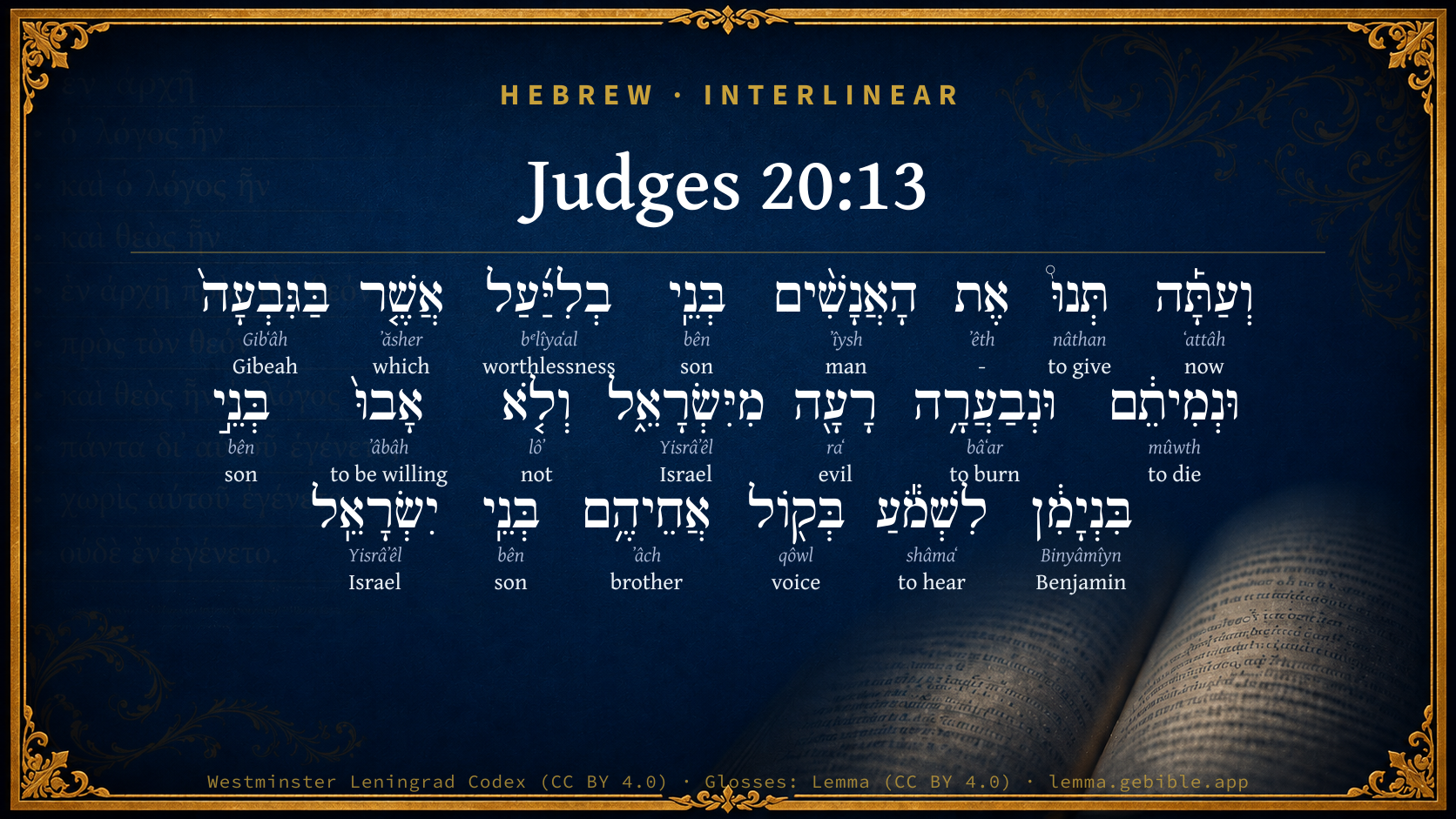
Judges 20:13

Hebrew (Westminster Leningrad Codex) Judges 20:13 appears in the Hebrew Old Testament. The text above is from the Westminster Leningrad Codex. Each word links to its Strong’s number, a concise gloss, and parsing drawn from the Open Scriptures Hebrew Bible morphology. Click any word for its full Brown-Driver-Briggs (BDB) entry.
Download image
Cite this verse

Judges 20:13 (World English Bible). Public Domain. Lemma interlinear Bible study tool, https://lemma.gebible.app/v/judges/20/13.

Show BibTeX & RIS
BibTeX
RIS
English Translation
Now therefore deliver up the men, the base fellows, who are in Gibeah, that we may put them to death, and put away evil from Israel. But Benjamin would not listen to the voice of their brothers the children of Israel.
World English Bible · Public Domain
Download a study sheet

One document with this verse’s original text, its word-by-word gloss line, the meaning frame, cross-references with their text, attributed commentary, and full source and license credits — printable, and it pastes into notes with its structure intact.

This verse Autodidact and up

Study sheet (.html) Plain text (.txt)

A passage Seminary Student

Up to 50 verses in one chapter. A passage sheet keeps up to 6 commentary sources and 12 cross-references per verse, in the order this page ranks them, and says so on the sheet whenever that leaves anything out. Ask for a single verse and you get the Autodidact verse sheet above.

Everything on this page stays free to read, with no account — the sheet is a download of what is already on screen, not access to it.

Want to remove ads? Support Godless Engineer
Compare translations 3

The same verse in 3 English versions, stacked beneath the original-language interlinear above. Click any original word for its lexicon entry.

Each is an independent rendering of the whole verse — the interlinear is not word-aligned to these translations.

Highlighted words mark where these versions differ — a whole-verse word diff, not a word-by-word alignment.

  • World English Bible Public Domain
    Now therefore deliver up the men, the base fellows, who are in Gibeah, that we may put them to death, and put away evil from Israel. But Benjamin would not listen to the voice of their brothers the children of Israel.
  • King James Version Public Domain
    Now therefore deliver us the men, the children of Belial, which are in Gibeah, that we may put them to death, and put away evil from Israel. But the children of Benjamin would not hearken to the voice of their brethren the children of Israel.
  • unfoldingWord Literal Text CC BY-SA 4.0
    And now, give over the men, the sons of wickedness, who in Gibeah, that we may kill them so that we may burn up evil from Israel.” But they were not willing, Benjamin, to listen to the voice of their brothers, the sons of Israel.

unfoldingWord Literal Text — © unfoldingWord, licensed CC BY-SA 4.0. Word-aligned USFM3 via Door43 (git.door43.org/unfoldingWord/en_ult).

Versions to compare (up to 4)

3 of 4 selected

Show all 18 translations

Every available English version of this verse, each an independent rendering of the whole verse.

  • World English Bible Public Domain
    Now therefore deliver up the men, the base fellows, who are in Gibeah, that we may put them to death, and put away evil from Israel. But Benjamin would not listen to the voice of their brothers the children of Israel.
  • Berean Standard Bible Public Domain
    Hand over the wicked men of Gibeah so we can put them to death and purge Israel of this evil.” But the Benjamites refused to heed the voice of their fellow Israelites.
  • Majority Standard Bible Public Domain
    Hand over the wicked men of Gibeah so we can put them to death and purge Israel of this evil.” But the Benjamites refused to heed the voice of their fellow Israelites.
  • King James Version Public Domain
    Now therefore deliver us the men, the children of Belial, which are in Gibeah, that we may put them to death, and put away evil from Israel. But the children of Benjamin would not hearken to the voice of their brethren the children of Israel.
  • American Standard Version (1901) Public Domain
    Now therefore deliver up the men, the base fellows, that are in Gibeah, that we may put them to death, and put away evil from Israel. But Benjamin would not hearken to the voice of their brethren the children of Israel.
  • Revised Version (1885) Public Domain
    Now therefore deliver up the men, the sons of Belial, which are in Gibeah, that we may put them to death, and put away evil from Israel. But Benjamin would not hearken to the voice of their brethren the children of Israel.
  • Geneva Bible (1599) Public Domain
    Nowe therefore deliuer vs those wicked men which are in Gibeah, that we may put them to death, and put away euill from Israel: but the children of Beniamin would not obey the voyce of their brethren the children of Israel.
  • Douay-Rheims (1899) Public Domain
    Deliver up the men of Gabaa, that have committed this heinous crime, that they may die, and the evil may be taken away out of Israel. But they would not hearken to the proposition of their brethren the children of Israel:
  • Young's Literal Translation Public Domain
    And now, give up the men -- sons of worthlessness -- which `are' in Gibeah, and we put them to death, and we put away evil from Israel.' And `the sons of' Benjamin have not been willing to hearken to the voice of their brethren, the sons of Israel;
  • Literal Standard Version CC BY-SA 4.0
    And now, give up the men—sons of worthlessness—which [are] in Gibeah, and we put them to death, and we put away evil from Israel.” And [the sons of] Benjamin have not been willing to listen to the voice of their brothers, the sons of Israel;
  • Unlocked Literal Bible CC BY-SA 4.0
    Therefore, give us those wicked men of Gibeah, so we may put them to death, and so we will completely remove this evil from Israel.” But the Benjamites would not listen to the voice of their brothers, the people of Israel.
  • unfoldingWord Literal Text CC BY-SA 4.0
    And now, give over the men, the sons of wickedness, who in Gibeah, that we may kill them so that we may burn up evil from Israel.” But they were not willing, Benjamin, to listen to the voice of their brothers, the sons of Israel.
  • Darby Bible Public Domain
    Now therefore give up the men, the base fellows in Gib'e-ah, that we may put them to death, and put away evil from Israel." But the Benjaminites would not listen to the voice of their brethren, the people of Israel.
  • World Messianic Bible Public Domain
    Now therefore deliver up the men, the wicked fellows who are in Gibeah, that we may put them to death and put away evil from Israel.” But Benjamin would not listen to the voice of their brothers, the children of Israel.
  • Webster's Bible Public Domain
    Now therefore deliver us the men, the children of Belial, who are in Gibeah, that we may put them to death, and banish evil from Israel. But the children of Benjamin would not hearken to the voice of their brethren, the children of Israel:
  • Free Bible Version CC BY-SA 4.0
    Hand over these wicked men so we can execute them and get rid of this evil from Israel!” But the Benjamites refused to listen to what their fellow Israelites had to say.
  • Bible in Basic English Public Domain
    Now give up those good-for-nothing persons in Gibeah so that we may put them to death, clearing away the evil from Israel. But the children of Benjamin would not give ear to the voice of their brothers, the children of Israel.
  • JPS Tanakh (1917) Public Domain
    Now therefore deliver up the men, the base fellows that are in Gibeah, that we may put them to death, and put away evil from Israel.' But the children of Benjamin would not hearken to the voice of their brethren the children of Israel.

Literal Standard Version (2020), Covenant Press — licensed CC BY-SA 4.0. Text via the HelloAO Bible API (eBible.org). Unlocked Literal Bible (unfoldingWord) — licensed CC BY-SA 4.0. Text via the HelloAO Bible API (eBible.org). unfoldingWord Literal Text — © unfoldingWord, licensed CC BY-SA 4.0. Word-aligned USFM3 via Door43 (git.door43.org/unfoldingWord/en_ult). Free Bible Version, Dr. Jonathan Gallagher — licensed CC BY-SA 4.0. Text via the HelloAO Bible API (eBible.org).

Word by word

More ways to search: Search by grammar → Find every occurrence → Compare this word →

Practice this passage: Drill this verse → Learn its vocabulary →

בְלִיַּ֜עַל
bᵉlîyaʻal
H1100
“worthlessness”
Noun, Common, Masculine, Singular, Absolute
Part of Speech
Noun
Type
Common
Gender
Masculine
Number
Singular
State
Absolute
Full BDB Definition

Origin: from H1097 and H3276

TWOT: 246g

worthlessness - worthless, good for nothing, unprofitable, base fellow - wicked - ruin, destruction (construct)
  1. וְעַתָּ֡ה ʻattâh H6258 “and · now” Conjunction + Adverb
  2. תְּנוּ֩ nâthan H5414 “give” Verb, Qal, Imperative, 2nd Person, Masculine, Plural
  3. אֶת ʼêth H853 “-” Particle, Direct Object
  4. הָאֲנָשִׁ֨ים ʼîysh H376 “the · men” Particle, Definite Article + Noun, Common, Masculine, Plural, Absolute
  5. בְּנֵֽי bên H1121 “sons of” Noun, Common, Masculine, Plural, Construct
  6. אֲשֶׁ֤ר ʼăsher H834 “which” Particle, Relative
  7. בַּגִּבְעָה֙ Gibʻâh H1390 “in/at the · Gibeah” Preposition, Determined + Noun, Proper
  8. וּנְמִיתֵ֔ם mûwth H4191 “and · to die · them” Conjunction + Verb, Hiphil, Cohortative, 1st Person, Common, Plural + Suffix, Personal, 3rd Person, Masculine, Plural
  9. וּנְבַעֲרָ֥ה bâʻar H1197 “and · to burn” Conjunction + Verb, Piel, Cohortative, 1st Person, Common, Plural
  10. רָעָ֖ה raʻ H7451 “evil” Noun, Common, Feminine, Singular, Absolute
  11. מִיִּשְׂרָאֵ֑ל Yisrâʼêl H3478 “from · Israel” Preposition + Noun, Proper
  12. וְלֹ֤א lôʼ H3808 “and · not” Conjunction + Particle, Negative
  13. אָבוּ֙ ʼâbâh H14 “to be willing” Verb, Qal, Perfect, 3rd Person, Common, Plural
  14. בְּנֵ֣י bên H1121 “sons of” Noun, Common, Masculine, Plural, Construct
  15. בִּנְיָמִ֔ן Binyâmîyn H1144 “Benjamin” Noun, Proper
  16. לִשְׁמֹ֕עַ shâmaʻ H8085 “to hear” Preposition + Verb, Qal, Infinitive Construct
  17. בְּק֖וֹל qôwl H6963 “in/at · voice of” Preposition + Noun, Common, Masculine, Singular, Construct
  18. אֲחֵיהֶ֥ם ʼâch H251 “brothers · their” Noun, Common, Masculine, Plural, Construct + Suffix, Personal, 3rd Person, Masculine, Plural
  19. בְּנֵֽי bên H1121 “sons of” Noun, Common, Masculine, Plural, Construct
  20. יִשְׂרָאֵֽל Yisrâʼêl H3478 “Israel” Noun, Proper

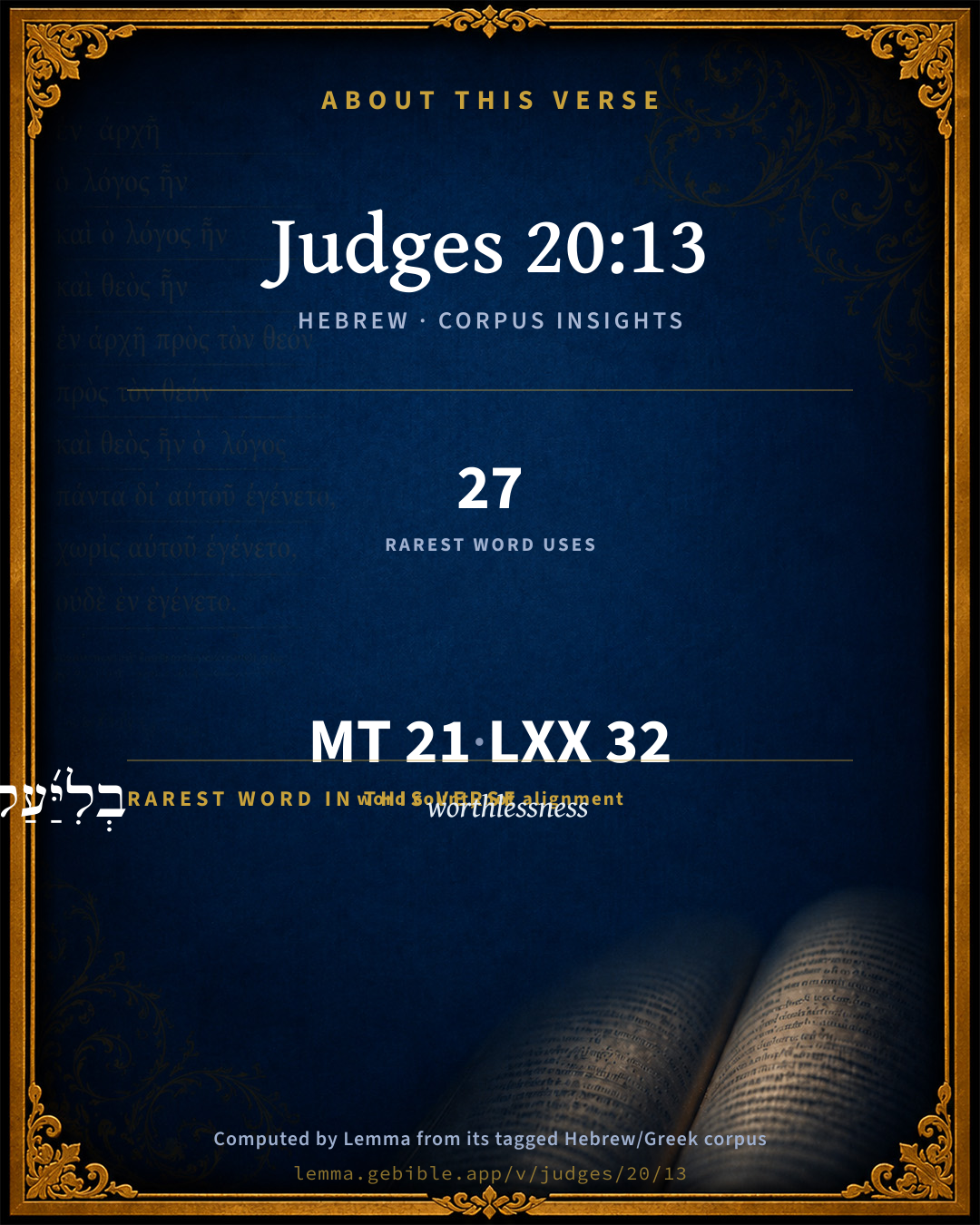
About this verse

These counts appear in no published source. They are computed here, from the morphology-tagged text and Lemma’s own curated glosses. What Lemma adds →

21
words
18
distinct lemmas
Historical
section

Shared distinctive vocabulary

בְלִיַּ֜עַל worthlessness H1100 occurs in 26 verses of the Hebrew Bible. Also found in:

Grammatical profile

  • 5 verbs
  • 12 nouns
  • 1 adverb
  • 3 particles

Verb forms

  • תְּנוּ֩ Qal · Imperative
  • וּנְמִיתֵ֔ם Hiphil · Cohortative
  • וּנְבַעֲרָ֥ה Piel · Cohortative
  • אָבוּ֙ Qal · Perfect
  • לִשְׁמֹ֕עַ Qal · Infinitive Construct

Repetition

Words recur within this verse — often emphatic in Hebrew:

  • בְּנֵֽי son H1121 ×3
  • מִיִּשְׂרָאֵ֑ל Israel H3478 ×2

Hebrew & Septuagint length

In English translation the verse runs 41 words from the Hebrew and 46 from the Septuagint (LXX English) — closely comparable.

A rough comparison of the two English renderings, which tokenize alike — not a word-level alignment.

Word counts can differ between the Hebrew and the Greek without any difference in meaning — e.g. the Hebrew direct-object marker אֵת has no separate Greek word, and Greek often adds the article ὁ.

In the original languages it is 21 Hebrew tokens and 32 Greek tokens — but the two are counted differently (Hebrew bundles its prefixes and suffixes into one token; the Greek is in lemma form), so that isn’t a like-for-like length.

Cross-references

25

Topical passages linked to Judges 20:13 in the Treasury of Scripture Knowledge — connected by theme and wording, ordered by reader-vote popularity; previews shown in the World English Bible.

  • Deuteronomy 17:12 The man who does presumptuously, in not listening to the priest who stands to minister there before Yahweh your God, or to the judge, even that man shall die: and you shall put away the evil from Israel.
  • Deuteronomy 13:13 Certain base fellows are gone out from the midst of you, and have drawn away the inhabitants of their city, saying, Let us go and serve other gods, which you have not known;
  • Judges 19:22 As they were making their hearts merry, behold, the men of the city, certain base fellows, beset the house round about, beating at the door; and they spoke to the master of the house, the old man, saying, Bring forth the man who came into your house, that we may know him.
  • Deuteronomy 13:5 That prophet, or that dreamer of dreams, shall be put to death, because he has spoken rebellion against Yahweh your God, who brought you out of the land of Egypt, and redeemed you out of the house of bondage, to draw you aside out of the way which Yahweh your God commanded you to walk in. So shall you put away the evil from the midst of you.
  • Deuteronomy 17:7 The hand of the witnesses shall be first on him to put him to death, and afterward the hand of all the people. So you shall put away the evil from the midst of you.
  • Deuteronomy 19:19 then shall you do to him, as he had thought to do to his brother: so shall you put away the evil from the midst of you.
  • Deuteronomy 21:21 All the men of his city shall stone him to death with stones: so shall you put away the evil from the midst of you; and all Israel shall hear, and fear.
  • Deuteronomy 22:21 then they shall bring out the young lady to the door of her father's house, and the men of her city shall stone her to death with stones, because she has done folly in Israel, to play the prostitute in her father's house: so shall you put away the evil from the midst of you.
  • Deuteronomy 22:24 then you shall bring them both out to the gate of that city, and you shall stone them to death with stones; the lady, because she didn't cry, being in the city; and the man, because he has humbled his neighbor's wife: so you shall put away the evil from the midst of you.
  • Deuteronomy 24:7 If a man be found stealing any of his brothers of the children of Israel, and he deal with him as a slave, or sell him; then that thief shall die: so shall you put away the evil from the midst of you.
  • 1 Samuel 2:25 If one man sin against another, God shall judge him; but if a man sin against Yahweh, who shall entreat for him? Notwithstanding, they didn't listen to the voice of their father, because Yahweh was minded to kill them.
  • 1 Samuel 30:22 Then answered all the wicked men and base fellows, of those who went with David, and said, Because they didn't go with us, we will not give them anything of the spoil that we have recovered, except to every man his wife and his children, that he may lead them away, and depart.
  • 2 Samuel 20:1 There happened to be there a base fellow, whose name was Sheba, the son of Bichri, a Benjamite: and he blew the trumpet, and said, We have no portion in David, neither have we inheritance in the son of Jesse: every man to his tents, Israel.
  • 2 Samuel 20:21–22 The matter is not so: but a man of the hill-country of Ephraim, Sheba the son of Bichri by name, has lifted up his hand against the king, even against David; deliver him only, and I will depart from the city. The woman said to Joab, Behold, his head shall be thrown to you over the wall.
  • 2 Samuel 23:6 But the ungodly shall be all of them as thorns to be thrust away, Because they can't be taken with the hand
  • 1 Kings 21:13 The two men, the base fellows, came in and sat before him: and the base fellows bore witness against him, even against Naboth, in the presence of the people, saying, Naboth did curse God and the king. Then they carried him forth out of the city, and stoned him to death with stones.
  • 2 Chronicles 13:7 There were gathered to him worthless men, base fellows, who strengthened themselves against Rehoboam the son of Solomon, when Rehoboam was young and tender-hearted, and could not withstand them.
  • 2 Chronicles 25:16 It happened, as he talked with him, that [the king] said to him, Have we made you of the king's counsel? Stop! Why should you be struck down? Then the prophet stopped, and said, I know that God has determined to destroy you, because you have done this, and have not listened to my counsel.
  • 2 Chronicles 25:20 But Amaziah would not hear; for it was of God, that he might deliver them into the hand [of their enemies], because they had sought after the gods of Edom.
  • Proverbs 29:1 He who is often rebuked and stiffens his neck Will be destroyed suddenly, with no remedy.
  • Ecclesiastes 11:10 Therefore remove sorrow from your heart, And put away evil from your flesh; For youth and the dawn of life are vanity.
  • Hosea 9:9 They have deeply corrupted themselves, As in the days of Gibeah. He will remember their iniquity. He will punish them for their sins.
  • Hosea 10:9 "Israel, you have sinned from the days of Gibeah. There they remained. The battle against the children of iniquity doesn't overtake them in Gibeah.
  • Romans 1:32 who, knowing the ordinance of God, that those who practice such things are worthy of death, not only do the same, but also approve of those who practice them.
  • Revelation 18:4–5 I heard another voice from heaven, saying, "Come out of her, my people, that you have no participation in her sins, and that you don't receive of her plagues,

Cross-references courtesy of OpenBible.info (CC BY 4.0).

Hebrew and Greek witnesses Masoretic Hebrew ↔ Greek Septuagint

The same verse in the two great witnesses to the Old Testament, shown verse-for-verse.

These are two independent witnesses, not word-aligned to each other, and the Septuagint is shown in lemma (dictionary) form.

Hebrew Judges 20:13 Masoretic · Westminster Leningrad Codex

וְעַתָּ֡ה תְּנוּ֩ אֶת הָאֲנָשִׁ֨ים בְּנֵֽי בְלִיַּ֜עַל אֲשֶׁ֤ר בַּגִּבְעָה֙ וּנְמִיתֵ֔ם וּנְבַעֲרָ֥ה רָעָ֖ה מִיִּשְׂרָאֵ֑ל וְלֹ֤א אָבוּ֙ בְּנֵ֣י בִּנְיָמִ֔ן לִשְׁמֹ֕עַ בְּק֖וֹל אֲחֵיהֶ֥ם בְּנֵֽי יִשְׂרָאֵֽל

Now therefore deliver up the men, the base fellows, who are in Gibeah, that we may put them to death, and put away evil from Israel. But Benjamin would not listen to the voice of their brothers the children of Israel.

World English Bible · Public Domain

Greek LXX Judges 20:13 Septuagint · lemma form

καί νῦν δίδωμι ὁ ἀνήρ υἱός παράνομος ὁ ἐν γαβαα καί θανατόω αὐτός καί ἐκκαθαρίζω πονηρία ἀπό ἰσραήλ καί οὐ εὐδοκέω ὁ υἱός βενιαμίν ἀκούω ὁ φωνή ὁ ἀδελφός αὐτός υἱός ἰσραήλ

Now then give up the men the sons of transgressors that are in Gabaa, and we will put them to death, and purge out wickedness from Israel: but the children of Benjamin consented not to listen to the voice of their brethren the children of Israel.

LXX2012 (modern English Septuagint) · Public Domain

Hebrew: Westminster Leningrad Codex (CC BY 4.0). Greek: Septuagint (public domain); English from LXX2012 (modern English Septuagint) (Public Domain). How the Septuagint differs from the Hebrew →

Targum (Aramaic paraphrase)

1

The Targum is the ancient Jewish Aramaic paraphrase of the Hebrew Scriptures — an interpretive translation, not the Hebrew text itself. Onkelos (literal) and Pseudo-Jonathan (expansive) render the Torah, and Jonathan the Prophets. Coverage is partial: where no permissively-licensed English translation exists for a verse, only the Aramaic is shown. This is verse-level text, not a word-by-word alignment to the Hebrew.

  1. Targum Jonathan Prophets (Joshua–Malachi)
    וּכְעַן אַיְתוּ יַת גַּבְרַיָא בְּנֵי רִשְׁעָא דִי בְגִבְעָתָא וְנִקְטְלִינוּן וּנְפַלֵי עָבְדֵי בִּישְׁתָא מִיִשְׂרָאֵל וְלָא אָבוּ בְנֵי בִּנְיָמִין לְקַבָּלָא לִמֵימַר אֲחוּהוֹן בְּנֵי יִשְׂרָאֵל:

    (no public-domain English translation for this verse)

    Targum Jonathan — Aramaic: “Mikraot Gedolot” (public domain). English: “Sefaria Community Translation” (CC0 1.0 (public-domain dedication)); “London "Chaldee Paraphrase," 1871” (public domain). Text via Sefaria.

Commentary

Notes on Judges 20:13 from classic Christian and Jewish commentators (each source and its license shown beneath its notes). The classic Christian expositions comment on the surrounding passage and are grouped to its opening verse, so a note may address several verses; the Jewish commentaries on the Tanakh (Rashi and others) are per-verse, so they appear only where the commentator wrote on this verse.

Lemma curates 59 commentaries, every one of them public domain or Creative Commons licensed, each selected and text-cleaned for this edition rather than reprinted as found. About our sources →

Trapp's Complete Commentary

John Trapp

Jdg 20:13 Now therefore deliver [us] the men, the children of Belial, which [are] in Gibeah, that we may put them to death, and put away evil from Israel. But the children of Benjamin would not hearken to the voice of their brethren the children of Israel:

Ver. 13. And put away evil from Irsael.] Both the evil of sin and the evil of punishment: for these two are inseparable companions Flagitium et flagellum sunt sicut acus et filum.

Would not hearken to the voice of their brethren.] God had a holy hand in it for the just punishment of both parties. In the text there is a space for "sons of" in the Ben Chayyin text and in the Ben Asher text just the vowel points are given and בני "sons of" is given as the marginal reading. {Hebrew Text Note}

John Trapp, A Commentary or Exposition upon All the Books of the Old and New Testament (1647–1656) — public domain. Text from a community e-Sword module.

Joseph Benson's Commentary

Jdg 20:13. That we may put away evil from Israel — Both the guilt and punishment wherein all Israel will be involved if they do not punish it. The children of Benjamin would not hearken — From the pride of their hearts, which made them scorn to submit to their brethren; from a conceit of their own valour; and from God’s just judgment. Certainly the degeneracy among them must have been very great, and it is probable the offenders might be men of considerable rank and power, which made the Benjamites refuse to deliver them up.

Joseph Benson's Commentary on the Old and New Testaments (1811–1818) — public domain. Text from a community e-Sword module.

Geneva Bible (1599)

Geneva Bible translators

Because they would not suffer the wicked to be punished, they declared themselves to maintain them in their evil, and therefore were all justly punished.

Geneva Bible (1599) marginal notes — public domain. Text via Bolls.life.

Adam Clarke's Commentary

Verse 13. Deliver us the men] Nothing could be fairer than this. They wish only to make the murderers answerable for their guilt.

Benjamin would not hearken] Thus making their whole tribe partakers of the guilt of the men of Gibeah. By not delivering up those bad men, they in effect said: "We will stand by them in what they have done, and would have acted the same part had we been present." This proves that the whole tribe was excessively depraved.

Adam Clarke's Commentary on the Bible (1810–1826) — public domain. Text from a community e-Sword/MySword module.

Ellicott's Commentary for English Readers

(13) The children of Benjamin would not hearken.—They were actuated by the same bad spirit of solidarity which has often made Highland clans defend a member of their body who has committed some grave outrage. That they should have preferred an internecine civil war to the giving up their criminals illustrates the peculiarly fierce character of the tribe (Gen_49:27). Their determination to hold out against united Israel is analogous to the courage in a bad cause of the Phocians in the sacred wars of Greece (Grote, iv. 85).

A Bible Commentary for English Readers, edited by Charles John Ellicott (1878–1897) — public domain. Text from a community e-Sword module.

The Cambridge Bible for Schools and Colleges

gen. ed. J. J. S. Perowne

13. deliver up the men … that we may put them to death] Similarly 1Sa_11:12.

the sons of Belial] See on Jdg_19:22.

put away evil] Read the evil, lit. burn up, consume the evil; a frequent expression in Deut., e.g. Deu_13:5, Deu_17:7; Deu_17:12, Deu_22:22.

The Cambridge Bible for Schools and Colleges (gen. ed. J. J. S. Perowne; Cambridge University Press, 1878–1918) — public domain. Text from a community e-Sword module.

John Gill's Exposition

Now, therefore, deliver us the men, the children of Belial, which are in Gibeah,.... Those wicked men that were the authors of that abominable wickedness there committed:

that we may put them to death; as they deserved, since they were guilty both of adultery and murder; their meaning is, that they in conjunction with the tribe of Benjamin might condemn them to death and punish them with it, as their crime deserved:

and put away evil from Israel; prevent both the spread of such a sinful evil in the nation, encouraged by such examples, and the evil of punishment coming upon them from God, should they let such wickedness pass with impunity:

but the children of Benjamin would not hearken to the voice of their brethren the children of Israel; they refused to give up the men of Gibeah, that had been guilty of such great wickedness; reckoning it a reproach, as Josephus (f) says, to obey the commands of others, for fear of war, and unwilling to yield to any in arms, neither on account of multitude nor courage.

(f) Antiqu. l. 5. c. 2. sect. 9.

John Gill's Exposition of the Whole Bible (1746–1763) — public domain (CC PDM 1.0). Text via the HelloAO Bible API.

Matthew Poole's English Annotations

Put away evil; both the guilt and the punishment, wherein all Israel will be involved, if they do not punish it.

The children of Benjamin would not hearken; partly, from the pride of their hearts, which made them scorn to submit it, their brethren, or to suffer them to meddle in their territory; partly, from the conceit of their own valour and military skill; and partly, from God’s just judgment.

Matthew Poole's English Annotations on the Holy Bible (1683–1685) — public domain. Text from a community e-Sword/MySword module.

Whedon's Commentary on the Bible

Daniel D. Whedon

13. Benjamin would not hearken — Here was amazing perversity. For a whole tribe to assume the responsibility of the crime of Gibeah, and fight to defend it, was another folly in Israel. But the measures taken to punish the crime, from their fierceness and suddenness, were not calculated to conciliate, but rather to provoke the Benjamites to war, and thus was brought to pass the saying of Jacob: “Benjamin shall raven as a wolf.” Gen_49:27.

Daniel D. Whedon (gen. ed.), Commentary on the Old and New Testaments (1874–1909) — public domain. Text from a community e-Sword module.

The Pulpit Commentary

Children of Belial. See Jud_1:19:22, note. There seems to be a reference hero to Deu_13:12-15.

The Pulpit Commentary (1880–1919), ed. H.D.M. Spence-Jones & Joseph S. Exell — public domain. Text from a community e-Sword module.

John Wesley's Explanatory Notes

Evil - Both the guilt and the punishment, wherein all Israel will be involved, if they do not punish it. Would not hearken - From the pride of their hearts, which made them scorn to submit to their brethren; from a conceit of their own valour; and from God's just judgment.

John Wesley, Explanatory Notes Upon the Whole Bible (1754–1765) — public domain. Text via the GEBible commentary corpus.

Lesson kit

Teaching starters — assembled from the data on this page, not authored interpretation. Every prompt links to the verse data it draws on. Edit before teaching.

Judges, in the Historical, opens this verse with 21 words (18 distinct Hebrew lemmas). Its most distinctive word is bᵉlîyaʻal (“worthlessness”). A historical commentator’s framing appears above. Read the whole chapter for the surrounding context.

Discussion questions

  1. How does “worthlessness” (bᵉlîyaʻal) shape what this verse is saying?
  2. Deuteronomy 13:13 shares the word «worthlessness» with this verse. How do the two illuminate each other?
  3. “son” occurs 3× in this one verse. What is the effect of the repetition?
  4. These translations render this verse differently. What is at stake in choosing one wording over another?
  5. The verb «תְּנוּ֩» is Qal Imperative. How does its form color the action?
  6. Reading how Trapp's Complete Commentary and Joseph Benson's Commentary read this verse, where do the two commentators agree and where do they part?

Things to notice

Reading settings

Reading text

Shown beneath each verse's original-language words.

Old Testament
Old Testament edition

Read the OT as the Masoretic Hebrew (MT) or the Greek Septuagint (LXX).

English shown for the Greek Septuagint (in the Hebrew ↔ Greek comparison).

Comparing translations? Open the Compare panel on any verse page to stack up to four side by side.