Joshua 10:14

Hebrew (Westminster Leningrad Codex) Joshua 10:14 appears in the Hebrew Old Testament. The text above is from the Westminster Leningrad Codex. Each word links to its Strong’s number, a concise gloss, and parsing drawn from the Open Scriptures Hebrew Bible morphology. Click any word for its full Brown-Driver-Briggs (BDB) entry.
Download image
Cite this verse

Joshua 10:14 (World English Bible). Public Domain. Lemma interlinear Bible study tool, https://lemma.gebible.app/v/joshua/10/14.

Show BibTeX & RIS
BibTeX
RIS
English Translation
There was no day like that before it or after it, that Yahweh listened to the voice of a man: for Yahweh fought for Israel.
World English Bible · Public Domain
Download a study sheet

One document with this verse’s original text, its word-by-word gloss line, the meaning frame, cross-references with their text, attributed commentary, and full source and license credits — printable, and it pastes into notes with its structure intact.

This verse Autodidact and up

Study sheet (.html) Plain text (.txt)

A passage Seminary Student

Up to 50 verses in one chapter. A passage sheet keeps up to 6 commentary sources and 12 cross-references per verse, in the order this page ranks them, and says so on the sheet whenever that leaves anything out. Ask for a single verse and you get the Autodidact verse sheet above.

Everything on this page stays free to read, with no account — the sheet is a download of what is already on screen, not access to it.

Want to remove ads? Support Godless Engineer
Compare translations 3

The same verse in 3 English versions, stacked beneath the original-language interlinear above. Click any original word for its lexicon entry.

Each is an independent rendering of the whole verse — the interlinear is not word-aligned to these translations.

Highlighted words mark where these versions differ — a whole-verse word diff, not a word-by-word alignment.

  • World English Bible Public Domain
    There was no day like that before it or after it, that Yahweh listened to the voice of a man: for Yahweh fought for Israel.
  • King James Version Public Domain
    And there was no day like that before it or after it, that the LORD hearkened unto the voice of a man: for the LORD fought for Israel.
  • unfoldingWord Literal Text CC BY-SA 4.0
    And none has been like that day to the face of it or after it, for Yahweh listening to the voice of a man, because Yahweh fought for Israel.

unfoldingWord Literal Text — © unfoldingWord, licensed CC BY-SA 4.0. Word-aligned USFM3 via Door43 (git.door43.org/unfoldingWord/en_ult).

Versions to compare (up to 4)

3 of 4 selected

Show all 18 translations

Every available English version of this verse, each an independent rendering of the whole verse.

  • World English Bible Public Domain
    There was no day like that before it or after it, that Yahweh listened to the voice of a man: for Yahweh fought for Israel.
  • Berean Standard Bible Public Domain
    There has been no day like it before or since, when the LORD listened to the voice of a man, because the LORD fought for Israel.
  • Majority Standard Bible Public Domain
    There has been no day like it before or since, when the LORD listened to the voice of a man, because the LORD fought for Israel.
  • King James Version Public Domain
    And there was no day like that before it or after it, that the LORD hearkened unto the voice of a man: for the LORD fought for Israel.
  • American Standard Version (1901) Public Domain
    And there was no day like that before it or after it, that Jehovah hearkened unto the voice of a man: for Jehovah fought for Israel.
  • Revised Version (1885) Public Domain
    And there was no day like that before it or after it, that the LORD hearkened unto the voice of a man: for the LORD fought for Israel.
  • Geneva Bible (1599) Public Domain
    And there was no day like that before it, nor after it, that the Lord heard the voyce of a man: for the Lord fought for Israel.
  • Douay-Rheims (1899) Public Domain
    There was not before nor after so long a day, the Lord obeying the voice of a man, and fighting for Israel.
  • Young's Literal Translation Public Domain
    And there hath not been like that day before it or after it, for Jehovah's hearkening to the voice of a man; for Jehovah is fighting for Israel.
  • Literal Standard Version CC BY-SA 4.0
    And there has not been like that day before it or after it, for YHWH’s listening to the voice of a man; for YHWH is fighting for Israel.
  • Unlocked Literal Bible CC BY-SA 4.0
    There has been no other day like it before or after it, when Yahweh obeyed the voice of a human being. For Yahweh was waging war on behalf of Israel.
  • unfoldingWord Literal Text CC BY-SA 4.0
    And none has been like that day to the face of it or after it, for Yahweh listening to the voice of a man, because Yahweh fought for Israel.
  • Darby Bible Public Domain
    And there was no day like that before it or after it, that Jehovah hearkened to the voice of a man; for Jehovah fought for Israel.
  • World Messianic Bible Public Domain
    There was no day like that before it or after it, that the LORD listened to the voice of a man; for the LORD fought for Israel.
  • Webster's Bible Public Domain
    And there was no day like that before it or after it, that the LORD hearkened to the voice of a man: for the LORD fought for Israel.
  • Free Bible Version CC BY-SA 4.0
    There wasn't a day like this ever before or since when the Lord listened to a human voice in such a way. It was because the Lord was fighting for Israel.
  • Bible in Basic English Public Domain
    And there was no day like that, before it or after it, when the Lord gave ear to the voice of a man; for the Lord was fighting for Israel.
  • JPS Tanakh (1917) Public Domain
    And there was no day like that before it or after it, that the LORD hearkened unto the voice of a man; for the LORD fought for Israel.

Literal Standard Version (2020), Covenant Press — licensed CC BY-SA 4.0. Text via the HelloAO Bible API (eBible.org). Unlocked Literal Bible (unfoldingWord) — licensed CC BY-SA 4.0. Text via the HelloAO Bible API (eBible.org). unfoldingWord Literal Text — © unfoldingWord, licensed CC BY-SA 4.0. Word-aligned USFM3 via Door43 (git.door43.org/unfoldingWord/en_ult). Free Bible Version, Dr. Jonathan Gallagher — licensed CC BY-SA 4.0. Text via the HelloAO Bible API (eBible.org).

Word by word

More ways to search: Search by grammar → Find every occurrence → Compare this word →

Practice this passage: Drill this verse → Learn its vocabulary →

נִלְחָ֖ם
lâcham
H3898
“to fight”
Verb, Niphal, Perfect, 3rd Person, Masculine, Singular
Part of Speech
Verb
Stem
Niphal
Form
Perfect
Person
3rd Person
Gender
Masculine
Number
Singular
Full BDB Definition

Origin: a primitive root

TWOT: 1104 , 1105

to fight, do battle, make war - (Qal) to fight, do battle - (Niphal) to engage in battle, wage war - (Qal) to eat, use as food
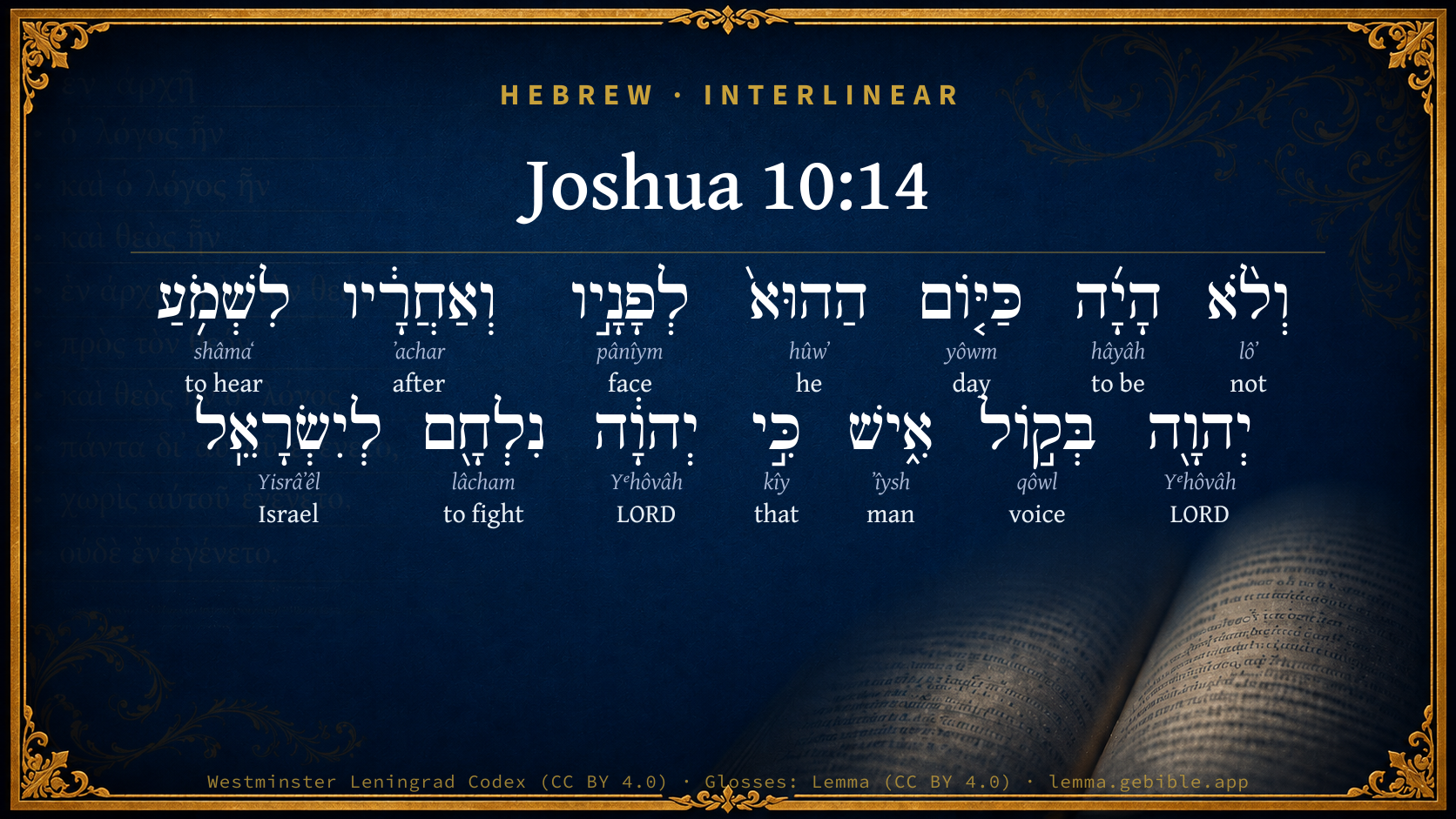
  1. וְלֹ֨א lôʼ H3808 “and · not” Conjunction + Particle, Negative
  2. הָיָ֜ה hâyâh H1961 “to be” Verb, Qal, Perfect, 3rd Person, Masculine, Singular
  3. כַּיּ֤וֹם yôwm H3117 “like/as the · day” Preposition, Determined + Noun, Common, Masculine, Singular, Absolute
  4. הַהוּא֙ hûwʼ H1931 “the · he” Particle, Definite Article + Pronoun, Personal, 3rd Person, Masculine, Singular
  5. לְפָנָ֣יו pânîym H6440 “to/for · face(s) · his” Preposition + Noun, Common, Both, Plural, Construct + Suffix, Personal, 3rd Person, Masculine, Singular
  6. וְאַחֲרָ֔יו ʼachar H310 “and · after · him” Conjunction + Preposition + Suffix, Personal, 3rd Person, Masculine, Singular
  7. לִשְׁמֹ֥עַ shâmaʻ H8085 “to hear” Preposition + Verb, Qal, Infinitive Construct
  8. יְהוָ֖ה Yᵉhôvâh H3068 “LORD” Noun, Proper
  9. בְּק֣וֹל qôwl H6963 “in/at · voice of” Preposition + Noun, Common, Masculine, Singular, Construct
  10. אִ֑ישׁ ʼîysh H376 “man” Noun, Common, Masculine, Singular, Absolute
  11. כִּ֣י kîy H3588 “that” Conjunction
  12. יְהוָ֔ה Yᵉhôvâh H3068 “LORD” Noun, Proper
  13. לְיִשְׂרָאֵֽל Yisrâʼêl H3478 “to/for · Israel” Preposition + Noun, Proper

About this verse

These counts appear in no published source. They are computed here, from the morphology-tagged text and Lemma’s own curated glosses. What Lemma adds →

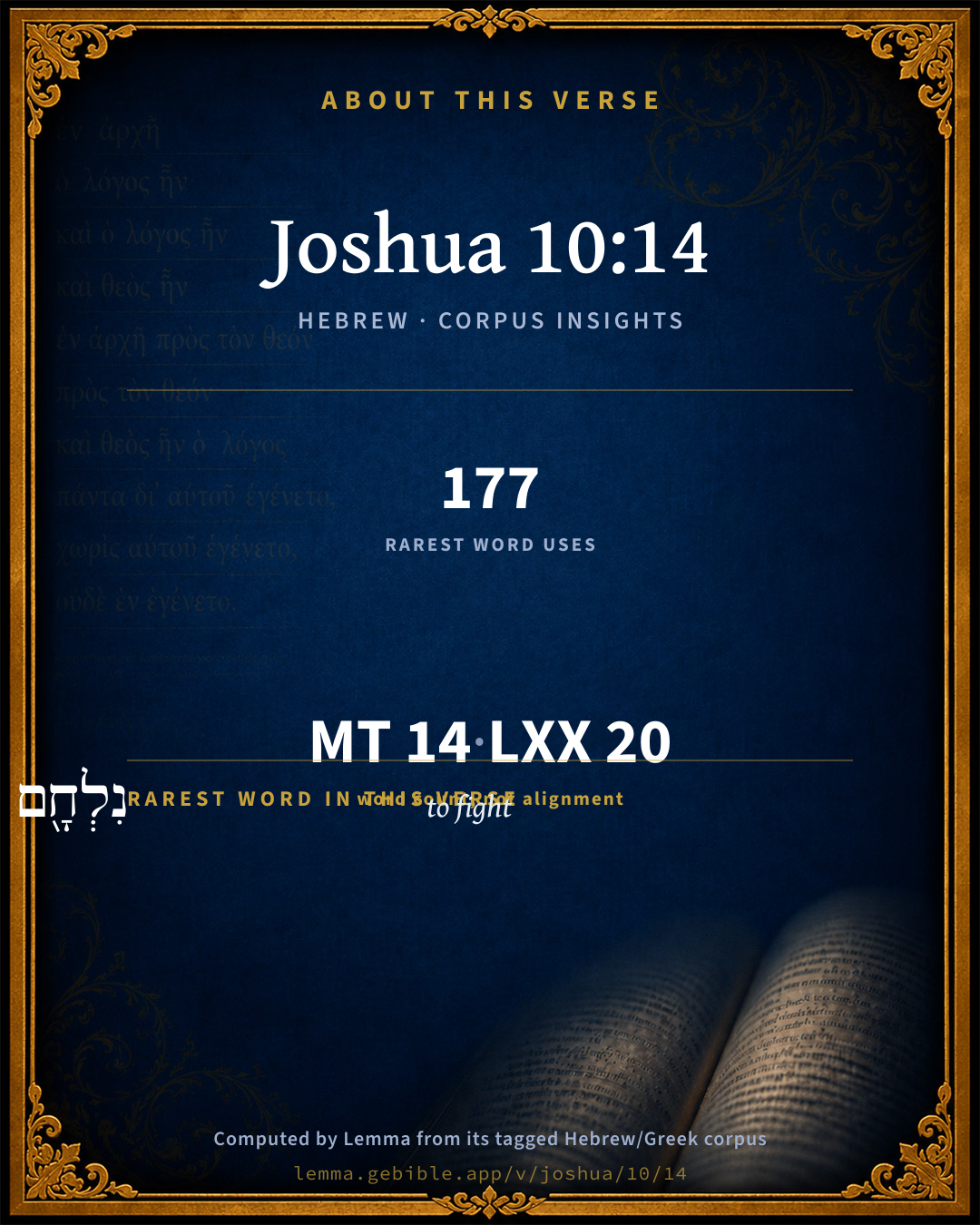
14
words
13
distinct lemmas
Historical
section

Grammatical profile

  • 3 verbs
  • 7 nouns
  • 1 pronoun
  • 1 preposition
  • 1 conjunction
  • 1 particle

Verb forms

  • הָיָ֜ה Qal · Perfect
  • לִשְׁמֹ֥עַ Qal · Infinitive Construct
  • נִלְחָ֖ם Niphal · Perfect

Repetition

A word recurs within this verse — often emphatic in Hebrew:

  • יְהוָ֖ה LORD H3068 ×2

Hebrew & Septuagint length

In English translation the verse runs 25 words from the Hebrew and 28 from the Septuagint (LXX English) — closely comparable.

A rough comparison of the two English renderings, which tokenize alike — not a word-level alignment.

Word counts can differ between the Hebrew and the Greek without any difference in meaning — e.g. the Hebrew direct-object marker אֵת has no separate Greek word, and Greek often adds the article ὁ.

In the original languages it is 14 Hebrew tokens and 20 Greek tokens — but the two are counted differently (Hebrew bundles its prefixes and suffixes into one token; the Greek is in lemma form), so that isn’t a like-for-like length.

Cross-references

10

Topical passages linked to Joshua 10:14 in the Treasury of Scripture Knowledge — connected by theme and wording, ordered by reader-vote popularity; previews shown in the World English Bible.

  • Deuteronomy 1:30 Yahweh your God who goes before you, he will fight for you, according to all that he did for you in Egypt before your eyes,
  • Exodus 14:14 Yahweh will fight for you, and you shall be still."
  • Joshua 10:42 All these kings and their land did Joshua take at one time, because Yahweh, the God of Israel, fought for Israel.
  • Joshua 23:3 and you have seen all that Yahweh your God has done to all these nations because of you; for Yahweh your God, he it is that has fought for you.
  • Isaiah 38:8 behold, I will cause the shadow on the steps, which is gone down on the dial of Ahaz with the sun, to return backward ten steps. So the sun returned ten steps on the dial whereon it was gone down.
  • Luke 17:6 The Lord said, "If you had faith like a grain of mustard seed, you would tell this sycamore tree, 'Be uprooted, and be planted in the sea,' and it would obey you.
  • Zechariah 4:6–7 Then he answered and spoke to me, saying, "This is the word of Yahweh to Zerubbabel, saying, 'Not by might, nor by power, but by my Spirit,' says Yahweh of Hosts.
  • Mark 11:22–24 Jesus answered them, "Have faith in God.
  • 2 Kings 20:10–11 Hezekiah answered, It is a light thing for the shadow to decline ten steps: nay, but let the shadow return backward ten steps.
  • Matthew 21:21–22 Jesus answered them, "Most assuredly I tell you, if you have faith, and don't doubt, you will not only do what is done to the fig tree, but even if you told this mountain, 'Be taken up and cast into the sea,' it would be done.

Cross-references courtesy of OpenBible.info (CC BY 4.0).

Hebrew and Greek witnesses Masoretic Hebrew ↔ Greek Septuagint

The same verse in the two great witnesses to the Old Testament, shown verse-for-verse.

These are two independent witnesses, not word-aligned to each other, and the Septuagint is shown in lemma (dictionary) form.

Hebrew Joshua 10:14 Masoretic · Westminster Leningrad Codex

וְלֹ֨א הָיָ֜ה כַּיּ֤וֹם הַהוּא֙ לְפָנָ֣יו וְאַחֲרָ֔יו לִשְׁמֹ֥עַ יְהוָ֖ה בְּק֣וֹל אִ֑ישׁ כִּ֣י יְהוָ֔ה נִלְחָ֖ם לְיִשְׂרָאֵֽל

There was no day like that before it or after it, that Yahweh listened to the voice of a man: for Yahweh fought for Israel.

World English Bible · Public Domain

Greek LXX Joshua 10:14 Septuagint · lemma form

καί οὐ γίγνομαι ἡμέρα τοιοῦτος οὐδέ ὁ πρότερος οὐδέ ὁ ἔσχατος ὥστε ἐπιἀκούω θεός ἄνθρωπος ὅτι κύριος συνπολεμέω ὁ ἰσραήλ

And there was not such a day either before or after, so that God should listen to a man, because the Lord fought on the side of Israel.

LXX2012 (modern English Septuagint) · Public Domain

Hebrew: Westminster Leningrad Codex (CC BY 4.0). Greek: Septuagint (public domain); English from LXX2012 (modern English Septuagint) (Public Domain). How the Septuagint differs from the Hebrew →

Targum (Aramaic paraphrase)

1

The Targum is the ancient Jewish Aramaic paraphrase of the Hebrew Scriptures — an interpretive translation, not the Hebrew text itself. Onkelos (literal) and Pseudo-Jonathan (expansive) render the Torah, and Jonathan the Prophets. Coverage is partial: where no permissively-licensed English translation exists for a verse, only the Aramaic is shown. This is verse-level text, not a word-by-word alignment to the Hebrew.

  1. Targum Jonathan Prophets (Joshua–Malachi)
    וְלָא הֲוָה כְּיוֹמָא הַהוּא קֳדָמוֹהִי וּבַתְרוֹהִי דְאִתְקַבָּלַת קֳדָם יְיָ צְלוֹת אֱנָשׁ אֲרֵי בְּמֵימְרֵיהּ יְיָ מֵגִיחַ קְרָבָא לְיִשְׂרָאֵל:

    (no public-domain English translation for this verse)

    Targum Jonathan — Aramaic: “Mikraot Gedolot” (public domain). English: “Sefaria Community Translation” (CC0 1.0 (public-domain dedication)); “London "Chaldee Paraphrase," 1871” (public domain). Text via Sefaria.

Commentary

Notes on Joshua 10:14 from classic Christian and Jewish commentators (each source and its license shown beneath its notes). The classic Christian expositions comment on the surrounding passage and are grouped to its opening verse, so a note may address several verses; the Jewish commentaries on the Tanakh (Rashi and others) are per-verse, so they appear only where the commentator wrote on this verse.

Lemma curates 59 commentaries, every one of them public domain or Creative Commons licensed, each selected and text-cleaned for this edition rather than reprinted as found. About our sources →

Trapp's Complete Commentary

John Trapp

Jos 10:14 And there was no day like that before it or after it, that the LORD hearkened unto the voice of a man: for the LORD fought for Israel.

Ver. 14. And there was no day llke that.] No, not Hezekiah’s long day, when the sun went backward ten degrees in the dial of Ahaz. Our forefathers had a long Sunday, as they called it, when King Edgar ordained that the Sabbath should be solemnised from Saturday nine of the clock till Monday morning. {a} The Jews likewise, in sanctifying the Sabbath, used to add, de profano ad sacrum, &c.

That the Lord hearkened to the voice of a man.] So he did when at the cry of blind Bartimaeus, Jesus stood still, {Mar 10:49} that Sun of righteousness. {Mal 4:2}

{a} Act. and Mon.

John Trapp, A Commentary or Exposition upon All the Books of the Old and New Testament (1647–1656) — public domain. Text from a community e-Sword module.

Joseph Benson's Commentary

Jos 10:14. There was no day like that — Namely in those parts of the world in which he here speaks. Vain, therefore, is that objection, that the days are longer near the northern and southern poles, where they are constantly longer at certain seasons, and that by the order of nature; whereas the length of this day was surely contingent, and granted by God in answer to Joshua’s prayer. The Lord hearkened to a man — Namely, in such a manner as to alter the course of nature, that a man might have more time to pursue and destroy his enemies. The Lord fought — This is added as the reason why God was so ready to answer Joshua’s petition, because he was resolved to fight for Israel, and that in a more than ordinary manner. We may observe here how remarkably pertinent both the miracle of the hailstones, and this of the sun’s being arrested in his course, were to the circumstances of the persons concerned in them. All nations had at this time their several tutelar deities, to whose protection they committed themselves and their country, and to whose power they imputed their successes in war. Now, the three principal deities whom the inhabitants of Canaan adored, were the sun, moon, and heavens, or air. To convince them, therefore, that the gods in whom they trusted were subject to the God of Israel, and to punish them, at the same time, for the false worship they paid them, “the Lord showered down great hailstones from the heavens, or air, which slew vast numbers of their powerful army; and then stopped the two great luminaries in their course,” which gave the Israelites time and opportunity to complete their victory over the remainder. It may be thought, perhaps, that the whole motive which induced Joshua to put up his prayer for the prolongation of the day, was only his zeal and eagerness for gaining an entire conquest over his enemies; but we cannot imagine that Joshua should, without a special intimation from heaven, have addressed unto God the prayer concerning the sun and moon, which he is recorded to have done in the sight of Israel; for of what an extravagance would he have appeared guilty, if an effect had not been given to what he asked for? Or how could he be so wild as to think of an accomplishment of so strange an expectation as this would have been, had it been only a thought of his own heart to wish for it? But unquestionably the same Lord who spake unto him before the battle, who bade him not fear the armies of the Canaanites, who assured him that they should not be able to stand before him, directed him to ask for this wonderful miracle, and in granting what he asked for, gave a full testimony, both to the Israelites and their enemies, that the gods of the heathen were but idols, and that it is the Lord that made (and that ruleth in) the heavens.

Joseph Benson's Commentary on the Old and New Testaments (1811–1818) — public domain. Text from a community e-Sword module.

Geneva Bible (1599)

Geneva Bible translators

By taking away the enemies’ hearts and destroying them with hail stones.

Geneva Bible (1599) marginal notes — public domain. Text via Bolls.life.

Adam Clarke's Commentary

Verse 14. And there was no day like that] There was no period of time in which the sun was kept so long above the horizon as on that occasion. Some learned men have supposed that the Fable of Phaeton was founded on this historic fact. The fable may be seen with all the elegance of poetic embellishment in the commencement of the second book of Ovid's Metamorphoses; but I confess I can see nothing in the pretended copy that can justify the above opinion.

Adam Clarke's Commentary on the Bible (1810–1826) — public domain. Text from a community e-Sword/MySword module.

John Calvin's Commentaries

14. And there was no day like that, etc We read in Isaiah and in the Sacred History, that the course of the sun was afterwards changed as a favor to King Hezekiah. (Isaiah 38:5-8) For to assure him that his life was still to be prolonged fifteen years, the shadow of the sun was carried back over ten degrees on which it had gone down. It is not, therefore, absolutely denied that anything similar had ever been conceded to any other person, but the miracle is extolled as singular. The rendering of the word שמע, by obeyed, as adopted by some, I reject as too harsh. For although it is said in the Psalm, that the Lord does according to the desire of his servants, which may be held to be equivalent to obeying, it is better to avoid anything which seems to give a subordinate office to God. Simply, therefore, the excellence of the miracle is praised, as nothing like it had been seen before or had happened after. The second clause of the verse celebrates the kindness and condescension of God in hearing Joshua, as well as his paternal favor towards the people, for whom he is said to have fought.

John Calvin's Commentaries (1540-1563) — public domain. Text from the Calvin Translation Society English edition (1840s-50s) via the Christian Classics Ethereal Library (ccel.org). Calvin's coverage is partial (roughly two-thirds of the Bible); uncommented books and verses are honest gaps, never fabricated. The 19th-century editor's footnotes and remarks are omitted so the notes are faithfully Calvin's own voice.

Ellicott's Commentary for English Readers

(14) And there was no day like that before it or after it.—These words are meaningless, unless the writer intended to convey the idea that there was really a great miracle. We may compare the prophecy in Isa_30:26, “Moreover, the light of the moon shall be as the light of the sun, and the light of the sun shall be sevenfold, as the light of seven days, in the day when the Lord bindeth up the breach of His people, and healeth the stroke of their wound.”

A Bible Commentary for English Readers, edited by Charles John Ellicott (1878–1897) — public domain. Text from a community e-Sword module.

The Cambridge Bible for Schools and Colleges

gen. ed. J. J. S. Perowne

14. And there was no day] This is still a quotation from the Book of Jashar, or “of riçtwise men,” as Wyclif translates it.

“And so stood the sunne in the mydil of heuene,

And hyede not to goo doun the space of o day;

There was not before ne afterward so loong a day;

For the Lord obeide to the vois of man,

And fauiçt for Israel.”

Compare the returning of the shadow on the dial of Ahaz in the time of Hezekiah, 2Ki_20:11; Isa_38:8.

for the Lord fought for Israel] Compare the account of Josephus, “He then heard that God was helping him, by the signs of thunder, lightning, and unusual hailstones; and that the day was increased lest the night should check the zeal of the Hebrews.… That the length of the day did then increase, and was longer than usual, is told in the books laid up in the temple.” Ant. 5. Jos_1:17.

The Cambridge Bible for Schools and Colleges (gen. ed. J. J. S. Perowne; Cambridge University Press, 1878–1918) — public domain. Text from a community e-Sword module.

John Gill's Exposition

And there was no day like that, before it, or after it,.... Which must be understood as referring not to natural days, or such as are according to the natural course of things, as those in the northern and southern poles, which are much longer, but to miraculous and extraordinary ones: never was there such a day as this, occasioned by the sun standing still; and as for Hezekiah's day, which is objected, when the sun went ten degrees backward on the dial of Ahaz, it is not certain whether those degrees were hours, or half hours, or quarters of an hour; and if they were hours, as the going backwards was at once, in a moment, it could only make an addition of ten hours in the return of them, and so it must make but a day of twenty two hours: besides, the writer of this book only speaks of days that had been in his time, and not of what might be hereafter; add to which, that this respects not so much the length of the day, as the manner in which it became so long; and especially it regards the following circumstance, being at the entreaty of a man, and that delivered in a very authoritative manner:

that the Lord hearkened unto the voice of a man; expressed in prayer, and which prayer was a prayer of faith:

for the Lord fought for Israel: by casting hailstones upon their enemies, and preserving them from them by the stopping the course of the sun, until they had taken full vengeance on them. The day on which this miracle was wrought, is conjectured to be Wednesday the eleventh of April, in the year before Christ 1454 (n).

(n) Bedford's Chronology, p. 492.

John Gill's Exposition of the Whole Bible (1746–1763) — public domain (CC PDM 1.0). Text via the HelloAO Bible API.

Haydock's Catholic Bible Commentary

Long. This word is not found in Hebrew, "and there was no day like that, before it, or after it, that the Lord hearkened unto," &c. But God had often wrought miracles before, at the prayer of his servants. The difference between this day and all others, must be therefore in the length, or in the stopping of the heavenly bodies. (Haydock) --- The long day which the prayer of Ezechias procured, (4 Kings xx., and Isaias xxxviii.) consisted of 32 hours; or, supposing that the retrograde motion of the sun was instantaneous on the dial, it might only be 22 hours in length. (Calmet) --- But if the day of Ezechias had been even longer, the words of this text may be verified, that neither in times past, nor while the author lived, had any such day been known. See Amama, p. 383. (Haydock) --- Obeying. God is ready to grant the requests of his servants, Isaias lviii. 9. "We remark something still stronger, in the power which he has given to priests, to consecrate the body and blood of Jesus Christ in the sacrament of the eucharist." (Calmet)

George Leo Haydock (1774–1849), Haydock's Catholic Family Bible and Commentary, 1859 edition — public domain. Excludes Psalms (Douay-Rheims chapter numbering differs from Protestant) and Deuterocanonical books (Catholic canon only).

Matthew Poole's English Annotations

There was no day like that, to wit, in those parts of the world in which he here speaks, and about which the comparison is here made: vain therefore is that objection, that the days are longer near the northern and southern poles, where they are constantly longer at certain seasons, and that by the order of nature; whereas the length of this day was purely contingent. and granted by God in answer to Joshua’s prayer, as is here added.

Object In Hezekiah’s time, and at his prayer, there was a day which may seem to have been longer; for the sun went back ten degrees in ten hours, and then returned again ten degrees in ten hours, and so it was twenty hours longer than a common day, and so longer than this.

Answer It is not certain either that each degree designed an hour, and not rather half an hour, or a quarter, as others think; or that the sun returned those ten degrees as slowly as he went down before or after. Besides, it was now near summer solstice, when the day was longest, and about fourteen hours; and that being doubled, the artificial day was twenty-eight hours; and because there is not the least evidence that Hezekiah’s day was longer, but rather of the contrary, it is much more reasonable to believe this Scripture assertion, than to deny or question upon mere suppositions or idle conjectures.

Hearkened unto the voice of a man, to wit, in such a manner to alter the course of nature, and of the heavenly bodies, that a man might have more time to pursue and destroy his enemies.

The Lord fought for Israel this is added as the reason why God was so ready to answer Joshua’s petition herein, because he was engaged and resolved to fight for Israel, and that in a more than ordinary manner.

Matthew Poole's English Annotations on the Holy Bible (1683–1685) — public domain. Text from a community e-Sword/MySword module.

Whedon's Commentary on the Bible

Daniel D. Whedon

14. No day like that — No day was ever before or since supernaturally extended at the command of man. God had often before this hearkened unto the voice of man, but never before to the voice of a man inspired with miracle-working faith to control the movements of the heavenly bodies.

Daniel D. Whedon (gen. ed.), Commentary on the Old and New Testaments (1874–1909) — public domain. Text from a community e-Sword module.

The Pulpit Commentary

There was no day like that before it or after it. Cf. for this expression 2Ki_18:5 2Ki_23:22, 2Ki_23:25.

HOMILIES BY J. WAITE Vers. 14. A day of wonders.

The Canaanite kings were slow in gathering their forces together to repel the advance of Joshua, but they were ready enough to come down in vengeance upon the Gibeonites for having made peace with him. The men of Gibeon found the advantage of having a strong and generous protector, one who would be true to his pledges, even though they had been extorted from him by fraud. Joshua responds at once to the cry that comes to him from the beleaguered city, and God makes its deliverance the occasion for a signal display of His power and the furtherance of His purpose in the overthrow of the kings. The blending of the natural and supernatural in the events of this day is very remarkable. The two elements are so interlaced and interwoven that it is not for us to say where the one ends and the other begins. We only feel, in following the course of the narrative, that we are in the presence of a marvellous Divine power that carries all resistance before it. Such records as this, however, have their true effect upon us when they lead us the more clearly to recognise the supernatural force in the natural, to discern behind the common, familiar order of things the mystery and majesty of the Divine. With the vexed question as to the historic truth of the declaration that "the sun stood still in the midst of heaven," we have not now to do (see Exposition). We simply note that, if the use the historian makes of the poetic quotation from the Book of Jasher compels us to regard it as having some basis of fact, there is no need on that account to believe in any actual arrest of the order of the universe. May not natural agents and natural laws be used miraculously by Him who is the Author of them? Just as He who created the hailstones could, without injury to the Israelites, turn them as engines of destruction against their foes, so surely He who at the beginning "commanded the light to shine out of darkness" could, in ways to us unknown, prolong the day in answer to Joshua"s prayer. Two broad lessons grow out of this:

I THAT GOD"S SOVEREIGNTY OVER NATURE IS SUBSERVIENT TO THE HIGHER PURPOSES OF HIS SPIRITUAL KINGDOM. We look through these outward incidents to the Divine end which they were all helping to work out. God was "forming a people for his praise." Giving them a local habitation, that they might the better conserve His truth and show forth His glory. He drove out the heathen before them, and planted them there that they might bear rich fruits of blessing to the world, that in them and in their seed all the earth might be blessed. Everything is to be looked at in the light of that moral purpose.

(1) The whole visible universe exists for spiritual ends the revelation of the invisible Divine beauty and order; the magnifying of the law of eternal righteousness. Its activity and its rest, its discords and its harmonies, its terror and its loveliness, all have a moral meaning and intent.

(2) The forces and laws of the universe are against those who are against God. You must be morally one with Him if you would have them befriend you. "The stars in their courses fight against Sisera." How terrible to think of some of the forms in which the Creator might, if He pleased, array the powers of nature against sinful men! His long-suffering beneficence is their only safeguard. "It is of the Lord"s mercies that we are not consumed". (Lam_3:22)

(3) The created universe attains its consummation only in the final spiritual triumph of the Redeemer. The groaning creation waits for the "manifestation of the sons of God." The glorious presence of the Lord will be "the restitution of all things." There will be "nothing to hurt or to destroy" in the "new heavens and the new earth wherein dwelleth righteousness.

II THAT MAN IS AN EFFICIENT INSTRUMENT IN SERVING THE CAUSE OF RIGHTEOUSNESS JUST SO FAR AS HE HAS FAITH TO LAY HOLD ON THE SOVEREIGN POWER OF GOD. "There was no day like that before it or after it," not because there was anything singular, unparalleled, in God"s "hearkening to the voice of a man." This was simply a conspicuous and noteworthy example of a universal law. "The effectual fervent prayer of a righteous man "has always" availed much." The resources of heaven wait upon it. Such prayer is "A breath that fleets beyond this iron world, And touches Him that made it.

(1) Let the Church "stir itself up to lay hold on God." Its strength lies in faith and prayer. The Lord will never fail to "fight for Israel" when she is true to her high calling. The weapons of her warfare are mighty through Him. "God is in the midst of her; she shall not be moved: God shall help her, and that right early". (Psa_46:5) This pledge of Divine protection and deliverance is given, not to ecclesiastical systems, which may have much that is of man rather than of God in their constitution, but to that Church which Christ has redeemed and chosen out of every land and nation to represent His own cause of truth and righteousness. When the Church goes forth in the energy of faith and prayer, its enemies flee before it.

(2) Let the individual Christian recognise the true source of moral power. No emergency of life need be overwhelming to one who casts himself unreservedly on God. "If God be for us, who can be against us?" Move on steadily in the path of duty and fear not. In all conceivable times of difficulty and danger, of temptation and sorrow, Christ"s answer to the cry of His faithful ones is the same grace is sufficient for thee. My strength is made perfect in weakness. W.

The Pulpit Commentary (1880–1919), ed. H.D.M. Spence-Jones & Joseph S. Exell — public domain. Text from a community e-Sword module.

John Wesley's Explanatory Notes

No day like that - Namely, in those parts of the world in which he here speaks, vain therefore is that objection, that the days are longer near the northern and southern poles, where they are constantly longer at certain seasons, and that by the order of nature; whereas the length of this day was purely contingent, and granted by God in answer to Joshua's prayer. The Lord hearkened to a man - Namely, in such a manner to alter the course of nature, and of the heavenly bodies, that a man might have more time to pursue and destroy his enemies. The Lord fought - This is added as the reason why God was so ready to answer Joshua's petition, because he was resolved to fight for Israel, and that in a more than ordinary manner. But this stupendous miracle was designed for something more, than to give Israel light to destroy the Canaanites. It was designed to convince and confound those idolaters, who worshipped the sun and moon, by demonstrating, that these also were subject to the command of the God of Israel: as also to signify, that in the latter days, when the world was covered with darkness, the sun of righteousness, even our Joshua, should arise, and be the true light of the world. To which we may add, that when Christ conquered our enemies upon the cross, the miracle wrought on the sun was the reverse of this. It was then darkened, as if going down at noon. For Christ needed not the light of the sun, to compleat his victory: so he made darkness his pavilion.

John Wesley, Explanatory Notes Upon the Whole Bible (1754–1765) — public domain. Text via the GEBible commentary corpus.

Lesson kit

Teaching starters — assembled from the data on this page, not authored interpretation. Every prompt links to the verse data it draws on. Edit before teaching.

Joshua, in the Historical, opens this verse with 14 words (13 distinct Hebrew lemmas). Its most distinctive word is lâcham (“to fight”). A historical commentator’s framing appears above. Read the whole chapter for the surrounding context.

Discussion questions

  1. The word lâcham carries the sense “to fight.” How does it shape the verse?
  2. Deuteronomy 1:30 shares this passage’s theme. How do the two illuminate each other?
  3. “LORD” occurs 2× in this one verse. What is the effect of the repetition?
  4. These translations render this verse differently; the difference is in the English rendering, not the original. What questions does that raise?
  5. The verb «הָיָ֜ה» is Qal Perfect. How does its form color the action?
  6. Reading how Trapp's Complete Commentary and Joseph Benson's Commentary read this verse, where do the two commentators agree and where do they part?

Things to notice

Reading settings

Reading text

Shown beneath each verse's original-language words.

Old Testament
Old Testament edition

Read the OT as the Masoretic Hebrew (MT) or the Greek Septuagint (LXX).

English shown for the Greek Septuagint (in the Hebrew ↔ Greek comparison).

Comparing translations? Open the Compare panel on any verse page to stack up to four side by side.