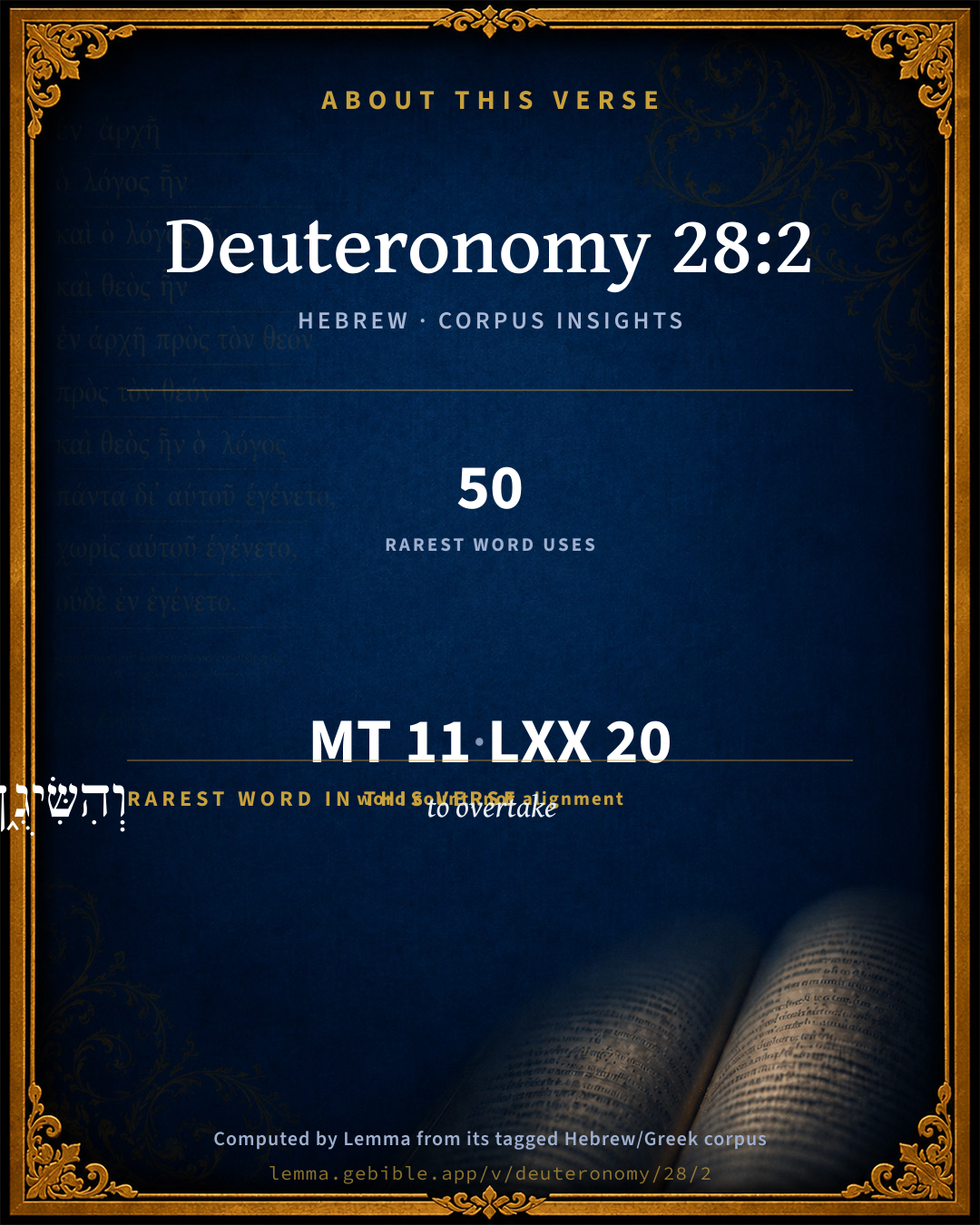
Deuteronomy 28:2

Hebrew (Westminster Leningrad Codex) Deuteronomy 28:2 appears in the Hebrew Old Testament. The text above is from the Westminster Leningrad Codex. Each word links to its Strong’s number, a concise gloss, and parsing drawn from the Open Scriptures Hebrew Bible morphology. Click any word for its full Brown-Driver-Briggs (BDB) entry.
Download image
Cite this verse

Deuteronomy 28:2 (World English Bible). Public Domain. Lemma interlinear Bible study tool, https://lemma.gebible.app/v/deuteronomy/28/2.

Show BibTeX & RIS
BibTeX
RIS
English Translation
and all these blessings shall come on you, and overtake you, if you shall listen to the voice of Yahweh your God.
World English Bible · Public Domain
Download a study sheet

One document with this verse’s original text, its word-by-word gloss line, the meaning frame, cross-references with their text, attributed commentary, and full source and license credits — printable, and it pastes into notes with its structure intact.

This verse Autodidact and up

Study sheet (.html) Plain text (.txt)

A passage Seminary Student

Up to 50 verses in one chapter. A passage sheet keeps up to 6 commentary sources and 12 cross-references per verse, in the order this page ranks them, and says so on the sheet whenever that leaves anything out. Ask for a single verse and you get the Autodidact verse sheet above.

Everything on this page stays free to read, with no account — the sheet is a download of what is already on screen, not access to it.

Want to remove ads? Support Godless Engineer
Compare translations 3

The same verse in 3 English versions, stacked beneath the original-language interlinear above. Click any original word for its lexicon entry.

Each is an independent rendering of the whole verse — the interlinear is not word-aligned to these translations.

Highlighted words mark where these versions differ — a whole-verse word diff, not a word-by-word alignment.

  • World English Bible Public Domain
    and all these blessings shall come on you, and overtake you, if you shall listen to the voice of Yahweh your God.
  • King James Version Public Domain
    And all these blessings shall come on thee, and overtake thee, if thou shalt hearken unto the voice of the LORD thy God.
  • unfoldingWord Literal Text CC BY-SA 4.0
    And all these blessings will come upon you and reach you, if you listen to the voice of Yahweh your God.

unfoldingWord Literal Text — © unfoldingWord, licensed CC BY-SA 4.0. Word-aligned USFM3 via Door43 (git.door43.org/unfoldingWord/en_ult).

Versions to compare (up to 4)

3 of 4 selected

Show all 18 translations

Every available English version of this verse, each an independent rendering of the whole verse.

  • World English Bible Public Domain
    and all these blessings shall come on you, and overtake you, if you shall listen to the voice of Yahweh your God.
  • Berean Standard Bible Public Domain
    And all these blessings will come upon you and overtake you, if you will obey the voice of the LORD your God:
  • Majority Standard Bible Public Domain
    And all these blessings will come upon you and overtake you, if you will obey the voice of the LORD your God:
  • King James Version Public Domain
    And all these blessings shall come on thee, and overtake thee, if thou shalt hearken unto the voice of the LORD thy God.
  • American Standard Version (1901) Public Domain
    and all these blessings shall come upon thee, and overtake thee, if thou shalt hearken unto the voice of Jehovah thy God.
  • Revised Version (1885) Public Domain
    and all these blessings shall come upon thee, and overtake thee, if thou shalt hearken unto the voice of the LORD thy God.
  • Geneva Bible (1599) Public Domain
    And all these blessings shall come on thee, and ouertake thee, if thou shalt obey the voyce of the Lord thy God.
  • Douay-Rheims (1899) Public Domain
    And all these blessings shall come upon thee and overtake thee: yet so if thou hear his precepts,
  • Young's Literal Translation Public Domain
    and all these blessings have come upon thee, and overtaken thee, because thou dost hearken to the voice of Jehovah thy God:
  • Literal Standard Version CC BY-SA 4.0
    and all these blessings have come on you and overtaken you, because you listen to the voice of your God YHWH:
  • Unlocked Literal Bible CC BY-SA 4.0
    All these blessings will come on you and overtake you, if you listen to the voice of Yahweh your God.
  • unfoldingWord Literal Text CC BY-SA 4.0
    And all these blessings will come upon you and reach you, if you listen to the voice of Yahweh your God.
  • Darby Bible Public Domain
    and all these blessings shall come on thee and overtake thee, if thou shalt hearken unto the voice of Jehovah thy God.
  • World Messianic Bible Public Domain
    All these blessings will come upon you, and overtake you, if you listen to the LORD your God’s voice.
  • Webster's Bible Public Domain
    And all these blessings shall come on thee, and overtake thee, if thou shalt hearken to the voice of the LORD thy God.
  • Free Bible Version CC BY-SA 4.0
    You will have all the following blessings and even more, if you do what the Lord your God says.
  • Bible in Basic English Public Domain
    And all these blessings will come on you and overtake you, if your ears are open to the voice of the Lord your God.
  • JPS Tanakh (1917) Public Domain
    And all these blessings shall come upon thee, and overtake thee, if thou shalt hearken unto the voice of the LORD thy God.

Literal Standard Version (2020), Covenant Press — licensed CC BY-SA 4.0. Text via the HelloAO Bible API (eBible.org). Unlocked Literal Bible (unfoldingWord) — licensed CC BY-SA 4.0. Text via the HelloAO Bible API (eBible.org). unfoldingWord Literal Text — © unfoldingWord, licensed CC BY-SA 4.0. Word-aligned USFM3 via Door43 (git.door43.org/unfoldingWord/en_ult). Free Bible Version, Dr. Jonathan Gallagher — licensed CC BY-SA 4.0. Text via the HelloAO Bible API (eBible.org).

Word by word

More ways to search: Search by grammar → Find every occurrence → Compare this word →

Practice this passage: Drill this verse → Learn its vocabulary →

וְהִשִּׂיגֻ֑ךָ
nâsag
H5381
“and · to overtake · you”
Conjunction + Verb, Hiphil, Sequential Perfect, 3rd Person, Common, Plural + Suffix, Personal, 2nd Person, Masculine, Singular
Part of Speech
Conjunction + Verb
Stem
Hiphil
Form
Sequential Perfect
Person
3rd Person
Gender
Common
Number
Plural
Full BDB Definition

Origin: a primitive root

TWOT: 1422

to reach, overtake, take hold upon - (Hiphil) - to overtake - to reach, attain to, cause to reach - to be able to secure, reach, have enough
  1. וּבָ֧אוּ bôwʼ H935 “and · to enter” Conjunction + Verb, Qal, Sequential Perfect, 3rd Person, Common, Plural
  2. עָלֶ֛יךָ ʻal H5921 “upon · you” Preposition + Suffix, Personal, 2nd Person, Masculine, Singular
  3. כָּל kôl H3605 “all of” Noun, Common, Masculine, Singular, Construct
  4. הַבְּרָכ֥וֹת Bᵉrâkâh H1293 “the · blessings” Particle, Definite Article + Noun, Common, Feminine, Plural, Absolute
  5. הָאֵ֖לֶּה ʼêl-leh H428 “the · these” Particle, Definite Article + Pronoun, Demonstrative, Common, Plural
  6. כִּ֣י kîy H3588 “that” Conjunction
  7. תִשְׁמַ֔ע shâmaʻ H8085 “to hear” Verb, Qal, Imperfect, 2nd Person, Masculine, Singular
  8. בְּק֖וֹל qôwl H6963 “in/at · voice of” Preposition + Noun, Common, Masculine, Singular, Construct
  9. יְהוָ֥ה Yᵉhôvâh H3068 “LORD” Noun, Proper
  10. אֱלֹהֶֽיךָ ʼĕlôhîym H430 “God(s) · your” Noun, Common, Masculine, Plural, Construct + Suffix, Personal, 2nd Person, Masculine, Singular

About this verse

These counts appear in no published source. They are computed here, from the morphology-tagged text and Lemma’s own curated glosses. What Lemma adds →

11
words
11
distinct lemmas
Pentateuch
section

Shared distinctive vocabulary

וְהִשִּׂיגֻ֑ךָ to overtake H5381 occurs in 47 verses of the Hebrew Bible. Also found in:

Grammatical profile

  • 3 verbs
  • 5 nouns
  • 1 pronoun
  • 1 preposition
  • 1 conjunction

Verb forms

  • וּבָ֧אוּ Qal · Sequential Perfect
  • וְהִשִּׂיגֻ֑ךָ Hiphil · Sequential Perfect
  • תִשְׁמַ֔ע Qal · Imperfect

Hebrew & Septuagint length

In English translation the verse runs 22 words from the Hebrew and 24 from the Septuagint (LXX English) — closely comparable.

A rough comparison of the two English renderings, which tokenize alike — not a word-level alignment.

Word counts can differ between the Hebrew and the Greek without any difference in meaning — e.g. the Hebrew direct-object marker אֵת has no separate Greek word, and Greek often adds the article ὁ.

In the original languages it is 11 Hebrew tokens and 20 Greek tokens — but the two are counted differently (Hebrew bundles its prefixes and suffixes into one token; the Greek is in lemma form), so that isn’t a like-for-like length.

Cross-references

4

Topical passages linked to Deuteronomy 28:2 in the Treasury of Scripture Knowledge — connected by theme and wording, ordered by reader-vote popularity; previews shown in the World English Bible.

  • Zechariah 1:6 But my words and my decrees, which I commanded my servants the prophets, didn't they overtake your fathers? "Then they repented and said, 'Just as Yahweh of Hosts determined to do to us, according to our ways, and according to our practices, so he has dealt with us.'"
  • Deuteronomy 28:15 But it shall come to pass, if you will not listen to the voice of Yahweh your God, to observe to do all his commandments and his statutes which I command you this day, that all these curses shall come on you, and overtake you.
  • 1 Timothy 4:8 For bodily exercise has some value, but godliness has value for all things, having the promise of the life which is now, and of that which is to come.
  • Deuteronomy 28:45 All these curses shall come on you, and shall pursue you, and overtake you, until you are destroyed; because you didn't listen to the voice of Yahweh your God, to keep his commandments and his statutes which he commanded you:

Cross-references courtesy of OpenBible.info (CC BY 4.0).

Hebrew and Greek witnesses Masoretic Hebrew ↔ Greek Septuagint

The same verse in the two great witnesses to the Old Testament, shown verse-for-verse.

These are two independent witnesses, not word-aligned to each other, and the Septuagint is shown in lemma (dictionary) form.

Hebrew Deuteronomy 28:2 Masoretic · Westminster Leningrad Codex

וּבָ֧אוּ עָלֶ֛יךָ כָּל הַבְּרָכ֥וֹת הָאֵ֖לֶּה וְהִשִּׂיגֻ֑ךָ כִּ֣י תִשְׁמַ֔ע בְּק֖וֹל יְהוָ֥ה אֱלֹהֶֽיךָ

and all these blessings shall come on you, and overtake you, if you shall listen to the voice of Yahweh your God.

World English Bible · Public Domain

Greek LXX Deuteronomy 28:2 Septuagint · lemma form

καί ἥκω ἐπί σύ πᾶς ὁ εὐλογία οὗτος καί εὑρίσκω σύ ἐάν ἀκοή ἀκούω ὁ φωνή κύριος ὁ θεός σύ

and all these blessings shall come upon you, and shall find you. If you will indeed hear the voice of the Lord your God,

LXX2012 (modern English Septuagint) · Public Domain

Hebrew: Westminster Leningrad Codex (CC BY 4.0). Greek: Septuagint (public domain); English from LXX2012 (modern English Septuagint) (Public Domain). How the Septuagint differs from the Hebrew →

Targum (Aramaic paraphrase)

2

The Targum is the ancient Jewish Aramaic paraphrase of the Hebrew Scriptures — an interpretive translation, not the Hebrew text itself. Onkelos (literal) and Pseudo-Jonathan (expansive) render the Torah, and Jonathan the Prophets. Coverage is partial: where no permissively-licensed English translation exists for a verse, only the Aramaic is shown. This is verse-level text, not a word-by-word alignment to the Hebrew.

  1. Targum Onkelos Torah (Genesis–Deuteronomy)
    וְיֵיתוּן עֲלָךְ כָּל בִּרְכְּתָא הָאִלֵין וְיִדְבְּקֻנָךְ אֲרֵי תְקַבַּל לְמֵימְרָא דַיְיָ אֱלָהָךְ

    (no public-domain English translation for this verse)

    Targum Onkelos — Aramaic: “Onkelos Genesis” (public domain); “Onkelos Exodus” (public domain); “Onkelos Leviticus” (public domain); “Onkelos Numbers” (public domain); “Onkelos Deuteronomy” (public domain). English: “Sefaria Community Translation” (CC0 1.0 (public-domain dedication)); “J.W. Etheridge. The Targums of Onkelos and Jonathan Ben Uzziel on the Pentateuch. London: Longmans, Green, 1862” (public domain). Text via Sefaria.

  2. Targum Pseudo-Jonathan Torah (Genesis–Deuteronomy)
    וְיֵיתוּן עֲלֵיכוֹן כָּל בִּרְכָתָא הָאִלֵין וְיִדְבּוּקַנְכוֹן אֲרוּם תְּקַבְּלוּן לְמֵימְרָא דַיְיָ אֱלָהָכוֹן

    and all these blessings shall come upon you, and abide with you, for that you will have hearkened to the Lord your God.

    Targum Pseudo-Jonathan — Aramaic: “Targum Jonathan on Genesis” (public domain); “Targum Jonathan on Exodus” (public domain); “Targum Jonathan on Leviticus” (public domain); “Targum Jonathan on Numbers” (public domain); “Targum Jonathan on Deuteronomy” (public domain). English: “The Targum of Jonathan ben Uzziel, trans. J. W. Etheridge, London, 1862” (public domain). Text via Sefaria.

Commentary

Notes on Deuteronomy 28:2 from classic Christian and Jewish commentators (each source and its license shown beneath its notes). The classic Christian expositions comment on the surrounding passage and are grouped to its opening verse, so a note may address several verses; the Jewish commentaries on the Tanakh (Rashi and others) are per-verse, so they appear only where the commentator wrote on this verse.

Lemma curates 59 commentaries, every one of them public domain or Creative Commons licensed, each selected and text-cleaned for this edition rather than reprinted as found. About our sources →

Trapp's Complete Commentary

John Trapp

Deu 28:2 And all these blessings shall come on thee, and overtake thee, if thou shalt hearken unto the voice of the LORD thy God.

Ver. 2. And overtake thee.] Unexpectedly befall thee. "Surely goodness and mercy shall follow thee," {Psa 23:6} as the evening sunbeams follow the passenger, as the rock water followed the Israelites in the wilderness, and overtook them at their stations. {1Co 10:4} "O continue," or draw out to the length, "thy lovingkindness unto them that know thee." {Psa 36:10} There will be a continued series, a connection between them, to all such.

John Trapp, A Commentary or Exposition upon All the Books of the Old and New Testament (1647–1656) — public domain. Text from a community e-Sword module.

Joseph Benson's Commentary

Deu 28:2-6. All these blessings shall overtake thee — The blessings which others greedily follow after, and never overtake, shall follow after thee, and shall be thrown into thy lap by special kindness. In the city, and in the field — Whether they were husbandmen or tradesmen, whether in the town or country, they should be preserved from the dangers of both, and have the comforts of both. How constantly must we depend upon God, both for the continuance and comfort of life. We need him at every turn: we cannot be safe if he withdraw his protection, nor easy if he suspend his favour: but if he bless us, go where we will, it is well with us. Store — Store-house, it shall always be well replenished, and the provision thou hast there shall be preserved for thy use and service. Comest in — That is, in all thy affairs and administrations.

Joseph Benson's Commentary on the Old and New Testaments (1811–1818) — public domain. Text from a community e-Sword module.

Geneva Bible (1599)

Geneva Bible translators

When thou thinkest thyself forsaken.

Geneva Bible (1599) marginal notes — public domain. Text via Bolls.life.

Jamieson, Fausset & Brown

Robert Jamieson, A. R. Fausset & David Brown

all these blessings shall come on thee--Their national obedience was to be rewarded by extraordinary and universal prosperity.

Jamieson, Fausset & Brown — Commentary Critical and Explanatory on the Whole Bible (1871) — public domain (CC PDM 1.0). Text via the HelloAO Bible API.

Adam Clarke's Commentary

Verse 2. All these blessings shall come on thee] God shall pour out his blessing from heaven upon thee. And overtake thee. Upright men are represented as going to the kingdom of God, and God's blessings as following and overtaking them in their heavenly journey. There are several things in this verse worthy of the most careful observation: -

1. If thou shalt hearken unto the voice of the Lord thy God. The voice of God must be heard; without a Divine revelation how can the Divine will be known? And if not known, it cannot be fulfilled.

2. When God speaks, men must hearken to the words of his mouth. He who does not hearken will not obey.

3. He who hearkens to the words of God must set out for the kingdom of heaven. The curse must fall on him who stands in the way of sinners, and will overtake them who loiter in the way of righteousness.

4. Those who run in the way of God's testimonies shall have an abundance of blessing. Blessings shall come upon them, and blessings shall overtake them - in every part of their march through life they shall continue to receive the fulfilment of the various promises of God which relate to all circumstances, vicissitudes, trials, stages of life, &c., &c., each overtaking them in the time and place where most needed.

Adam Clarke's Commentary on the Bible (1810–1826) — public domain. Text from a community e-Sword/MySword module.

Ellicott's Commentary for English Readers

(2) And overtake thee.—A beautiful expression, i.e., shall come home to thee, and impress the heart with the thought of God’s love and of His promises, even when it is least expected. Comp. Zec_1:6. “My words and my statutes, did they not take hold of (i.e., overtake) your fathers? and they returned and said, Like as the Lord of hosts thought to do unto us . . . so hath he dealt with us.” The opposite is true also of the curses (Deu_28:15).

A Bible Commentary for English Readers, edited by Charles John Ellicott (1878–1897) — public domain. Text from a community e-Sword module.

The Cambridge Bible for Schools and Colleges

gen. ed. J. J. S. Perowne

2. overtake] This vb. is used of the avenger, Deu_19:6. A man’s goodness as well as his sin is sure to find him out, even when he does not expect this: see Mat_25:37.

The Cambridge Bible for Schools and Colleges (gen. ed. J. J. S. Perowne; Cambridge University Press, 1878–1918) — public domain. Text from a community e-Sword module.

John Gill's Exposition

And all these blessings shall come on thee and overtake thee,.... After mentioned, which should come upon them from God from heaven, by the direction of his providence, and that freely and plentifully, and beyond their expectations and deserts, and continue with them:

if thou shall hearken to the voice of the Lord thy God; obedience to the law being the condition of their coming and continuance; for only temporal blessings in the land of Canaan are here intended, as follow.

John Gill's Exposition of the Whole Bible (1746–1763) — public domain (CC PDM 1.0). Text via the HelloAO Bible API.

Haydock's Catholic Bible Commentary

All these blessings, &c. In the Old Testament God promised temporal blessings to the keepers of his law, heaven being not opened as yet; and that gross and sensual people being more moved with present and sensible things. But in the New Testament, the goods that are promised us are spiritual and eternal: and temporal evils are turned into blessings.

George Leo Haydock (1774–1849), Haydock's Catholic Family Bible and Commentary, 1859 edition — public domain. Excludes Psalms (Douay-Rheims chapter numbering differs from Protestant) and Deuterocanonical books (Catholic canon only).

Matthew Poole's English Annotations

Those blessings which others greedily follow after, and ofttimes never overtake, they shall follow after thee, and shall be thrown into thy lap by my special kindness.

Matthew Poole's English Annotations on the Holy Bible (1683–1685) — public domain. Text from a community e-Sword/MySword module.

The Pulpit Commentary

The blessings about to be specified are represented as personified, as actual agencies coming upon their objects and following them along their path.

The Pulpit Commentary (1880–1919), ed. H.D.M. Spence-Jones & Joseph S. Exell — public domain. Text from a community e-Sword module.

John Wesley's Explanatory Notes

Overtake thee - Those blessings which others greedily follow after, and never overtake, shall follow after thee, and shall be thrown into thy lap by special kindness.

John Wesley, Explanatory Notes Upon the Whole Bible (1754–1765) — public domain. Text via the GEBible commentary corpus.

Lesson kit

Teaching starters — assembled from the data on this page, not authored interpretation. Every prompt links to the verse data it draws on. Edit before teaching.

Deuteronomy, in the Pentateuch, opens this verse with 11 words (11 distinct Hebrew lemmas). Its most distinctive word is nâsag (“to overtake”). A historical commentator’s framing appears above. Read the whole chapter for the surrounding context.

Discussion questions

  1. How does “to overtake” (nâsag) shape what this verse is saying?
  2. How does Genesis 31:25, which shares the word «to overtake», read alongside this verse?
  3. These translations render this verse differently. What is at stake in choosing one wording over another?
  4. «וּבָ֧אוּ» is a Qal Sequential Perfect verb. How does that grammatical form shape the action described?
  5. Compare how Trapp's Complete Commentary and Joseph Benson's Commentary read this verse. Where do they agree or differ?

Things to notice

Reading settings

Reading text

Shown beneath each verse's original-language words.

Old Testament
Old Testament edition

Read the OT as the Masoretic Hebrew (MT) or the Greek Septuagint (LXX).

English shown for the Greek Septuagint (in the Hebrew ↔ Greek comparison).

Comparing translations? Open the Compare panel on any verse page to stack up to four side by side.