2 Chronicles 23:12

Hebrew (Westminster Leningrad Codex) 2 Chronicles 23:12 appears in the Hebrew Old Testament. The text above is from the Westminster Leningrad Codex. Each word links to its Strong’s number, a concise gloss, and parsing drawn from the Open Scriptures Hebrew Bible morphology. Click any word for its full Brown-Driver-Briggs (BDB) entry.
Download image
Cite this verse

2 Chronicles 23:12 (World English Bible). Public Domain. Lemma interlinear Bible study tool, https://lemma.gebible.app/v/2-chronicles/23/12.

Show BibTeX & RIS
BibTeX
RIS
English Translation
When Athaliah heard the noise of the people running and praising the king, she came to the people into the house of Yahweh:
World English Bible · Public Domain
Download a study sheet

One document with this verse’s original text, its word-by-word gloss line, the meaning frame, cross-references with their text, attributed commentary, and full source and license credits — printable, and it pastes into notes with its structure intact.

This verse Autodidact and up

Study sheet (.html) Plain text (.txt)

A passage Seminary Student

Up to 50 verses in one chapter. A passage sheet keeps up to 6 commentary sources and 12 cross-references per verse, in the order this page ranks them, and says so on the sheet whenever that leaves anything out. Ask for a single verse and you get the Autodidact verse sheet above.

Everything on this page stays free to read, with no account — the sheet is a download of what is already on screen, not access to it.

Want to remove ads? Support Godless Engineer
Compare translations 3

The same verse in 3 English versions, stacked beneath the original-language interlinear above. Click any original word for its lexicon entry.

Each is an independent rendering of the whole verse — the interlinear is not word-aligned to these translations.

Highlighted words mark where these versions differ — a whole-verse word diff, not a word-by-word alignment.

  • World English Bible Public Domain
    When Athaliah heard the noise of the people running and praising the king, she came to the people into the house of Yahweh:
  • King James Version Public Domain
    Now when Athaliah heard the noise of the people running and praising the king, she came to the people into the house of the LORD:
  • unfoldingWord Literal Text CC BY-SA 4.0
    And Athaliah heard the sound of the people running and praising the king, and she came to the people at the house of Yahweh.

unfoldingWord Literal Text — © unfoldingWord, licensed CC BY-SA 4.0. Word-aligned USFM3 via Door43 (git.door43.org/unfoldingWord/en_ult).

Versions to compare (up to 4)

3 of 4 selected

Show all 18 translations

Every available English version of this verse, each an independent rendering of the whole verse.

  • World English Bible Public Domain
    When Athaliah heard the noise of the people running and praising the king, she came to the people into the house of Yahweh:
  • Berean Standard Bible Public Domain
    When Athaliah heard the noise of the people running and cheering the king, she went out to them in the house of the LORD.
  • Majority Standard Bible Public Domain
    When Athaliah heard the noise of the people running and cheering the king, she went out to them in the house of the LORD.
  • King James Version Public Domain
    Now when Athaliah heard the noise of the people running and praising the king, she came to the people into the house of the LORD:
  • American Standard Version (1901) Public Domain
    And when Athaliah heard the noise of the people running and praising the king, she came to the people into the house of Jehovah:
  • Revised Version (1885) Public Domain
    And when Athaliah heard the noise of the people running and praising the king, she came to the people into the house of the LORD:
  • Geneva Bible (1599) Public Domain
    But when Athaliah heard the noyse of the people running and praising the king, she came to the people into the house of the Lord.
  • Douay-Rheims (1899) Public Domain
    Now when Athalia heard the noise of the people running and praising the king, she came in to the people, into the temple of the Lord.
  • Young's Literal Translation Public Domain
    And Athaliah heareth the voice of the people who are running, and who are praising the king, and she cometh in unto the people in the house of Jehovah,
  • Literal Standard Version CC BY-SA 4.0
    And Athaliah hears the voice of the people who are running, and who are praising the king, and she comes to the people [in] the house of YHWH,
  • Unlocked Literal Bible CC BY-SA 4.0
    When Athaliah heard the noise of the people running and praising the king, she came to the people in the house of Yahweh,
  • unfoldingWord Literal Text CC BY-SA 4.0
    And Athaliah heard the sound of the people running and praising the king, and she came to the people at the house of Yahweh.
  • Darby Bible Public Domain
    And Athaliah heard the noise of the people running and praising the king, and she came to the people into the house of Jehovah.
  • World Messianic Bible Public Domain
    When Athaliah heard the noise of the people running and praising the king, she came to the people into the LORD’s house.
  • Webster's Bible Public Domain
    Now when Athaliah heard the noise of the people running and praising the king, she came to the people into the house of the LORD:
  • Free Bible Version CC BY-SA 4.0
    When Athaliah heard the noise of people running and shouting praise to the king, she rushed to the crowds at the Lord's Temple.
  • Bible in Basic English Public Domain
    Now Athaliah, hearing the noise of the people running and praising the king, came to the people in the house of the Lord:
  • JPS Tanakh (1917) Public Domain
    And when Athaliah heard the noise of the people running and praising the king, she came to the people into the house of the LORD;

Literal Standard Version (2020), Covenant Press — licensed CC BY-SA 4.0. Text via the HelloAO Bible API (eBible.org). Unlocked Literal Bible (unfoldingWord) — licensed CC BY-SA 4.0. Text via the HelloAO Bible API (eBible.org). unfoldingWord Literal Text — © unfoldingWord, licensed CC BY-SA 4.0. Word-aligned USFM3 via Door43 (git.door43.org/unfoldingWord/en_ult). Free Bible Version, Dr. Jonathan Gallagher — licensed CC BY-SA 4.0. Text via the HelloAO Bible API (eBible.org).

Word by word

More ways to search: Search by grammar → Find every occurrence → Compare this word →

Practice this passage: Drill this verse → Learn its vocabulary →

עֲתַלְיָ֗הוּ
ʻĂthalyâh
H6271
“Athaliah”
Noun, Proper
Part of Speech
Noun
Type
Proper
Full BDB Definition

Origin: from the same as H6270 and H3050

TWOT: None

Athaliah = "afflicted of the Lord" - son of Jeroham of the tribe of Benjamin (noun proper masculine) - father of Jeshaiah of the sons of Elam who was one of the heads of a family who returned with Ezra from exile (noun proper masculine) - the daughter of Ahab and Jezebel and the wife of king Jehoram of Judah; killer of all the members of the royal family of Judah with the exception of one baby named Joash who was hidden by the high priest Jehoiada until 6 years had passed and Jehoiada led the revolution to put him on the throne, overthrowing Athaliah and putting her to death (noun proper feminine)
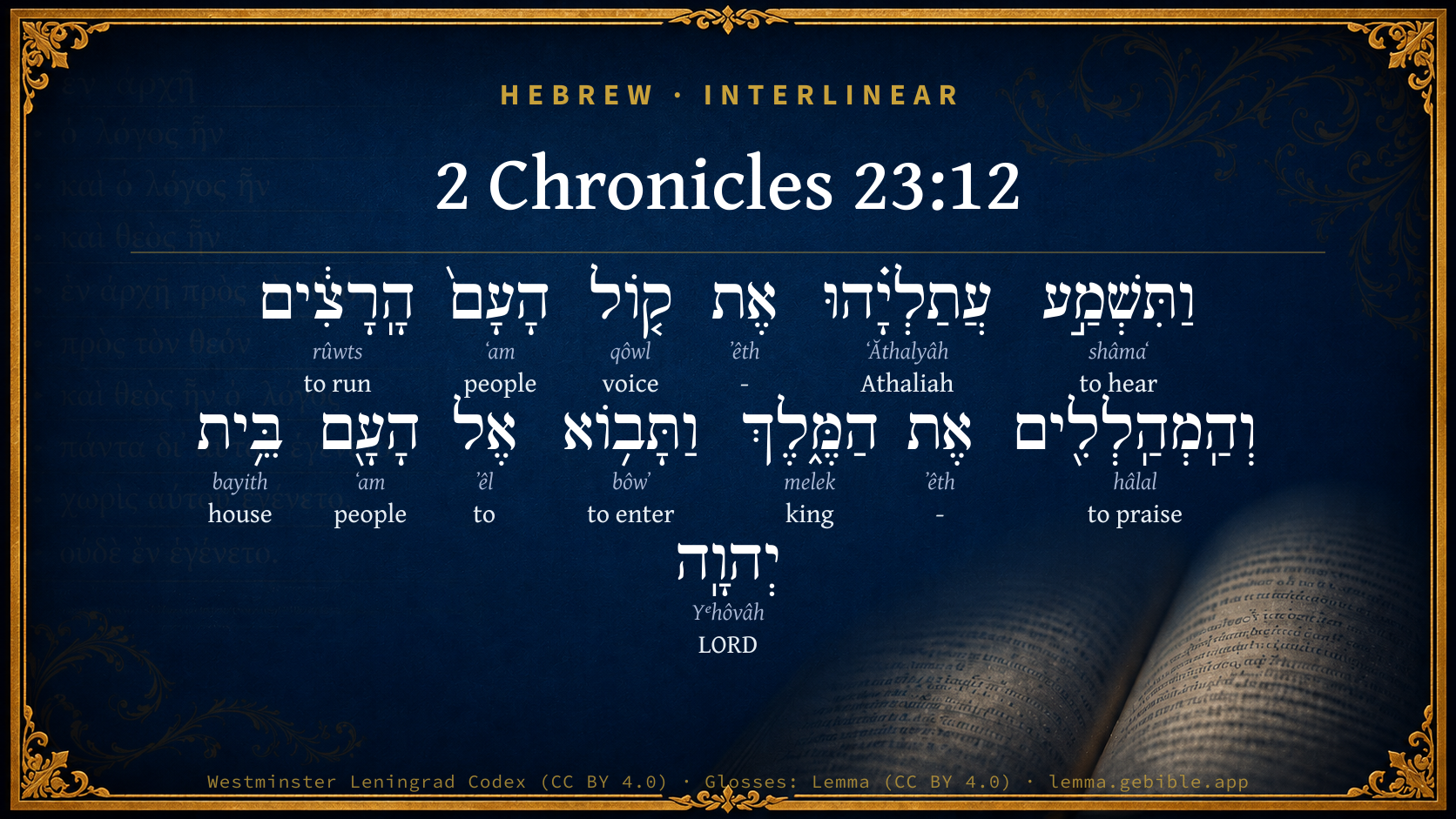
  1. וַתִּשְׁמַ֣ע shâmaʻ H8085 “and · to hear” Conjunction + Verb, Qal, Sequential Imperfect, 3rd Person, Feminine, Singular
  2. אֶת ʼêth H853 “-” Particle, Direct Object
  3. ק֤וֹל qôwl H6963 “voice of” Noun, Common, Masculine, Singular, Construct
  4. הָעָם֙ ʻam H5971 “the · people” Particle, Definite Article + Noun, Common, Masculine, Singular, Absolute
  5. הָֽרָצִ֔ים rûwts H7323 “the · running” Particle, Definite Article + Verb, Qal, Participle Active, Masculine, Plural, Absolute
  6. וְהַֽמְהַֽלְלִ֖ים hâlal H1984 “and · the · praising” Conjunction + Particle, Definite Article + Verb, Piel, Participle Active, Masculine, Plural, Absolute
  7. אֶת ʼêth H853 “-” Particle, Direct Object
  8. הַמֶּ֑לֶךְ melek H4428 “the · king” Particle, Definite Article + Noun, Common, Masculine, Singular, Absolute
  9. וַתָּב֥וֹא bôwʼ H935 “and · to enter” Conjunction + Verb, Qal, Sequential Imperfect, 3rd Person, Feminine, Singular
  10. אֶל ʼêl H413 “to” Preposition
  11. הָעָ֖ם ʻam H5971 “the · people” Particle, Definite Article + Noun, Common, Masculine, Singular, Absolute
  12. בֵּ֥ית bayith H1004 “house of” Noun, Common, Masculine, Singular, Construct
  13. יְהוָֽה Yᵉhôvâh H3068 “LORD” Noun, Proper

About this verse

These counts appear in no published source. They are computed here, from the morphology-tagged text and Lemma’s own curated glosses. What Lemma adds →

14
words
12
distinct lemmas
Historical
section

Notable vocabulary

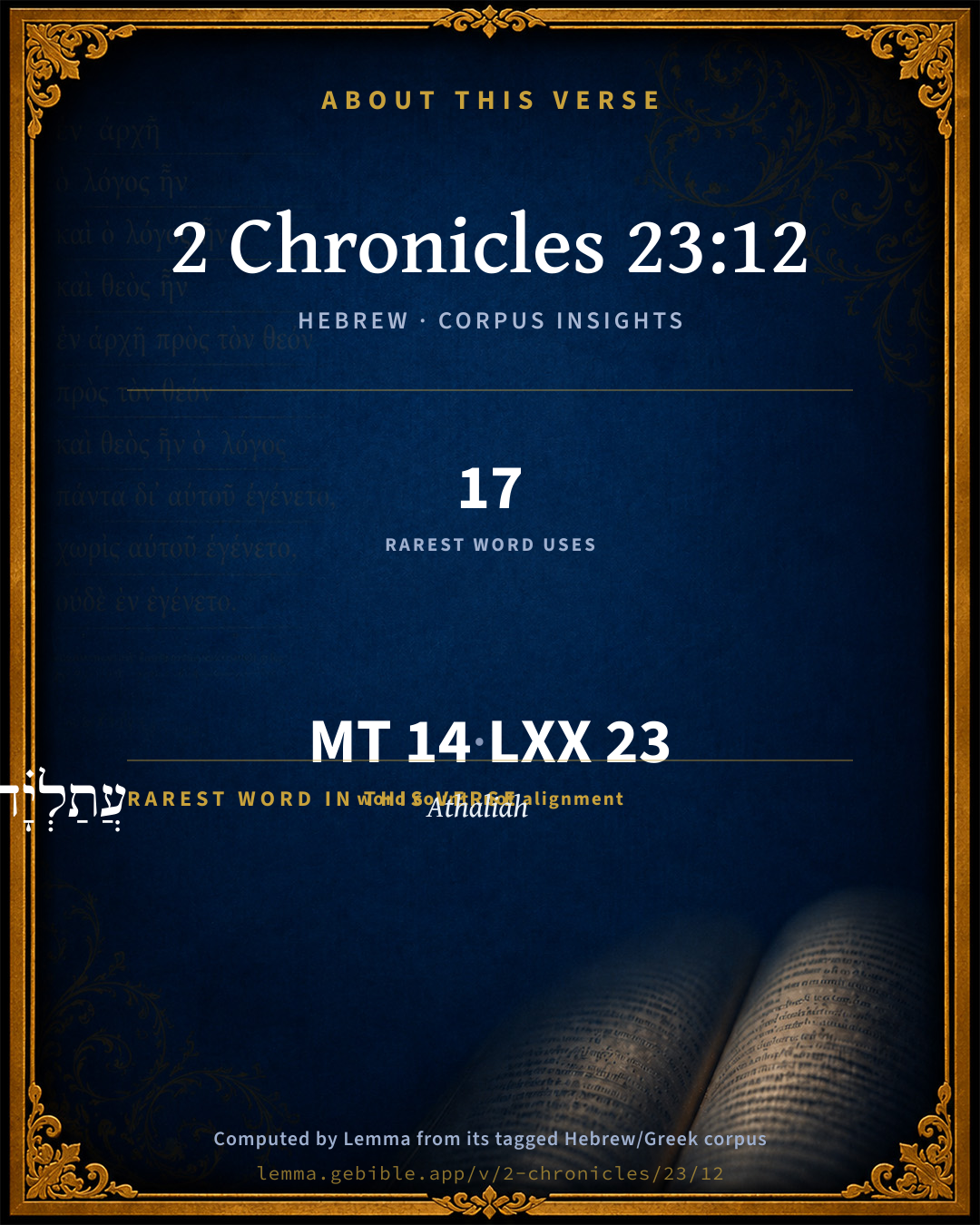
The rarest word here is עֲתַלְיָ֗הוּ Athaliah H6271 — appearing just 17 times in the whole Hebrew Bible.

Shared distinctive vocabulary

עֲתַלְיָ֗הוּ Athaliah H6271 occurs in 17 verses of the Hebrew Bible. Also found in:

Grammatical profile

  • 4 verbs
  • 7 nouns
  • 1 preposition
  • 2 particles

Verb forms

  • וַתִּשְׁמַ֣ע Qal · Sequential Imperfect
  • הָֽרָצִ֔ים Qal · Participle Active
  • וְהַֽמְהַֽלְלִ֖ים Piel · Participle Active
  • וַתָּב֥וֹא Qal · Sequential Imperfect

Repetition

A word recurs within this verse — often emphatic in Hebrew:

  • הָעָם֙ people H5971 ×2

Hebrew & Septuagint length

In English translation the verse runs 23 words from the Hebrew and 28 from the Septuagint (LXX English) — closely comparable.

A rough comparison of the two English renderings, which tokenize alike — not a word-level alignment.

Word counts can differ between the Hebrew and the Greek without any difference in meaning — e.g. the Hebrew direct-object marker אֵת has no separate Greek word, and Greek often adds the article ὁ.

In the original languages it is 14 Hebrew tokens and 23 Greek tokens — but the two are counted differently (Hebrew bundles its prefixes and suffixes into one token; the Greek is in lemma form), so that isn’t a like-for-like length.

Cross-references

2

Topical passages linked to 2 Chronicles 23:12 in the Treasury of Scripture Knowledge — connected by theme and wording, ordered by reader-vote popularity; previews shown in the World English Bible.

  • 2 Kings 9:32–37 He lifted up his face to the window, and said, Who is on my side? who? There looked out to him two or three eunuchs.
  • 2 Kings 11:13–16 When Athaliah heard the noise of the guard [and of] the people, she came to the people into the house of Yahweh:

Cross-references courtesy of OpenBible.info (CC BY 4.0).

Hebrew and Greek witnesses Masoretic Hebrew ↔ Greek Septuagint

The same verse in the two great witnesses to the Old Testament, shown verse-for-verse.

These are two independent witnesses, not word-aligned to each other, and the Septuagint is shown in lemma (dictionary) form.

Hebrew 2 Chronicles 23:12 Masoretic · Westminster Leningrad Codex

וַתִּשְׁמַ֣ע עֲתַלְיָ֗הוּ אֶת ק֤וֹל הָעָם֙ הָֽרָצִ֔ים וְהַֽמְהַֽלְלִ֖ים אֶת הַמֶּ֑לֶךְ וַתָּב֥וֹא אֶל הָעָ֖ם בֵּ֥ית יְהוָֽה

When Athaliah heard the noise of the people running and praising the king, she came to the people into the house of Yahweh:

World English Bible · Public Domain

Greek LXX 2 Chronicles 23:12 Septuagint · lemma form

καί ἀκούω γοθολια ὁ φωνή ὁ λαός ὁ τρέχω καί ἐκὁμολογέω καί αἰνέω ὁ βασιλεύς καί εἰςἔρχομαι πρός ὁ βασιλεύς εἰς οἶκος κύριος

And Gotholia heard the sound of the people running, and acknowledging and praising the king: and she went in to the king into the house of the Lord.

LXX2012 (modern English Septuagint) · Public Domain

Hebrew: Westminster Leningrad Codex (CC BY 4.0). Greek: Septuagint (public domain); English from LXX2012 (modern English Septuagint) (Public Domain). How the Septuagint differs from the Hebrew →

Commentary

Notes on 2 Chronicles 23:12 from classic Christian and Jewish commentators (each source and its license shown beneath its notes). The classic Christian expositions comment on the surrounding passage and are grouped to its opening verse, so a note may address several verses; the Jewish commentaries on the Tanakh (Rashi and others) are per-verse, so they appear only where the commentator wrote on this verse.

Lemma curates 59 commentaries, every one of them public domain or Creative Commons licensed, each selected and text-cleaned for this edition rather than reprinted as found. About our sources →

Matthew Henry's Commentary

Here we have, I. The people pleased, Ch2 23:12, Ch2 23:13. When the king stood at his pillar, whose right it was to stand there, all the people of the land rejoiced to see a rod sprung out of the stem of Jesse, Isa 11:1. When it seemed a withered root in a dry ground, to see what they despaired of ever seeing - a king of the house of David, what a pleasing surprise was it to them! They ran in transports of joy to see this sight, praised the king, and praised God, for they had with them such as taught to sing praise.

II. Athaliah slain. She ran upon the point of the sword of justice; for, imagining her interest much better than it was, she ventured into the house of the Lord at that time, and cried, Treason, treason! But nobody seconded her, or sided with her. The pride of her heart deceived her. She thought all her own, whereas none were cordially so. Jehoiada, as protector in the king's minority, ordered her to be slain (Ch2 23:14), which was done immediately (Ch2 23:15), only care was taken that she should not be slain in the house of the Lord, that sacred place must not be so far disgraced, nor that wicked woman so far honoured.

III. The original contract agreed to, Ch2 23:16. In the Kings it is said that Jehoiada made a covenant between the Lord, the people, and the king, Kg2 11:17. Here it is said to be between himself, the people, and the king; for he, as God's priest, was his representative in this transaction, or a sort of mediator, as Moses was. The indenture was tripartite, but the true intent and meaning of the whole was that they should be the Lord's people. God covenanted by Jehoiada to take them for his people; the king and people covenanted with him to be his; and then the king covenanted with the people to govern them as the people of God, and the people with the king to be subject to him as the Lord's people, in his fear and for his sake. Let us look upon ourselves and one another as the Lord's people, and this will have a powerful influence upon us in the discharge of all our duty both to God and man.

IV. Baal destroyed, Ch2 23:17. They would not have done half their work if they had only destroyed the usurper of the king's right, and not the usurper of God's right - if they had asserted the honour of the throne, and not that of the altar. The greatest grievance of Athaliah's reign was the bringing in of the worship of Baal, and supporting of that; therefore that must be abolished in the first place. Down with Baal's house, his altars, his images; down with them all, and let the blood of his priests be mingled with his sacrifices; for God had commanded that seducers to idolatry should be put to death, Deu 13:5, Deu 13:6.

V. The temple service revived, Ch2 23:18, Ch2 23:19. This had been neglected in the last reigns, the priest and people wanting either power or zeal to keep it up when they had princes that were disaffected to it. But Jehoiada restored the offices of the house of the Lord, which in the late times had been disturbed and invaded, to the proper course and proper hands. 1. He appointed the priests to their courses, for the due offering of sacrifices, according to the law of Moses. 2. The singers to theirs, according to the appointment of David. The sacrifices (it should seem) were offered with rejoicing and singing, and with good reason. We joy in God when we receive the atonement, Rom 5:11. 3. The porters were put in their respective posts as David ordered (Ch2 23:19), and their office was to take care that none who were upon any account ceremonially unclean should be admitted into the courts of the temple.

VI. The civil government re-established, Ch2 23:20. They brought the king in state to his own palace, and set him upon the throne of the kingdom, to give law, and give judgment, either in his own person or by Jehoiada his tutor. Thus was this happy revolution perfected. The generality of the people rejoiced in it, and the rest were quiet and made no opposition, Ch2 23:21. When the Son of David is enthroned in the soul all is quiet and springs of joy are opened.

Matthew Henry's Commentary on the Whole Bible (1708–1710) — public domain (CC PDM 1.0). Text via the HelloAO Bible API.

Jamieson, Fausset & Brown

Robert Jamieson, A. R. Fausset & David Brown

ATHALIAH SLAIN. (Ch2 23:12-15)

Athaliah heard the noise of the people--The unusual commotion, indicated by the blast of the trumpets and the vehement acclamations of the people, drew her attention, or excited her fears. She might have flattered herself that, having slain all the royal family, she was in perfect security; but it is just as likely that, finding on reflection, one had escaped her murderous hands, she might not deem it expedient to institute any enquiries; but the very idea would keep her constantly in a state of jealous suspicion and irritation. In that state of mind, the wicked usurper, hearing across the Tyropœon the outburst of popular joy, rushed across the bridge to the temple grounds, and, penetrating from a single glance the meaning of the whole scene, raised a shriek of "Treason!"

Jamieson, Fausset & Brown — Commentary Critical and Explanatory on the Whole Bible (1871) — public domain (CC PDM 1.0). Text via the HelloAO Bible API.

Ellicott's Commentary for English Readers

THE EXECUTION OF ATHALIAH (2Ch_23:12-21).

(See 2Ki_11:13-20.)

(12) Now when Athaliah . . . she came.—And Athaliah heard . . . and she came.

The noise of the people running and praising the king.—Or, the noise of the people, the Couriers, and those who were acclaiming the king. (1Ki_11:13, “the noise of the runners, the people;” where the people may be an inadvertent repetition, as the same expression follows directly. The rest of the verse is the same as here.)

A Bible Commentary for English Readers, edited by Charles John Ellicott (1878–1897) — public domain. Text from a community e-Sword module.

Trapp's Complete Commentary

John Trapp

2Ch 23:12 Now when Athaliah heard the noise of the people running and praising the king, she came to the people into the house of the LORD:

Ver. 12. Now when Athaliah.] See 2Ki 11:13.

John Trapp, A Commentary or Exposition upon All the Books of the Old and New Testament (1647–1656) — public domain. Text from a community e-Sword module.

The Cambridge Bible for Schools and Colleges

gen. ed. J. J. S. Perowne

12–15 (= 2Ki_11:13-16). Death of Athaliah

12. Now when] R.V. And when.

praising the king] Perhaps verses were extemporised in praise of a king at his coronation just as over a maiden at her marriage; cp. Psa_78:63 (A.V. mg. and R.V.).

she came] Athaliah was allowed to pass the palace guard, but now it was too late for her to save her crown.

The Cambridge Bible for Schools and Colleges (gen. ed. J. J. S. Perowne; Cambridge University Press, 1878–1918) — public domain. Text from a community e-Sword module.

The Pulpit Commentary

When Athaliah heard the noise. The parallel (2Ki_11:13-16) shows only two differences of any noteworthiness, and these will come under notice next verse. The noise; Hebrew, the voice; i.e. no doubt the voices of the people. Praising. The Hebrew is the piel participle; our corresponding phrase would be, "singing out the praises of the king," i.e. not any personal praises, but such as the cries of "Long live the king!" or, as our Authorized Version has it, "God save the king I

Vers. 12-15.

The fall of Athaliah.

I A STARTLED QUEEN. (Vers. 12, 13.)

1. An unusual sound. Secretly as the coronation of Joash had been conducted, Athaliah"s quick ear caught the noise of trampling feet, clapping hands, and shouting voices that issued from the temple on the other side of the Tyropoean valley. Guilty consciences, of sovereigns, as of common sinners, are prone to be startled by strange sounds; (Job_18:11, Job_18:12) cf. "Macbeth" (act 2. sc. 2), "I have done the deed: didst thou not hear a noise?

2. An unexpected sight. Mustering her guards, Athahah proceeded from her palace across the bridge that spanned the valley, and entered the temple court, when a most unwelcome spectacle met her gaze-a boy standing on a raised platform in front of the inner court, probably the brazen scaffold of Solomon, (2Ch_6:13) his head encircled with a diadem, his hand grasping a roll of parchment as if it were a sceptre; beside him Jehoiada the priest, the princes of the people, and the Levitical trumpeters; around him all the people of the land, rejoicing and singing.

3. An unrestrained cry. Whether or not Athaliah recognized in Joash one of Ahaziah"s sons, whom she fancied she had murdered six years before, she had no difficulty in comprehending the situation. A usurper herself, she perfectly understood the scene she beheld to mean revolution. Rending her garments in horror at the spectacle (2Ki_6:30; Ezr_9:3) and perhaps in involuntary acknowledgment that the hour of her overthrow had struck (1Sa_15:27, 1Sa_15:28; 1Ki_11:30) she likewise rent the air with a shriek of "Treason! treason!". (cf. 2Ki_9:23)

II AN AVENGING PRIEST. (Vers. 14, 15.)

1. A charge to the captains.

(1) Concerning the queen. To arrest her, to lead her beyond the precincts of the temple, to put her to death. Sudden and peremptory, this order was absolutely necessary. Divine justice and public safety alike demanded Athaliah"s blood. A murderess herself, (2Ch_22:10) her life was forfeit to the law. (Gen_9:6) An idolatress of the rankest type, she had incurred the sentence, "I will cast your carcases upon the carcases of your idols, and my soul shall abhor you". (Lev_26:30) A conspiratress, so long as she was spared the life of Joash was not secure.

(2) Concerning her adherents. That they also should be put to the sword. To follow Athaliah, defend her person or champion her cause, was to be guilty of leze majesty against Joash, and indeed against Jehovah, whose vicegerent Joash was.

2. Its execution by the captains.

(1) They hurried the unhappy queen beyond the precincts of the temple, that the holy place might not be polluted with human blood.

(2) They conducted her forth to the vicinity of the king"s stables, the people opening their ranks and making way for her to pass.

(3) They slew her there, within sight of the palace she had usurped and of the temple she had desecrated. As by violence she had climbed into the throne, by violence she was hurled from it. As she had lived so doubtless she died, in unbelief and sin a victim at once of popular fury and Divine retribution. (Pro_11:31)

Learn:

1. That the way of transgressors is hard.

2. That the wages of sin is death.

3. That they who take the sword shall perish with the sword.

4. That verily there is a God who judgeth in the earth.

5. That with what measure one metes it shall be measured to himagain. W.

The Pulpit Commentary (1880–1919), ed. H.D.M. Spence-Jones & Joseph S. Exell — public domain. Text from a community e-Sword module.

Kretzmann's Popular Commentary

Paul E. Kretzmann

Athaliah Slain

v. 12. Now, when Athaliah, from her palace on the other side of the valley, heard the noise of the people running and praising the king, for the joyful shouts of the people and the loud blasts of the Temple trumpets indicated an unusual occurrence on the Temple grounds, she came to the people, having rushed across the magnificent bridge of Solomon to the Temple grounds, into the house of the Lord;

v. 13. and she looked, and, behold, the king stood at his pillar, at the entering in, apparently some sort of a platform near the entrance to the Temple proper, and the princes and the trumpets by the king. And all the people of the land rejoiced and sounded with trumpets, also the singers with instruments of music, rendering some of the Temple music in honor of Jehovah, and such as taught to sing praise, with the psalms used on festival occasions. Then Athaliah rent her clothes, in grief and anger, signifying her deep disgust, and said, Treason, treason! This call was a last desperate attempt to stop the proceedings, as if they were unlawful.

v. 14. Then Jehoiada, the priest, brought out the captains of hundreds that were set over the hosts, those in charge of the guard and the Levites upon this occasion, and said unto them, Have her forth of the ranges, out of the Temple grounds, in such a way that she was led out between ranks of soldiers and had no chance to communicate with any followers; and whoso followeth her, let him be slain with the sword. For the priest said, Slay her not in the house of the Lord, where her blood would desecrate the Sanctuary.

v. 15. So they laid hands on her, they arrested her; and when she was come to the entering of the horse gate by the king’s house, the entrance where the horses were led into the complex of buildings which formed the royal palace, near the royal stables, they slew her there. Thus the Lord’s punishment was visited upon her for her idolatry and for her murders. The vengeance of the Lord is sometimes slow in coming, but it always finds the transgressors some time.

Paul E. Kretzmann, Popular Commentary of the Bible (1921–1924) — public domain. Text from a community e-Sword module.

unfoldingWord translationNotes

Door43 World Missions Community

behold

This alerts the reader that the following information is very important.

standing by his pillar at the entrance

The relationship between the king and this particular pillar at the temple entrance is unclear.

All the people of the land

This is a generalization to show that many people participated in the event. AT: "A very large number of the people of the land" (See: Hyperbole and Generalization)

Athaliah tore her clothes

This was a symbolic action to show her great distress. (See: Symbolic Action)

Treason! Treason!

Treason is acting to overthrow the government. Athaliah had killed the legitimate heirs of the king and made herself ruler in 2 Chronicles 22:10-11. She was angry that Joash became king in her place. The exclamation is repeated for emphasis. AT: "You are committing treason!"

translationWords

Athaliah

praise

Yahweh

column

joy

trumpet

unfoldingWord translationNotes — © Distant Shores Media and the Door43 World Missions Community, licensed CC BY-SA 4.0. Source: git.door43.org/Door43/en_tn.

Lesson kit

Teaching starters — assembled from the data on this page, not authored interpretation. Every prompt links to the verse data it draws on. Edit before teaching.

2 Chronicles, in the Historical, opens this verse with 14 words (12 distinct Hebrew lemmas). Its most distinctive word is ʻĂthalyâh (“Athaliah”). A historical commentator’s framing appears above. Read the whole chapter for the surrounding context.

Discussion questions

  1. How does “Athaliah” (ʻĂthalyâh) shape what this verse is saying?
  2. 2 Kings 8:26 shares the word «Athaliah» with this verse. How do the two illuminate each other?
  3. “people” occurs 2× in this one verse. What is the effect of the repetition?
  4. The translations on this page render this verse differently — a whole-verse word diff, not a word-by-word alignment. What might account for the different wordings?
  5. The verb «וַתִּשְׁמַ֣ע» is Qal Sequential Imperfect. How does its form color the action?
  6. Reading how Matthew Henry's Commentary and Jamieson, Fausset & Brown read this verse, where do the two commentators agree and where do they part?

Things to notice

Reading settings

Reading text

Shown beneath each verse's original-language words.

Old Testament
Old Testament edition

Read the OT as the Masoretic Hebrew (MT) or the Greek Septuagint (LXX).

English shown for the Greek Septuagint (in the Hebrew ↔ Greek comparison).

Comparing translations? Open the Compare panel on any verse page to stack up to four side by side.