
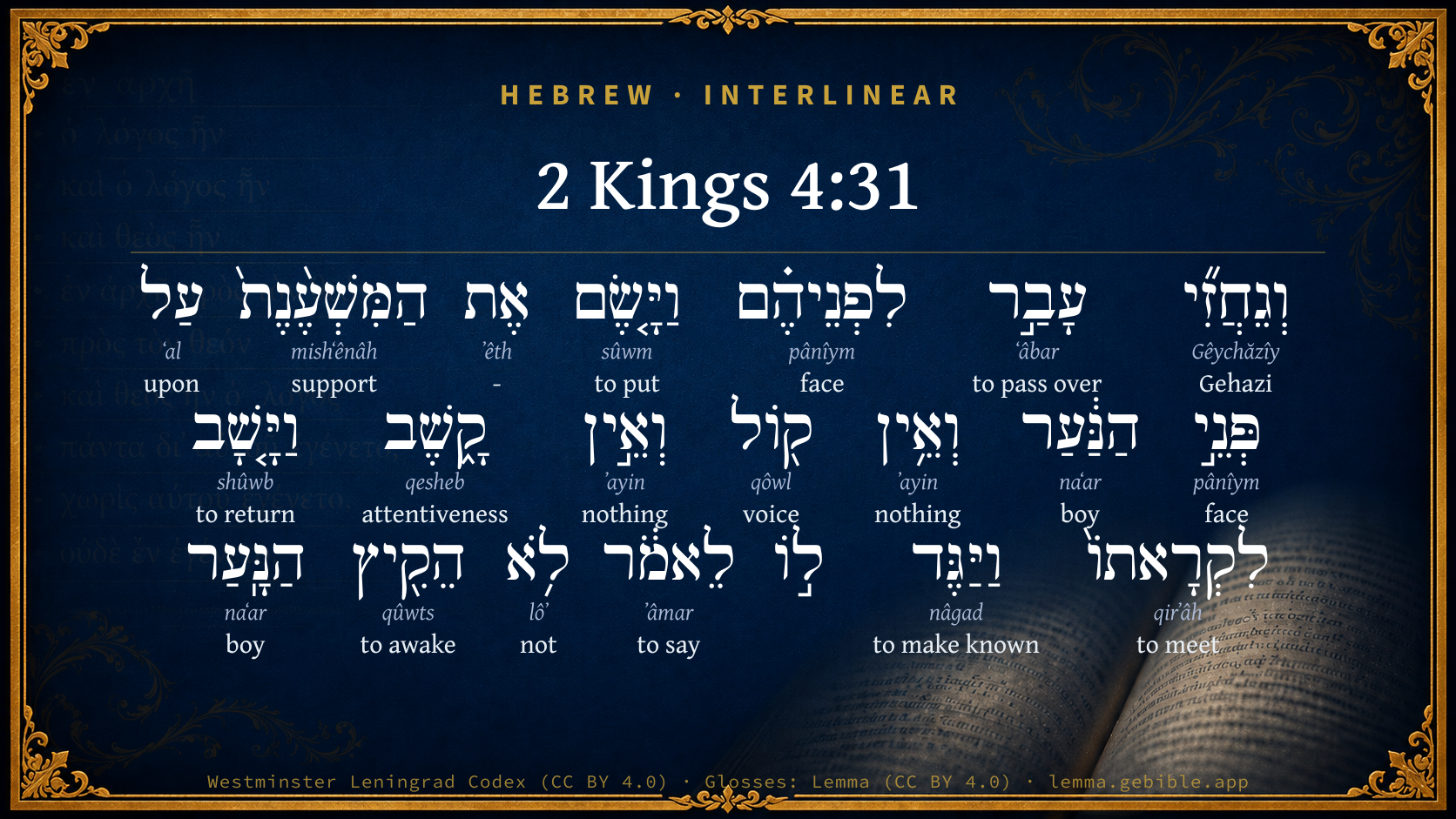
2 Kings 4:31

Hebrew (Westminster Leningrad Codex) 2 Kings 4:31 appears in the Hebrew Old Testament. The text above is from the Westminster Leningrad Codex. Each word links to its Strong’s number, a concise gloss, and parsing drawn from the Open Scriptures Hebrew Bible morphology. Click any word for its full Brown-Driver-Briggs (BDB) entry.
Download image
Cite this verse

2 Kings 4:31 (World English Bible). Public Domain. Lemma interlinear Bible study tool, https://lemma.gebible.app/v/2-kings/4/31.

Show BibTeX & RIS
BibTeX
RIS
English Translation
Gehazi passed on before them, and laid the staff on the face of the child; but there was neither voice, nor hearing. Therefore he returned to meet him, and told him, saying, The child has not awakened.
World English Bible · Public Domain
Download a study sheet

One document with this verse’s original text, its word-by-word gloss line, the meaning frame, cross-references with their text, attributed commentary, and full source and license credits — printable, and it pastes into notes with its structure intact.

This verse Autodidact and up

Study sheet (.html) Plain text (.txt)

A passage Seminary Student

Up to 50 verses in one chapter. A passage sheet keeps up to 6 commentary sources and 12 cross-references per verse, in the order this page ranks them, and says so on the sheet whenever that leaves anything out. Ask for a single verse and you get the Autodidact verse sheet above.

Everything on this page stays free to read, with no account — the sheet is a download of what is already on screen, not access to it.

Want to remove ads? Support Godless Engineer
Compare translations 3

The same verse in 3 English versions, stacked beneath the original-language interlinear above. Click any original word for its lexicon entry.

Each is an independent rendering of the whole verse — the interlinear is not word-aligned to these translations.

Highlighted words mark where these versions differ — a whole-verse word diff, not a word-by-word alignment.

  • World English Bible Public Domain
    Gehazi passed on before them, and laid the staff on the face of the child; but there was neither voice, nor hearing. Therefore he returned to meet him, and told him, saying, The child has not awakened.
  • King James Version Public Domain
    And Gehazi passed on before them, and laid the staff upon the face of the child; but there was neither voice, nor hearing. Wherefore he went again to meet him, and told him, saying, The child is not awaked.
  • unfoldingWord Literal Text CC BY-SA 4.0
    And Gehazi went on to their faces, and he put the staff on the face of the young man, but there was no voice, and there was no hearing. And he returned to meet him, and he declared to him, saying, “The young man did not awaken.”

unfoldingWord Literal Text — © unfoldingWord, licensed CC BY-SA 4.0. Word-aligned USFM3 via Door43 (git.door43.org/unfoldingWord/en_ult).

Versions to compare (up to 4)

3 of 4 selected

Show all 18 translations

Every available English version of this verse, each an independent rendering of the whole verse.

  • World English Bible Public Domain
    Gehazi passed on before them, and laid the staff on the face of the child; but there was neither voice, nor hearing. Therefore he returned to meet him, and told him, saying, The child has not awakened.
  • Berean Standard Bible Public Domain
    Gehazi went on ahead of them and laid the staff on the boy’s face, but there was no sound or response. So he went back to meet Elisha and told him, “The boy has not awakened.”
  • Majority Standard Bible Public Domain
    Gehazi went on ahead of them and laid the staff on the boy’s face, but there was no sound or response. So he went back to meet Elisha and told him, “The boy has not awakened.”
  • King James Version Public Domain
    And Gehazi passed on before them, and laid the staff upon the face of the child; but there was neither voice, nor hearing. Wherefore he went again to meet him, and told him, saying, The child is not awaked.
  • American Standard Version (1901) Public Domain
    And Gehazi passed on before them, and laid the staff upon the face of the child; but there was neither voice, nor hearing. Wherefore he returned to meet him, and told him, saying, The child is not awaked.
  • Revised Version (1885) Public Domain
    And Gehazi passed on before them, and laid the staff upon the face of the child; but there was neither voice, nor hearing. Wherefore he returned to meet him, and told him, saying, The child is not awaked.
  • Geneva Bible (1599) Public Domain
    But Gehazi was gone before them, and had layed the staffe vpon the face of the childe, but he neither spake nor heard: wherefore hee returned to meete him, and told him, saying, The childe is not waken.
  • Douay-Rheims (1899) Public Domain
    But Giezi was gone before them, and laid the staff upon the face of the child, and there was no voice nor sense: and he returned to meet him, and told him, saying: The child is not risen.
  • Young's Literal Translation Public Domain
    And Gehazi hath passed on before them, and layeth the staff on the face of the youth, and there is no voice, and there is no attention, and he turneth back to meet him, and declareth to him, saying, `The youth hath not awaked.'
  • Literal Standard Version CC BY-SA 4.0
    And Gehazi has passed on before them, and lays the staff on the face of the youth, and there is no voice, and there is no attention, and he turns back to meet him, and declares to him, saying, “The youth has not awoken.”
  • Unlocked Literal Bible CC BY-SA 4.0
    Gehazi hurried on ahead of them and laid the staff on the child's face, but the child did not speak or hear. So then Gehazi returned to meet Elisha and told him saying, “The child has not awakened.”
  • unfoldingWord Literal Text CC BY-SA 4.0
    And Gehazi went on to their faces, and he put the staff on the face of the young man, but there was no voice, and there was no hearing. And he returned to meet him, and he declared to him, saying, “The young man did not awaken.”
  • Darby Bible Public Domain
    And Gehazi passed on before them, and laid the staff upon the face of the lad; but there was neither voice, nor sign of attention. And he returned to meet him, and told him saying, The lad is not awaked.
  • World Messianic Bible Public Domain
    Gehazi went ahead of them, and laid the staff on the child’s face; but there was no voice and no hearing. Therefore he returned to meet him, and told him, “The child has not awakened.”
  • Webster's Bible Public Domain
    And Gehazi passed on before them, and laid the staff upon the face of the child; but there was neither voice, nor hearing. Wherefore he went again to meet him, and told him, saying, The child is not awaked.
  • Free Bible Version CC BY-SA 4.0
    Gehazi ran on ahead and placed the staff on the boy's face, but there was no sound or sign of life. So Gehazi went back to meet Elisha and told him, “The boy hasn't woken up.”
  • Bible in Basic English Public Domain
    And Gehazi went on before them and put the stick on the child's face; but there was no voice, and no one gave attention. So he went back, and meeting him gave him the news, saying, The child is not awake.
  • JPS Tanakh (1917) Public Domain
    And Gehazi passed on before them, and laid the staff upon the face of the child; but there was neither voice, nor hearing. Wherefore he returned to meet him, and told him, saying: 'The child is not awaked.'

Literal Standard Version (2020), Covenant Press — licensed CC BY-SA 4.0. Text via the HelloAO Bible API (eBible.org). Unlocked Literal Bible (unfoldingWord) — licensed CC BY-SA 4.0. Text via the HelloAO Bible API (eBible.org). unfoldingWord Literal Text — © unfoldingWord, licensed CC BY-SA 4.0. Word-aligned USFM3 via Door43 (git.door43.org/unfoldingWord/en_ult). Free Bible Version, Dr. Jonathan Gallagher — licensed CC BY-SA 4.0. Text via the HelloAO Bible API (eBible.org).

Word by word

More ways to search: Search by grammar → Find every occurrence → Compare this word →

Practice this passage: Drill this verse → Learn its vocabulary →

קָ֑שֶׁב
qesheb
H7182
“attentiveness”
Noun, Common, Masculine, Singular, Absolute
Part of Speech
Noun
Type
Common
Gender
Masculine
Number
Singular
State
Absolute
Full BDB Definition

Origin: from H7181

TWOT: 2084a

attentiveness, attention
  1. וְגֵחֲזִ֞י Gêychăzîy H1522 “and · Gehazi” Conjunction + Noun, Proper
  2. עָבַ֣ר ʻâbar H5674 “to pass over” Verb, Qal, Perfect, 3rd Person, Masculine, Singular
  3. לִפְנֵיהֶ֗ם pânîym H6440 “to/for · face(s) · their” Preposition + Noun, Common, Both, Plural, Construct + Suffix, Personal, 3rd Person, Masculine, Plural
  4. וַיָּ֤שֶׂם sûwm H7760 “and · to put” Conjunction + Verb, Qal, Sequential Imperfect, 3rd Person, Masculine, Singular
  5. אֶת ʼêth H853 “-” Particle, Direct Object
  6. הַמִּשְׁעֶ֨נֶת֙ mishʻênâh H4938 “the · support” Particle, Definite Article + Noun, Common, Feminine, Singular, Absolute
  7. עַל ʻal H5921 “upon” Preposition
  8. פְּנֵ֣י pânîym H6440 “face(s) of” Noun, Common, Both, Plural, Construct
  9. הַנַּ֔עַר naʻar H5288 “the · boy” Particle, Definite Article + Noun, Common, Masculine, Singular, Absolute
  10. וְאֵ֥ין ʼayin H369 “and · nothing” Conjunction + Particle, Negative
  11. ק֖וֹל qôwl H6963 “voice” Noun, Common, Masculine, Singular, Absolute
  12. וְאֵ֣ין ʼayin H369 “and · nothing” Conjunction + Particle, Negative
  13. וַיָּ֤שָׁב shûwb H7725 “and · to return” Conjunction + Verb, Qal, Sequential Imperfect, 3rd Person, Masculine, Singular
  14. לִקְרָאתוֹ֙ qirʼâh H7125 “to meet · him” Preposition + Verb, Qal, Infinitive Construct + Suffix, Personal, 3rd Person, Masculine, Singular
  15. וַיַּגֶּד nâgad H5046 “and · to make known” Conjunction + Verb, Hiphil, Sequential Imperfect, 3rd Person, Masculine, Singular
  16. לֵאמֹ֔ר ʼâmar H559 “to say” Preposition + Verb, Qal, Infinitive Construct
  17. לֹ֥א lôʼ H3808 “not” Particle, Negative
  18. הֵקִ֖יץ qûwts H6974 “to awake” Verb, Hiphil, Perfect, 3rd Person, Masculine, Singular
  19. הַנָּֽעַר naʻar H5288 “the · boy” Particle, Definite Article + Noun, Common, Masculine, Singular, Absolute

About this verse

These counts appear in no published source. They are computed here, from the morphology-tagged text and Lemma’s own curated glosses. What Lemma adds →

21
words
17
distinct lemmas
Historical
section

Notable vocabulary

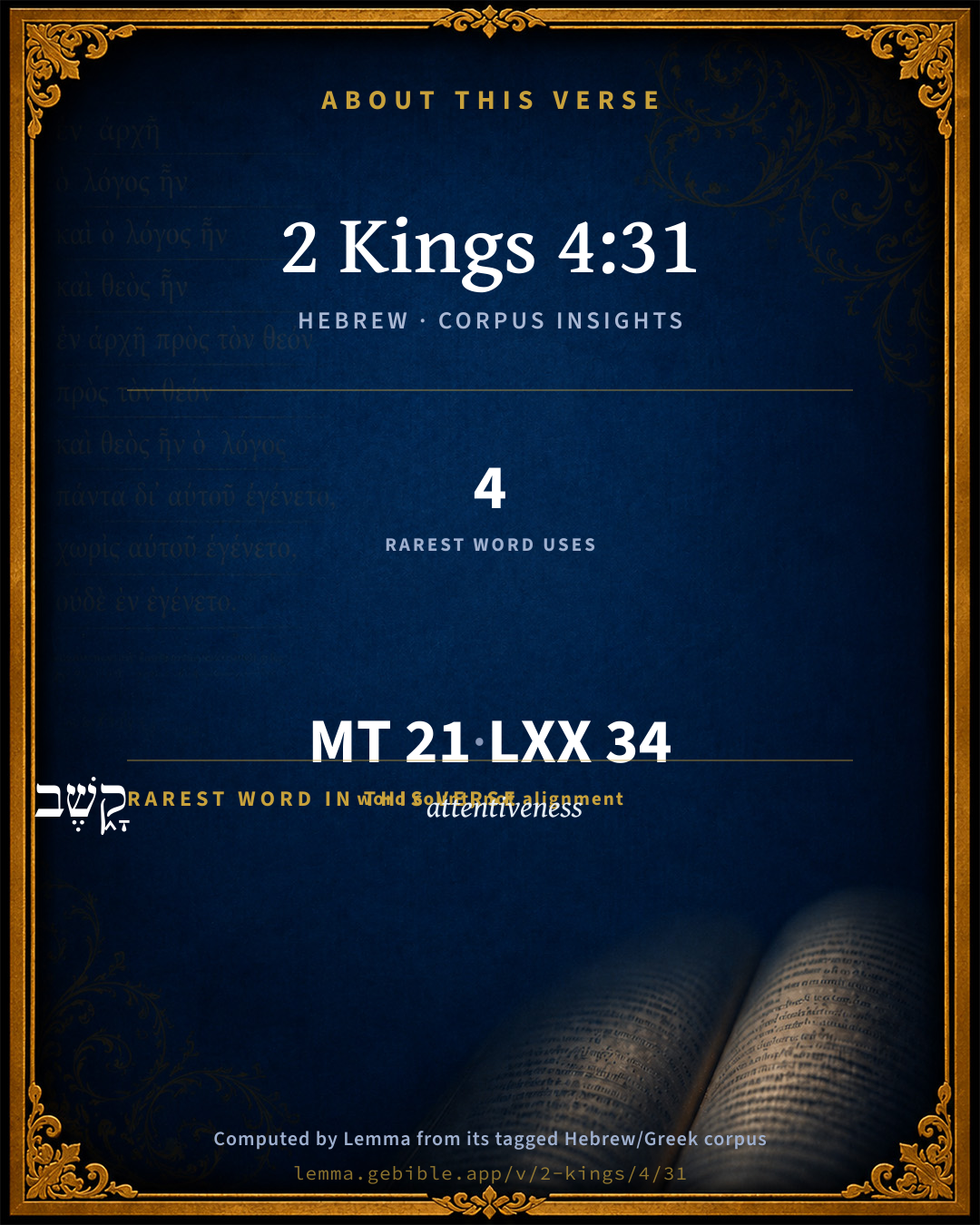
The rarest word here is קָ֑שֶׁב attentiveness H7182 — appearing just 4 times in the whole Hebrew Bible.

Shared distinctive vocabulary

קָ֑שֶׁב attentiveness H7182 occurs in 3 verses of the Hebrew Bible. Also found in:

Grammatical profile

  • 7 verbs
  • 8 nouns
  • 2 prepositions
  • 4 particles

Verb forms

  • עָבַ֣ר Qal · Perfect
  • וַיָּ֤שֶׂם Qal · Sequential Imperfect
  • וַיָּ֤שָׁב Qal · Sequential Imperfect
  • לִקְרָאתוֹ֙ Qal · Infinitive Construct
  • וַיַּגֶּד Hiphil · Sequential Imperfect
  • לֵאמֹ֔ר Qal · Infinitive Construct
  • הֵקִ֖יץ Hiphil · Perfect

Repetition

Words recur within this verse — often emphatic in Hebrew:

  • לִפְנֵיהֶ֗ם face H6440 ×2
  • הַנַּ֔עַר boy H5288 ×2
  • וְאֵ֥ין nothing H369 ×2

Hebrew & Septuagint length

In English translation the verse runs 37 words from the Hebrew and 37 from the Septuagint (LXX English) — the same length.

A rough comparison of the two English renderings, which tokenize alike — not a word-level alignment.

Word counts can differ between the Hebrew and the Greek without any difference in meaning — e.g. the Hebrew direct-object marker אֵת has no separate Greek word, and Greek often adds the article ὁ.

In the original languages it is 21 Hebrew tokens and 34 Greek tokens — but the two are counted differently (Hebrew bundles its prefixes and suffixes into one token; the Greek is in lemma form), so that isn’t a like-for-like length.

Cross-references

14

Topical passages linked to 2 Kings 4:31 in the Treasury of Scripture Knowledge — connected by theme and wording, ordered by reader-vote popularity; previews shown in the World English Bible.

  • John 11:11 He said these things, and after that, he said to them, "Our friend, Lazarus, has fallen asleep, but I am going so that I may awake him out of sleep."
  • 1 Samuel 14:37 Saul asked counsel of God, Shall I go down after the Philistines? will you deliver them into the hand of Israel? But he didn't answer him that day.
  • 1 Samuel 28:6 When Saul inquired of Yahweh, Yahweh didn't answer him, neither by dreams, nor by Urim, nor by prophets.
  • 1 Kings 18:26 They took the bull which was given them, and they dressed it, and called on the name of Baal from morning even until noon, saying, Baal, hear us. But there was no voice, nor any who answered. They leaped about the altar which was made.
  • 1 Kings 18:29 It was so, when midday was past, that they prophesied until the time of the offering of the [evening] offering; but there was neither voice, nor any to answer, nor any who regarded.
  • Job 14:12 So man lies down and doesn't rise; Until the heavens are no more, they shall not awake, Nor be roused out of their sleep.
  • Ezekiel 14:3 Son of man, these men have taken their idols into their heart, and put the stumbling block of their iniquity before their face: should I be inquired of at all by them?
  • Daniel 12:2 Many of those who sleep in the dust of the earth shall awake, some to everlasting life, and some to shame and everlasting contempt.
  • Matthew 17:16–20 So I brought him to your disciples, and they could not cure him."
  • Mark 5:39 When he had entered in, he said to them, "Why do you make an uproar and weep? The child is not dead, but is asleep."
  • Mark 9:19–29 He answered him, "Unbelieving generation, how long shall I be with you? How long shall I bear with you? Bring him to me."
  • John 11:43–44 When he had said this, he cried with a loud voice, "Lazarus, come out!"
  • Acts 19:13–17 But some of the itinerant Jews, exorcists, took on themselves to name over those who had the evil spirits the name of the Lord Jesus, saying, "We adjure you by Jesus whom Paul preaches."
  • Ephesians 5:14 Therefore he says, "Awake, you who sleep, and arise from the dead, and Christ will shine on you."

Cross-references courtesy of OpenBible.info (CC BY 4.0).

Hebrew and Greek witnesses Masoretic Hebrew ↔ Greek Septuagint

The same verse in the two great witnesses to the Old Testament, shown verse-for-verse.

These are two independent witnesses, not word-aligned to each other, and the Septuagint is shown in lemma (dictionary) form.

Hebrew 2 Kings 4:31 Masoretic · Westminster Leningrad Codex

וְגֵחֲזִ֞י עָבַ֣ר לִפְנֵיהֶ֗ם וַיָּ֤שֶׂם אֶת הַמִּשְׁעֶ֨נֶת֙ עַל פְּנֵ֣י הַנַּ֔עַר וְאֵ֥ין ק֖וֹל וְאֵ֣ין קָ֑שֶׁב וַיָּ֤שָׁב לִקְרָאתוֹ֙ וַיַּגֶּד ל֣וֹ לֵאמֹ֔ר לֹ֥א הֵקִ֖יץ הַנָּֽעַר

Gehazi passed on before them, and laid the staff on the face of the child; but there was neither voice, nor hearing. Therefore he returned to meet him, and told him, saying, The child has not awakened.

World English Bible · Public Domain

Greek LXX 2 Kings 4:31 Septuagint · lemma form

καί γιεζι διαἔρχομαι ἔμπροσθεν αὐτός καί ἐπιτίθημι ὁ βακτηρία ἐπί πρόσωπον ὁ παιδάριον καί οὐ εἰμί φωνή καί οὐ εἰμί ἀκρόασις καί ἐπιστρέφω εἰς ἀπαντή αὐτός καί ἀποἀγγέλλω αὐτός λέγω οὐ ἐγείρω ὁ παιδάριον

And Giezi went on before her, and laid his staff on the child's face: but there was neither voice nor any hearing. So he returned to meet him, and told him, saying, The child is not awaked.

LXX2012 (modern English Septuagint) · Public Domain

Hebrew: Westminster Leningrad Codex (CC BY 4.0). Greek: Septuagint (public domain); English from LXX2012 (modern English Septuagint) (Public Domain). How the Septuagint differs from the Hebrew →

Targum (Aramaic paraphrase)

1

The Targum is the ancient Jewish Aramaic paraphrase of the Hebrew Scriptures — an interpretive translation, not the Hebrew text itself. Onkelos (literal) and Pseudo-Jonathan (expansive) render the Torah, and Jonathan the Prophets. Coverage is partial: where no permissively-licensed English translation exists for a verse, only the Aramaic is shown. This is verse-level text, not a word-by-word alignment to the Hebrew.

  1. Targum Jonathan Prophets (Joshua–Malachi)
    וְגֵיחֲזִי עֲבַר קֳדָמֵיהוֹן וְשַׁוֵי יַת חוּטְרָא עַל אַפֵּי רַבְיָא וְלֵית קָל וְלֵית דְמָצִית וְתַב לָקֳדָמוּתֵיהּ וְחַוֵי לֵיהּ לְמֵימַר לָא אִתְעַר רַבְיָא:

    (no public-domain English translation for this verse)

    Targum Jonathan — Aramaic: “Mikraot Gedolot” (public domain). English: “Sefaria Community Translation” (CC0 1.0 (public-domain dedication)); “London "Chaldee Paraphrase," 1871” (public domain). Text via Sefaria.

Commentary

Notes on 2 Kings 4:31 from classic Christian and Jewish commentators (each source and its license shown beneath its notes). The classic Christian expositions comment on the surrounding passage and are grouped to its opening verse, so a note may address several verses; the Jewish commentaries on the Tanakh (Rashi and others) are per-verse, so they appear only where the commentator wrote on this verse.

Lemma curates 59 commentaries, every one of them public domain or Creative Commons licensed, each selected and text-cleaned for this edition rather than reprinted as found. About our sources →

Trapp's Complete Commentary

John Trapp

2Ki 4:31 And Gehazi passed on before them, and laid the staff upon the face of the child; but [there was] neither voice, nor hearing. Wherefore he went again to meet him, and told him, saying, The child is not awaked.

Ver. 31. But there was neither voice nor hearing.] God withholding his power and help till the prophet himself came and renewed the dead. Hereby was allegorically signified, saith one, that the law was used before the coming of Christ to revive the dead in sin. But this being done in vain, Christ afterwards came with his Spirit, and gave life unto them that believe.

John Trapp, A Commentary or Exposition upon All the Books of the Old and New Testament (1647–1656) — public domain. Text from a community e-Sword module.

The Biblical Illustrator

Joseph S. Exell

2Ki_4:31

And Gehazi passed on before them, and laid the staff upon the face of the child.

Personal power

Here is a remarkable thing in Bible history--nothing less than that a miracle should miscarry. Here is an attempt to work a miracle, which ends in failure. This is strange and most painful. Who knows what may fail next? Are there any purposed miracles suddenly broken in failure? Does the staff ever come back without having done its work? We are bound to ask these sharp and serious questions. Do not let us hasten perfunctorily oyez the melancholy fact of our failure; let us face it and wisely consider it, and find out whether the blame be in Elisha, or Gehazi, or the staff, or whether God Himself may be working out some mystery of wisdom in occasionally rebuking us in the use of means and instrument. Elisha was not a man likely to make vain experiments. We had, therefore, better know, with all frankness and simplicity, exactly what the case is, for in faithfulness may be the beginning of success. Gehazi came back and said, in effect, Here is the staff, but it has done no good. There is neither sight, nor hearing, nor sound of returning voice; the child is not awaked.

1. Who was this Gehazi? An undeveloped hypocrite. There were three or four different men in that Gehazi figure. There are three or four different men in you and in me. Which man is it to whom I speak; who is it that announces the hymn, that offers the prayer, that reads the Scriptures, that proclaims the Word? Things are not what they seem. Gehazi was at this moment an undeveloped knave, and what can he do with Elishas staff, or with Gods sunlight? The bad man spoils whatever he touches. In the fall of man, everything with which man has to do must also fall. Virtue perished out of Elishas staff; it became in the grip of Gehazi but a common stick. There is law in that deterioration; there is a whole philosophy in that mysterious depletion of virtue, and we ought to understand somewhat of its operation. Sin impoverishes everything. The universe is but a gigantic shell gleaming with painted fire to the bad man. To him there are no flowers in the garden; there may be some diversity of colour, but flowers as tabernacles in which God reveals Himself, creations of the supreme power, there are none, there can be none. A man cannot go down in his highest religious nature without going down all round. Whatever his pretence of interest may be in things beautiful and musical, and pure and noble, it is only a skilful hypocrisy. When the fool says in his heart, There is no God, he also says in his heart, There is no beauty, there is no virtue, there is no purity, there is no soul. God is the inclusive term, and denial in relation to that term is negation in reference to everything that belongs to it--all music and beauty, all virtue and tenderness, all chivalry and self-sacrifice. You cannot be theologically wrong, and yet morally and socially right. We know what it is to have done the evil deed, and then to have seen all the sunshine run away from the universe like a thing affrighted. Thus we may be coming nearer to the reason why the staff failed. The staff is good, the hand that wielded it was bad; there was no true sympathy or connection between the hand and the staff. The staff was only in the hand, it was not in the heart. There was a merely physical grasp, there was no moral hold of the symbol of prophetic presence and power. Gehazi had already stolen from Naaman, and already there had gone out from the court of heaven the decree which blanched him into a leper as white as snow. Now, let us come home. We have an inspired Book as our staff, our symbol, but are we inspired readers? An inspired Book should have an inspired perusal: like should come to like. By inspiration, by the human side, I mean a meek, reverent, contrite and willing heart, a disposition unprejudiced, a holy, sacred burning desire to know Gods will and to do it all. How stands the case now? You read the Bible and get nothing out of it. No, because you read it without corresponding inspiration on your part. No bad man can preach well. He may preach eloquently, learnedly, effectively. He may go very near to being a good preacher in the right sense of that term, but the bad man cannot preach well in Gods sense and definition of the term. What can the bad man preach? Can he preach salvation by the blood of Christ, he who knows not what it is to shed one drop of blood for any human creature? Can he speak nobly who never felt nobly? (J. Parker, D. D.)

The personal element

Personality is the one thing of real value. The other day I stood looking at ten or fifteen pounds of clay. It was valued at one thousand dollars. But this clay bore upon it the impress of personality. It had been touched by mans intelligence and innermost spirit. It had been designed, and moulded into beauteous form; painted by artistic skill; glazed and baked and perfected by mans inventive genius, and when it came from his hand, bearing the impress of his art, the beauty of thought, the very life of his personality, it had risen in value from zero to a thousand dollars--from worthless clay to a vase of surpassing value and loveliness. Whenever we purchase an article of any kind, in any store, we buy manhood, and not materials; personality, and not things. What we buy would be worthless without the impress of the human soul. Material things take their value from man. They rise in value as he rises in intelligence and moral power. The only thing of real value in the world is the human soul. (Homiletic Review.)

The child is not awaked.

Are you awake?

Many of you are, or have been, quite as dead, in the truest sense of that word, as was the boy who lay still and white in the prophets chamber at Shunem, and need to be awaked quite as much as he did. No doubt even in the youngest of you there are evil germs which may unfold themselves by and by, until you too die, or fall asleep, to God and goodness. No doubt even you often do wrong, and know that it is wrong while you do it. But, for all that, I do not call you dead if God is near and present to you, if you think of Him as your Father, if you are sorry when you do wrong, if you are quickly and easily moved to love, admire, and imitate whatsoever is right and brave and noble. But there are some of you who have lived long enough, and have long enough been knocked about in the little world of school, to have grown somewhat dull and dead. God is not so real, or He is not so much, to you as He was. You are not so ashamed of doing wrong as you were; it may be even that there are some things which you know your masters or parents would think wrong that you take a foolish pride in hiding from them. Perhaps you are getting greedy, selfish, hard to please; or, like Gehazi, covetous of the good things which others have, but you have not. Yes: I have often seen a most gruesome sight. I have seen a dead boy inside a living boy, and a dead girl inside a living girl! That is to say, I have seen girls and boys who had lost their sensibility to spiritual things, their love of goodness, truth, kindness, and gentleness, and were nevertheless quite content with themselves so long as they could get nice food to eat, nice clothes to wear, and plenty of pocketmoney and amusement. Is it too much to say that such boys and girls are dead? And, then, some of you, if you are not dead, are at least fast asleep. Your spiritual faculties and affections rust unused, or they are seldom used. You are dreaming, and pursuing dreams. For what we often call the real world, the world outside us, is not truly the real one; but the world within it and behind it, and beyond it. Thousands of men pass into this outward world, and pass out of it every day; and they can only take with them what they have stored up within themselves. So that it is this inner world which is the real world to us, the world in which alone true and enduring treasures are to be found. And if any of you think the outside world--in which you only stay for a few years at most--to be the real one, and are living only or mainly for that, while the inward and spiritual world, in which you are to abide for ever, is unreal and unattractive to you;--what can we say of you except that you are fast asleep, and do not see things as they are, and mistake dreams for realities, and realities for dreams? You have eyes, but they are not open. There are faculties in you capable of apprehending the true realities, but as yet they are not in exercise. Like the Shunammites son, who was both asleep and dead, you need to be awaked; you need to be quickened unto life. I should like to creep into your very hearts, and whisper, Are you awake? and to go on asking it till you were roused from your dreams, and saw things as they really are; for it is my duty to you, as it is that of your other teachers, to rouse and wake you, if we anyhow can. But, at the very outset, you may turn upon me, and say--How are we to know whether we are what you call awake? What is it to be awake, and alive, toward God? What do you want us to be and to do? And I reply: Well, for one thing, I do not want to see you trying to become sanctimonious little saints. I should hate to see you behaving and to hear you talking as some of the good children behave and talk of whom you read in certain tracts and books. What I want is that you should set yourselves to become good, useful, and happy men and women, by placing the best and highest aims before you, by acting on right motives, because you know that God loves you, and is bent on making you good. How are you to know whether you are alive and awake, or asleep and dead? In a hundred different ways--such ways as these. If you are at school, and set yourself to learn your lessons well and to get on fast--you may have very different motives for doing your duty in school. You may care only to beat your class-fellows, to stand above them, to get on in your little world and be looked up to; and if that be your aim or motive, it is a selfish one, and you are asleep and dead to the true motives and aims by which you ought to be inspired. But if you are eager to learn because you wish to do your duty, and to fit yourselves for larger duties by and by, because you want to become wiser, better, more useful, or because you want to please your parents and show that you are not unmindful of how much they have done for you, or because you want to please God and to prove that you thankfully remember how much He has done for you and given you, then you are alive and awake: for, now, your motives reach up out of and beyond this present world, which will soon pass away, and you are trying to prepare yourselves for any life, or any world, to which it may please God to call you. And, lastly, some of you are growing up into men and women, and have to go out into the world to earn your daily bread. Are you diligent, thoughtful, eager to advance? Why, so far, well. But you may be diligent, observant, quick to seize every advantage and opportunity, mainly because you hate work and hope to get free from it the more quickly; or because you want to lay by money, to get rich, to make a fortune; or because you are bent on distinction, reputation, applause. And, in that case, you are dead and asleep; you are not alive and awake to the best things, the most satisfying, the most enduring. For this life, for which alone you are living, will soon be over, and the riches which have wings soon use them and fly away. If you should die to-night, our Father would not have sorrowfully to say of you, The child is not awake, and feel that He must put you into hard and painful conditions which will rouse and sting you to a sense of all that you have lost and thrown away. And if you should live to be never so old, still all your life will be a useful and happy preparation for the better life to come. (S. Cox, D. D.)

On being awake

A member of Whitefields Sunday Afternoon Mens Meeting stopped Mr. Horne a little while ago and said, I have a crow to pluck with you. Oh, only one? said Mr. Home. What is that? You have taken away my Sunday afternoons nap! How is that? asked the well-known preacher. Well, I used to sleep all Sunday afternoon, and now I come to Whitefields. And how do you like it? Oh, I find it far more interesting to be awake! The story is worth repeating, because there are tens of thousands of people who seriously assume that it is more interesting to be asleep. God has made us for wakefulness, and in all the departments of our life the wakeful man receives the surprises of the Almighty. How much the wakeful man can see in the country lane! There are uncounted numbers of village people who are still asleep, and whose senses have never begun to discern the transient glories of their own surroundings. I have just been staying with a man who makes it part of his ministry of life to open the senses of young villagers whose lives are cast in these entrancing spots. He tells me that they are entering into the unknown world with all the fascination exercised by a fairy tale. Birds and flowers have become the fairies in their once commonplace world, and now that they am awake they find it surpassingly interesting. (Hartley Aspen.)

The Biblical Illustrator, edited by Joseph S. Exell (c. 1880s–1900s) — public domain. Text from a community e-Sword module.

Joseph Benson's Commentary

2Ki 4:31. There was neither voice nor hearing — No sign of life appeared, which Gehazi, probably through unbelief, expected would be the case. It is likely the power was withheld, which might have accompanied the laying on of the staff; because the prophet having changed his mind, and yielded to her request that he would go with her, did alter his course of proceeding, and not join his prayers with Gehazi’s action. Or, perhaps, God did not see fit that the child should come to life again by the touch of the staff, lest it might be thought that he had only lain in a swoon, which at length went off of itself. The child is not awaked — That is, not revived; death being oft and fitly compared to a sleep, because of the resurrection, which will in due time follow it, and here followed speedily, which makes the expression peculiarly proper in this place.

Joseph Benson's Commentary on the Old and New Testaments (1811–1818) — public domain. Text from a community e-Sword module.

Tyndale Open Study Notes

Tyndale Open Resources

4:31 no sign of life: Elisha’s staff held no magical power; only God is the author of life (Acts 17:25-28).

Tyndale Open Study Notes — © Tyndale Open Resources, licensed CC BY-SA 4.0. Text via the HelloAO Bible API.

Ellicott's Commentary for English Readers

(31) There was neither voice, nor hearing.—1Ki_18:29; see margin, and Isa_21:7.

Wherefore he went again.—And he came back to meet him (Elisha).

The child is not awaked.—The lad woke not.

The Rabbis explain Gehazi’s failure by assuming that he had disobeyed his master’s injunction by loitering on the way. This is contradicted by the narrative itself. He had acted with all despatch. Others blame him on other grounds, which, in the absolute silence of the text, cannot be substantiated. The prophet says no word of censure when he receives the announcement of the failure. Bähr thinks that Elisha himself was at fault in supposing he could transfer the spirit and power of a prophet to his servant; and acted in over-haste without a Divine incentive. (Comp. 2Sa_7:3 seq.)

The true explanation is suggested in the Note on 2Ki_4:29. (Bähr is wrong in taking the staff to be other than a walking staff. A different word would be used for rod or sceptre.)

A Bible Commentary for English Readers, edited by Charles John Ellicott (1878–1897) — public domain. Text from a community e-Sword module.

The Cambridge Bible for Schools and Colleges

gen. ed. J. J. S. Perowne

31. there was neither voice, nor hearing] In the margin both A.V. and R.V. give ‘attention’ as the literal meaning of the last word. It is the same which in the account of Elijah’s contest with the Baal-priests (1Ki_18:29) is translated ‘any that regarded’. Here it means that no sign of returning life was seen. The word is used as an adverb ‘diligently’ after the cognate verb ‘to hearken’ in Isa_21:7.

Wherefore he went again] R.V. returned. The same word is so rendered below in verse 35.

The child is not awaked] This does not mean that Gehazi thought the child was not dead. He knew this as well as the mother. But ‘sleep’, even in the Old Testament, is used for its more dreadful sister ‘death’. Cf. Job_14:12; Psa_13:3; Jer_51:57. The common phrase on the death of a king is ‘he slept with his fathers’. See 1Ki_1:21.

The Cambridge Bible for Schools and Colleges (gen. ed. J. J. S. Perowne; Cambridge University Press, 1878–1918) — public domain. Text from a community e-Sword module.

John Gill's Exposition

And Gehazi passed on before them,.... The prophet and the Shunammite:

and laid the staff upon the face of the child; as he was ordered:

but there was neither voice nor hearing: it seems as if he spoke when he laid the staff on the child, but it heard and answered him not, so that there was no sign of life in it:

wherefore he went again to meet him; upon the road between Carmel and Shunem:

and told him, saying, the child is not awaked; by which he expresses its being dead; or, if he knew nothing of its death, he supposed it fast asleep, which was the reason of its not hearing and answering, though the former seems best.

John Gill's Exposition of the Whole Bible (1746–1763) — public domain (CC PDM 1.0). Text via the HelloAO Bible API.

Albert Barnes' Notes on the Bible

There was neither voice nor hearing - Compare 1Ki 18:29.

The child is not awakened - See 2Ki 4:20. The euphemism by which death is spoken of as a sleep was already familiar to the Jews (see 1Ki 1:21 note).

Albert Barnes' Notes on the Bible (1834–1885) — public domain. Text from a community e-Sword/MySword module.

Haydock's Catholic Bible Commentary

The child is not risen. By the staff of Eliseus is represented the rod of Moses, or the old law, which was incapable of restoring life to mankind, then dead by sin. It was necessary that Christ himself should come in our flesh, to restore us to life again. In this, Eliseus, as a figure of Christ, behoved to go in person to restore the dead child to life. (Challoner) --- St. Augustine (contra Faust. xii. 35.) shews that many like things recorded in the Old Testament are figures of the New. (Worthington) --- Many of the fathers observe, that this miracle was intended to shew the necessity of the Incarnation to redeem lost man. The staff did not therefore restore life. Some lay the blame on Giezi; others on the woman, who required the prophet to come in person; and others suppose that Eliseus followed herein his own spirit. But all this is destitute of proof. (Calmet) --- He might alter his mind (Tirinus) at the request of the woman, and to imitate Elias; (3 Kings xvii. 21.) all by God’s direction. (Haydock) --- He had before trusted that God would perform the miracle by means of the staff, as he did formerly by the rod of Moses, or by the mantle of Elias. (Menochius)

George Leo Haydock (1774–1849), Haydock's Catholic Family Bible and Commentary, 1859 edition — public domain. Excludes Psalms (Douay-Rheims chapter numbering differs from Protestant) and Deuterocanonical books (Catholic canon only).

Matthew Poole's English Annotations

Neither voice, nor hearing, i.e. neither speech nor sense, nor any sign of life, to wit, in the child; which disappointment might proceed from hence, that Elisha having changed his mind, and yielded to her importunity to go with her, did alter his course, and not join his fervent prayers with Gehazi’s action, but reserved them till he came thither.

Not awaked, i.e. not revived; death being oft and fitly compared to a sleep, as Psa 76:5; Dan 12:2, because of the resurrection which will in due time follow it, and here followed speedily, which makes the expression most proper in this place.

Matthew Poole's English Annotations on the Holy Bible (1683–1685) — public domain. Text from a community e-Sword/MySword module.

Whedon's Commentary on the Bible

Daniel D. Whedon

31. Neither voice, nor hearing — He uttered no cry, he paid no heed. That is, he gave no signs of life. Here again comes up the question, Why was Gehazi’s mission with the staff a failure? First of all, we maintain that it is far from certain or evident that Elisha expected his staff and his servant would be effectual in raising the dead. On the contrary, it is very possible that he meant Gehazi’s mission should be a failure, in order to show that the miracle could not be wrought by any supposed magic of the staff, or by any mere human agency whatever. But on the other supposition, certainly admissible, and even probable, that the prophet expected his staff to resuscitate the child, the failure is thus well explained by Kitto: “Elisha did not at first mean to go himself to Shunem, and for that reason sent his staff to supply the lack of his own presence. But after he had sent away the servant, his observation of the uneasiness of the mother, whom he had expected to have gone home satisfied, and her avowed determination not to leave him, induced him to alter his purpose, and with the kindness natural to him, to forego his own engagements at Carmel, and to accompany her to her forlorn home. It was probably in consequence of this change of plan that no response was made to the first claim of faith by means of the staff. That appeal was in fact superseded the moment he resolved to go in person, the Lord thus reserving for the personal intercession of his prophet the honour of this marvellous deed.”

But Gehazi’s supposed unfitness to work the miracle, and the woman’s lack of faith in him, are facts not to be overlooked. They may be a sufficient reason for the failure of Gehazi’s mission. For in the realm of the miraculous Divine Power works not blindly nor arbitrarily, but according to sacred laws. To affirm that there must be a sympathetic union or spontaneous affiliation between the human agencies employed and those deeply concerned in a given miracle, is only to say what is abundantly suggested in the Scriptures. Nor is this to degrade a class of miracles to the low plane of animal magnetism, or explain them away on naturalistic principles; yet it need not be denied that the psychological basis of animal magnetism was a medium through which many miracles were performed, and without which some miracles could not have been wrought. When the disciples, after their failure to heal a lunatic child, asked Jesus why they could not work the miracle, he replied, “Because of your unbelief,” Mat_17:20. Compare Mat_13:58; Mar_6:56; Mar_9:23.

Daniel D. Whedon (gen. ed.), Commentary on the Old and New Testaments (1874–1909) — public domain. Text from a community e-Sword module.

The Pulpit Commentary

And Gehazi passed on before them, and laid the staff on the face of the child; but there was neither voice, nor hearing. Gehazi did as he had Been told, executed his mission faithfully; but there was no apparent result. The child was not reused by the staff being placed across his face. All remained still and silent as before. Although on some occasions it has pleased God to allow miracles to be wrought by the instrumentality of lifeless objects, as when Elisha"s hones resuscitated a dead man, (2Ki_13:21) and when virtue went out from the hem of our Lord"s garment, (Mar_5:25-34) and still more remarkably, when "handkerchiefs or aprons from the body of Paul were brought unto the sick, and the diseases departed from them, and the evil spirits were case out of them"; (Act_19:12) yet the instances are, comparatively speaking, rare, and form exceptions to what may be called the usual Divine economy of miracles. Miracles are, as a general rule, attached in Scripture to intense unwavering faith faith, sometimes, in those that are the objects of them, almost always in those that are the workers of them. The present case was not to be an exception to the general rule, the circumstances not calling for an exception. The power of faith was to be shown forth once more in Elisha, as not long previously in Elijah; (1Ki_17:19-23) and Israel was to be taught, by a second marvelous example, how much the effectual fervent prayer of a faithful and righteous man avails with the Most High. The lesson would have been lest had the staff been allowed to effect the resuscitation. Wherefore he i.e. Gehaziwent again to meet him i.e. Elishaand told him, saying, The child is not waked. It is clear from this, that Gehazi had expected an awakening; but there is nothing to show what the prophet himself had expected. We are certainly not entitled to conclude, with Peter Martyr," that "Elisha did wrong in attempting to "delegate his power of working miracles to another;" or even, with Starke, that "Elisha gave the command to Gehazi from over haste, without having any Divine incentive to it."

The Pulpit Commentary (1880–1919), ed. H.D.M. Spence-Jones & Joseph S. Exell — public domain. Text from a community e-Sword module.

John Wesley's Explanatory Notes

Neither voice - Neither speech, nor sense, nor any sign of life, in the child. This disappointment might proceed from hence, that Elisha having changed his mind, and yielded to her importunity to go with her, did alter his course, and not join his fervent prayers with Gehazi's action. Not awaked - Not revived.

John Wesley, Explanatory Notes Upon the Whole Bible (1754–1765) — public domain. Text via the GEBible commentary corpus.

Lesson kit

Teaching starters — assembled from the data on this page, not authored interpretation. Every prompt links to the verse data it draws on. Edit before teaching.

2 Kings, in the Historical, opens this verse with 21 words (17 distinct Hebrew lemmas). Its most distinctive word is qesheb (“attentiveness”). A historical commentator’s framing appears above. Read the whole chapter for the surrounding context.

Discussion questions

  1. What does “attentiveness” (qesheb) contribute to the verse as a whole?
  2. 1 Kings 18:29 shares the word «attentiveness» with this verse. How do the two illuminate each other?
  3. “face” occurs 2× in this one verse. What is the effect of the repetition?
  4. The translations on this page render this verse differently — a whole-verse word diff, not a word-by-word alignment. What might account for the different wordings?
  5. The verb «עָבַ֣ר» is Qal Perfect. How does its form color the action?
  6. Reading how Trapp's Complete Commentary and The Biblical Illustrator read this verse, where do the two commentators agree and where do they part?

Things to notice

Reading settings

Reading text

Shown beneath each verse's original-language words.

Old Testament
Old Testament edition

Read the OT as the Masoretic Hebrew (MT) or the Greek Septuagint (LXX).

English shown for the Greek Septuagint (in the Hebrew ↔ Greek comparison).

Comparing translations? Open the Compare panel on any verse page to stack up to four side by side.