
Jeremiah 10:13

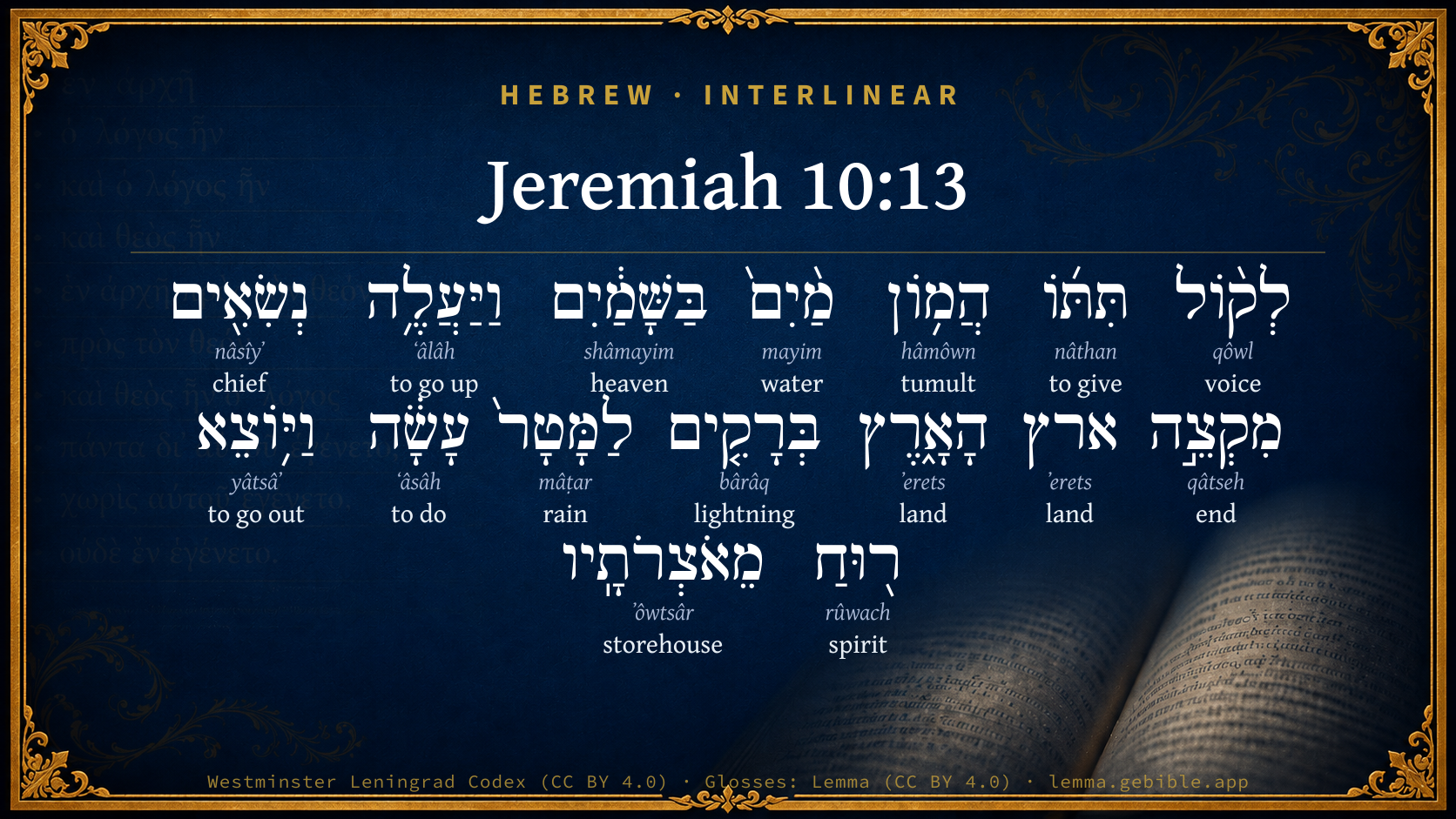
Hebrew (Westminster Leningrad Codex) Jeremiah 10:13 appears in the Hebrew Old Testament. The text above is from the Westminster Leningrad Codex. Each word links to its Strong’s number, a concise gloss, and parsing drawn from the Open Scriptures Hebrew Bible morphology. Click any word for its full Brown-Driver-Briggs (BDB) entry.
Download image
Cite this verse

Jeremiah 10:13 (World English Bible). Public Domain. Lemma interlinear Bible study tool, https://lemma.gebible.app/v/jeremiah/10/13.

Show BibTeX & RIS
BibTeX
RIS
English Translation
when he utters his voice, there is a tumult of waters in the heavens, and he causes the vapors to ascend from the ends of the earth; he makes lightnings for the rain, and brings forth the wind out of his treasuries.
World English Bible · Public Domain
Download a study sheet

One document with this verse’s original text, its word-by-word gloss line, the meaning frame, cross-references with their text, attributed commentary, and full source and license credits — printable, and it pastes into notes with its structure intact.

This verse Autodidact and up

Study sheet (.html) Plain text (.txt)

A passage Seminary Student

Up to 50 verses in one chapter. A passage sheet keeps up to 6 commentary sources and 12 cross-references per verse, in the order this page ranks them, and says so on the sheet whenever that leaves anything out. Ask for a single verse and you get the Autodidact verse sheet above.

Everything on this page stays free to read, with no account — the sheet is a download of what is already on screen, not access to it.

Want to remove ads? Support Godless Engineer
Compare translations 3

The same verse in 3 English versions, stacked beneath the original-language interlinear above. Click any original word for its lexicon entry.

Each is an independent rendering of the whole verse — the interlinear is not word-aligned to these translations.

Highlighted words mark where these versions differ — a whole-verse word diff, not a word-by-word alignment.

  • World English Bible Public Domain
    when he utters his voice, there is a tumult of waters in the heavens, and he causes the vapors to ascend from the ends of the earth; he makes lightnings for the rain, and brings forth the wind out of his treasuries.
  • King James Version Public Domain
    When he uttereth his voice, there is a multitude of waters in the heavens, and he causeth the vapours to ascend from the ends of the earth; he maketh lightnings with rain, and bringeth forth the wind out of his treasures.
  • unfoldingWord Literal Text CC BY-SA 4.0
    At the sound of his uttering, a tumult of waters in the heavens, and he causes mists to ascend from the end of the earth, he makes lightning for the rain, and he brings out wind from his storehouses.

unfoldingWord Literal Text — © unfoldingWord, licensed CC BY-SA 4.0. Word-aligned USFM3 via Door43 (git.door43.org/unfoldingWord/en_ult).

Versions to compare (up to 4)

3 of 4 selected

Show all 18 translations

Every available English version of this verse, each an independent rendering of the whole verse.

  • World English Bible Public Domain
    when he utters his voice, there is a tumult of waters in the heavens, and he causes the vapors to ascend from the ends of the earth; he makes lightnings for the rain, and brings forth the wind out of his treasuries.
  • Berean Standard Bible Public Domain
    When He thunders, the waters in the heavens roar; He causes the clouds to rise from the ends of the earth. He generates the lightning with the rain and brings forth the wind from His storehouses.
  • Majority Standard Bible Public Domain
    When He thunders, the waters in the heavens roar; He causes the clouds to rise from the ends of the earth. He generates the lightning with the rain and brings forth the wind from His storehouses.
  • King James Version Public Domain
    When he uttereth his voice, there is a multitude of waters in the heavens, and he causeth the vapours to ascend from the ends of the earth; he maketh lightnings with rain, and bringeth forth the wind out of his treasures.
  • American Standard Version (1901) Public Domain
    when he uttereth his voice, there is a tumult of waters in the heavens, and he causeth the vapors to ascend from the ends of the earth; he maketh lightnings for the rain, and bringeth forth the wind out of his treasuries.
  • Revised Version (1885) Public Domain
    when he uttereth his voice, there is a tumult of waters in the heavens, and he causeth the vapours to ascend from the ends of the earth; he maketh lightnings for the rain, and bringeth forth the wind out of his treasuries.
  • Geneva Bible (1599) Public Domain
    Hee giueth by his voyce the multitude of waters in the heauen, and he causeth the cloudes to ascend from the endes of the earth: he turneth lightnings to rayne, and bringeth forth the winde out of his treasures.
  • Douay-Rheims (1899) Public Domain
    At his voice he giveth a multitude of waters in the heaven, and lifteth up the clouds from the ends of the earth: he maketh lightnings for rain, and bringeth for the wind out of his treasures.
  • Young's Literal Translation Public Domain
    At the voice He giveth forth, A multitude of waters `is' in the heavens, And He causeth vapours to come up from the end of the earth, Lightnings for rain He hath made, And bringeth out wind from His treasures.
  • Literal Standard Version CC BY-SA 4.0
    When He gives forth His voice, || A multitude of waters [is] in the heavens, || And He causes vapors to come up from the end of the earth, || He has made lightnings for rain, || And brings out wind from His treasures.
  • Unlocked Literal Bible CC BY-SA 4.0
    His voice makes the roar of waters in the heavens, and he brings up the mists from the ends of the earth. He makes lightning for the rain and sends out wind from his storehouse.
  • unfoldingWord Literal Text CC BY-SA 4.0
    At the sound of his uttering, a tumult of waters in the heavens, and he causes mists to ascend from the end of the earth, he makes lightning for the rain, and he brings out wind from his storehouses.
  • Darby Bible Public Domain
    When he uttereth his voice, there is a tumult of waters in the heavens, and he causeth the vapours to ascend from the end of the earth; he maketh lightnings for the rain, and bringeth forth the wind out of his treasuries.
  • World Messianic Bible Public Domain
    When he utters his voice, the waters in the heavens roar, and he causes the vapors to ascend from the ends of the earth. He makes lightnings for the rain, and brings the wind out of his treasuries.
  • Webster's Bible Public Domain
    When he uttereth his voice, there is a multitude of waters in the heavens, and he causeth the vapors to ascend from the ends of the earth; he maketh lightnings with rain, and bringeth forth the wind out of his treasures.
  • Free Bible Version CC BY-SA 4.0
    The waters of the heavens rain down with a roar at his command. He makes the clouds to rise all over the earth. He makes lightning to accompany rain, and sends the wind from his storehouses.
  • Bible in Basic English Public Domain
    At the sound of his voice there is a massing of waters in the heavens, and he makes the mists go up from the ends of the earth; he makes the thunder-flames for the rain, and sends out the wind from his store-houses.
  • JPS Tanakh (1917) Public Domain
    At the sound of His giving a multitude of waters in the heavens, when He causeth the vapours to ascend from the ends of the earth; when He maketh lightnings with the rain, and bringeth forth the wind out of His treasuries;

Literal Standard Version (2020), Covenant Press — licensed CC BY-SA 4.0. Text via the HelloAO Bible API (eBible.org). Unlocked Literal Bible (unfoldingWord) — licensed CC BY-SA 4.0. Text via the HelloAO Bible API (eBible.org). unfoldingWord Literal Text — © unfoldingWord, licensed CC BY-SA 4.0. Word-aligned USFM3 via Door43 (git.door43.org/unfoldingWord/en_ult). Free Bible Version, Dr. Jonathan Gallagher — licensed CC BY-SA 4.0. Text via the HelloAO Bible API (eBible.org).

Word by word

More ways to search: Search by grammar → Find every occurrence → Compare this word →

Practice this passage: Drill this verse → Learn its vocabulary →

בְּרָקִ֤ים
bârâq
H1300
“lightnings”
Noun, Common, Masculine, Plural, Absolute
Part of Speech
Noun
Type
Common
Gender
Masculine
Number
Plural
State
Absolute
Full BDB Definition

Origin: from H1299

TWOT: 287a

lightning - lightnings, lightning flashes - of flashing arrow-head (figuratively)
  1. לְק֨וֹל qôwl H6963 “to/for · voice of” Preposition + Noun, Common, Masculine, Singular, Construct
  2. תִּתּ֜וֹ nâthan H5414 “to give · him” Verb, Qal, Infinitive Construct + Suffix, Personal, 3rd Person, Masculine, Singular
  3. הֲמ֥וֹן hâmôwn H1995 “tumult of” Noun, Common, Masculine, Singular, Construct
  4. מַ֨יִם֙ mayim H4325 “water(s)” Noun, Common, Masculine, Plural, Absolute
  5. בַּשָּׁמַ֔יִם shâmayim H8064 “in/at the · heaven(s)” Preposition, Determined + Noun, Common, Masculine, Plural, Absolute
  6. וַיַּעֲלֶ֥ה ʻâlâh H5927 “and · to go up” Conjunction + Verb, Hiphil, Sequential Imperfect, 3rd Person, Masculine, Singular
  7. נְשִׂאִ֖ים nâsîyʼ H5387 “chiefs” Noun, Common, Masculine, Plural, Absolute
  8. מִקְצֵ֣ה qâtseh H7097 “from · end of” Preposition + Noun, Common, Both, Singular, Construct
  9. ארץ ʼerets H776 “land” Noun, Common, Both, Singular, Absolute
  10. הָאָ֑רֶץ ʼerets H776 “the · land” Particle, Definite Article + Noun, Common, Both, Singular, Absolute
  11. לַמָּטָר֙ mâṭar H4306 “to/for the · rain” Preposition, Determined + Noun, Common, Masculine, Singular, Absolute
  12. עָשָׂ֔ה ʻâsâh H6213 “to do” Verb, Qal, Perfect, 3rd Person, Masculine, Singular
  13. וַיּ֥וֹצֵא yâtsâʼ H3318 “and · to go out” Conjunction + Verb, Hiphil, Sequential Imperfect, 3rd Person, Masculine, Singular
  14. ר֖וּחַ rûwach H7307 “spirit” Noun, Common, Both, Singular, Absolute
  15. מֵאֹצְרֹתָֽיו ʼôwtsâr H214 “from · storehouses · his” Preposition + Noun, Common, Masculine, Plural, Construct + Suffix, Personal, 3rd Person, Masculine, Singular

About this verse

These counts appear in no published source. They are computed here, from the morphology-tagged text and Lemma’s own curated glosses. What Lemma adds →

16
words
15
distinct lemmas
Prophets
section

Notable vocabulary

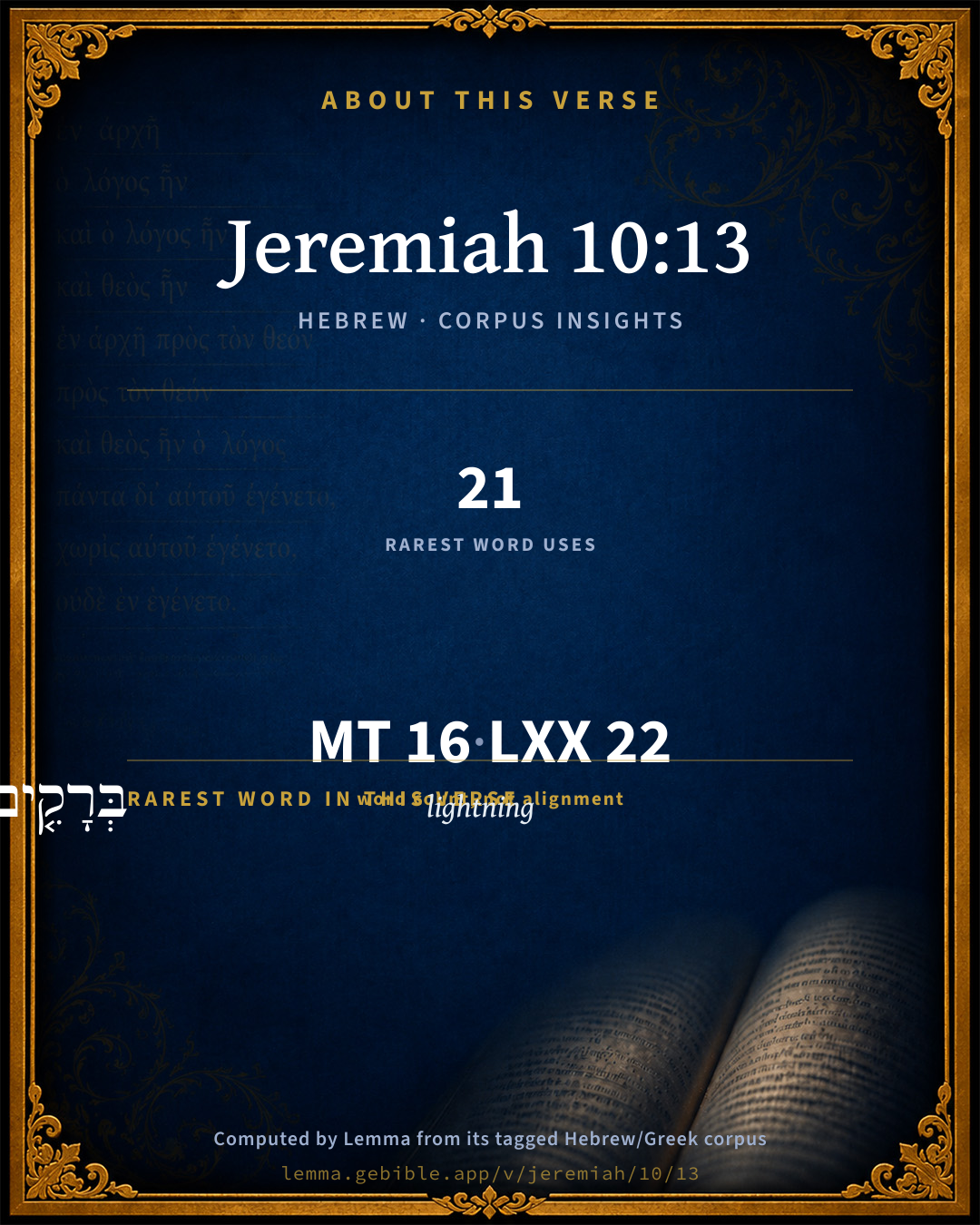
The rarest word here is בְּרָקִ֤ים lightning H1300 — appearing just 21 times in the whole Hebrew Bible.

Shared distinctive vocabulary

בְּרָקִ֤ים lightning H1300 occurs in 21 verses of the Hebrew Bible. Also found in:

Grammatical profile

  • 4 verbs
  • 12 nouns

Verb forms

  • תִּתּ֜וֹ Qal · Infinitive Construct
  • וַיַּעֲלֶ֥ה Hiphil · Sequential Imperfect
  • עָשָׂ֔ה Qal · Perfect
  • וַיּ֥וֹצֵא Hiphil · Sequential Imperfect

Repetition

A word recurs within this verse — often emphatic in Hebrew:

  • ארץ land H776 ×2

Hebrew & Septuagint length

In the original languages it is 16 Hebrew tokens and 22 Greek tokens — but the two are counted differently (Hebrew bundles its prefixes and suffixes into one token; the Greek is in lemma form), so that isn’t a like-for-like length.

Cross-references

16

Topical passages linked to Jeremiah 10:13 in the Treasury of Scripture Knowledge — connected by theme and wording, ordered by reader-vote popularity; previews shown in the World English Bible.

  • Psalms 135:7 Who causes the clouds to rise from the ends of the earth; Who makes lightnings with the rain; Who brings forth the wind out of his treasuries;
  • Job 38:22 Have you entered the treasuries of the snow, Or have you seen the treasures of the hail,
  • Job 38:34–35 "Can you lift up your voice to the clouds, That abundance of waters may cover you?
  • Psalms 18:13 Yahweh also thundered in the sky, The Most High uttered his voice: Hailstones and coals of fire.
  • Exodus 9:23 Moses stretched forth his rod toward the heavens, and Yahweh sent thunder, hail, and lightning flashed down to the earth. Yahweh rained hail on the land of Egypt.
  • 1 Samuel 12:17–18 Isn't it wheat harvest today? I will call to Yahweh, that he may send thunder and rain; and you shall know and see that your wickedness is great, which you have done in the sight of Yahweh, in asking you a king.
  • 1 Kings 18:41 Elijah said to Ahab, Get you up, eat and drink; for there is the sound of abundance of rain.
  • 1 Kings 18:45–46 It happened in a little while, that the sky grew black with clouds and wind, and there was a great rain. Ahab rode, and went to Jezreel:
  • Job 36:27–33 For he draws up the drops of water, Which distill in rain from his vapor,
  • Job 37:2–5 Hear, oh, hear the noise of his voice, The sound that goes out of his mouth.
  • Job 38:25–27 Who has cut a channel for the flood water, Or the path for the thunderstorm;
  • Psalms 29:3–10 Yahweh's voice is on the waters. The God of glory thunders, even Yahweh on many waters.
  • Psalms 68:33 To him who rides on the heaven of heavens, which are of old; Behold, he utters his voice, a mighty voice.
  • Psalms 135:17 They have ears, but they can't hear; Neither is there any breath in their mouths.
  • Psalms 147:8 Who covers the sky with clouds, Who prepares rain for the earth, Who makes grass grow on the mountains.
  • Zechariah 10:1 Ask of Yahweh rain in the spring time, Yahweh who makes storm clouds, And he gives rain showers to everyone for the plants in the field.

Cross-references courtesy of OpenBible.info (CC BY 4.0).

Hebrew and Greek witnesses Masoretic Hebrew ↔ Greek Septuagint

The same verse in the two great witnesses to the Old Testament, shown verse-for-verse.

These are two independent witnesses, not word-aligned to each other, and the Septuagint is shown in lemma (dictionary) form.

Hebrew Jeremiah 10:13 Masoretic · Westminster Leningrad Codex

לְק֨וֹל תִּתּ֜וֹ הֲמ֥וֹן מַ֨יִם֙ בַּשָּׁמַ֔יִם וַיַּעֲלֶ֥ה נְשִׂאִ֖ים מִקְצֵ֣ה ארץ הָאָ֑רֶץ בְּרָקִ֤ים לַמָּטָר֙ עָשָׂ֔ה וַיּ֥וֹצֵא ר֖וּחַ מֵאֹצְרֹתָֽיו

when he utters his voice, there is a tumult of waters in the heavens, and he causes the vapors to ascend from the ends of the earth; he makes lightnings for the rain, and brings forth the wind out of his treasuries.

World English Bible · Public Domain

Greek LXX Structure differs

In the Septuagint, Jeremiah is about an eighth shorter than the Hebrew and arranges its material differently — the Oracles Against the Nations (Hebrew chapters 46–51) appear in the middle of the Greek book, after 25:13. Because the chapter and verse boundaries do not line up, a verse-for-verse comparison with the Hebrew is not shown.

A verse-for-verse comparison isn’t shown here because the chapters and verses don’t line up. Switch to the LXX edition with the MT / LXX toggle above to read the Greek directly.

Hebrew: Westminster Leningrad Codex (CC BY 4.0). Greek: Septuagint (public domain); English from a public-domain English Septuagint. How the Septuagint differs from the Hebrew →

Targum (Aramaic paraphrase)

1

The Targum is the ancient Jewish Aramaic paraphrase of the Hebrew Scriptures — an interpretive translation, not the Hebrew text itself. Onkelos (literal) and Pseudo-Jonathan (expansive) render the Torah, and Jonathan the Prophets. Coverage is partial: where no permissively-licensed English translation exists for a verse, only the Aramaic is shown. This is verse-level text, not a word-by-word alignment to the Hebrew.

  1. Targum Jonathan Prophets (Joshua–Malachi)
    לְקַל מִתְּנִיָהּ רִכְפַת דְמַיִין בִּשְׁמַיָא וּמֵסִיק עֲנָנִין מִסְיָפֵי אַרְעָא בַּרְקִין לִזְמַן מִטְרָא עָבַד וּמַפֵּיק רוּחִין מִבֵּית גִנְזוֹהִי:

    (no public-domain English translation for this verse)

    Targum Jonathan — Aramaic: “Mikraot Gedolot” (public domain). English: “Sefaria Community Translation” (CC0 1.0 (public-domain dedication)); “London "Chaldee Paraphrase," 1871” (public domain). Text via Sefaria.

Commentary

Notes on Jeremiah 10:13 from classic Christian and Jewish commentators (each source and its license shown beneath its notes). The classic Christian expositions comment on the surrounding passage and are grouped to its opening verse, so a note may address several verses; the Jewish commentaries on the Tanakh (Rashi and others) are per-verse, so they appear only where the commentator wrote on this verse.

Lemma curates 59 commentaries, every one of them public domain or Creative Commons licensed, each selected and text-cleaned for this edition rather than reprinted as found. About our sources →

Trapp's Complete Commentary

John Trapp

Jer 10:13 When he uttereth his voice, [there is] a multitude of waters in the heavens, and he causeth the vapours to ascend from the ends of the earth; he maketh lightnings with rain, and bringeth forth the wind out of his treasures.

Ver. 13. When he uttereth his voice.] Again, when he thundereth, {Psa 29:3} it raineth amain, lightneth in the midst of the rain (which is a great miracle), and bloweth for life, as we say, no man knowing whence or whither. {Joh 3:8} All which wondrous works of God may well serve for a theological alphabet, and cannot be attributed to any god but our God.

And he causeth the vapours to ascend.] See Psa 135:7. {See Trapp on "Psa 135:7"}

John Trapp, A Commentary or Exposition upon All the Books of the Old and New Testament (1647–1656) — public domain. Text from a community e-Sword module.

Tyndale Open Study Notes

Tyndale Open Resources

10:13 This affirmation struck at the essence of Baal, the Canaanite god of storm and fertility. The Canaanites believed that Baal actually was the thunder and the rain, but the Lord claimed them as his creations (Ps 135:5-7) through which he can speak and even roar (Job 37:2-5).

Tyndale Open Study Notes — © Tyndale Open Resources, licensed CC BY-SA 4.0. Text via the HelloAO Bible API.

Jamieson, Fausset & Brown

Robert Jamieson, A. R. Fausset & David Brown

Literally, "At the voice of His giving forth," that is, when He thunders. (Job 38:34; Psa 29:3-5).

waters-- (Gen 1:7) --above the firmament; heavy rains accompany thunder.

vapours . . . ascend-- (Psa 135:7).

treasures--His stores.

Jamieson, Fausset & Brown — Commentary Critical and Explanatory on the Whole Bible (1871) — public domain (CC PDM 1.0). Text via the HelloAO Bible API.

Adam Clarke's Commentary

Verse 13. When he uttereth his voice, there is a multitude of waters] This is a plain allusion to a storm of thunder and lightning, and the abundance of rain which is the consequence. Water is composed of two gases, hydrogen and oxygen: the electric or galvanic spark decomposes them, and they become air; when recomposed, they form water. The lightning acts upon the hydrogen and oxygen, which are found In the atmospheric air: they are decomposed, and water or rain is the consequence; which, being heavier than the air falls down in the form of rain.

This verse and the three following are the same in substance, and nearly in words, as Jer 51:16, and following.

Adam Clarke's Commentary on the Bible (1810–1826) — public domain. Text from a community e-Sword/MySword module.

John Calvin's Commentaries

The Prophet then descends to the other works of God, to those which are changeable, for there is in nature a perpetual constancy as to the heavens and the earth; and there are many things subject to changes; as when God darkens the air, when he raises winds, when he pours down rain. These things happen not according to the settled order of the world of which he had spoken. We see then that the Prophet has hitherto referred to the fixed and regular government of the world, to what had been done at the creation. But now, as I have said, he sets before us things of another kind, — that God gives or sends forth, by his voice, abundance of waters from the heavens Some render המון emun, “sound;” but it is, on the contrary, to be taken for “multitude,” or abundance. Moreover, he takes “voice” for thunder: for though it often rains without thunder, yet when God thunders from heaven, there is a sudden change, which not only disturbs the air, but also fills us with dread. As then in this sudden and unexpected change the power of God more strikingly appears, the Prophet says, At his voice he gives abundance of waters

He then says, he makes elevations to ascend; for we see that vapours arise from the earth and ascend upwards. Philosophers shew how this happens: but yet the power of God cannot be excluded, when we say that anything is done according to nature. For we hence more clearly see what the Prophet means, that is, that God has so set in order the world, that when he causes vapours to ascend, he shews that he rules in the heavens and on the earth. And he adds, from the extremity of the earth: for we see that vapors rise at a distance and immediately spread over our heads. Is not this wonderful? And were we not accustomed to such a thing, it could not but fill us with admiration. The Prophet then rouses men here from their torpor, that they may learn to consider what is presented to their view. He goes on and says, creating or making lightnings for the rain, or with the rain: for ל, lamed, is taken by some, as though he had said, that lightnings are mingled with rain: and doubtless we see that these things, fire and rain, are contrary to one another; yet fire generates water, and it dwells also in the midst of a mass of waters: it rains, and yet the air is at the same time kindled with lightnings. Since then God thus mingles contrary things, and makes fire the origin and the cause of rain, is it not so wonderful that it is sufficient, to move the very stones? How great then must be the stupidity of men, when they attend not to so conspicuous a work of God, in which they may see the glory of his wisdom as well as of his power!

He then says, that God brings forth the wind from his treasures He calls hidden places the treasures of God; for whence the winds except from the caverns of the earth? Since, then, the earth, where it is hollow, generates winds, rightly does the Prophet say, that they were the bidden treasures of God. The philosophers also find out the cause why the winds arise from the earth; for the sun attracts vapors and exhalations; from vapors are formed clouds, snows, and rains, according to the fixed order of the middle region of the air. From the exhalations also are formed the thunders, lightnings, the comets also, and the winds; for the exhalations differ from the vapours only in their lightness and rarity, the vapors being thicker and heavier. Then from vapor arises rain; but the exhalation is lighter, and not so thick; hence the exhalations generate thunders as well as winds, according to the heat they contain. How, then, is it that the same exhalation now breaks forth into wind, then into lightnings? It is according to the measure of its heat; when it is dense it rises into the air; but the winds vanish and thus disturb the lower part of the world. These are the things said by philosophers; but the chief thing in philosophy is to have regard to God, who brings the winds out of his treasures, for he keeps them hidden. We wonder that the wind rises suddenly when it is quite calm; who ought not to acknowledge that winds are formed, and are sent here and there at God’s pleasure? And hence in Psalm 104:4, they are called the swift messengers of God,

“who makes spirits his messengers.”

It follows: —

John Calvin's Commentaries (1540-1563) — public domain. Text from the Calvin Translation Society English edition (1840s-50s) via the Christian Classics Ethereal Library (ccel.org). Calvin's coverage is partial (roughly two-thirds of the Bible); uncommented books and verses are honest gaps, never fabricated. The 19th-century editor's footnotes and remarks are omitted so the notes are faithfully Calvin's own voice.

Ellicott's Commentary for English Readers

(13) A multitude of waters.—Better, a rush of waters, following on the thunder, which is thought of as the voice of God (comp. Psa_29:3). The prophet finds the tokens of Almighty Power alike in the fixed order of the Cosmos and its most catastrophic perturbations. The strict construction of the Hebrew gives, At the voice of His giving the roar of waters.

He maketh lightnings.—The last half of the verse agrees verbally with Psa_135:7 (where see Note), and one is obviously a quotation from the other, or both from some common source. We have no data, however, for saying which is the older of the two. The idea of the “treasure chambers” from which the winds are brought appears in Job_38:22.

A Bible Commentary for English Readers, edited by Charles John Ellicott (1878–1897) — public domain. Text from a community e-Sword module.

The Cambridge Bible for Schools and Colleges

gen. ed. J. J. S. Perowne

13. when he uttereth his voice, etc.] The sense is plain, though the form of the Hebrew in MT. is peculiar, and hence the alternative in mg. at the sound of his giving an abundance of waters, continuing, when he causeth or (simply), he causeth. Thunder, torrential rain, lightning, and winds mark Jehovah’s supremacy over the elements of the storm.

maketh lightnings for the rain] probably meaning, pierceth with his flash the clouds, so that they pour their contents upon the earth. For the v. cp. Psa_135:7.

The Cambridge Bible for Schools and Colleges (gen. ed. J. J. S. Perowne; Cambridge University Press, 1878–1918) — public domain. Text from a community e-Sword module.

John Gill's Exposition

When he uttereth his voice,.... Declares his will and pleasure, issues out his commands; or when he thunders, for thunder is his voice, Job 37:2,

there is a multitude of waters in the heavens; they are covered with clouds, and these clouds full of water; which is brought about by the following means:

and he causeth the vapours to ascend from the ends of the earth; from the north and south, as Kimchi observes from the philosophers; or from all parts of the earth, the most distant, and particularly from the sea, the border of the earth, from whence clouds arise, being exhaled by the sun; see Kg1 18:43.

He maketh lightnings with rain; which very often go together, and the one makes way for the other, Job 28:26, though they are so opposite one to another:

and bringeth forth the wind out of his treasures; the caverns of the earth, or his fists, in which he holds it, Pro 30:4 and lets its loose at his pleasure; he has plenty of it in reserve; he is Lord over it; he sends it forth when he pleases, and it fulfils his will and his word.

John Gill's Exposition of the Whole Bible (1746–1763) — public domain (CC PDM 1.0). Text via the HelloAO Bible API.

Albert Barnes' Notes on the Bible

When ... - i. e., the rushing downpour of rain follows immediately upon the thunder. The rest of the verse is identical with marginal reference; but probably the words belong to Jeremiah, the Psalm being of comparatively late date.

With rain - For the rain Psa 135:7.

Albert Barnes' Notes on the Bible (1834–1885) — public domain. Text from a community e-Sword/MySword module.

Haydock's Catholic Bible Commentary

Voice. Thunder, (Psalm xxviii. 3.) which is usually the forerunner of rain. Lightning is occasioned by the inflamed exhalations of conflicting clouds.

George Leo Haydock (1774–1849), Haydock's Catholic Family Bible and Commentary, 1859 edition — public domain. Excludes Psalms (Douay-Rheims chapter numbering differs from Protestant) and Deuterocanonical books (Catholic canon only).

Matthew Poole's English Annotations

As in the former verse he relates God’s unspeakable power and wisdom in his creating and fixing the stated order of things; so here he further sets it forth in his providential ordering and disposing their accidents.

When he uttereth his voice, there is a multitude of waters; i.e. either at his command, when he is pleased to call for the rain; or rather, when he thundereth in the heavens, Job 37:4,5; Psa 77:18; though it often rains when it thunders not, and thunders when it rains not, yet when it rains and thunders the rain usually falls more forcibly from the clouds, and in more sudden plenty, as it were a more immediate consequent of it.

The heavens, viz. the lowest heaven, the region of the air.

The vapours; exhalations, whether wet or dry, causing wind or rain, by the ascending whereof the lower heavens gather them into clouds, which, when full and burdened, descend in showers for the conveniences of the earth and springs.

He maketh lightnings with rain: though fire and water be contrary, yet it opens the clouds to make way for the rain, and is produced in the midst of waters, all which is wonderful.

And bringeth forth the wind out of his treasures; which, partly, notes that it is secret and hidden, as coming from the caverns and hollow parts of the earth; no man knows from whence they come, or whither they go, Joh 3:8; and it is wonderful to observe how suddenly at a calm time the winds will rise how they will whirl about, how various, unconstant, and contrary in their motions; and partly, the plenty, both for vehemency and continuance, signified also by treasures, the plenty of snow and hail being thus expressed, Job 38:22; and partly, that it is at his disposal to bring out of his treasure when he pleases. See Psa 135:7.

Matthew Poole's English Annotations on the Holy Bible (1683–1685) — public domain. Text from a community e-Sword/MySword module.

Whedon's Commentary on the Bible

Daniel D. Whedon

13. When he uttereth his voice — Every thunderstorm becomes a declaration of God. There is some question as to the exact translation of this verse, though none at all as to its general meaning. A literal rendering of the first clause, retaining the words and idiom just as they stand in the original, would be, At the voice of his giving a roar of waters in the heavens. The remainder of the verse answers to Psa_135:7, but is probably original here, and quoted there.

Daniel D. Whedon (gen. ed.), Commentary on the Old and New Testaments (1874–1909) — public domain. Text from a community e-Sword module.

The Pulpit Commentary

When he uttereth his voice, etc. The phrase is difficult, but the Authorized Version probably gives the right sense. God"s "voice" is the thunder, (Psa_29:3) which is accompanied by the gathering of heavy clouds. ("His pavilion round about him," Psa_18:11) He causeth the vapors to ascend, etc.; the storm-clouds coming up more and more thickly from the horizon. From this point the verse agrees with Psa_135:7 (the psalm is full of such reminiscences, and is obviously very late). Lightning"s with rain; rather, for the rain. The lightning"s are, as it were, the heralds or attendants of the rain. The wind out of his treasures; a noble figure, used elsewhere of the snow and hail, (Job_38:22) and of the waters of the sea. (Psa_33:7)

The Pulpit Commentary (1880–1919), ed. H.D.M. Spence-Jones & Joseph S. Exell — public domain. Text from a community e-Sword module.

John Wesley's Explanatory Notes

When - As in the former verse he relates God's unspeakable power and wisdom in his creating and fixing the stated order of things, so here he farther sets it forth in his providential ordering and disposing of them.

John Wesley, Explanatory Notes Upon the Whole Bible (1754–1765) — public domain. Text via the GEBible commentary corpus.

Rashi

Rabbi Shlomo Yitzchaki (Rashi)

At the sound of His giving At the time the sound comes that He is giving a multitude of water in the heavens.

clouds Heb. נשאים, clouds.

lightning plaindres in old French.

Rashi on the Tanakh — English translations: “The Judaica Press complete Tanach with Rashi, translated by A. J. Rosenberg” (CC BY 4.0); “Pentateuch with Rashi's commentary by M. Rosenbaum and A.M. Silbermann, 1929-1934” (public domain); “The Metsudah Tanach series, Lakewood, N.J” (CC BY 4.0); and “The Book of Joshua, Metsudah Publications, 1997” (CC BY 4.0). Text via Sefaria.

Lesson kit

Teaching starters — assembled from the data on this page, not authored interpretation. Every prompt links to the verse data it draws on. Edit before teaching.

Jeremiah, in the Prophets, opens this verse with 16 words (15 distinct Hebrew lemmas). Its most distinctive word is bârâq (“lightning”). A historical commentator’s framing appears above. Read the whole chapter for the surrounding context.

Discussion questions

  1. What does “lightning” (bârâq) contribute to the verse as a whole?
  2. Exodus 19:16 shares the word «lightning» with this verse. How do the two illuminate each other?
  3. “land” occurs 2× in this one verse. What is the effect of the repetition?
  4. These translations render this verse differently; the difference is in the English rendering, not the original. What questions does that raise?
  5. The verb «תִּתּ֜וֹ» is Qal Infinitive Construct. How does its form color the action?
  6. Reading how Trapp's Complete Commentary and Tyndale Open Study Notes read this verse, where do the two commentators agree and where do they part?

Things to notice

Reading settings

Reading text

Shown beneath each verse's original-language words.

Old Testament
Old Testament edition

Read the OT as the Masoretic Hebrew (MT) or the Greek Septuagint (LXX).

English shown for the Greek Septuagint (in the Hebrew ↔ Greek comparison).

Comparing translations? Open the Compare panel on any verse page to stack up to four side by side.