
2 Chronicles 36:22

Hebrew (Westminster Leningrad Codex) 2 Chronicles 36:22 appears in the Hebrew Old Testament. The text above is from the Westminster Leningrad Codex. Each word links to its Strong’s number, a concise gloss, and parsing drawn from the Open Scriptures Hebrew Bible morphology. Click any word for its full Brown-Driver-Briggs (BDB) entry.
Download image
Cite this verse

2 Chronicles 36:22 (World English Bible). Public Domain. Lemma interlinear Bible study tool, https://lemma.gebible.app/v/2-chronicles/36/22.

Show BibTeX & RIS
BibTeX
RIS
English Translation
Now in the first year of Cyrus king of Persia, that the word of Yahweh by the mouth of Jeremiah might be accomplished, Yahweh stirred up the spirit of Cyrus king of Persia, so that he made a proclamation throughout all his kingdom, and [put it] also in writing, saying,
World English Bible · Public Domain
Highlights
  • 1 first appearance in the Hebrew Bible
Full analysis ↓
Download a study sheet

One document with this verse’s original text, its word-by-word gloss line, the meaning frame, cross-references with their text, attributed commentary, and full source and license credits — printable, and it pastes into notes with its structure intact.

This verse Autodidact and up

Study sheet (.html) Plain text (.txt)

A passage Seminary Student

Up to 50 verses in one chapter. A passage sheet keeps up to 6 commentary sources and 12 cross-references per verse, in the order this page ranks them, and says so on the sheet whenever that leaves anything out. Ask for a single verse and you get the Autodidact verse sheet above.

Everything on this page stays free to read, with no account — the sheet is a download of what is already on screen, not access to it.

Want to remove ads? Support Godless Engineer
Compare translations 3

The same verse in 3 English versions, stacked beneath the original-language interlinear above. Click any original word for its lexicon entry.

Each is an independent rendering of the whole verse — the interlinear is not word-aligned to these translations.

Highlighted words mark where these versions differ — a whole-verse word diff, not a word-by-word alignment.

  • World English Bible Public Domain
    Now in the first year of Cyrus king of Persia, that the word of Yahweh by the mouth of Jeremiah might be accomplished, Yahweh stirred up the spirit of Cyrus king of Persia, so that he made a proclamation throughout all his kingdom, and [put it] also in writing, saying,
  • King James Version Public Domain
    Now in the first year of Cyrus king of Persia, that the word of the LORD spoken by the mouth of Jeremiah might be accomplished, the LORD stirred up the spirit of Cyrus king of Persia, that he made a proclamation throughout all his kingdom, and put it also in writing, saying,
  • unfoldingWord Literal Text CC BY-SA 4.0
    And in the first year of Cyrus, the king of Persia, to complete the word of Yahweh by the mouth of Jeremiah. Yahweh stirred up the spirit of Cyrus, the king of Persia, and he caused voice to pass through all his kingdom, and also in writing, saying,

unfoldingWord Literal Text — © unfoldingWord, licensed CC BY-SA 4.0. Word-aligned USFM3 via Door43 (git.door43.org/unfoldingWord/en_ult).

Versions to compare (up to 4)

3 of 4 selected

Show all 18 translations

Every available English version of this verse, each an independent rendering of the whole verse.

  • World English Bible Public Domain
    Now in the first year of Cyrus king of Persia, that the word of Yahweh by the mouth of Jeremiah might be accomplished, Yahweh stirred up the spirit of Cyrus king of Persia, so that he made a proclamation throughout all his kingdom, and [put it] also in writing, saying,
  • Berean Standard Bible Public Domain
    In the first year of Cyrus king of Persia, to fulfill the word of the LORD spoken through Jeremiah, the LORD stirred the spirit of Cyrus king of Persia to send a proclamation throughout his kingdom and to put it in writing as follows:
  • Majority Standard Bible Public Domain
    In the first year of Cyrus king of Persia, to fulfill the word of the LORD spoken through Jeremiah, the LORD stirred the spirit of Cyrus king of Persia to send a proclamation throughout his kingdom and to put it in writing as follows:
  • King James Version Public Domain
    Now in the first year of Cyrus king of Persia, that the word of the LORD spoken by the mouth of Jeremiah might be accomplished, the LORD stirred up the spirit of Cyrus king of Persia, that he made a proclamation throughout all his kingdom, and put it also in writing, saying,
  • American Standard Version (1901) Public Domain
    Now in the first year of Cyrus king of Persia, that the word of Jehovah by the mouth of Jeremiah might be accomplished, Jehovah stirred up the spirit of Cyrus king of Persia, so that he made a proclamation throughout all his kingdom, and `put it' also in writing, saying,
  • Revised Version (1885) Public Domain
    Now in the first year of Cyrus king of Persia, that the word of the LORD by the mouth of Jeremiah might be accomplished, the LORD stirred up the spirit of Cyrus king of Persia, that he made a proclamation throughout all his kingdom, and put it also in writing, saying,
  • Geneva Bible (1599) Public Domain
    But in the first yeere of Cyrus King of Persia (when the worde of the Lord, spoken by the mouth of Ieremiah, was finished) the Lord stirred vp the spirit of Cyrus King of Persia, and he made a proclamation through all his kingdome, and also by writing, saying,
  • Douay-Rheims (1899) Public Domain
    But in the first year d of Cyrus king of the Persians, to fulfil the word of the Lord, which he had spoken by the mouth of Jeremias, the Lord stirred up the heart of Cyrus king of the Persians who commanded it to be proclaimed through all his kingdom, and by writing also, saying:
  • Young's Literal Translation Public Domain
    And in the first year of Cyrus king of Persia, at the completion of the word of Jehovah in the mouth of Jeremiah, hath Jehovah waked up the spirit of Cyrus king of Persia, and he causeth an intimation to pass over into all his kingdom, and also in writing, saying,
  • Literal Standard Version CC BY-SA 4.0
    And in the first year of Cyrus king of Persia, at the completion of the word of YHWH in the mouth of Jeremiah, YHWH has awoken the spirit of Cyrus king of Persia, and he causes an intimation to pass over into all his kingdom, and also in writing, saying,
  • Unlocked Literal Bible CC BY-SA 4.0
    Now in the first year of Cyrus, king of Persia, so that the word of Yahweh by the mouth of Jeremiah might be carried out, Yahweh motivated the spirit of Cyrus, king of Persia, so that he made a proclamation throughout all his kingdom, and put it also in writing. He said,
  • unfoldingWord Literal Text CC BY-SA 4.0
    And in the first year of Cyrus, the king of Persia, to complete the word of Yahweh by the mouth of Jeremiah. Yahweh stirred up the spirit of Cyrus, the king of Persia, and he caused voice to pass through all his kingdom, and also in writing, saying,
  • Darby Bible Public Domain
    And in the first year of Cyrus king of Persia, that the word of Jehovah by the mouth of Jeremiah might be accomplished, Jehovah stirred up the spirit of Cyrus king of Persia, and he made a proclamation throughout his kingdom, and also in writing, saying,
  • World Messianic Bible Public Domain
    Now in the first year of Cyrus king of Persia, that the LORD’s word by the mouth of Jeremiah might be accomplished, the LORD stirred up the spirit of Cyrus king of Persia, so that he made a proclamation throughout all his kingdom, and put it also in writing, saying,
  • Webster's Bible Public Domain
    Now in the first year of Cyrus king of Persia, that the word of the LORD spoken by the mouth of Jeremiah might be accomplished, the LORD stirred up the spirit of Cyrus king of Persia, that he made a proclamation throughout all his kingdom, and put it also in writing, saying,
  • Free Bible Version CC BY-SA 4.0
    In the first year of Cyrus, king of Persia, to fulfill the Lord's prophecy given through Jeremiah, the Lord encouraged Cyrus, king of Persia, to issue a proclamation throughout his kingdom and also to put it in writing, saying,
  • Bible in Basic English Public Domain
    Now in the first year of Cyrus, king of Persia, in order that the words which the Lord had said by the mouth of Jeremiah might come true, the spirit of Cyrus, king of Persia, was moved by the Lord, and he made a public statement and had it given out through all his kingdom and put in writing, saying,
  • JPS Tanakh (1917) Public Domain
    Now in the first year of Cyrus king of Persia, that the word of the LORD by the mouth of Jeremiah might be accomplished, the LORD stirred up the spirit of Cyrus king of Persia, that he made a proclamation throughout all his kingdom, and put it also in writing, saying:

Literal Standard Version (2020), Covenant Press — licensed CC BY-SA 4.0. Text via the HelloAO Bible API (eBible.org). Unlocked Literal Bible (unfoldingWord) — licensed CC BY-SA 4.0. Text via the HelloAO Bible API (eBible.org). unfoldingWord Literal Text — © unfoldingWord, licensed CC BY-SA 4.0. Word-aligned USFM3 via Door43 (git.door43.org/unfoldingWord/en_ult). Free Bible Version, Dr. Jonathan Gallagher — licensed CC BY-SA 4.0. Text via the HelloAO Bible API (eBible.org).

Word by word

More ways to search: Search by grammar → Find every occurrence → Compare this word →

Practice this passage: Drill this verse → Learn its vocabulary →

בְּמִכְתָּ֖ב
miktâb
H4385
“in/at · writing”
Preposition + Noun, Common, Masculine, Singular, Absolute
Part of Speech
Preposition + Noun
Type
Common
Gender
Masculine
Number
Singular
State
Absolute
Full BDB Definition

Origin: from H3789

TWOT: 1053c

writing, thing written - handwriting - thing written - writing
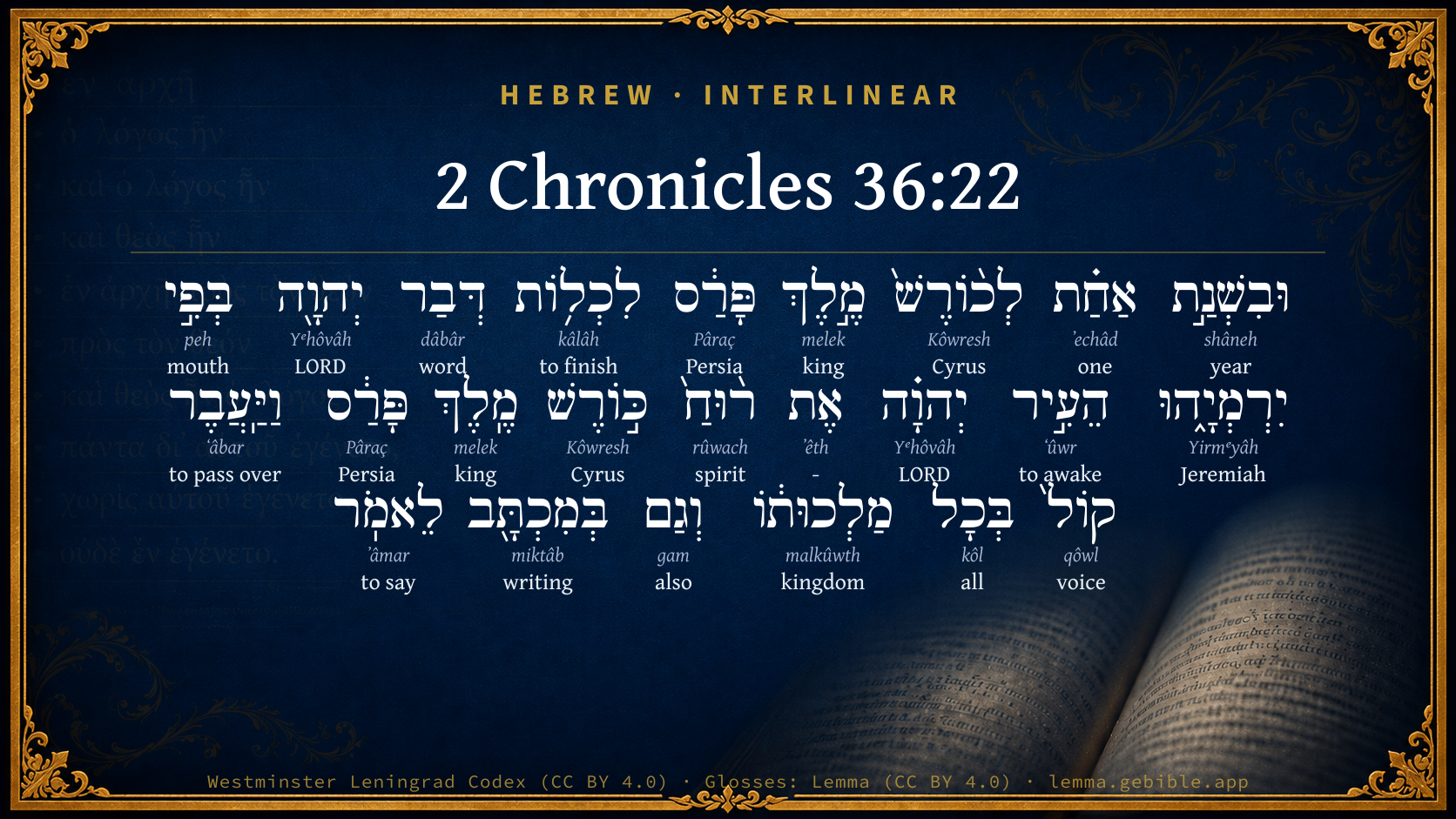
  1. וּבִשְׁנַ֣ת shâneh H8141 “and · in/at · year of” Conjunction + Preposition + Noun, Common, Feminine, Singular, Construct
  2. אַחַ֗ת ʼechâd H259 “one” Adjective, Cardinal number, Feminine, Singular, Absolute
  3. לְכ֨וֹרֶשׁ֙ Kôwresh H3566 “to/for · Cyrus” Preposition + Noun, Proper
  4. מֶ֣לֶךְ melek H4428 “king of” Noun, Common, Masculine, Singular, Construct
  5. פָּרַ֔ס Pâraç H6539 “Persia” Noun, Proper
  6. לִכְל֥וֹת kâlâh H3615 “to finish” Preposition + Verb, Qal, Infinitive Construct
  7. דְּבַר dâbâr H1697 “word of” Noun, Common, Masculine, Singular, Construct
  8. יְהוָ֖ה Yᵉhôvâh H3068 “LORD” Noun, Proper
  9. בְּפִ֣י peh H6310 “in/at · mouth of” Preposition + Noun, Common, Masculine, Singular, Construct
  10. יִרְמְיָ֑הוּ Yirmᵉyâh H3414 “Jeremiah” Noun, Proper
  11. הֵעִ֣יר ʻûwr H5782 “to awake” Verb, Hiphil, Perfect, 3rd Person, Masculine, Singular
  12. יְהוָ֗ה Yᵉhôvâh H3068 “LORD” Noun, Proper
  13. אֶת ʼêth H853 “-” Particle, Direct Object
  14. ר֨וּחַ֙ rûwach H7307 “spirit of” Noun, Common, Both, Singular, Construct
  15. כּ֣וֹרֶשׁ Kôwresh H3566 “Cyrus” Noun, Proper
  16. מֶֽלֶךְ melek H4428 “king of” Noun, Common, Masculine, Singular, Construct
  17. פָּרַ֔ס Pâraç H6539 “Persia” Noun, Proper
  18. וַיַּֽעֲבֶר ʻâbar H5674 “and · to pass over” Conjunction + Verb, Hiphil, Sequential Imperfect, 3rd Person, Masculine, Singular
  19. קוֹל֙ qôwl H6963 “voice” Noun, Common, Masculine, Singular, Absolute
  20. בְּכָל kôl H3605 “in/at · all of” Preposition + Noun, Common, Masculine, Singular, Construct
  21. מַלְכוּת֔וֹ malkûwth H4438 “kingdom · his” Noun, Common, Feminine, Singular, Construct + Suffix, Personal, 3rd Person, Masculine, Singular
  22. וְגַם gam H1571 “and · also” Conjunction + Particle, Accusative
  23. לֵאמֹֽר ʼâmar H559 “to say” Preposition + Verb, Qal, Infinitive Construct

About this verse

These counts appear in no published source. They are computed here, from the morphology-tagged text and Lemma’s own curated glosses. What Lemma adds →

24
words
20
distinct lemmas
Historical
section

Notable vocabulary

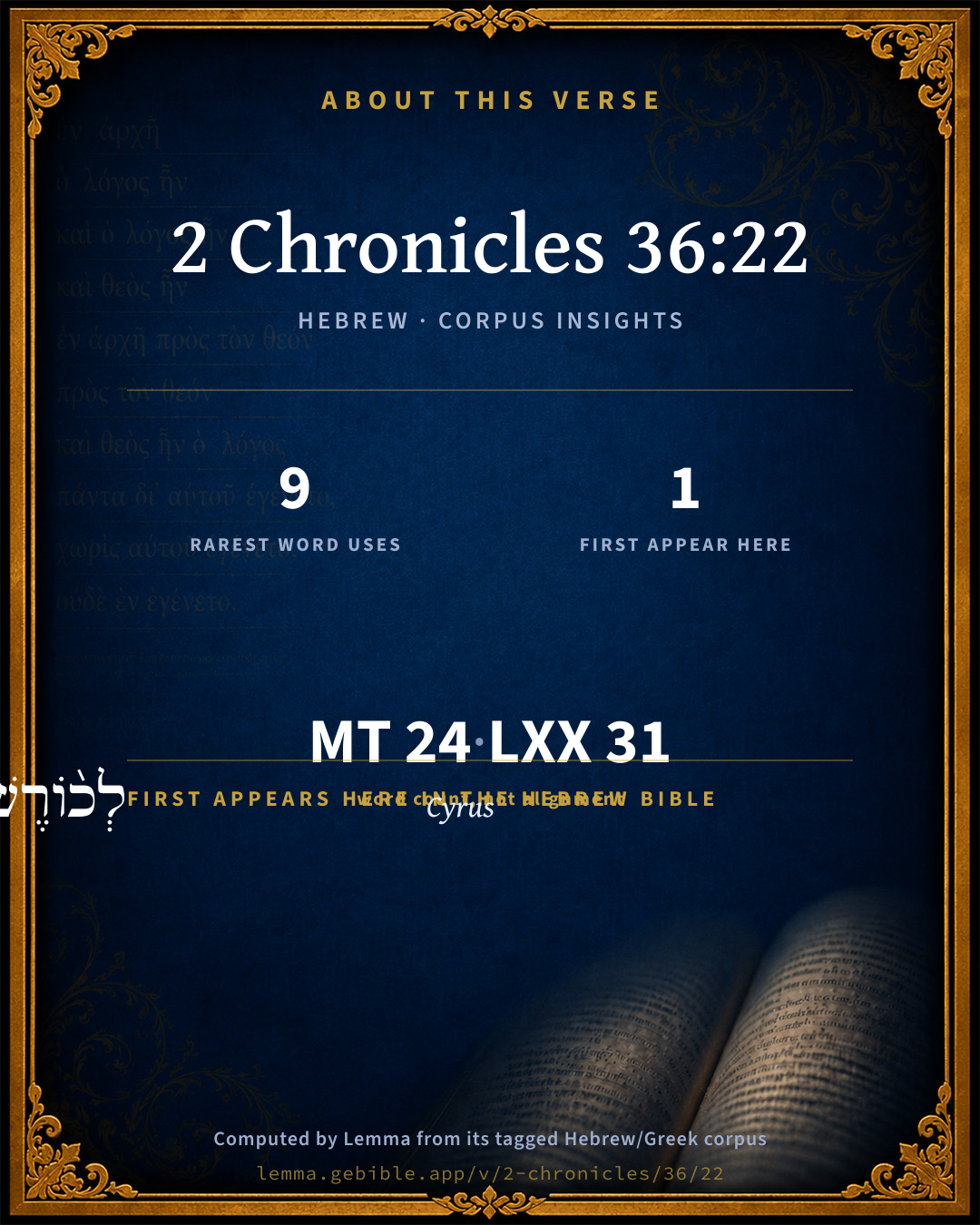
The rarest word here is בְּמִכְתָּ֖ב writing H4385 — appearing just 9 times in the whole Hebrew Bible.

First appearance in Scripture

This word makes its first canonical appearance in the Hebrew Bible here:

  • לְכ֨וֹרֶשׁ֙ Cyrus H3566

Shared distinctive vocabulary

בְּמִכְתָּ֖ב writing H4385 occurs in 8 verses of the Hebrew Bible. Also found in:

Grammatical profile

  • 4 verbs
  • 17 nouns
  • 1 adjective
  • 2 particles

Verb forms

  • לִכְל֥וֹת Qal · Infinitive Construct
  • הֵעִ֣יר Hiphil · Perfect
  • וַיַּֽעֲבֶר Hiphil · Sequential Imperfect
  • לֵאמֹֽר Qal · Infinitive Construct

Repetition

Words recur within this verse — often emphatic in Hebrew:

  • לְכ֨וֹרֶשׁ֙ Cyrus H3566 ×2
  • מֶ֣לֶךְ king H4428 ×2
  • פָּרַ֔ס Persia H6539 ×2
  • יְהוָ֖ה LORD H3068 ×2

Hebrew & Septuagint length

In English translation the verse runs 50 words from the Hebrew and 49 from the Septuagint (LXX English) — closely comparable.

A rough comparison of the two English renderings, which tokenize alike — not a word-level alignment.

Word counts can differ between the Hebrew and the Greek without any difference in meaning — e.g. the Hebrew direct-object marker אֵת has no separate Greek word, and Greek often adds the article ὁ.

In the original languages it is 24 Hebrew tokens and 31 Greek tokens — but the two are counted differently (Hebrew bundles its prefixes and suffixes into one token; the Greek is in lemma form), so that isn’t a like-for-like length.

Cross-references

21

Topical passages linked to 2 Chronicles 36:22 in the Treasury of Scripture Knowledge — connected by theme and wording, ordered by reader-vote popularity; previews shown in the World English Bible.

  • Jeremiah 25:12 It shall happen, when seventy years are accomplished, that I will punish the king of Babylon, and that nation, says Yahweh, for their iniquity, and the land of the Chaldeans; and I will make it desolate forever.
  • Ezra 1:1–3 Now in the first year of Cyrus king of Persia, that the word of Yahweh by the mouth of Jeremiah might be accomplished, Yahweh stirred up the spirit of Cyrus king of Persia, so that he made a proclamation throughout all his kingdom, and [put it] also in writing, saying,
  • Jeremiah 29:10 For thus says Yahweh, After seventy years are accomplished for Babylon, I will visit you, and perform my good word toward you, in causing you to return to this place.
  • 2 Chronicles 36:21 to fulfill the word of Yahweh by the mouth of Jeremiah, until the land had enjoyed its Sabbaths: [for] as long as it lay desolate it kept Sabbath, to fulfill seventy years.
  • Isaiah 44:28–45:5 Who says of Cyrus, [He is] my shepherd, and shall perform all my pleasure, even saying of Jerusalem, She shall be built; and of the temple, Your foundation shall be laid.
  • Isaiah 13:17–18 Behold, I will stir up the Medes against them, who shall not regard silver, and as for gold, they shall not delight in it.
  • Jeremiah 33:10–14 Thus says Yahweh: Yet again there shall be heard in this place, about which you say, It is waste, without man and without animal, even in the cities of Judah, and in the streets of Jerusalem, that are desolate, without man and without inhabitant and without animal,
  • Ezra 1:5 Then rose up the heads of fathers' [houses] of Judah and Benjamin, and the priests, and the Levites, even all whose spirit God had stirred to go up to build the house of Yahweh which is in Jerusalem.
  • Jeremiah 32:42–44 For thus says Yahweh: Like as I have brought all this great evil on this people, so will I bring on them all the good that I have promised them.
  • Daniel 10:1 In the third year of Cyrus king of Persia a thing was revealed to Daniel, whose name was called Belteshazzar; and the thing was true, even a great warfare: and he understood the thing, and had understanding of the vision.
  • 1 Samuel 26:19 Now therefore, please let my lord the king hear the words of his servant. If it be Yahweh that has stirred you up against me, let him accept an offering: but if it be the children of men, cursed be they before Yahweh: for they have driven me out this day that I shouldn't cling to Yahweh's inheritance, saying, Go, serve other gods.
  • 1 Kings 11:14 Yahweh raised up an adversary to Solomon, Hadad the Edomite: he was of the king's seed in Edom.
  • 1 Kings 11:23 God raised up [another] adversary to him, Rezon the son of Eliada, who had fled from his lord Hadadezer king of Zobah.
  • 1 Chronicles 5:26 The God of Israel stirred up the spirit of Pul king of Assyria, and the spirit of Tilgath Pilneser king of Assyria, and he carried them away, even the Reubenites, and the Gadites, and the half-tribe of Manasseh, and brought them to Halah, and Habor, and Hara, and to the river of Gozan, to this day.
  • 2 Chronicles 21:16 Yahweh stirred up against Jehoram the spirit of the Philistines, and of the Arabians who are beside the Ethiopians:
  • 2 Chronicles 24:9 They made a proclamation through Judah and Jerusalem, to bring in for Yahweh the tax that Moses the servant of God laid on Israel in the wilderness.
  • 2 Chronicles 30:5 So they established a decree to make proclamation throughout all Israel, from Beersheba even to Dan, that they should come to keep the Passover to Yahweh, the God of Israel, at Jerusalem: for they had not kept it in great numbers in such sort as it is written.
  • Isaiah 13:3–5 I have commanded my consecrated ones, yes, I have called my mighty men for my anger, even my proudly exulting ones.
  • Jeremiah 25:14 For many nations and great kings shall make bondservants of them, even of them; and I will recompense them according to their deeds, and according to the work of their hands.
  • Haggai 1:14 Yahweh stirred up the spirit of Zerubbabel, the son of Shealtiel, governor of Judah, and the spirit of Joshua, the son of Jehozadak, the high priest, and the spirit of all the remnant of the people; and they came and worked on the house of Yahweh of Hosts, their God,
  • Hebrews 10:23 let us hold fast the confession of our hope unyieldingly. For he who promised is faithful.

Cross-references courtesy of OpenBible.info (CC BY 4.0).

Hebrew and Greek witnesses Masoretic Hebrew ↔ Greek Septuagint

The same verse in the two great witnesses to the Old Testament, shown verse-for-verse.

These are two independent witnesses, not word-aligned to each other, and the Septuagint is shown in lemma (dictionary) form.

Hebrew 2 Chronicles 36:22 Masoretic · Westminster Leningrad Codex

וּבִשְׁנַ֣ת אַחַ֗ת לְכ֨וֹרֶשׁ֙ מֶ֣לֶךְ פָּרַ֔ס לִכְל֥וֹת דְּבַר יְהוָ֖ה בְּפִ֣י יִרְמְיָ֑הוּ הֵעִ֣יר יְהוָ֗ה אֶת ר֨וּחַ֙ כּ֣וֹרֶשׁ מֶֽלֶךְ פָּרַ֔ס וַיַּֽעֲבֶר קוֹל֙ בְּכָל מַלְכוּת֔וֹ וְגַם בְּמִכְתָּ֖ב לֵאמֹֽר

Now in the first year of Cyrus king of Persia, that the word of Yahweh by the mouth of Jeremiah might be accomplished, Yahweh stirred up the spirit of Cyrus king of Persia, so that he made a proclamation throughout all his kingdom, and [put it] also in writing, saying,

World English Bible · Public Domain

Greek LXX 2 Chronicles 36:22 Septuagint · lemma form

ἔτος πρῶτος κῦρος βασιλεύς πέρσης μετά ὁ πληρόω ῥῆμα κύριος διά στόμα ἰερεμίας ἐκἀγείρω κύριος ὁ πνεῦμα κῦρος βασιλεύς πέρσης καί παραἀγγέλλω κηρύσσω ἐν πᾶς ὁ βασιλεία αὐτός ἐν γραπτόν λέγω

In the first year of Cyrus king of the Persians, after the fulfillment of the word of the Lord by the mouth of Jeremias, the Lord stirred up the spirit of Cyrus king of the Persians, and told him to make proclamation in writing throughout all his kingdom, saying,

LXX2012 (modern English Septuagint) · Public Domain

Hebrew: Westminster Leningrad Codex (CC BY 4.0). Greek: Septuagint (public domain); English from LXX2012 (modern English Septuagint) (Public Domain). How the Septuagint differs from the Hebrew →

Commentary

Notes on 2 Chronicles 36:22 from classic Christian and Jewish commentators (each source and its license shown beneath its notes). The classic Christian expositions comment on the surrounding passage and are grouped to its opening verse, so a note may address several verses; the Jewish commentaries on the Tanakh (Rashi and others) are per-verse, so they appear only where the commentator wrote on this verse.

Lemma curates 59 commentaries, every one of them public domain or Creative Commons licensed, each selected and text-cleaned for this edition rather than reprinted as found. About our sources →

Matthew Henry's Commentary

These last two verses of this book have a double aspect. 1. They look back to the prophecy of Jeremiah, and show how that was accomplished, Ch2 36:22. God had, by him, promised the restoring of the captives and the rebuilding of Jerusalem, at the end of seventy years; and that time to favour Sion, that set time, came at last. After a long and dark night the day-spring from on high visited them. God will be found true to every word he has spoken. 2. They look forward to the history of Ezra, which begins with the repetition of these last two verses. They are there the introduction to a pleasant story; here they are the conclusion of a very melancholy one; and so we learn from them that, though God's church be cast down, it is not cast off, though his people be corrected, they are not abandoned, though thrown into the furnace, yet not lost there, nor left there any longer than till the dross be separated. Though God contend long, he will not contend always. The Israel of God shall be fetched out of Babylon in due time, and even the dry bones made to live. It may be long first; but the vision is for an appointed time, and at the end it shall speak and not lie; therefore, though it tarry, wait for it.

Matthew Henry's Commentary on the Whole Bible (1708–1710) — public domain (CC PDM 1.0). Text via the HelloAO Bible API.

Jamieson, Fausset & Brown

Robert Jamieson, A. R. Fausset & David Brown

CYRUS' PROCLAMATION. (Ch2 36:22-23)

the Lord stirred up the spirit of Cyrus--(See on Ezr 1:1-3).

Next: Ezra Introduction

Jamieson, Fausset & Brown — Commentary Critical and Explanatory on the Whole Bible (1871) — public domain (CC PDM 1.0). Text via the HelloAO Bible API.

Trapp's Complete Commentary

John Trapp

2Ch 36:22 Now in the first year of Cyrus king of Persia, that the word of the LORD [spoken] by the mouth of Jeremiah might be accomplished, the LORD stirred up the spirit of Cyrus king of Persia, that he made a proclamation throughout all his kingdom, and [put it] also in writing, saying,

2Ch 36:23 Thus saith Cyrus king of Persia, All the kingdoms of the earth hath the LORD God of heaven given me; and he hath charged me to build him an house in Jerusalem, which [is] in Judah. Who [is there] among you of all his people? The LORD his God [be] with him, and let him go up.

Ver. 22, 23. See Ezr 1:1, {See Trapp on "Ezr 1:1"}

Laus Deo in aeterum

John Trapp, A Commentary or Exposition upon All the Books of the Old and New Testament (1647–1656) — public domain. Text from a community e-Sword module.

The Biblical Illustrator

Joseph S. Exell

2Ch_36:22-23

Now, in the first year of Cyrus, king of Persta.

Cyrus: the divinely-directed deliverer

I. God stirred up cyrus to do a great and necessary work.

II. Cyrus was a fitting instrument for the great work.

III. God has various means whereby to incite to action.

IV. The divine incitement to the necessary work was at a most opportune time.

V. God teaches his instruments how as well as when to act.

VI. As the lord stirred up the spirit of Cyrus, so he can stir men now. (F. Hastings.)

He made a proclamation.--

The decree of Cyrus; or, all things for the Church

I. God uses kings and rulers for His Church. That the Lord raises up men within the Church to be leaders and mighty workers in her behalf is a fact which the Bible and all history fully prove. Such men were Noah, Abraham, Joseph, Moses, David, Paul, Augustine, Luther, Calvin, Wesley. But He calls men from without also to work for her. Conspicuous among this number is Cyrus, the Persian king. Though Cyrus be a marked illustration of the matter under discussion, especially so because of the clear declarations of prophecy on his behalf, still he is by no means the only one. Through the intervention of Joseph, God made Pharaoh the preserver of His people. The immediate successors of Cyrus on the Persian throne followed his example. Through the influence of Esther and Mordecai, Ahasuerus, in a most critical time, became the saviour of the Jews. Later, in the time of Darius, the interrupted work upon the temple at Jerusalem was renewed and pushed forward. Still later, in the days of Ezra and Nehemiah, Artaxerxes expended his royal treasure in establishing the remnant of the Jews in their ancient and. Alexander the Great, marching upon Jerusalem with a bitter purpose in his heart, is suddenly changed from foe to friend. Like Cyrus, he too doubtless was shown the sacred books of the Jews, and in the prophesy of Daniel saw himself described and his career delineated. The general policy of the Roman government was severe, but many of the emperors, moved by kindness of disposition or considerations of State, were lenient towards the Christians. Ere long the government itself became Christian, and throughout the Middle Ages, power was on the side of the Church. At the Reformation, whenever and wherever needed, men were raised up among the rulers of the world to be abettors of the new faith and breakwaters against the floods of persecution. Such were the elector of Saxony in the days of Luther, and measurably so Henry VIII of England. Such were the Syndics who stood around Calvin At Geneva. Such Elisabeth, Gustavus Adolphus, Cromwell And the same thing is transpiring in our own days.

II. God handles the nations for the good of the Church. We know that the nations round about the Hebrews in all their history were instruments in Gods hands for disciplining them and fashioning them to His will. To this end He ordered their affairs. And the same thing is apparent in these modern ages. Was it fortuitous that England early became Protestant and the champion of the new faith? Was it a thing of chance that Saxony, the Netherlands, Switzerland, Sweden, resisted the tyranny of the Pope? Did it merely happen that this broad land of ours was sealed against the efforts of Rome to possess it, and was preserved as virgin soil for a pure faith and a free government? Is not Gods hand in Englands occupancy of India, and can we not see that thereby that land is bespoken for Christ? Is Italys emancipation from the Pope wholly of man? Is Germanys attitude to Rome of Bismarck as much as it is of God? Blind is he who cannot see Gods use of the nations in these modem times!

III. God uses the worlds material resources and forces for the Church. God has always put the worlds wealth under tribute as He has needed it, from the day when Israel went out of Egypt to the present time. And the tribute increases as the Church increases. More of the worlds wealth is flowing into the channels of the Church now than ever before. But not merely wealth--money expression of value--but every good and uplifting form at work among men God uses for the development of His plan. Discovery, invention, progress in economical and industrial arts, natural science--all these things, which are represented in the complicated civilisation of our day, are likewise represented in the Christianity of the times. Providence takes them up and utilises them as they appear; nay, more, orders the time and the manner of their appearance. How true of the art of printing! The first book printed was the Bible, And from that day forward God has been presiding at the printing press and scattering its leaves for the healing of the nations. The fleets of commerce beam the gospel to the corners of the world. Discovery in geography, ethnology, philology adds new buttresses to Christianity. All these and the like, though material and natural forces, yet work spiritual results.

1. By all these means God fulfils His prophecies and accomplishes His purpose. None can hinder, none compel. On the trains of providence there are neither accidents nor delays.

2. Herein we see the undying nature of the Church. Great has been the heat of her affliction, but by it have her enemies been consumed.

3. The Spirit of God is abroad in the world, preparing the way for the coming of Christs kingdom. How should the servants of the Lord be encouraged in labour and in prayer by the Spirits antecedent work in every heart!

4. In all these things we have the assurance of the triumph of Gods kingdom. (H. S. Kelsey.)

The Biblical Illustrator, edited by Joseph S. Exell (c. 1880s–1900s) — public domain. Text from a community e-Sword module.

Joseph Benson's Commentary

2Ch 36:22. Now in the first year of Cyrus — Kennicott thinks that the last two verses of this book belong properly to the book of Ezra, and were subjoined to the Chronicles through the inadvertency of some transcriber. And thus ends the history of the kingdom of Judah, as governed by the successors of the illustrious King David, with the destruction of Jerusalem, the temple, and the whole Jewish monarchy, by the conquest of the Babylonian king: which, in the course of a righteous providence, in punishment of the idolatry and other sins of this people, fell out about nine hundred and three years after their deliverance from Egypt; eight hundred and sixty-three from their first entrance into the land of Canaan; four hundred and sixty-eight from David’s reign; four hundred and seventeen after the building of the temple; and one hundred and thirty-four after the destruction of the kingdom of the ten tribes.

It is justly observed by a late writer, that the propriety of this dispensation of Divine Providence toward this people will appear, if we reflect,

1st, That this dreadful calamity came upon them gradually, by a succession of judgments, from less to greater, for the space of twenty-two years; in which the lenity of God was very apparent, and which should have been a warning to them, that the threatenings denounced by the prophets would certainly be executed; but which effected no amendment of the religion or morals of the nation; Zedekiah, the last king, being as bad as his predecessors.

2d, That it was a just punishment of their sins, particularly of their idolatry, whereby they forsook God, and therefore God justly forsook them, and delivered them into the hands of their enemies, as Moses had foretold, Lev 26:30-36.

3d, That this terrible overthrow was the most effectual means to work their reformation, which was the end proposed by the divine wisdom. Now, in their captive, disconsolate state, they had time, and their calamities had a natural tendency to give them a disposition, to reflect upon the long series of iniquity and perverseness which had brought them under the heaviest of God’s judgments. Now their own wickedness corrected them, and their backslidings reproved them: now they must know and see that it was an evil thing and bitter, that they had forsaken the Lord their God, and that his fear had not been in them, Jer 2:19. In the land of their captivity, the sermons of the prophets, declaiming with the highest authority against their profane and vicious practices, would be still sounding in their ears, and their abject, wretched condition, the consequence of such practices, would cause these discourses to sink deep into their hearts, and produce an utter detestation of what they very well knew was the cause of all their grievous sufferings.

4th, The law of God, written by Moses, as the rule of their conduct in all affairs, civil and religious, and the ground of their happiness, they had so far neglected, that once it was almost unknown and lost among them, 2Ki 22:8-12. This contempt of the divine law the prophets had frequently and strongly protested against, and publicly declared that it would be their ruin. And in their ruined state this would be remembered as the primary reason of all their sufferings; and they would be made thoroughly sensible that a due regard to the law of God was the only way to recover his favour and their own prosperity; and accordingly would be disposed to attend to it; which, in some measure, was the case. This was another good effect of this dispensation, and may justly be given as one good reason of their being so strongly fixed against idolatry ever after the Babylonish captivity.

5th, This dispensation was also calculated to produce good effects among the nations whither they were carried into captivity. For wherever they were dispersed, in the eastern countries, they would bring with them the knowledge of the true God, now seriously impressed upon their hearts. But Divine Providence, by such signal circumstances of his interposition as were published and known over all the vast extent of the eastern empire, raised some of the captive Jews to the highest posts of dignity and power in the courts of Assyria and Persia, (Dan 1:19-20,) insomuch that the most haughty monarchs openly confessed the living and true God, (Dan 2:47-49; Dan 4:34, &c.,) and made decrees, which were published throughout their spacious dominions, in favour of the profession and worship of him. Dan 3:29; Dan 6:25, &c. From all this, it is clear, that the Jews, notwithstanding their depravity in their own country, during the captivity of seventy years, must have been the means of diffusing a blessed light all over the eastern countries. And thus, in this dispensation also, God, the Father and Governor of mankind, was working for the reformation and improvement of the world, in that which is the true excellence of their nature, and the only foundation of their happiness. See Dodd and Taylor’s Scheme of Scripture Doctrine.

Joseph Benson's Commentary on the Old and New Testaments (1811–1818) — public domain. Text from a community e-Sword module.

Tyndale Open Study Notes

Tyndale Open Resources

36:22-23 Chronicles concludes with the verses that form the introduction to Ezra. King Cyrus of Persia permitted the community of Judah to experience a new exodus, as proclaimed by the prophet Isaiah (Isa 40:1-11).

Tyndale Open Study Notes — © Tyndale Open Resources, licensed CC BY-SA 4.0. Text via the HelloAO Bible API.

Geneva Bible (1599)

Geneva Bible translators

In the first year that he reigned over the Chaldeans, Ezra 1:1.

Geneva Bible (1599) marginal notes — public domain. Text via Bolls.life.

Adam Clarke's Commentary

Verse 22. Now in the first year of Cyrus] This and the following verse are supposed to have been written by mistake from the book of Ezra, which begins in the same way. The book of the Chronicles, properly speaking, does close with the twenty-first verse, as then the Babylonish captivity commences, and these two verses speak of the transactions of a period seventy years after. This was in the first year of the reign of Cyrus over the empire of the East which is reckoned to be A.M. 3468. But he was king of Persia from the year 3444 or 3445. See Calmet and Usher.

Adam Clarke's Commentary on the Bible (1810–1826) — public domain. Text from a community e-Sword/MySword module.

The Cambridge Bible for Schools and Colleges

gen. ed. J. J. S. Perowne

22. stirred up the spirit] Cp. 1Ch_5:26; Hag_1:14.

made a proclamation] cp. 2Ch_30:5. The phrase is characteristic of the Chronicler.

22, 23 (= Ezr_1:1-3 a; 1Es_2:1-5 a). Cyrus Decrees the Rebuilding of the Temple

On this section see the full notes of Professor Ryle on Ezra.

The historical character of this decree of Cyrus has been questioned (on purely subjective grounds) by Cheyne, Jewish Religious Life after the Exile, pp. 5–7.

The Cambridge Bible for Schools and Colleges (gen. ed. J. J. S. Perowne; Cambridge University Press, 1878–1918) — public domain. Text from a community e-Sword module.

Albert Barnes' Notes on the Bible

This and the next verse are repeated at the commencement of the book of Ezra Ezr 1:1-3, which was, it is probable, originally a continuation of Chronicles, Chronicles and Ezra together forming one work. See the introduction to Chronicles.

Albert Barnes' Notes on the Bible (1834–1885) — public domain. Text from a community e-Sword/MySword module.

Haydock's Catholic Bible Commentary

First. Cyrus had ruled over Persia from the year of the world 3444. He was now emperor of the east. The year of the world 3468. C. --- These two verses are repeated by Esdras, which evinces that he was the author of this work also, (T.) adding them when he restored (W.) or revised (H.) the holy scriptures. W.

George Leo Haydock (1774–1849), Haydock's Catholic Family Bible and Commentary, 1859 edition — public domain. Excludes Psalms (Douay-Rheims chapter numbering differs from Protestant) and Deuterocanonical books (Catholic canon only).

Matthew Poole's English Annotations

This and the next verse are repeated in the beginning of the next book, where they will be more fitly explained.

Matthew Poole's English Annotations on the Holy Bible (1683–1685) — public domain. Text from a community e-Sword/MySword module.

The Pulpit Commentary

In the first year of Cyrus King of Persia. A period of half a century has elapsed between the latest date of the foregoing verses (circ. B.C. 586) and the date signalized here (circ. B.C. 5.38-6). With the proclamation of Cyrus begins in fact the manhood, with all its mystic, its wonderful, and its still non-progressing struggles, of the Jew. His simple childhood, wilful youth, am indeed for ever gone. But he and his nation are with unspeakably painful travail born. No life of nation that is or ever has been merits the devout observation and study that this unchal-lengeably does. Our present verse and the one succeeding it are, sentence for sentence, the same with the opening verses of the Book of Ezra, which may possibly once have joined on to Chronicles, as one work, though we think this exceedingly unlikely. Cyrus (the vr,wOk of the Hebrew text) was the son of a royal Persian, Cambysses; his mother was Mandane, daughter of Astyages, last King of Media. The name appears on the monuments, written Kurus. Cyrus defeated his grandfather Astyages, B.C. 559; ending thereby the Median royal line; and he defeated Croesus, B.C. 546, possessing himself thereby of the kingdom of Lydia; he took Babylon, as above, B.C. 538. He himself died in battle, B.C. 529. That the word of the Lord by Jeremiah might be accomplished. (see Jer_25:11-14 Jer_29:9-11) The Lord stirred up the spirit of Cyrus. The fact is told us, and this, no doubt, as on a thousand other unsuspected occasions of far more intrinsic and vital interest in the Bible, is sufficient. It would have been interesting to know, however, even here, the mode in which Cyrus was appealed to; as, e.g. , it has been plausibly suggested that Daniel may have been in part instrumental in the work, and that, again, in part perhaps by directing the attention of Cyrus to Isa_44:28 Isa_45:1.

Vers. 22, 23.

Cyrus of Persia; or, the return of the exiles.

I The GREAT DELIVERER. (Ver. 22.)

1. Foretold in Scripture.

(1) That his name should be Cyrus.

(2) That he should come from the East.

(3) That he should be a mighty conqueror, subduing nations and dethroning kings.

(4) That he should overthrow Babylon, and become the sovereign of the empire of that name.

(5) That he should liberate the captive Jews in that city and empire.

(6) That he should issue orders or grant permission for the rebuilding of both the city and the temple of Jerusalem.

(7) That in doing all this he should act (whether consciously or unconsciously is not stated) under the immediate guidance and direct superintendence of Jehovah. (Isa_41:2 Isa_44:28 Isa_45:1-5 Isa_46:11 Isa_48:14, Isa_48:15)

2. Raised up in history.

(1) He was called Cyrus, in Hebrew Coresh; (ver. 22 Ezr_1:1) in the inscriptions K"ur"us and Ku-ra-as (Schrader, "Die Keilinschriften," p. 372).

(2) He came from the East, being named in sacred history; (ver. 22 Ezr_1:1 Ezr_4:3; Dan_6:28) as well as in profane (Herod., 9:122; Xen., "Cyr.," 8. 2:7), King of Persia, though the monuments now show that he was originally King of Elam, on the east of Persia (Sayce, "Fresh Light," etc., pp. 168, etc.).

(3) First he conquered Astyages the Median, who had marched against him in the sixth year of Nabonidus King of Babylon. Next, before the ninth year of Nabonidus, he must have acquired the sovereignty of Persia, as in that year he calls himself "King of Persia.

(4) In the month Nisan (March), of the ninth year of Nabonidus, Cyrus marched his troops into Accad, or Northern Babylonia. In the tenth year Erech was captured. In the eleventh the situation remained in statu quo. In the seventeenth year, in the month of Tammuz (July), Cyrus encountered the army of Accad in the town of Rutum, upon the river Nizallat, when the soldiers of Nabonidus broke into revolt. On the fourteenth day the garrison of Sippara surrendered, while Nabonidus fled. On the sixteenth the governor of Gutium (Kurdistan) marched the troops of Cyrus into Babylon without requiring to strike a blow. Nabonidus, subsequently captured, was cast into fetters in Babylon. Whether the siege of Babylon described by Herodotus (3:158, 159) was this of Cyrus (Budge), or a later one of Darius Hystaspis (Sayce), need not here be determined; it is sufficient to note that after this Cyrus assumed the title "King of Babylon" (Ezr_5:13) in addition to his other titles of Persia and King of Elam.

(5) The clay cylinder of Cyrus contains "a reference to the restoration of the Babylonian captives to their several homes. The experience of Cyrus had taught him that the old Assyrian and Babylonian system of transporting conquered nations was an error, and did but introduce a dangerously disaffected people into the country to which they had been brought" (Sayce, ibid.).

(6) "Those who chose to return to Jerusalem were allowed to do so, and there rebuild a fortress, which Cyrus considered would be useful to him as a check upon Egypt" (Sayce).

(7) In the Cyrus cylinder it is said, "Merodach sought out a king for himself who would perform according to the heart"s desire of the god whatever was entrusted to him. He proclaimed the renown of Cyrus the King of Anzan Elam, Sayce; Persia, Budge throughout the length and breadth of the land Merodach, the great lord, directed his (Cyrus"s) hand-and heart" (Budge, " Babyonian Life," etc., pp. 80, 81).

II THE CHEERING PROCLAMATION. (Ver. 23.)

1. Its date. The first year of Cyrus, i.e. the first year of his reign as King of Babylon, i.e. B.C. 538 (Canon of Ptolemy).

2. Its cause. The stirring up of his heart by Jehovah. Though the monuments have shown that Cyrus was not a monotheist, but a polytheist, they have also made it manifest that he considered himself as under the immediate guidance of Heaven in the taking of Babylon; and hence, it may be assumed, also in the liberation of the captives. That he was powerfully persuaded of the propriety of such an action, and regarded his impulse in that direction as "from Heaven," is apparent. The sacred writer states that the true source of that inspiration was Jehovah. Cyrus believed it to be Merodach.

3. Its design. To fulfil the Word of the Lord by the mouth of Jeremiah, (Jer_29:10) that after seventy years the captives should be restored. This was Jehovah"s design, not Cyrus"s concerning which see above. That the seventy years, in round numbers, were accomplished, can be seen from an easy calculation. Dating from s.c. 599, the year of Jehoiachin"s captivity, and setting down the first year of Cyrus as B.C. 538, the interval is only sixty-one years; but if the period of the exile be dated from the third (Dan_1:1) or the fourth year of Jehoiakim, (Jer_25:1-12) i.e. B.C. 606, then the interval from Jeremiah"s prediction to Cyrus"s proclamation will be sixty-eight years, or sixty-nine inclusive, which, with the months that elapsed before the first company of exiles settled in Palestine, (Ezr_3:1) will practically make seventy years. Or the prophetic year may be taken as consisting of 360 days; in which case 360 70 = 25, 200 days = 69 years of 365 days.

4. Its form.

(1) Vocal; being probably proclaimed by means of heralds (cf. (2Ch_30:5, 2Ch_30:6)

(2) Written; being most likely set forth in two languages Persian and Chaldee.

5. Its contents.

(1) A devout acknowledgment of Heaven"s grace. "All the kingdoms of the earth hath the Lord God of heaven given me" (ver. 23; (Ezr_1:1) the term "Jehovah" being employed in the Hebrew copy instead of "Ormazd," in the Persian. Persian sovereigns were accustomed to speak of the Supreme Being as the God of heaven, (Ezr_6:9, 10 7:12, 23) and to recognize their dependence on him for their earthly power, an inscription of Darius saying, "Then the land was mine, and the other lands which Ormazd has given into my hand. I conquered them by the grace of Ormazd" ("Records," etc., 9:68). And the cylinder of Cyrus stating, "Cyrus King of Elam, he (Merodach) proclaimed by name for sovereignty; all men everywhere commemorate his name" (Sayce, "Fresh Light," etc., p. 172).

(2) A hearty submission to Divine will. "He hath charged me to build him a house in Jerusalem, which is in Judah." According to Josephus ("Ant.," 11:1. 2), Cyrus learnt the Divine will concerning himself by reading Isaiah"s prophecy; (Isa_44:28) but as Cyrus, whether a polytheist (Sayce) or a monotheist (Budge), was extremely tolerant to all religions, and as on capturing Babylon he immediately proceeded to restore the shrines of the Babylonian gods, he may have conceived himself as called upon by Jehovah to do the same thing for the Jews in Palestine.

(3) An earnest inquiry after Jehovah"s people. "Who is there among you of all his people. The proclamation was not limited to the Judahites, but extended to all worshippers of Jehovah to those who had been carried captive from both kingdoms.

(4) A free permission to return to Jerusalem. "Let him go up." "Jerusalem was on a much higher level than Babylonia, and the travellers would consequently have to ascend considerably" ("Pulpit Commentary on Ezra," 1:3.).

(5) A solemn benediction on those who availed themselves of his permission. The Lord his God be with him." The expression of this wish or pray corresponded with the mild and benevolent character of Cyrus.

LESSONS.

1. The ability of God to fulfil his promises no less than his threatenings.

2. The secret access which God has to the hearts of men of kings no less than of common men.

3. The certainty that God can raise up at any moment a fitting instrument to do his will. W.

The Pulpit Commentary (1880–1919), ed. H.D.M. Spence-Jones & Joseph S. Exell — public domain. Text from a community e-Sword module.

Keil & Delitzsch

C. F. Keil & F. Delitzsch

To point out still further how exactly God had fulfilled His word by the mouth of the prophet Jeremiah, it is in conclusion briefly mentioned that God, in the first year of Coresh king of Persia, stirred up the spirit of this king to cause a command to go forth in all his kingdom, that Jahve, the God of heaven, who had given him all the kingdoms of the earth, had commanded him to build again His temple in Jerusalem, and that whoever belonged to the people of God might go up to Jerusalem. With this comforting prospect for the future, the author of the Chronicle closes his consideration of the prae-exilic history of the people of God without completely communicating the contents of the royal edict of Cyrus, since he purposed to narrate the history of the restoration of Judah to their own land in a separate work. This we have in the book of Ezra, which commences by giving us the whole of the edict of Cyrus the king of the Persians (Ezr 1:1-3), and then narrates the return of a great part of the people to Jerusalem and Judah, the rebuilding of the temple, and the re-settlement in the land of their fathers of those who had returned.

Keil & Delitzsch — Biblical Commentary on the Old Testament (1861–1891) — public domain (CC PDM 1.0). Text via the HelloAO Bible API. (Old Testament only.)

unfoldingWord translationNotes

Door43 World Missions Community

in the first year

This refers to the beginning of the reign of King Cyrus. (See: Ordinal Numbers)

so that the word of Yahweh by the mouth of Jeremiah might be carried out

Here the noun "word" can be translated with the verb "spoke." The word "mouth" represents Jeremiah. This can be stated in active form. AT: "so that what Yahweh spoke through Jeremiah might happen" or "so that the word from Yahweh that Jeremiah spoke might happen" (See: Synecdoche and Active or Passive)

Yahweh motivated the spirit of Cyrus, king of Persia

Motivating the spirit is a synecdoche for making someone want to act. AT: "Yahweh made Cyrus, king of Persia, want to act" (See: Synecdoche)

all the kingdoms of the earth

This is an exaggeration, as there were kingdoms over which Cyrus did not rule. (See: Hyperbole and Generalization)

to build a house for him

Here the word "house" represents a temple. AT: "to build a temple for him" (See: Metonymy)

his people

"Yahweh's people"

Let him go up to the land

"Let that person go up to the land of Judah"

translationWords

Cyrus

spirit

preach

kingdom

earth

heaven

command

house of God

Judah

unfoldingWord translationNotes — © Distant Shores Media and the Door43 World Missions Community, licensed CC BY-SA 4.0. Source: git.door43.org/Door43/en_tn.

Rashi

Rabbi Shlomo Yitzchaki (Rashi)

the spirit of Cyrus his will.

and he issued a proclamation lie made an announcement to all his subjects.

and also in writing He sent to all his subjects, saying.

Rashi on the Tanakh — English translations: “The Judaica Press complete Tanach with Rashi, translated by A. J. Rosenberg” (CC BY 4.0); “Pentateuch with Rashi's commentary by M. Rosenbaum and A.M. Silbermann, 1929-1934” (public domain); “The Metsudah Tanach series, Lakewood, N.J” (CC BY 4.0); and “The Book of Joshua, Metsudah Publications, 1997” (CC BY 4.0). Text via Sefaria.

Lesson kit

Teaching starters — assembled from the data on this page, not authored interpretation. Every prompt links to the verse data it draws on. Edit before teaching.

2 Chronicles, in the Historical, opens this verse with 24 words (20 distinct Hebrew lemmas). Its most distinctive word is miktâb (“writing”). A historical commentator’s framing appears above. Read the whole chapter for the surrounding context.

Discussion questions

  1. What does “writing” (miktâb) contribute to the verse as a whole?
  2. This is the first place “Cyrus” appears in Scripture (first appears here). What does its debut here establish?
  3. How does Exodus 32:16, which shares the word «writing», read alongside this verse?
  4. What does the repetition of “Cyrus” (2× in this one verse) do in this verse?
  5. These translations render this verse differently. What is at stake in choosing one wording over another?
  6. «לִכְל֥וֹת» is a Qal Infinitive Construct verb. How does that grammatical form shape the action described?
  7. Compare how Matthew Henry's Commentary and Jamieson, Fausset & Brown read this verse. Where do they agree or differ?

Things to notice

Reading settings

Reading text

Shown beneath each verse's original-language words.

Old Testament
Old Testament edition

Read the OT as the Masoretic Hebrew (MT) or the Greek Septuagint (LXX).

English shown for the Greek Septuagint (in the Hebrew ↔ Greek comparison).

Comparing translations? Open the Compare panel on any verse page to stack up to four side by side.