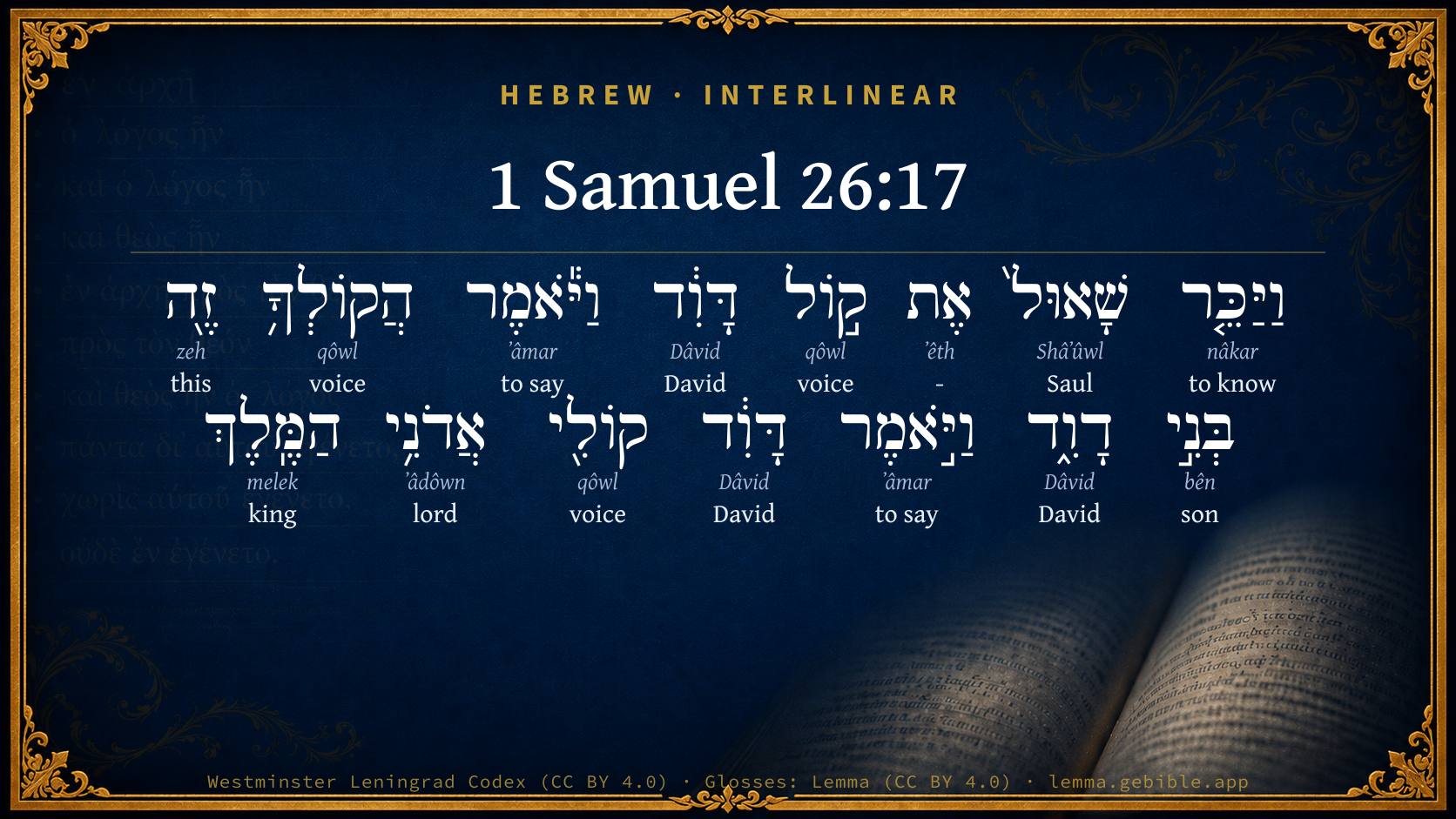
1 Samuel 26:17

Hebrew (Westminster Leningrad Codex) 1 Samuel 26:17 appears in the Hebrew Old Testament. The text above is from the Westminster Leningrad Codex. Each word links to its Strong’s number, a concise gloss, and parsing drawn from the Open Scriptures Hebrew Bible morphology. Click any word for its full Brown-Driver-Briggs (BDB) entry.
Download image
Cite this verse

1 Samuel 26:17 (World English Bible). Public Domain. Lemma interlinear Bible study tool, https://lemma.gebible.app/v/1-samuel/26/17.

Show BibTeX & RIS
BibTeX
RIS
English Translation
Saul knew David's voice, and said, Is this your voice, my son David? David said, It is my voice, my lord, O king.
World English Bible · Public Domain
Download a study sheet

One document with this verse’s original text, its word-by-word gloss line, the meaning frame, cross-references with their text, attributed commentary, and full source and license credits — printable, and it pastes into notes with its structure intact.

This verse Autodidact and up

Study sheet (.html) Plain text (.txt)

A passage Seminary Student

Up to 50 verses in one chapter. A passage sheet keeps up to 6 commentary sources and 12 cross-references per verse, in the order this page ranks them, and says so on the sheet whenever that leaves anything out. Ask for a single verse and you get the Autodidact verse sheet above.

Everything on this page stays free to read, with no account — the sheet is a download of what is already on screen, not access to it.

Want to remove ads? Support Godless Engineer
Compare translations 3

The same verse in 3 English versions, stacked beneath the original-language interlinear above. Click any original word for its lexicon entry.

Each is an independent rendering of the whole verse — the interlinear is not word-aligned to these translations.

Highlighted words mark where these versions differ — a whole-verse word diff, not a word-by-word alignment.

  • World English Bible Public Domain
    Saul knew David's voice, and said, Is this your voice, my son David? David said, It is my voice, my lord, O king.
  • King James Version Public Domain
    And Saul knew David's voice, and said, Is this thy voice, my son David? And David said, It is my voice, my lord, O king.
  • unfoldingWord Literal Text CC BY-SA 4.0
    And Saul recognized the voice of David and said, “ this your voice, my son David?” And David said, “My voice, my lord the king.”

unfoldingWord Literal Text — © unfoldingWord, licensed CC BY-SA 4.0. Word-aligned USFM3 via Door43 (git.door43.org/unfoldingWord/en_ult).

Versions to compare (up to 4)

3 of 4 selected

Show all 18 translations

Every available English version of this verse, each an independent rendering of the whole verse.

  • World English Bible Public Domain
    Saul knew David's voice, and said, Is this your voice, my son David? David said, It is my voice, my lord, O king.
  • Berean Standard Bible Public Domain
    Then Saul recognized David’s voice and asked, “Is that your voice, David my son?” “It is my voice, my lord and king,” David said.
  • Majority Standard Bible Public Domain
    Then Saul recognized David’s voice and asked, “Is that your voice, David my son?” “It is my voice, my lord and king,” David said.
  • King James Version Public Domain
    And Saul knew David's voice, and said, Is this thy voice, my son David? And David said, It is my voice, my lord, O king.
  • American Standard Version (1901) Public Domain
    And Saul knew David's voice, and said, Is this thy voice, my son David? And David said, It is my voice, my lord, O king.
  • Revised Version (1885) Public Domain
    And Saul knew David’s voice, and said, Is this thy voice, my son David? And David said, It is my voice, my lord, O king.
  • Geneva Bible (1599) Public Domain
    And Saul knewe Dauids voyce, and sayde, Is this thy voyce, my sonne Dauid? And Dauid sayde, It is my voyce, my lorde O King.
  • Douay-Rheims (1899) Public Domain
    And Saul knew David's voice, and said: Is this thy voice, my son David? And David said: It is my voice, my lord the king.
  • Young's Literal Translation Public Domain
    And Saul discerneth the voice of David, and saith, `Is this thy voice, my son David?' and David saith, `My voice, my lord, O king!'
  • Literal Standard Version CC BY-SA 4.0
    And Saul discerns the voice of David and says, “Is this your voice, my son David?” And David says, “My voice, my lord, O king!”
  • Unlocked Literal Bible CC BY-SA 4.0
    Saul recognized David's voice and said, “Is that your voice, my son David?” David said, “It is my voice, my master, king.”
  • unfoldingWord Literal Text CC BY-SA 4.0
    And Saul recognized the voice of David and said, “ this your voice, my son David?” And David said, “My voice, my lord the king.”
  • Darby Bible Public Domain
    And Saul knew David's voice, and said, Is this thy voice, my son David? And David said, It is my voice, my lord, O king.
  • World Messianic Bible Public Domain
    Saul recognized David’s voice, and said, “Is this your voice, my son David?” David said, “It is my voice, my lord, O king.”
  • Webster's Bible Public Domain
    And Saul knew David's voice, and said, Is this thy voice, my son David? and David said, It is my voice, my lord, O king.
  • Free Bible Version CC BY-SA 4.0
    Saul recognized David's voice and asked, “Is that you speaking, David, my son?” “Yes it's me, my lord and king,” David replied.
  • Bible in Basic English Public Domain
    And Saul, conscious that the voice was David's, said, Is that your voice, David, my son? And David said, It is my voice, O my lord king.
  • JPS Tanakh (1917) Public Domain
    And Saul knew David's voice, and said: 'Is this thy voice, my son David?' And David said: 'It is my voice, my lord, O king.'

Literal Standard Version (2020), Covenant Press — licensed CC BY-SA 4.0. Text via the HelloAO Bible API (eBible.org). Unlocked Literal Bible (unfoldingWord) — licensed CC BY-SA 4.0. Text via the HelloAO Bible API (eBible.org). unfoldingWord Literal Text — © unfoldingWord, licensed CC BY-SA 4.0. Word-aligned USFM3 via Door43 (git.door43.org/unfoldingWord/en_ult). Free Bible Version, Dr. Jonathan Gallagher — licensed CC BY-SA 4.0. Text via the HelloAO Bible API (eBible.org).

Word by word

More ways to search: Search by grammar → Find every occurrence → Compare this word →

Practice this passage: Drill this verse → Learn its vocabulary →

וַיַּכֵּ֤ר
nâkar
H5234
“and · to know”
Conjunction + Verb, Hiphil, Sequential Imperfect, 3rd Person, Masculine, Singular
Part of Speech
Conjunction + Verb
Stem
Hiphil
Form
Sequential Imperfect
Person
3rd Person
Gender
Masculine
Number
Singular
Full BDB Definition

Origin: a primitive root

TWOT: 1368

to recognise, acknowledge, know, respect, discern, regard - (Niphal) to be recognised - (Piel) to regard - (Hiphil) - to regard, observe, pay attention to, pay regard to, notice - to recognise (as formerly known), perceive - to be willing to recognise or acknowledge, acknowledge with honour - to be acquainted with - to distinguish, understand - (Hithpael) to make oneself known - to act or treat as foreign or strange, disguise, misconstrue - (Niphal) to disguise oneself - (Piel) - to treat as foreign (profane) - to misconstrue - (Hithpael) - to act as alien - to disguise oneself
  1. שָׁאוּל֙ Shâʼûwl H7586 “Saul” Noun, Proper
  2. אֶת ʼêth H853 “-” Particle, Direct Object
  3. ק֣וֹל qôwl H6963 “voice of” Noun, Common, Masculine, Singular, Construct
  4. דָּוִ֔ד Dâvid H1732 “David” Noun, Proper
  5. וַיֹּ֕אמֶר ʼâmar H559 “and · to say” Conjunction + Verb, Qal, Sequential Imperfect, 3rd Person, Masculine, Singular
  6. הֲקוֹלְךָ֥ qôwl H6963 “voice · your” Particle, Interrogative + Noun, Common, Masculine, Singular, Construct + Suffix, Personal, 2nd Person, Masculine, Singular
  7. זֶ֖ה zeh H2088 “this” Pronoun, Demonstrative, Masculine, Singular
  8. בְּנִ֣י bên H1121 “son · my” Noun, Common, Masculine, Singular, Construct + Suffix, Personal, 1st Person, Common, Singular
  9. דָוִ֑ד Dâvid H1732 “David” Noun, Proper
  10. וַיֹּ֣אמֶר ʼâmar H559 “and · to say” Conjunction + Verb, Qal, Sequential Imperfect, 3rd Person, Masculine, Singular
  11. דָּוִ֔ד Dâvid H1732 “David” Noun, Proper
  12. קוֹלִ֖י qôwl H6963 “voice · my” Noun, Common, Masculine, Singular, Construct + Suffix, Personal, 1st Person, Common, Singular
  13. אֲדֹנִ֥י ʼâdôwn H113 “lord · my” Noun, Common, Masculine, Singular, Construct + Suffix, Personal, 1st Person, Common, Singular
  14. הַמֶּֽלֶךְ melek H4428 “the · king” Particle, Definite Article + Noun, Common, Masculine, Singular, Absolute

About this verse

These counts appear in no published source. They are computed here, from the morphology-tagged text and Lemma’s own curated glosses. What Lemma adds →

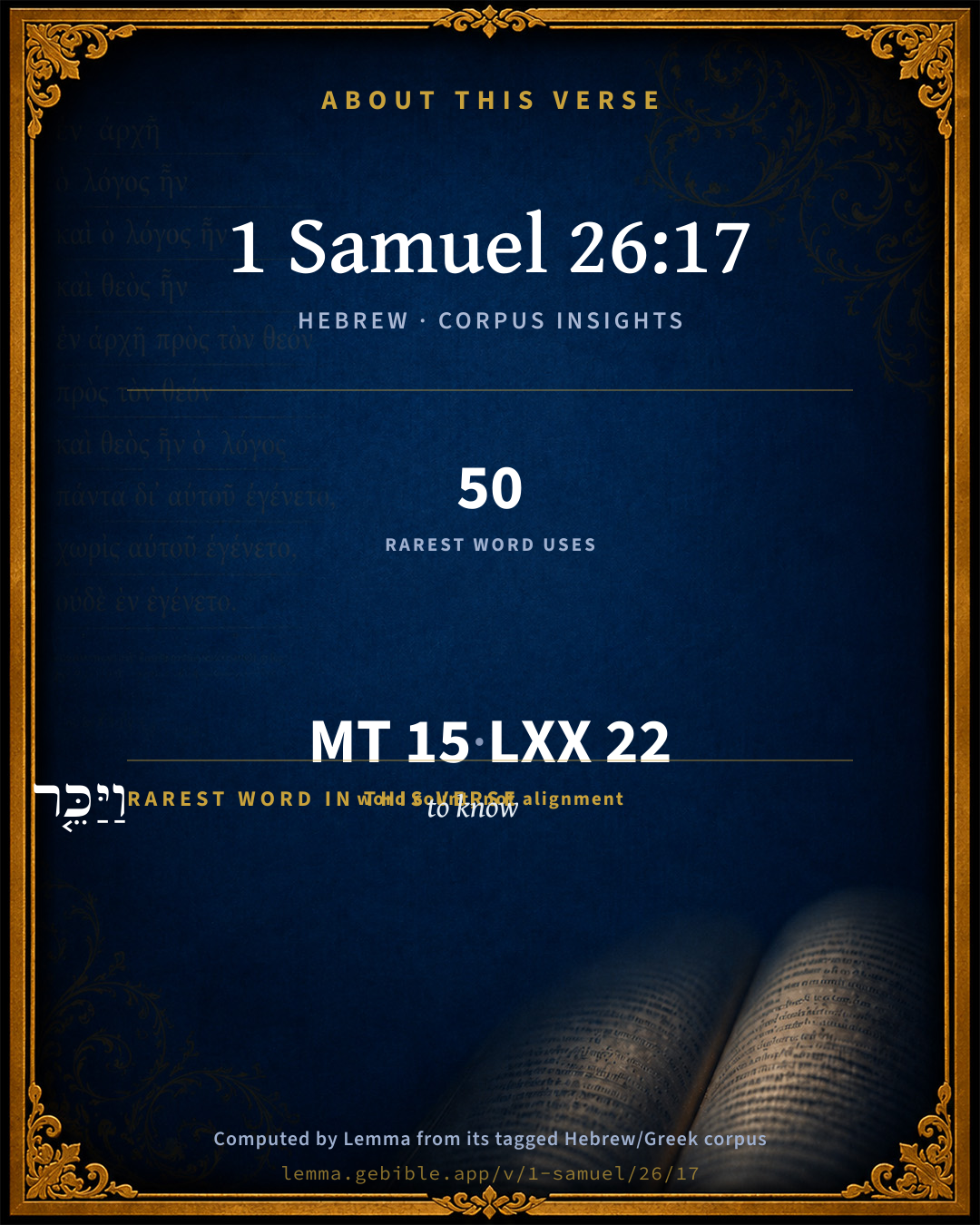
15
words
10
distinct lemmas
Historical
section

Shared distinctive vocabulary

וַיַּכֵּ֤ר to know H5234 occurs in 47 verses of the Hebrew Bible. Also found in:

Grammatical profile

  • 3 verbs
  • 10 nouns
  • 1 pronoun
  • 1 particle

Verb forms

  • וַיַּכֵּ֤ר Hiphil · Sequential Imperfect
  • וַיֹּ֕אמֶר Qal · Sequential Imperfect
  • וַיֹּ֣אמֶר Qal · Sequential Imperfect

Repetition

Words recur within this verse — often emphatic in Hebrew:

  • ק֣וֹל voice H6963 ×3
  • דָּוִ֔ד David H1732 ×3
  • וַיֹּ֕אמֶר to say H559 ×2

Hebrew & Septuagint length

In English translation the verse runs 23 words from the Hebrew and 26 from the Septuagint (LXX English) — closely comparable.

A rough comparison of the two English renderings, which tokenize alike — not a word-level alignment.

Word counts can differ between the Hebrew and the Greek without any difference in meaning — e.g. the Hebrew direct-object marker אֵת has no separate Greek word, and Greek often adds the article ὁ.

In the original languages it is 15 Hebrew tokens and 22 Greek tokens — but the two are counted differently (Hebrew bundles its prefixes and suffixes into one token; the Greek is in lemma form), so that isn’t a like-for-like length.

Cross-references

2

Topical passages linked to 1 Samuel 26:17 in the Treasury of Scripture Knowledge — connected by theme and wording, ordered by reader-vote popularity; previews shown in the World English Bible.

  • 1 Samuel 24:16 It came to pass, when David had made an end of speaking these words to Saul, that Saul said, Is this your voice, my son David? Saul lifted up his voice, and wept.
  • 1 Samuel 24:8 David also arose afterward, and went out of the cave, and cried after Saul, saying, My lord the king. When Saul looked behind him, David bowed with his face to the earth, and did obeisance.

Cross-references courtesy of OpenBible.info (CC BY 4.0).

Hebrew and Greek witnesses Masoretic Hebrew ↔ Greek Septuagint

The same verse in the two great witnesses to the Old Testament, shown verse-for-verse.

These are two independent witnesses, not word-aligned to each other, and the Septuagint is shown in lemma (dictionary) form.

Hebrew 1 Samuel 26:17 Masoretic · Westminster Leningrad Codex

וַיַּכֵּ֤ר שָׁאוּל֙ אֶת ק֣וֹל דָּוִ֔ד וַיֹּ֕אמֶר הֲקוֹלְךָ֥ זֶ֖ה בְּנִ֣י דָוִ֑ד וַיֹּ֣אמֶר דָּוִ֔ד קוֹלִ֖י אֲדֹנִ֥י הַמֶּֽלֶךְ

Saul knew David's voice, and said, Is this your voice, my son David? David said, It is my voice, my lord, O king.

World English Bible · Public Domain

Greek LXX 1 Samuel 26:17 Septuagint · lemma form

καί ἐπιγιγνώσκω σαούλ ὁ φωνή ὁ δαυίδ καί εἶπον εἰμί φωνή σύ οὗτος τέκνον δαυίδ καί εἶπον δαυίδ δοῦλος σύ κύριος βασιλεύς

And Saul recognized the voice of David, and said, Is this your voice, son David? and David said, I am your servant, my lord, O king.

LXX2012 (modern English Septuagint) · Public Domain

Hebrew: Westminster Leningrad Codex (CC BY 4.0). Greek: Septuagint (public domain); English from LXX2012 (modern English Septuagint) (Public Domain). How the Septuagint differs from the Hebrew →

Targum (Aramaic paraphrase)

1

The Targum is the ancient Jewish Aramaic paraphrase of the Hebrew Scriptures — an interpretive translation, not the Hebrew text itself. Onkelos (literal) and Pseudo-Jonathan (expansive) render the Torah, and Jonathan the Prophets. Coverage is partial: where no permissively-licensed English translation exists for a verse, only the Aramaic is shown. This is verse-level text, not a word-by-word alignment to the Hebrew.

  1. Targum Jonathan Prophets (Joshua–Malachi)
    וְאִשְׁתְּמוֹדַע שָׁאוּל יַת קָלָא דְדָוִד וַאֲמַר הֲקָלָךְ דֵין בְּרִי דָוִד וַאֲמַר דָוִד קָלִי רִבּוֹנִי מַלְכָּא:

    (no public-domain English translation for this verse)

    Targum Jonathan — Aramaic: “Mikraot Gedolot” (public domain). English: “Sefaria Community Translation” (CC0 1.0 (public-domain dedication)); “London "Chaldee Paraphrase," 1871” (public domain). Text via Sefaria.

Commentary

Notes on 1 Samuel 26:17 from classic Christian and Jewish commentators (each source and its license shown beneath its notes). The classic Christian expositions comment on the surrounding passage and are grouped to its opening verse, so a note may address several verses; the Jewish commentaries on the Tanakh (Rashi and others) are per-verse, so they appear only where the commentator wrote on this verse.

Lemma curates 59 commentaries, every one of them public domain or Creative Commons licensed, each selected and text-cleaned for this edition rather than reprinted as found. About our sources →

Trapp's Complete Commentary

John Trapp

1Sa 26:17 And Saul knew David’s voice, and said, [Is] this thy voice, my son David? And David said, [It is] my voice, my lord, O king.

Ver. 17. Is this thy voice, my son David?] See 1Sa 24:16, {See Trapp on "1Sa 24:16"}

John Trapp, A Commentary or Exposition upon All the Books of the Old and New Testament (1647–1656) — public domain. Text from a community e-Sword module.

Tyndale Open Study Notes

Tyndale Open Resources

26:17 Is that you, my son David? Cp. 24:16.

Tyndale Open Study Notes — © Tyndale Open Resources, licensed CC BY-SA 4.0. Text via the HelloAO Bible API.

Geneva Bible (1599)

Geneva Bible translators

Hereby it appeareth, that the hypocrite persecuted David against his own conscience, and contrary to his promise.

Geneva Bible (1599) marginal notes — public domain. Text via Bolls.life.

Ellicott's Commentary for English Readers

(17) And Saul knew David’s voice.—The account is most natural throughout. 1Sa_26:7 speaks of the enterprise being undertaken “by night,” when the soldiers of Saul had fallen into “a deep sleep” (1Sa_26:12). When David on his return stood on the opposite ridge, it was still, no doubt, the dawn of early morning. So Saul speaks of hearing that voice of David so well known to him, and which once he so dearly loved; he could not as yet discern the figure of his former friend.

A Bible Commentary for English Readers, edited by Charles John Ellicott (1878–1897) — public domain. Text from a community e-Sword module.

The Cambridge Bible for Schools and Colleges

gen. ed. J. J. S. Perowne

17. Saul knew David’s voice] It was still too dark to see him at a distance. Saul’s question is the same as in 1Sa_24:16, but there it stands in quite a different connexion.

The Cambridge Bible for Schools and Colleges (gen. ed. J. J. S. Perowne; Cambridge University Press, 1878–1918) — public domain. Text from a community e-Sword module.

John Gill's Exposition

And Saul knew David's voice,.... Though Abner at first did not, as appears by his words, but Saul did, by being this time thoroughly awake through the discourse that passed between David and Abner:

and said, is this thy voice, my son David? the same question he put before, when he followed him out of the cave; see Gill on Sa1 24:16,

and David said, it is my voice, my lord, O king; he not only owns him to be king, whom he sought not to depose, but his own liege lord and sovereign, whose commands he was ready to obey.

John Gill's Exposition of the Whole Bible (1746–1763) — public domain (CC PDM 1.0). Text via the HelloAO Bible API.

Matthew Poole's English Annotations

My son David; as thou wast my son by marriage, so thou hast expressed the care and affection of a son to me now a second time.

Matthew Poole's English Annotations on the Holy Bible (1683–1685) — public domain. Text from a community e-Sword/MySword module.

Whedon's Commentary on the Bible

Daniel D. Whedon

17. Saul knew David’s voice — The distance and the dimness of the early morning hindered him from recognising David by sight.

Daniel D. Whedon (gen. ed.), Commentary on the Old and New Testaments (1874–1909) — public domain. Text from a community e-Sword module.

The Pulpit Commentary

Vers. 17-19. Is this thy voice? So 1Sa_24:16. In the darkness the only way of recognising David was by his voice. If Jehovah have stirred thee up, etc. This is one of the many passages indicative of the intensity with which the Israelites had grasped the idea of the omnipresence of the Deity, and of his being the one power by whose energy all things exist and all acts are done. (see on 1Sa_2:2) Alike evil and good come from God, for he alone is the source of all; but it does not therefore follow that everything which he makes possible, or to which his providence seems to lead, is therefore right for man to do. (1Sa_24:4, 1Sa_24:6) On the contrary, all leadings of providence are to be judged by God"s immutable law, and the conduct of a Shimei may be absolutely wrong and unjustifiable, even though "Jehovah had bidden him do it". (2Sa_16:11) If, indeed, an external command come by the hand of a properly accredited person, it may take the same high position as the published law of God, and so override the conscience; but Shimei"s bidding came through the working of his own passions, and was no more binding than the mowng of David"s mind by Jehovah to number Israel. (2Sa_24:1) David, then, here sets forth the two only possible cases: first, Saul may be stirred up by Jehovah to persecute David, i.e. the temptation may come by the working of his own mind under those strong impulses which to the Israelite had in them always something Divine. But this was an impulse to break God"s law, and was therefore to be resisted; and just as in modern phrase we should bid a person when strongly moved to some act to carry it to God"s throne in prayer, so David urges Saul to seek for the quieting of his emotions in religion. Under holy influences these fierce passions would pass away, and Jehovah would accept an offering. Hebrew, "would smell it," because the offering, minchah, consisting of flour and frankincense, was burnt for a sweet odour before God. But, secondly, Saul might be stirred up by the calumnies of wicked men, in which case David prays that they may be cursed before Jehovah; because by forcing him to leave the covenant land of Israel they virtually say to him, Go, serve other gods. To a mind so intensely religious as David"s, not only was the private devotion of the heart a necessity, but also the taking part in the public worship of the; (Psa_42:2 Psa_63:2 Psa_84:2) and, therefore, to deprive him of this privilege and expel him from the inheritance of Jehovah, i.e. the earthly limits of Jehovah"s Church, was to force him, as far as his enemies could do so, to be a heathen and a worshipper of strange gods.

The Pulpit Commentary (1880–1919), ed. H.D.M. Spence-Jones & Joseph S. Exell — public domain. Text from a community e-Sword module.

unfoldingWord translationNotes

Door43 World Missions Community

my son

Saul was not David's true father. Saul speaks as if he were David's father to show David that he wants David to trust and respect him as David would trust and respect his own father. (See: Metaphor)

Why does my master pursue his servant?

Possible meanings are 1) David really does want Saul to answer the question or 2) this rhetorical question can be translated as a statement. AT: "My master has no reason to pursue his servant." (See: Rhetorical Question)

Why does my master pursue his servant?

Here David speaks of Saul in third person calling him "my master," and he speaks of himself in third person calling himself "his servant." David speaks this way to show respect to Saul. AT: "Why are you, my master, pursuing me, your servant?" or "Why are you pursuing me?" (See: First, Second, or Third Person)

What have I done?

Possible meanings are 1) David really does want Saul to answer the question or 2) this rhetorical question can be translated as a statement. AT: "You know that I have done nothing to harm you." (See: Rhetorical Question)

What evil is in my hand?

This speaks of evil as if it were an object that is held in the hand. Here "hand" represents a person acting or doing something. Possible meanings are 1) David really does want Saul to answer the question. AT: "What have I done wrong?" or 2) this rhetorical question can be translated as a statement. AT: "I have done nothing wrong!" (See: Metonymy and Rhetorical Question)

translationWords

Saul (OT)

David

voice

son

lord

king

servant

evil

hand

unfoldingWord translationNotes — © Distant Shores Media and the Door43 World Missions Community, licensed CC BY-SA 4.0. Source: git.door43.org/Door43/en_tn.

Lesson kit

Teaching starters — assembled from the data on this page, not authored interpretation. Every prompt links to the verse data it draws on. Edit before teaching.

1 Samuel, in the Historical, opens this verse with 15 words (10 distinct Hebrew lemmas). Its most distinctive word is nâkar (“to know”). A historical commentator’s framing appears above. Read the whole chapter for the surrounding context.

Discussion questions

  1. What does “to know” (nâkar) contribute to the verse as a whole?
  2. Genesis 27:23 shares the word «to know» with this verse. How do the two illuminate each other?
  3. “voice” occurs 3× in this one verse. What is the effect of the repetition?
  4. These translations render this verse differently; the difference is in the English rendering, not the original. What questions does that raise?
  5. The verb «וַיַּכֵּ֤ר» is Hiphil Sequential Imperfect. How does its form color the action?
  6. Reading how Trapp's Complete Commentary and Tyndale Open Study Notes read this verse, where do the two commentators agree and where do they part?

Things to notice

Reading settings

Reading text

Shown beneath each verse's original-language words.

Old Testament
Old Testament edition

Read the OT as the Masoretic Hebrew (MT) or the Greek Septuagint (LXX).

English shown for the Greek Septuagint (in the Hebrew ↔ Greek comparison).

Comparing translations? Open the Compare panel on any verse page to stack up to four side by side.