
Exodus 5:2

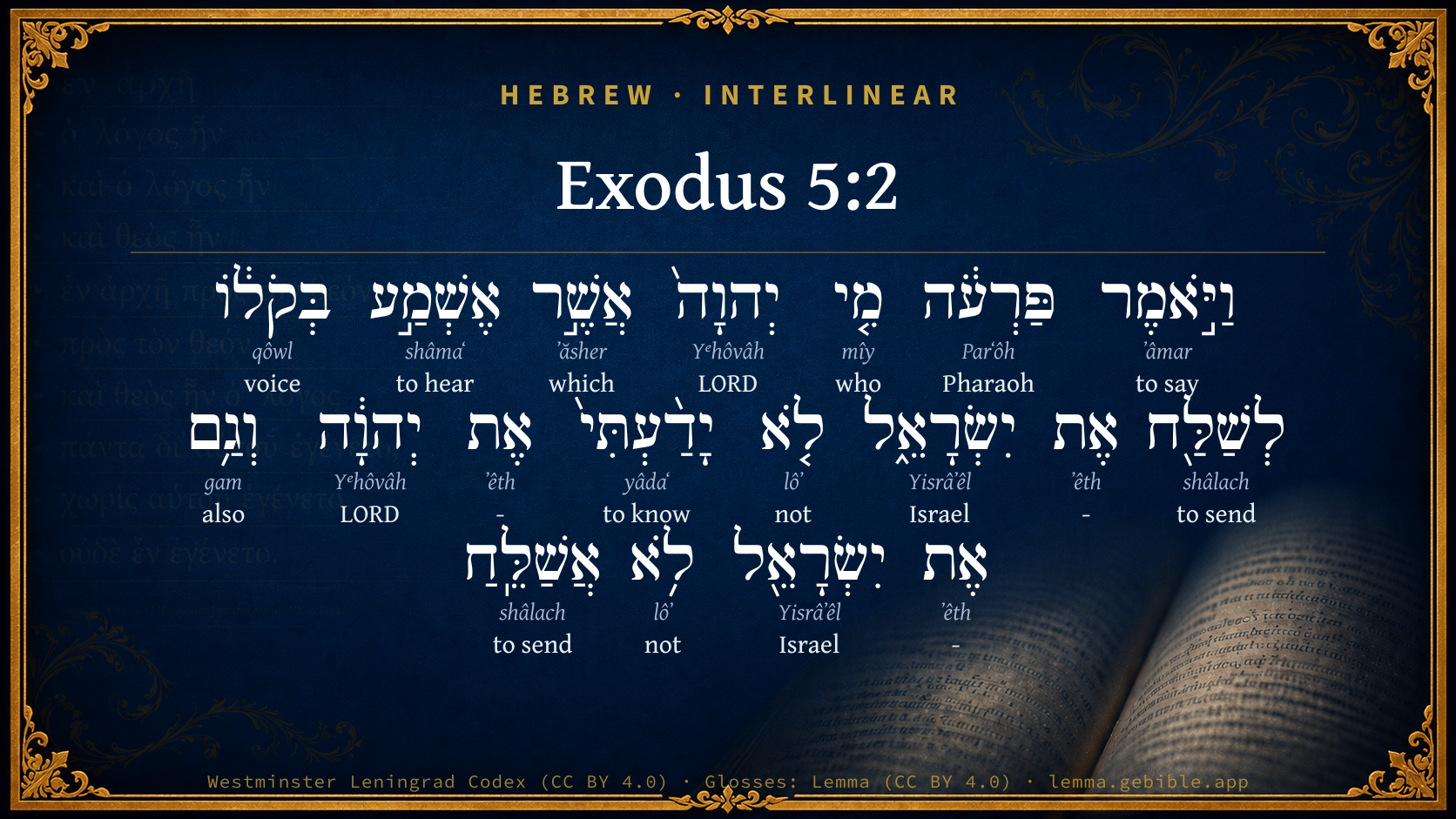
Hebrew (Westminster Leningrad Codex) Exodus 5:2 appears in the Hebrew Old Testament. The text above is from the Westminster Leningrad Codex. Each word links to its Strong’s number, a concise gloss, and parsing drawn from the Open Scriptures Hebrew Bible morphology. Click any word for its full Brown-Driver-Briggs (BDB) entry.
Download image
Cite this verse

Exodus 5:2 (World English Bible). Public Domain. Lemma interlinear Bible study tool, https://lemma.gebible.app/v/exodus/5/2.

Show BibTeX & RIS
BibTeX
RIS
English Translation
Pharaoh said, "Who is Yahweh, that I should listen to his voice to let Israel go? I don't know Yahweh, and moreover I will not let Israel go."
World English Bible · Public Domain
Download a study sheet

One document with this verse’s original text, its word-by-word gloss line, the meaning frame, cross-references with their text, attributed commentary, and full source and license credits — printable, and it pastes into notes with its structure intact.

This verse Autodidact and up

Study sheet (.html) Plain text (.txt)

A passage Seminary Student

Up to 50 verses in one chapter. A passage sheet keeps up to 6 commentary sources and 12 cross-references per verse, in the order this page ranks them, and says so on the sheet whenever that leaves anything out. Ask for a single verse and you get the Autodidact verse sheet above.

Everything on this page stays free to read, with no account — the sheet is a download of what is already on screen, not access to it.

Want to remove ads? Support Godless Engineer
Compare translations 3

The same verse in 3 English versions, stacked beneath the original-language interlinear above. Click any original word for its lexicon entry.

Each is an independent rendering of the whole verse — the interlinear is not word-aligned to these translations.

Highlighted words mark where these versions differ — a whole-verse word diff, not a word-by-word alignment.

  • World English Bible Public Domain
    Pharaoh said, "Who is Yahweh, that I should listen to his voice to let Israel go? I don't know Yahweh, and moreover I will not let Israel go."
  • King James Version Public Domain
    And Pharaoh said, Who is the LORD, that I should obey his voice to let Israel go? I know not the LORD, neither will I let Israel go.
  • unfoldingWord Literal Text CC BY-SA 4.0
    And Pharaoh said, “Who is Yahweh, that I should listen to his voice to let Israel go? I do not know Yahweh, and moreover, I shall not let Israel go.”

unfoldingWord Literal Text — © unfoldingWord, licensed CC BY-SA 4.0. Word-aligned USFM3 via Door43 (git.door43.org/unfoldingWord/en_ult).

Versions to compare (up to 4)

3 of 4 selected

Show all 18 translations

Every available English version of this verse, each an independent rendering of the whole verse.

  • World English Bible Public Domain
    Pharaoh said, "Who is Yahweh, that I should listen to his voice to let Israel go? I don't know Yahweh, and moreover I will not let Israel go."
  • Berean Standard Bible Public Domain
    But Pharaoh replied, “Who is the LORD that I should obey His voice and let Israel go? I do not know the LORD, and I will not let Israel go.”
  • Majority Standard Bible Public Domain
    But Pharaoh replied, “Who is the LORD that I should obey His voice and let Israel go? I do not know the LORD, and I will not let Israel go.”
  • King James Version Public Domain
    And Pharaoh said, Who is the LORD, that I should obey his voice to let Israel go? I know not the LORD, neither will I let Israel go.
  • American Standard Version (1901) Public Domain
    And Pharaoh said, Who is Jehovah, that I should hearken unto his voice to let Israel go? I know not Jehovah, and moreover I will not let Israel go.
  • Revised Version (1885) Public Domain
    And Pharaoh said, Who is the LORD, that I should hearken unto his voice to let Israel go? I know not the LORD, and moreover I will not let Israel go.
  • Geneva Bible (1599) Public Domain
    And Pharaoh saide, Who is the Lord, that I should heare his voyce, and let Israel go? I knowe not the Lord, neither will I let Israel goe.
  • Douay-Rheims (1899) Public Domain
    But he answered: Who is the Lord, that I should hear his voice, and let Israel go? I know not the Lord, neither will I let Israel go.
  • Young's Literal Translation Public Domain
    and Pharaoh saith, `Who `is' Jehovah, that I hearken to His voice, to send Israel away? I have not known Jehovah, and Israel also I do not send away.'
  • Literal Standard Version CC BY-SA 4.0
    and Pharaoh says, “Who [is] YHWH, that I listen to His voice to send Israel away? I have not known YHWH, and I also do not send Israel away.”
  • Unlocked Literal Bible CC BY-SA 4.0
    Pharaoh said, “Who is Yahweh? Why should I listen to his voice and let Israel go? I do not know Yahweh; moreover, I will not let Israel go.”
  • unfoldingWord Literal Text CC BY-SA 4.0
    And Pharaoh said, “Who is Yahweh, that I should listen to his voice to let Israel go? I do not know Yahweh, and moreover, I shall not let Israel go.”
  • Darby Bible Public Domain
    And Pharaoh said, Who is Jehovah, to whose voice I am to hearken to let Israel go? I do not know Jehovah, neither will I let Israel go.
  • World Messianic Bible Public Domain
    Pharaoh said, “Who is the LORD, that I should listen to his voice to let Israel go? I don’t know the LORD, and moreover I will not let Israel go.”
  • Webster's Bible Public Domain
    And Pharaoh said, Who is the LORD, that I should obey his voice to let Israel go? I know not the LORD, neither will I let Israel go.
  • Free Bible Version CC BY-SA 4.0
    “Who is this ‘Lord’ that I should listen to his request to let Israel go?” Pharaoh replied. “I don't know the Lord and I certainly won't let Israel leave!”
  • Bible in Basic English Public Domain
    And Pharaoh said, Who is the Lord, to whose voice I am to give ear and let Israel go? I have no knowledge of the Lord and I will not let Israel go.
  • JPS Tanakh (1917) Public Domain
    And Pharaoh said: 'Who is the LORD, that I should hearken unto His voice to let Israel go? I know not the LORD, and moreover I will not let Israel go.'

Literal Standard Version (2020), Covenant Press — licensed CC BY-SA 4.0. Text via the HelloAO Bible API (eBible.org). Unlocked Literal Bible (unfoldingWord) — licensed CC BY-SA 4.0. Text via the HelloAO Bible API (eBible.org). unfoldingWord Literal Text — © unfoldingWord, licensed CC BY-SA 4.0. Word-aligned USFM3 via Door43 (git.door43.org/unfoldingWord/en_ult). Free Bible Version, Dr. Jonathan Gallagher — licensed CC BY-SA 4.0. Text via the HelloAO Bible API (eBible.org).

Word by word

More ways to search: Search by grammar → Find every occurrence → Compare this word →

Practice this passage: Drill this verse → Learn its vocabulary →

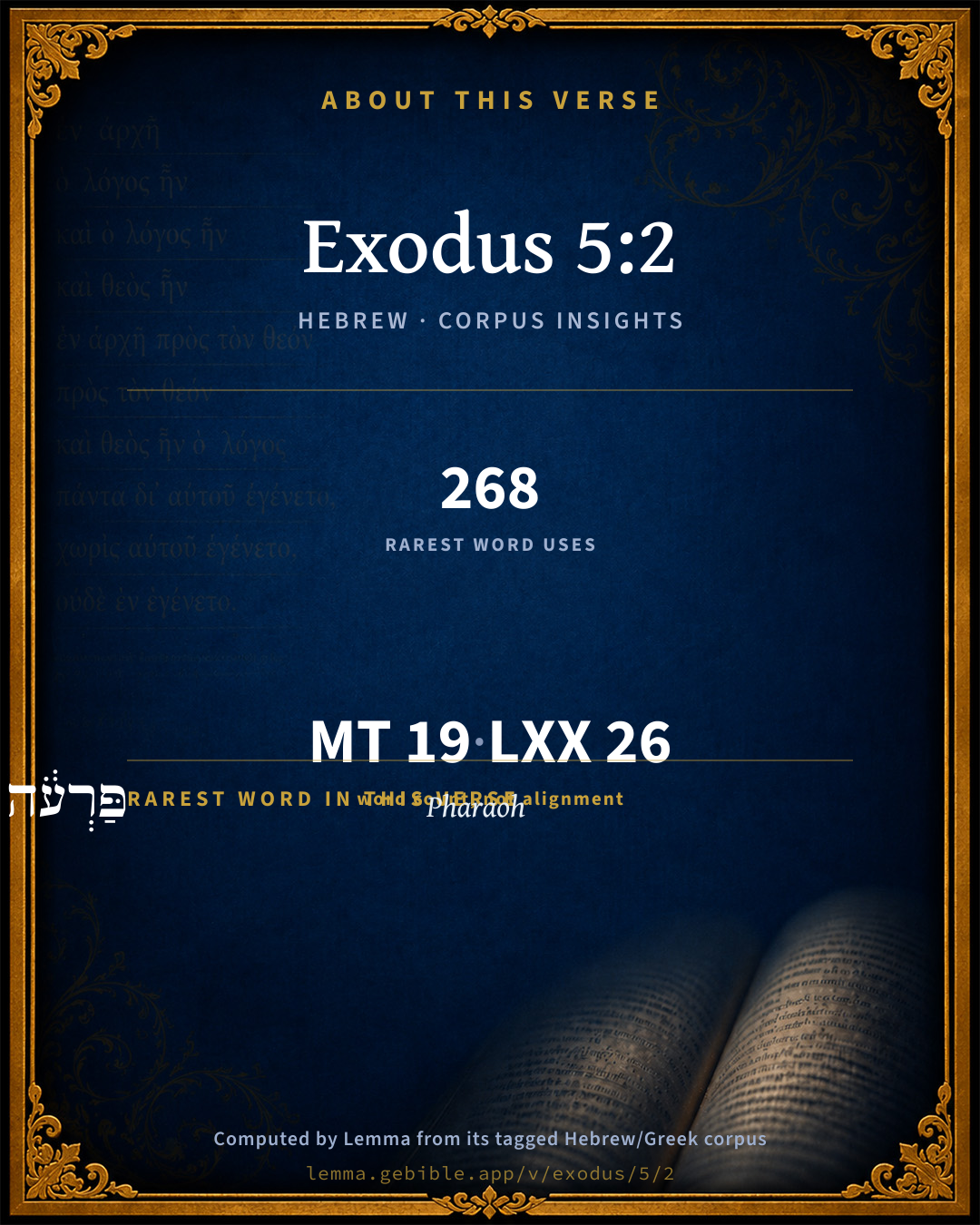
פַּרְעֹ֔ה
Parʻôh
H6547
“Pharaoh”
Noun, Proper
Part of Speech
Noun
Type
Proper
Full BDB Definition

Origin: of Egyptian derivation

TWOT: 1825

Pharaoh = "great house" - the common title of the king of Egypt
  1. וַיֹּ֣אמֶר ʼâmar H559 “and · to say” Conjunction + Verb, Qal, Sequential Imperfect, 3rd Person, Masculine, Singular
  2. מִ֤י mîy H4310 “who” Particle, Interrogative
  3. יְהוָה֙ Yᵉhôvâh H3068 “LORD” Noun, Proper
  4. אֲשֶׁ֣ר ʼăsher H834 “which” Particle, Relative
  5. אֶשְׁמַ֣ע shâmaʻ H8085 “to hear” Verb, Qal, Imperfect, 1st Person, Common, Singular
  6. בְּקֹל֔וֹ qôwl H6963 “in/at · voice · his” Preposition + Noun, Common, Masculine, Singular, Construct + Suffix, Personal, 3rd Person, Masculine, Singular
  7. לְשַׁלַּ֖ח shâlach H7971 “to send” Preposition + Verb, Piel, Infinitive Construct
  8. אֶת ʼêth H853 “-” Particle, Direct Object
  9. יִשְׂרָאֵ֑ל Yisrâʼêl H3478 “Israel” Noun, Proper
  10. לֹ֤א lôʼ H3808 “not” Particle, Negative
  11. יָדַ֨עְתִּי֙ yâdaʻ H3045 “to know” Verb, Qal, Perfect, 1st Person, Common, Singular
  12. אֶת ʼêth H853 “-” Particle, Direct Object
  13. יְהוָ֔ה Yᵉhôvâh H3068 “LORD” Noun, Proper
  14. וְגַ֥ם gam H1571 “and · also” Conjunction + Particle, Accusative
  15. אֶת ʼêth H853 “-” Particle, Direct Object
  16. יִשְׂרָאֵ֖ל Yisrâʼêl H3478 “Israel” Noun, Proper
  17. לֹ֥א lôʼ H3808 “not” Particle, Negative
  18. אֲשַׁלֵּֽחַ shâlach H7971 “to send” Verb, Piel, Imperfect, 1st Person, Common, Singular

About this verse

These counts appear in no published source. They are computed here, from the morphology-tagged text and Lemma’s own curated glosses. What Lemma adds →

19
words
13
distinct lemmas
Pentateuch
section

Grammatical profile

  • 5 verbs
  • 6 nouns
  • 8 particles

Verb forms

  • וַיֹּ֣אמֶר Qal · Sequential Imperfect
  • אֶשְׁמַ֣ע Qal · Imperfect
  • לְשַׁלַּ֖ח Piel · Infinitive Construct
  • יָדַ֨עְתִּי֙ Qal · Perfect
  • אֲשַׁלֵּֽחַ Piel · Imperfect

Repetition

Words recur within this verse — often emphatic in Hebrew:

  • יְהוָה֙ LORD H3068 ×2
  • לְשַׁלַּ֖ח to send H7971 ×2
  • יִשְׂרָאֵ֑ל Israel H3478 ×2
  • לֹ֤א not H3808 ×2

Hebrew & Septuagint length

In English translation the verse runs 28 words from the Hebrew and 36 from the Septuagint (LXX English) — closely comparable.

A rough comparison of the two English renderings, which tokenize alike — not a word-level alignment.

Word counts can differ between the Hebrew and the Greek without any difference in meaning — e.g. the Hebrew direct-object marker אֵת has no separate Greek word, and Greek often adds the article ὁ.

In the original languages it is 19 Hebrew tokens and 26 Greek tokens — but the two are counted differently (Hebrew bundles its prefixes and suffixes into one token; the Greek is in lemma form), so that isn’t a like-for-like length.

Cross-references

13

Topical passages linked to Exodus 5:2 in the Treasury of Scripture Knowledge — connected by theme and wording, ordered by reader-vote popularity; previews shown in the World English Bible.

  • Exodus 3:19 I know that the king of Egypt won't give you permission to go, no, not by a mighty hand.
  • Job 21:15 What is the Almighty, that we should serve him? What profit should we have, if we pray to him?'
  • 2 Kings 18:35 Who are they among all the gods of the countries, that have delivered their country out of my hand, that Yahweh should deliver Jerusalem out of my hand?
  • John 16:3 They will do these things because they have not known the Father, nor me.
  • Romans 1:28 Even as they refused to have God in their knowledge, God gave them up to a reprobate mind, to do those things which are not fitting;
  • 2 Thessalonians 1:8 giving vengeance to those who don't know God, and to those who don't obey the Gospel of our Lord Jesus,
  • 1 Samuel 2:12 Now the sons of Eli were base men; they didn't know Yahweh.
  • 2 Chronicles 32:15 Now therefore don't let Hezekiah deceive you, nor persuade you after this manner, neither believe you him; for no god of any nation or kingdom was able to deliver his people out of my hand, and out of the hand of my fathers: how much less shall your God deliver you out of my hand?
  • 2 Chronicles 32:19 They spoke of the God of Jerusalem, as of the gods of the peoples of the earth, which are the work of men's hands.
  • Psalms 10:4 The wicked, in the pride of his face, Has no room in his thoughts for God.
  • Psalms 12:4 Who have said, "With our tongue we will prevail. Our lips are our own. Who is lord over us?"
  • Psalms 14:1 The fool has said in his heart, "There is no God." They are corrupt. They have done abominable works. There is none who does good.
  • Jeremiah 44:16–17 As for the word that you have spoken to us in the name of Yahweh, we will not listen to you.

Cross-references courtesy of OpenBible.info (CC BY 4.0).

Hebrew and Greek witnesses Masoretic Hebrew ↔ Greek Septuagint

The same verse in the two great witnesses to the Old Testament, shown verse-for-verse.

These are two independent witnesses, not word-aligned to each other, and the Septuagint is shown in lemma (dictionary) form.

Hebrew Exodus 5:2 Masoretic · Westminster Leningrad Codex

וַיֹּ֣אמֶר פַּרְעֹ֔ה מִ֤י יְהוָה֙ אֲשֶׁ֣ר אֶשְׁמַ֣ע בְּקֹל֔וֹ לְשַׁלַּ֖ח אֶת יִשְׂרָאֵ֑ל לֹ֤א יָדַ֨עְתִּי֙ אֶת יְהוָ֔ה וְגַ֥ם אֶת יִשְׂרָאֵ֖ל לֹ֥א אֲשַׁלֵּֽחַ

Pharaoh said, "Who is Yahweh, that I should listen to his voice to let Israel go? I don't know Yahweh, and moreover I will not let Israel go."

World English Bible · Public Domain

Greek LXX Exodus 5:2 Septuagint · lemma form

καί εἶπον φαραώ τίς εἰμί ὅς εἰςἀκούω ὁ φωνή αὐτός ὥστε ἐκ ἀποστέλλω ὁ υἱός ἰσραήλ οὐ οἶδα ὁ κύριος καί ὁ ἰσραήλ οὐ ἐκ ἀποστέλλω

And Pharao said, Who is he that I should listen to his voice, so that I should send away the children of Israel? I do not know the Lord, and I will not let Israel go.

LXX2012 (modern English Septuagint) · Public Domain

Hebrew: Westminster Leningrad Codex (CC BY 4.0). Greek: Septuagint (public domain); English from LXX2012 (modern English Septuagint) (Public Domain). How the Septuagint differs from the Hebrew →

Targum (Aramaic paraphrase)

2

The Targum is the ancient Jewish Aramaic paraphrase of the Hebrew Scriptures — an interpretive translation, not the Hebrew text itself. Onkelos (literal) and Pseudo-Jonathan (expansive) render the Torah, and Jonathan the Prophets. Coverage is partial: where no permissively-licensed English translation exists for a verse, only the Aramaic is shown. This is verse-level text, not a word-by-word alignment to the Hebrew.

  1. Targum Onkelos Torah (Genesis–Deuteronomy)
    וַאֲמַר פַּרְעֹה שְׁמָא דַיְיָ לָא אִתְגְלִי לִי דִי אֲקַבֵּל לְמֵמְרֵהּ לְשַׁלָחָא יָת יִשְׂרָאֵל לָא אִתְגְלִי לִי שְׁמָא דַיְיָ וְאַף יָת יִשְׂרָאֵל לָא אֲשַׁלַח:

    (no public-domain English translation for this verse)

    Targum Onkelos — Aramaic: “Onkelos Genesis” (public domain); “Onkelos Exodus” (public domain); “Onkelos Leviticus” (public domain); “Onkelos Numbers” (public domain); “Onkelos Deuteronomy” (public domain). English: “Sefaria Community Translation” (CC0 1.0 (public-domain dedication)); “J.W. Etheridge. The Targums of Onkelos and Jonathan Ben Uzziel on the Pentateuch. London: Longmans, Green, 1862” (public domain). Text via Sefaria.

  2. Targum Pseudo-Jonathan Torah (Genesis–Deuteronomy)
    וַאֲמַר פַּרְעה שְׁמָא דַיְיָ לָא אִיתְגְלֵי לִי דַאֲקַבֵּל בְּמֵימְרֵיהּ לְמִפְטוֹר יַת יִשְרָאֵל לָא אַשְׁכָּחִית בְּסֵפֶר מַלְאָכַיָא כְּתִיב יַת שְׁמָא דַיְיָ מִינֵהּ לֵית אֲנָא דָחִיל וְאוּף יַת יִשְרָאֵל לָא אִיפְטוֹר

    And Pharoh said, The name of the Lord is not made known to me, that I should receive His word to release Israel. I have not found written in the Book of the Angels the name of the Lord. Of Him I am not afraid, neither will I release Israel.

    Targum Pseudo-Jonathan — Aramaic: “Targum Jonathan on Genesis” (public domain); “Targum Jonathan on Exodus” (public domain); “Targum Jonathan on Leviticus” (public domain); “Targum Jonathan on Numbers” (public domain); “Targum Jonathan on Deuteronomy” (public domain). English: “The Targum of Jonathan ben Uzziel, trans. J. W. Etheridge, London, 1862” (public domain). Text via Sefaria.

Commentary

Notes on Exodus 5:2 from classic Christian and Jewish commentators (each source and its license shown beneath its notes). The classic Christian expositions comment on the surrounding passage and are grouped to its opening verse, so a note may address several verses; the Jewish commentaries on the Tanakh (Rashi and others) are per-verse, so they appear only where the commentator wrote on this verse.

Lemma curates 59 commentaries, every one of them public domain or Creative Commons licensed, each selected and text-cleaned for this edition rather than reprinted as found. About our sources →

Trapp's Complete Commentary

John Trapp

Exo 5:2 And Pharaoh said, Who [is] the LORD, that I should obey his voice to let Israel go? I know not the LORD, neither will I let Israel go.

Ver. 2. Who is the Lord?] God’s attributes either show what he is, or who he is. To the question of Moses - What he is? - God gave a short answer, "I am." To this second by Pharaoh, Who he is? - God made a large reply, till Pharaoh was compelled to answer himself, "The Lord is righteous."

John Trapp, A Commentary or Exposition upon All the Books of the Old and New Testament (1647–1656) — public domain. Text from a community e-Sword module.

The Biblical Illustrator

Joseph S. Exell

Exo_5:2

Who is the Lord that I should obey His voice?

Pharaohs question answered

If we would know God as He is, we should neither take our own idea nor adopt the worlds estimates, but see Him as He has revealed Himself in His Word, especially in the Gospel which began to be spoken by His Son, the only Teacher competent to instruct us here.

1. God is One, indeed, who will punish sin, etc. As a Holy God, He hates it; and, as a Just God, He will by no means clear the guilty, etc.

2. But, at the same time, He is One who would rather not, and who will not unless He must. Judgment is His strange work, and He would have all men to be saved and to come to a knowledge of the truth.

3. One, too, so averse to punish that He spared not His own Son, etc. Abraham could give no higher proof of his love to God than by his willingness to offer up his son, his only son, Isaac. God so loved, etc.

4. One, too, who, in addition to giving His Son, strives with men by His Word, ordinances, Spirit, Providence, to dispose them to accept that Son and find peace and joy in believing.

5. One, again, who has filled His Word with warnings to arouse, invitations to attract, directions to instruct, promises to encourage, etc.

6. One, too, who has thrown the door of hope wide open to all, and imposed no impossible, or even difficult, condition in the case of any.

7. One, in fine, who can say, What more could I have done for My vineyard that I have not done in it? One whose plan, provision and proffer of salvation is such that if any fail of its privileges, they can but blame themselves. This is the Lord! Not only our Creator (that itself should summon our service; see Psa_100:1-5.), nor only our Preserver (living by His bounty, should we not live by His bidding, too?); but also our Redeemer: the God and Father of our Lord Jesus Christ. Surely, then, if there be any voice, we should obey, it is His. That voice, further, is the voice of One who knows us; knows our frame, knows what suits us, knows what will contribute to our well-being. His commands are so far from being arbitrary that in the very keeping of them there is great reward; and, following the course they indicate, we shall ever have growing reason to say, The lines are fallen unto me in pleasant places; while, on the other hand, all experience, as well as revelation, declares, the way of transgressors is hard. The sinner flies from Gods voice, thinking it a voice of anger; whereas, did he but stop and listen, he would wonder at the gracious words that proceed out of His mouth. Only let us acquaint ourselves with Him, and we shall be at peace, and good shall thereby come to us. But if we follow after lying vanities, we forsake our own mercies. (David Jamison, B. A.)

Lessons

1. Proud imperious spirits are hasty to reply roughly upon Gods messengers.

2. Idolaters are apt to despise God in the true revelation of Him.

3. Hardened souls vent their contempt upon God Himself more than on His Church.

4. Contempt of Jehovah suffers not men to hear His voice.

5. Disobedience to God ushers in oppression to His people.

6. Scorners of God can never come to the right knowledge of God or acknowledgment of Him.

7. Wicked wretches glory in the contempt of knowing God.

8. Denial of knowing God denieth all good commanded for His people. (G. Hughes, B. D.)

God entitled to an obedience

I. We ought to obey God, because He is the benevolent Creator of the universe.

II. We are bound to obey God, because He is the constant preserver of the creatures of His power.

III. We are under yet greater obligations to obey God, because He is the perfect Governor of the universe.

IV. We are obligated in the highest degree to obey God, because He is the Merciful Redeemer of sinners. (C. Coffin, D. D.)

Gods claim on our obedience

I. Some particulars relative to Gods voice.

1. The persons to whom He speaks--Mankind.

(1) His favourite creatures.

(2) Ignorant creatures.

(3) Improvable creatures.

2. The means by which He speaks.

(1) His works.

(a) Of creation.

(b) Of providence.

(2) His Word.

3. What He says to us. He speaks to us variously, according to our various states, as sinful, submissive, and reclaimed creatures. As sinful creatures, who transgress His laws, He speaks to us in the language of reproof; charging us with rebellion (Isa_1:1-2); and ingratitude (Deu_32:6); and in the language of warning; showing us that we are rejected by Him (Pro_15:8; Pro_15:26); under His curse (Gal_3:10); and under the sentence of eternal death (Eze_18:20; Rom_6:21). As submissive creatures, who desire to obey Him, He speaks to us in the language of kind authority (Isa_55:6-7; Mat_11:28-29); of encouragement (Isa_1:16-18); and of caution against delay. (Psa_95:7-8). As reclaimed creatures, restored to His favour and service, He speaks in the language of instruction (Mic_6:8; Tit_2:12); and in the language of consolation, (Isa_40:1; Psa_84:11).

4. With what design He speaks. This is to engage our obedience. His works teach us to glorify Him as God (Rom_1:21). His Word requires practical piety as mans indispensable duty (1Sa_15:22; Mat_7:21; Jam_1:22; Jam_1:25). The obedience thus required must be prompt, without delay (Job_22:21). Universal, without defect (Psa_119:6). Persevering, without intermission (Rom_2:7); and humble, without arrogance. It must be humbly ascribed to Divine grace (Isa_26:12); humbly presented through Christ for acceptance (1Pe_2:5); and humbly as unprofitable at best (Luk_17:10). Such being the obedience which God requires, let us consider--

II. His claims on our obedience to His voice. These will appear by answering the inquiry here instituted--Who is the Lord? etc.

1. He is our indisputable Proprietor.

2. He is our acknowledged Sovereign.

3. He is our best Friend, and kindest Benefactor.

4. He is the Disposer of our eternal destiny.

(1) Omniscient.

(2) Just.

(3) Powerful. (Sketches of Sermons.)

Pharaohs impious interrogation

I. God has spoken to mankind.

II. Why and how you should hear.

1. Why.

(1) Because of His right in and over you.

(2) Because of His condescension to you.

(3) Because of the design of His speaking--your present and eternal welfare.

2. How. With awe, sacred attentions, holy anxiety.

III. The impiety and folly of refusing to hear the voice of God.

1. It is a flagrant contempt of God.

2. It is open rebellion against authority.

3. It must be eventually ruinous to the sinner. (J. Burns, D. D.)

Scorners of God

1. They hear not His voice.

2. They perceive not His revelations.

3. They recognize not His claims.

4. They insult His servants.

5. They enslave His people.

6. They are obstinate in their denials. (J. S. Exell, M. A.)

Pharaoh fighting against God

A certain king used to wander about in disguise. Once he fell into a quarrel, and was getting rather roughly handled. But as soon as his assailant knew that he was pummeling the king, he dropped on his knees, asking for mercy. It is a good thing to know against whom we are fighting. Pharaoh did not realize that. When Job came to see that he was fighting against God, he said, Behold, I am vile . . . I will lay mine hand upon mine mouth.

I know not the Lord-agnosticism of the heart and will

A kind of agnosticism more prevalent than agnosticism of a scientific kind. There is an agnosticism of the heart; there is an agnosticism of the will. Men reason foolishly about this not knowing. Men imagine that because they know not the Lord, the Lord knows not them. There is a vital distinction. We do not extinguish the sun by closing our eyes. If men will not inquire for God in a spirit worthy of such an inquiry, they can never know God. Pharaohs no-knowledge was avowed in a tone of defiance. It was not an intellectual ignorance, but a spirit of moral denial. Pharaoh practically made himself god by denying the true God. This is the natural result of all atheism. Atheism cannot be a mere negative; if it pretend to intelligence it must, in some degree, involve the Godhead of the being who presumes to deny God; the greatest difficulty is with people who know the Lord, and do not obey Him. If they who professedly know the Lord, would carry out His will in daily obedience and sacrifice of the heart, their lives would constitute the most powerful of all arguments. (J. Parker, D. D.)

Dangerous ignorance

He says he does not know Jehovah; he does not recognize His authority or admit His claims. His soul is full of practical unbelief in God--a fact which commonly lies at the bottom of all the hardening of sinners hearts in every age. Pharaoh did not at first contemplate crossing swords and measuring strong arms with the Almighty God. If he had taken this view of the case he might have paused a while to consider. So it usually is with sinners. Unbelief in God conduces to launch them upon this terrible conflict. Once committed, they become more hardened; one sin leads on to more sinning till sin becomes incurable--shall we say it?--an uncontrollable madness. (H. Cowles, D. D.)

Who is the Lord?

This is--

1. The language of independence. Who is the Lord? I am the lord of Egypt, etc.

2. Of decided opposition; a setting up of his will against that of Jehovah; Who is the Lord that I should obey Him?

3. Of contemptuous rejection of Divine authority. He says, Let My people go; but I say, I will not.

4. Of insolent defiance, braving all terrors. Are we not struck with horror at the impiety of Pharaohs answer to the message of Jehovah?

But what, if in this congregation, there be a man or woman in whose heart the same principle of rebellion reigns!

1. I address myself first to the young--My son, give Me thine heart. Now what is the answer of many? is your heart either divided, or altogether devoted to worldly,pursuits and gratifications? if so then the principle, if not the words of Pharaoh is yours.

2. I would address those who are more advanced in life. Ye men of business, I have a message to you. Let me ask you if, on account of worldly gain, you do not sometimes violate your conscience? Then is not your language, Who is the Lord? I must mind my business first, I know not the Lord, neither will I let my gains go. (George Breay, B. A.)

Pharaohs ignorance self-imposed

We may think that this would be of course the language of a heathen king, of one who was not in the covenant. The Scripture does not teach us so. We are told that the Lord spoke to Laban and to Abimelech, and that they understood His voice. When Joseph told Pharaoh who was reigning in his day, that the Lord had sent him his dream, and had interpreted it, he believed the message and acted accordingly. It is never assumed in any part of Scripture that God is not declaring Himself to heathens, or that heathens may not own Him. We shall find precisely the opposite doctrine in the Old Testament as in the New. When then this Pharaoh said, Who is the Lord, that I should obey His voice? we are to understand that he had brought himself into a condition of ignorance and darkness, which did not belong to him in consequence of his position, or of any natural disadvantages. He had come to regard himself as the Lord, his will as the will which all things were to obey; therefore he said inevitably, Who is the Lord? He had lost the sense of a righteous government and order in the world; he had come to believe in tricks and lies; he had come to think men were the mere creatures and slaves of natural agencies. Had God no voice for such a man, or for the priests and the people whom he represented, and whose feelings were the counterparts of his? We shall find that He had. (F. D. Maurice, M. A.)

The Biblical Illustrator, edited by Joseph S. Exell (c. 1880s–1900s) — public domain. Text from a community e-Sword module.

Joseph Benson's Commentary

Exo 5:2. Who is the Lord, that I should obey his voice? — I am the sovereign lord of Egypt, and I own no superior here. The Hebrew name Jehovah ought to have been retained in this and the preceding verse, and not to have been translated Lord. Thus saith Jehovah — who is Jehovah — I know not Jehovah. The Egyptians, it must be observed, and other nations were at this time sunk in idolatry, and knowing nothing of the true God, the possessor of heaven and earth, each nation had a god or gods of its own. Pharaoh, therefore, did not speak as an atheist, or mean that he knew nothing of any god whom he ought to obey; but he knew nothing of the God of the Hebrews, whom they termed Jehovah, imagining him to be like one of the gods of Egypt, or of some other country, a mere local deity, whom therefore it neither concerned him to know nor to obey. Now the train of miracles which followed were intended to teach Pharaoh and his people, that Jehovah was not only the God of the Hebrews, but of all the world, having an uncontrolled and sovereign power over universal nature.

Joseph Benson's Commentary on the Old and New Testaments (1811–1818) — public domain. Text from a community e-Sword module.

Tyndale Open Study Notes

Tyndale Open Resources

5:2 Pharaoh immediately moved to the heart of the issue. What god could possibly be superior to Pharaoh? What god could compel him to do what he did not want to do? This is a central issue for the whole human race. Is there someone or something greater than my self-interest?

Tyndale Open Study Notes — © Tyndale Open Resources, licensed CC BY-SA 4.0. Text via the HelloAO Bible API.

Jamieson, Fausset & Brown

Robert Jamieson, A. R. Fausset & David Brown

And Pharaoh said, Who is the Lord--rather "Jehovah." Lord was a common name applied to objects of worship; but Jehovah was a name he had never heard of. Pharaoh estimated the character and power of this God by the abject and miserable condition of the worshippers and concluded that He held as low a rank among the gods as His people did in the nation. To demonstrate the supremacy of the true God over all the gods of Egypt, was the design of the plagues.

I know not the Lord, neither will I let Israel go--As his honor and interest were both involved he determined to crush this attempt, and in a tone of insolence, or perhaps profanity, rejected the request for the release of the Hebrew slaves.

Jamieson, Fausset & Brown — Commentary Critical and Explanatory on the Whole Bible (1871) — public domain (CC PDM 1.0). Text via the HelloAO Bible API.

Adam Clarke's Commentary

Verse 2. Who is the Lord] Who is Jehovah, that I should obey his voice? What claims has he on me? I am under no obligation to him. Pharaoh spoke here under the common persuasion that every place and people had a tutelary deity, and he supposed that this Jehovah might be the tutelary deity of the Israelites, to whom he, as an Egyptian, could be under no kind of obligation. It is not judicious to bring this question as a proof that Pharaoh was an atheist: of this the text affords no evidence.

Adam Clarke's Commentary on the Bible (1810–1826) — public domain. Text from a community e-Sword/MySword module.

Ellicott's Commentary for English Readers

(2) Who is the Lord?—Heb., Who is Jehovah? If Jehovah was a name, the use of which had been laid aside, as would seem to have been the case by the later chapters of Genesis, and which was revived by the scene at the burning bush, Pharaoh may very probably not have heard of it.

That I should obey his voice.—The king means to say, that, whoever Jehovah is, He can have no authority over him, as He is not one of his gods. The Egyptians were accustomed to the idea of local gods, and quite expected every nation to have a deity or several deities of its own; but they regarded the power of each as circumscribed, certainly not extending beyond the race or nation to which the god belonged.

A Bible Commentary for English Readers, edited by Charles John Ellicott (1878–1897) — public domain. Text from a community e-Sword module.

The Cambridge Bible for Schools and Colleges

gen. ed. J. J. S. Perowne

2. The Pharaoh replies contemptuously that he knows nothing of Jehovah, and need not therefore listen to His behests.

The Cambridge Bible for Schools and Colleges (gen. ed. J. J. S. Perowne; Cambridge University Press, 1878–1918) — public domain. Text from a community e-Sword module.

John Gill's Exposition

And Pharaoh said, who is the Lord,.... Jehovah, they made mention of, which, whether he took it for the name of a deity, or of a king, whose ambassadors they declared themselves to be, was a name he had never heard of before; and this being expressed and pronounced, shows that this name is not ineffable, or unlawful to be pronounced, as say the Jews:

that I should obey his voice, to let Israel go? he knew of no superior monarch to him, whose orders he was obliged to obey in any respect, and particularly in this, the dismission of the people of Israel out of his land, though it was but for a short time:

I know not the Lord; who this Jehovah is, that made this demand, and required Israel's dismission. The Targum of Jonathan paraphrases it,"I have not found the name of Jehovah written in the book of angels, I am not afraid of him.''An Egyptian book, in which, the paraphrast supposes, were written the names of gods and of angels; and no such name being there, he was the more bold and insolent:

neither will I let Israel go; determining he would pay no regard to such an unknown Deity, or King, be he who he would.

John Gill's Exposition of the Whole Bible (1746–1763) — public domain (CC PDM 1.0). Text via the HelloAO Bible API.

Albert Barnes' Notes on the Bible

I know not the Lord - Either Pharaoh had not heard of Yahweh, or he did not recognize Him as a God.

Albert Barnes' Notes on the Bible (1834–1885) — public domain. Text from a community e-Sword/MySword module.

Haydock's Catholic Bible Commentary

The Lord. Is there anyone above me?

George Leo Haydock (1774–1849), Haydock's Catholic Family Bible and Commentary, 1859 edition — public domain. Excludes Psalms (Douay-Rheims chapter numbering differs from Protestant) and Deuterocanonical books (Catholic canon only).

Matthew Poole's English Annotations

I am the sovereign lord of Egypt, and I own no superior here.

Matthew Poole's English Annotations on the Holy Bible (1683–1685) — public domain. Text from a community e-Sword/MySword module.

Whedon's Commentary on the Bible

Daniel D. Whedon

2. Who is Jehovah? It is possible that Pharaoh had never heard the name, for hitherto it had not been much used among the Hebrews in Egypt. At least he refuses to recognise Jehovah’s authority.

Daniel D. Whedon (gen. ed.), Commentary on the Old and New Testaments (1874–1909) — public domain. Text from a community e-Sword module.

The Pulpit Commentary

And Pharaoh said, Who is the Lord? Rather, "Who is Jehovah?" Either Pharaoh is actually ignorant, or he pretends to be. The former is possible, since Jehovah was a name but little employed, until the return of Moses to Egypt. The latter, however, is more probable. That I should obey his voice. Why am I to obey his voice? What is your Jehovah to me? What authority has he over me? He is, at best, your god, not mine. I know not Jehovah. I acknowledge him not. He is not within the range of my Pantheon. Neither will I let Israel go, i.e. "nor even, if he were, would I consent to such a request as this from him." The Pharaohs assumed to be themselves gods, on a par with the national gods, and not bound to obey them.

HOMILIES BY D. YOUNG Ver. 2. Pharaoh"s first response: his answer in word.

Moses and Aaron, somehow or other, have found their way into Pharaoh"s presence. All things, so far, have happened as God said they would happen. The very brevity and compactness of the record at the end of ch. 4. is an instructive comment on the way in which Moses had mistaken comparative shadows for substantial difficulties. The actual meeting of Moses with Israel is dismissed in a few satisfactory and significant words; as much as to say that enough space had already been occupied in detailing the difficulties started by Moses in his ignorance and alarm. It is when Moses and Pharaoh meet that the tug of war really begins. Moses addresses to Pharaoh the commanded request, and is met, as was to be expected, with a prompt and contemptuous defiance. Observe

I PHARAOH, IN HIS REJOINDER TO MOSES, PUTS A QUESTION WHICH GOD ALONE CAN PROPERLY ANSWER. "Who is the Lord that I should obey his voice to let Israel go?

1. This was evidently in Pharaoh"s opinion a question which needed no answer at all. It had nothing interrogative about it, except the form. Taking the form of a question, it served to express more forcibly Pharaoh"s defiant spirit. There was, in his opinion, really no need to consider or confer at all. "Am I not the great Pharaoh, successor to many great Pharaohs before me? Is not my power accepted and undisputed far and wide?" He could not so much as comprehend any danger unless it took the form of physical force; and not only so, but a form plainly visible near, threatening, overwhelming. If only some great king had been approaching strong with the strength of a large and victorious army to demand the liberation of Israel, Pharaoh would not so have spoken. To him the invisible was as the unreal. Pharaoh listens to Moses, and what does he hear? a claim that seems to dispute his supremacy, from this new deity, whose image he has never seen, whose name mayhap his priests have told him is not that of any deity worshipped in Canaan of which they have ever heard. Certainly it looks a large claim upon the first presentation of it, small as it is in comparison with what is to follow. This, then, is what he hears, and the audacity and presumption of it are not diminished by what he sees. There stand Moses and Aaron, completely devoid in person and surroundings of anything to impress the king with the peril of refusing their request. Surely if the men who say they are sent look so contemptible, the unseen being from whom they say they come may be safely neglected. Such is the reasoning, silently powerful, if not openly expressed, of those who despise and reject the claims of God. Christ is judged of, not as he is in himself, but by the superficial aspect of Christians. Because they are often low in station, or inconsistent in life, or lacking in disposition and ability to make much outward show, the world thinks that there is little or nothing behind them. It is the folly of only too many to take Pharaoh"s stand. For the right reception of the things of God we need all possible humility and openmindedness; what then is to be done, if upon the very first approach of religion, we pooh-pooh it as mere superstition, folly, and delusion?

2. This was a question to which Moses could have given a very effective and alarming answer if only he had been allowed opportunity. Moses, fresh from the revelations and sanctities of Horeb, could have told Pharaoh such a story of the workings of Jehovah as would have been enough, and more than enough, to guide the steps of a right-minded listener. Not only his own personal experience; not only the sight of the burning bush, the rod transformed, the leprous hand, the blood where water ought to be; but also the fulness, the terrible fulness of Jehovah"s power in the earlier days of the world, were within his reach to speak about. He could have told Pharaoh very admonitory things concerning Sodom and the Deluge if only he had been willing to listen. We may well believe that the effect of Pharaoh"s defiant attitude would be to send Moses away striving to refresh and sustain his mind with the evidences, so available and so abundant, that in spite of this proud king"s contempt, Jehovah, in his vast power and resources, was indeed no vain imagination. When the proud and self-sufficient ask this Pharaoh-question, it is for us to make such answer as may be reassuring to ourselves; not to doubt our own eyesight because others are blind, our own heating because others are deaf.

How few sometimes may know, when thousands err.

The truth which we may not be able to make even probable to others, we must strive so to grasp and penetrate, that more and more it may be felt as certain and satisfying to ourselves.

3. Thus we see how the Lord himself needed to deal with this question. Knowledge of God is of many kinds, according to the disposition of the person who is to be taught, and according to the use which God purposes to make of him. Pharaoh was evidently not going to be a docile scholar in God"s school one who comes to it willing and eager, thirsting for a refreshing knowledge of the living God. But still he had to be a scholar, willingly or not. He had to learn this much at least, that he was transgressing on the peculiar possessions of God when he sported with Israel in his despotic caprice. It is for no man to say that his present real ignorance gives assurance that he will never come to some knowledge of God. It may be as pitifully true of the atheist as it is encouragingly true of the godly, that what he knows not now, he will know hereafter. Now he knows not God, but in due time he will know him; not dubiously, not distantly, but in the most practical and it may be most painful and humiliating manner. Pharaoh says, with a sneer on his face, and derision in his voice, "Who is Jehovah?" That question is duly answered by Jehovah in signs and plagues, and the last answer we hear anything about on earth comes unmistakable and sublime, amid the roll of the Red Sea"s returning waters.

II But Pharaoh not only puts this defiant question; HE UTTERS A MOST DETERMINED RESOLUTION WHICH GOD ALONE CAN ALTER. "Neither will I let Israel go." What then are Israel"s chances for the future? There was every certainty that, if left to himself, Pharaoh would go on, tyrannous and oppressive as ever. From a human point of view he had everything to help him in sticking to his resolution. His fears, if he had any the wealth which he and his people had gained from the incessant toils of Israel the great dislocations and changes which would have been produced by even a temporary withdrawal of Israel all these things helped to a firm maintenance of the resolution. It was a resolution which had strong and active support in all the baser feelings of his own breast. It is just in the firmness and haughtiness of such a resolution, revealing as it does the spirit of the man, that we get the reason for such an accumulation of calamities as came upon his land. Here is another significant illustration of the manifold power of God, that he could break down so much proud determination. There was no change in Pharaoh"s feeling; no conversion to an equitable and compassionate mind; he simply yielded, because he could not help himself, to continuous and increasing pressure, and God alone was able to exert that pressure. Pharaoh here is but the visible and unconscious exponent of that dark Power which is behind all evil men and cruel and selfish policies. That Power, holding men in all sorts of bitter disappointments and degrading miseries, virtually says, "I will not let them go." Our confidence ought ever to be, that though we can do nothing to break this bitter bondage, God, who forced the foe of Israel to relax Iris voracious grasp, will by his own means force freedom for us from every interference of our spiritual foe. It was Pharaoh"s sad prerogative to shut his own heart, to shut it persistently, to shut it for ever, against the authority and benedictions of Jehovah. But no one, though he be as mighty and arrogant as a thousand Pharaohs, can fasten us up from God, if so be we are willing to go to him, from whom alone we can gain a pure and eternal life. Y.

The Pulpit Commentary (1880–1919), ed. H.D.M. Spence-Jones & Joseph S. Exell — public domain. Text from a community e-Sword module.

John Wesley's Explanatory Notes

Who is the Lord that I should obey his voice? - Being summoned to surrender, he thus hangs out the flag of defiance. Who is Jehovah? I neither know him nor care for him; neither value nor fear him. It is a hard name that he never heard of before, but he resolves it shall be no bugbear to him. Israel was now a despised, oppressed people, and by the character they bore he makes his estimate of their God, and concludes that he made no better figure among the gods, than his people did among the nations.

John Wesley, Explanatory Notes Upon the Whole Bible (1754–1765) — public domain. Text via the GEBible commentary corpus.

Lesson kit

Teaching starters — assembled from the data on this page, not authored interpretation. Every prompt links to the verse data it draws on. Edit before teaching.

Exodus, in the Pentateuch, opens this verse with 19 words (13 distinct Hebrew lemmas). Its most distinctive word is Parʻôh (“Pharaoh”). A historical commentator’s framing appears above. Read the whole chapter for the surrounding context.

Discussion questions

  1. The word Parʻôh carries the sense “Pharaoh.” How does it shape the verse?
  2. How does Exodus 3:19, which shares this passage’s theme, read alongside this verse?
  3. What does the repetition of “LORD” (2× in this one verse) do in this verse?
  4. The translations on this page render this verse differently — a whole-verse word diff, not a word-by-word alignment. What might account for the different wordings?
  5. «וַיֹּ֣אמֶר» is a Qal Sequential Imperfect verb. How does that grammatical form shape the action described?
  6. Compare how Trapp's Complete Commentary and The Biblical Illustrator read this verse. Where do they agree or differ?

Things to notice

Reading settings

Reading text

Shown beneath each verse's original-language words.

Old Testament
Old Testament edition

Read the OT as the Masoretic Hebrew (MT) or the Greek Septuagint (LXX).

English shown for the Greek Septuagint (in the Hebrew ↔ Greek comparison).

Comparing translations? Open the Compare panel on any verse page to stack up to four side by side.