Ezekiel 3:13

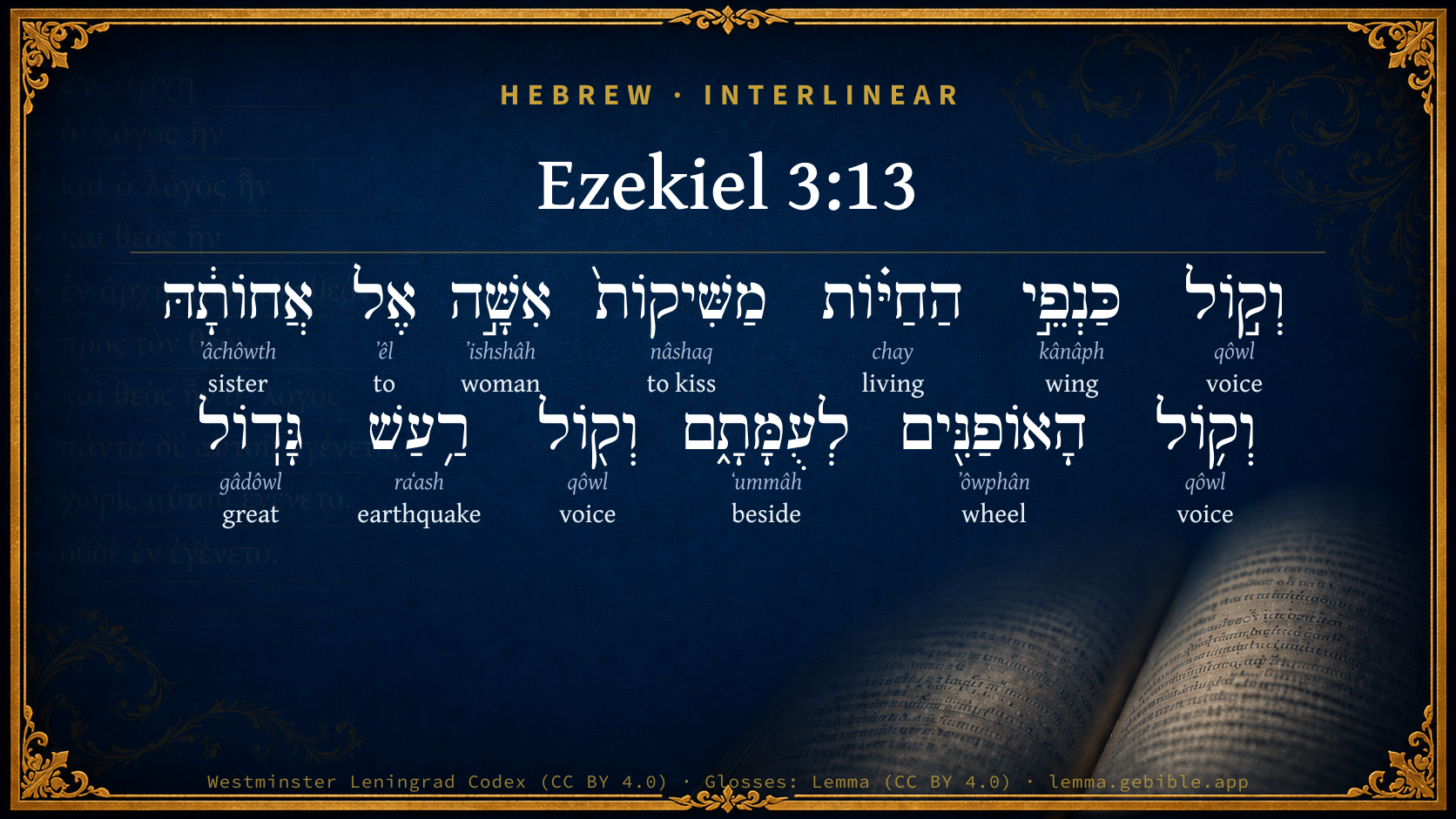
Hebrew (Westminster Leningrad Codex) Ezekiel 3:13 appears in the Hebrew Old Testament. The text above is from the Westminster Leningrad Codex. Each word links to its Strong’s number, a concise gloss, and parsing drawn from the Open Scriptures Hebrew Bible morphology. Click any word for its full Brown-Driver-Briggs (BDB) entry.
Download image
Cite this verse

Ezekiel 3:13 (World English Bible). Public Domain. Lemma interlinear Bible study tool, https://lemma.gebible.app/v/ezekiel/3/13.

Show BibTeX & RIS
BibTeX
RIS
English Translation
[I heard] the noise of the wings of the living creatures as they touched one another, and the noise of the wheels beside them, even the noise of a great rushing.
World English Bible · Public Domain
Download a study sheet

One document with this verse’s original text, its word-by-word gloss line, the meaning frame, cross-references with their text, attributed commentary, and full source and license credits — printable, and it pastes into notes with its structure intact.

This verse Autodidact and up

Study sheet (.html) Plain text (.txt)

A passage Seminary Student

Up to 50 verses in one chapter. A passage sheet keeps up to 6 commentary sources and 12 cross-references per verse, in the order this page ranks them, and says so on the sheet whenever that leaves anything out. Ask for a single verse and you get the Autodidact verse sheet above.

Everything on this page stays free to read, with no account — the sheet is a download of what is already on screen, not access to it.

Want to remove ads? Support Godless Engineer
Compare translations 3

The same verse in 3 English versions, stacked beneath the original-language interlinear above. Click any original word for its lexicon entry.

Each is an independent rendering of the whole verse — the interlinear is not word-aligned to these translations.

Highlighted words mark where these versions differ — a whole-verse word diff, not a word-by-word alignment.

  • World English Bible Public Domain
    [I heard] the noise of the wings of the living creatures as they touched one another, and the noise of the wheels beside them, even the noise of a great rushing.
  • King James Version Public Domain
    I heard also the noise of the wings of the living creatures that touched one another, and the noise of the wheels over against them, and a noise of a great rushing.
  • unfoldingWord Literal Text CC BY-SA 4.0
    It was the sound of the wings of the living creatures as they touched one another, and the sound of the wheels that were with them, and the sound of a great earthquake.

unfoldingWord Literal Text — © unfoldingWord, licensed CC BY-SA 4.0. Word-aligned USFM3 via Door43 (git.door43.org/unfoldingWord/en_ult).

Versions to compare (up to 4)

3 of 4 selected

Show all 18 translations

Every available English version of this verse, each an independent rendering of the whole verse.

  • World English Bible Public Domain
    [I heard] the noise of the wings of the living creatures as they touched one another, and the noise of the wheels beside them, even the noise of a great rushing.
  • Berean Standard Bible Public Domain
    It was the sound of the wings of the living creatures brushing against one another and the sound of the wheels beside them, a great rumbling sound.
  • Majority Standard Bible Public Domain
    It was the sound of the wings of the living creatures brushing against one another and the sound of the wheels beside them, a great rumbling sound.
  • King James Version Public Domain
    I heard also the noise of the wings of the living creatures that touched one another, and the noise of the wheels over against them, and a noise of a great rushing.
  • American Standard Version (1901) Public Domain
    And `I heard' the noise of the wings of the living creatures as they touched one another, and the noise of the wheels beside them, even the noise of a great rushing.
  • Revised Version (1885) Public Domain
    And I heard the noise of the wings of the living creatures as they touched one another, and the noise of the wheels beside them, even the noise of a great rushing.
  • Geneva Bible (1599) Public Domain
    I heard also the noyse of the wings of the beasts, that touched one another, and the ratling of the wheeles that were by them, euen a noyse of a great russhing.
  • Douay-Rheims (1899) Public Domain
    And the noise of the wings of the living creatures striking one against another, and the noise of the wheels following the living creatures, and the noise of a great commotion.
  • Young's Literal Translation Public Domain
    even a noise of the wings of the living creatures touching one another, and a noise of the wheels over-against them, even a noise of a great rushing.
  • Literal Standard Version CC BY-SA 4.0
    Even a noise of the wings of the living creatures touching one another, and a noise of the wheels alongside them, even a noise of a great rushing.
  • Unlocked Literal Bible CC BY-SA 4.0
    It was the sound of the wings of the living creatures as they touched one another, and the sound of the wheels that were with them, and the sound of a great earthquake.
  • unfoldingWord Literal Text CC BY-SA 4.0
    It was the sound of the wings of the living creatures as they touched one another, and the sound of the wheels that were with them, and the sound of a great earthquake.
  • Darby Bible Public Domain
    -- and the sound of the wings of the living creatures that touched one another, and the sound of the wheels beside them, and the sound of a great rushing.
  • World Messianic Bible Public Domain
    I heard the noise of the wings of the living creatures as they touched one another, and the noise of the wheels beside them, even the noise of a great rushing.
  • Webster's Bible Public Domain
    I heard also the noise of the wings of the living creatures that touched one another, and the noise of the wheels over against them, and the noise of a great rushing.
  • Free Bible Version CC BY-SA 4.0
    It was the sound made by the wings of the beings as they brushed against each other and the noise made by the wheels next to them, a really loud noise that sounded like an earthquake.
  • Bible in Basic English Public Domain
    And there was the sound of the wings of the living beings touching one another, and the sound of the wheels at their side, the sound of a great rushing.
  • JPS Tanakh (1917) Public Domain
    also the noise of the wings of the living creatures as they touched one another, and the noise of the wheels beside them, even the noise of a great rushing.

Literal Standard Version (2020), Covenant Press — licensed CC BY-SA 4.0. Text via the HelloAO Bible API (eBible.org). Unlocked Literal Bible (unfoldingWord) — licensed CC BY-SA 4.0. Text via the HelloAO Bible API (eBible.org). unfoldingWord Literal Text — © unfoldingWord, licensed CC BY-SA 4.0. Word-aligned USFM3 via Door43 (git.door43.org/unfoldingWord/en_ult). Free Bible Version, Dr. Jonathan Gallagher — licensed CC BY-SA 4.0. Text via the HelloAO Bible API (eBible.org).

Word by word

More ways to search: Search by grammar → Find every occurrence → Compare this word →

Practice this passage: Drill this verse → Learn its vocabulary →

רַ֥עַשׁ
raʻash
H7494
“earthquake”
Noun, Common, Masculine, Singular, Absolute
Part of Speech
Noun
Type
Common
Gender
Masculine
Number
Singular
State
Absolute
Full BDB Definition

Origin: from H7493

TWOT: 2195a

quaking, rattling, shaking - earthquake - quaking, trembling (of person) - shaking, quivering (of dart)
  1. וְק֣וֹל qôwl H6963 “and · voice of” Conjunction + Noun, Common, Masculine, Singular, Construct
  2. כַּנְפֵ֣י kânâph H3671 “wings of” Noun, Common, Feminine, Dual, Construct
  3. הַחַיּ֗וֹת chay H2416 “the · living things” Particle, Definite Article + Noun, Common, Feminine, Plural, Absolute
  4. מַשִּׁיקוֹת֙ nâshaq H5401 “kissing” Verb, Hiphil, Participle Active, Feminine, Plural, Absolute
  5. אִשָּׁ֣ה ʼishshâh H802 “woman” Noun, Common, Feminine, Singular, Absolute
  6. אֶל ʼêl H413 “to” Preposition
  7. אֲחוֹתָ֔הּ ʼâchôwth H269 “sister · her” Noun, Common, Feminine, Singular, Construct + Suffix, Personal, 3rd Person, Feminine, Singular
  8. וְק֥וֹל qôwl H6963 “and · voice of” Conjunction + Noun, Common, Masculine, Singular, Construct
  9. הָאוֹפַנִּ֖ים ʼôwphân H212 “the · wheels” Particle, Definite Article + Noun, Common, Masculine, Plural, Absolute
  10. לְעֻמָּתָ֑ם ʻummâh H5980 “to/for · beside · their” Preposition + Noun, Common, Feminine, Singular, Construct + Suffix, Personal, 3rd Person, Masculine, Plural
  11. וְק֖וֹל qôwl H6963 “and · voice of” Conjunction + Noun, Common, Masculine, Singular, Construct
  12. גָּדֽוֹל gâdôwl H1419 “great” Adjective, Adjective, Masculine, Singular, Absolute

About this verse

These counts appear in no published source. They are computed here, from the morphology-tagged text and Lemma’s own curated glosses. What Lemma adds →

13
words
11
distinct lemmas
Prophets
section

Notable vocabulary

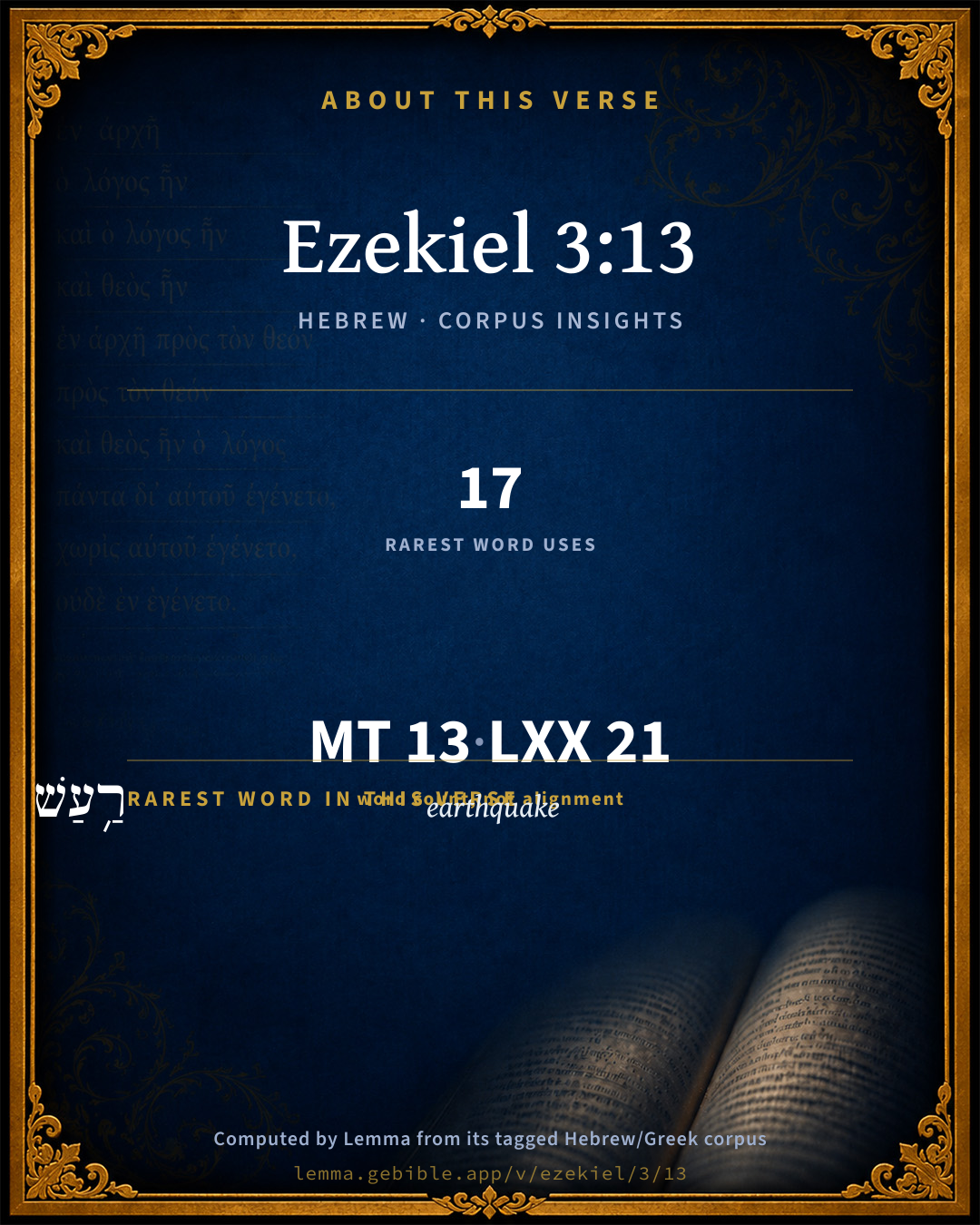
The rarest word here is רַ֥עַשׁ earthquake H7494 — appearing just 17 times in the whole Hebrew Bible.

Shared distinctive vocabulary

רַ֥עַשׁ earthquake H7494 occurs in 16 verses of the Hebrew Bible. Also found in:

Grammatical profile

  • 1 verb
  • 10 nouns
  • 1 adjective
  • 1 preposition

Verb forms

  • מַשִּׁיקוֹת֙ Hiphil · Participle Active

Repetition

A word recurs within this verse — often emphatic in Hebrew:

  • וְק֣וֹל voice H6963 ×3

Hebrew & Septuagint length

In English translation the verse runs 31 words from the Hebrew and 32 from the Septuagint (LXX English) — closely comparable.

A rough comparison of the two English renderings, which tokenize alike — not a word-level alignment.

Word counts can differ between the Hebrew and the Greek without any difference in meaning — e.g. the Hebrew direct-object marker אֵת has no separate Greek word, and Greek often adds the article ὁ.

In the original languages it is 13 Hebrew tokens and 21 Greek tokens — but the two are counted differently (Hebrew bundles its prefixes and suffixes into one token; the Greek is in lemma form), so that isn’t a like-for-like length.

Cross-references

5

Topical passages linked to Ezekiel 3:13 in the Treasury of Scripture Knowledge — connected by theme and wording, ordered by reader-vote popularity; previews shown in the World English Bible.

  • Ezekiel 1:24 When they went, I heard the noise of their wings like the noise of great waters, like the voice of the Almighty, a noise of tumult like the noise of a host: when they stood, they let down their wings.
  • Ezekiel 10:16–17 When the cherubim went, the wheels went beside them; and when the cherubim lifted up their wings to mount up from the earth, the wheels also didn't turn from beside them.
  • Ezekiel 10:5 The sound of the wings of the cherubim was heard even to the outer court, as the voice of God Almighty when he speaks.
  • 2 Samuel 5:24 It shall be, when you hear the sound of marching in the tops of the mulberry trees, that then you shall bestir yourself; for then is Yahweh gone out before you to strike the host of the Philistines.
  • Ezekiel 1:15 Now as I saw the living creatures, behold, one wheel on the earth beside the living creatures, for each of the four faces of it.

Cross-references courtesy of OpenBible.info (CC BY 4.0).

Hebrew and Greek witnesses Masoretic Hebrew ↔ Greek Septuagint

The same verse in the two great witnesses to the Old Testament, shown verse-for-verse.

These are two independent witnesses, not word-aligned to each other, and the Septuagint is shown in lemma (dictionary) form.

Hebrew Ezekiel 3:13 Masoretic · Westminster Leningrad Codex

וְק֣וֹל כַּנְפֵ֣י הַחַיּ֗וֹת מַשִּׁיקוֹת֙ אִשָּׁ֣ה אֶל אֲחוֹתָ֔הּ וְק֥וֹל הָאוֹפַנִּ֖ים לְעֻמָּתָ֑ם וְק֖וֹל רַ֥עַשׁ גָּדֽוֹל

[I heard] the noise of the wings of the living creatures as they touched one another, and the noise of the wheels beside them, even the noise of a great rushing.

World English Bible · Public Domain

Greek LXX Ezekiel 3:13 Septuagint · lemma form

καί ὁράω φωνή πτέρυξ ὁ ζῷον πτερύσσομαι ἕτερος πρός ὁ ἕτερος καί φωνή ὁ τροχός ἔχω αὐτός καί φωνή ὁ σεισμός

And I perceived the sound of the wings of the living creatures clapping one to the other, and the sound of the wheels was near them, and the sound of the earthquake.

LXX2012 (modern English Septuagint) · Public Domain

Hebrew: Westminster Leningrad Codex (CC BY 4.0). Greek: Septuagint (public domain); English from LXX2012 (modern English Septuagint) (Public Domain). How the Septuagint differs from the Hebrew →

Targum (Aramaic paraphrase)

1

The Targum is the ancient Jewish Aramaic paraphrase of the Hebrew Scriptures — an interpretive translation, not the Hebrew text itself. Onkelos (literal) and Pseudo-Jonathan (expansive) render the Torah, and Jonathan the Prophets. Coverage is partial: where no permissively-licensed English translation exists for a verse, only the Aramaic is shown. This is verse-level text, not a word-by-word alignment to the Hebrew.

  1. Targum Jonathan Prophets (Joshua–Malachi)
    וְקַל גַפֵּי בִּרְיָתָא נַקְשָׁן חַד לְחַד וְקַל גַלְגְלַיָא לְקִבְלֵהוֹן וְקַל זִיעַ סַגִי:

    (no public-domain English translation for this verse)

    Targum Jonathan — Aramaic: “Mikraot Gedolot” (public domain). English: “Sefaria Community Translation” (CC0 1.0 (public-domain dedication)); “London "Chaldee Paraphrase," 1871” (public domain). Text via Sefaria.

Commentary

Notes on Ezekiel 3:13 from classic Christian and Jewish commentators (each source and its license shown beneath its notes). The classic Christian expositions comment on the surrounding passage and are grouped to its opening verse, so a note may address several verses; the Jewish commentaries on the Tanakh (Rashi and others) are per-verse, so they appear only where the commentator wrote on this verse.

Lemma curates 59 commentaries, every one of them public domain or Creative Commons licensed, each selected and text-cleaned for this edition rather than reprinted as found. About our sources →

Trapp's Complete Commentary

John Trapp

Eze 3:13 [I heard] also the noise of the wings of the living creatures that touched one another, and the noise of the wheels over against them, and a noise of a great rushing.

Ver. 13. I heard also the noise of the wings of the living creatures.] In consent with the former doxology.

That touched one another.] Heb., Kissed; noting the love and good agreement that is between the holy angels. No woman is so well affected to her sister as they are one to another in serving God and his people.

And the noise of the wheels.] As the angels, so all actions and motions do, as they can, sing praise to God.

John Trapp, A Commentary or Exposition upon All the Books of the Old and New Testament (1647–1656) — public domain. Text from a community e-Sword module.

Jamieson, Fausset & Brown

Robert Jamieson, A. R. Fausset & David Brown

touched--literally, "kissed," that is, closely embraced.

noise of a great rushing--typical of great disasters impending over the Jews.

Jamieson, Fausset & Brown — Commentary Critical and Explanatory on the Whole Bible (1871) — public domain (CC PDM 1.0). Text via the HelloAO Bible API.

Adam Clarke's Commentary

Verse 13. A great rushing.] All the living creatures and the wheels being then in motion.

Adam Clarke's Commentary on the Bible (1810–1826) — public domain. Text from a community e-Sword/MySword module.

John Calvin's Commentaries

The Prophet now seems to express from whence the voice which he heard proceeded: for I do not think that the voice proceeded from any other quarter, and that afterwards the living creatures moved in unison with the wheels, but it seems to me to explain what would otherwise have been doubtful, namely, that God’s glory was celebrated by the living creatures and the wheels. It is not wonderful then that a voice should be attributed to the living creatures, because we saw them to be cherubim or angels, as by the wheels God wishes to mark all actions and motions; motions, I say, which seem fortuitous, but yet are governed by the living creatures, whom God inspires with his own virtue, while he wishes to execute his designs, and so exercises his dominion over all creatures; for nothing happens which is not governed by his will. Hence a voice proceeds as well from the living creatures as from the wheels, which extolled the glory of God, and proclaimed him, in the midst of that sad and wretched slaughter of the people, still reigning in his own Temple; then, indeed, especially exercising his power, because he was a judge, in punishing their wickedness; then because he was about to become the deliverer of his own people, as he had promised them restoration after seventy years. He says also, I heard the voice of wings when they mutually embraced each other; for נקש, nekesh, signifies to embrace: others translate, when they struck or engaged in conflict with each other: but by the word osculating, conjunction is metaphorically signified. When, therefore, each wing embraced its fellow, then the voice emerged: he adds also the same thing concerning the wheels, and at length he repeats what he had said, that there was a sound of a great rushing It follows —

John Calvin's Commentaries (1540-1563) — public domain. Text from the Calvin Translation Society English edition (1840s-50s) via the Christian Classics Ethereal Library (ccel.org). Calvin's coverage is partial (roughly two-thirds of the Bible); uncommented books and verses are honest gaps, never fabricated. The 19th-century editor's footnotes and remarks are omitted so the notes are faithfully Calvin's own voice.

The Cambridge Bible for Schools and Colleges

gen. ed. J. J. S. Perowne

13. I heard also the noise] More fairly: and the noise. The words seem to state the cause of the great rushing sound in Eze_3:12, it came from the wings of the living creatures touching one another when they flew, and from the wheels. Cf. ch. Eze_1:9; Eze_1:11; Eze_1:23.

The Cambridge Bible for Schools and Colleges (gen. ed. J. J. S. Perowne; Cambridge University Press, 1878–1918) — public domain. Text from a community e-Sword module.

John Gill's Exposition

I heard also the noise of the wings of the living creatures,.... Which they clapped, when they uttered the preceding words; See Gill on Eze 1:24;

that touched one another; or "kissed, a woman her sister" (r); denoting their affection and agreement in the doxology or ascription of glory to God; see Eze 1:9;

and the noise of the wheels over against them: the living creatures; for the wheels were by the living creatures, and went over against them, as they went, Eze 1:15; ministers and churches join together in this doxology:

and a noise of a great rushing; which is repeated for the confirmation of the thing, and to express the greatness of the noise made by the living creatures and wheels, like that of thunder or an earthquake; it is said to be like the noise of great waters, Eze 1:24.

(r) "attingentium more osculantium, vira ad sororem suam", Vatablus; "osculantium", Polanus, Starckius. So Ben Melech.

John Gill's Exposition of the Whole Bible (1746–1763) — public domain (CC PDM 1.0). Text via the HelloAO Bible API.

Albert Barnes' Notes on the Bible

That touched - literally, touching. The living creatures in their flight raised their wings, so as to touch each other.

Albert Barnes' Notes on the Bible (1834–1885) — public domain. Text from a community e-Sword/MySword module.

Matthew Poole's English Annotations

I heard, added to connect the verses and to make the reading full, hath I think somewhat perplexed the words, and occasioned inquiry after two different sounds or voices; whereas if we read them as in the Hebrew and as the Latin,

And the noise was of the wings, & c., so the 13th verse will explain the 12th, and tell you what was that great rushing which Ezekiel heard behind him.

Touched one another: see Eze 1:9. Over against them: see Eze 1:19,20.

Matthew Poole's English Annotations on the Holy Bible (1683–1685) — public domain. Text from a community e-Sword/MySword module.

The Pulpit Commentary

And I heard, etc. There is no verb in the Hebrew, but it may be supplied from ver. 12. We lose in the English the kissing, or touching, poetry of the original, "each its sister." The attitude as of wings raised for flight, and the sound of both the wings and wheels, implied the departure of the glorious vision, presumably to the region from which it came.

The Pulpit Commentary (1880–1919), ed. H.D.M. Spence-Jones & Joseph S. Exell — public domain. Text from a community e-Sword module.

John Wesley's Explanatory Notes

Rushing - The wheels of providence moved over against the angels, and in concert with them.

John Wesley, Explanatory Notes Upon the Whole Bible (1754–1765) — public domain. Text via the GEBible commentary corpus.

Rashi

Rabbi Shlomo Yitzchaki (Rashi)

touching Heb. מַשִּׁיקוֹת, an expression of kissing (נְשִּׁיקָה). They would knock one against the other, and a song was heard with their knocking, as he said above (1:24): “And I heard the sound of their wings.”

Rashi on the Tanakh — English translations: “The Judaica Press complete Tanach with Rashi, translated by A. J. Rosenberg” (CC BY 4.0); “Pentateuch with Rashi's commentary by M. Rosenbaum and A.M. Silbermann, 1929-1934” (public domain); “The Metsudah Tanach series, Lakewood, N.J” (CC BY 4.0); and “The Book of Joshua, Metsudah Publications, 1997” (CC BY 4.0). Text via Sefaria.

Lesson kit

Teaching starters — assembled from the data on this page, not authored interpretation. Every prompt links to the verse data it draws on. Edit before teaching.

Ezekiel, in the Prophets, opens this verse with 13 words (11 distinct Hebrew lemmas). Its most distinctive word is raʻash (“earthquake”). A historical commentator’s framing appears above. Read the whole chapter for the surrounding context.

Discussion questions

  1. How does “earthquake” (raʻash) shape what this verse is saying?
  2. 1 Kings 19:11 shares the word «earthquake» with this verse. How do the two illuminate each other?
  3. “voice” occurs 3× in this one verse. What is the effect of the repetition?
  4. These translations render this verse differently; the difference is in the English rendering, not the original. What questions does that raise?
  5. The verb «מַשִּׁיקוֹת֙» is Hiphil Participle Active. How does its form color the action?
  6. Reading how Trapp's Complete Commentary and Jamieson, Fausset & Brown read this verse, where do the two commentators agree and where do they part?

Things to notice

Reading settings

Reading text

Shown beneath each verse's original-language words.

Old Testament
Old Testament edition

Read the OT as the Masoretic Hebrew (MT) or the Greek Septuagint (LXX).

English shown for the Greek Septuagint (in the Hebrew ↔ Greek comparison).

Comparing translations? Open the Compare panel on any verse page to stack up to four side by side.