Exodus 23:22

Hebrew (Westminster Leningrad Codex) Exodus 23:22 appears in the Hebrew Old Testament. The text above is from the Westminster Leningrad Codex. Each word links to its Strong’s number, a concise gloss, and parsing drawn from the Open Scriptures Hebrew Bible morphology. Click any word for its full Brown-Driver-Briggs (BDB) entry.
Download image
Cite this verse

Exodus 23:22 (World English Bible). Public Domain. Lemma interlinear Bible study tool, https://lemma.gebible.app/v/exodus/23/22.

Show BibTeX & RIS
BibTeX
RIS
English Translation
But if you indeed listen to his voice, and do all that I speak, then I will be an enemy to your enemies, and an adversary to your adversaries.
World English Bible · Public Domain
Highlights Full analysis ↓
Download a study sheet

One document with this verse’s original text, its word-by-word gloss line, the meaning frame, cross-references with their text, attributed commentary, and full source and license credits — printable, and it pastes into notes with its structure intact.

This verse Autodidact and up

Study sheet (.html) Plain text (.txt)

A passage Seminary Student

Up to 50 verses in one chapter. A passage sheet keeps up to 6 commentary sources and 12 cross-references per verse, in the order this page ranks them, and says so on the sheet whenever that leaves anything out. Ask for a single verse and you get the Autodidact verse sheet above.

Everything on this page stays free to read, with no account — the sheet is a download of what is already on screen, not access to it.

Want to remove ads? Support Godless Engineer
Compare translations 3

The same verse in 3 English versions, stacked beneath the original-language interlinear above. Click any original word for its lexicon entry.

Each is an independent rendering of the whole verse — the interlinear is not word-aligned to these translations.

Highlighted words mark where these versions differ — a whole-verse word diff, not a word-by-word alignment.

  • World English Bible Public Domain
    But if you indeed listen to his voice, and do all that I speak, then I will be an enemy to your enemies, and an adversary to your adversaries.
  • King James Version Public Domain
    But if thou shalt indeed obey his voice, and do all that I speak; then I will be an enemy unto thine enemies, and an adversary unto thine adversaries.
  • unfoldingWord Literal Text CC BY-SA 4.0
    For if you indeed heed his voice and do everything that I speak, then I will be an enemy to your enemies and I will be an adversary to your adversaries.

unfoldingWord Literal Text — © unfoldingWord, licensed CC BY-SA 4.0. Word-aligned USFM3 via Door43 (git.door43.org/unfoldingWord/en_ult).

Versions to compare (up to 4)

3 of 4 selected

Show all 18 translations

Every available English version of this verse, each an independent rendering of the whole verse.

  • World English Bible Public Domain
    But if you indeed listen to his voice, and do all that I speak, then I will be an enemy to your enemies, and an adversary to your adversaries.
  • Berean Standard Bible Public Domain
    But if you will listen carefully to his voice and do everything I say, I will be an enemy to your enemies and a foe to your foes.
  • Majority Standard Bible Public Domain
    But if you will listen carefully to his voice and do everything I say, I will be an enemy to your enemies and a foe to your foes.
  • King James Version Public Domain
    But if thou shalt indeed obey his voice, and do all that I speak; then I will be an enemy unto thine enemies, and an adversary unto thine adversaries.
  • American Standard Version (1901) Public Domain
    But if thou shalt indeed hearken unto his voice, and do all that I speak; then I will be an enemy unto thine enemies, and an adversary unto thine adversaries.
  • Revised Version (1885) Public Domain
    But if thou shalt indeed hearken unto his voice, and do all that I speak; then I will be an enemy unto thine enemies, and an adversary unto thine adversaries.
  • Geneva Bible (1599) Public Domain
    But if thou hearken vnto his voyce, and do all that I speake, the I wil be an enemie vnto thine enemies, and will afflict them that afflict thee.
  • Douay-Rheims (1899) Public Domain
    But if thou wilt hear his voice, and do all that I speak, I will be an enemy to thy enemies, and will afflict them that afflict thee.
  • Young's Literal Translation Public Domain
    for, if thou diligently hearken to his voice, and hast done all that which I speak, then I have been at enmity with thine enemies, and have distressed those distressing thee.
  • Literal Standard Version CC BY-SA 4.0
    for if you listen diligently to His voice, and have done all that which I speak, then I have been at enmity with your enemies, and have distressed those distressing you.
  • Unlocked Literal Bible CC BY-SA 4.0
    If you indeed obey his voice and do everything that I tell you, then I will be an enemy to your enemies and an adversary to your adversaries.
  • unfoldingWord Literal Text CC BY-SA 4.0
    For if you indeed heed his voice and do everything that I speak, then I will be an enemy to your enemies and I will be an adversary to your adversaries.
  • Darby Bible Public Domain
    But if thou shalt diligently hearken unto his voice, and do all that I shall say, then I will be an enemy to thine enemies, and an adversary to thine adversaries.
  • World Messianic Bible Public Domain
    But if you indeed listen to his voice, and do all that I speak, then I will be an enemy to your enemies, and an adversary to your adversaries.
  • Webster's Bible Public Domain
    But if thou shalt indeed obey his voice, and do all that I speak; then I will be an enemy to thy enemies, and an adversary to thy adversaries.
  • Free Bible Version CC BY-SA 4.0
    However, if you listen to him carefully, and do everything that I tell you, then I will be an enemy to your enemies and I will fight those who fight against you.
  • Bible in Basic English Public Domain
    But if you truly give ear to his voice, and do whatever I say, then I will be against those who are against you, fighting those who are fighting you.
  • JPS Tanakh (1917) Public Domain
    But if thou shalt indeed hearken unto his voice, and do all that I speak; then I will be an enemy unto thine enemies, and an adversary unto thine adversaries.

Literal Standard Version (2020), Covenant Press — licensed CC BY-SA 4.0. Text via the HelloAO Bible API (eBible.org). Unlocked Literal Bible (unfoldingWord) — licensed CC BY-SA 4.0. Text via the HelloAO Bible API (eBible.org). unfoldingWord Literal Text — © unfoldingWord, licensed CC BY-SA 4.0. Word-aligned USFM3 via Door43 (git.door43.org/unfoldingWord/en_ult). Free Bible Version, Dr. Jonathan Gallagher — licensed CC BY-SA 4.0. Text via the HelloAO Bible API (eBible.org).

Word by word

More ways to search: Search by grammar → Find every occurrence → Compare this word →

Practice this passage: Drill this verse → Learn its vocabulary →

וְאָֽיַבְתִּי֙
ʼâyab
H340
“and · to be hostile”
Conjunction + Verb, Qal, Sequential Perfect, 1st Person, Common, Singular
Part of Speech
Conjunction + Verb
Stem
Qal
Form
Sequential Perfect
Person
1st Person
Gender
Common
Number
Singular
Full BDB Definition

Origin: a primitive root

TWOT: 78

to be hostile to, to be an enemy to - (Qal) - to be hostile to - to treat as an enemy
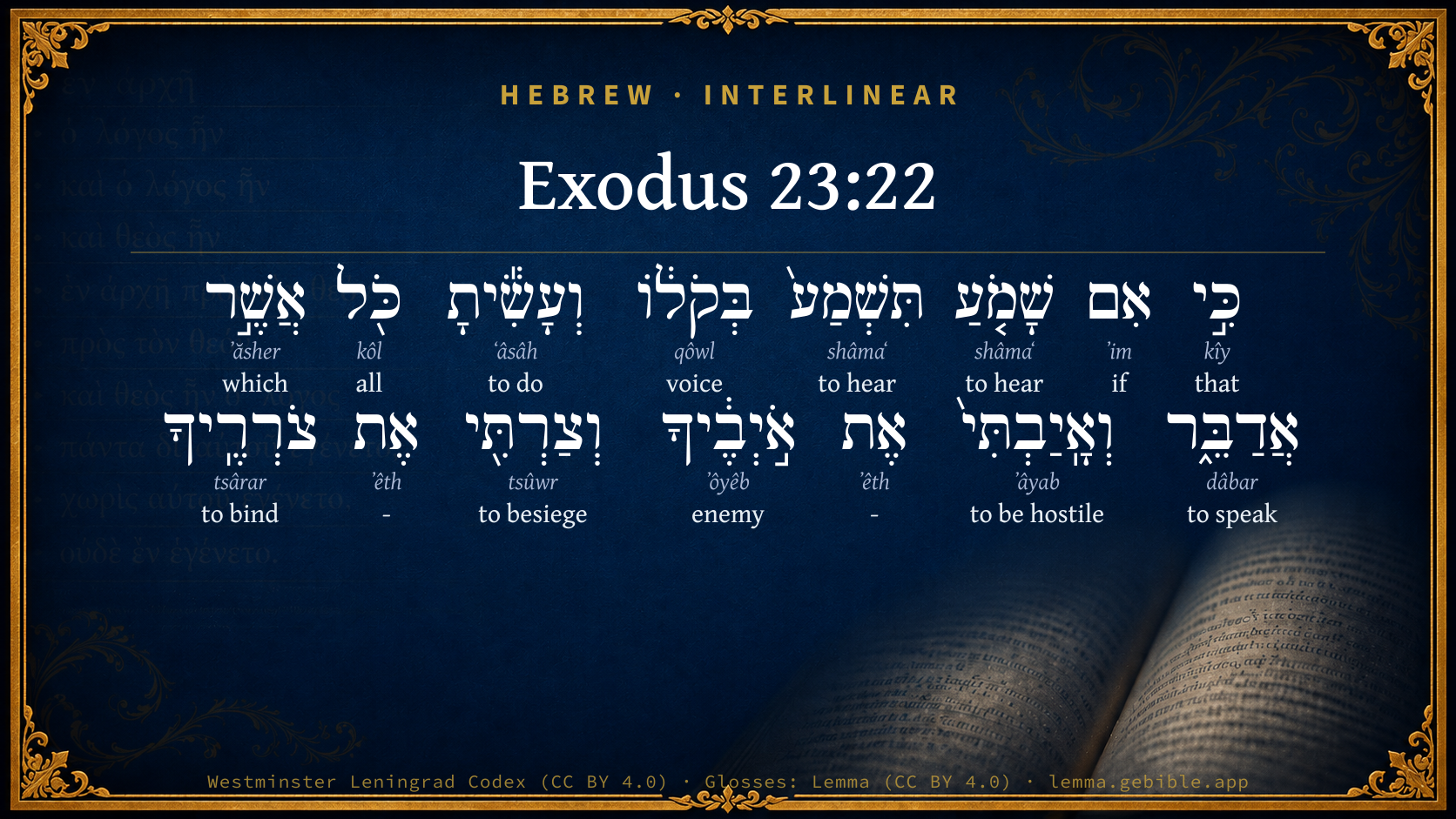
  1. כִּ֣י kîy H3588 “that” Conjunction
  2. אִם ʼim H518 “if” Conjunction
  3. שָׁמֹ֤עַ shâmaʻ H8085 “to hear” Verb, Qal, Infinitive Absolute
  4. תִּשְׁמַע֙ shâmaʻ H8085 “to hear” Verb, Qal, Imperfect, 2nd Person, Masculine, Singular
  5. בְּקֹל֔וֹ qôwl H6963 “in/at · voice · his” Preposition + Noun, Common, Masculine, Singular, Construct + Suffix, Personal, 3rd Person, Masculine, Singular
  6. וְעָשִׂ֕יתָ ʻâsâh H6213 “and · to do” Conjunction + Verb, Qal, Sequential Perfect, 2nd Person, Masculine, Singular
  7. כֹּ֖ל kôl H3605 “all” Noun, Common, Masculine, Singular, Absolute
  8. אֲשֶׁ֣ר ʼăsher H834 “which” Particle, Relative
  9. אֲדַבֵּ֑ר dâbar H1696 “to speak” Verb, Piel, Imperfect, 1st Person, Common, Singular
  10. אֶת ʼêth H853 “-” Particle, Direct Object
  11. אֹ֣יְבֶ֔יךָ ʼôyêb H341 “enemy · you” Verb, Qal, Participle Active, Masculine, Plural, Construct + Suffix, Personal, 2nd Person, Masculine, Singular
  12. וְצַרְתִּ֖י tsûwr H6696 “and · to besiege” Conjunction + Verb, Qal, Sequential Perfect, 1st Person, Common, Singular
  13. אֶת ʼêth H853 “-” Particle, Direct Object
  14. צֹרְרֶֽיךָ tsârar H6887 “binding · you” Verb, Qal, Participle Active, Masculine, Plural, Construct + Suffix, Personal, 2nd Person, Masculine, Singular

About this verse

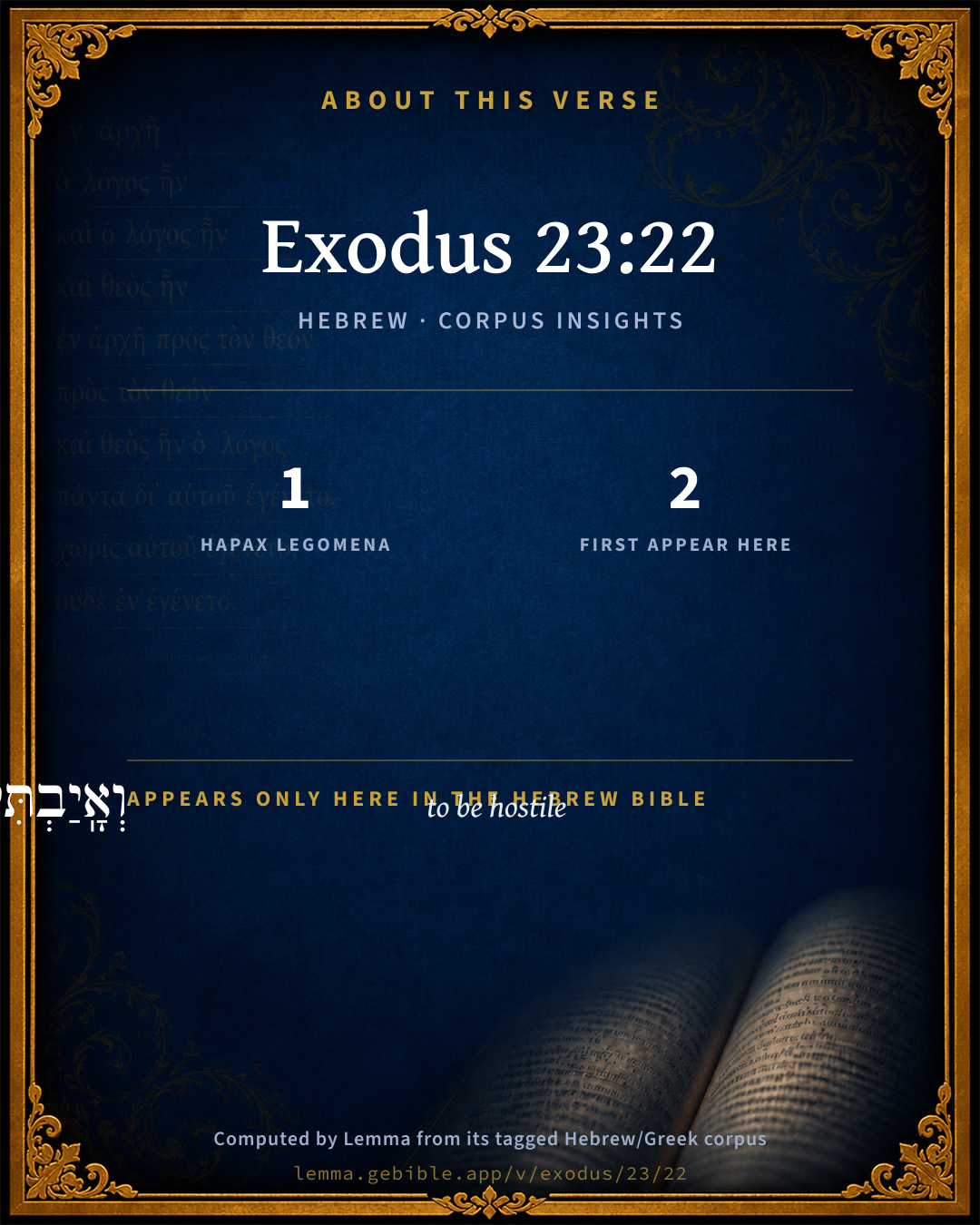
These counts appear in no published source. They are computed here, from the morphology-tagged text and Lemma’s own curated glosses. What Lemma adds →

15
words
13
distinct lemmas
Pentateuch
section

Notable vocabulary

1 hapax legomenon — a word that appears only here in the entire Hebrew Bible:

  • וְאָֽיַבְתִּי֙ to be hostile H340

First appearance in Scripture

These words make their first canonical appearance in the Hebrew Bible here:

  • וְאָֽיַבְתִּי֙ to be hostile H340
  • וְצַרְתִּ֖י to besiege H6696

Shared distinctive vocabulary

וְצַרְתִּ֖י to besiege H6696 occurs in 36 verses of the Hebrew Bible. Also found in:

Grammatical profile

  • 8 verbs
  • 2 nouns
  • 2 conjunctions
  • 3 particles

Verb forms

  • שָׁמֹ֤עַ Qal · Infinitive Absolute
  • תִּשְׁמַע֙ Qal · Imperfect
  • וְעָשִׂ֕יתָ Qal · Sequential Perfect
  • אֲדַבֵּ֑ר Piel · Imperfect
  • וְאָֽיַבְתִּי֙ Qal · Sequential Perfect
  • אֹ֣יְבֶ֔יךָ Qal · Participle Active
  • וְצַרְתִּ֖י Qal · Sequential Perfect
  • צֹרְרֶֽיךָ Qal · Participle Active

Repetition

A word recurs within this verse — often emphatic in Hebrew:

  • שָׁמֹ֤עַ to hear H8085 ×2

Hebrew & Septuagint length

In English translation the verse runs 29 words from the Hebrew and 94 from the Septuagint (LXX English) — the Septuagint runs noticeably longer here. See the side-by-side →

A rough comparison of the two English renderings, which tokenize alike — not a word-level alignment.

Word counts can differ between the Hebrew and the Greek without any difference in meaning — e.g. the Hebrew direct-object marker אֵת has no separate Greek word, and Greek often adds the article ὁ.

Cross-references

6

Topical passages linked to Exodus 23:22 in the Treasury of Scripture Knowledge — connected by theme and wording, ordered by reader-vote popularity; previews shown in the World English Bible.

  • Genesis 12:3 I will bless those who bless you, and I will curse him who curses you. In you will all of the families of the earth be blessed."
  • Deuteronomy 30:7 Yahweh your God will put all these curses on your enemies, and on those who hate you, who persecuted you.
  • Zechariah 2:8 For thus says Yahweh of hosts: 'For honor he has sent me to the nations which plundered you; for he who touches you touches the apple of his eye.
  • Jeremiah 30:20 Their children also shall be as before, and their congregation shall be established before me; and I will punish all who oppress them.
  • Numbers 24:9 He couched, he lay down as a lion, As a lioness; who shall rouse him up? Blessed be everyone who blesses you, Cursed be everyone who curses you.
  • Acts 9:4–5 He fell on the earth, and heard a voice saying to him, "Saul, Saul, why do you persecute me?"

Cross-references courtesy of OpenBible.info (CC BY 4.0).

Hebrew and Greek witnesses Masoretic Hebrew ↔ Greek Septuagint

The same verse in the two great witnesses to the Old Testament, shown verse-for-verse.

Here the Septuagint runs noticeably longer than the Hebrew — LXX2012 (modern English Septuagint) 94 words vs World English Bible 29. A rough length comparison of the two English translations, not a word-level alignment — read both below.

These are two independent witnesses, not word-aligned to each other, and the Septuagint is shown in lemma (dictionary) form.

Hebrew Exodus 23:22 Masoretic · Westminster Leningrad Codex

כִּ֣י אִם שָׁמֹ֤עַ תִּשְׁמַע֙ בְּקֹל֔וֹ וְעָשִׂ֕יתָ כֹּ֖ל אֲשֶׁ֣ר אֲדַבֵּ֑ר וְאָֽיַבְתִּי֙ אֶת אֹ֣יְבֶ֔יךָ וְצַרְתִּ֖י אֶת צֹרְרֶֽיךָ

But if you indeed listen to his voice, and do all that I speak, then I will be an enemy to your enemies, and an adversary to your adversaries.

World English Bible · Public Domain

Greek LXX Exodus 23:22 Septuagint · lemma form

ἐάν ἀκοή ἀκούω ὁ ἐμός φωνή καί ποιέω πᾶς ὅσος ἄν ἐντέλλομαι σύ καί φυλάσσω ὁ διαθήκη ἐγώ εἰμί ἐγώ λαός περιούσιος ἀπό πᾶς ὁ ἔθνος ἐμός γάρ εἰμί πᾶς ὁ γῆ σύ δέ εἰμί ἐγώ βασίλειος ἱεράτευμα καί ἔθνος ἅγιος οὗτος ὁ ῥῆμα εἶπον ὁ υἱός ἰσραήλ ἐάν ἀκοή ἀκούω ὁ φωνή ἐγώ καί ποιέω πᾶς ὅσος ἄν εἶπον σύ ἐχθρεύω ὁ ἐχθρός σύ καί ἀντικεῖμαι ὁ ἀντικεῖμαι σύ

If you⌃ will indeed hear my voice, and if you will do all the things I shall charge you with, and keep my covenant, you⌃ shall be to me a peculiar people above all nations, for the whole earth is mine; and you⌃ shall be to me a royal priesthood, and a holy nation: these words shall you⌃ speak to the children of Israel, If you⌃ shall indeed hear my voice, and do all the things I shall tell you, I will be an enemy to your enemies, and an adversary to your adversaries.

LXX2012 (modern English Septuagint) · Public Domain

Hebrew: Westminster Leningrad Codex (CC BY 4.0). Greek: Septuagint (public domain); English from LXX2012 (modern English Septuagint) (Public Domain). How the Septuagint differs from the Hebrew →

Targum (Aramaic paraphrase)

2

The Targum is the ancient Jewish Aramaic paraphrase of the Hebrew Scriptures — an interpretive translation, not the Hebrew text itself. Onkelos (literal) and Pseudo-Jonathan (expansive) render the Torah, and Jonathan the Prophets. Coverage is partial: where no permissively-licensed English translation exists for a verse, only the Aramaic is shown. This is verse-level text, not a word-by-word alignment to the Hebrew.

  1. Targum Onkelos Torah (Genesis–Deuteronomy)
    אֲרֵי אִם קַבָּלָא תְקַבֵּל לְמֵימְרֵהּ וְתַעְבֵּד כֹּל דִאֱמַלֵל וְאֶסְנֵי יָת סָנְאָךְ וְאָעִיק לְדִמְעִיקִין לָךְ:

    (no public-domain English translation for this verse)

    Targum Onkelos — Aramaic: “Onkelos Genesis” (public domain); “Onkelos Exodus” (public domain); “Onkelos Leviticus” (public domain); “Onkelos Numbers” (public domain); “Onkelos Deuteronomy” (public domain). English: “Sefaria Community Translation” (CC0 1.0 (public-domain dedication)); “J.W. Etheridge. The Targums of Onkelos and Jonathan Ben Uzziel on the Pentateuch. London: Longmans, Green, 1862” (public domain). Text via Sefaria.

  2. Targum Pseudo-Jonathan Torah (Genesis–Deuteronomy)
    אֲרוּם אִין קַבָּלָא תְקַבֵּיל לְמֵימְרֵיהּ וְתַעֲבֵיד כָּל דַּאֲמַלֵּיל עַל יְדוֹי וְאַסְגֵי יַת סַנְאָךְ וְאָעִיק לְמֵיעִיקְיָךְ

    For if thou wilt indeed hearken to His Word, and do all that I speak by Him, I will be the enemy of thy enemy, and will trouble them who trouble thee.

    Targum Pseudo-Jonathan — Aramaic: “Targum Jonathan on Genesis” (public domain); “Targum Jonathan on Exodus” (public domain); “Targum Jonathan on Leviticus” (public domain); “Targum Jonathan on Numbers” (public domain); “Targum Jonathan on Deuteronomy” (public domain). English: “The Targum of Jonathan ben Uzziel, trans. J. W. Etheridge, London, 1862” (public domain). Text via Sefaria.

Commentary

Notes on Exodus 23:22 from classic Christian and Jewish commentators (each source and its license shown beneath its notes). The classic Christian expositions comment on the surrounding passage and are grouped to its opening verse, so a note may address several verses; the Jewish commentaries on the Tanakh (Rashi and others) are per-verse, so they appear only where the commentator wrote on this verse.

Lemma curates 59 commentaries, every one of them public domain or Creative Commons licensed, each selected and text-cleaned for this edition rather than reprinted as found. About our sources →

Trapp's Complete Commentary

John Trapp

Exo 23:22 But if thou shalt indeed obey his voice, and do all that I speak; then I will be an enemy unto thine enemies, and an adversary unto thine adversaries.

Ver. 22. An enemy unto thine enemies.] There is a covenant offensive and defensive betwixt God and his people. Tua causa erit mea causa, said that emperor to his wronged friend: so saith God to his.

John Trapp, A Commentary or Exposition upon All the Books of the Old and New Testament (1647–1656) — public domain. Text from a community e-Sword module.

Ellicott's Commentary for English Readers

(22) An adversary unto thine adversaries.—Rather, an afflictor of thy afflictors.

A Bible Commentary for English Readers, edited by Charles John Ellicott (1878–1897) — public domain. Text from a community e-Sword module.

The Cambridge Bible for Schools and Colleges

gen. ed. J. J. S. Perowne

22. Obedience to God’s commands will be, as ever, the guarantee of His effectual help.

all that I speak] viz. through the angel. His speech is identical with Jehovah’s.

23–25a. Generally regarded as an expansion of the original text: as Di. points out, the warning against idolatry in Canaan is not only out of place in a series of promises (vv. 22b, 25b, 26, &c.), but it anticipates the conquest promised in v. 27 f. With both these verses and vv. 31b–33, comp. Exo_34:12-16.

The Cambridge Bible for Schools and Colleges (gen. ed. J. J. S. Perowne; Cambridge University Press, 1878–1918) — public domain. Text from a community e-Sword module.

John Gill's Exposition

Thou shalt not bow down to their gods,.... In a way of honour to them, doing them reverence, expressing thereby an high esteem of them, trust in them, and expectation of good things from them:

nor serve them: in any kind of service in which they usually are served by their votaries; as by offering sacrifice, incense, libations, &c. or by praying to them or praising of them, or in whatsoever way they are served by idolaters:

nor do after their works; the works of the worshippers of idols; all those wicked works in general done by them, which should not be imitated; and those particularly relating to the service and worship of their deities:

but thou shalt overthrow them; the heathen gods; utterly destroy them, and break them to pieces, or demolish their temples, the idolatrous houses built for them, and their altars; for the word has the signification, of demolishing buildings, and razing up the very foundations of them:

and quite break down their images; or, "in breaking break down" (o); utterly and entirely break them down, break them to shivers, all their statues of gold or silver, brass, wood, or stone, or of whatsoever materials they were made; none were to be spared, nor any remains of them to be seen, that they might not prove a snare to any to worship them; and hereby they were to express their detestation of idolatry, and their strict and close adherence to the true God, and the worship of him as follows.

(o) "confringendo confringes", Pagninus, Montanus, Drusius, "perfringendo perfringito", Piscator.

John Gill's Exposition of the Whole Bible (1746–1763) — public domain (CC PDM 1.0). Text via the HelloAO Bible API.

Albert Barnes' Notes on the Bible

The rendering in the margin is better. Cf. Deu 20:4.

Albert Barnes' Notes on the Bible (1834–1885) — public domain. Text from a community e-Sword/MySword module.

Matthew Poole's English Annotations

All that I speak; all that I have already commanded, and shall further prescribe by him unto Moses.

Matthew Poole's English Annotations on the Holy Bible (1683–1685) — public domain. Text from a community e-Sword/MySword module.

The Pulpit Commentary

If thou shalt indeed obey his voice, and do all that I speak. The change of persons in the latter clause that I speak," instead of "all that he speaks implies the doctrine of the perienchoresis or circuminsessio, that God the Father is in the Son and the Spirit, as they are in him. An adversary to thy adversaries. Rather "an affiictor of thy affiictors."

The Pulpit Commentary (1880–1919), ed. H.D.M. Spence-Jones & Joseph S. Exell — public domain. Text from a community e-Sword module.

Rashi

Rabbi Shlomo Yitzchaki (Rashi)

וצרתי — render this as the Targum does: I will distress.

Rashi on the Tanakh — English translations: “The Judaica Press complete Tanach with Rashi, translated by A. J. Rosenberg” (CC BY 4.0); “Pentateuch with Rashi's commentary by M. Rosenbaum and A.M. Silbermann, 1929-1934” (public domain); “The Metsudah Tanach series, Lakewood, N.J” (CC BY 4.0); and “The Book of Joshua, Metsudah Publications, 1997” (CC BY 4.0). Text via Sefaria.

Lesson kit

Teaching starters — assembled from the data on this page, not authored interpretation. Every prompt links to the verse data it draws on. Edit before teaching.

Exodus, in the Pentateuch, opens this verse with 15 words (13 distinct Hebrew lemmas). Its most distinctive word is ʼâyab (“to be hostile”). The Greek Septuagint runs longer here. A historical commentator’s framing appears above. Read the whole chapter for the surrounding context.

Discussion questions

  1. What does “to be hostile” (ʼâyab) contribute to the verse as a whole?
  2. 1 word here appears nowhere else in the Hebrew Bible. Why might the author reach for such rare wording?
  3. 2 words make their first appearance in Scripture here. What does this debut establish?
  4. How does Deuteronomy 2:9, which shares the word «to besiege», read alongside this verse?
  5. What does the repetition of “to hear” (2× in this one verse) do in this verse?
  6. The Septuagint runs longer here than the Hebrew. What might account for the difference?
  7. These translations render this verse differently; the difference is in the English rendering, not the original. What questions does that raise?
  8. «שָׁמֹ֤עַ» is a Qal Infinitive Absolute verb. How does that grammatical form shape the action described?

Things to notice

  • 1 word in this verse appears nowhere else in the Hebrew Bible.
  • 2 words make their first canonical appearance in Scripture here.
  • These translations choose different wording for 6 words in this verse.
  • “to hear” occurs 2× in this single verse.
  • 13 distinct Hebrew lemmas span 15 words in this verse.

Reading settings

Reading text

Shown beneath each verse's original-language words.

Old Testament
Old Testament edition

Read the OT as the Masoretic Hebrew (MT) or the Greek Septuagint (LXX).

English shown for the Greek Septuagint (in the Hebrew ↔ Greek comparison).

Comparing translations? Open the Compare panel on any verse page to stack up to four side by side.