
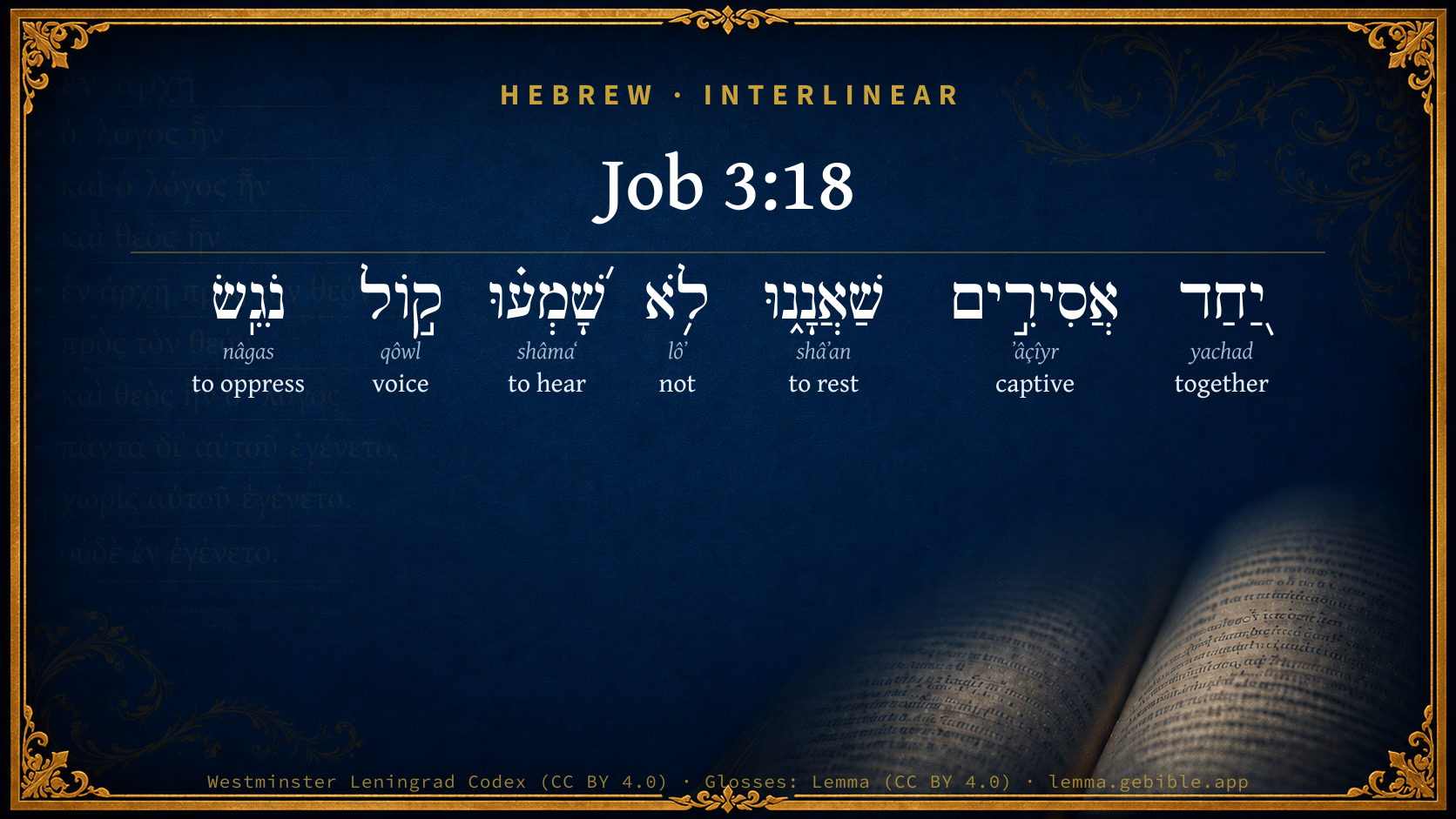
Job 3:18

Hebrew (Westminster Leningrad Codex) Job 3:18 appears in the Hebrew Old Testament. The text above is from the Westminster Leningrad Codex. Each word links to its Strong’s number, a concise gloss, and parsing drawn from the Open Scriptures Hebrew Bible morphology. Click any word for its full Brown-Driver-Briggs (BDB) entry.
Download image
Cite this verse

Job 3:18 (World English Bible). Public Domain. Lemma interlinear Bible study tool, https://lemma.gebible.app/v/job/3/18.

Show BibTeX & RIS
BibTeX
RIS
English Translation
There the prisoners are at ease together. They don't hear the voice of the taskmaster.
World English Bible · Public Domain
Highlights
  • 1 first appearance in the Hebrew Bible
Full analysis ↓
Download a study sheet

One document with this verse’s original text, its word-by-word gloss line, the meaning frame, cross-references with their text, attributed commentary, and full source and license credits — printable, and it pastes into notes with its structure intact.

This verse Autodidact and up

Study sheet (.html) Plain text (.txt)

A passage Seminary Student

Up to 50 verses in one chapter. A passage sheet keeps up to 6 commentary sources and 12 cross-references per verse, in the order this page ranks them, and says so on the sheet whenever that leaves anything out. Ask for a single verse and you get the Autodidact verse sheet above.

Everything on this page stays free to read, with no account — the sheet is a download of what is already on screen, not access to it.

Want to remove ads? Support Godless Engineer
Compare translations 3

The same verse in 3 English versions, stacked beneath the original-language interlinear above. Click any original word for its lexicon entry.

Each is an independent rendering of the whole verse — the interlinear is not word-aligned to these translations.

Highlighted words mark where these versions differ — a whole-verse word diff, not a word-by-word alignment.

  • World English Bible Public Domain
    There the prisoners are at ease together. They don't hear the voice of the taskmaster.
  • King James Version Public Domain
    There the prisoners rest together; they hear not the voice of the oppressor.
  • unfoldingWord Literal Text CC BY-SA 4.0
    Captives relax together; they do not hear the voice of a taskmaster.

unfoldingWord Literal Text — © unfoldingWord, licensed CC BY-SA 4.0. Word-aligned USFM3 via Door43 (git.door43.org/unfoldingWord/en_ult).

Versions to compare (up to 4)

3 of 4 selected

Show all 18 translations

Every available English version of this verse, each an independent rendering of the whole verse.

  • World English Bible Public Domain
    There the prisoners are at ease together. They don't hear the voice of the taskmaster.
  • Berean Standard Bible Public Domain
    The captives enjoy their ease; they do not hear the voice of the oppressor.
  • Majority Standard Bible Public Domain
    The captives enjoy their ease; they do not hear the voice of the oppressor.
  • King James Version Public Domain
    There the prisoners rest together; they hear not the voice of the oppressor.
  • American Standard Version (1901) Public Domain
    There the prisoners are at ease together; They hear not the voice of the taskmaster.
  • Revised Version (1885) Public Domain
    There the prisoners are at ease together; they hear not the voice of the taskmaster.
  • Geneva Bible (1599) Public Domain
    The prisoners rest together, and heare not the voyce of the oppressour.
  • Douay-Rheims (1899) Public Domain
    And they sometime bound together without disquiet, have not heard the voice of the oppressor.
  • Young's Literal Translation Public Domain
    Together prisoners have been at ease, They have not heard the voice of an exactor,
  • Literal Standard Version CC BY-SA 4.0
    Together prisoners have been at ease, || They have not heard the voice of an exactor,
  • Unlocked Literal Bible CC BY-SA 4.0
    There the prisoners are at ease together; they do not hear the voice of the slave driver.
  • unfoldingWord Literal Text CC BY-SA 4.0
    Captives relax together; they do not hear the voice of a taskmaster.
  • Darby Bible Public Domain
    The prisoners together are at ease; they hear not the voice of the taskmaster.
  • World Messianic Bible Public Domain
    There the prisoners are at ease together. They don’t hear the voice of the taskmaster.
  • Webster's Bible Public Domain
    There the prisoners rest together; they hear not the voice of the oppressor.
  • Free Bible Version CC BY-SA 4.0
    There prisoners take it easy—they don't hear the commands of their oppressors.
  • Bible in Basic English Public Domain
    There the prisoners are at peace together; the voice of the overseer comes not again to their ears.
  • JPS Tanakh (1917) Public Domain
    There the prisoners are at ease together; they hear not the voice of the taskmaster.

Literal Standard Version (2020), Covenant Press — licensed CC BY-SA 4.0. Text via the HelloAO Bible API (eBible.org). Unlocked Literal Bible (unfoldingWord) — licensed CC BY-SA 4.0. Text via the HelloAO Bible API (eBible.org). unfoldingWord Literal Text — © unfoldingWord, licensed CC BY-SA 4.0. Word-aligned USFM3 via Door43 (git.door43.org/unfoldingWord/en_ult). Free Bible Version, Dr. Jonathan Gallagher — licensed CC BY-SA 4.0. Text via the HelloAO Bible API (eBible.org).

Word by word

More ways to search: Search by grammar → Find every occurrence → Compare this word →

Practice this passage: Drill this verse → Learn its vocabulary →

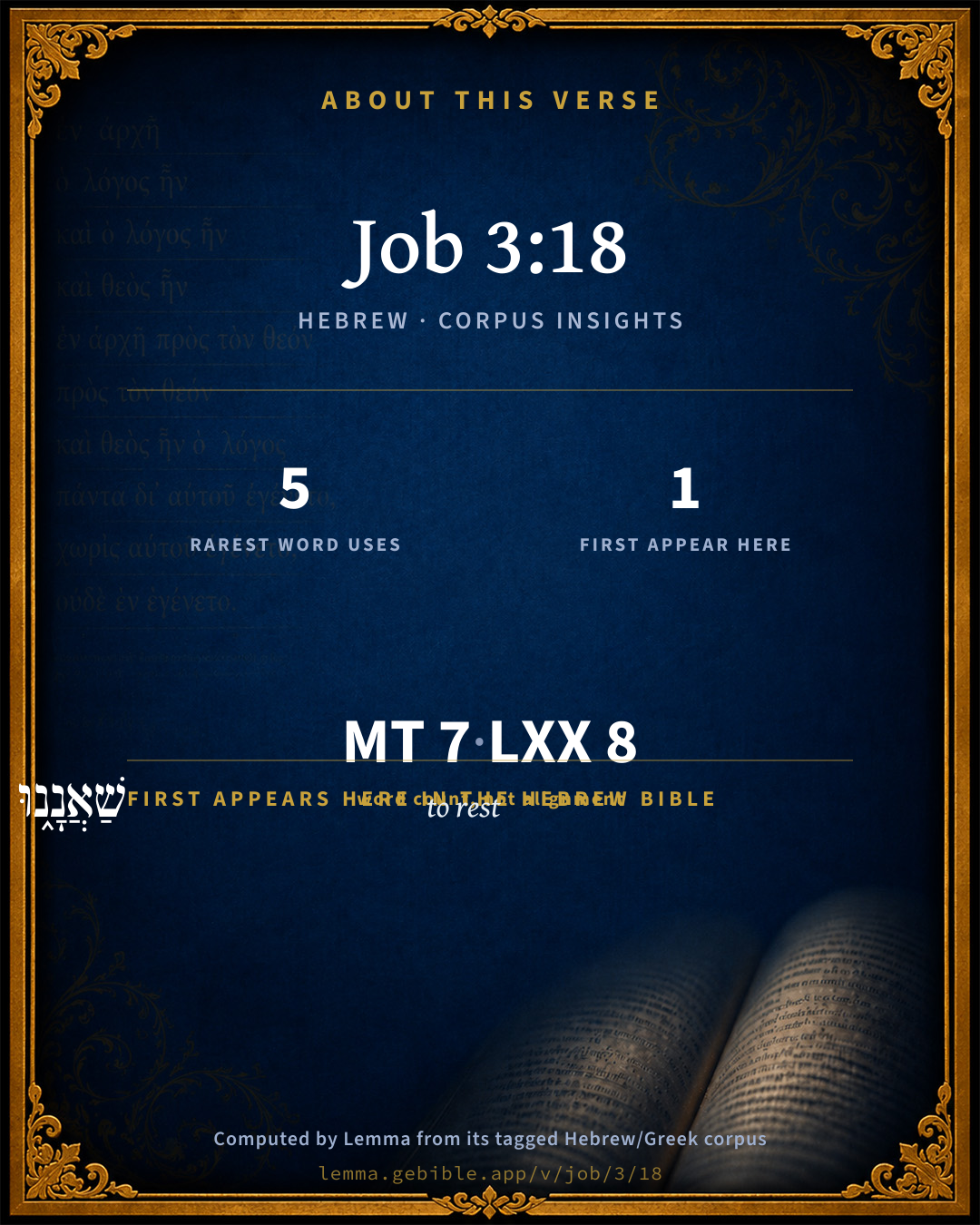
About this verse

These counts appear in no published source. They are computed here, from the morphology-tagged text and Lemma’s own curated glosses. What Lemma adds →

7
words
7
distinct lemmas
Wisdom
section

Notable vocabulary

The rarest word here is שַׁאֲנָ֑נוּ to rest H7599 — appearing just 5 times in the whole Hebrew Bible.

First appearance in Scripture

This word makes its first canonical appearance in the Hebrew Bible here:

  • שַׁאֲנָ֑נוּ to rest H7599

Shared distinctive vocabulary

שַׁאֲנָ֑נוּ to rest H7599 occurs in 5 verses of the Hebrew Bible. Also found in:

Grammatical profile

  • 3 verbs
  • 2 nouns
  • 1 adverb
  • 1 particle

Verb forms

  • שַׁאֲנָ֑נוּ Palel · Perfect
  • שָׁ֝מְע֗וּ Qal · Perfect
  • נֹגֵֽשׂ Qal · Participle Active

Hebrew & Septuagint length

In English translation the verse runs 15 words from the Hebrew and 14 from the Septuagint (LXX English) — closely comparable.

A rough comparison of the two English renderings, which tokenize alike — not a word-level alignment.

Word counts can differ between the Hebrew and the Greek without any difference in meaning — e.g. the Hebrew direct-object marker אֵת has no separate Greek word, and Greek often adds the article ὁ.

In the original languages it is 7 Hebrew tokens and 8 Greek tokens — but the two are counted differently (Hebrew bundles its prefixes and suffixes into one token; the Greek is in lemma form), so that isn’t a like-for-like length.

Cross-references

5

Topical passages linked to Job 3:18 in the Treasury of Scripture Knowledge — connected by theme and wording, ordered by reader-vote popularity; previews shown in the World English Bible.

  • Job 39:7 He scorns the tumult of the city, Neither hears he the shouting of the driver.
  • Exodus 5:6–8 The same day Pharaoh commanded the taskmasters of the people, and their officers, saying,
  • Exodus 5:15–19 Then the officers of the children of Israel came and cried to Pharaoh, saying, "Why do you deal this way with your servants?
  • Judges 4:3 The children of Israel cried to Yahweh: for he had nine hundred chariots of iron; and twenty years he mightily oppressed the children of Israel.
  • Isaiah 14:3–4 It shall happen in the day that Yahweh shall give you rest from your sorrow, and from your trouble, and from the hard service in which you were made to serve,

Cross-references courtesy of OpenBible.info (CC BY 4.0).

Hebrew and Greek witnesses Masoretic Hebrew ↔ Greek Septuagint

The same verse in the two great witnesses to the Old Testament, shown verse-for-verse.

These are two independent witnesses, not word-aligned to each other, and the Septuagint is shown in lemma (dictionary) form.

Hebrew Job 3:18 Masoretic · Westminster Leningrad Codex

יַ֭חַד אֲסִירִ֣ים שַׁאֲנָ֑נוּ לֹ֥א שָׁ֝מְע֗וּ ק֣וֹל נֹגֵֽשׂ

There the prisoners are at ease together. They don't hear the voice of the taskmaster.

World English Bible · Public Domain

Greek LXX Job 3:18 Septuagint · lemma form

ὁμοθυμαδόν δέ ὁ αἰώνιος οὐ ἀκούω φωνή φορολόγος

And the men of old time have together ceased to hear the exactor's voice.

LXX2012 (modern English Septuagint) · Public Domain

On this verse, Albert Barnes' Notes on the Bible discusses the Septuagint’s reading. Read the note in Commentary ↓

Hebrew: Westminster Leningrad Codex (CC BY 4.0). Greek: Septuagint (public domain); English from LXX2012 (modern English Septuagint) (Public Domain). How the Septuagint differs from the Hebrew →

Commentary

Notes on Job 3:18 from classic Christian and Jewish commentators (each source and its license shown beneath its notes). The classic Christian expositions comment on the surrounding passage and are grouped to its opening verse, so a note may address several verses; the Jewish commentaries on the Tanakh (Rashi and others) are per-verse, so they appear only where the commentator wrote on this verse.

Lemma curates 59 commentaries, every one of them public domain or Creative Commons licensed, each selected and text-cleaned for this edition rather than reprinted as found. About our sources →

Trapp's Complete Commentary

John Trapp

Job 3:18 [There] the prisoners rest together; they hear not the voice of the oppressor.

Ver. 18. There the prisoners rest together] Or alike, as do their cruel creditors and hard taskmasters. There, that is, in the state of the dead, whether by land or sea, the prisoners, or bound persons, the miserable captives, rest; such as were those poor Christians, shut up so close (by Barbarossa, the Turkish general, returning toward Constantinople) under hatches among the excrements of nature, that all the way as he went almost every hour, some of them were cast dead over board. Such were many of the martyrs, kept fast shut up in Lollard’s tower, in the bishop of London’s coal house, a dark and ugly prison, said Mr Philpot, as any is about London; but I thank the Lord, I am not alone, but have six other faithful companions, who in our darkness do lightsomely sing psalms and praises to God for his great goodness, but especially for this, that I am so near the apprehension of eternal bliss. God forgive me mine unthankfulness and unworthiness of so great glory (Acts and Mon. 1669, 1670). What pitiful hard usage God’s poor prisoners met with in the late troubles, at Oxford especially (from which death God graciously delivered me when I was in their hands) and in the western parts, see Mr Bonas’ Sermon called Job in the West, where he compareth the enemies’ cruelty to that of the American cannibals, who, when they take a prisoner, feed upon him alive, and by degrees, to the unutterable aggravation of his horror and torment.

They hear not the voice of the oppressor] Their harsh and hard speeches, Jdg 1:15, that were as a murdering weapon in the poor prisoner’s bones, Psa 42:10. Send me back to my frogs and toads again, where I may pray for your conversion, said one of the martyrs to his railing adversaries. Art thou come, thou villain? how darest thou look me in the face for shame? said Stephen Gardiner to Dr Taylor the martyr, who told him his own freely, but fairly: for the spirit of grace is nec mendax, nec mordax. neither lying nor deceitful. Est autem Satanae pectus faecundissimum convitiis, Moreover, there is in the heart of Satan most fruitful vice,saith Luther; the devil and his agents are bitter railers, fetching their words as far as hell, to break the hearts of God’s prisoners, Psa 69:20. But besides that they have their cordial of a good conscience by them, 2Co 1:12, in the grave they hear not the voice of the oppressor, nor the barkings of these dead dogs, any more.

John Trapp, A Commentary or Exposition upon All the Books of the Old and New Testament (1647–1656) — public domain. Text from a community e-Sword module.

Joseph Benson's Commentary

Job 3:18. There the prisoners rest together — That is, one as well as another; they who were lately deprived of their liberty, kept in the strongest chains and closest prisons, and condemned to the most hard and miserable slavery, rest as well as those who were captives in much better circumstances. They hear not the voice of the oppressor — Or exactor, or taskmaster, (as the word נגשׁ, nogesh, is translated Exo 5:6,) who urges and forces them, by cruel threatenings and stripes, to labour beyond their strength. Job does not here take into consideration their eternal state after death, of which he speaks hereafter, but only their freedom from worldly troubles, which is the sole matter of his present discourse.

Joseph Benson's Commentary on the Old and New Testaments (1811–1818) — public domain. Text from a community e-Sword module.

Geneva Bible (1599)

Geneva Bible translators

All they that sustain any kind of calamity and misery in this world: which he speaketh after the judgment of the flesh.

Geneva Bible (1599) marginal notes — public domain. Text via Bolls.life.

Jamieson, Fausset & Brown

Robert Jamieson, A. R. Fausset & David Brown

There the prisoners rest--from their chains.

Jamieson, Fausset & Brown — Commentary Critical and Explanatory on the Whole Bible (1871) — public domain (CC PDM 1.0). Text via the HelloAO Bible API.

Adam Clarke's Commentary

Verse 18. The prisoners rest together] Those who were slaves, feeling all the troubles, and scarcely tasting any of the pleasures of life, are quiet in the grave together; and the voice of the oppressor, the hard, unrelenting task-master, which was more terrible than death, is heard no more. They are free from his exactions, and his mouth is silent in the dust. This may be a reference to the Egyptian bondage. The children of Israel cried by reason of their oppressors or task-masters.

Adam Clarke's Commentary on the Bible (1810–1826) — public domain. Text from a community e-Sword/MySword module.

Ellicott's Commentary for English Readers

(18) The oppressor.—As this is the word rendered taskmaster in Exodus, some have thought there may be an allusion to that history here.

A Bible Commentary for English Readers, edited by Charles John Ellicott (1878–1897) — public domain. Text from a community e-Sword module.

The Cambridge Bible for Schools and Colleges

gen. ed. J. J. S. Perowne

18. the prisoners rest together] The “prisoners” are not those immured in prison, but captives driven to forced labour.

the oppressor] The taskmaster, Exo_3:7. The prisoners are there all together, and they hear not the voice, the shouts and curses of the driver ch. Job_39:7).

The Cambridge Bible for Schools and Colleges (gen. ed. J. J. S. Perowne; Cambridge University Press, 1878–1918) — public domain. Text from a community e-Sword module.

John Gill's Exposition

There the prisoners rest together,.... "Are at ease", as Mr. Broughton renders the words; such who while they lived were in prison for debt, or were condemned to the galleys, to lead a miserable life; or such who suffered bonds and imprisonment for the sake of religion, at death their chains are knocked off, and they are as much at liberty, and enjoy as much ease, as the dead that never were prisoners; and not only rest together with those who were their fellow prisoners, but with those who never were in prison, yea, with those who cast them into it; for there the prisoners and those that imprisoned them are upon a level, enjoying equal ease and liberty:

they hear not the voice of the oppressor; or "exactor" (x); neither of their creditors that demanded their debt of them, and threatened them with a prison, or that detained them in it; nor of the jail keeper that gave them hard words as well as stripes; nor of cruel taskmasters, who kept them to hard service in prison, and threatened them severely if they did not perform it, like the taskmasters in Egypt, Exo 5:11; but, in the grave, the blustering, terrifying, voice of such, is not heard.

(x) "exactoris", Pagninus, Montanus, Junius & Tremellius, Piscator, &c.

John Gill's Exposition of the Whole Bible (1746–1763) — public domain (CC PDM 1.0). Text via the HelloAO Bible API.

Albert Barnes' Notes on the Bible

There the prisoners rest together - Herder translates this, “There the prisoners rejoice in their freedom.” The Septuagint strangely enough, “There they of old (ὁ αἰώνιοι hoi aiōnioi) assembled together (ὁμοθυμαδόν homothumadon) have not heard the voice of the exactor.” The Hebrew word שׁאן shâ'an means “to rest, to be quiet, to be tranquil”; and the sense is, that they are in the grave freed from chains and oppressions.

They hear not the voice of the oppressor - Of him who exacted taxes, and who laid on them heavy burdens, and who imprisoned them for imaginary crimes. He who is bound in chains, and who has no other prospect of release, can look for it in the grave and will find it there. Similar sentiments are found respecting death in Seneca, ad Marcian, 20: “Mots omnibus finis, multis remedium, quibusdam votum; haec servitutem invito domino remittit; haec captivorum catenas levat; haec a carcere reducit, quos exire imperium impofens vetuerat; haec exulibus, in pairtam semper animum oculosque tendentibus, ostendit, nibil interesse inter quos quisque jaceat; haec, ubi res communes fortuna male divisit, et aequo jure genitos allure alii donavit, exaequat omnia; haec est, quae nihil quidquam alieno fecit arbitrio; haec est, ea qua nemo humilitatem guam sensit; haec est, quae nuili paruit.” The sense in Job is, that all are at liberty in death. Chains no longer bind; prisons no longer incarccrate; the voice of oppression no longer alarms.

Albert Barnes' Notes on the Bible (1834–1885) — public domain. Text from a community e-Sword/MySword module.

Haydock's Catholic Bible Commentary

Bound in chains, like incorrigible slaves, (Calmet) or debtors. (Cocceius.) --- These were formerly treated with great severity, Luke xii. 59. (Calmet)

George Leo Haydock (1774–1849), Haydock's Catholic Family Bible and Commentary, 1859 edition — public domain. Excludes Psalms (Douay-Rheims chapter numbering differs from Protestant) and Deuterocanonical books (Catholic canon only).

Matthew Poole's English Annotations

The prisoners rest together, i.e. one as well as another; they who were kept in the strongest chains and closest prisons, and condemned to the most hard and miserable slavery, rest as well as those who were captives in much better circumstances. Or,

in like manner, ( as this word oft signifies,) as those oppressors and oppressed do.

The oppressor, or, exacter, or taskmaster, who urgeth and forceth them by cruel threatenings and stripes to greater diligence in the works to which they are condemned. See Exo 3:7; 5:6,10,13. Job meddles not here with their eternal state after death, or the sentence and judgment of God against wicked men, of which he speaks hereafter; but only speaks of their freedom from worldly troubles, which is the only matter of his complaint and present discourse.

Matthew Poole's English Annotations on the Holy Bible (1683–1685) — public domain. Text from a community e-Sword/MySword module.

Whedon's Commentary on the Bible

Daniel D. Whedon

18. Rest — שׁאננו, an intensive form of the verb, expressive of deep and abiding rest.

The oppressor — נגשׂ, taskmaster. The same word appears in Exo_5:6.

Daniel D. Whedon (gen. ed.), Commentary on the Old and New Testaments (1874–1909) — public domain. Text from a community e-Sword module.

The Pulpit Commentary

There the prisoners rest together. "There those who in life were prisoners, condemned to work at enforced labours, enjoy sweet rest together." They hear not the voice of the oppressor; rather, of the taskmaster. (comp. Exo_3:7 Exo_5:6, where the same word is used) The task. master continually urged on the wearied labourers with such words as those of Exo_5:13, "Fulfil your works, fulfil your daily tasks. In the grave these hated sounds would not be heard.

The Pulpit Commentary (1880–1919), ed. H.D.M. Spence-Jones & Joseph S. Exell — public domain. Text from a community e-Sword module.

John Wesley's Explanatory Notes

The oppressor - Or, taskmaster, who urges and forces them to work by cruel threatenings and stripes. Job meddles not here with their eternal state after death, of which he speaks hereafter, but only their freedom from worldly troubles, which is the sole matter of his present discourse.

John Wesley, Explanatory Notes Upon the Whole Bible (1754–1765) — public domain. Text via the GEBible commentary corpus.

Lesson kit

Teaching starters — assembled from the data on this page, not authored interpretation. Every prompt links to the verse data it draws on. Edit before teaching.

Job, in the Wisdom, opens this verse with 7 words (7 distinct Hebrew lemmas). Its most distinctive word is shâʼan (“to rest”). A historical commentator’s framing appears above. Read the whole chapter for the surrounding context.

Discussion questions

  1. The word shâʼan carries the sense “to rest.” How does it shape the verse?
  2. This is the first place “to rest” appears in Scripture (first appears here). What does its debut here establish?
  3. How does Proverbs 1:33, which shares the word «to rest», read alongside this verse?
  4. The translations on this page render this verse differently — a whole-verse word diff, not a word-by-word alignment. What might account for the different wordings?
  5. «שַׁאֲנָ֑נוּ» is a Palel Perfect verb. How does that grammatical form shape the action described?
  6. Compare how Trapp's Complete Commentary and Joseph Benson's Commentary read this verse. Where do they agree or differ?

Things to notice

Reading settings

Reading text

Shown beneath each verse's original-language words.

Old Testament
Old Testament edition

Read the OT as the Masoretic Hebrew (MT) or the Greek Septuagint (LXX).

English shown for the Greek Septuagint (in the Hebrew ↔ Greek comparison).

Comparing translations? Open the Compare panel on any verse page to stack up to four side by side.