
Exodus 9:29

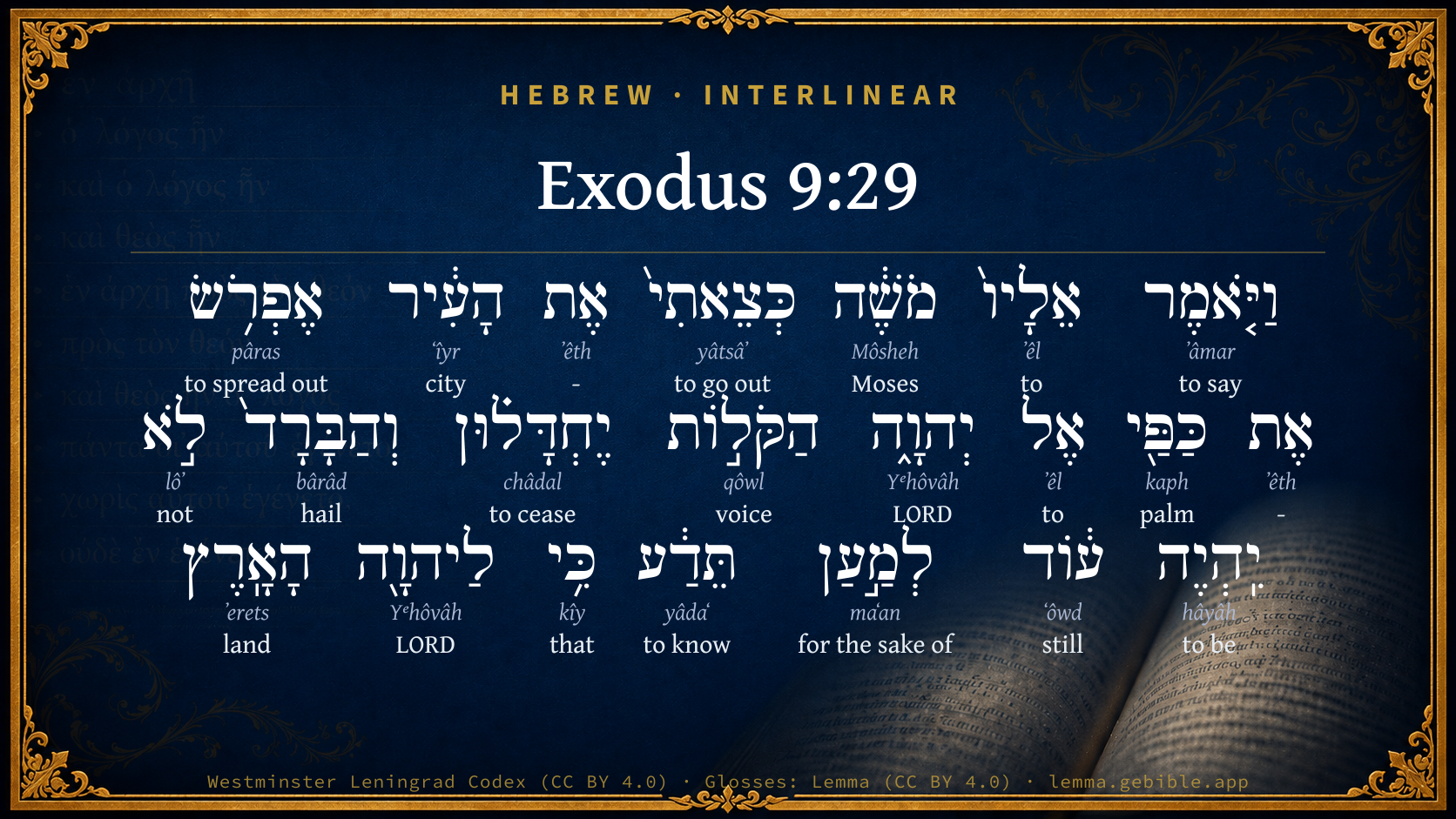
Hebrew (Westminster Leningrad Codex) Exodus 9:29 appears in the Hebrew Old Testament. The text above is from the Westminster Leningrad Codex. Each word links to its Strong’s number, a concise gloss, and parsing drawn from the Open Scriptures Hebrew Bible morphology. Click any word for its full Brown-Driver-Briggs (BDB) entry.
Download image
Cite this verse

Exodus 9:29 (World English Bible). Public Domain. Lemma interlinear Bible study tool, https://lemma.gebible.app/v/exodus/9/29.

Show BibTeX & RIS
BibTeX
RIS
English Translation
Moses said to him, "As soon as I have gone out of the city, I will spread abroad my hands to Yahweh. The thunders shall cease, neither shall there be any more hail; that you may know that the earth is Yahweh's.
World English Bible · Public Domain
Highlights
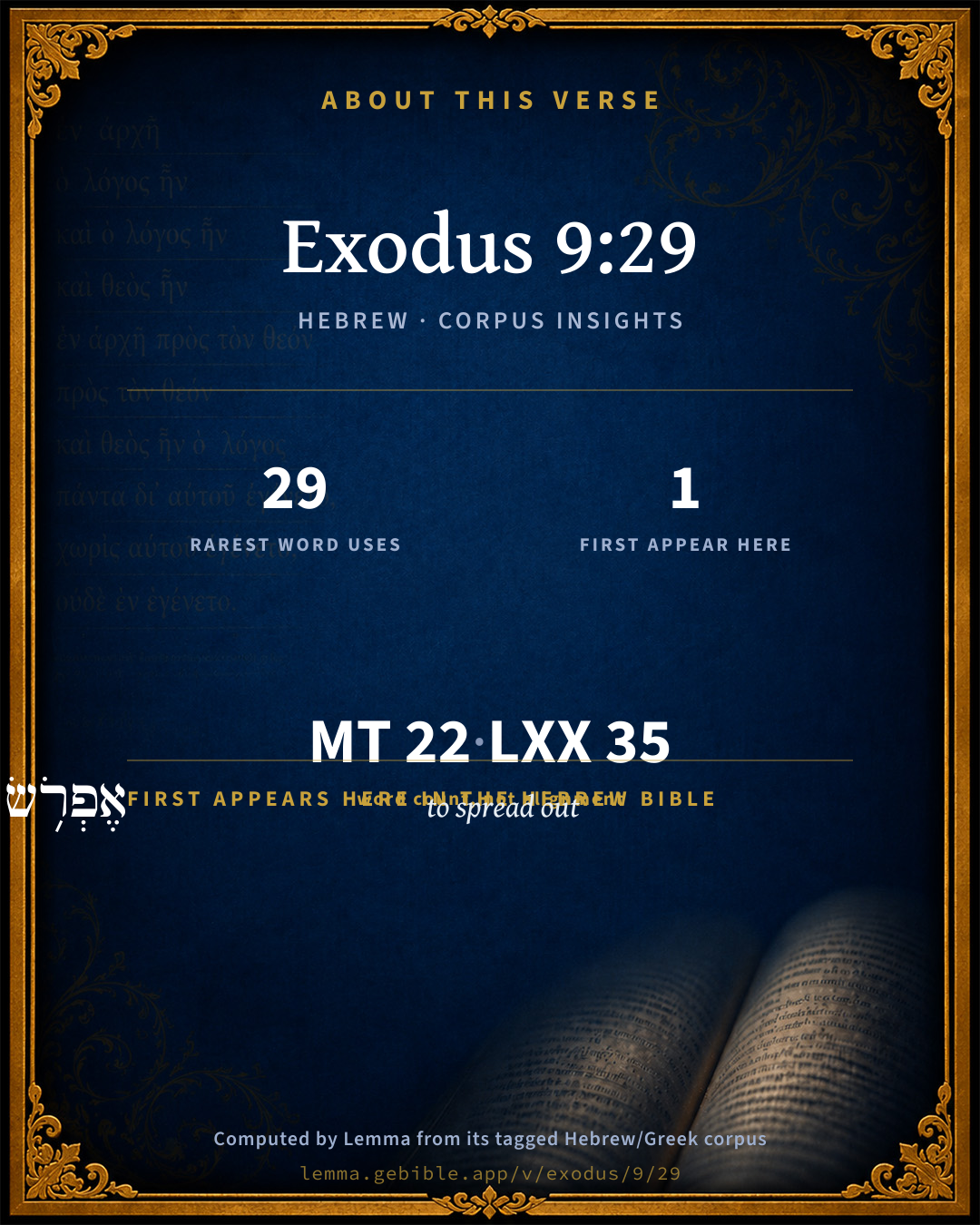
  • 1 first appearance in the Hebrew Bible
Full analysis ↓
Download a study sheet

One document with this verse’s original text, its word-by-word gloss line, the meaning frame, cross-references with their text, attributed commentary, and full source and license credits — printable, and it pastes into notes with its structure intact.

This verse Autodidact and up

Study sheet (.html) Plain text (.txt)

A passage Seminary Student

Up to 50 verses in one chapter. A passage sheet keeps up to 6 commentary sources and 12 cross-references per verse, in the order this page ranks them, and says so on the sheet whenever that leaves anything out. Ask for a single verse and you get the Autodidact verse sheet above.

Everything on this page stays free to read, with no account — the sheet is a download of what is already on screen, not access to it.

Want to remove ads? Support Godless Engineer
Compare translations 3

The same verse in 3 English versions, stacked beneath the original-language interlinear above. Click any original word for its lexicon entry.

Each is an independent rendering of the whole verse — the interlinear is not word-aligned to these translations.

Highlighted words mark where these versions differ — a whole-verse word diff, not a word-by-word alignment.

  • World English Bible Public Domain
    Moses said to him, "As soon as I have gone out of the city, I will spread abroad my hands to Yahweh. The thunders shall cease, neither shall there be any more hail; that you may know that the earth is Yahweh's.
  • King James Version Public Domain
    And Moses said unto him, As soon as I am gone out of the city, I will spread abroad my hands unto the LORD; and the thunder shall cease, neither shall there be any more hail; that thou mayest know how that the earth is the LORD's.
  • unfoldingWord Literal Text CC BY-SA 4.0
    And Moses said to him, “As I leave the city, I will spread my palms to Yahweh. The thunder will cease, and the hail will not continue, so that you may know that the earth belongs to Yahweh.

unfoldingWord Literal Text — © unfoldingWord, licensed CC BY-SA 4.0. Word-aligned USFM3 via Door43 (git.door43.org/unfoldingWord/en_ult).

Versions to compare (up to 4)

3 of 4 selected

Show all 18 translations

Every available English version of this verse, each an independent rendering of the whole verse.

  • World English Bible Public Domain
    Moses said to him, "As soon as I have gone out of the city, I will spread abroad my hands to Yahweh. The thunders shall cease, neither shall there be any more hail; that you may know that the earth is Yahweh's.
  • Berean Standard Bible Public Domain
    Moses said to him, “When I have left the city, I will spread out my hands to the LORD. The thunder will cease, and there will be no more hail, so that you may know that the earth is the LORD’s.
  • Majority Standard Bible Public Domain
    Moses said to him, “When I have left the city, I will spread out my hands to the LORD. The thunder will cease, and there will be no more hail, so that you may know that the earth is the LORD’s.
  • King James Version Public Domain
    And Moses said unto him, As soon as I am gone out of the city, I will spread abroad my hands unto the LORD; and the thunder shall cease, neither shall there be any more hail; that thou mayest know how that the earth is the LORD's.
  • American Standard Version (1901) Public Domain
    And Moses said unto him, As soon as I am gone out of the city, I will spread abroad my hands unto Jehovah; the thunders shall cease, neither shall there be any more hail; that thou mayest know that the earth is Jehovah's.
  • Revised Version (1885) Public Domain
    And Moses said unto him, As soon as I am gone out of the city, I will spread abroad my hands unto the LORD; the thunders shall cease, neither shall there be any more hail; that thou mayest know that the earth is the LORD’S.
  • Geneva Bible (1599) Public Domain
    Then Moses saide vnto him, Assoone as I am out of the citie, I will spreade mine hands vnto the Lord, and the thunder shall cease, neither shall there be any more haile, that thou mayest knowe that the earth is the Lordes.
  • Douay-Rheims (1899) Public Domain
    Moses said: As soon as I am gone out of the city, I will stretch forth my hands to the Lord, and the thunders shall cease, and the hail shall be no more: that thou mayst know that the earth is the Lord's.
  • Young's Literal Translation Public Domain
    And Moses saith unto him, `At my going out of the city, I spread my palms unto Jehovah -- the voices cease, and the hail is not any more, so that thou knowest that the earth `is' Jehovah's;
  • Literal Standard Version CC BY-SA 4.0
    And Moses says to him, “At my going out of the city, I spread my palms to YHWH—the voices cease, and there is no more hail, so that you know that the earth [is] YHWH’s;
  • Unlocked Literal Bible CC BY-SA 4.0
    Moses said to him, “As soon as I leave the city, I will spread my hands out to Yahweh. The thunder will stop, and there will not be any more hail. In this way you will know that the earth belongs to Yahweh.
  • unfoldingWord Literal Text CC BY-SA 4.0
    And Moses said to him, “As I leave the city, I will spread my palms to Yahweh. The thunder will cease, and the hail will not continue, so that you may know that the earth belongs to Yahweh.
  • Darby Bible Public Domain
    And Moses said to him, When I go out of the city, I will spread out my hands to Jehovah: the thunder will cease, and there will be no more hail; that thou mayest know that the earth is Jehovah's.
  • World Messianic Bible Public Domain
    Moses said to him, “As soon as I have gone out of the city, I will spread out my hands to the LORD. The thunders shall cease, and there will not be any more hail; that you may know that the earth is the LORD’s.
  • Webster's Bible Public Domain
    And Moses said to him, As soon as I am gone out of the city, I will spread abroad my hands to the LORD; and the thunder shall cease, neither shall there be any more hail; that thou mayest know how that the earth is the LORD'S.
  • Free Bible Version CC BY-SA 4.0
    “Once I've left the city, I will pray to the Lord for you,” Moses told him. “The thunder will stop, and there'll be no more hail, so that you will realize that the earth belongs to the Lord.
  • Bible in Basic English Public Domain
    And Moses said, When I am gone outside the town, my hands will be stretched out to the Lord; the thunders and the ice-storm will come to an end, so that you may see that the earth is the Lord's.
  • JPS Tanakh (1917) Public Domain
    And Moses said unto him: 'As soon as I am gone out of the city, I will spread forth my hands unto the LORD; the thunders shall cease, neither shall there be any more hail; that thou mayest know that the earth is the LORD'S.

Literal Standard Version (2020), Covenant Press — licensed CC BY-SA 4.0. Text via the HelloAO Bible API (eBible.org). Unlocked Literal Bible (unfoldingWord) — licensed CC BY-SA 4.0. Text via the HelloAO Bible API (eBible.org). unfoldingWord Literal Text — © unfoldingWord, licensed CC BY-SA 4.0. Word-aligned USFM3 via Door43 (git.door43.org/unfoldingWord/en_ult). Free Bible Version, Dr. Jonathan Gallagher — licensed CC BY-SA 4.0. Text via the HelloAO Bible API (eBible.org).

Word by word

More ways to search: Search by grammar → Find every occurrence → Compare this word →

Practice this passage: Drill this verse → Learn its vocabulary →

וְהַבָּרָד֙
bârâd
H1259
“and · the · hail”
Conjunction + Particle, Definite Article + Noun, Common, Masculine, Singular, Absolute
Part of Speech
Conjunction + Particle + Noun
Type
Common
Gender
Masculine
Number
Singular
State
Absolute
Full BDB Definition

Origin: from H1258

TWOT: 280a

hail - of God's judgment (figuratively)
  1. וַיֹּ֤אמֶר ʼâmar H559 “and · to say” Conjunction + Verb, Qal, Sequential Imperfect, 3rd Person, Masculine, Singular
  2. אֵלָיו֙ ʼêl H413 “to · him” Preposition + Suffix, Personal, 3rd Person, Masculine, Singular
  3. מֹשֶׁ֔ה Môsheh H4872 “Moses” Noun, Proper
  4. כְּצֵאתִי֙ yâtsâʼ H3318 “like/as · to go out · me” Preposition + Verb, Qal, Infinitive Construct + Suffix, Personal, 1st Person, Common, Singular
  5. אֶת ʼêth H853 “-” Particle, Direct Object
  6. הָעִ֔יר ʻîyr H5892 “the · city” Particle, Definite Article + Noun, Common, Feminine, Singular, Absolute
  7. אֶפְרֹ֥שׂ pâras H6566 “to spread out” Verb, Qal, Imperfect, 1st Person, Common, Singular
  8. אֶת ʼêth H853 “-” Particle, Direct Object
  9. כַּפַּ֖י kaph H3709 “palms · my” Noun, Common, Feminine, Dual, Construct + Suffix, Personal, 1st Person, Common, Singular
  10. אֶל ʼêl H413 “to” Preposition
  11. יְהוָ֑ה Yᵉhôvâh H3068 “LORD” Noun, Proper
  12. הַקֹּל֣וֹת qôwl H6963 “the · voices” Particle, Definite Article + Noun, Common, Masculine, Plural, Absolute
  13. יֶחְדָּל֗וּן châdal H2308 “to cease” Verb, Qal, Imperfect, 3rd Person, Masculine, Plural + Suffix, n
  14. לֹ֣א lôʼ H3808 “not” Particle, Negative
  15. יִֽהְיֶה hâyâh H1961 “to be” Verb, Qal, Imperfect, 3rd Person, Masculine, Singular
  16. ע֔וֹד ʻôwd H5750 “still” Adverb
  17. לְמַ֣עַן maʻan H4616 “for the sake of” Preposition
  18. תֵּדַ֔ע yâdaʻ H3045 “to know” Verb, Qal, Imperfect, 2nd Person, Masculine, Singular
  19. כִּ֥י kîy H3588 “that” Conjunction
  20. לַיהוָ֖ה Yᵉhôvâh H3068 “to/for · LORD” Preposition + Noun, Proper
  21. הָאָֽרֶץ ʼerets H776 “the · land” Particle, Definite Article + Noun, Common, Both, Singular, Absolute

About this verse

These counts appear in no published source. They are computed here, from the morphology-tagged text and Lemma’s own curated glosses. What Lemma adds →

22
words
19
distinct lemmas
Pentateuch
section

First appearance in Scripture

This word makes its first canonical appearance in the Hebrew Bible here:

  • אֶפְרֹ֥שׂ to spread out H6566

Shared distinctive vocabulary

וְהַבָּרָד֙ hail H1259 occurs in 26 verses of the Hebrew Bible. Also found in:

Grammatical profile

  • 6 verbs
  • 8 nouns
  • 3 prepositions
  • 1 conjunction
  • 1 adverb
  • 3 particles

Verb forms

  • וַיֹּ֤אמֶר Qal · Sequential Imperfect
  • כְּצֵאתִי֙ Qal · Infinitive Construct
  • אֶפְרֹ֥שׂ Qal · Imperfect
  • יֶחְדָּל֗וּן Qal · Imperfect
  • יִֽהְיֶה Qal · Imperfect
  • תֵּדַ֔ע Qal · Imperfect

Repetition

Words recur within this verse — often emphatic in Hebrew:

  • יְהוָ֑ה LORD H3068 ×2
  • אֵלָיו֙ to H413 ×2

Hebrew & Septuagint length

In English translation the verse runs 42 words from the Hebrew and 47 from the Septuagint (LXX English) — closely comparable.

A rough comparison of the two English renderings, which tokenize alike — not a word-level alignment.

Word counts can differ between the Hebrew and the Greek without any difference in meaning — e.g. the Hebrew direct-object marker אֵת has no separate Greek word, and Greek often adds the article ὁ.

In the original languages it is 22 Hebrew tokens and 35 Greek tokens — but the two are counted differently (Hebrew bundles its prefixes and suffixes into one token; the Greek is in lemma form), so that isn’t a like-for-like length.

Cross-references

16

Topical passages linked to Exodus 9:29 in the Treasury of Scripture Knowledge — connected by theme and wording, ordered by reader-vote popularity; previews shown in the World English Bible.

  • 1 Kings 8:22 Solomon stood before the altar of Yahweh in the presence of all the assembly of Israel, and spread forth his hands toward heaven;
  • 1 Kings 8:38 whatever prayer and supplication be made by any man, [or] by all your people Israel, who shall know every man the plague of his own heart, and spread forth his hands toward this house:
  • Psalms 143:6 I spread forth my hands to you. My soul thirsts for you, like a parched land. Selah.
  • Isaiah 1:15 When you spread forth your hands, I will hide my eyes from you; Yes, when you make many prayers, I will not hear. Your hands are full of blood.
  • 1 Corinthians 10:26 for "the earth is the Lord's, and its fullness."
  • Deuteronomy 10:14 Behold, to Yahweh your God belongs heaven and the heaven of heavens, the earth, with all that is therein.
  • Exodus 9:33 Moses went out of the city from Pharaoh, and spread abroad his hands to Yahweh; and the thunders and hail ceased, and the rain was not poured on the earth.
  • Exodus 19:5 Now therefore, if you will indeed obey my voice, and keep my covenant, then you shall be my own possession from among all peoples; for all the earth is mine;
  • 2 Chronicles 6:12–13 He stood before the altar of Yahweh in the presence of all the assembly of Israel, and spread forth his hands
  • Ezra 9:5 At the evening offering I arose up from my humiliation, even with my garment and my robe torn; and I fell on my knees, and spread out my hands to Yahweh my God;
  • Job 11:13 "If you set your heart aright, Stretch out your hands toward him.
  • Psalms 24:1–2 The earth is Yahweh's, with its fullness; The world, and those who dwell therein.
  • Psalms 50:12 If I were hungry, I would not tell you, For the world is mine, and all that is in it.
  • Psalms 95:4–5 In his hand are the deep places of the earth. The heights of the mountains are also his.
  • Psalms 135:6 Whatever Yahweh pleased, that he has done, In heaven and in earth, in the seas and in all deeps;
  • 1 Corinthians 10:28 But if anyone says to you, "This was offered to idols," don't eat it for the sake of the one who told you, and for the sake of conscience. For "the earth is the Lord's, and all its fullness."

Cross-references courtesy of OpenBible.info (CC BY 4.0).

Hebrew and Greek witnesses Masoretic Hebrew ↔ Greek Septuagint

The same verse in the two great witnesses to the Old Testament, shown verse-for-verse.

These are two independent witnesses, not word-aligned to each other, and the Septuagint is shown in lemma (dictionary) form.

Hebrew Exodus 9:29 Masoretic · Westminster Leningrad Codex

וַיֹּ֤אמֶר אֵלָיו֙ מֹשֶׁ֔ה כְּצֵאתִי֙ אֶת הָעִ֔יר אֶפְרֹ֥שׂ אֶת כַּפַּ֖י אֶל יְהוָ֑ה הַקֹּל֣וֹת יֶחְדָּל֗וּן וְהַבָּרָד֙ לֹ֣א יִֽהְיֶה ע֔וֹד לְמַ֣עַן תֵּדַ֔ע כִּ֥י לַיהוָ֖ה הָאָֽרֶץ

Moses said to him, "As soon as I have gone out of the city, I will spread abroad my hands to Yahweh. The thunders shall cease, neither shall there be any more hail; that you may know that the earth is Yahweh's.

World English Bible · Public Domain

Greek LXX Exodus 9:29 Septuagint · lemma form

εἶπον δέ αὐτός μωυσῆς ὡς ἄν ἐκἔρχομαι ὁ πόλις ἐκπετάννυμι ὁ χείρ ἐγώ πρός κύριος καί ὁ φωνή παύω καί ὁ χάλαζα καί ὁ ὑετός οὐ εἰμί ἔτι ἵνα γιγνώσκω ὅτι ὁ κύριος ὁ γῆ

And Moses said to him, When I shall have departed from the city, I will stretch out my hands to the Lord, and the thunderings shall cease, and the hail and the rain shall be no longer, that you may know that the earth is the Lord's.

LXX2012 (modern English Septuagint) · Public Domain

Hebrew: Westminster Leningrad Codex (CC BY 4.0). Greek: Septuagint (public domain); English from LXX2012 (modern English Septuagint) (Public Domain). How the Septuagint differs from the Hebrew →

Targum (Aramaic paraphrase)

2

The Targum is the ancient Jewish Aramaic paraphrase of the Hebrew Scriptures — an interpretive translation, not the Hebrew text itself. Onkelos (literal) and Pseudo-Jonathan (expansive) render the Torah, and Jonathan the Prophets. Coverage is partial: where no permissively-licensed English translation exists for a verse, only the Aramaic is shown. This is verse-level text, not a word-by-word alignment to the Hebrew.

  1. Targum Onkelos Torah (Genesis–Deuteronomy)
    וַאֲמַר לֵהּ משֶׁה כְּמִפְּקִי מִן קַרְתָּא אֶפְרוֹשׂ יְדַי בִּצְלוֹ קֳדָם יְיָ קָלַיָא יִתְמַנְעוּן וּבַרְדָא לָא יְהֵי עוֹד בְּדִיל דְתִדַע אֲרֵי דַיְיָ אַרְעָא:

    (no public-domain English translation for this verse)

    Targum Onkelos — Aramaic: “Onkelos Genesis” (public domain); “Onkelos Exodus” (public domain); “Onkelos Leviticus” (public domain); “Onkelos Numbers” (public domain); “Onkelos Deuteronomy” (public domain). English: “Sefaria Community Translation” (CC0 1.0 (public-domain dedication)); “J.W. Etheridge. The Targums of Onkelos and Jonathan Ben Uzziel on the Pentateuch. London: Longmans, Green, 1862” (public domain). Text via Sefaria.

  2. Targum Pseudo-Jonathan Torah (Genesis–Deuteronomy)
    וַאֲמַר לֵיהּ משֶׁה כְּמִפְקִי סְמִיךְ לְקַרְתָּא אֶפְרוֹשׁ יַת יְדַי בִּצְלוֹי קֳדָם יְיָ קָלַיָיא יִתְמַנְעוּן וּבַרְדָא לָא יְהִי תוּב מִן בִּגְלַל דְתִנְדַע אֲרוּם דַיְיָ הִיא אַרְעָא

    And Mosheh said to him, When I have gone out from thee into the city, I will outspread my hands in prayer before the Lord, and the thunders shall cease, and there shall be no more hail; that you may know that the earth is the Lord's.

    Targum Pseudo-Jonathan — Aramaic: “Targum Jonathan on Genesis” (public domain); “Targum Jonathan on Exodus” (public domain); “Targum Jonathan on Leviticus” (public domain); “Targum Jonathan on Numbers” (public domain); “Targum Jonathan on Deuteronomy” (public domain). English: “The Targum of Jonathan ben Uzziel, trans. J. W. Etheridge, London, 1862” (public domain). Text via Sefaria.

Commentary

Notes on Exodus 9:29 from classic Christian and Jewish commentators (each source and its license shown beneath its notes). The classic Christian expositions comment on the surrounding passage and are grouped to its opening verse, so a note may address several verses; the Jewish commentaries on the Tanakh (Rashi and others) are per-verse, so they appear only where the commentator wrote on this verse.

Lemma curates 59 commentaries, every one of them public domain or Creative Commons licensed, each selected and text-cleaned for this edition rather than reprinted as found. About our sources →

Trapp's Complete Commentary

John Trapp

Exo 9:29 And Moses said unto him, As soon as I am gone out of the city, I will spread abroad my hands unto the LORD; [and] the thunder shall cease, neither shall there be any more hail; that thou mayest know how that the earth [is] the LORD’S.

Ver. 29. I will spread abroad my hands,] viz., In prayer; holding up and out the palms of the hand, as those do that expect to receive an alms, in a having manner: so did Solomon, 2Ch 6:13 Psa 143:6 Ezr 9:5.

That the earth is the Lord’s.] {See Trapp on "Exo 9:14"}

John Trapp, A Commentary or Exposition upon All the Books of the Old and New Testament (1647–1656) — public domain. Text from a community e-Sword module.

The Biblical Illustrator

Joseph S. Exell

Exo_9:29-30

I know that ye will not yet fear the Lord God.

Lessons

1. Gracious souls are willing to yield to vilest persecutors to help them though they deceive them.

2. Time and place convenient, Gods servants take to answer the desires of the wicked.

3. Heart and hand do Gods saints lay out in prayer to God for their enemies.

4. Under Gods revelation his ministers may assure the wicked of His mercies.

5. Such discoveries are made to wicked men that they might acknowledge His propriety and sovereignty over all (Exo_9:29).

6. Though Gods servants know how the wicked will afterward behave themselves, yet they may pray for them.

7. God doth foretell by His servants sometimes the incorrigibility of the wicked under judgment and mercy.

8. Wicked men may tremble under vengeance, but never fear the Lord God when it is removed (Exo_9:30). (G. Hughes, B. D.)

Wise ministerial treatment of an obstinate sinner

I. That the true minister is willing to render help to the vilest persecutor in the hour of imagined repentance. Moses did not remain away from Pharaoh in the hour of his penitence. He did not treat him with contempt, as unworthy of further effort. He went to him at once. Ministers are never justified in leaving even the vilest men to themselves in their time of perplexity. They should visit them and render them all the aid in their power. The hypocrite must never be forsaken by the servant of God.

II. That the true minister will pray for the most obstinate sinner in the hour of distress. As soon as I am gone out of the city, I will spread abroad my hands unto the Lord.

1. The prayer will be offered in private. Out of the city. Solitude is favourable to prayer. The minister should seek solitude. It is well for him to go outside of the city to meditate and to pray about obstinate men.

2. It will be offered with earnestness. I will spread abroad my hands unto the Lord. The ministers of God should employ their hands and hearts in prayer to heaven for the souls of wicked men.

III. That the true minister may assure the most obstinate sinner of the mercy of God toward him. A contrite heart shall not hear the thunder of retributive judgment.

IV. That the true minister must assert the unbending sovereignty of God to the most obstinate sinner.

V. That the true minister will deal faithfully with the most obstinate sinner who mat manifest tokens of repentance. Lessons:

1. That ministers are often perplexed as to the best method of conduct toward obstinate sinners.

2. They must pray for them.

3. They must be faithful to them. (J. S. Exell, M. A.)

The earth is the Lords

1. Then admire its beauty.

2. Then participate in its bounty.

3. Then tread it reverently.

4. Then use it generously. (J. S. Exell, M. A.)

I know that ye will not fear the Lord God

1. Because your mind is dark.

2. Because your heart is hard.

3. Because your conscience is seared.

4. Because your will is rebellious.

5. Because your sin is a pleasure. (J. S. Exell, M. A.)

The Biblical Illustrator, edited by Joseph S. Exell (c. 1880s–1900s) — public domain. Text from a community e-Sword module.

Joseph Benson's Commentary

Exo 9:29. That the earth is the Lord’s — That is, the whole world, the heavens and the earth. This is one great point that the Scriptures are intended to establish, that the whole universe, and all creatures therein, belong to the Lord, and are under his government. This truth, the foundation of all religion, ought to be established in our hearts, that we may put our trust in him, and be resigned to his will, whatever the dispensations of his adorable providence may be; however mysterious and unsearchable, as to the reasons of them, persuaded that they are as wise as they are powerful, and as gracious as they are just and holy, and will assuredly all work for good to those that love him.

Joseph Benson's Commentary on the Old and New Testaments (1811–1818) — public domain. Text from a community e-Sword module.

The Preacher's Complete Homiletical Commentary

Joseph S. Exell (gen. ed.)

CRITICAL NOTES.—

Exo_9:31. Bolled] “In flower.”

MAIN HOMILETICS OF THE PARAGRAPH.—Exo_9:29-35

WISE MINISTERIAL TREATMENT OF AN OBSTINATE SINNER

Moses was a true minister. He was a real and worthy servant of God. He had to deal with an obstinate sinner in Pharaoh. We see in these verses the manner in which he treated him when he pretended to be sorry for his rebellion against God.

I. That the true minister is willing to render help to the vilest persecutor in the hour of imagined repentance. Moses did not remain away from Pharaoh in the hour of his penitence. He did not treat him with contempt, as unworthy of further effort. He went to him at once. Ministers are never justified in leaving even the vilest men to themselves in their time of perplexity. They should visit them and render them all the aid in their power. The true minister of the cross will be generous and forbearing. He will have too much sympathy with the souls of men ever to leave them, even though he has little faith in their professed repentance or their final salvation. The hypocrite must never be forsaken by the servant of God.

II. That the true minister will pray for the most obstinate sinner in the hour of distress. “As soon as I am gone out of the city, I will spread abroad my hands unto the Lord.”

1. The prayer will be offered in private. “Out of the city.” Did Moses go out of the city to pray because it was idolatrous, and because he would not mix the worship of God with the profane superstitions of the Egyptians? Moses went out from the presence of Pharaoh; he would give the king time to fully consider his promise, and to test the motive of his repentance. Also Moses wanted to be alone with God. Solitude is favourable to prayer. The minister should seek solitude. It is well for him to go outside of the city to meditate and to pray about obstinate men.

2. It will be offered with earnestness. “I will spread abroad my hands unto the Lord.” The ministers of God should employ their hands and hearts in prayer to heaven for the souls of wicked men.

III. That the true minister may assure the most obstinate sinner of the mercy of God toward him.“And the thunder shall cease, neither shall there be anymore hail.” Thus Moses makes known to Pharoah the abundant mercy of God. And this should be the method of a true minister in his treatment of wicked men. He should assure them of the compassion of the Infinite Father for the truly penitent. A contrite heart shall not hear the thunder of retributive judgment.

IV. That the true minister must assert the unbending Sovereignty of God to the most obstinate sinner. “That thou mayest know how that the earth is the Lord’s.” The divine sovereignty must be asserted to the most obstinate man, even though he may be the proud Monarch of Egypt. True repentance will be led to acknowledge the royal supremacy of God in the material as well as in the moral universe. Ministers must seek to give repentant souls rightful views of the Character and Rulership of the Eternal.

V. That the true Minister will deal faithfully with the most obstinate sinner who may manifest tokens of repentance. “But as for thee and thy servants, I know that ye will not yet fear the Lord God.” This language was most faithful on the part of Moses. It was plain. It was fearless. He knew Pharaoh too well to imagine that his repentance was genuine. He knew his reformation would not be permanent. In this way will the wise and true minister deal with the obstinate sinner who manifests repentance and seeks the removal of woe. LESSONS:

1. That ministers are often perplexed as to the best method of conduct toward obstinate sinners.

2. They must pray for them.

3. They must be faithful to them.

SUGGESTIVE COMMENTS ON THE VERSES

Exo_9:29-30. Under God’s revelation His ministers may assure the wicked of His mercy.

Such discoveries are made to wicked men that they may acknowledge the sovereignty and ownership of God over all.

Though God’s servants know how the wicked will afterwards behave, yet they may pray for them. Wicked men may tremble under vengeance, but never fear the Lord when it is removed.

“The earth is the Lord’s:”—

1. Then admire its beauty.

2. Then participate in its bounty.

3. Then tread it reverently.

4. Then use it generously.

“I know that ye will not fear the Lord God:”—

1. Because your mind is dark.

2. Because your heart is hard.

3. Because your conscience is seared.

4. Because your will is rebellious.

5. Because your sin is a pleasure.

Exo_9:31-32. God in His prerogative determines what creatures to destroy for the punishment of man. When creatures grow nearest for man’s comfort, he takes them away for man’s sin.

The smitings of God.—

1. The outcome of Divine anger.

2. The punishment of man’s sin.

3. The richest growths stricken.

4. The immature things left unhurt.

PHARAOH’S CONDUCT AFTER THE STORM

Exo_9:34. Mercy makes some men worse. Let the rod cease to strike and they will rebel the more basely. Some need judgments continually to keep them from sin. Pharaoh’s vices were only kept down by his terrors, as soon as they ceased his vices sprang up again most vigorously. The storm over and God is forgotten.

I. Pharaoh’s conduct is often resembled by men of our day. There was a great deal of common human nature in Pharaoh. Those who visit men much in their afflictions know how transitory are the impressions made upon them at such seasons. Vows made then are seldom kept. To estimate men by their sayings on a bed of suffering, or amid the crash of bankruptcy, or under the bitterness of bereavement, is altogether misleading. Men’s views of themselves and life change as the dark clouds roll away, and the sun breaks forth to gild their path again. This has become proverbial. How often have the ironical words of Rabelais been quoted concerning men!

“The devil was sick, the devil a monk would be:

The devil was well, the devil a monk was he!”

An old Puritan relates that, “It is storied of a merchant, that in a great storm at sea, vowed to Jupiter, if he would save him, and his vessel, he would give him a hecatomb. The storm ceaseth and he bethinks that a hecatomb was unreasonable; he resolves on seven oxen. Another tempest comes and now he vows again the seven at least. Delivered then also, he thought that seven were too many, and one ox would serve the turn. Yet another peril comes, and now he vows solemnly to fall no lower, if he might be rescued an ox Jupiter shall have. Again freed, the ox appears too much, and he would fain draw his devotion to a lower rate; a sheep was sufficient. But at last being set ashore, he thought a sheep too much, and purposeth to carry to the altar only a few dates. But by the way he eats up the dates, and lays on the altar only the shells.”—Adams, vol. i., p. 112. This is how many act towards God. Terrors are soon forgotten. Virtues begotten in the hour of trouble are short-lived. Men would live well if they always lived as they purposed in their hours of sorrow.

II. Pharaoh’s conduct reveals that his heart had been unchanged. Afflictions do change some sinners into saints. They effect a permanent reformation. Some have found an affliction a divine epoch in their lives. They have come out of the storm new men. But it often produces no radical change. It does not change the heart. Unless men’s dispositions towards God are rectified in the hour of affliction no lasting good is effected. Men cannot change their own hearts, but they can give them up into the hands of God to be changed. Love only ensures future allegiance. Love only awakens permanent resistance to sin. Pharaoh’s heart was unrenewed though the words of penitence had been upon his lips. Sin had been checked, but it was still loved. The weeds had been trampled down for a moment, but not uprooted; the disease was controlled, but not cured; the fire was covered over, but it yet smouldered. Men reveal what effects have been produced in them during the storm by their actions in the subsequent calm.

III. Pharaoh’s conduct manifested the basest ingratitude. Sin is always lamentable, but more so in the face of Divine mercy. As God had heard the prayers of Moses on Pharaoh’s behalf, and had withdrawn the fierceness of His anger; the king ought to have humbled himself by obedience. Common feelings of gratitude would have prompted to this. But Pharaoh was so hardened that he could find in God’s goodness a fresh incentive to sin. The goodness of God manifested to obdurate sinners often leads them to further transgression and not to repentance. Such insensibility to mercy is sure to bring another judgment.

IV. Pharaoh’s conduct was most presumptuous. He had again and again suffered for his rebellion. He ought to have feared the consequences of another attempt to resist the will of Jehovah, Sin thus deludes. It infatuates him so that he runs madly upon the “thick bosses of God’s buckler.” Sin after both judgment and mercy is madness. How many that know the judgment of God against their sins, yet sin on, because they will not see the eternal blackness which is gathering around them.

V. Pharaoh’s conduct shows the amount of depravity that may lurk in a human heart. Pharaoh had a stubborn nature. All have not the same gigantic lusts to evercome. Every man has some depravity. God estimates a man’s nature in dealing with him. Every man may overcome the evil within him if he will seek for Divine help. God’s grace is sufficient for the most obdurate. Wonderful is the power of some men to resist God. Neither judgment nor mercy will affect them. They “sin more and more.” There is a terrible momentum in evil. Some seem driven by their own evil hearts to hell. Our only safety is in humbling ourselves before the Lord and seeking for his grace to overcome our own stubbornness and sins.—W. Lilley.

The performance of ministerial duty:—

1. Immediate.

2. According to promise.

3. Divinely sanctioned.

4. Greatly abused.

The cessation of penitential sorrow:—

1. When calamity was removed.

2. When mercy was bestowed.

3. When gratitude was expected.

God spares wicked men in answer to the prayers of the good.

Mercy may prove the occasion of hardening to wicked souls.

Heart-hardening:—

1. After mercy given.

2. After promise made.

3. After prediction uttered.

ILLUSTRATIONS

BY

REV. WM. ADAMSON

Ministerial Pity! Exo_9:29. Very recently off our south-eastern shores, a German ship collided with an English vessel known as the Strathclyde. This collision was apparently done of set purpose and deliberation. But the captain of the Franconia roused a storm of indignation against him in Europe, when it was discovered from the evidence that he had relentlessly sailed away, and left the sinking vessel and drowning wretches to their fate. No such reckless want of feeling do Moses and Aaron display. Of set purpose had they driven the prow of Judgment sheer into the hull of Egypt’s national life—cleaving it amidships; but no sooner did they hear the cry for help, then at once they hurried to the rescue. It is the duty of the ambassadors of Christ to collide against the conscience of the sinner; but, like their Divine Master, they are eager to bind up and to heal. They crush the decayed timbers of the sinner’s ship of self-deception and indifference; but it is only that they may receive the sinner’s soul on board that noble vessel—the ark of Salvation—whose beams never decay, and whose prow breasts the wildest waves.

“High billows are upon the deep,

And all the sky is dark,

But faithfulness and mercy keep

The covenanted Ark.”

Contrast! Exo_9:30. How remarkable the difference between Pharaoh and Nebuchadnezzar, both oppressors of Israel! What produced this contrast in the effects of the Divine chastenings on these two monarchs? A surgeon has two patients suffering frem the same disease, and requiring to undergo the same operation. He performs both cases with the same surgical instruments, and with an equally firm hand and admirable skill. Yet one dies, while the other lives and recovers. How is this? Their bodies were in a different condition. That of the one was highly favourable; that of the other was full of gross humours from self-indulgence. The heart of the conqueror of nations was wicked, but still the Divine judgments wrought a successful cure; while the condition of Pharoah’s heart was so corrupt and perverse that Jehovah’s visitations failed to bring him to a saving repentance. He repented not, though—

“Deep in his soul conviction’s ploughshare rings,

And to the surface his corruption brings.”

—Holmes.

Divine Care! Exo_9:33 The Lord preserveth the souls of His servants. And so, as has been said, this man of God went forth into the field, walking without fear through the storm of hail and tempest of fire. Moses knew that he was safe—safe, though all around might be destroyed. Standing then under the canopy of heaven, bareheaded, in the attitude of prayer, he wrestled until the hail ceased. None that trust in Him shall be laid waste. The just man fears not in the midst of dangers.

“Let God’s dread arm with thunder rend the spheres,

Amid the crash of worlds undaunted he appears.

—Horace.

Contrast! Exo_9:34. If the sea has its sorrows, the llanos have their sufferings. Nothing can be more remarkable than the contrast between the immeasurable plains of Venezuela and New Grenada and the watery plains of the sea. Like the ocean, their limits melt in the hazy distance with those of the horizon; but here the resemblance ceases, for no refreshing breeze wafts coolness over the desert, and comforts the drooping spirits of the wanderer. It is true that the llanos have their storms, when the dust of the savanah, set in motion by conflicting winds, ascends in mighty, columns and glides over the desert plain; as the sea has its tempests, when the waterspout, raised by contending air currents, rises to the clouds and sweeps over the floods. But no cooling zephyr fans the burning temples, or allays the irritation of the blistered skin of the traveller on the land—and indeed, the glaring sand suspended in the air only increases the sultriness of the atmosphere. Such is the difference between the repentance of the good and the remorse of the bad. Pharaoh’s contrition was as the tropical llanos—there was no water. The storms swept over his heart, but it remained dry.

“What time, beneath God’s chastening rod afraid,

He drank coercive of affliction’s cup.”

—Man.

The Preacher's Complete Homiletical Commentary (gen. ed. Joseph S. Exell; Funk & Wagnalls, c. 1892) — public domain (pre-1929). A full-Bible homiletical/sermon-outline anthology covering 65 of 66 books (2 John is absent from the source module). Text from a community e-Sword module.

Tyndale Open Study Notes

Tyndale Open Resources

9:29 There is no one like the Lord in all the earth (9:14), and all the earth belongs to the Lord. This was the inescapable message of the plagues, though the Egyptians had difficulty accepting it.

Tyndale Open Study Notes — © Tyndale Open Resources, licensed CC BY-SA 4.0. Text via the HelloAO Bible API.

Adam Clarke's Commentary

Verse 29. I will spread abroad my hands] That is, I will make supplication to God that he may remove this plague. This may not be an improper place to make some observations on the ancient manner of approaching the Divine Being in prayer. Kneeling down, stretching out the hands, and lifting them up to heaven, were in frequent use among the Hebrews in their religious worship. SOLOMON kneeled down on his knees, and spread forth his hands to heaven; 2Ch 6:13. So DAVID, Ps 143:6: I stretch forth my hands unto thee. So EZRA: I fell upon my knees, and spread out my hands unto the Lord my God; Ezr 9:5. See also JOB Job 11:13: If thou prepare thine heart, and stretch out thy hands towards him. Most nations who pretended to any kind of worship made use of the same means in approaching the objects of their adoration, viz., kneeling down and stretching out their hands; which custom it is very likely they borrowed from the people of God. Kneeling was ever considered to be the proper posture of supplication, as it expresses humility, contrition, and subjection. If the person to whom the supplication was addressed was within reach, the supplicant caught him by the knees; for as among the ancients the forehead was consecrated to genius, the ear to memory, and the right hand to faith, so the knees were consecrated to mercy. Hence those who entreated favour fell at and caught hold of the knees of the person whose kindness they supplicated. This mode of supplication is particularly referred to in the following passages in Homer: -

Των νυν μιν μνησασα παρεζεο, και λαβε γουνων.

Iliad i., ver. 407.

Now therefore, of these things reminding Jove,

Embrace his knees. COWPER.

To which the following answer is made: -

Και τοτ' επειτα τοι ειμι Διος ποτι χαλκοβατες δω,

Και μιν γουνασομαι, και μιν πεισεσθαι οΐω.

Iliad i., ver. 426.

Then will I to Jove's brazen-floor'd abode,

That I may clasp his knees; and much misdeem

Of my endeavour, or my prayer shall speed. Id.

See the issue of thus addressing Jove, Ibid., ver. 500-502, and ver. 511, c.

In the same manner we find our Lord accosted, Mt 17:14: There came to him a certain man, kneeling down to him γονυπετων αυτον, falling down at his knees.

As to the lifting up or stretching out of the hands, (often joined to kneeling,) of which we have seen already several instances, and of which we have a very remarkable one in this book, Ex 17:11, where the lifting up or stretching out of the hands of Moses was the means of Israel's prevailing over Amalek we find many examples of both in ancient authors. Thus HOMER: -

Εσθλον γαρ Δυ χειρας ανασχεμεν, αι κ' ελεησῃ.

Iliad xxiv., ver. 301.

For right it is to spread abroad the hands

To Jove for mercy.

Also VIRGIL:-

Corripio e stratis corpus, TENDOQUE SUPINAS

AD COELUM cum voce MANUS, et munera libo

AEneid iii., ver. 176.

I started from my bed, and raised on high

My hands and voice in rapture to the sky;

And pour libations. PITT.

Dixerat: et GENUA AMPLEXUS, genibusque volutans Haerebat. Ibid., ver. 607.

Then kneel'd the wretch, and suppliant clung around My knees with tears, and grovell'd on the ground.

Id.

----------------media inter numina divum

Multa Jovem MANIBUS SUPPLEX orasse SUPINIS.

Ibid. iv., ver. 204.

Amidst the statues of the gods he stands,

And spreading forth to Jove his lifted hands.

Id.

Et DUPLICES cum voce MANUS ad sidera TENDIT.

Ibid. x., ver. 667.

And lifted both his hands and voice to heaven.

In some cases the person petitioning came forward, and either sat in the dust or kneeled on the ground, placing his left hand on the knee of him from whom he expected the favour, while he touched the person's chin with his right. We have an instance of this also in HOMER: -

Και ρα παροιθ' αυτοιο καθεζετο, και λαβε γουνων Σκαιῃ· δεξιτερῃ δ' αρ' ὑπ' ανθερεωνος ἑλουσα.

Iliad i., ver. 500.

Suppliant the goddess stood: one hand she placed Beneath his chin, and one his knee embraced.

POPE.

When the supplicant could not approach the person to whom he prayed, as where a deity was the object of the prayer, he washed his hands, made an offering, and kneeling down, either stretched out both his hands to heaven, or laid them upon the offering or sacrifice, or upon the altar. Thus Homer represents the priest of Apollo praying: -

Χερνιψαντο δ' επειτα, και ουλοχυτας ανελοντο.

Τοισιν δε Χρυσης μεγαλ' ευχετο, χειρας ανασχων.

Iliad i., ver. 449.

With water purify their hands, and take

The sacred offering of the salted cake,

While thus, with arms devoutly raised in air,

And solemn voice, the priest directs his prayer.

POPE.

How necessary ablutions of the whole body, and of the hands particularly, accompanied with offerings and sacrifices were, under the law, every reader of the Bible knows: see especially Ex 29:1-4, where Aaron and his sons were commanded to be washed, previously to their performing the priest's office; and Ex 30:19-21, where it is said: "Aaron and his sons shall wash their hands - that they die not." See also Le 17:15. When the high priest among the Jews blessed the people, he lifted up his hands, Le 9:22. And the Israelites, when they presented a sacrifice to God, lifted up their hands and placed them on the head of the victim: "If any man of you bring an offering unto the Lord - of the cattle of the herd, and of the flock - he shall put his hand upon the head of the burnt-offering, and it shall be accepted for him, to make atonement for him;" Le 1:2-4. To these circumstances the apostle alludes, 1Ti 2:8: "I will therefore that men pray everywhere, lifting up holy hands, without wrath and doubting." In the apostle's word επαιροντας, lifting up, there is a manifest reference to stretching out the hands to place them either on the altar or on the head of the victim. Four things were signified by this lifting up of the hands.

1. It was the posture of supplication, and expressed a strong invitation - Come to my help;

2. It expressed the earnest desire of the person to lay hold on the help he required, by bringing him who was the object of his prayer to his assistance;

3. It showed the ardour of the person to receive the blessings he expected; and

4. By this act he designated and consecrated his offering or sacrifice to his God.

From a great number of evidences and coincidences it is not unreasonable to conclude that the heathens borrowed all that was pure and rational, even in their mode of worship, from the ancient people of God; and that the preceding quotations are proofs of this.

Adam Clarke's Commentary on the Bible (1810–1826) — public domain. Text from a community e-Sword/MySword module.

Ellicott's Commentary for English Readers

(29) That thou mayest know how that the earth is the Lord’s.—Comp, Exo_9:15. It was the general belief of the Egyptians, as of most ancient nations, that each country had its own god or gods. Pharaoh had already admitted Jehovah’s power (Exo_8:8), and now regarded Him as the God of the Hebrews (Exo_8:28). God desired to have it generally acknowledged that He was the God of the whole earth.

A Bible Commentary for English Readers, edited by Charles John Ellicott (1878–1897) — public domain. Text from a community e-Sword module.

The Cambridge Bible for Schools and Colleges

gen. ed. J. J. S. Perowne

29. spread abroad my hands] The attitude of prayer: v. 33, 1Ki_8:22; 1Ki_8:38 al.

that thou mayest know, &c.] cf. Exo_8:10, with the note.

The Cambridge Bible for Schools and Colleges (gen. ed. J. J. S. Perowne; Cambridge University Press, 1878–1918) — public domain. Text from a community e-Sword module.

John Gill's Exposition

But as for thee, and thy servants,.... Notwithstanding the confession of sin he had made, and his earnest request that the Lord might be entreated to remove this plague, and though he had been assured it would be removed:

I know that ye will not yet fear the Lord God: they had not feared him yet; the confession of sin made did not arise from the true fear of God, but from a dread of punishment, and when delivered from this plague, the goodness of God would have no such effect as to cause him and his servants to fear the Lord; or "I know, that before ye were afraid of the face of the Lord God" (n), which Kimchi (o) and Ben Melech interpret thus,"I know that thou and thy servants, before I pray for you, are afraid of the face of the Lord God, but after I have prayed, and the thunders and rain are ceased, ye will sin again;''and so they did.

(n) "priusquam timeretis", Tigurine version. (o) Sepher Shorash, rad.

John Gill's Exposition of the Whole Bible (1746–1763) — public domain (CC PDM 1.0). Text via the HelloAO Bible API.

Matthew Poole's English Annotations

Or, that this land is the Lord’s, even his whom thou deniedst to have any jurisdiction in it, or over thee, Exo 5:2. Or the earth is put for the world, the heaven and the earth: q. d. That thou mayst see that he can either cause the heavens to send forth such thunders and hails, or restrain them as he pleaseth.

Matthew Poole's English Annotations on the Holy Bible (1683–1685) — public domain. Text from a community e-Sword/MySword module.

The Pulpit Commentary

As soon as I am gone out of the city. "The city" is probably Tanis (Zoan). We may gather from the expression of this verse, and again of verse 33, that Moses and Aaron did not live in the city, but in the country with the other Israelites. When it was necessary for them to have an interview with the king, they sought the city: when their interview was over they quitted it. To obtain for Pharaoh a speedy accomplishment of his wish, Moses undertakes to pray for the removal of the plague as soon as he is outside the city walls. That thou mayest know that the earth is the Lord"s. The phrase used is ambiguous. It may mean either "that the earth is Jehovah"s," or "that the land (of Egypt) is his." On the whole, perhaps the former rendering is the best. The other plagues sufficiently showed that Egypt was Jehovah"s; this, which came from the open heaven that surrounds and embraces the whole world, indicated that the entire earth was his. (Comp. Psa_24:1: "The earth is the Lord"s and the fulness thereof: the world, and they that dwell therein.

The Pulpit Commentary (1880–1919), ed. H.D.M. Spence-Jones & Joseph S. Exell — public domain. Text from a community e-Sword module.

John Wesley's Explanatory Notes

The earth - The world, the heaven and the earth.

John Wesley, Explanatory Notes Upon the Whole Bible (1754–1765) — public domain. Text via the GEBible commentary corpus.

Keil & Delitzsch

C. F. Keil & F. Delitzsch

Moses promised that his request should be granted, that he might know "that the land belonged to Jehovah," i.e., that Jehovah ruled as Lord over Egypt (cf. Exo 8:18); at the same time he told him that the fear manifested by himself and his servants was no true fear of God. יי מפּני ירא denotes the true fear of God, which includes a voluntary subjection to the divine will. Observe the expression, Jehovah, Elohim: Jehovah, who is Elohim, the Being to be honoured as supreme, the true God.

Keil & Delitzsch — Biblical Commentary on the Old Testament (1861–1891) — public domain (CC PDM 1.0). Text via the HelloAO Bible API. (Old Testament only.)

unfoldingWord translationNotes

Door43 World Missions Community

Moses said to him

"Moses said to Pharaoh"

spread my hands out to Yahweh

This symbolic gesture accompanies prayer. AT: "lift up my hands and pray to Yahweh" (See: Symbolic Action)

honor Yahweh God

Honoring God involves obeying him and living in a way that shows how great he is.

translationWords

Moses

Yahweh

unfoldingWord translationNotes — © Distant Shores Media and the Door43 World Missions Community, licensed CC BY-SA 4.0. Source: git.door43.org/Door43/en_tn.

Rashi

Rabbi Shlomo Yitzchaki (Rashi)

כצאתי את העיר — This is the same as מן העיר [AS SOON AS I AM GONE OUT] FROM THE CITY. But he did not pray within the city because it was full of idols (Exodus Rabbah 12:5).

Rashi on the Tanakh — English translations: “The Judaica Press complete Tanach with Rashi, translated by A. J. Rosenberg” (CC BY 4.0); “Pentateuch with Rashi's commentary by M. Rosenbaum and A.M. Silbermann, 1929-1934” (public domain); “The Metsudah Tanach series, Lakewood, N.J” (CC BY 4.0); and “The Book of Joshua, Metsudah Publications, 1997” (CC BY 4.0). Text via Sefaria.

Ramban (Nachmanides)

Rabbi Moshe ben Nachman (Ramban / Nachmanides)

AS SOON AS I AM GONE OUT OF THE CITY, I WILL SPREAD FORTH MY HANDS UNTO THE ETERNAL. In line with the plain meaning of Scripture, it is possible to say that [on other occasions] Moses prayed in his house, [which was within the city]. However, this time He saw fit that his hands be spread heavenward so that the thunders and the hail cease immediately, and that was impossible to be done in the city [because it was replete with idols]. Hence he said, As soon as I am gone out of the city. And so it is said further on, And Moses went out of the city from Pharaoh, and spread forth his hands. But at first, [i.e., during the plague of swarms], Moses said to Pharaoh, Behold, I go out from thee, and I will entreat the Eternal, [for as soon as he left the palace he went to his house in the city and prayed].But our Rabbis have said that Moses “did not pray within the city because it was full of idols, and all the more He did not converse with him except outside the city.” If so, we must say that since Pharaoh now pleaded with Moses that he remove the hail immediately, Moses found it necessary to explain to him that he must go out of the city first and after that he will spread forth his hands to the Eternal, and He will remove it on account of his prayer. This is the true explanation.

Ramban (Nachmanides) on the Tanakh — English translation: “Commentary on the Torah by Ramban (Nachmanides). Translated and annotated by Charles B. Chavel. New York, Shilo Pub. House, 1971-1976” (CC BY 4.0). Text via Sefaria.

Lesson kit

Teaching starters — assembled from the data on this page, not authored interpretation. Every prompt links to the verse data it draws on. Edit before teaching.

Exodus, in the Pentateuch, opens this verse with 22 words (19 distinct Hebrew lemmas). Its most distinctive word is bârâd (“hail”). A historical commentator’s framing appears above. Read the whole chapter for the surrounding context.

Discussion questions

  1. The word bârâd carries the sense “hail.” How does it shape the verse?
  2. The word “to spread out” first appears here in Scripture. What is being introduced at this debut?
  3. Exodus 9:18 shares the word «hail» with this verse. How do the two illuminate each other?
  4. “LORD” occurs 2× in this one verse. What is the effect of the repetition?
  5. These translations render this verse differently; the difference is in the English rendering, not the original. What questions does that raise?
  6. The verb «וַיֹּ֤אמֶר» is Qal Sequential Imperfect. How does its form color the action?
  7. Reading how Trapp's Complete Commentary and The Biblical Illustrator read this verse, where do the two commentators agree and where do they part?

Things to notice

Reading settings

Reading text

Shown beneath each verse's original-language words.

Old Testament
Old Testament edition

Read the OT as the Masoretic Hebrew (MT) or the Greek Septuagint (LXX).

English shown for the Greek Septuagint (in the Hebrew ↔ Greek comparison).

Comparing translations? Open the Compare panel on any verse page to stack up to four side by side.