
2 Samuel 15:10

Hebrew (Westminster Leningrad Codex) 2 Samuel 15:10 appears in the Hebrew Old Testament. The text above is from the Westminster Leningrad Codex. Each word links to its Strong’s number, a concise gloss, and parsing drawn from the Open Scriptures Hebrew Bible morphology. Click any word for its full Brown-Driver-Briggs (BDB) entry.
Download image
Cite this verse

2 Samuel 15:10 (World English Bible). Public Domain. Lemma interlinear Bible study tool, https://lemma.gebible.app/v/2-samuel/15/10.

Show BibTeX & RIS
BibTeX
RIS
English Translation
But Absalom sent spies throughout all the tribes of Israel, saying, As soon as you hear the sound of the trumpet, then you shall say, Absalom is king in Hebron.
World English Bible · Public Domain
Download a study sheet

One document with this verse’s original text, its word-by-word gloss line, the meaning frame, cross-references with their text, attributed commentary, and full source and license credits — printable, and it pastes into notes with its structure intact.

This verse Autodidact and up

Study sheet (.html) Plain text (.txt)

A passage Seminary Student

Up to 50 verses in one chapter. A passage sheet keeps up to 6 commentary sources and 12 cross-references per verse, in the order this page ranks them, and says so on the sheet whenever that leaves anything out. Ask for a single verse and you get the Autodidact verse sheet above.

Everything on this page stays free to read, with no account — the sheet is a download of what is already on screen, not access to it.

Want to remove ads? Support Godless Engineer
Compare translations 3

The same verse in 3 English versions, stacked beneath the original-language interlinear above. Click any original word for its lexicon entry.

Each is an independent rendering of the whole verse — the interlinear is not word-aligned to these translations.

Highlighted words mark where these versions differ — a whole-verse word diff, not a word-by-word alignment.

  • World English Bible Public Domain
    But Absalom sent spies throughout all the tribes of Israel, saying, As soon as you hear the sound of the trumpet, then you shall say, Absalom is king in Hebron.
  • King James Version Public Domain
    But Absalom sent spies throughout all the tribes of Israel, saying, As soon as ye hear the sound of the trumpet, then ye shall say, Absalom reigneth in Hebron.
  • unfoldingWord Literal Text CC BY-SA 4.0
    Then Absalom sent spies among all of the tribes of Israel, saying, “When you hear the sound of the shofar, then you shall say, ‘Absalom reigns in Hebron!’”

unfoldingWord Literal Text — © unfoldingWord, licensed CC BY-SA 4.0. Word-aligned USFM3 via Door43 (git.door43.org/unfoldingWord/en_ult).

Versions to compare (up to 4)

3 of 4 selected

Show all 18 translations

Every available English version of this verse, each an independent rendering of the whole verse.

  • World English Bible Public Domain
    But Absalom sent spies throughout all the tribes of Israel, saying, As soon as you hear the sound of the trumpet, then you shall say, Absalom is king in Hebron.
  • Berean Standard Bible Public Domain
    Then Absalom sent spies throughout the tribes of Israel with this message: “When you hear the sound of the horn, you are to say, ‘Absalom reigns in Hebron!’”
  • Majority Standard Bible Public Domain
    Then Absalom sent spies throughout the tribes of Israel with this message: “When you hear the sound of the horn, you are to say, ‘Absalom reigns in Hebron!’”
  • King James Version Public Domain
    But Absalom sent spies throughout all the tribes of Israel, saying, As soon as ye hear the sound of the trumpet, then ye shall say, Absalom reigneth in Hebron.
  • American Standard Version (1901) Public Domain
    But Absalom sent spies throughout all the tribes of Israel, saying, As soon as ye hear the sound of the trumpet, then ye shall say, Absalom is king in Hebron.
  • Revised Version (1885) Public Domain
    But Absalom sent spies throughout all the tribes of Israel, saying, As soon as ye hear the sound of the trumpet, then ye shall say, Absalom is king in Hebron.
  • Geneva Bible (1599) Public Domain
    Then Absalom sent spyes throughout all the tribes of Israel, saying, When yee heare the sound of the trumpet, Ye shall say, Absalom reigneth in Hebron.
  • Douay-Rheims (1899) Public Domain
    And Absalom sent spies into all the tribes of Israel, saying: As soon as you shall hear the sound of the trumpet, say ye: Absalom reigneth in Hebron.
  • Young's Literal Translation Public Domain
    and Absalom sendeth spies through all the tribes of Israel, saying, `At your hearing the voice of the trumpet, then ye have said, Absalom hath reigned in Hebron.'
  • Literal Standard Version CC BY-SA 4.0
    and Absalom sends spies through all the tribes of Israel, saying, “At your hearing the voice of the horn, then you have said, Absalom has reigned in Hebron.”
  • Unlocked Literal Bible CC BY-SA 4.0
    But then Absalom sent spies throughout all the tribes of Israel, saying, “As soon as you hear the sound of the trumpet, then you must say, 'Absalom is king in Hebron.'”
  • unfoldingWord Literal Text CC BY-SA 4.0
    Then Absalom sent spies among all of the tribes of Israel, saying, “When you hear the sound of the shofar, then you shall say, ‘Absalom reigns in Hebron!’”
  • Darby Bible Public Domain
    And Absalom sent emissaries into all the tribes of Israel, saying, When ye hear the sound of the trumpet, ye shall say, Absalom reigns in Hebron.
  • World Messianic Bible Public Domain
    But Absalom sent spies throughout all the tribes of Israel, saying, “As soon as you hear the sound of the shofar, then you shall say, ‘Absalom is king in Hebron!’”
  • Webster's Bible Public Domain
    But Absalom sent spies throughout all the tribes of Israel, saying, As soon as ye hear the sound of the trumpet, then ye shall say, Absalom reigneth in Hebron.
  • Free Bible Version CC BY-SA 4.0
    Then Absalom sent his accomplices among all the tribes of Israel, saying, “When you hear the sound of the ram's horn, shout, ‘Absalom is king at Hebron!’”
  • Bible in Basic English Public Domain
    But Absalom at the same time sent watchers through all the tribes of Israel to say, At the sound of the horn you are to say, Absalom is king in Hebron.
  • JPS Tanakh (1917) Public Domain
    But Absalom sent spies throughout all the tribes of Israel, saying: 'As soon as ye hear the sound of the horn, then ye shall say: Absalom is king in Hebron.'

Literal Standard Version (2020), Covenant Press — licensed CC BY-SA 4.0. Text via the HelloAO Bible API (eBible.org). Unlocked Literal Bible (unfoldingWord) — licensed CC BY-SA 4.0. Text via the HelloAO Bible API (eBible.org). unfoldingWord Literal Text — © unfoldingWord, licensed CC BY-SA 4.0. Word-aligned USFM3 via Door43 (git.door43.org/unfoldingWord/en_ult). Free Bible Version, Dr. Jonathan Gallagher — licensed CC BY-SA 4.0. Text via the HelloAO Bible API (eBible.org).

Word by word

More ways to search: Search by grammar → Find every occurrence → Compare this word →

Practice this passage: Drill this verse → Learn its vocabulary →

מְרַגְּלִ֔ים
râgal
H7270
“walking”
Verb, Piel, Participle Active, Masculine, Plural, Absolute
Part of Speech
Verb
Stem
Piel
Form
Participle Active
Gender
Masculine
Number
Plural
State
Absolute
Full BDB Definition

Origin: a primitive root

TWOT: 2113

to go on foot, spy out, foot it, go about, walk along, move the feet - (Qal) to be a tale-bearer, slander, go about - (Piel) - to slander - to go about as explorer, spy - (Tiphel) to teach to walk
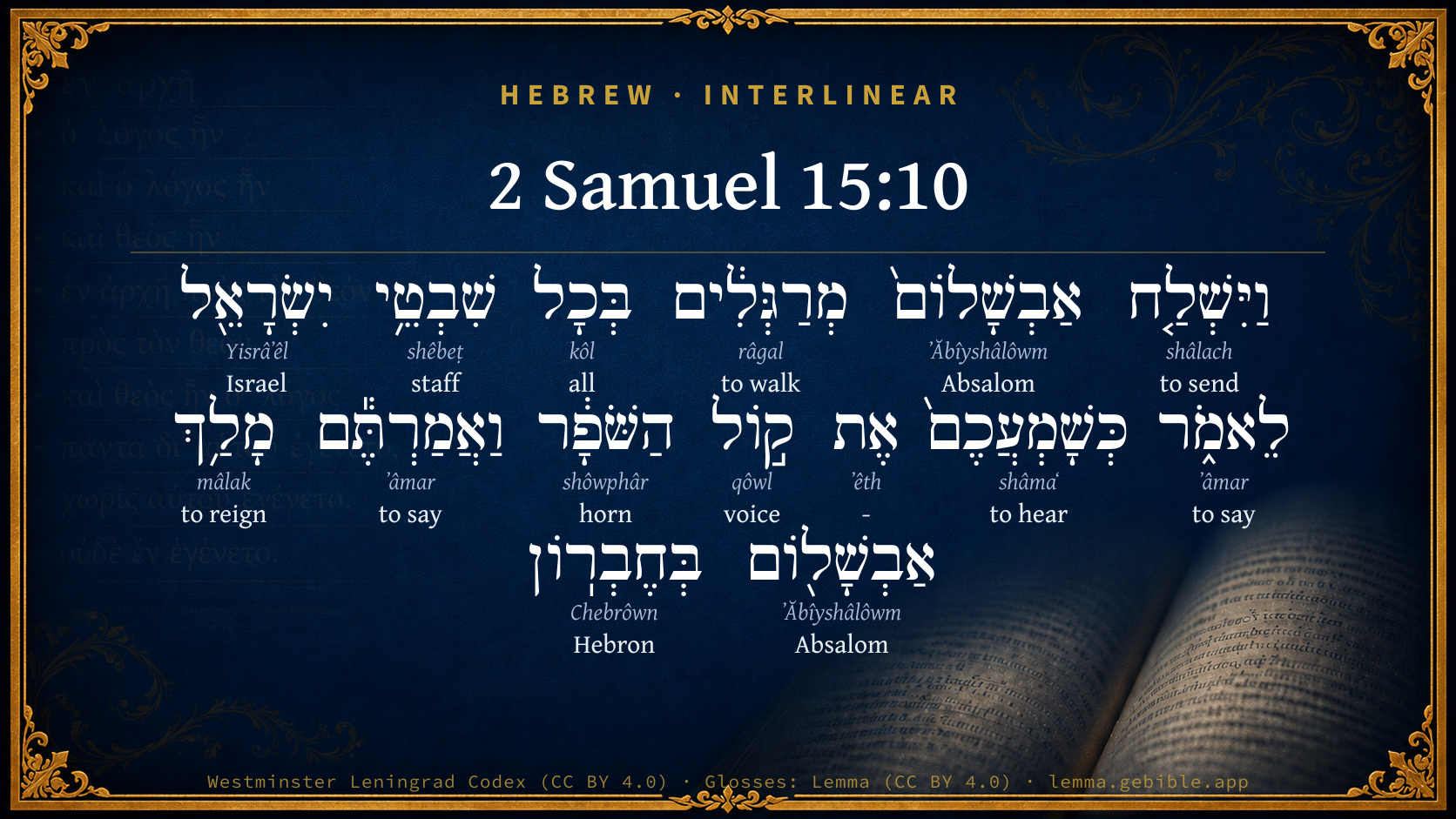
  1. וַיִּשְׁלַ֤ח shâlach H7971 “and · to send” Conjunction + Verb, Qal, Sequential Imperfect, 3rd Person, Masculine, Singular
  2. אַבְשָׁלוֹם֙ ʼĂbîyshâlôwm H53 “Absalom” Noun, Proper
  3. בְּכָל kôl H3605 “in/at · all of” Preposition + Noun, Common, Masculine, Singular, Construct
  4. שִׁבְטֵ֥י shêbeṭ H7626 “staffs of” Noun, Common, Masculine, Plural, Construct
  5. יִשְׂרָאֵ֖ל Yisrâʼêl H3478 “Israel” Noun, Proper
  6. לֵאמֹ֑ר ʼâmar H559 “to say” Preposition + Verb, Qal, Infinitive Construct
  7. כְּשָׁמְעֲכֶם֙ shâmaʻ H8085 “like/as · to hear · you” Preposition + Verb, Qal, Infinitive Construct + Suffix, Personal, 2nd Person, Masculine, Plural
  8. אֶת ʼêth H853 “-” Particle, Direct Object
  9. ק֣וֹל qôwl H6963 “voice of” Noun, Common, Masculine, Singular, Construct
  10. הַשֹּׁפָ֔ר shôwphâr H7782 “the · horn” Particle, Definite Article + Noun, Common, Masculine, Singular, Absolute
  11. וַאֲמַרְתֶּ֕ם ʼâmar H559 “and · to say” Conjunction + Verb, Qal, Perfect, 2nd Person, Masculine, Plural
  12. מָלַ֥ךְ mâlak H4427 “to reign” Verb, Qal, Perfect, 3rd Person, Masculine, Singular
  13. אַבְשָׁל֖וֹם ʼĂbîyshâlôwm H53 “Absalom” Noun, Proper
  14. בְּחֶבְרֽוֹן Chebrôwn H2275 “in/at · Hebron” Preposition + Noun, Proper

About this verse

These counts appear in no published source. They are computed here, from the morphology-tagged text and Lemma’s own curated glosses. What Lemma adds →

15
words
13
distinct lemmas
Historical
section

Notable vocabulary

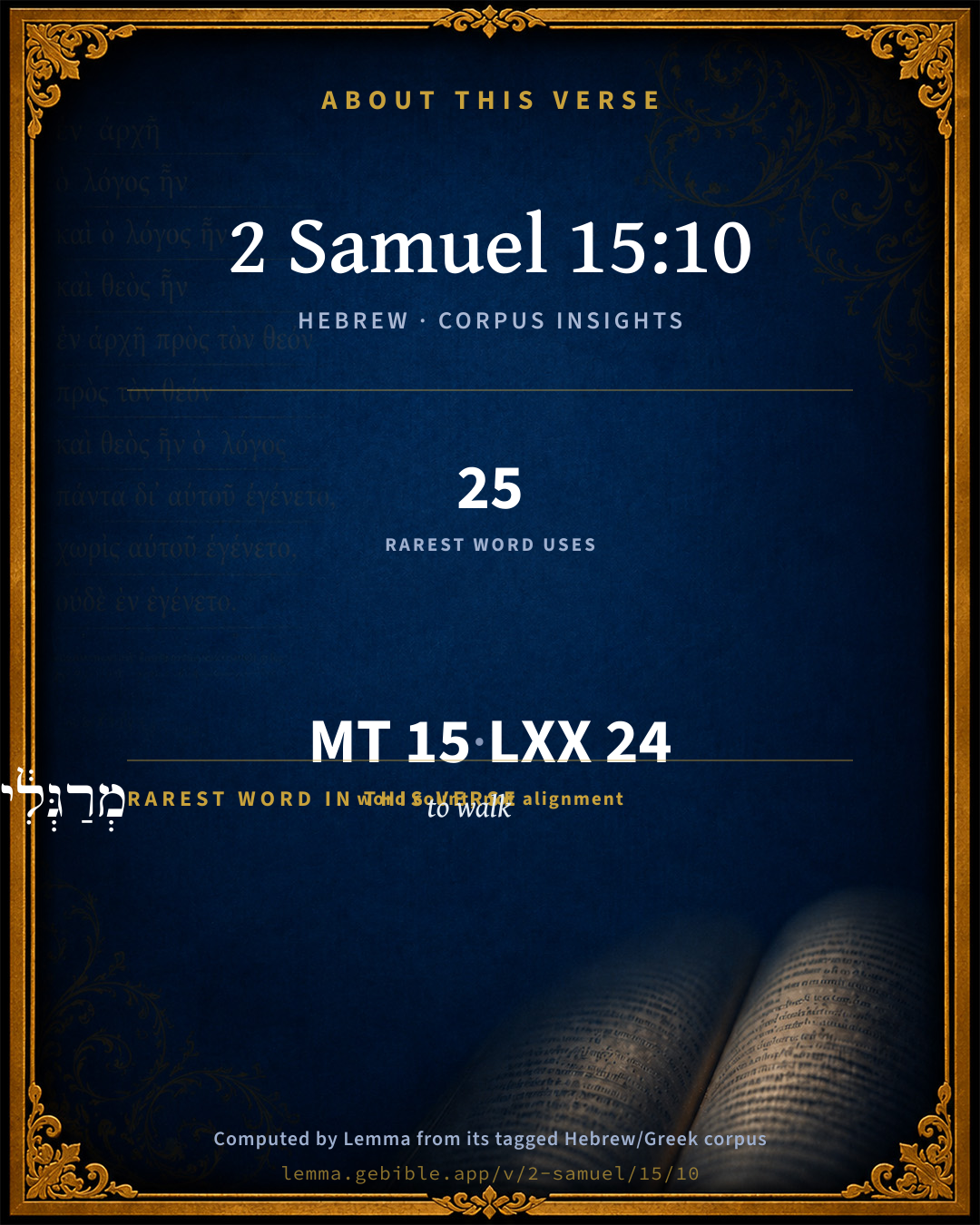
The rarest word here is מְרַגְּלִ֔ים to walk H7270 — appearing just 25 times in the whole Hebrew Bible.

Shared distinctive vocabulary

מְרַגְּלִ֔ים to walk H7270 occurs in 24 verses of the Hebrew Bible. Also found in:

Grammatical profile

  • 6 verbs
  • 8 nouns
  • 1 particle

Verb forms

  • וַיִּשְׁלַ֤ח Qal · Sequential Imperfect
  • מְרַגְּלִ֔ים Piel · Participle Active
  • לֵאמֹ֑ר Qal · Infinitive Construct
  • כְּשָׁמְעֲכֶם֙ Qal · Infinitive Construct
  • וַאֲמַרְתֶּ֕ם Qal · Perfect
  • מָלַ֥ךְ Qal · Perfect

Repetition

Words recur within this verse — often emphatic in Hebrew:

  • אַבְשָׁלוֹם֙ Absalom H53 ×2
  • לֵאמֹ֑ר to say H559 ×2

Hebrew & Septuagint length

In English translation the verse runs 30 words from the Hebrew and 29 from the Septuagint (LXX English) — closely comparable.

A rough comparison of the two English renderings, which tokenize alike — not a word-level alignment.

Word counts can differ between the Hebrew and the Greek without any difference in meaning — e.g. the Hebrew direct-object marker אֵת has no separate Greek word, and Greek often adds the article ὁ.

In the original languages it is 15 Hebrew tokens and 24 Greek tokens — but the two are counted differently (Hebrew bundles its prefixes and suffixes into one token; the Greek is in lemma form), so that isn’t a like-for-like length.

Cross-references

14

Topical passages linked to 2 Samuel 15:10 in the Treasury of Scripture Knowledge — connected by theme and wording, ordered by reader-vote popularity; previews shown in the World English Bible.

  • 2 Samuel 2:1 It happened after this, that David inquired of Yahweh, saying, Shall I go up into any of the cities of Judah? Yahweh said to him, Go up. David said, Where shall I go up? He said, To Hebron.
  • 2 Samuel 2:11 The time that David was king in Hebron over the house of Judah was seven years and six months.
  • 2 Samuel 3:2–3 To David were sons born in Hebron: and his firstborn was Amnon, of Ahinoam the Jezreelitess;
  • 2 Samuel 5:5 In Hebron he reigned over Judah seven years and six months; and in Jerusalem he reigned thirty-three years over all Israel and Judah.
  • 2 Samuel 13:28 Absalom commanded his servants, saying, Mark you now, when Amnon's heart is merry with wine; and when I tell you, Smite Amnon, then kill him; don't be afraid; haven't I commanded you? be courageous, and be valiant.
  • 2 Samuel 14:30 Therefore he said to his servants, Behold, Joab's field is near mine, and he has barley there; go and set it on fire. Absalom's servants set the field on fire.
  • 2 Samuel 19:10 Absalom, whom we anointed over us, is dead in battle. Now therefore why don't you speak a word of bringing the king back?
  • 1 Kings 1:34 and let Zadok the priest and Nathan the prophet anoint him there king over Israel; and blow you the trumpet, and say, [Long] live king Solomon.
  • 2 Kings 9:13 Then they hurried, and took every man his garment, and put it under him on the top of the stairs, and blew the trumpet, saying, Jehu is king.
  • 1 Chronicles 11:3 So all the elders of Israel came to the king to Hebron; and David made a covenant with them in Hebron before Yahweh; and they anointed David king over Israel, according to the word of Yahweh by Samuel.
  • 1 Chronicles 12:23 These are the numbers of the heads of those who were armed for war, who came to David to Hebron, to turn the kingdom of Saul to him, according to the word of Yahweh.
  • 1 Chronicles 12:38 All these being men of war, who could order the battle array, came with a perfect heart to Hebron, to make David king over all Israel: and all the rest also of Israel were of one heart to make David king.
  • Job 20:5–29 That the triumphing of the wicked is short, The joy of the godless but for a moment?
  • Psalms 73:18–19 Surely you set them in slippery places. You throw them down to destruction.

Cross-references courtesy of OpenBible.info (CC BY 4.0).

Hebrew and Greek witnesses Masoretic Hebrew ↔ Greek Septuagint

The same verse in the two great witnesses to the Old Testament, shown verse-for-verse.

These are two independent witnesses, not word-aligned to each other, and the Septuagint is shown in lemma (dictionary) form.

Hebrew 2 Samuel 15:10 Masoretic · Westminster Leningrad Codex

וַיִּשְׁלַ֤ח אַבְשָׁלוֹם֙ מְרַגְּלִ֔ים בְּכָל שִׁבְטֵ֥י יִשְׂרָאֵ֖ל לֵאמֹ֑ר כְּשָׁמְעֲכֶם֙ אֶת ק֣וֹל הַשֹּׁפָ֔ר וַאֲמַרְתֶּ֕ם מָלַ֥ךְ אַבְשָׁל֖וֹם בְּחֶבְרֽוֹן

But Absalom sent spies throughout all the tribes of Israel, saying, As soon as you hear the sound of the trumpet, then you shall say, Absalom is king in Hebron.

World English Bible · Public Domain

Greek LXX 2 Samuel 15:10 Septuagint · lemma form

καί ἀποστέλλω αβεσσαλωμ κατάσκοπος ἐν πᾶς φυλή ἰσραήλ λέγω ἐν ὁ ἀκούω σύ ὁ φωνή ὁ κερατίνη καί εἶπον βασιλεύω βασιλεύς αβεσσαλωμ ἐν χεβρων

And Abessalom sent spies throughout all the tribes of Israel, saying, When you⌃ hear the sound of the trumpet, then shall you⌃ say, Abessalom is become king in Chebron.

LXX2012 (modern English Septuagint) · Public Domain

Hebrew: Westminster Leningrad Codex (CC BY 4.0). Greek: Septuagint (public domain); English from LXX2012 (modern English Septuagint) (Public Domain). How the Septuagint differs from the Hebrew →

Targum (Aramaic paraphrase)

1

The Targum is the ancient Jewish Aramaic paraphrase of the Hebrew Scriptures — an interpretive translation, not the Hebrew text itself. Onkelos (literal) and Pseudo-Jonathan (expansive) render the Torah, and Jonathan the Prophets. Coverage is partial: where no permissively-licensed English translation exists for a verse, only the Aramaic is shown. This is verse-level text, not a word-by-word alignment to the Hebrew.

  1. Targum Jonathan Prophets (Joshua–Malachi)
    וּשְׁלַח אַבְשָׁלוֹם מְאַלְלִין בְּכָל שִׁבְטַיָא דְיִשְׂרָאֵל לְמֵימָר כְּמִשְׁמָעֲכוֹן יַת קַל שׁוֹפָרָא וְתֵימְרוּן מְלַךְ אַבְשָׁלוֹם בְּחֶבְרוֹן:

    (no public-domain English translation for this verse)

    Targum Jonathan — Aramaic: “Mikraot Gedolot” (public domain). English: “Sefaria Community Translation” (CC0 1.0 (public-domain dedication)); “London "Chaldee Paraphrase," 1871” (public domain). Text via Sefaria.

Commentary

Notes on 2 Samuel 15:10 from classic Christian and Jewish commentators (each source and its license shown beneath its notes). The classic Christian expositions comment on the surrounding passage and are grouped to its opening verse, so a note may address several verses; the Jewish commentaries on the Tanakh (Rashi and others) are per-verse, so they appear only where the commentator wrote on this verse.

Lemma curates 59 commentaries, every one of them public domain or Creative Commons licensed, each selected and text-cleaned for this edition rather than reprinted as found. About our sources →

Jamieson, Fausset & Brown

Robert Jamieson, A. R. Fausset & David Brown

HE FORMS A CONSPIRACY. (Sa2 15:10-12)

Absalom sent spies throughout all the tribes of Israel--These emissaries were to sound the inclination of the people, to further the interests of Absalom, and exhort all the adherents of his party to be in readiness to join his standard as soon as they should hear that he had been proclaimed king. As the summons was to be made by the sound of trumpets, it is probable that care had been taken to have trumpeters stationed on the heights, and at convenient stations--a mode of announcement that would soon spread the news over all the country of his inauguration to the throne.

Jamieson, Fausset & Brown — Commentary Critical and Explanatory on the Whole Bible (1871) — public domain (CC PDM 1.0). Text via the HelloAO Bible API.

Trapp's Complete Commentary

John Trapp

2Sa 15:10 But Absalom sent spies throughout all the tribes of Israel, saying, As soon as ye hear the sound of the trumpet, then ye shall say, Absalom reigneth in Hebron.

Ver. 10. But Absalom sent spies.] Under a show of messengers and invitants to Absalom’s feast, but indeed to underfeel the chief of each tribe, and to acquaint them with the intent of the meeting at Hebron. And hereunto probably Ahithophel - that old fox - had paved a way by his persuasions; though for the present he had withdrawn himself, and lay close, as having learned to put others before him in dangerous actions, and, with the ape, to take nuts out of the fire with the paw of the cat.

John Trapp, A Commentary or Exposition upon All the Books of the Old and New Testament (1647–1656) — public domain. Text from a community e-Sword module.

Joseph Benson's Commentary

2Sa 15:10. Absalom sent spies throughout all the tribes — Before he left Jerusalem he took care to send his emissaries into all parts; doubtless under colour of inviting persons of distinction to the sacrifice; but in reality to carry the watchword and signal, before agreed on between them. As soon as ye shall hear the sound of the trumpet, &c. — This was the signal which was to be given for the people’s taking up arms, their hearing the sound of the trumpet, which Absalom took care should be blown in all the tribes at the same time, by persons purposely placed in the towns and villages, at such a distance from one another as that each trumpet could be heard by the person appointed to blow the next. The spies, or emissaries, immediately upon hearing the sound of it, were to proclaim that Absalom was crowned king in Hebron. Upon this being done, all his partisans, it is likely, shouted, God save King Absalom.

Joseph Benson's Commentary on the Old and New Testaments (1811–1818) — public domain. Text from a community e-Sword module.

Adam Clarke's Commentary

Verse 10. Absalom sent spies] These persons were to go into every tribe; and the trumpet was to be blown as a signal for all to arise, and proclaim Absalom in every place. The trumpet was probably used as a kind of telegraph by the spies: trumpet exciting trumpet from place to place; so that, in a few minutes all Israel would hear the proclamation.

Adam Clarke's Commentary on the Bible (1810–1826) — public domain. Text from a community e-Sword/MySword module.

Ellicott's Commentary for English Readers

(10) Sent spies.—These were agents who were to sound the people in the various parts of the land, and doubtless to communicate the conspiracy only secretly, and to those whom they found favourably disposed. They started from Jerusalem, perhaps, at the same time with Absalom, or possibly had been sent out quietly, a few at a time, beforehand. The signal for rising was to be a messenger with a trumpet.

A Bible Commentary for English Readers, edited by Charles John Ellicott (1878–1897) — public domain. Text from a community e-Sword module.

The Cambridge Bible for Schools and Colleges

gen. ed. J. J. S. Perowne

10. spies] Absalom’s emissaries are called spies, because they were sent secretly to ascertain public feeling, and only divulge their real purpose where they could count on support.

the sound of the trumpet] The signal for revolt and for the gathering of his supporters, like the hoisting of a standard in modern times. He was to be proclaimed king simultaneously all over the country. Cp. ch. 2Sa_20:1; 1Ki_1:34; 2Ki_9:13.

in Hebron] The choice of Hebron clearly shews that Absalom expected to find his chief support in the tribe of Judah. It is probable that the old tribal jealousies had been revived, and that Judah resented its absorption into the nation at large. Such a spirit of discontent would account for the slackness of Judah to bring back the king when the rebellion was over (ch. 2Sa_19:11). Hebron itself too probably contained many persons who were aggrieved by the removal of the court to Jerusalem. See Ewald’s Hist. of Israel, III. 176.

The Cambridge Bible for Schools and Colleges (gen. ed. J. J. S. Perowne; Cambridge University Press, 1878–1918) — public domain. Text from a community e-Sword module.

John Gill's Exposition

But Absalom sent spies throughout all the land of Israel,.... To sound the disposition of the people towards him, to insinuate things into their minds in favour of him, and to improve every opportunity of recommending him to their esteem and affections:

saying, as soon as ye hear the sound of the trumpet; in any place; and which it is probable he employed men to sound in many places:

then ye shall say, Absalom reigneth in Hebron: which is the cause of the trumpet's sounding; and by this means they would learn how the people stood affected to him, whether the news was grateful or not.

John Gill's Exposition of the Whole Bible (1746–1763) — public domain (CC PDM 1.0). Text via the HelloAO Bible API.

Haydock's Catholic Bible Commentary

Spies, or men to give a plausible appearance to his ambition, and to insinuate that all was done according to order, and with David’s approbation. "The first word (or step) is the most difficult," on such occasions; (Tacitus, Hist. ii.; Grotius) and those who find themselves incautiously entangled, find a repugnance to recede. (Haydock) --- Reigneth. He was solemnly anointed, chap. xix. 10. (Menochius)

George Leo Haydock (1774–1849), Haydock's Catholic Family Bible and Commentary, 1859 edition — public domain. Excludes Psalms (Douay-Rheims chapter numbering differs from Protestant) and Deuterocanonical books (Catholic canon only).

Matthew Poole's English Annotations

Absalom sent from Hebron; or, had sent from Jerusalem; that when he went to Hebron, they should go into the several tribes to sift the people, and to dispose them to Absalom’s party, and acquaint them with his success.

As soon as ye hear the sound of the trumpet; which I shall take care to have sounded in several parts by other persons; and when that is done, you shall inform them of the reason of it. Or, as soon as you understand that the trumpet was sounded at Hebron; partly to call the people together for my assistance; and partly to celebrate my inauguration to the kingdom, which you shall speedily know by messengers whom I shall send to you to that end.

Matthew Poole's English Annotations on the Holy Bible (1683–1685) — public domain. Text from a community e-Sword/MySword module.

Whedon's Commentary on the Bible

Daniel D. Whedon

10. Spies — So called, says Keil, “because they were first of all to ascertain the feelings of the people in the different tribes, and were only to execute their commission in placers where they could reckon upon support.”

Sound of the trumpet — The common signal to call the people together for purposes of war or self-defence. Jer_4:5; Jer_4:19.

Daniel D. Whedon (gen. ed.), Commentary on the Old and New Testaments (1874–1909) — public domain. Text from a community e-Sword module.

The Pulpit Commentary

Absalom sent spies. The word means "those who go hither and thither," and, as the object of such journeying would usually be. to gather information, the right translation often is "spies." Here there was no such purpose, nor were they to report to Absalom, but to disperse themselves everywhere, and, when the signal was given at Hebron, they were to endeavour to gather the people to Absalom"s standard. Some simple minded commentators wonder how one trumpet could be heard throughout the land. It was heard only at Hebron, but the news of the proclamation would rapidly spread; and, though the rumour might be vague and confused, yet these emissaries, fully acquainted beforehand with its meaning, would turn it to Absalom"s advantage, and urge the people to confirm the choice, made, as they would affirm, by the whole tribe of Judah. In such attempts everything depends upon gathering a powerful following at first; and usually a good deal of vigour and even force is necessary to make men take part in a revolt. But as the numbers swell, adherents readily flock in to what seems to be the winning side.

The Pulpit Commentary (1880–1919), ed. H.D.M. Spence-Jones & Joseph S. Exell — public domain. Text from a community e-Sword module.

Keil & Delitzsch

C. F. Keil & F. Delitzsch

When Absalom went to Hebron, he sent spies into all the tribes of Israel to say, "When ye hear the sound of the trumpet, say, Absalom has become king in Hebron." We must suppose the sending the spies to have been contemporaneous with the removal of Absalom to Hebron, so that ויּשׁלח is used quite regularly, and there is no reason for translating it as a pluperfect. The messengers sent out are called "spies," because they were first of all to ascertain the feelings of the people in the different tribes, and were only to execute their commission in places where they could reckon upon support. The conspiracy had hitherto been kept very secret, as we may see from the statement in Sa2 15:11 : "With Absalom there had gone two hundred men out of Jerusalem, invited (to the sacrificial festival), and going in their simplicity, who knew nothing at all of the affair." (כּל־דּבר לא: nothing at all.)

Keil & Delitzsch — Biblical Commentary on the Old Testament (1861–1891) — public domain (CC PDM 1.0). Text via the HelloAO Bible API. (Old Testament only.)

Lesson kit

Teaching starters — assembled from the data on this page, not authored interpretation. Every prompt links to the verse data it draws on. Edit before teaching.

2 Samuel, in the Historical, opens this verse with 15 words (13 distinct Hebrew lemmas). Its most distinctive word is râgal (“to walk”). A historical commentator’s framing appears above. Read the whole chapter for the surrounding context.

Discussion questions

  1. How does “to walk” (râgal) shape what this verse is saying?
  2. Genesis 42:9 shares the word «to walk» with this verse. How do the two illuminate each other?
  3. “Absalom” occurs 2× in this one verse. What is the effect of the repetition?
  4. The translations on this page render this verse differently — a whole-verse word diff, not a word-by-word alignment. What might account for the different wordings?
  5. The verb «וַיִּשְׁלַ֤ח» is Qal Sequential Imperfect. How does its form color the action?
  6. Reading how Jamieson, Fausset & Brown and Trapp's Complete Commentary read this verse, where do the two commentators agree and where do they part?

Things to notice

Reading settings

Reading text

Shown beneath each verse's original-language words.

Old Testament
Old Testament edition

Read the OT as the Masoretic Hebrew (MT) or the Greek Septuagint (LXX).

English shown for the Greek Septuagint (in the Hebrew ↔ Greek comparison).

Comparing translations? Open the Compare panel on any verse page to stack up to four side by side.