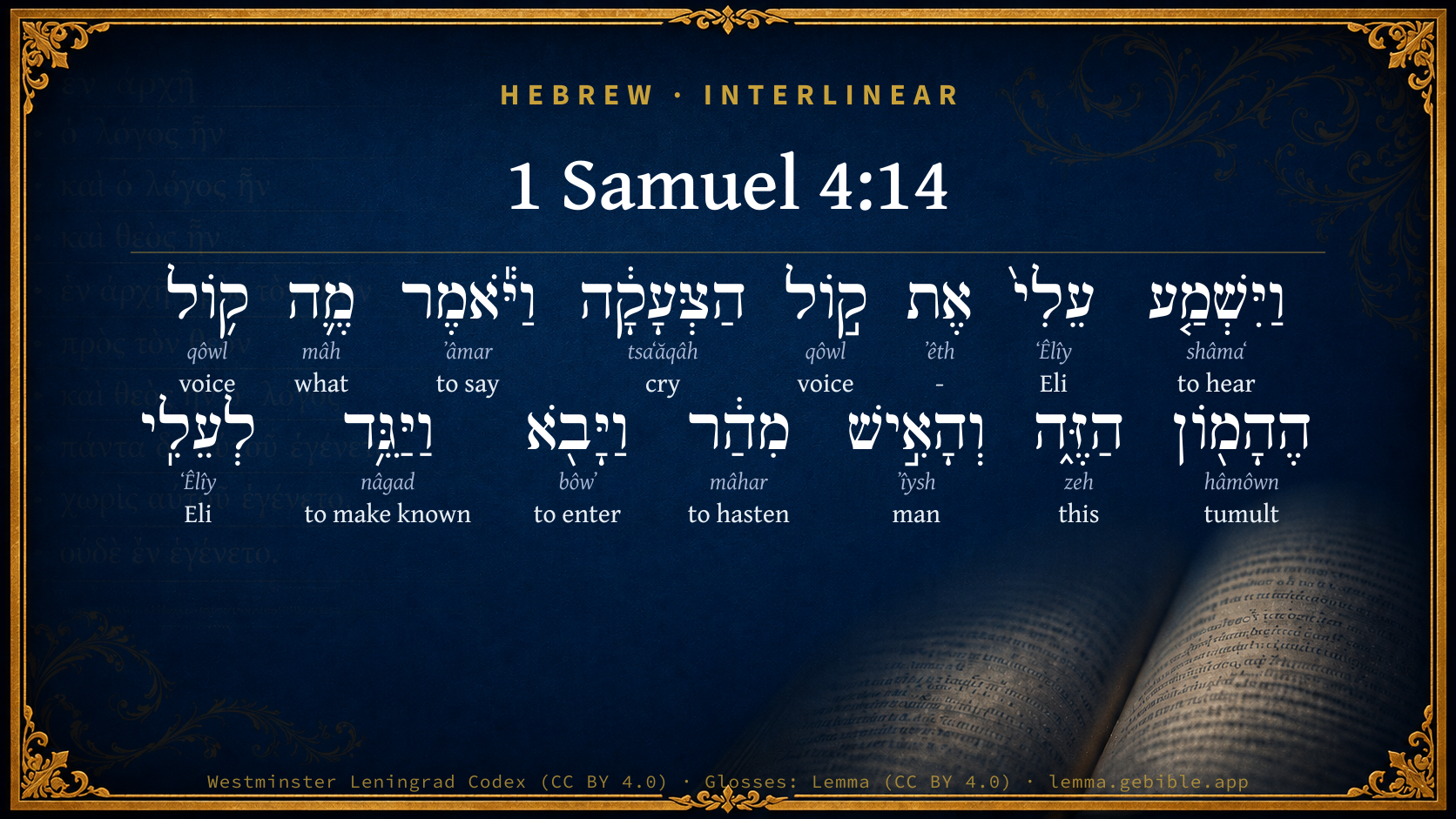
1 Samuel 4:14

Hebrew (Westminster Leningrad Codex) 1 Samuel 4:14 appears in the Hebrew Old Testament. The text above is from the Westminster Leningrad Codex. Each word links to its Strong’s number, a concise gloss, and parsing drawn from the Open Scriptures Hebrew Bible morphology. Click any word for its full Brown-Driver-Briggs (BDB) entry.
Download image
Cite this verse

1 Samuel 4:14 (World English Bible). Public Domain. Lemma interlinear Bible study tool, https://lemma.gebible.app/v/1-samuel/4/14.

Show BibTeX & RIS
BibTeX
RIS
English Translation
When Eli heard the noise of the crying, he said, What means the noise of this tumult? The man hurried, and came and told Eli.
World English Bible · Public Domain
Download a study sheet

One document with this verse’s original text, its word-by-word gloss line, the meaning frame, cross-references with their text, attributed commentary, and full source and license credits — printable, and it pastes into notes with its structure intact.

This verse Autodidact and up

Study sheet (.html) Plain text (.txt)

A passage Seminary Student

Up to 50 verses in one chapter. A passage sheet keeps up to 6 commentary sources and 12 cross-references per verse, in the order this page ranks them, and says so on the sheet whenever that leaves anything out. Ask for a single verse and you get the Autodidact verse sheet above.

Everything on this page stays free to read, with no account — the sheet is a download of what is already on screen, not access to it.

Want to remove ads? Support Godless Engineer
Compare translations 3

The same verse in 3 English versions, stacked beneath the original-language interlinear above. Click any original word for its lexicon entry.

Each is an independent rendering of the whole verse — the interlinear is not word-aligned to these translations.

Highlighted words mark where these versions differ — a whole-verse word diff, not a word-by-word alignment.

  • World English Bible Public Domain
    When Eli heard the noise of the crying, he said, What means the noise of this tumult? The man hurried, and came and told Eli.
  • King James Version Public Domain
    And when Eli heard the noise of the crying, he said, What meaneth the noise of this tumult? And the man came in hastily, and told Eli.
  • unfoldingWord Literal Text CC BY-SA 4.0
    And Eli heard the sound of the outcry, and he said, “What the sound of this tumult?” And the man hurried and came and reported to Eli.

unfoldingWord Literal Text — © unfoldingWord, licensed CC BY-SA 4.0. Word-aligned USFM3 via Door43 (git.door43.org/unfoldingWord/en_ult).

Versions to compare (up to 4)

3 of 4 selected

Show all 18 translations

Every available English version of this verse, each an independent rendering of the whole verse.

  • World English Bible Public Domain
    When Eli heard the noise of the crying, he said, What means the noise of this tumult? The man hurried, and came and told Eli.
  • Berean Standard Bible Public Domain
    Eli heard the outcry and asked, “Why this commotion?” So the man hurried over and reported to Eli.
  • Majority Standard Bible Public Domain
    Eli heard the outcry and asked, “Why this commotion?” So the man hurried over and reported to Eli.
  • King James Version Public Domain
    And when Eli heard the noise of the crying, he said, What meaneth the noise of this tumult? And the man came in hastily, and told Eli.
  • American Standard Version (1901) Public Domain
    And when Eli heard the noise of the crying, he said, What meaneth the noise of this tumult? And the man hasted, and came and told Eli.
  • Revised Version (1885) Public Domain
    And when Eli heard the noise of the crying, he said, What meaneth the noise of this tumult? And the man hasted and came and told Eli.
  • Geneva Bible (1599) Public Domain
    And when Eli heard the noyse of the crying, he sayd, What meaneth this noyse of the tumult? and the man came in hastily, and tolde Eli.
  • Douay-Rheims (1899) Public Domain
    And Heli heard the noise of the cry, and he said: What meaneth the noise of this uproar? But he made haste, and came, and told Heli.
  • Young's Literal Translation Public Domain
    And Eli heareth the noise of the cry, and saith, `What -- the noise of this tumult!' And the man hasted, and cometh in, and declareth to Eli.
  • Literal Standard Version CC BY-SA 4.0
    And Eli hears the noise of the cry and says, “What [is] the noise of this tumult?” And the man hurried, and comes in, and tells Eli.
  • Unlocked Literal Bible CC BY-SA 4.0
    When Eli heard the noise of the outcry, he said, “What is the meaning of this uproar?” The man quickly came and told Eli.
  • unfoldingWord Literal Text CC BY-SA 4.0
    And Eli heard the sound of the outcry, and he said, “What the sound of this tumult?” And the man hurried and came and reported to Eli.
  • Darby Bible Public Domain
    And Eli heard the noise of the crying, and said, What is the noise of this tumult? And the man came hastily, and told Eli.
  • World Messianic Bible Public Domain
    When Eli heard the noise of the crying, he said, “What does the noise of this tumult mean?” The man hurried, and came and told Eli.
  • Webster's Bible Public Domain
    And when Eli heard the noise of the crying, he said, What meaneth the noise of this tumult? And the man came in hastily, and told Eli.
  • Free Bible Version CC BY-SA 4.0
    Eli heard the crying and asked, “What's all this noise?” The man rushed over to Eli and told him what had happened.
  • Bible in Basic English Public Domain
    And Eli, hearing the noise and the cries, said, What is the reason of this outcry? And the man came quickly and gave the news to Eli.
  • JPS Tanakh (1917) Public Domain
    And when Eli heard the noise of the crying, he said: 'What meaneth the noise of this tumult?' And the man made haste, and came and told Eli.

Literal Standard Version (2020), Covenant Press — licensed CC BY-SA 4.0. Text via the HelloAO Bible API (eBible.org). Unlocked Literal Bible (unfoldingWord) — licensed CC BY-SA 4.0. Text via the HelloAO Bible API (eBible.org). unfoldingWord Literal Text — © unfoldingWord, licensed CC BY-SA 4.0. Word-aligned USFM3 via Door43 (git.door43.org/unfoldingWord/en_ult). Free Bible Version, Dr. Jonathan Gallagher — licensed CC BY-SA 4.0. Text via the HelloAO Bible API (eBible.org).

Word by word

More ways to search: Search by grammar → Find every occurrence → Compare this word →

Practice this passage: Drill this verse → Learn its vocabulary →

הַצְּעָקָ֔ה
tsaʻăqâh
H6818
“the · cry”
Particle, Definite Article + Noun, Common, Feminine, Singular, Absolute
Part of Speech
Particle + Noun
Type
Common
Gender
Feminine
Number
Singular
State
Absolute
Full BDB Definition

Origin: from H6817

TWOT: 1947a

cry, outcry - outcry (against) - cry of distress (especially as heard by God)
  1. וַיִּשְׁמַ֤ע shâmaʻ H8085 “and · to hear” Conjunction + Verb, Qal, Sequential Imperfect, 3rd Person, Masculine, Singular
  2. עֵלִי֙ ʻÊlîy H5941 “Eli” Noun, Proper
  3. אֶת ʼêth H853 “-” Particle, Direct Object
  4. ק֣וֹל qôwl H6963 “voice of” Noun, Common, Masculine, Singular, Construct
  5. וַיֹּ֕אמֶר ʼâmar H559 “and · to say” Conjunction + Verb, Qal, Sequential Imperfect, 3rd Person, Masculine, Singular
  6. מֶ֛ה mâh H4100 “what” Particle, Interrogative
  7. ק֥וֹל qôwl H6963 “voice of” Noun, Common, Masculine, Singular, Construct
  8. הֶהָמ֖וֹן hâmôwn H1995 “the · tumult” Particle, Definite Article + Noun, Common, Masculine, Singular, Absolute
  9. הַזֶּ֑ה zeh H2088 “the · this” Particle, Definite Article + Pronoun, Demonstrative, Masculine, Singular
  10. וְהָאִ֣ישׁ ʼîysh H376 “and · the · man” Conjunction + Particle, Definite Article + Noun, Common, Masculine, Singular, Absolute
  11. מִהַ֔ר mâhar H4116 “to hasten” Verb, Piel, Perfect, 3rd Person, Masculine, Singular
  12. וַיָּבֹ֖א bôwʼ H935 “and · to enter” Conjunction + Verb, Qal, Sequential Imperfect, 3rd Person, Masculine, Singular
  13. וַיַּגֵּ֥ד nâgad H5046 “and · to make known” Conjunction + Verb, Hiphil, Sequential Imperfect, 3rd Person, Masculine, Singular
  14. לְעֵלִֽי ʻÊlîy H5941 “to/for · Eli” Preposition + Noun, Proper

About this verse

These counts appear in no published source. They are computed here, from the morphology-tagged text and Lemma’s own curated glosses. What Lemma adds →

15
words
13
distinct lemmas
Historical
section

Notable vocabulary

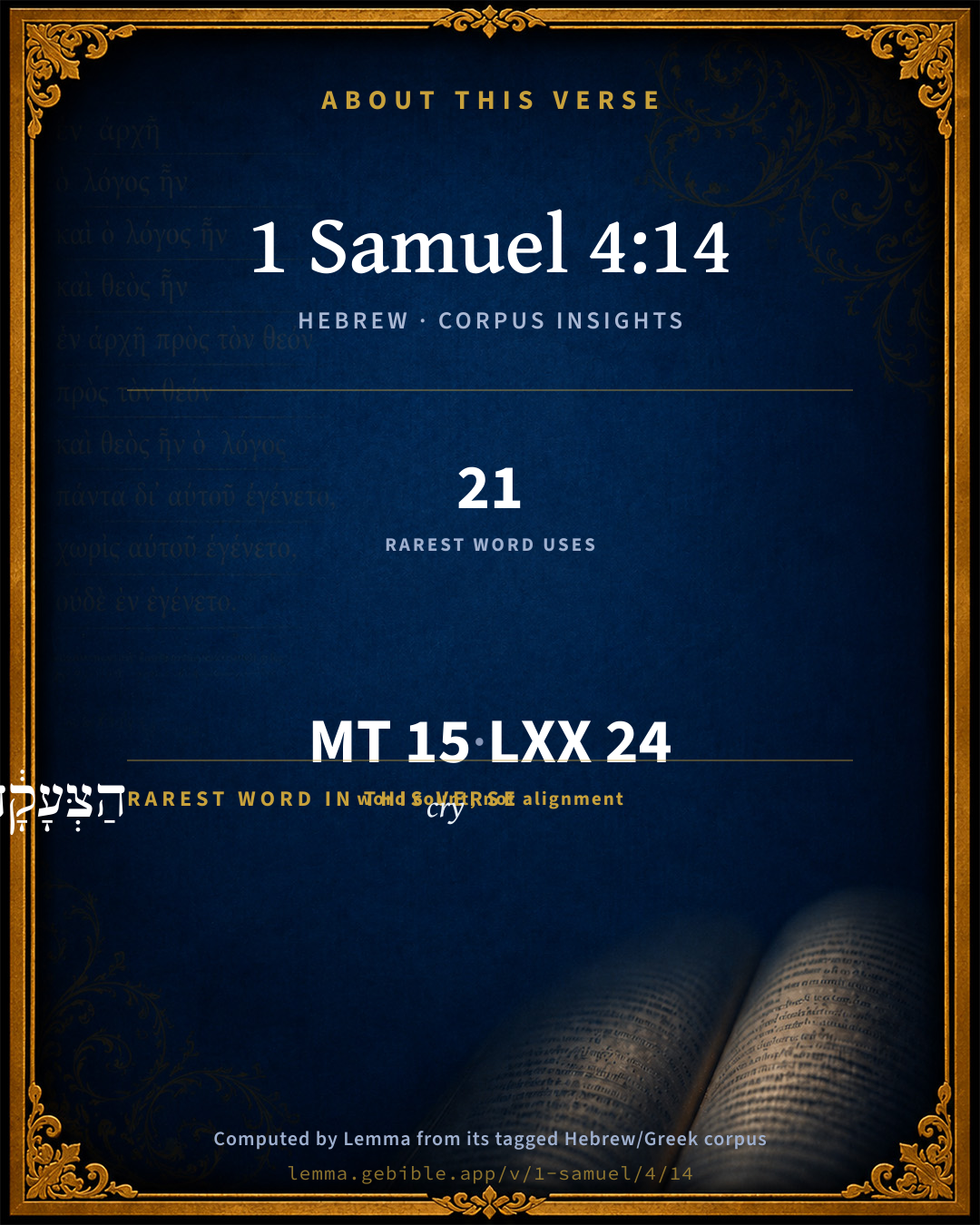
The rarest word here is הַצְּעָקָ֔ה cry H6818 — appearing just 21 times in the whole Hebrew Bible.

Shared distinctive vocabulary

הַצְּעָקָ֔ה cry H6818 occurs in 20 verses of the Hebrew Bible. Also found in:

Grammatical profile

  • 5 verbs
  • 7 nouns
  • 1 pronoun
  • 2 particles

Verb forms

  • וַיִּשְׁמַ֤ע Qal · Sequential Imperfect
  • וַיֹּ֕אמֶר Qal · Sequential Imperfect
  • מִהַ֔ר Piel · Perfect
  • וַיָּבֹ֖א Qal · Sequential Imperfect
  • וַיַּגֵּ֥ד Hiphil · Sequential Imperfect

Repetition

Words recur within this verse — often emphatic in Hebrew:

  • עֵלִי֙ Eli H5941 ×2
  • ק֣וֹל voice H6963 ×2

Hebrew & Septuagint length

In English translation the verse runs 25 words from the Hebrew and 28 from the Septuagint (LXX English) — closely comparable.

A rough comparison of the two English renderings, which tokenize alike — not a word-level alignment.

Word counts can differ between the Hebrew and the Greek without any difference in meaning — e.g. the Hebrew direct-object marker אֵת has no separate Greek word, and Greek often adds the article ὁ.

In the original languages it is 15 Hebrew tokens and 24 Greek tokens — but the two are counted differently (Hebrew bundles its prefixes and suffixes into one token; the Greek is in lemma form), so that isn’t a like-for-like length.

Hebrew and Greek witnesses Masoretic Hebrew ↔ Greek Septuagint

The same verse in the two great witnesses to the Old Testament, shown verse-for-verse.

These are two independent witnesses, not word-aligned to each other, and the Septuagint is shown in lemma (dictionary) form.

Hebrew 1 Samuel 4:14 Masoretic · Westminster Leningrad Codex

וַיִּשְׁמַ֤ע עֵלִי֙ אֶת ק֣וֹל הַצְּעָקָ֔ה וַיֹּ֕אמֶר מֶ֛ה ק֥וֹל הֶהָמ֖וֹן הַזֶּ֑ה וְהָאִ֣ישׁ מִהַ֔ר וַיָּבֹ֖א וַיַּגֵּ֥ד לְעֵלִֽי

When Eli heard the noise of the crying, he said, What means the noise of this tumult? The man hurried, and came and told Eli.

World English Bible · Public Domain

Greek LXX 1 Samuel 4:14 Septuagint · lemma form

καί ἀκούω ηλι ὁ φωνή ὁ βοή καί εἶπον τίς ὁ βοή ὁ φωνή οὗτος καί ὁ ἄνθρωπος σπεύδω εἰςἔρχομαι καί ἀποἀγγέλλω ὁ ηλι

And Heli heard the sound of the cry, and said, What is the voice of this cry? and the men hasted and went in, and reported to Heli.

LXX2012 (modern English Septuagint) · Public Domain

Hebrew: Westminster Leningrad Codex (CC BY 4.0). Greek: Septuagint (public domain); English from LXX2012 (modern English Septuagint) (Public Domain). How the Septuagint differs from the Hebrew →

Targum (Aramaic paraphrase)

1

The Targum is the ancient Jewish Aramaic paraphrase of the Hebrew Scriptures — an interpretive translation, not the Hebrew text itself. Onkelos (literal) and Pseudo-Jonathan (expansive) render the Torah, and Jonathan the Prophets. Coverage is partial: where no permissively-licensed English translation exists for a verse, only the Aramaic is shown. This is verse-level text, not a word-by-word alignment to the Hebrew.

  1. Targum Jonathan Prophets (Joshua–Malachi)
    וּשְׁמַע עֵלִי יַת קַל צַוְחָתָא וַאֲמַר מָה קַל שִׁגּוּשַׁיָא הָדֵין וְגַבְרָא אוֹחִי וְאָתָא וְחַוֵי לְעֵלִי:

    (no public-domain English translation for this verse)

    Targum Jonathan — Aramaic: “Mikraot Gedolot” (public domain). English: “Sefaria Community Translation” (CC0 1.0 (public-domain dedication)); “London "Chaldee Paraphrase," 1871” (public domain). Text via Sefaria.

Commentary

Notes on 1 Samuel 4:14 from classic Christian and Jewish commentators (each source and its license shown beneath its notes). The classic Christian expositions comment on the surrounding passage and are grouped to its opening verse, so a note may address several verses; the Jewish commentaries on the Tanakh (Rashi and others) are per-verse, so they appear only where the commentator wrote on this verse.

Lemma curates 59 commentaries, every one of them public domain or Creative Commons licensed, each selected and text-cleaned for this edition rather than reprinted as found. About our sources →

Trapp's Complete Commentary

John Trapp

1Sa 4:14 And when Eli heard the noise of the crying, he said, What [meaneth] the noise of this tumult? And the man came in hastily, and told Eli.

Ver. 14. And the man came in hastily.] Aι βλαβαι ποδωκεις: Ill news, like ill weather, cometh ere it be sent for; but this doleful messenger was not so discreet as he might have been.

John Trapp, A Commentary or Exposition upon All the Books of the Old and New Testament (1647–1656) — public domain. Text from a community e-Sword module.

Ellicott's Commentary for English Readers

(14) What meaneth the noise?—The blind old man, we must suppose, was seated on his chair of state, surrounded by priests and Levites, who were in attendance on him as high priest and judge. As the runner drew near, and the torn dress and the dust sprinkled on his head—the symbols of disaster—became visible, the wail of woe would soon run through the place. The cry of sorrow was the first intimation to the blind Eli: he was soon to hear the details. His question was probably, in the first place, addressed to the little court standing by his throne. The narrative is so vivid we seem to hear the sound of the cries of grief and terror which Eli heard, and to see the scene of dismay and confusion which those sightless eyes were prevented from looking on.

A Bible Commentary for English Readers, edited by Charles John Ellicott (1878–1897) — public domain. Text from a community e-Sword module.

The Cambridge Bible for Schools and Colleges

gen. ed. J. J. S. Perowne

14. he said] The Sept. adds ‘to the men that stood by him.’

came in hastily] Made haste and came through the town to the tabernacle enclosure which stood on a slight eminence.

The Cambridge Bible for Schools and Colleges (gen. ed. J. J. S. Perowne; Cambridge University Press, 1878–1918) — public domain. Text from a community e-Sword module.

John Gill's Exposition

And when Eli heard the noise of the crying,.... The shrieks of the men and women, which were very clamorous and terrible. Eli had his hearing, though not his sight; he could not see the distress in their countenances, but he heard the lamentations they made:

and said, what meaneth the noise of this tumult? it seems the people ran about, wringing their hands, and making doleful shrieks; the noise of which Eli heard, and the meaning of which he inquired after, or what should be the cause of it:

and the man came in hastily, and told Eli; or made haste, and came to him, and related all that is later expressed; for Eli was not in any house, but on a seat by the way side, and therefore could not be said to come "in" to him; but he came to him, where he was, being brought by some of the citizens Eli had inquired of what should be the meaning of this noise; and therefore without delay the man was hastened to give the whole account unto him, as it was highly proper he should, being the supreme magistrate.

John Gill's Exposition of the Whole Bible (1746–1763) — public domain (CC PDM 1.0). Text via the HelloAO Bible API.

Whedon's Commentary on the Bible

Daniel D. Whedon

14. The man came in — Into some place by the gate of the city to which Eli seems to have hastened when he heard the crying.

Daniel D. Whedon (gen. ed.), Commentary on the Old and New Testaments (1874–1909) — public domain. Text from a community e-Sword module.

The Pulpit Commentary

And when Eli heard the noise of the crying, he asked the meaning of this tumult. The word signifies any confused noise, as the splashing of rain, (1Ki_18:41) but especially the din made by a multitude of people. (Job_39:7) It exactly expresses here the Babel of voices, all asking news at once, which at the coming of the messenger surged around the high priest"s throne. He demands the reason, and the uproar is quelled, while "the man hasted, and came and told Eli." Not came in, for Eli was without on the wayside, but simply came to Eli, being summoned thither by one of the Levites in attendance. Eli, as the chief ruler, was, of course, the person whom he sought, and immediately that he knew where he was, he hasted to him.

The Pulpit Commentary (1880–1919), ed. H.D.M. Spence-Jones & Joseph S. Exell — public domain. Text from a community e-Sword module.

unfoldingWord translationNotes

Door43 World Missions Community

The man

"The man of Benjamin"

unfoldingWord translationNotes — © Distant Shores Media and the Door43 World Missions Community, licensed CC BY-SA 4.0. Source: git.door43.org/Door43/en_tn.

Lesson kit

Teaching starters — assembled from the data on this page, not authored interpretation. Every prompt links to the verse data it draws on. Edit before teaching.

1 Samuel, in the Historical, opens this verse with 15 words (13 distinct Hebrew lemmas). Its most distinctive word is tsaʻăqâh (“cry”). A historical commentator’s framing appears above. Read the whole chapter for the surrounding context.

Discussion questions

  1. The word tsaʻăqâh carries the sense “cry.” How does it shape the verse?
  2. How does Genesis 18:21, which shares the word «cry», read alongside this verse?
  3. What does the repetition of “Eli” (2× in this one verse) do in this verse?
  4. These translations render this verse differently; the difference is in the English rendering, not the original. What questions does that raise?
  5. «וַיִּשְׁמַ֤ע» is a Qal Sequential Imperfect verb. How does that grammatical form shape the action described?
  6. Compare how Trapp's Complete Commentary and Ellicott's Commentary for English Readers read this verse. Where do they agree or differ?

Things to notice

Reading settings

Reading text

Shown beneath each verse's original-language words.

Old Testament
Old Testament edition

Read the OT as the Masoretic Hebrew (MT) or the Greek Septuagint (LXX).

English shown for the Greek Septuagint (in the Hebrew ↔ Greek comparison).

Comparing translations? Open the Compare panel on any verse page to stack up to four side by side.