
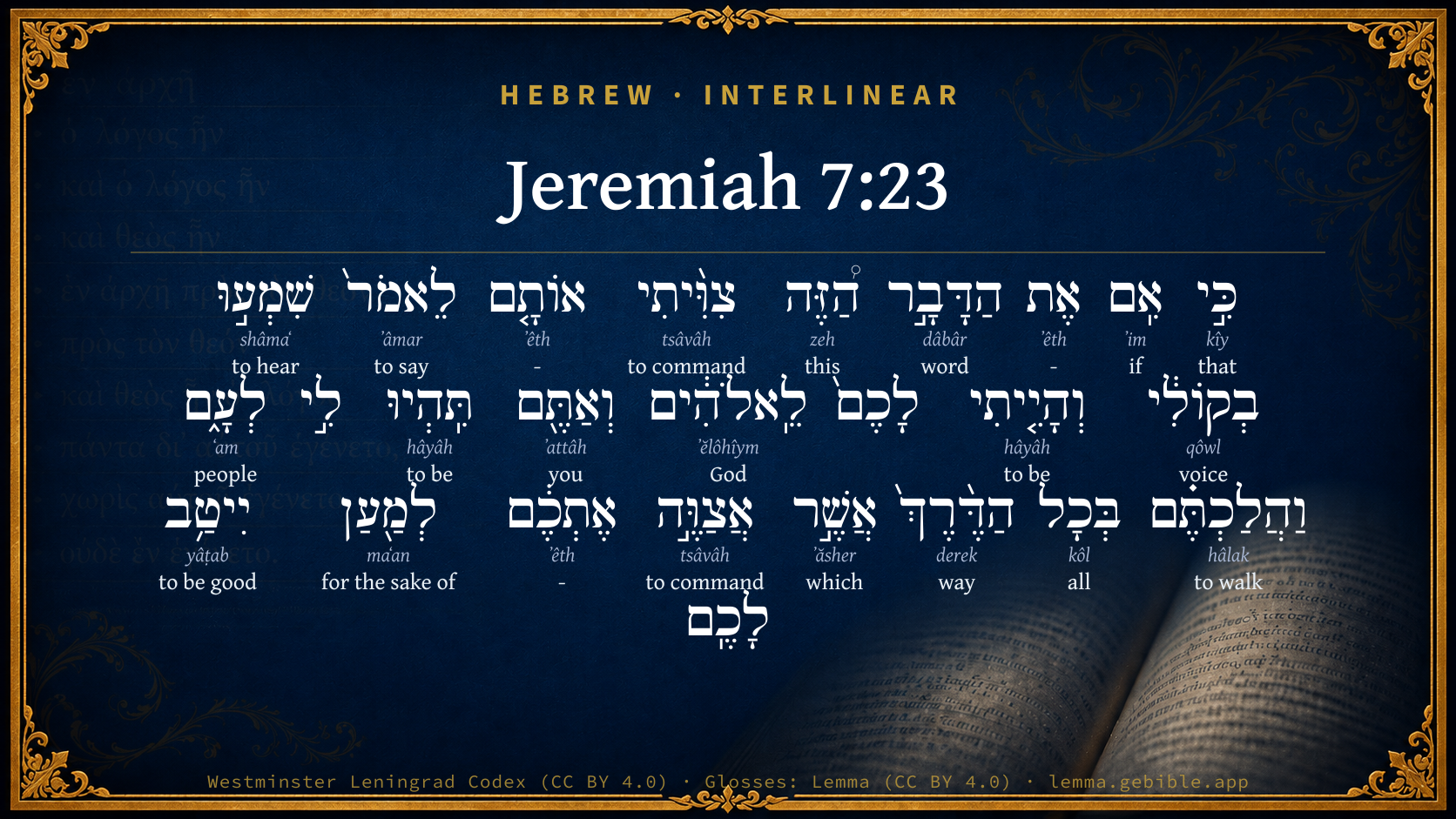
Jeremiah 7:23

Hebrew (Westminster Leningrad Codex) Jeremiah 7:23 appears in the Hebrew Old Testament. The text above is from the Westminster Leningrad Codex. Each word links to its Strong’s number, a concise gloss, and parsing drawn from the Open Scriptures Hebrew Bible morphology. Click any word for its full Brown-Driver-Briggs (BDB) entry.
Download image
Cite this verse

Jeremiah 7:23 (World English Bible). Public Domain. Lemma interlinear Bible study tool, https://lemma.gebible.app/v/jeremiah/7/23.

Show BibTeX & RIS
BibTeX
RIS
English Translation
but this thing I commanded them, saying, Listen to my voice, and I will be your God, and you shall be my people; and walk you in all the way that I command you, that it may be well with you.
World English Bible · Public Domain
Download a study sheet

One document with this verse’s original text, its word-by-word gloss line, the meaning frame, cross-references with their text, attributed commentary, and full source and license credits — printable, and it pastes into notes with its structure intact.

This verse Autodidact and up

Study sheet (.html) Plain text (.txt)

A passage Seminary Student

Up to 50 verses in one chapter. A passage sheet keeps up to 6 commentary sources and 12 cross-references per verse, in the order this page ranks them, and says so on the sheet whenever that leaves anything out. Ask for a single verse and you get the Autodidact verse sheet above.

Everything on this page stays free to read, with no account — the sheet is a download of what is already on screen, not access to it.

Want to remove ads? Support Godless Engineer
Compare translations 3

The same verse in 3 English versions, stacked beneath the original-language interlinear above. Click any original word for its lexicon entry.

Each is an independent rendering of the whole verse — the interlinear is not word-aligned to these translations.

Highlighted words mark where these versions differ — a whole-verse word diff, not a word-by-word alignment.

  • World English Bible Public Domain
    but this thing I commanded them, saying, Listen to my voice, and I will be your God, and you shall be my people; and walk you in all the way that I command you, that it may be well with you.
  • King James Version Public Domain
    But this thing commanded I them, saying, Obey my voice, and I will be your God, and ye shall be my people: and walk ye in all the ways that I have commanded you, that it may be well unto you.
  • unfoldingWord Literal Text CC BY-SA 4.0
    But I commanded them this word, saying, “Listen to my voice, and I will be your God and you will be my people; and you shall walk in all the ways that I command you so that it may go well for you.”

unfoldingWord Literal Text — © unfoldingWord, licensed CC BY-SA 4.0. Word-aligned USFM3 via Door43 (git.door43.org/unfoldingWord/en_ult).

Versions to compare (up to 4)

3 of 4 selected

Show all 18 translations

Every available English version of this verse, each an independent rendering of the whole verse.

  • World English Bible Public Domain
    but this thing I commanded them, saying, Listen to my voice, and I will be your God, and you shall be my people; and walk you in all the way that I command you, that it may be well with you.
  • Berean Standard Bible Public Domain
    but this is what I commanded them: Obey Me, and I will be your God, and you will be My people. You must walk in all the ways I have commanded you, so that it may go well with you.
  • Majority Standard Bible Public Domain
    but this is what I commanded them: Obey Me, and I will be your God, and you will be My people. You must walk in all the ways I have commanded you, so that it may go well with you.
  • King James Version Public Domain
    But this thing commanded I them, saying, Obey my voice, and I will be your God, and ye shall be my people: and walk ye in all the ways that I have commanded you, that it may be well unto you.
  • American Standard Version (1901) Public Domain
    but this thing I commanded them, saying, Hearken unto my voice, and I will be your God, and ye shall be my people; and walk ye in all the way that I command you, that it may be well with you.
  • Revised Version (1885) Public Domain
    but this thing I commanded them, saying, Hearken unto my voice, and I will be your God, and ye shall be my people: and walk ye in all the way that I command you, that it may be well with you.
  • Geneva Bible (1599) Public Domain
    But this thing commanded I them, saying, Obey my voyce, and I will be your God, and yee shalbe my people: and walke yee in all the wayes which I haue commanded you, that it may be well vnto you.
  • Douay-Rheims (1899) Public Domain
    But this thing I commanded them, saying: Hearken to my voice, and I will be your God, and you shall be my people: and walk ye in all the way that I have commanded you, that it may be well with you.
  • Young's Literal Translation Public Domain
    But this thing I commanded them, saying: Hearken to My voice, And I have been to you for God, And ye -- ye are to Me for a people, And have walked in all the way that I command you, So that it is well for you.
  • Literal Standard Version CC BY-SA 4.0
    But this thing I commanded them, saying, || Listen to My voice, || And I have been to you for God, || And you are to Me for a people, || And have walked in all the way that I command you, || So that it is well for you.
  • Unlocked Literal Bible CC BY-SA 4.0
    I only gave them this command, “Listen to my voice, and I will be your God and you will be my people. So walk in all the ways that I am commanding you, so that it may go well with you.”
  • unfoldingWord Literal Text CC BY-SA 4.0
    But I commanded them this word, saying, “Listen to my voice, and I will be your God and you will be my people; and you shall walk in all the ways that I command you so that it may go well for you.”
  • Darby Bible Public Domain
    but I commanded them this thing, saying, Hearken unto my voice, and I will be your God, and ye shall be my people; and walk in all the way that I command you, that it may be well with you.
  • World Messianic Bible Public Domain
    but this thing I commanded them, saying, ‘Listen to my voice, and I will be your God, and you shall be my people. Walk in all the way that I command you, that it may be well with you.’
  • Webster's Bible Public Domain
    But this thing I commanded them, saying, Obey my voice, and I will be your God, and ye shall be my people: and walk ye in all the ways that I have commanded you, that it may be well to you.
  • Free Bible Version CC BY-SA 4.0
    This is the commandment I gave them: Obey me, and I will be your God, and you will be my people. Follow everything I have commanded you to do, so that all will go well for you.
  • Bible in Basic English Public Domain
    But this was the order I gave them, saying, Give ear to my voice, and I will be your God, and you will be my people: go in all the way ordered by me, so that all may be well for you.
  • JPS Tanakh (1917) Public Domain
    but this thing I commanded them, saying: 'Hearken unto My voice, and I will be your God, and ye shall be My people; and walk ye in all the way that I command you, that it may be well with you.'

Literal Standard Version (2020), Covenant Press — licensed CC BY-SA 4.0. Text via the HelloAO Bible API (eBible.org). Unlocked Literal Bible (unfoldingWord) — licensed CC BY-SA 4.0. Text via the HelloAO Bible API (eBible.org). unfoldingWord Literal Text — © unfoldingWord, licensed CC BY-SA 4.0. Word-aligned USFM3 via Door43 (git.door43.org/unfoldingWord/en_ult). Free Bible Version, Dr. Jonathan Gallagher — licensed CC BY-SA 4.0. Text via the HelloAO Bible API (eBible.org).

Word by word

More ways to search: Search by grammar → Find every occurrence → Compare this word →

Practice this passage: Drill this verse → Learn its vocabulary →

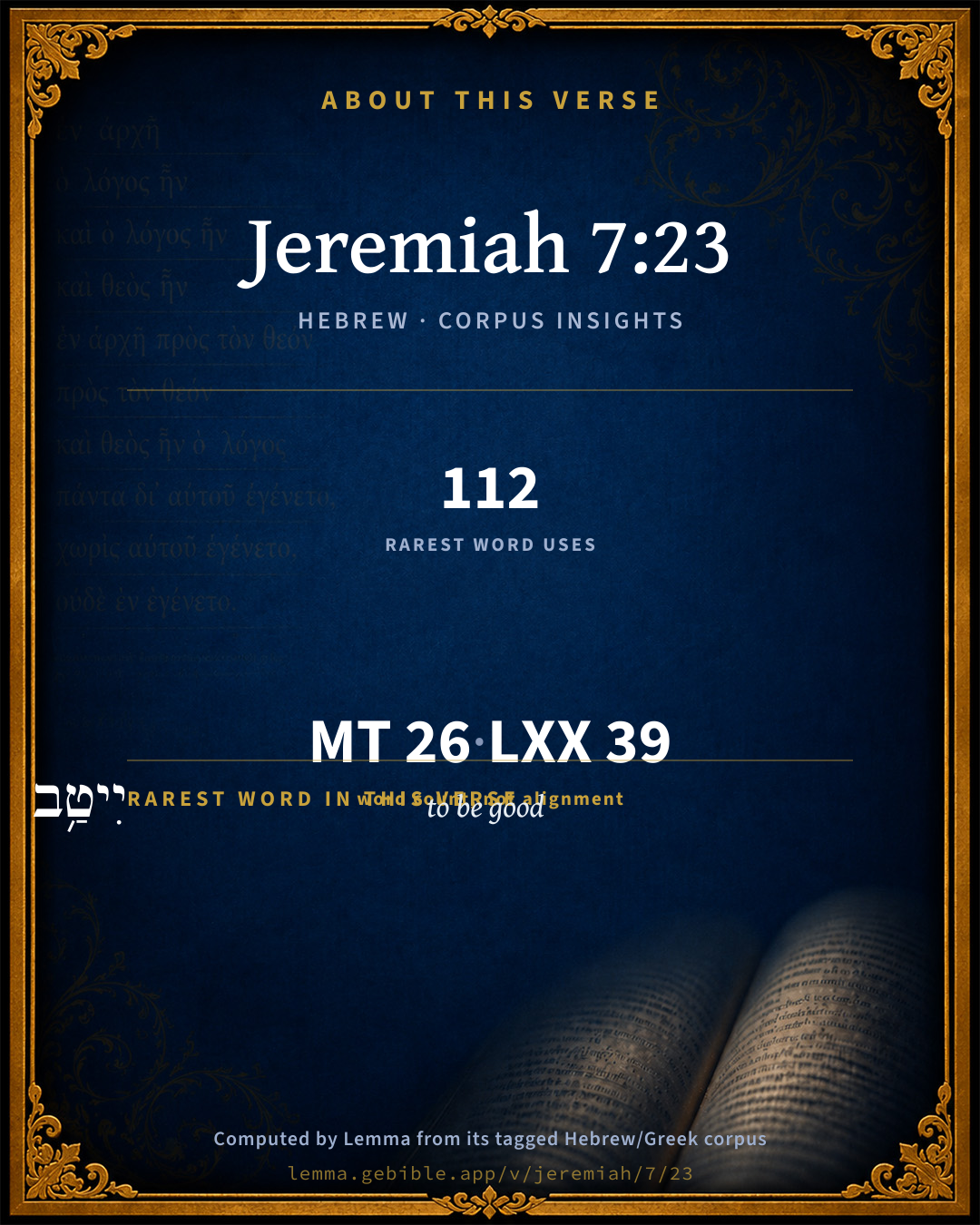
יִיטַ֥ב
yâṭab
H3190
“to be good”
Verb, Qal, Imperfect, 3rd Person, Masculine, Singular
Part of Speech
Verb
Stem
Qal
Form
Imperfect
Person
3rd Person
Gender
Masculine
Number
Singular
Full BDB Definition

Origin: a primitive root

TWOT: 863

to be good, be pleasing, be well, be glad - (Qal) - to be glad, be joyful - to be well placed - to be well for, be well with, go well with - to be pleasing, be pleasing to - (Hiphil) - to make glad, rejoice - to do good to, deal well with - to do well, do thoroughly - to make a thing good or right or beautiful - to do well, do right
  1. כִּ֣י kîy H3588 “that” Conjunction
  2. אִֽם ʼim H518 “if” Conjunction
  3. אֶת ʼêth H853 “-” Particle, Direct Object
  4. הַדָּבָ֣ר dâbâr H1697 “the · word” Particle, Definite Article + Noun, Common, Masculine, Singular, Absolute
  5. הַ֠זֶּה zeh H2088 “the · this” Particle, Definite Article + Pronoun, Demonstrative, Masculine, Singular
  6. צִוִּ֨יתִי tsâvâh H6680 “to command” Verb, Piel, Perfect, 1st Person, Common, Singular
  7. אוֹתָ֤ם ʼêth H853 “- · them” Particle, Direct Object + Suffix, Personal, 3rd Person, Masculine, Plural
  8. לֵאמֹר֙ ʼâmar H559 “to say” Preposition + Verb, Qal, Infinitive Construct
  9. שִׁמְע֣וּ shâmaʻ H8085 “hear” Verb, Qal, Imperative, 2nd Person, Masculine, Plural
  10. בְקוֹלִ֔י qôwl H6963 “in/at · voice · my” Preposition + Noun, Common, Masculine, Singular, Construct + Suffix, Personal, 1st Person, Common, Singular
  11. וְהָיִ֤יתִי hâyâh H1961 “and · to be” Conjunction + Verb, Qal, Sequential Perfect, 1st Person, Common, Singular
  12. לֵֽאלֹהִ֔ים ʼĕlôhîym H430 “to/for · God(s)” Preposition + Noun, Common, Masculine, Plural, Absolute
  13. וְאַתֶּ֖ם ʼattâh H859 “and · you” Conjunction + Pronoun, Personal, 2nd Person, Masculine, Plural
  14. תִּֽהְיוּ hâyâh H1961 “to be” Verb, Qal, Imperfect, 2nd Person, Masculine, Plural
  15. לְעָ֑ם ʻam H5971 “to/for · people” Preposition + Noun, Common, Masculine, Singular, Absolute
  16. וַהֲלַכְתֶּ֗ם hâlak H1980 “and · to walk” Conjunction + Verb, Qal, Sequential Perfect, 2nd Person, Masculine, Plural
  17. בְּכָל kôl H3605 “in/at · all of” Preposition + Noun, Common, Masculine, Singular, Construct
  18. הַדֶּ֨רֶךְ֙ derek H1870 “the · way” Particle, Definite Article + Noun, Common, Both, Singular, Absolute
  19. אֲשֶׁ֣ר ʼăsher H834 “which” Particle, Relative
  20. אֲצַוֶּ֣ה tsâvâh H6680 “to command” Verb, Piel, Imperfect, 1st Person, Common, Singular
  21. אֶתְכֶ֔ם ʼêth H853 “- · you” Particle, Direct Object + Suffix, Personal, 2nd Person, Masculine, Plural
  22. לְמַ֖עַן maʻan H4616 “for the sake of” Preposition

About this verse

These counts appear in no published source. They are computed here, from the morphology-tagged text and Lemma’s own curated glosses. What Lemma adds →

26
words
19
distinct lemmas
Prophets
section

Grammatical profile

  • 8 verbs
  • 6 nouns
  • 2 pronouns
  • 4 prepositions
  • 2 conjunctions
  • 4 particles

Verb forms

  • צִוִּ֨יתִי Piel · Perfect
  • לֵאמֹר֙ Qal · Infinitive Construct
  • שִׁמְע֣וּ Qal · Imperative
  • וְהָיִ֤יתִי Qal · Sequential Perfect
  • תִּֽהְיוּ Qal · Imperfect
  • וַהֲלַכְתֶּ֗ם Qal · Sequential Perfect
  • אֲצַוֶּ֣ה Piel · Imperfect
  • יִיטַ֥ב Qal · Imperfect

Repetition

Words recur within this verse — often emphatic in Hebrew:

  • צִוִּ֨יתִי to command H6680 ×2
  • וְהָיִ֤יתִי to be H1961 ×2

Hebrew & Septuagint length

In the original languages it is 26 Hebrew tokens and 39 Greek tokens — but the two are counted differently (Hebrew bundles its prefixes and suffixes into one token; the Greek is in lemma form), so that isn’t a like-for-like length.

Cross-references

20

Topical passages linked to Jeremiah 7:23 in the Treasury of Scripture Knowledge — connected by theme and wording, ordered by reader-vote popularity; previews shown in the World English Bible.

  • Exodus 15:26 and he said, "If you will diligently listen to the voice of Yahweh your God, and will do that which is right in his eyes, and will pay attention to his commandments, and keep all his statutes, I will put none of the diseases on you, which I have put on the Egyptians; for I am Yahweh who heals you."
  • Deuteronomy 5:33 You shall walk in all the way which Yahweh your God has commanded you, that you may live, and that it may be well with you, and that you may prolong your days in the land which you shall possess.
  • Exodus 19:5–6 Now therefore, if you will indeed obey my voice, and keep my covenant, then you shall be my own possession from among all peoples; for all the earth is mine;
  • Jeremiah 42:6 Whether it be good, or whether it be evil, we will obey the voice of Yahweh our God, to whom we send you; that it may be well with us, when we obey the voice of Yahweh our God.
  • Hebrews 5:9 Having been made perfect, he became to all of those who obey him the author of eternal salvation,
  • Deuteronomy 6:3 Hear therefore, Israel, and observe to do it; that it may be well with you, and that you may increase mightily, as Yahweh, the God of your fathers, has promised to you, in a land flowing with milk and honey.
  • Deuteronomy 13:4 You shall walk after Yahweh your God, and fear him, and keep his commandments, and obey his voice, and you shall serve him, and cleave to him.
  • Deuteronomy 30:20 to love Yahweh your God, to obey his voice, and to cleave to him; for he is your life, and the length of your days; that you may dwell in the land which Yahweh swore to your fathers, to Abraham, to Isaac, and to Jacob, to give them.
  • Jeremiah 11:4 which I commanded your fathers in the day that I brought them forth out of the land of Egypt, out of the iron furnace, saying, Obey my voice, and do them, according to all which I command you: so shall you be my people, and I will be your God;
  • Deuteronomy 5:29 Oh that there were such a heart in them, that they would fear me, and keep all my commandments always, that it might be well with them, and with their children forever!
  • Deuteronomy 30:2 and shall return to Yahweh your God, and shall obey his voice according to all that I command you this day, you and your children, with all your heart, and with all your soul;
  • 2 Corinthians 10:5 throwing down imaginations and every high thing that is exalted against the knowledge of God, and bringing every thought into captivity to the obedience of Christ;
  • Deuteronomy 30:8 You shall return and obey the voice of Yahweh, and do all his commandments which I command you this day.
  • Jeremiah 11:7 For I earnestly protested to your fathers in the day that I brought them up out of the land of Egypt, even to this day, rising early and protesting, saying, Obey my voice.
  • Leviticus 26:3–12 "'If you walk in my statutes, and keep my commandments, and do them;
  • Deuteronomy 4:10 the day that you stood before Yahweh your God in Horeb, when Yahweh said to me, Assemble me the people, and I will make them hear my words, that they may learn to fear me all the days that they live on the earth, and that they may teach their children.
  • Deuteronomy 5:16 "Honor your father and your mother, as Yahweh your God commanded you; that your days may be long, and that it may go well with you, in the land which Yahweh your God gives you.
  • Deuteronomy 11:27 the blessing, if you shall listen to the commandments of Yahweh your God, which I command you this day;
  • Romans 16:26
  • Jeremiah 31:33 But this is the covenant that I will make with the house of Israel after those days, says Yahweh: I will put my law in their inward parts, and in their heart will I write it; and I will be their God, and they shall be my people:

Cross-references courtesy of OpenBible.info (CC BY 4.0).

Hebrew and Greek witnesses Masoretic Hebrew ↔ Greek Septuagint

The same verse in the two great witnesses to the Old Testament, shown verse-for-verse.

These are two independent witnesses, not word-aligned to each other, and the Septuagint is shown in lemma (dictionary) form.

Hebrew Jeremiah 7:23 Masoretic · Westminster Leningrad Codex

כִּ֣י אִֽם אֶת הַדָּבָ֣ר הַ֠זֶּה צִוִּ֨יתִי אוֹתָ֤ם לֵאמֹר֙ שִׁמְע֣וּ בְקוֹלִ֔י וְהָיִ֤יתִי לָכֶם֙ לֵֽאלֹהִ֔ים וְאַתֶּ֖ם תִּֽהְיוּ לִ֣י לְעָ֑ם וַהֲלַכְתֶּ֗ם בְּכָל הַדֶּ֨רֶךְ֙ אֲשֶׁ֣ר אֲצַוֶּ֣ה אֶתְכֶ֔ם לְמַ֖עַן יִיטַ֥ב לָכֶֽם

but this thing I commanded them, saying, Listen to my voice, and I will be your God, and you shall be my people; and walk you in all the way that I command you, that it may be well with you.

World English Bible · Public Domain

Greek LXX Structure differs

In the Septuagint, Jeremiah is about an eighth shorter than the Hebrew and arranges its material differently — the Oracles Against the Nations (Hebrew chapters 46–51) appear in the middle of the Greek book, after 25:13. Because the chapter and verse boundaries do not line up, a verse-for-verse comparison with the Hebrew is not shown.

A verse-for-verse comparison isn’t shown here because the chapters and verses don’t line up. Switch to the LXX edition with the MT / LXX toggle above to read the Greek directly.

Hebrew: Westminster Leningrad Codex (CC BY 4.0). Greek: Septuagint (public domain); English from a public-domain English Septuagint. How the Septuagint differs from the Hebrew →

Targum (Aramaic paraphrase)

1

The Targum is the ancient Jewish Aramaic paraphrase of the Hebrew Scriptures — an interpretive translation, not the Hebrew text itself. Onkelos (literal) and Pseudo-Jonathan (expansive) render the Torah, and Jonathan the Prophets. Coverage is partial: where no permissively-licensed English translation exists for a verse, only the Aramaic is shown. This is verse-level text, not a word-by-word alignment to the Hebrew.

  1. Targum Jonathan Prophets (Joshua–Malachi)
    אֱלָהֵין יַת פִּתְגָמָא הָדֵין פַּקְדֵית יַתְהוֹן לְמֵימַר קַבִּילוּ לְמֵימְרִי וְאֶהֱוֵי לְכוֹן לֶאֱלָהָא וְאַתּוּן תְּהוֹן קֳדָמַי לְעָם וּתְהָכוּן בְּכָל אוֹרְחָא דַאֲפַקֵיד יַתְכוֹן בְּדִיל דְיִיטַב לְכוֹן:

    (no public-domain English translation for this verse)

    Targum Jonathan — Aramaic: “Mikraot Gedolot” (public domain). English: “Sefaria Community Translation” (CC0 1.0 (public-domain dedication)); “London "Chaldee Paraphrase," 1871” (public domain). Text via Sefaria.

Commentary

Notes on Jeremiah 7:23 from classic Christian and Jewish commentators (each source and its license shown beneath its notes). The classic Christian expositions comment on the surrounding passage and are grouped to its opening verse, so a note may address several verses; the Jewish commentaries on the Tanakh (Rashi and others) are per-verse, so they appear only where the commentator wrote on this verse.

Lemma curates 59 commentaries, every one of them public domain or Creative Commons licensed, each selected and text-cleaned for this edition rather than reprinted as found. About our sources →

Trapp's Complete Commentary

John Trapp

Jer 7:23 But this thing commanded I them, saying, Obey my voice, and I will be your God, and ye shall be my people: and walk ye in all the ways that I have commanded you, that it may be well unto you.

Ver. 23. But this thing I commanded them,] i.e., I principally commanded them, giving them therefore first the decalogue, and then afterwards the ceremonial law, which was, or should have been, their gospel.

John Trapp, A Commentary or Exposition upon All the Books of the Old and New Testament (1647–1656) — public domain. Text from a community e-Sword module.

Jamieson, Fausset & Brown

Robert Jamieson, A. R. Fausset & David Brown

(Exo 15:26; Exo 19:5).

Jamieson, Fausset & Brown — Commentary Critical and Explanatory on the Whole Bible (1871) — public domain (CC PDM 1.0). Text via the HelloAO Bible API.

Adam Clarke's Commentary

Verse 23. This thing commanded I them - Obey my voice] It was not sacrifices and oblations which I required of your fathers in the wilderness, but obedience; it was to walk in that way of righteousness which I have commanded; then I should have acknowledged them for my people, and I should have been their God; and then it would have been well with them. But to my commands,

1. They hearkened not - paid no regard to my word.

2. They inclined not the ear - showed no disposition to attend to my counsels.

3. They walked in the imaginations of their evil heart - followed its irregular and impure motions, rather than the holy dictates of my Spirit.

4. They went backward and not forward. Instead of becoming more wise, obedient, and holy, they grew more corrupt; so that they became more profligate than their fathers.

Adam Clarke's Commentary on the Bible (1810–1826) — public domain. Text from a community e-Sword/MySword module.

John Calvin's Commentaries

I spoke not then to your fathers, nor commanded them in the day I brought them forth from the land of Egypt, etc. The Prophet calls the attention of the Jews to the first condition of the Church; for though God had made his covenant with Abraham, Isaac, and Jacob, yet he then only formed or framed for himself a Church when the Law was promulgated. Hence God at that time showed what pleased him, and prescribed certain things, which were in future to be inviolably observed: and as the Jews violated the rule given them, the Prophet concludes that God was corruptly and absurdly worshipped by them. This is the reason why he expressly speaks here of the deliverance granted to the fathers. There follows afterwards a clearer explanation, which removes all ambiguity: for God subordinates sacrifices to obedience. Yet sacrifices are a part of obedience: very true; but as the people were to be subject to the whole law, it hence follows, that the worship of God was mutilated by them, when there was no care for true piety. We now then, no doubt, understand the meaning of the Prophet, and see at the same time the reason why God so expressly rejected sacrifices: for what God has connected, it is not in the power of man to separate. (Matthew 19:6; Mark 10:9.) This rending of things is impious. As the Jews had separated sacrifices from their right and legitimate end, whatever they did was a sacrilege and a profanation.

That we may now more fully comprehend this doctrine, we must remember this principle — that the basis of true religion is obedience. For unless God shines on us with his word, there is no religion, but only hypocrisy and superstition; as the case is with heathens, who, though they busy themselves much and with great diligence, yet loose all their labor, and uselessly weary themselves, for God has not shewn to them the right way. In short, true religion may always be distinguished from superstition by this mark — If the truth of God guides us, then our religion is true; but if any one follows his own reason, or is led by the opinion and consent of men, he forms for himself superstition; and nothing that he does will please God. This is one thing.

Now, in the second place, let us see what God chiefly requires from those who are his servants. Being fully convinced of this truth — that God cannot be truly served, except we obey his voice, we must consider, as I have said, what God commands us to do. Now, as he is a Spirit, so he demands sincerity of heart. (John 4:24.) We also know that God so comes to us, that he would have us to trust wholly in his gratuitous goodness, that he would have us to depend altogether on his paternal kindness, that he would have us to call on him, and to offer him the sacrifice of praise. Since, then, God has expressly required these things in his word, it is certain, that all other modes of worship are rejected by him as vitious; that is, when there is no faith, when there is no prayer and praise: for these hold the first place in true and legitimate worship.

This one passage is sufficient to put an end to all the contentions which are now in the world. For if the Papists admitted that obedience is of more account with God than all sacrifices, (1 Samuel 15:22,) we might easily agree. They might afterwards debate every article of faith; but there would be in the main an agreement between us, were they to submit simply and unreservedly to the word of God. But we see how pertinaciously they insist on this point — that we are not to stand on God’s word, nor acquiesce in it, because there is in it nothing certain. Hence they regard the doctrine of the Fathers, and what they call the perpetual consent of the Catholic Church, as of more value than the Law and the Prophets and the Gospel. They dare not indeed to contend on this ground; and so far they act wisely: for if the disputes between us are capable of being removed, as I have said, by God’s word, we could easily overcome them. But while they, fostering their own blindness, strive to extinguish the light, and willfully envelop themselves in darkness, let us follow what God’s Spirit shews to us here, — that the main part of true and right worship and service is to hear God speaking, and to regard obedience of more account than all offerings and sacrifices, according to the passage we have quoted from 1 Samuel 15:22.

He afterwards adds, I will be to you a God, and ye shall be to me a people; and ye shall walk in all the way which I shall shew to you, that it may be well with you. The Prophet confirms what I have already said, that if we would obey God, we must consider what he commands. Now God omits no part of true worship: we shall then never go astray from true religion, if only we render ourselves teachable. Whence then is it, that men diligently labor and profit nothing, except that they are deaf to God’s voice? for as it has been already often said, God has not only spoken generally, and in various ways, of obedience, but has clearly and distinctly taught what he approves. Our obedience then will please him, if only we learn what he would have us to do.

And at the same time he adds, that this condition was mentioned to the Jews, that it would be well with them, if they only obeyed God. Hence their perverseness is more fully detected; for they willfully sought to be miserable, and procured for themselves their own destruction: for a happy life was offered to them, provided only they submitted to God. Since they refused this, who does not see that they willfully gave themselves up to misery, as though they wished to provoke God’s anger, and did so designedly? for it immediately follows —

John Calvin's Commentaries (1540-1563) — public domain. Text from the Calvin Translation Society English edition (1840s-50s) via the Christian Classics Ethereal Library (ccel.org). Calvin's coverage is partial (roughly two-thirds of the Bible); uncommented books and verses are honest gaps, never fabricated. The 19th-century editor's footnotes and remarks are omitted so the notes are faithfully Calvin's own voice.

Ellicott's Commentary for English Readers

(23) But this thing commanded I them.—The words that follow are a composite quotation, partly from the lately re-found Deuteronomy (Deu_5:33), partly from the words that were strictly true of the “day” when Israel came out of Egypt (Exo_19:5), partly from the very book which seemed to be most characterised by sacrificial ritual, Leviticus (Lev_26:12). The influence of Jeremiah’s teaching on later Jewish thought is shown by the fact that this very section of Jeremiah (Jer_7:21-28) appears in the Synagogue ritual as the Haphtara, or second lesson from the prophets, after Leviticus 6-8, as the Parashah, or first lesson from the Law. The Synagogue worship, indeed, was, in the nature of the case, the result of the teaching of scribes and prophets rather than of priests, and therefore a witness for the spiritual truth symbolised in sacrifice, and not for the perpetuation of the symbol.

A Bible Commentary for English Readers, edited by Charles John Ellicott (1878–1897) — public domain. Text from a community e-Sword module.

The Cambridge Bible for Schools and Colleges

gen. ed. J. J. S. Perowne

23. The nature of the compact was protection on the one hand conditional upon obedience on the other.

Hearken unto my voice] The nearest approach to these words, considered as a quotation, is Exo_19:5, but it corresponds closely to the general tone of Deuteronomy.

in all the way, etc.] Only once elsewhere, viz. Deu_5:33.

The Cambridge Bible for Schools and Colleges (gen. ed. J. J. S. Perowne; Cambridge University Press, 1878–1918) — public domain. Text from a community e-Sword module.

John Gill's Exposition

But this thing commanded I them, saying,.... This was the sum and substance of what was then commanded, even obedience to the moral law; this was the main and principal thing enjoined, and to which the promise was annexed:

obey my voice: the word of the Lord, his commands, the precepts of the decalogue; obedience to which was preferable to the sacrifices of the ceremonial law; see Sa1 15:22, wherefore it follows:

and I will be your God, and ye shall be my people; the meaning is, that while they were obedient to him, he would protect them from their enemies, and continue them in their privileges and blessings, which he had bestowed upon them as his peculiar people:

and walk ye in all the ways that I have commanded you; not only in some of them, but in all of them; not merely in the observance of legal sacrifices, but chiefly in the performance of moral actions; even in all the duties of religion, in whatsoever is required in the law, respecting God or man:

that it may be well unto you; that they might continue in the land which was given them for an inheritance, and enjoy all the blessings promised to their obedience.

John Gill's Exposition of the Whole Bible (1746–1763) — public domain (CC PDM 1.0). Text via the HelloAO Bible API.

Albert Barnes' Notes on the Bible

Obey ... - These words are not found verbatim in the Pentateuch, but are a sum mary of its principles. Sacrifice is never the final cause of the covenant, but always obedience (Exo 19:5-6; Lev 11:45. Compare Exo. 20; Deut. 11, in which the moral object of the Mosaic dispensation is most clearly taught). In connection with Jeremiah’s argument, notice that Amo 5:25 (taken in conjunction with Jos 5:2-7) proves that the ceremonial law was not observed during the 40 years’ wandering in the wilderness. A thing so long in abeyance in the very time of its founder, could not be of primary importance.

Albert Barnes' Notes on the Bible (1834–1885) — public domain. Text from a community e-Sword/MySword module.

Matthew Poole's English Annotations

This thing, or word, which is the rule by which all obedience is to be tried, viz. what commands, every thing else being but mere superstition.

That it may be well unto you: he shows what would be the good effect of their obedience, Exo 15:26; Deu 5:29,33, which implies that their sufferings are from their perverseness, as it is expressed in the next verse.

Matthew Poole's English Annotations on the Holy Bible (1683–1685) — public domain. Text from a community e-Sword/MySword module.

The Pulpit Commentary

But this thing... Obey my voice, etc. Comp. Deu_6:3, "Hear the verb rendered here "obey therefore, O Israel, and observe to do it; that it may be well with thee," etc. The words, I will be your God; rather, to you a God, etc., occur in Lev_26:12. (comp. Exo_6:7 Deu_29:13) Walk ye in all the ways, etc., is not a citation, but reminds us of passages like Deu_9:12, 16 11:28 31:29. That it may be well unto you is a characteristic phrase of Jeremiah; (Jer_43:6 Jer_38:20 Jer_40:9) but is also frequent in Deuteronomy. (comp., besides the passage quoted above, Deu_4:40 Deu_5:16 Deu_6:18 Deu_12:25)

The Pulpit Commentary (1880–1919), ed. H.D.M. Spence-Jones & Joseph S. Exell — public domain. Text from a community e-Sword module.

Lesson kit

Teaching starters — assembled from the data on this page, not authored interpretation. Every prompt links to the verse data it draws on. Edit before teaching.

Jeremiah, in the Prophets, opens this verse with 26 words (19 distinct Hebrew lemmas). Its most distinctive word is yâṭab (“to be good”). A historical commentator’s framing appears above. Read the whole chapter for the surrounding context.

Discussion questions

  1. The word yâṭab carries the sense “to be good.” How does it shape the verse?
  2. How does Exodus 15:26, which shares this passage’s theme, read alongside this verse?
  3. What does the repetition of “to command” (2× in this one verse) do in this verse?
  4. These translations render this verse differently; the difference is in the English rendering, not the original. What questions does that raise?
  5. «צִוִּ֨יתִי» is a Piel Perfect verb. How does that grammatical form shape the action described?
  6. Compare how Trapp's Complete Commentary and Jamieson, Fausset & Brown read this verse. Where do they agree or differ?

Things to notice

Reading settings

Reading text

Shown beneath each verse's original-language words.

Old Testament
Old Testament edition

Read the OT as the Masoretic Hebrew (MT) or the Greek Septuagint (LXX).

English shown for the Greek Septuagint (in the Hebrew ↔ Greek comparison).

Comparing translations? Open the Compare panel on any verse page to stack up to four side by side.