
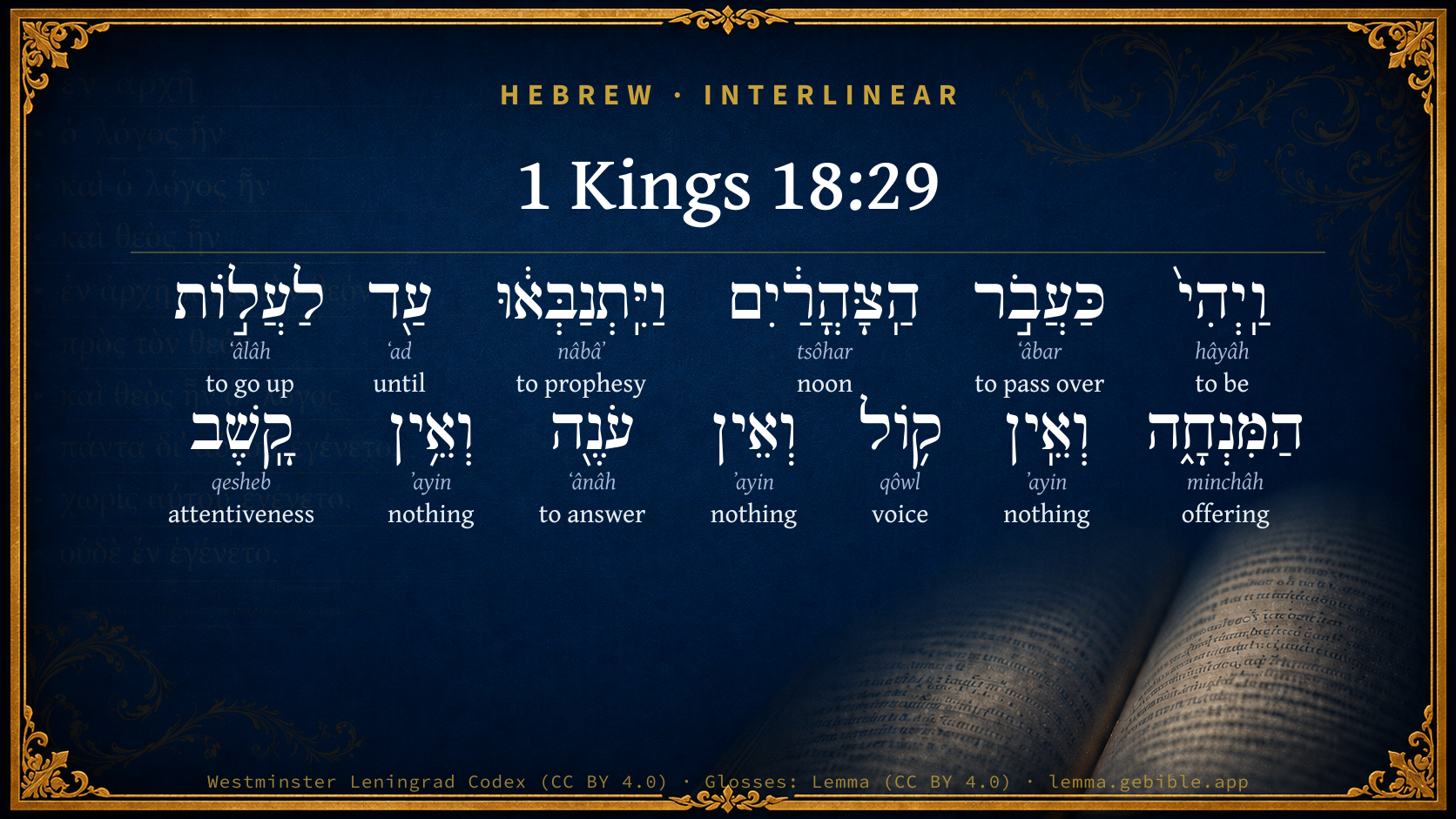
1 Kings 18:29

Hebrew (Westminster Leningrad Codex) 1 Kings 18:29 appears in the Hebrew Old Testament. The text above is from the Westminster Leningrad Codex. Each word links to its Strong’s number, a concise gloss, and parsing drawn from the Open Scriptures Hebrew Bible morphology. Click any word for its full Brown-Driver-Briggs (BDB) entry.
Download image
Cite this verse

1 Kings 18:29 (World English Bible). Public Domain. Lemma interlinear Bible study tool, https://lemma.gebible.app/v/1-kings/18/29.

Show BibTeX & RIS
BibTeX
RIS
English Translation
It was so, when midday was past, that they prophesied until the time of the offering of the [evening] offering; but there was neither voice, nor any to answer, nor any who regarded.
World English Bible · Public Domain
Highlights Full analysis ↓
Download a study sheet

One document with this verse’s original text, its word-by-word gloss line, the meaning frame, cross-references with their text, attributed commentary, and full source and license credits — printable, and it pastes into notes with its structure intact.

This verse Autodidact and up

Study sheet (.html) Plain text (.txt)

A passage Seminary Student

Up to 50 verses in one chapter. A passage sheet keeps up to 6 commentary sources and 12 cross-references per verse, in the order this page ranks them, and says so on the sheet whenever that leaves anything out. Ask for a single verse and you get the Autodidact verse sheet above.

Everything on this page stays free to read, with no account — the sheet is a download of what is already on screen, not access to it.

Want to remove ads? Support Godless Engineer
Compare translations 3

The same verse in 3 English versions, stacked beneath the original-language interlinear above. Click any original word for its lexicon entry.

Each is an independent rendering of the whole verse — the interlinear is not word-aligned to these translations.

Highlighted words mark where these versions differ — a whole-verse word diff, not a word-by-word alignment.

  • World English Bible Public Domain
    It was so, when midday was past, that they prophesied until the time of the offering of the [evening] offering; but there was neither voice, nor any to answer, nor any who regarded.
  • King James Version Public Domain
    And it came to pass, when midday was past, and they prophesied until the time of the offering of the evening sacrifice, that there was neither voice, nor any to answer, nor any that regarded.
  • unfoldingWord Literal Text CC BY-SA 4.0
    And it happened, when midday passed, that they prophesied until the offering of the grain offering. But no voice, and no answering, and there was no attention.

unfoldingWord Literal Text — © unfoldingWord, licensed CC BY-SA 4.0. Word-aligned USFM3 via Door43 (git.door43.org/unfoldingWord/en_ult).

Versions to compare (up to 4)

3 of 4 selected

Show all 18 translations

Every available English version of this verse, each an independent rendering of the whole verse.

  • World English Bible Public Domain
    It was so, when midday was past, that they prophesied until the time of the offering of the [evening] offering; but there was neither voice, nor any to answer, nor any who regarded.
  • Berean Standard Bible Public Domain
    Midday passed, and they kept on raving until the time of the evening sacrifice. But there was no response; no one answered, no one paid attention.
  • Majority Standard Bible Public Domain
    Midday passed, and they kept on raving until the time of the evening sacrifice. But there was no response; no one answered, no one paid attention.
  • King James Version Public Domain
    And it came to pass, when midday was past, and they prophesied until the time of the offering of the evening sacrifice, that there was neither voice, nor any to answer, nor any that regarded.
  • American Standard Version (1901) Public Domain
    And it was so, when midday was past, that they prophesied until the time of the offering of the `evening' oblation; but there was neither voice, nor any to answer, nor any that regarded.
  • Revised Version (1885) Public Domain
    And it was so, when midday was past, that they prophesied until the time of the offering of the evening oblation; but there was neither voice, nor any to answer, nor any that regarded.
  • Geneva Bible (1599) Public Domain
    And when midday was passed, and they had prophecied vntil the offring of the euening sacrifice, there was neither voyce, nor one to answere, nor any that regarded.
  • Douay-Rheims (1899) Public Domain
    And after midday was past, and while they were prophesying, the time was come of offering sacrifice, and there was no voice heard, nor did any one answer, nor regard them as they prayed:
  • Young's Literal Translation Public Domain
    and it cometh to pass, at the passing by of the noon, that they feign themselves prophets till the going up of the present, and there is no voice, and there is none answering, and there is none attending.
  • Literal Standard Version CC BY-SA 4.0
    and it comes to pass, at the passing by of the noon, that they feign themselves prophets until the going up of the present, and there is no voice, and there is none answering, and there is none attending.
  • Unlocked Literal Bible CC BY-SA 4.0
    Midday passed, and they were still raving until the time of offering of the evening sacrifice, but there was no voice or anyone to answer; there was no one who paid any attention to their pleadings.
  • unfoldingWord Literal Text CC BY-SA 4.0
    And it happened, when midday passed, that they prophesied until the offering of the grain offering. But no voice, and no answering, and there was no attention.
  • Darby Bible Public Domain
    And it came to pass when midday was past, that they prophesied until the [time] of the offering up of the oblation; but there was neither voice, nor any that answered, nor any attention.
  • World Messianic Bible Public Domain
    When midday was past, they prophesied until the time of the evening offering; but there was no voice, no answer, and nobody paid attention.
  • Webster's Bible Public Domain
    And it came to pass, when mid-day was past, and they prophesied until the time of the offering of the evening sacrifice, that there was neither voice, nor any to answer, nor any that regarded.
  • Free Bible Version CC BY-SA 4.0
    Noon came and went, and they went on with their manic “prophesying” until the time of the evening sacrifice. But no voice was heard, no one answered, no one was listening.
  • Bible in Basic English Public Domain
    And from the middle of the day they went on with their prayers till the time of the offering; but there was no voice, or any answer, or any who gave attention to them.
  • JPS Tanakh (1917) Public Domain
    And it was so, when midday was past, that they prophesied until the time of the offering of the evening offering; but their was neither voice, nor any to answer, nor any that regarded.

Literal Standard Version (2020), Covenant Press — licensed CC BY-SA 4.0. Text via the HelloAO Bible API (eBible.org). Unlocked Literal Bible (unfoldingWord) — licensed CC BY-SA 4.0. Text via the HelloAO Bible API (eBible.org). unfoldingWord Literal Text — © unfoldingWord, licensed CC BY-SA 4.0. Word-aligned USFM3 via Door43 (git.door43.org/unfoldingWord/en_ult). Free Bible Version, Dr. Jonathan Gallagher — licensed CC BY-SA 4.0. Text via the HelloAO Bible API (eBible.org).

Word by word

More ways to search: Search by grammar → Find every occurrence → Compare this word →

Practice this passage: Drill this verse → Learn its vocabulary →

קָֽשֶׁב
qesheb
H7182
“attentiveness”
Noun, Common, Masculine, Singular, Absolute
Part of Speech
Noun
Type
Common
Gender
Masculine
Number
Singular
State
Absolute
Full BDB Definition

Origin: from H7181

TWOT: 2084a

attentiveness, attention
  1. וַֽיְהִי֙ hâyâh H1961 “and · to be” Conjunction + Verb, Qal, Sequential Imperfect, 3rd Person, Masculine, Singular
  2. כַּעֲבֹ֣ר ʻâbar H5674 “like/as · to pass over” Preposition + Verb, Qal, Infinitive Construct
  3. הַֽצָּהֳרַ֔יִם tsôhar H6672 “the · noon” Particle, Definite Article + Noun, Common, Masculine, Plural, Absolute
  4. וַיִּֽתְנַבְּא֔וּ nâbâʼ H5012 “and · to prophesy” Conjunction + Verb, Hithpael, Sequential Imperfect, 3rd Person, Masculine, Plural
  5. עַ֖ד ʻad H5704 “until” Preposition
  6. לַעֲל֣וֹת ʻâlâh H5927 “to go up” Preposition + Verb, Hiphil, Infinitive Construct
  7. הַמִּנְחָ֑ה minchâh H4503 “the · offering” Particle, Definite Article + Noun, Common, Feminine, Singular, Absolute
  8. וְאֵֽין ʼayin H369 “and · nothing” Conjunction + Particle, Negative
  9. ק֥וֹל qôwl H6963 “voice” Noun, Common, Masculine, Singular, Absolute
  10. וְאֵין ʼayin H369 “and · nothing” Conjunction + Particle, Negative
  11. עֹנֶ֖ה ʻânâh H6030 “answering” Verb, Qal, Participle Active, Masculine, Singular, Absolute
  12. וְאֵ֥ין ʼayin H369 “and · nothing” Conjunction + Particle, Negative

About this verse

These counts appear in no published source. They are computed here, from the morphology-tagged text and Lemma’s own curated glosses. What Lemma adds →

13
words
11
distinct lemmas
Historical
section

Notable vocabulary

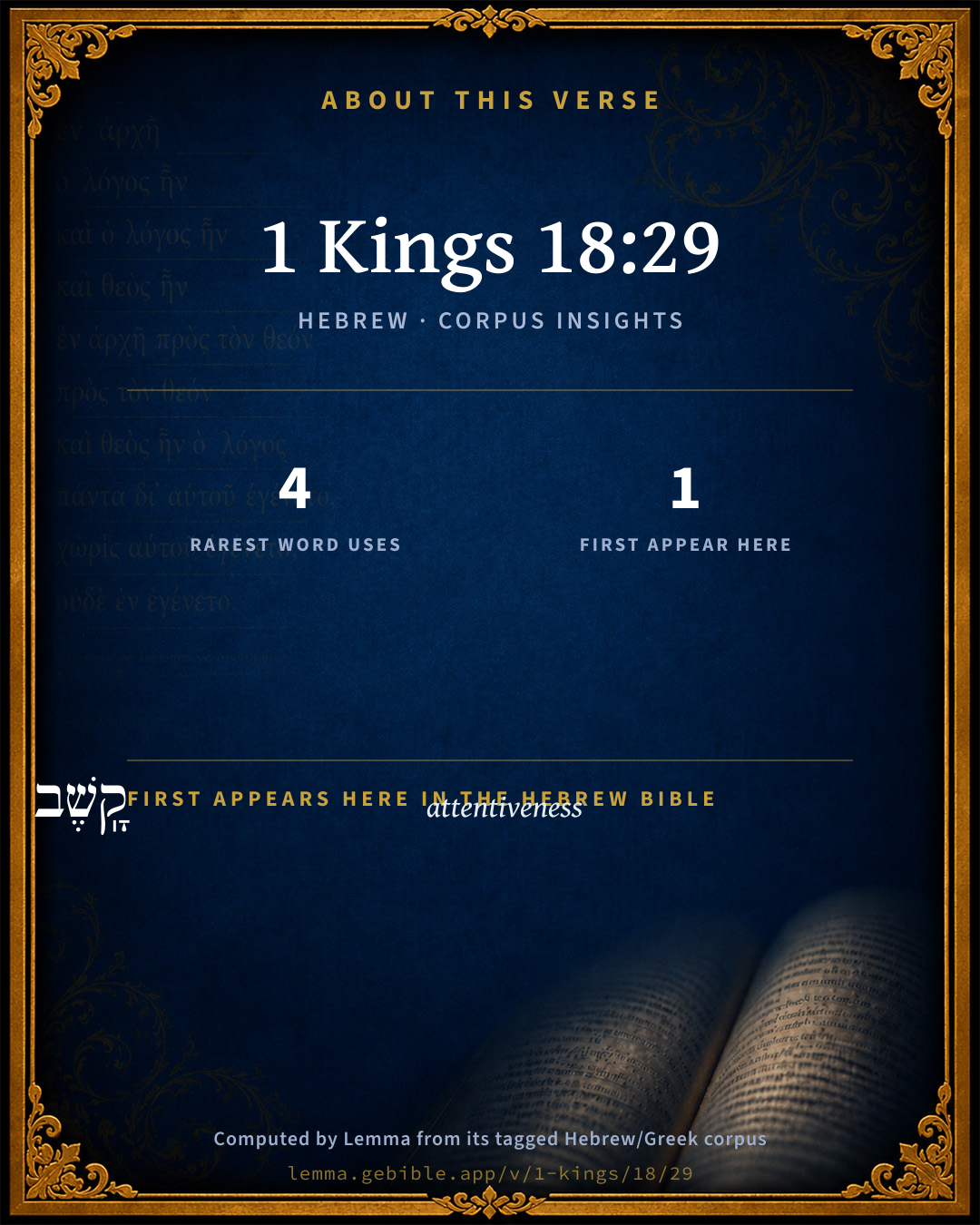
The rarest word here is קָֽשֶׁב attentiveness H7182 — appearing just 4 times in the whole Hebrew Bible.

First appearance in Scripture

This word makes its first canonical appearance in the Hebrew Bible here:

  • קָֽשֶׁב attentiveness H7182

Shared distinctive vocabulary

קָֽשֶׁב attentiveness H7182 occurs in 3 verses of the Hebrew Bible. Also found in:

Grammatical profile

  • 5 verbs
  • 4 nouns
  • 1 preposition
  • 3 particles

Verb forms

  • וַֽיְהִי֙ Qal · Sequential Imperfect
  • כַּעֲבֹ֣ר Qal · Infinitive Construct
  • וַיִּֽתְנַבְּא֔וּ Hithpael · Sequential Imperfect
  • לַעֲל֣וֹת Hiphil · Infinitive Construct
  • עֹנֶ֖ה Qal · Participle Active

Repetition

A word recurs within this verse — often emphatic in Hebrew:

  • וְאֵֽין nothing H369 ×3

Hebrew & Septuagint length

In English translation the verse runs 33 words from the Hebrew and 52 from the Septuagint (LXX English) — the Septuagint runs noticeably longer here. See the side-by-side →

A rough comparison of the two English renderings, which tokenize alike — not a word-level alignment.

Word counts can differ between the Hebrew and the Greek without any difference in meaning — e.g. the Hebrew direct-object marker אֵת has no separate Greek word, and Greek often adds the article ὁ.

Cross-references

11

Topical passages linked to 1 Kings 18:29 in the Treasury of Scripture Knowledge — connected by theme and wording, ordered by reader-vote popularity; previews shown in the World English Bible.

  • Exodus 29:39 The one lamb you shall offer in the morning; and the other lamb you shall offer at evening:
  • Exodus 29:41 The other lamb you shall offer at evening, and shall do to it according to the meal-offering of the morning, and according to its drink-offering, for a sweet savor, an offering made by fire to Yahweh.
  • 1 Samuel 18:10 It happened on the next day, that an evil spirit from God came mightily on Saul, and he prophesied in the midst of the house: and David played with his hand, as he did day by day. Saul had his spear in his hand;
  • 1 Kings 18:26 They took the bull which was given them, and they dressed it, and called on the name of Baal from morning even until noon, saying, Baal, hear us. But there was no voice, nor any who answered. They leaped about the altar which was made.
  • 1 Kings 22:10 Now the king of Israel and Jehoshaphat the king of Judah were sitting each on his throne, arrayed in their robes, in an open place at the entrance of the gate of Samaria; and all the prophets were prophesying before them.
  • 1 Kings 22:12 All the prophets prophesied so, saying, Go up to Ramoth-gilead, and prosper; for Yahweh will deliver it into the hand of the king.
  • Jeremiah 28:6–9 even the prophet Jeremiah said, Amen: Yahweh do so; Yahweh perform your words which you have prophesied, to bring again the vessels of Yahweh's house, and all them of the captivity, from Babylon to this place.
  • Acts 16:16–17 It happened, as we were going to prayer, that a certain girl having a spirit of divination met us, who brought her masters much gain by fortune telling.
  • 1 Corinthians 11:4–5 Every man praying or prophesying, having his head covered, dishonors his head.
  • Galatians 4:8 However at that time, not knowing God, you were in bondage to those who by nature are not gods.
  • 2 Timothy 3:8–9 Even as Jannes and Jambres opposed Moses, so do these also oppose the truth; men corrupted in mind, reprobate concerning the faith.

Cross-references courtesy of OpenBible.info (CC BY 4.0).

Hebrew and Greek witnesses Masoretic Hebrew ↔ Greek Septuagint

The same verse in the two great witnesses to the Old Testament, shown verse-for-verse.

Here the Septuagint runs noticeably longer than the Hebrew — LXX2012 (modern English Septuagint) 52 words vs World English Bible 33. A rough length comparison of the two English translations, not a word-level alignment — read both below.

These are two independent witnesses, not word-aligned to each other, and the Septuagint is shown in lemma (dictionary) form.

Hebrew 1 Kings 18:29 Masoretic · Westminster Leningrad Codex

וַֽיְהִי֙ כַּעֲבֹ֣ר הַֽצָּהֳרַ֔יִם וַיִּֽתְנַבְּא֔וּ עַ֖ד לַעֲל֣וֹת הַמִּנְחָ֑ה וְאֵֽין ק֥וֹל וְאֵין עֹנֶ֖ה וְאֵ֥ין קָֽשֶׁב

It was so, when midday was past, that they prophesied until the time of the offering of the [evening] offering; but there was neither voice, nor any to answer, nor any who regarded.

World English Bible · Public Domain

Greek LXX 1 Kings 18:29 Septuagint · lemma form

καί προφητεύω ἕως ὅς παραἔρχομαι ὁ δειλινός καί γίγνομαι ὡς ὁ καιρός ὁ ἀναβαίνω ὁ θυσία καί οὐ εἰμί φωνή καί λαλέω ηλιου ὁ θεσβίτης πρός ὁ προφήτης ὁ προσόχθισμα λέγω μεταἵστημι ἀπό ὁ νῦν καί ἐγώ ποιέω ὁ ὁλοκαύτωμα ἐγώ καί μεταἵστημι καί ἀποἔρχομαι

And they prophesied until the evening came; and it came to pass as it was the time of the offering of the sacrifice, that Eliu the Thesbite spoke to the prophets of the abominations, saying, Stand by for the present, and I will offer my sacrifice. And they stood aside and departed.

LXX2012 (modern English Septuagint) · Public Domain

On this verse, The Cambridge Bible for Schools and Colleges discusses the Septuagint’s reading. Read the note in Commentary ↓

Hebrew: Westminster Leningrad Codex (CC BY 4.0). Greek: Septuagint (public domain); English from LXX2012 (modern English Septuagint) (Public Domain). How the Septuagint differs from the Hebrew →

Targum (Aramaic paraphrase)

1

The Targum is the ancient Jewish Aramaic paraphrase of the Hebrew Scriptures — an interpretive translation, not the Hebrew text itself. Onkelos (literal) and Pseudo-Jonathan (expansive) render the Torah, and Jonathan the Prophets. Coverage is partial: where no permissively-licensed English translation exists for a verse, only the Aramaic is shown. This is verse-level text, not a word-by-word alignment to the Hebrew.

  1. Targum Jonathan Prophets (Joshua–Malachi)
    וַהֲוָה כְּמֶעְבַּר טִיהֲרָא וְאִשְׁתַּטִיאוּ עַד לְמִיסַק מִנְחָתָא וְלֵית קַל וְלֵית דְעָנֵי וְלֵית דְמַצִית:

    (no public-domain English translation for this verse)

    Targum Jonathan — Aramaic: “Mikraot Gedolot” (public domain). English: “Sefaria Community Translation” (CC0 1.0 (public-domain dedication)); “London "Chaldee Paraphrase," 1871” (public domain). Text via Sefaria.

Commentary

Notes on 1 Kings 18:29 from classic Christian and Jewish commentators (each source and its license shown beneath its notes). The classic Christian expositions comment on the surrounding passage and are grouped to its opening verse, so a note may address several verses; the Jewish commentaries on the Tanakh (Rashi and others) are per-verse, so they appear only where the commentator wrote on this verse.

Lemma curates 59 commentaries, every one of them public domain or Creative Commons licensed, each selected and text-cleaned for this edition rather than reprinted as found. About our sources →

Trapp's Complete Commentary

John Trapp

1Ki 18:29 And it came to pass, when midday was past, and they prophesied until the [time] of the offering of the [evening] sacrifice, that [there was] neither voice, nor any to answer, nor any that regarded.

Ver. 29. And they prophesied.] Did all their mad pranks, and haply sang the praises of their idol god.

Nor any to answer, nor any that regarded.] Jupiter Cretensis was pictured without ears, as well he might, for he had no use of them. But our God scorneth that any should seek to him in vain. {Isa 45:19}

John Trapp, A Commentary or Exposition upon All the Books of the Old and New Testament (1647–1656) — public domain. Text from a community e-Sword module.

Joseph Benson's Commentary

1Ki 18:29. They prophesied, &c. — That is, prayed to, or sung hymns in honour of their god, falling into strange contortions, as if they were excited and actuated by some divine power. Until the time of the evening sacrifice — Here termed the sacrifice by way of eminence, (for in the Hebrew there is nothing for evening,) because it was more solemn and public, and more frequented than the morning sacrifice; of which divers reasons may be given. See Exo 12:6; Psa 141:2; Act 3:1. Nor any that regarded — Hebrew, אין קשׁב, ein kasheb, there was no attention; either of their god who was so far from answering that he did not mind any of their words or actions; or of the people, who were now tired out with so long attention and expectation; and therefore, more readily deserted them, and drew near to Elijah and his altar at his call.

Joseph Benson's Commentary on the Old and New Testaments (1811–1818) — public domain. Text from a community e-Sword module.

Adam Clarke's Commentary

Verse 29. They prophesied] They made incessant prayer and supplication; a farther proof that to pray or supplicate is the proper ideal meaning of the word נבא naba, which we constantly translate to prophesy, when even all the circumstances of the time and place are against such a meaning. See what is said on the case of Saul among the prophets, in Clarke's note on "1Sa 10:5".

Adam Clarke's Commentary on the Bible (1810–1826) — public domain. Text from a community e-Sword/MySword module.

Ellicott's Commentary for English Readers

(29) They prophesied—raved in their frenzy; like Saul in the hour of madness (1Sa_18:10), or of overpowering religious excitement (1Sa_19:20-24). As a rule, not perhaps without some rare exceptions, the true prophetic inspiration, even if felt as overmastering the will (see Jer_20:7-9), gave no place to frenzy. “The spirits of the prophets are subject to the prophets.”

A Bible Commentary for English Readers, edited by Charles John Ellicott (1878–1897) — public domain. Text from a community e-Sword module.

The Cambridge Bible for Schools and Colleges

gen. ed. J. J. S. Perowne

29. And it came to pass [R.V. it was so], when midday was past, and [R.V. that] they prophesied] The word used for the wild raving of these heathen priests is the same which is employed for the most solemn utterances of the prophets of Jehovah (cf. Eze_37:10). The thought which connects the two uses seems to be of a person acting under some influence which he cannot control. In both cases the external manifestation was in a degree alike, for Jehovah’s prophets were moved at times by great outward excitement. In these Baal-prophets it appears to have been of the nature of raving. On the bodily agitations of the prophets Maimonides (de Fundam. Legis VII. 3) writes ‘The limbs of all the prophets, during the time of their prophetic inspiration, are agitated, their strength of body fails, their thoughts are snatched aside, and their intellect is left free to understand what is shewn to them.’ Then he quotes the instances of Abraham (Gen_15:12) and of Daniel (Dan_10:8).

the offering of the evening sacrifice] R.V. oblation. The Hebrew word מנחה here used signifies that offering of fine flour mixed with oil, salt and frankincense, which was the accompaniment at times of sacrifices, but which at times was offered alone. It is generally rendered in A.V. ‘meat offering,’ and R.V. has changed this to ‘meal offering’ that the nature of the oblation might be more nearly described in the translation. ‘Sacrifice’ here is misleading, for the offering was without blood.

that [R.V. but] there was neither voice … regarded] The change in R.V. follows on the alterations made in the first half of the verse. The sense then is given more clearly. What is meant to be expressed is, that though they went on the whole day through, yet there was no result of their cries and lacerations.

The LXX. omits this clause, and gives instead ‘And Elijah the Tishbite spake to the prophets of the abominations, saying, Stand aside now, and I will offer my burnt offering. And they stood aside and went away.’

The Cambridge Bible for Schools and Colleges (gen. ed. J. J. S. Perowne; Cambridge University Press, 1878–1918) — public domain. Text from a community e-Sword module.

John Gill's Exposition

And Elijah took twelve stones, according to the number of the tribes of the sons of Jacob,.... Which he might very easily come at from the mountain:

unto whom the word of the Lord came, saying, Israel shall be thy name, which signifies one that has power with God, as Jacob had, when the word came to him to make a change in his name at Penuel, Gen 32:28, and as Elijah hoped and believed he should have at this time, being a prophet, and a worshipper of Israel's God.

John Gill's Exposition of the Whole Bible (1746–1763) — public domain (CC PDM 1.0). Text via the HelloAO Bible API.

Albert Barnes' Notes on the Bible

And they prophesied - Compare 1Ki 22:12. The expression seems to be used of any case where there was an utterance of words by persons in a state of religious ecstasy.

Until the time of the offering etc - Rather, “Until toward the time.” Elijah had built his altar by the actual time of the offering 1Ki 18:36.

Albert Barnes' Notes on the Bible (1834–1885) — public domain. Text from a community e-Sword/MySword module.

Haydock's Catholic Bible Commentary

Prophesying, "acting like fools;" (Chaldean) performing their superstitious rites, and singing the praises of their god, &c. (Calmet) --- Sacrifice, by Elias, who had assigned all the morning to Baal’s prophets. Perhaps he waited till the time of the evening sacrifice, Exodus xxix. 38. (Menochius)

George Leo Haydock (1774–1849), Haydock's Catholic Family Bible and Commentary, 1859 edition — public domain. Excludes Psalms (Douay-Rheims chapter numbering differs from Protestant) and Deuterocanonical books (Catholic canon only).

Matthew Poole's English Annotations

They prophesied, i. e. praised, and prayed unto, and worshipped their god; for so the word prophesying is used, 1Sa 10:10; 19:20; 1Ch 25:2,3; Mt 7:22; 1Co 11:4; 14:5,6, &c.

Of the evening sacrifice, Heb. of the sacrifice; which being here opposed to the time of their offering, which was the morning, 1Ki 18:26, must needs be meant of the evening sacrifice; of which see Exo 29:39, &c.; which is called the sacrifice, by way of eminency, because it was more solemn, and public, and frequented than the morning sacrifice; of which divers reasons may be given. See Exo 12:6; Psa 141:2; Act 3:1.

Nor any that regarded, Heb. there was no attention; either, first, Of their god, who was so far from answering, that he did not mind any of their words and actions. Or, secondly, Of the people, who were now tired out with so long attention and expectation; and therefore more readily deserted them, and approached to Elijah and his altar, at his call, 1Ki 18:30.

Matthew Poole's English Annotations on the Holy Bible (1683–1685) — public domain. Text from a community e-Sword/MySword module.

Whedon's Commentary on the Bible

Daniel D. Whedon

29. They prophesied — In the manner described in the last verse. See note on 1Sa_18:10.

Until the time of the offering of the evening sacrifice — Or, until towards the offering. The time is indicated only approximately. There is nothing in the Hebrew that answers to evening, which is here supplied by our translators; but the context shows that the evening sacrifice is meant, for from morning until after midday had the priests of Baal kept up their orgies. The evening sacrifice was offered “between the two evenings.” Exo_29:39; Num_28:4. This expression also designates the time at which the paschal lamb was killed. See note on Exo_12:6. The exact hour was disputed even by the ancients. It would seem from a casual remark of Josephus (Antiquties, 1Ki_14:4; 1Ki_14:3) to have been about the ninth hour, or three o’clock in the afternoon.

Daniel D. Whedon (gen. ed.), Commentary on the Old and New Testaments (1874–1909) — public domain. Text from a community e-Sword module.

The Pulpit Commentary

And it came to pass, when midday was past Elijah allowed them all the time he could, consistently with the great work he had himself to do, which would absorb all the rest of the day, and they prophesied Notice the striking coincidence with the description of the worship of Ashtoreth given above. We are not to think of vaticinations, but of frenzied cries, etc. It is not clear, however, that any fresh element in their worship is intended, as Keil imagines. Their service as a whole, seeing they were prophets, would be called a "prophesying," and the word, consequently, may merely mean "they pursued their calling," "they cried and prayed," etc. until the time of the offering Keil and Rawlinson would translate, "until towards the time," etc. There is certainly some indefiniteness in the words twOl until the hour for placing, etc., but we may well believe that their dances and cries continued up to the moment of Elijah"s prayer (ver. 36) of the evening sacrifice Heb. the Minchah, i.e., the meat offering or unbloody sacrifice. Inz, Gen_4:3-6 the word would appear to be used of any offering; but at a later day it was restricted to bloodless offerings, and was opposed to jb Cf. Psa_40:7; Jer_17:26. Directions as to the offering of the Minchah are given, Exo_29:38-41; Num_28:3-8. The evening sacrifice was probably offered then, as it certainly was at a later day, at the ninth hour. Act_3:1 Act_10:3, Act_10:30, and see Jos., Ant. 14:4. 3. Wordsworth think, this synchronism very significant, as suggesting that the true worship of God was that of the temple in Jerusalem, that there was neither voice, nor any to answer as in ver. 26, nor any that regarded. Heb. and not attention. The LXX has a curious variation and addition here: "And Elijah the Tishbite said to the prophets of the idols, Stand back; I will now make ready my offering."

The Pulpit Commentary (1880–1919), ed. H.D.M. Spence-Jones & Joseph S. Exell — public domain. Text from a community e-Sword module.

John Wesley's Explanatory Notes

Prophesied - That is, prayed to, and worshipped their God.

John Wesley, Explanatory Notes Upon the Whole Bible (1754–1765) — public domain. Text via the GEBible commentary corpus.

Rashi

Rabbi Shlomo Yitzchaki (Rashi)

They continued to prophesy. [Targum Yonoson rendered,] “and they raved.”

Rashi on the Tanakh — English translations: “The Judaica Press complete Tanach with Rashi, translated by A. J. Rosenberg” (CC BY 4.0); “Pentateuch with Rashi's commentary by M. Rosenbaum and A.M. Silbermann, 1929-1934” (public domain); “The Metsudah Tanach series, Lakewood, N.J” (CC BY 4.0); and “The Book of Joshua, Metsudah Publications, 1997” (CC BY 4.0). Text via Sefaria.

Lesson kit

Teaching starters — assembled from the data on this page, not authored interpretation. Every prompt links to the verse data it draws on. Edit before teaching.

1 Kings, in the Historical, opens this verse with 13 words (11 distinct Hebrew lemmas). Its most distinctive word is qesheb (“attentiveness”). The Greek Septuagint runs longer here. A historical commentator’s framing appears above. Read the whole chapter for the surrounding context.

Discussion questions

  1. What does “attentiveness” (qesheb) contribute to the verse as a whole?
  2. This is the first place “attentiveness” appears in Scripture (first appears here). What does its debut here establish?
  3. How does 2 Kings 4:31, which shares the word «attentiveness», read alongside this verse?
  4. What does the repetition of “nothing” (3× in this one verse) do in this verse?
  5. The Septuagint runs longer here than the Hebrew. What might account for the difference?
  6. The translations on this page render this verse differently — a whole-verse word diff, not a word-by-word alignment. What might account for the different wordings?
  7. «וַֽיְהִי֙» is a Qal Sequential Imperfect verb. How does that grammatical form shape the action described?
  8. Compare how Trapp's Complete Commentary and Joseph Benson's Commentary read this verse. Where do they agree or differ?

Things to notice

  • 1 word makes its first canonical appearance in Scripture here.
  • These translations choose different wording for 16 words in this verse.
  • “nothing” occurs 3× in this single verse.
  • 11 distinct Hebrew lemmas span 13 words in this verse.

Reading settings

Reading text

Shown beneath each verse's original-language words.

Old Testament
Old Testament edition

Read the OT as the Masoretic Hebrew (MT) or the Greek Septuagint (LXX).

English shown for the Greek Septuagint (in the Hebrew ↔ Greek comparison).

Comparing translations? Open the Compare panel on any verse page to stack up to four side by side.