
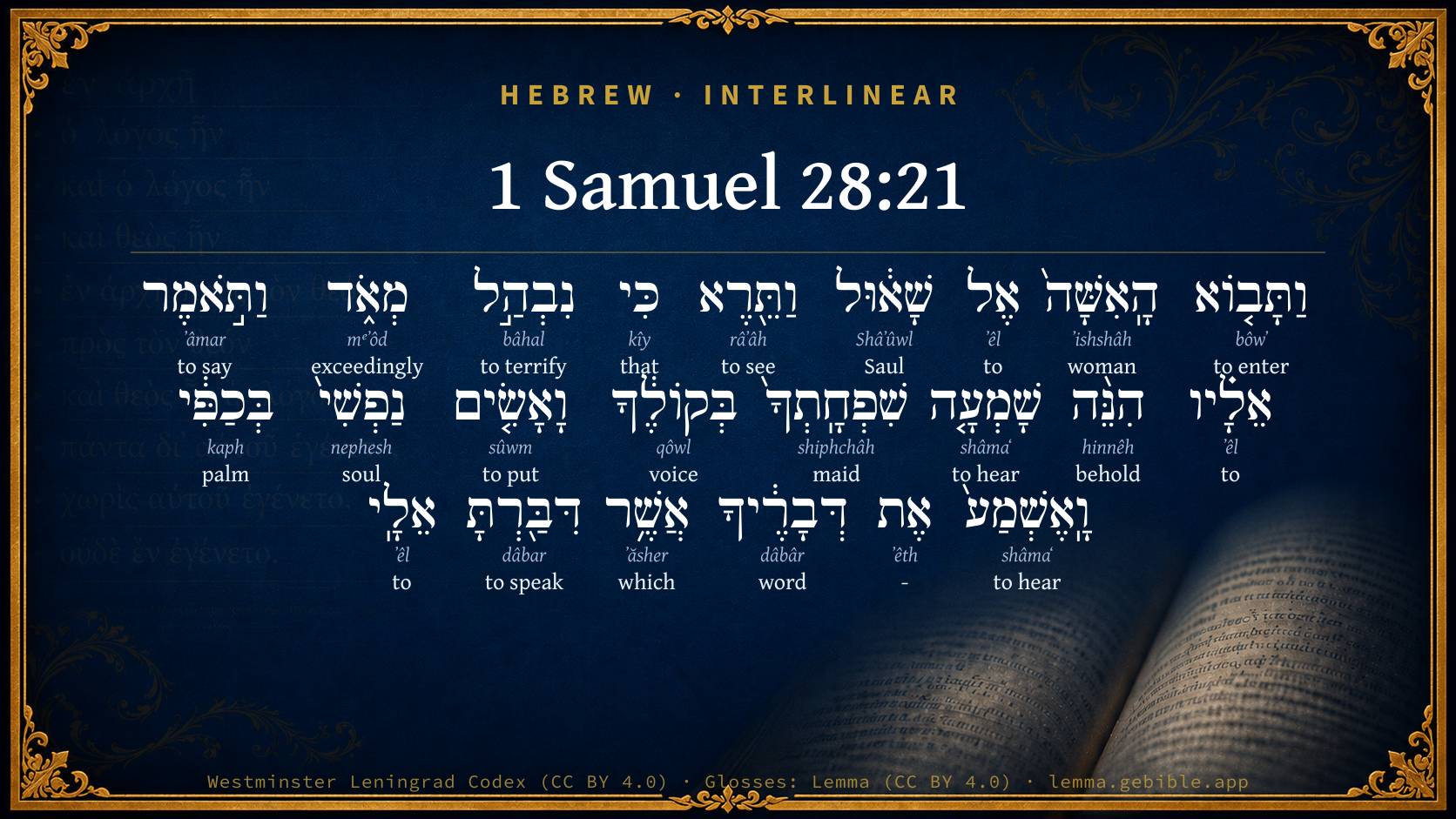
1 Samuel 28:21

Hebrew (Westminster Leningrad Codex) 1 Samuel 28:21 appears in the Hebrew Old Testament. The text above is from the Westminster Leningrad Codex. Each word links to its Strong’s number, a concise gloss, and parsing drawn from the Open Scriptures Hebrew Bible morphology. Click any word for its full Brown-Driver-Briggs (BDB) entry.
Download image
Cite this verse

1 Samuel 28:21 (World English Bible). Public Domain. Lemma interlinear Bible study tool, https://lemma.gebible.app/v/1-samuel/28/21.

Show BibTeX & RIS
BibTeX
RIS
English Translation
The woman came to Saul, and saw that he was sore troubled, and said to him, Behold, your handmaid has listened to your voice, and I have put my life in my hand, and have listened to your words which you spoke to me.
World English Bible · Public Domain
Download a study sheet

One document with this verse’s original text, its word-by-word gloss line, the meaning frame, cross-references with their text, attributed commentary, and full source and license credits — printable, and it pastes into notes with its structure intact.

This verse Autodidact and up

Study sheet (.html) Plain text (.txt)

A passage Seminary Student

Up to 50 verses in one chapter. A passage sheet keeps up to 6 commentary sources and 12 cross-references per verse, in the order this page ranks them, and says so on the sheet whenever that leaves anything out. Ask for a single verse and you get the Autodidact verse sheet above.

Everything on this page stays free to read, with no account — the sheet is a download of what is already on screen, not access to it.

Want to remove ads? Support Godless Engineer
Compare translations 3

The same verse in 3 English versions, stacked beneath the original-language interlinear above. Click any original word for its lexicon entry.

Each is an independent rendering of the whole verse — the interlinear is not word-aligned to these translations.

Highlighted words mark where these versions differ — a whole-verse word diff, not a word-by-word alignment.

  • World English Bible Public Domain
    The woman came to Saul, and saw that he was sore troubled, and said to him, Behold, your handmaid has listened to your voice, and I have put my life in my hand, and have listened to your words which you spoke to me.
  • King James Version Public Domain
    And the woman came unto Saul, and saw that he was sore troubled, and said unto him, Behold, thine handmaid hath obeyed thy voice, and I have put my life in my hand, and have hearkened unto thy words which thou spakest unto me.
  • unfoldingWord Literal Text CC BY-SA 4.0
    And the woman came to Saul, and she saw that he was very frightened, And she said to him, “Behold, your maidservant has listened to your voice, and I have put my life in my palm, for I heard the words that you spoke to me.

unfoldingWord Literal Text — © unfoldingWord, licensed CC BY-SA 4.0. Word-aligned USFM3 via Door43 (git.door43.org/unfoldingWord/en_ult).

Versions to compare (up to 4)

3 of 4 selected

Show all 18 translations

Every available English version of this verse, each an independent rendering of the whole verse.

  • World English Bible Public Domain
    The woman came to Saul, and saw that he was sore troubled, and said to him, Behold, your handmaid has listened to your voice, and I have put my life in my hand, and have listened to your words which you spoke to me.
  • Berean Standard Bible Public Domain
    When the woman came to Saul and saw how distraught he was, she said to him, “Look, your maidservant has obeyed your voice. I took my life in my hands and did as you told me.
  • Majority Standard Bible Public Domain
    When the woman came to Saul and saw how distraught he was, she said to him, “Look, your maidservant has obeyed your voice. I took my life in my hands and did as you told me.
  • King James Version Public Domain
    And the woman came unto Saul, and saw that he was sore troubled, and said unto him, Behold, thine handmaid hath obeyed thy voice, and I have put my life in my hand, and have hearkened unto thy words which thou spakest unto me.
  • American Standard Version (1901) Public Domain
    And the woman came unto Saul, and saw that he was sore troubled, and said unto him, Behold, thy handmaid hath hearkened unto thy voice, and I have put my life in my hand, and have hearkened unto thy words which thou spakest unto me.
  • Revised Version (1885) Public Domain
    And the woman came unto Saul, and saw that he was sore troubled, and said unto him, Behold, thine handmaid hath hearkened unto thy voice, and I have put my life in my hand, and have hearkened unto thy words which thou spakest unto me.
  • Geneva Bible (1599) Public Domain
    Then the woman came vnto Saul, and sawe that he was sore troubled, and said vnto him, See, thine handmaide hath obeyed thy voyce, and I haue put my soule in mine hande, and haue obeyed thy wordes which thou saydest vnto me.
  • Douay-Rheims (1899) Public Domain
    And the woman came to Saul (for he was very much troubled) and said to him: Behold thy handmaid hath obeyed thy voice, and I have put my life in my hand: and I hearkened unto the words which thou spokest to me.
  • Young's Literal Translation Public Domain
    And the woman cometh in unto Saul, and seeth that he hath been greatly troubled, and saith unto him, `Lo, thy maid-servant hath hearkened to thy voice, and I put my soul in my hand, and I obey thy words which thou hast spoken unto me;
  • Literal Standard Version CC BY-SA 4.0
    And the woman comes to Saul, and sees that he has been greatly troubled, and says to him, “Behold, your maidservant has listened to your voice, and I put my soul in my hand, and I obey your words which you have spoken to me;
  • Unlocked Literal Bible CC BY-SA 4.0
    The woman came to Saul and saw that he was very troubled, She said to him, “See, your woman servant has listened to your voice; I have put my life in my hand and have listened to the words that you said to me.
  • unfoldingWord Literal Text CC BY-SA 4.0
    And the woman came to Saul, and she saw that he was very frightened, And she said to him, “Behold, your maidservant has listened to your voice, and I have put my life in my palm, for I heard the words that you spoke to me.
  • Darby Bible Public Domain
    And the woman came to Saul, and saw that he was sore troubled, and said to him, Behold, thy bondmaid has hearkened to thy voice, and I have put my life in my hand, and have hearkened to thy words which thou spokest to me.
  • World Messianic Bible Public Domain
    The woman came to Saul and saw that he was very troubled, and said to him, “Behold, your servant has listened to your voice, and I have put my life in my hand, and have listened to your words which you spoke to me.
  • Webster's Bible Public Domain
    And the woman came to Saul, and saw that he was greatly troubled, and said to him, Behold, thy handmaid hath obeyed thy voice, and I have put my life in my hand, and have hearkened to thy words, which thou didst speak
  • Free Bible Version CC BY-SA 4.0
    The woman came over to Saul and saw that he was absolutely terrified. She told him, “Look, sir, I did what you asked. I risked my life and did what you told me.
  • Bible in Basic English Public Domain
    And the woman came to Saul and saw that he was in great trouble, and said to him, See now, your servant has given ear to your words, and I have put my life in danger by doing what you said.
  • JPS Tanakh (1917) Public Domain
    And the woman came unto Saul, and saw that he was sore affrighted, and said unto him: 'Behold, thy handmaid hath hearkened unto thy voice, and I have put my life in my hand, and have hearkened unto thy words which thou spokest unto me.

Literal Standard Version (2020), Covenant Press — licensed CC BY-SA 4.0. Text via the HelloAO Bible API (eBible.org). Unlocked Literal Bible (unfoldingWord) — licensed CC BY-SA 4.0. Text via the HelloAO Bible API (eBible.org). unfoldingWord Literal Text — © unfoldingWord, licensed CC BY-SA 4.0. Word-aligned USFM3 via Door43 (git.door43.org/unfoldingWord/en_ult). Free Bible Version, Dr. Jonathan Gallagher — licensed CC BY-SA 4.0. Text via the HelloAO Bible API (eBible.org).

Word by word

More ways to search: Search by grammar → Find every occurrence → Compare this word →

Practice this passage: Drill this verse → Learn its vocabulary →

נִבְהַ֣ל
bâhal
H926
“to terrify”
Verb, Niphal, Perfect, 3rd Person, Masculine, Singular
Part of Speech
Verb
Stem
Niphal
Form
Perfect
Person
3rd Person
Gender
Masculine
Number
Singular
Full BDB Definition

Origin: a primitive root

TWOT: 207

to disturb, alarm, terrify, hurry, be disturbed, be anxious, be afraid, be hurried, be nervous - (Niphal) - to be disturbed, dismayed, terrified, anxious - to be in haste, be hasty - (Piel) - to make haste, act hastily, be hurried, be hastened - to dismay, terrify - (Pual) - to hasten - hastened, hastily gained (participle) - (Hiphil) - to hasten, hurry, make haste - to dismay, terrify
  1. וַתָּב֤וֹא bôwʼ H935 “and · to enter” Conjunction + Verb, Qal, Sequential Imperfect, 3rd Person, Feminine, Singular
  2. הָֽאִשָּׁה֙ ʼishshâh H802 “the · woman” Particle, Definite Article + Noun, Common, Feminine, Singular, Absolute
  3. אֶל ʼêl H413 “to” Preposition
  4. שָׁא֔וּל Shâʼûwl H7586 “Saul” Noun, Proper
  5. וַתֵּ֖רֶא râʼâh H7200 “and · to see” Conjunction + Verb, Qal, Sequential Imperfect, 3rd Person, Feminine, Singular
  6. כִּי kîy H3588 “that” Conjunction
  7. מְאֹ֑ד mᵉʼôd H3966 “exceedingly” Adverb
  8. וַתֹּ֣אמֶר ʼâmar H559 “and · to say” Conjunction + Verb, Qal, Sequential Imperfect, 3rd Person, Feminine, Singular
  9. אֵלָ֗יו ʼêl H413 “to · him” Preposition + Suffix, Personal, 3rd Person, Masculine, Singular
  10. הִנֵּ֨ה hinnêh H2009 “behold” Particle, Demonstrative
  11. שָׁמְעָ֤ה shâmaʻ H8085 “to hear” Verb, Qal, Perfect, 3rd Person, Feminine, Singular
  12. שִׁפְחָֽתְךָ֙ shiphchâh H8198 “maid · your” Noun, Common, Feminine, Singular, Construct + Suffix, Personal, 2nd Person, Masculine, Singular
  13. בְּקוֹלֶ֔ךָ qôwl H6963 “in/at · voice · your” Preposition + Noun, Common, Masculine, Singular, Construct + Suffix, Personal, 2nd Person, Masculine, Singular
  14. וָאָשִׂ֤ים sûwm H7760 “and · to put” Conjunction + Verb, Qal, Sequential Imperfect, 1st Person, Common, Singular
  15. נַפְשִׁי֙ nephesh H5315 “soul · my” Noun, Common, Both, Singular, Construct + Suffix, Personal, 1st Person, Common, Singular
  16. בְּכַפִּ֔י kaph H3709 “in/at · palm · my” Preposition + Noun, Common, Feminine, Singular, Construct + Suffix, Personal, 1st Person, Common, Singular
  17. וָֽאֶשְׁמַע֙ shâmaʻ H8085 “and · to hear” Conjunction + Verb, Qal, Sequential Imperfect, 1st Person, Common, Singular
  18. אֶת ʼêth H853 “-” Particle, Direct Object
  19. דְּבָרֶ֔יךָ dâbâr H1697 “words · your” Noun, Common, Masculine, Plural, Construct + Suffix, Personal, 2nd Person, Masculine, Singular
  20. אֲשֶׁ֥ר ʼăsher H834 “which” Particle, Relative
  21. דִּבַּ֖רְתָּ dâbar H1696 “to speak” Verb, Piel, Perfect, 2nd Person, Masculine, Singular
  22. אֵלָֽי ʼêl H413 “to · me” Preposition + Suffix, Personal, 1st Person, Common, Singular

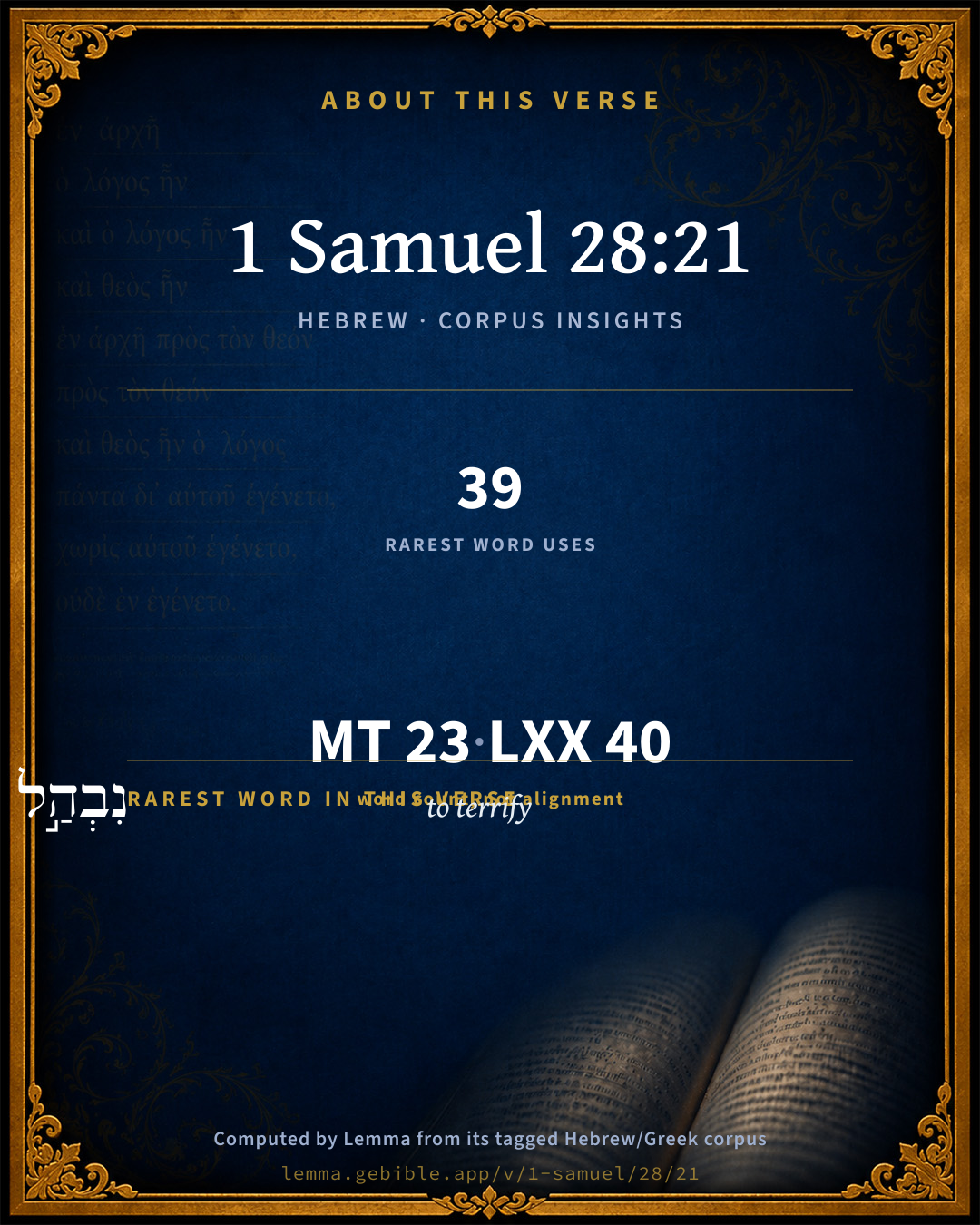
About this verse

These counts appear in no published source. They are computed here, from the morphology-tagged text and Lemma’s own curated glosses. What Lemma adds →

23
words
20
distinct lemmas
Historical
section

Shared distinctive vocabulary

נִבְהַ֣ל to terrify H926 occurs in 39 verses of the Hebrew Bible. Also found in:

Grammatical profile

  • 8 verbs
  • 7 nouns
  • 3 prepositions
  • 1 conjunction
  • 1 adverb
  • 3 particles

Verb forms

  • וַתָּב֤וֹא Qal · Sequential Imperfect
  • וַתֵּ֖רֶא Qal · Sequential Imperfect
  • נִבְהַ֣ל Niphal · Perfect
  • וַתֹּ֣אמֶר Qal · Sequential Imperfect
  • שָׁמְעָ֤ה Qal · Perfect
  • וָאָשִׂ֤ים Qal · Sequential Imperfect
  • וָֽאֶשְׁמַע֙ Qal · Sequential Imperfect
  • דִּבַּ֖רְתָּ Piel · Perfect

Repetition

Words recur within this verse — often emphatic in Hebrew:

  • שָׁמְעָ֤ה to hear H8085 ×2
  • אֶל to H413 ×3

Hebrew & Septuagint length

In English translation the verse runs 44 words from the Hebrew and 47 from the Septuagint (LXX English) — closely comparable.

A rough comparison of the two English renderings, which tokenize alike — not a word-level alignment.

Word counts can differ between the Hebrew and the Greek without any difference in meaning — e.g. the Hebrew direct-object marker אֵת has no separate Greek word, and Greek often adds the article ὁ.

In the original languages it is 23 Hebrew tokens and 40 Greek tokens — but the two are counted differently (Hebrew bundles its prefixes and suffixes into one token; the Greek is in lemma form), so that isn’t a like-for-like length.

Cross-references

3

Topical passages linked to 1 Samuel 28:21 in the Treasury of Scripture Knowledge — connected by theme and wording, ordered by reader-vote popularity; previews shown in the World English Bible.

  • Judges 12:3 When I saw that you didn't save me, I put my life in my hand, and passed over against the children of Ammon, and Yahweh delivered them into my hand: why then are you come up to me this day, to fight against me?
  • 1 Samuel 19:5 for he put his life in his hand, and struck the Philistine, and Yahweh worked a great victory for all Israel: you saw it, and did rejoice; why then will you sin against innocent blood, to kill David without a cause?
  • Job 13:14 Why should I take my flesh in my teeth, And put my life in my hand?

Cross-references courtesy of OpenBible.info (CC BY 4.0).

Hebrew and Greek witnesses Masoretic Hebrew ↔ Greek Septuagint

The same verse in the two great witnesses to the Old Testament, shown verse-for-verse.

These are two independent witnesses, not word-aligned to each other, and the Septuagint is shown in lemma (dictionary) form.

Hebrew 1 Samuel 28:21 Masoretic · Westminster Leningrad Codex

וַתָּב֤וֹא הָֽאִשָּׁה֙ אֶל שָׁא֔וּל וַתֵּ֖רֶא כִּי נִבְהַ֣ל מְאֹ֑ד וַתֹּ֣אמֶר אֵלָ֗יו הִנֵּ֨ה שָׁמְעָ֤ה שִׁפְחָֽתְךָ֙ בְּקוֹלֶ֔ךָ וָאָשִׂ֤ים נַפְשִׁי֙ בְּכַפִּ֔י וָֽאֶשְׁמַע֙ אֶת דְּבָרֶ֔יךָ אֲשֶׁ֥ר דִּבַּ֖רְתָּ אֵלָֽי

The woman came to Saul, and saw that he was sore troubled, and said to him, Behold, your handmaid has listened to your voice, and I have put my life in my hand, and have listened to your words which you spoke to me.

World English Bible · Public Domain

Greek LXX 1 Samuel 28:21 Septuagint · lemma form

καί εἰςἔρχομαι ὁ γυνή πρός σαούλ καί ὁράω ὅτι σπεύδω σφόδρα καί εἶπον πρός αὐτός ἰδού δή ἀκούω ὁ δούλη σύ ὁ φωνή σύ καί τίθημι ὁ ψυχή ἐγώ ἐν ὁ χείρ ἐγώ καί ἀκούω ὁ λόγος ὅς λαλέω ἐγώ

And the woman went in to Saul, and saw that he was greatly disquieted, and said to him, Behold now, your handmaid has listened to your voice, and I have put my life in my hand, and have heard the words which you have spoken to me.

LXX2012 (modern English Septuagint) · Public Domain

Hebrew: Westminster Leningrad Codex (CC BY 4.0). Greek: Septuagint (public domain); English from LXX2012 (modern English Septuagint) (Public Domain). How the Septuagint differs from the Hebrew →

Targum (Aramaic paraphrase)

1

The Targum is the ancient Jewish Aramaic paraphrase of the Hebrew Scriptures — an interpretive translation, not the Hebrew text itself. Onkelos (literal) and Pseudo-Jonathan (expansive) render the Torah, and Jonathan the Prophets. Coverage is partial: where no permissively-licensed English translation exists for a verse, only the Aramaic is shown. This is verse-level text, not a word-by-word alignment to the Hebrew.

  1. Targum Jonathan Prophets (Joshua–Malachi)
    וְאָתַת אִתְּתָא לְוַת שָׁאוּל וַחֲזַת אֲרֵי אִתְבָהֵיל לַחֲדָא וַאֲמַרַת לֵיהּ הָא קַבִּילַת אַמְתָךְ מִנָךְ וּמְסָרִית נַפְשִׁי כְּעַל גַב לְאִתְקְטָלָא וּשְׁמָעִית יַת פִּתְגָמָךְ דְמַלֵילְתָּא עִמִי:

    (no public-domain English translation for this verse)

    Targum Jonathan — Aramaic: “Mikraot Gedolot” (public domain). English: “Sefaria Community Translation” (CC0 1.0 (public-domain dedication)); “London "Chaldee Paraphrase," 1871” (public domain). Text via Sefaria.

Commentary

Notes on 1 Samuel 28:21 from classic Christian and Jewish commentators (each source and its license shown beneath its notes). The classic Christian expositions comment on the surrounding passage and are grouped to its opening verse, so a note may address several verses; the Jewish commentaries on the Tanakh (Rashi and others) are per-verse, so they appear only where the commentator wrote on this verse.

Lemma curates 59 commentaries, every one of them public domain or Creative Commons licensed, each selected and text-cleaned for this edition rather than reprinted as found. About our sources →

Ellicott's Commentary for English Readers

(21) And the woman.—The story is completed in these few concluding verses (1Sa_28:21-25) in a most natural and unaffected style. The witch, though a grievous sinner, is struck with a woman’s pity for the stricken king, and with kind words and still kinder acts does her best to recover him from the death-like swoon into which the hapless Saul had fallen. Her whole behaviour contradicts the supposition that she was moved by a bitter hatred against Saul (see Excursus L at end of this Book) to desire the appearance of Samuel, and to imitate his voice by means of ventriloquism. Firstly, she was herself terrified at the apparition; and secondly, she was saddened by the effect of the dead seer’s words on the king, and did her poor best to restore him to composure and strength again. We read in the next verse how the woman, with Saul’s servants, used even a gentle compulsion to induce the king to take the nourishment he was so sorely in need of.

A Bible Commentary for English Readers, edited by Charles John Ellicott (1878–1897) — public domain. Text from a community e-Sword module.

Trapp's Complete Commentary

John Trapp

1Sa 28:21 And the woman came unto Saul, and saw that he was sore troubled, and said unto him, Behold, thine handmaid hath obeyed thy voice, and I have put my life in my hand, and have hearkened unto thy words which thou spakest unto me.

Ver. 21. And the woman came unto Saul.] Though she were a wicked woman, yet she was not without pity and humanity, as some savages are.

John Trapp, A Commentary or Exposition upon All the Books of the Old and New Testament (1647–1656) — public domain. Text from a community e-Sword module.

Geneva Bible (1599)

Geneva Bible translators

I have ventured my life.

Geneva Bible (1599) marginal notes — public domain. Text via Bolls.life.

The Cambridge Bible for Schools and Colleges

gen. ed. J. J. S. Perowne

21. I have put my life in my hand] By doing that which rendered her liable to the punishment of death. Cp. 1Sa_19:5.

The Cambridge Bible for Schools and Colleges (gen. ed. J. J. S. Perowne; Cambridge University Press, 1878–1918) — public domain. Text from a community e-Sword module.

John Gill's Exposition

And the woman came unto Saul,.... Having left him and the apparition in a room by themselves to converse together, and perhaps on hearing him fall to the ground came in:

and saw that he was sore troubled: by his lying on the ground, and the agonies he seemed to be in, and the uneasiness that sat upon his countenance:

and said unto him, behold, thine handmaid hath obeyed thy voice; in divining by her familiar spirit for him, and in bringing up Samuel to him, as he desired:

and I have put my life in my hand; exposed it to the utmost danger, since a person of her profession, and token in the exercise of it, was punishable with death; and especially she was in the greater danger, as it was Saul himself, who had by an edict expelled all such persons from his dominions, who now employed her, as she perceived:

and have hearkened unto thy words which thou spakest unto me: to the oath he had taken, that no hurt should come to her, which she confided in, and relied upon, and to what he bid her do, according to her art of divination.

John Gill's Exposition of the Whole Bible (1746–1763) — public domain (CC PDM 1.0). Text via the HelloAO Bible API.

Haydock's Catholic Bible Commentary

Hand, in the most imminent danger. See Judges xii. 3.

George Leo Haydock (1774–1849), Haydock's Catholic Family Bible and Commentary, 1859 edition — public domain. Excludes Psalms (Douay-Rheims chapter numbering differs from Protestant) and Deuterocanonical books (Catholic canon only).

Matthew Poole's English Annotations

The woman came unto Saul; from whom she departed, when she had brought him and Samuel together, that they might more freely converse together, as being alone.

Matthew Poole's English Annotations on the Holy Bible (1683–1685) — public domain. Text from a community e-Sword/MySword module.

Whedon's Commentary on the Bible

Daniel D. Whedon

21. The woman came unto Saul — During the interview she had been standing at a distance from him, not out of sight, or in an adjoining room, as some have supposed, but a little removed from the king’s presence, so as to be less liable to detection in her arts.

Saw that he was sore troubled — Saw how completely her oracles had overwhelmed him with terror and excitement.

Daniel D. Whedon (gen. ed.), Commentary on the Old and New Testaments (1874–1909) — public domain. Text from a community e-Sword module.

John Wesley's Explanatory Notes

Came to Saul - From whom she departed, when she had brought him and Samuel together, that they might more freely converse together.

John Wesley, Explanatory Notes Upon the Whole Bible (1754–1765) — public domain. Text via the GEBible commentary corpus.

Lesson kit

Teaching starters — assembled from the data on this page, not authored interpretation. Every prompt links to the verse data it draws on. Edit before teaching.

1 Samuel, in the Historical, opens this verse with 23 words (20 distinct Hebrew lemmas). Its most distinctive word is bâhal (“to terrify”). A historical commentator’s framing appears above. Read the whole chapter for the surrounding context.

Discussion questions

  1. The word bâhal carries the sense “to terrify.” How does it shape the verse?
  2. How does Genesis 45:3, which shares the word «to terrify», read alongside this verse?
  3. What does the repetition of “to hear” (2× in this one verse) do in this verse?
  4. These translations render this verse differently; the difference is in the English rendering, not the original. What questions does that raise?
  5. «וַתָּב֤וֹא» is a Qal Sequential Imperfect verb. How does that grammatical form shape the action described?
  6. Compare how Ellicott's Commentary for English Readers and Trapp's Complete Commentary read this verse. Where do they agree or differ?

Things to notice

Reading settings

Reading text

Shown beneath each verse's original-language words.

Old Testament
Old Testament edition

Read the OT as the Masoretic Hebrew (MT) or the Greek Septuagint (LXX).

English shown for the Greek Septuagint (in the Hebrew ↔ Greek comparison).

Comparing translations? Open the Compare panel on any verse page to stack up to four side by side.