
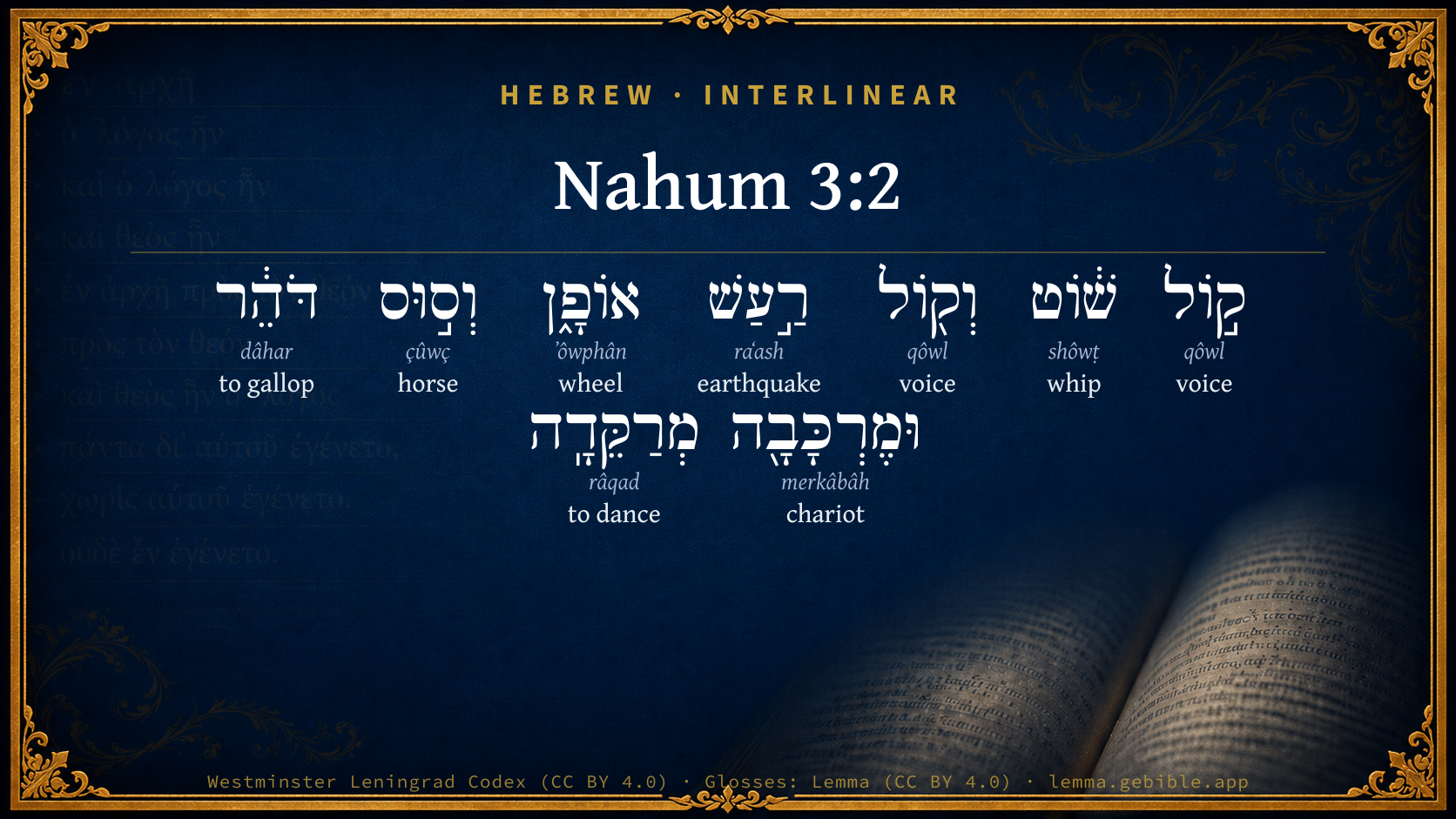
Nahum 3:2

Hebrew (Westminster Leningrad Codex) Nahum 3:2 appears in the Hebrew Old Testament. The text above is from the Westminster Leningrad Codex. Each word links to its Strong’s number, a concise gloss, and parsing drawn from the Open Scriptures Hebrew Bible morphology. Click any word for its full Brown-Driver-Briggs (BDB) entry.
Download image
Cite this verse

Nahum 3:2 (World English Bible). Public Domain. Lemma interlinear Bible study tool, https://lemma.gebible.app/v/nahum/3/2.

Show BibTeX & RIS
BibTeX
RIS
English Translation
The noise of the whip, the noise of the rattling of wheels, prancing horses, and bounding chariots,
World English Bible · Public Domain
Highlights
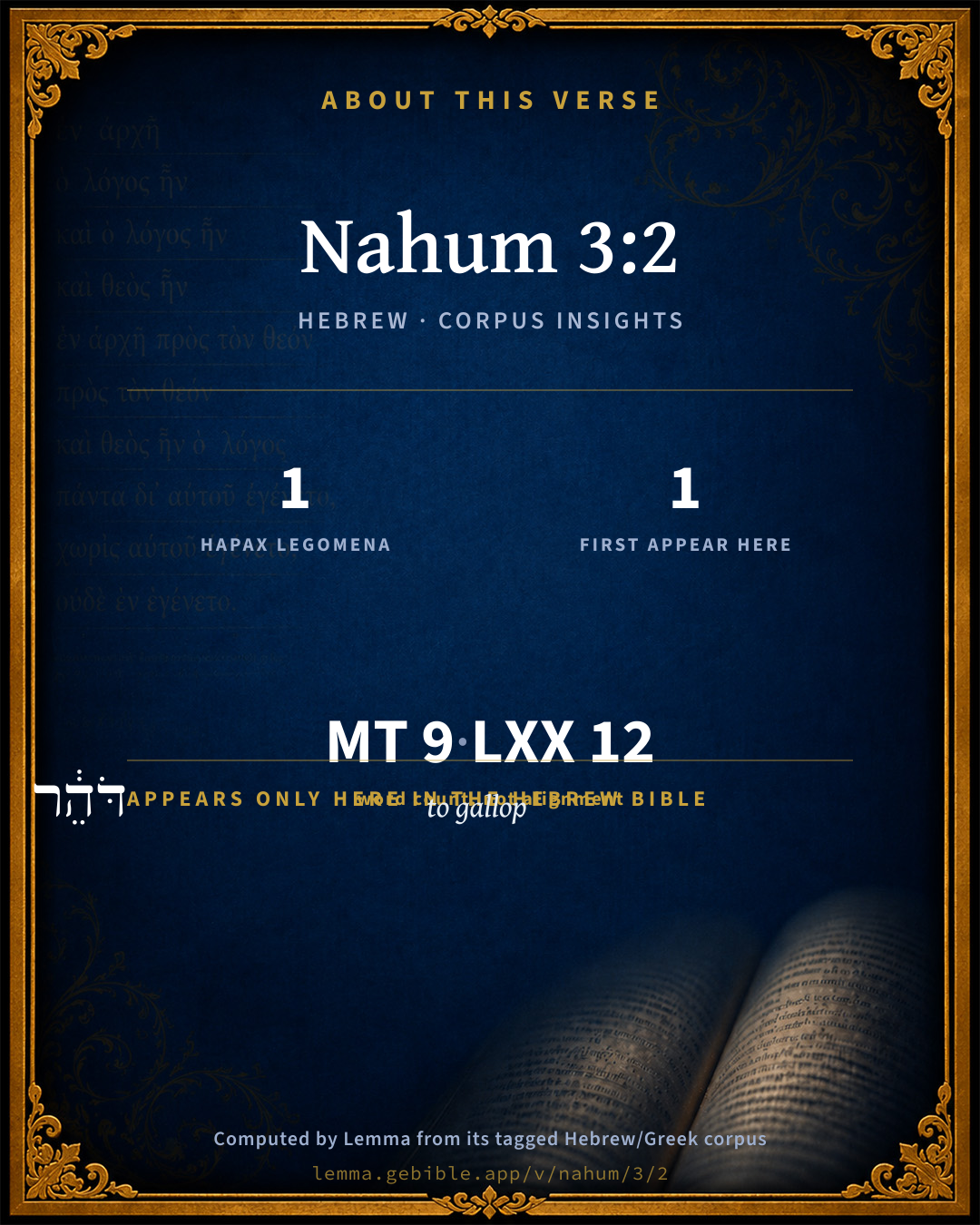
  • 1 hapax legomenon — only here in the Hebrew Bible
  • 1 first appearance in the Hebrew Bible
Full analysis ↓
Download a study sheet

One document with this verse’s original text, its word-by-word gloss line, the meaning frame, cross-references with their text, attributed commentary, and full source and license credits — printable, and it pastes into notes with its structure intact.

This verse Autodidact and up

Study sheet (.html) Plain text (.txt)

A passage Seminary Student

Up to 50 verses in one chapter. A passage sheet keeps up to 6 commentary sources and 12 cross-references per verse, in the order this page ranks them, and says so on the sheet whenever that leaves anything out. Ask for a single verse and you get the Autodidact verse sheet above.

Everything on this page stays free to read, with no account — the sheet is a download of what is already on screen, not access to it.

Want to remove ads? Support Godless Engineer
Compare translations 3

The same verse in 3 English versions, stacked beneath the original-language interlinear above. Click any original word for its lexicon entry.

Each is an independent rendering of the whole verse — the interlinear is not word-aligned to these translations.

Highlighted words mark where these versions differ — a whole-verse word diff, not a word-by-word alignment.

  • World English Bible Public Domain
    The noise of the whip, the noise of the rattling of wheels, prancing horses, and bounding chariots,
  • King James Version Public Domain
    The noise of a whip, and the noise of the rattling of the wheels, and of the pransing horses, and of the jumping chariots.
  • unfoldingWord Literal Text CC BY-SA 4.0
    The sound of a whip and the sound of a rattling wheel and a galloping horse and a bounding chariot!

unfoldingWord Literal Text — © unfoldingWord, licensed CC BY-SA 4.0. Word-aligned USFM3 via Door43 (git.door43.org/unfoldingWord/en_ult).

Versions to compare (up to 4)

3 of 4 selected

Show all 18 translations

Every available English version of this verse, each an independent rendering of the whole verse.

  • World English Bible Public Domain
    The noise of the whip, the noise of the rattling of wheels, prancing horses, and bounding chariots,
  • Berean Standard Bible Public Domain
    The crack of the whip, the rumble of the wheel, galloping horse and bounding chariot!
  • Majority Standard Bible Public Domain
    The crack of the whip, the rumble of the wheel, galloping horse and bounding chariot!
  • King James Version Public Domain
    The noise of a whip, and the noise of the rattling of the wheels, and of the pransing horses, and of the jumping chariots.
  • American Standard Version (1901) Public Domain
    The noise of the whip, and the noise of the rattling of wheels, and prancing horses, and bounding chariots,
  • Revised Version (1885) Public Domain
    The noise of the whip, and the noise of the rattling of wheels; and pransing horses, and jumping chariots;
  • Geneva Bible (1599) Public Domain
    The noyse of a whippe, and the noyse of the mouing of the wheeles, and the beating of the horses, and the leaping of the charets.
  • Douay-Rheims (1899) Public Domain
    The noise of the whip, and the noise of the rattling of the wheels, and of the neighing horse, and of the running chariot, and of the horsemen coming up,
  • Young's Literal Translation Public Domain
    The sound of a whip, And the sound of the rattling of a wheel, And of a prancing horse, and of a bounding chariot, Of a horseman mounting.
  • Literal Standard Version CC BY-SA 4.0
    The sound of a whip, || And the sound of the rattling of a wheel, || And of a prancing horse, and of a bounding chariot, || Of a horseman mounting.
  • Unlocked Literal Bible CC BY-SA 4.0
    But now there is the noise of whips and the sound of rattling wheels, prancing horses, and bounding chariots.
  • unfoldingWord Literal Text CC BY-SA 4.0
    The sound of a whip and the sound of a rattling wheel and a galloping horse and a bounding chariot!
  • Darby Bible Public Domain
    The crack of the whip, and the noise of the rattling of the wheels, and of the prancing horses, and of the bounding chariots!
  • World Messianic Bible Public Domain
    The noise of the whip, the noise of the rattling of wheels, prancing horses, and bounding chariots,
  • Webster's Bible Public Domain
    The noise of a whip, and the noise of the rattling of the wheels, and of the prancing horses, and of the bounding chariots.
  • Free Bible Version CC BY-SA 4.0
    Listen to the noise: whips crack, wheels clatter, horses gallop, chariots rattle!
  • Bible in Basic English Public Domain
    The noise of the whip, and the noise of thundering wheels; horses rushing and war-carriages jumping,
  • JPS Tanakh (1917) Public Domain
    Hark! the whip, and hark! the rattling of the wheels; and prancing horses, and bounding chariots;

Literal Standard Version (2020), Covenant Press — licensed CC BY-SA 4.0. Text via the HelloAO Bible API (eBible.org). Unlocked Literal Bible (unfoldingWord) — licensed CC BY-SA 4.0. Text via the HelloAO Bible API (eBible.org). unfoldingWord Literal Text — © unfoldingWord, licensed CC BY-SA 4.0. Word-aligned USFM3 via Door43 (git.door43.org/unfoldingWord/en_ult). Free Bible Version, Dr. Jonathan Gallagher — licensed CC BY-SA 4.0. Text via the HelloAO Bible API (eBible.org).

Word by word

More ways to search: Search by grammar → Find every occurrence → Compare this word →

Practice this passage: Drill this verse → Learn its vocabulary →

About this verse

These counts appear in no published source. They are computed here, from the morphology-tagged text and Lemma’s own curated glosses. What Lemma adds →

9
words
8
distinct lemmas
Prophets
section

Notable vocabulary

1 hapax legomenon — a word that appears only here in the entire Hebrew Bible:

  • דֹּהֵ֔ר to gallop H1725

First appearance in Scripture

This word makes its first canonical appearance in the Hebrew Bible here:

  • דֹּהֵ֔ר to gallop H1725

Shared distinctive vocabulary

מְרַקֵּדָֽה to dance H7540 occurs in 9 verses of the Hebrew Bible. Also found in:

Grammatical profile

  • 2 verbs
  • 7 nouns

Verb forms

  • דֹּהֵ֔ר Qal · Participle Active
  • מְרַקֵּדָֽה Piel · Participle Active

Repetition

A word recurs within this verse — often emphatic in Hebrew:

  • ק֣וֹל voice H6963 ×2

Hebrew & Septuagint length

In English translation the verse runs 17 words from the Hebrew and 22 from the Septuagint (LXX English) — closely comparable.

A rough comparison of the two English renderings, which tokenize alike — not a word-level alignment.

Word counts can differ between the Hebrew and the Greek without any difference in meaning — e.g. the Hebrew direct-object marker אֵת has no separate Greek word, and Greek often adds the article ὁ.

In the original languages it is 9 Hebrew tokens and 12 Greek tokens — but the two are counted differently (Hebrew bundles its prefixes and suffixes into one token; the Greek is in lemma form), so that isn’t a like-for-like length.

Cross-references

5

Topical passages linked to Nahum 3:2 in the Treasury of Scripture Knowledge — connected by theme and wording, ordered by reader-vote popularity; previews shown in the World English Bible.

  • Jeremiah 47:3 At the noise of the stamping of the hoofs of his strong ones, at the rushing of his chariots, at the rumbling of his wheels, the fathers don't look back to their children for feebleness of hands;
  • Nahum 2:3–4 The shield of his mighty men is made red. The valiant men are in scarlet. The chariots flash with steel in the day of his preparation, and the pine spears are brandished.
  • Judges 5:22 Then did the horse hoofs stamp By reason of the prancings, the prancings of their strong ones.
  • Job 39:22–25 He mocks at fear, and is not dismayed; Neither does he turn back from the sword.
  • Isaiah 9:5 For all the armor of the armed man in the tumult, and the garments rolled in blood, shall be for burning, for fuel of fire.

Cross-references courtesy of OpenBible.info (CC BY 4.0).

Hebrew and Greek witnesses Masoretic Hebrew ↔ Greek Septuagint

The same verse in the two great witnesses to the Old Testament, shown verse-for-verse.

These are two independent witnesses, not word-aligned to each other, and the Septuagint is shown in lemma (dictionary) form.

Hebrew Nahum 3:2 Masoretic · Westminster Leningrad Codex

ק֣וֹל שׁ֔וֹט וְק֖וֹל רַ֣עַשׁ אוֹפָ֑ן וְס֣וּס דֹּהֵ֔ר וּמֶרְכָּבָ֖ה מְרַקֵּדָֽה

The noise of the whip, the noise of the rattling of wheels, prancing horses, and bounding chariots,

World English Bible · Public Domain

Greek LXX Nahum 3:2 Septuagint · lemma form

φωνή μάστιξ καί φωνή σεισμός τροχός καί ἵππος διώκω καί ἅρμα ἀναβράσσω

The noise of whips, and the noise of the rumbling of wheels, and of the pursuing horse, and of the bounding chariot,

LXX2012 (modern English Septuagint) · Public Domain

Hebrew: Westminster Leningrad Codex (CC BY 4.0). Greek: Septuagint (public domain); English from LXX2012 (modern English Septuagint) (Public Domain). How the Septuagint differs from the Hebrew →

Targum (Aramaic paraphrase)

1

The Targum is the ancient Jewish Aramaic paraphrase of the Hebrew Scriptures — an interpretive translation, not the Hebrew text itself. Onkelos (literal) and Pseudo-Jonathan (expansive) render the Torah, and Jonathan the Prophets. Coverage is partial: where no permissively-licensed English translation exists for a verse, only the Aramaic is shown. This is verse-level text, not a word-by-word alignment to the Hebrew.

  1. Targum Jonathan Prophets (Joshua–Malachi)
    קַל נִקוּשׁ מְחָא וְקַל זִיוּעַ גַלְגְלִין וְסוּסְוָן מְפַנְכִין וּרְתִיכִין מְקַפְּצָן:

    (no public-domain English translation for this verse)

    Targum Jonathan — Aramaic: “Mikraot Gedolot” (public domain). English: “Sefaria Community Translation” (CC0 1.0 (public-domain dedication)); “London "Chaldee Paraphrase," 1871” (public domain). Text via Sefaria.

Commentary

Notes on Nahum 3:2 from classic Christian and Jewish commentators (each source and its license shown beneath its notes). The classic Christian expositions comment on the surrounding passage and are grouped to its opening verse, so a note may address several verses; the Jewish commentaries on the Tanakh (Rashi and others) are per-verse, so they appear only where the commentator wrote on this verse.

Lemma curates 59 commentaries, every one of them public domain or Creative Commons licensed, each selected and text-cleaned for this edition rather than reprinted as found. About our sources →

The Cambridge Bible for Schools and Colleges

gen. ed. J. J. S. Perowne

2, 3. Graphic description of the attack on Nineveh. Nah_3:2 describes rather what is heard when the onset commences: cracking whips and prancing horsemen and rattling wheels; and Nah_3:3 what is seen: charging horsemen, and flashing swords and glittering spears. On the whip, Layard, II. 356.

jumping chariots] i.e. bounding either from their excessive speed, or from the obstacles which they meet in the uneven ground before the city.

The Cambridge Bible for Schools and Colleges (gen. ed. J. J. S. Perowne; Cambridge University Press, 1878–1918) — public domain. Text from a community e-Sword module.

Trapp's Complete Commentary

John Trapp

Nah 3:2 The noise of a whip, and the noise of the rattling of the wheels, and of the pransing horses, and of the jumping chariots.

Ver. 2. The noise of a whip, and the noise of the rattling of the wheels] A most elegant and lively hypotyposis, or description, of the Chaldeans coming to take Nineveh; Tam pulchra, saith Jerome, et picturae similis, ut omnis meus sermo sit vilior; So gallant and picture like a representation of an advancing army, that no words of mine can come near it. Virgil is commended for his excellent expressions suitable to the matter he treateth of; as when he sets forth the cutting down of trees, by - Sonat icta securibus ilex; the ferryman’s trade, by - fremit ictibus aerea puppis; the gliding of his boat, by - Labitur uncta vadis abies, &c. But all this is but dull stuff to the divine rhetoric here to be read. Let those that refuse to hear God’s sweet words fear lest they be forced to hear the noise of the whip, the rattling of the wheels, &c., Psa 7:12-13 Luk 19:42; Luk 19:44 Pro 1:24. The enemy is sent to revenge the quarrel of God’s covenant; the red horse is at the heels of the white, Rev 6:4.

John Trapp, A Commentary or Exposition upon All the Books of the Old and New Testament (1647–1656) — public domain. Text from a community e-Sword module.

Joseph Benson's Commentary

Nah 3:2-3. The noise of a whip, &c. — These verses are highly poetical; the prophet tells them, that he already hears the sound of the whips driving on the horses, and the rattling of the chariot wheels, &c., of their enemies coming against them. The horseman lifteth up both the bright sword, &c. — In the Hebrew it is, The horseman lifteth up the flame of the sword, and the lightning of the spear, which is more poetical than our rendering. The style of the whole passage is extremely fine; scarce any thing can be more picturesque, or strongly descriptive of a victorious army.

Joseph Benson's Commentary on the Old and New Testaments (1811–1818) — public domain. Text from a community e-Sword module.

Keil & Delitzsch

C. F. Keil & F. Delitzsch

This threat is explained in Nah 3:2., by a description of the manner in which a hostile army enters Nineveh and fills the city with corpses. Nah 3:2. "The cracking of whips, and noise of the rattling of wheels, and the horse in galloping, and chariots flying high. Nah 3:3. Riders dashing along, and flame of the sword, and flashing of the lance, and multitude of slain men and mass of dead men, and no end of corpses; they stumble over their corpses. Nah 3:4. For the multitude of the whoredoms of the harlot, the graceful one, the mistress of witchcrafts, who sells nations with her whoredoms, and families with her witchcrafts." Nahum sees in spirit the hostile army bursting upon Nineveh. He hears the noise, i.e., the cracking of the whips of the charioteers, and the rattling (ra‛ash) of the chariot-wheels, sees horses and chariots driving along (dâhar, to hunt, cf. Jdg 5:22; riqqēd, to jump, applied to the springing up of the chariots as they drive quickly along over a rugged road), dashing riders (ma‛ăleh, lit., to cause to ascend, sc. the horse, i.e., to make it prance, by driving the spur into its side to accelerate its speed), flaming swords, and flashing lances. As these words are well adapted to depict the attack, so are those which follow to describe the consequence or effect of the attack. Slain men, fallen men in abundance, and so many corpses, that one cannot help stumbling or falling over them. כּבד, the heavy multitude. The chethib יכשׁלו is to be read יכּשׁלוּ (niphal), in the sense of stumbling, as in Nah 2:6. The keri וכשׁלוּ is unsuitable, as the sentence does not express any progress, but simply exhibits the infinite number of the corpses (Hitzig). גויּתם, their (the slain men's) corpses. This happens to the city of sins because of the multitude of its whoredoms. Nineveh is called Zōnâh, and its conduct zenūnı̄m, not because it had fallen away from the living God and pursued idolatry, for there is nothing about idolatry either here or in what follows; nor because of its commercial intercourse, in which case the commerce of Nineveh would appear here under the perfectly new figure of love-making with other nations (Ewald), for commercial intercourse as such is not love-making; but the love-making, with its parallel "witchcrafts" (keshâphı̄m), denotes "the treacherous friendship and crafty politics with which the coquette in her search for conquests ensnared the smaller states" (Hitzig, after Abarbanel, Calvin, J. H. Michaelis, and others). This policy is called whoring or love-making, "inasmuch as it was that selfishness which wraps itself up in the dress of love, and under the appearance of love seeks simply the gratification of its own lust" (Hengstenberg on the Rev.). The zōnâh is described still more minutely as טובת חן, beautiful with grace. This refers to the splendour and brilliancy of Nineveh, by which this city dazzled and ensnared the nations, like a graceful coquette. Ba‛ălath keshâphı̄m, devoted to witchcrafts, mistress of them. Keshâphı̄m (witchcrafts) connected with zenūnı̄m, as in Kg2 9:22, are "the secret wiles, which, like magical arts, do not come to the light in themselves, but only in their effects" (Hitzig). מכר, to sell nations, i.e., to rob them of liberty and bring them into slavery, to make them tributary, as in Deu 32:30; Jdg 2:14; Jdg 3:8, etc. (not = כמר from כבר, to entangle: Hitzig). בּזנוּניה, with (not for) their whoredoms. Mishpâchōth, families, synonymous with עמּים, are smaller peoples or tribes (cf. Jer 25:9; Eze 20:32).

Keil & Delitzsch — Biblical Commentary on the Old Testament (1861–1891) — public domain (CC PDM 1.0). Text via the HelloAO Bible API. (Old Testament only.)

Tyndale Open Study Notes

Tyndale Open Resources

3:2-3 These short, staccato phrases dramatize the effects of seeing and hearing the battle. • Assyrian chariots and charioteers were feared far and wide.

Tyndale Open Study Notes — © Tyndale Open Resources, licensed CC BY-SA 4.0. Text via the HelloAO Bible API.

Geneva Bible (1599)

Geneva Bible translators

He showeth how the Chaldeans shall haste, and how courageous their horses shall be in beating the ground when they come against the Assyrians.

Geneva Bible (1599) marginal notes — public domain. Text via Bolls.life.

Jamieson, Fausset & Brown

Robert Jamieson, A. R. Fausset & David Brown

The reader is transported into the midst of the fight (compare Jer 47:3). The "noise of the whips" urging on the horses (in the chariots) is heard, and of "the rattling of the wheels" of war chariots, and the "horses" are seen "prancing," and the "chariots jumping," &c.

Jamieson, Fausset & Brown — Commentary Critical and Explanatory on the Whole Bible (1871) — public domain (CC PDM 1.0). Text via the HelloAO Bible API.

John Calvin's Commentaries

The Prophet represents here as in a lively picture, what was nigh the Assyrians; for he sets forth the Chaldeans their enemies, with all their preparations and in their quick movements. The sound of the whip, he says; the whips, made a noise in exciting the horses: the sound of the rattling of the wheel; that is, great shall be the haste and celerity, when the horses shall be forced on by the whip; the horse also shaking the earth, and the chariot bounding; the horseman making it to ascend; and then, the flame of the sword and the lightning of the spear He then says, that there would be such a slaughter, that the whole place would be full of dead bodies.

We now then understand what the Prophet means: for as Nineveh might have then appeared impregnable the Prophet confirms at large what he had said of its approaching ruin, and thus sets before the eyes of the Israelites what was then incredible.

John Calvin's Commentaries (1540-1563) — public domain. Text from the Calvin Translation Society English edition (1840s-50s) via the Christian Classics Ethereal Library (ccel.org). Calvin's coverage is partial (roughly two-thirds of the Bible); uncommented books and verses are honest gaps, never fabricated. The 19th-century editor's footnotes and remarks are omitted so the notes are faithfully Calvin's own voice.

Ellicott's Commentary for English Readers

(2) The noise of . . .—Better, Hark to the whip, and hark to the rattling of the wheel, and the horse galloping, and the chariot bounding. The entry of the victorious besiegers is here described.

A Bible Commentary for English Readers, edited by Charles John Ellicott (1878–1897) — public domain. Text from a community e-Sword module.

John Gill's Exposition

The noise of a whip,.... Of a horseman or chariot driver whipping his horses to make speed to Nineveh, and enter into it, so near as to be heard by the inhabitants of it; and is thus represented in order to strike terror into them:

and the noise of the rattling of the wheels; that is, of the chariots upon the stones, whose drivers drove Jehu like, making the utmost haste they could to get in first, and seize the prey:

and of the pransing horses; or bounding steeds, upon a full gallop; either with horsemen on them riding full speed to partake of the booty; or in chariots, in which they caper and prance, and shake the ground as they go; hence it follows:

and of the jumping chariots; which, through the swiftness of the motion, seem to leap and dance as they run along.

John Gill's Exposition of the Whole Bible (1746–1763) — public domain (CC PDM 1.0). Text via the HelloAO Bible API.

Albert Barnes' Notes on the Bible

The noise (literally, “voice”) of the whip - There is cry against cry; the voice of the enemy, brought upon them through the voice of the oppressed. Blood hath a voice which crieth Gen 4:10 to heaven; its echo or counterpart, as it were, is the cry of the destroyer. All is urged on with terrific speed. The chariot-wheels quiver in the rapid onset; the chariots bound, like living things; the earth echoes with the whirling swiftness of the speed of the cavalry. The prophet within, with the inward ear and eye which hears “the mysteries of the Kingdom of God” Mat 13:11, Mat 13:16 and sees things to come, as they shall come upon the wicked, sees and hears the scourge coming, with The words in Hebrew are purposely chosen with rough “r” sounds: רעשׁ ra‛ash, דהר dâhar, מרקדה meraqēdâh, a great noise, impetuously; and so describes it as present. Wars and rumors of wars are among the signs of the Day of Judgment. The “scourge,” though literally relating to the vehement onset of the enemy, suggests to the thoughts, the scourges of Almighty God, wherewith He chastens the penitent, punishes the impenitent; the wheel, the swift changes of man’s condition in the rolling-on of time. “O God, make them like a rolling thing” Psa 83:14.

Albert Barnes' Notes on the Bible (1834–1885) — public domain. Text from a community e-Sword/MySword module.

Haydock's Catholic Bible Commentary

The noise. He has described the forces of Ninive, now he specifies those of Cyaxares and Nabopolassar.

George Leo Haydock (1774–1849), Haydock's Catholic Family Bible and Commentary, 1859 edition — public domain. Excludes Psalms (Douay-Rheims chapter numbering differs from Protestant) and Deuterocanonical books (Catholic canon only).

Matthew Poole's English Annotations

The French reads this verse with a negative distributive, and so links this and the next verse with the former negative, Nah 3:1; thus, The prey departeth not, nor the noise of the whip, nor, &c., intimating the long continuance of the Chaldeans insulting over the Ninevites.

The noise of a whip, with which the charioteer roused and animated the horses which drew the warlike chariots.

The noise of the rattling of the wheels, by the swift motion of the horses,

and of the pransing horses, in the chariots proudly and stately trampling, and of the jumping chariots, made to jump by the swiftness and strength of the horses which drew them.

Matthew Poole's English Annotations on the Holy Bible (1683–1685) — public domain. Text from a community e-Sword/MySword module.

The Pulpit Commentary

The noise of a whip. The prophet describes the advance of the investing army. He hears the cracking of the whips of the charioteers, and the rattling of the wheels of the chariots, and the galloping horses, and the chariots bounding over the plain. Probably all the expressions in this verso refer to chariots and to horses yoked to them, which varied in number from one to three. The whip was a simple thong attached to a short handle. Comp. Virg., "Georg.," 3:106, etc. "...illi instant verbere torto Et proni dant lora, volat vi fervidus axis; Jamque humiles, jamque elati sublime videntur Aera per vacuum ferri, atque adsurgere in auras.

The Pulpit Commentary (1880–1919), ed. H.D.M. Spence-Jones & Joseph S. Exell — public domain. Text from a community e-Sword module.

Rashi

Rabbi Shlomo Yitzchaki (Rashi)

The sound of the scourge—The sound of striking the horses was always heard therein.

and the sound of the noise—of the wheels of the chariots.

and galloping horses Heb. דֹּהֵר, skipping and jumping. And so it is in (Jud. 5:22) “By reason of the prancings, the prancings of their mighty ones.”

Rashi on the Tanakh — English translations: “The Judaica Press complete Tanach with Rashi, translated by A. J. Rosenberg” (CC BY 4.0); “Pentateuch with Rashi's commentary by M. Rosenbaum and A.M. Silbermann, 1929-1934” (public domain); “The Metsudah Tanach series, Lakewood, N.J” (CC BY 4.0); and “The Book of Joshua, Metsudah Publications, 1997” (CC BY 4.0). Text via Sefaria.

Lesson kit

Teaching starters — assembled from the data on this page, not authored interpretation. Every prompt links to the verse data it draws on. Edit before teaching.

Nahum, in the Prophets, opens this verse with 9 words (8 distinct Hebrew lemmas). Its most distinctive word is dâhar (“to gallop”). A historical commentator’s framing appears above. Read the whole chapter for the surrounding context.

Discussion questions

  1. The word dâhar carries the sense “to gallop.” How does it shape the verse?
  2. This verse holds 1 word here found nowhere else in the Hebrew Bible. What might the rare word draw attention to?
  3. The word “to gallop” first appears here in Scripture. What is being introduced at this debut?
  4. 1 Chronicles 15:29 shares the word «to dance» with this verse. How do the two illuminate each other?
  5. “voice” occurs 2× in this one verse. What is the effect of the repetition?
  6. These translations render this verse differently; the difference is in the English rendering, not the original. What questions does that raise?
  7. The verb «דֹּהֵ֔ר» is Qal Participle Active. How does its form color the action?
  8. Reading how The Cambridge Bible for Schools and Colleges and Trapp's Complete Commentary read this verse, where do the two commentators agree and where do they part?

Things to notice

  • 1 word in this verse appears nowhere else in the Hebrew Bible.
  • 1 word makes its first canonical appearance in Scripture here.
  • This verse counts 9 Hebrew ↔ 12 Greek words.
  • These translations choose different wording for 13 words in this verse.
  • “voice” occurs 2× in this single verse.

Reading settings

Reading text

Shown beneath each verse's original-language words.

Old Testament
Old Testament edition

Read the OT as the Masoretic Hebrew (MT) or the Greek Septuagint (LXX).

English shown for the Greek Septuagint (in the Hebrew ↔ Greek comparison).

Comparing translations? Open the Compare panel on any verse page to stack up to four side by side.