Daniel 10:9

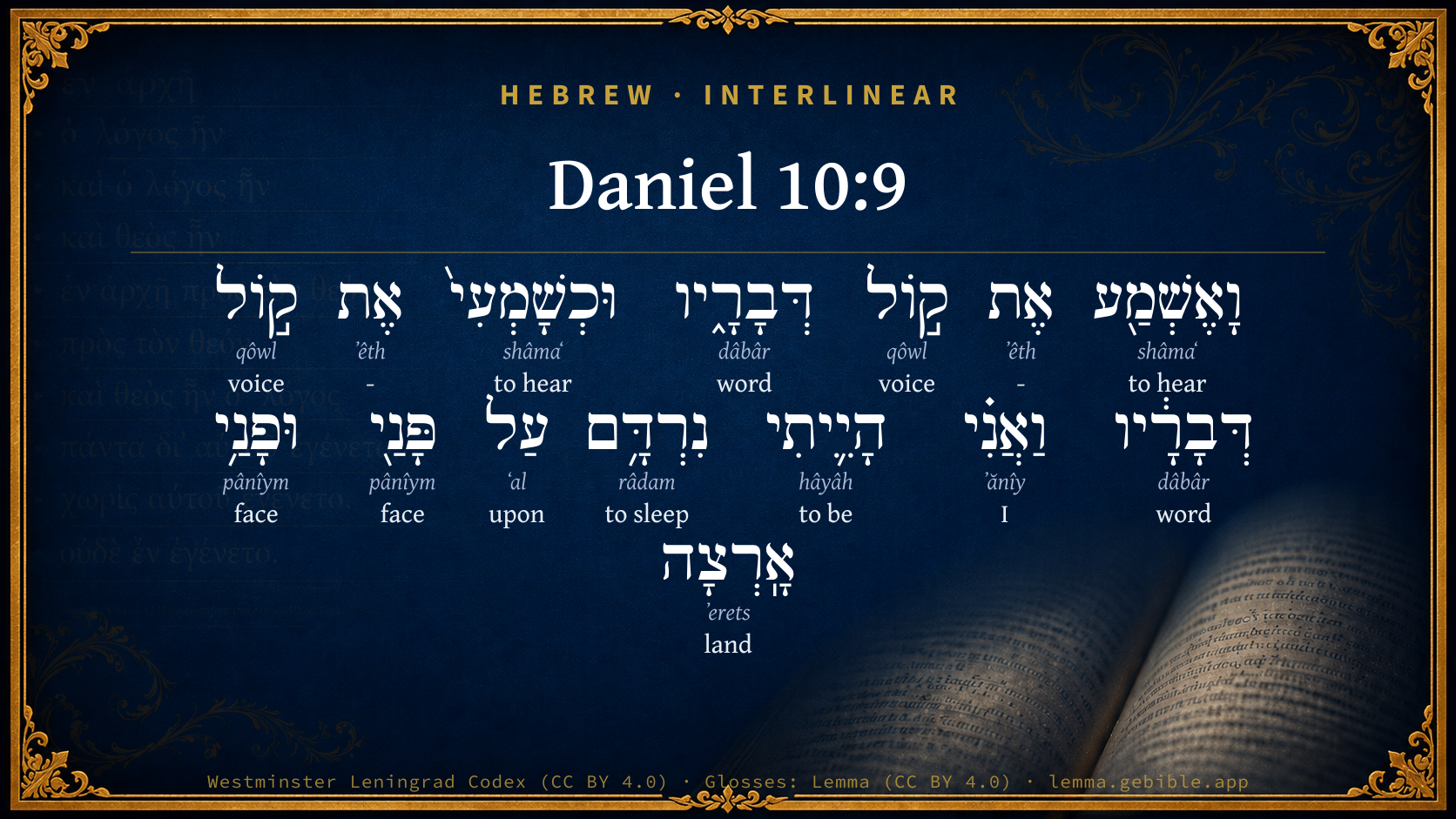
Hebrew (Westminster Leningrad Codex) Daniel 10:9 appears in the Hebrew Old Testament. The text above is from the Westminster Leningrad Codex. Each word links to its Strong’s number, a concise gloss, and parsing drawn from the Open Scriptures Hebrew Bible morphology. Click any word for its full Brown-Driver-Briggs (BDB) entry.
Download image
Cite this verse

Daniel 10:9 (World English Bible). Public Domain. Lemma interlinear Bible study tool, https://lemma.gebible.app/v/daniel/10/9.

Show BibTeX & RIS
BibTeX
RIS
English Translation
Yet heard I the voice of his words; and when I heard the voice of his words, then was I fallen into a deep sleep on my face, with my face toward the ground.
World English Bible · Public Domain
Download a study sheet

One document with this verse’s original text, its word-by-word gloss line, the meaning frame, cross-references with their text, attributed commentary, and full source and license credits — printable, and it pastes into notes with its structure intact.

This verse Autodidact and up

Study sheet (.html) Plain text (.txt)

A passage Seminary Student

Up to 50 verses in one chapter. A passage sheet keeps up to 6 commentary sources and 12 cross-references per verse, in the order this page ranks them, and says so on the sheet whenever that leaves anything out. Ask for a single verse and you get the Autodidact verse sheet above.

Everything on this page stays free to read, with no account — the sheet is a download of what is already on screen, not access to it.

Want to remove ads? Support Godless Engineer
Compare translations 3

The same verse in 3 English versions, stacked beneath the original-language interlinear above. Click any original word for its lexicon entry.

Each is an independent rendering of the whole verse — the interlinear is not word-aligned to these translations.

Highlighted words mark where these versions differ — a whole-verse word diff, not a word-by-word alignment.

  • World English Bible Public Domain
    Yet heard I the voice of his words; and when I heard the voice of his words, then was I fallen into a deep sleep on my face, with my face toward the ground.
  • King James Version Public Domain
    Yet heard I the voice of his words: and when I heard the voice of his words, then was I in a deep sleep on my face, and my face toward the ground.
  • unfoldingWord Literal Text CC BY-SA 4.0
    Then I heard the sound of his words, and as I heard the sound of his words, I fell on my face in a deep sleep with my face to the ground.

unfoldingWord Literal Text — © unfoldingWord, licensed CC BY-SA 4.0. Word-aligned USFM3 via Door43 (git.door43.org/unfoldingWord/en_ult).

Versions to compare (up to 4)

3 of 4 selected

Show all 18 translations

Every available English version of this verse, each an independent rendering of the whole verse.

  • World English Bible Public Domain
    Yet heard I the voice of his words; and when I heard the voice of his words, then was I fallen into a deep sleep on my face, with my face toward the ground.
  • Berean Standard Bible Public Domain
    I heard the sound of his words, and as I listened, I fell into a deep sleep, with my face to the ground.
  • Majority Standard Bible Public Domain
    I heard the sound of his words, and as I listened, I fell into a deep sleep, with my face to the ground.
  • King James Version Public Domain
    Yet heard I the voice of his words: and when I heard the voice of his words, then was I in a deep sleep on my face, and my face toward the ground.
  • American Standard Version (1901) Public Domain
    Yet heard I the voice of his words; and when I heard the voice of his words, then was I fallen into a deep sleep on my face, with my face toward the ground.
  • Revised Version (1885) Public Domain
    Yet heard I the voice of his words: and when I heard the voice of his words, then was I fallen into a deep sleep on my face, with my face toward the ground.
  • Geneva Bible (1599) Public Domain
    Yet heard I the voyce of his wordes: and when I heard the voyce of his wordes, I slept on my face: and my face was toward the ground.
  • Douay-Rheims (1899) Public Domain
    And I heard the voice of his words: and when I heard, I lay in a consternation, upon my face, and my face was close to the ground.
  • Young's Literal Translation Public Domain
    `And I hear the voice of his words, and when I hear the voice of his words, then I have been in a trance on my face, and my face `is' to the earth;
  • Literal Standard Version CC BY-SA 4.0
    And I hear the voice of his words, and when I hear the voice of his words, then I have been in a trance on my face, and my face [is] to the earth;
  • Unlocked Literal Bible CC BY-SA 4.0
    Then I heard his words—and as I heard them, I fell on my face in deep sleep with my face to the ground.
  • unfoldingWord Literal Text CC BY-SA 4.0
    Then I heard the sound of his words, and as I heard the sound of his words, I fell on my face in a deep sleep with my face to the ground.
  • Darby Bible Public Domain
    And I heard the voice of his words; and when I heard the voice of his words, I fell into a deep stupor on my face, and my face to the ground.
  • World Messianic Bible Public Domain
    Yet I heard the voice of his words. When I heard the voice of his words, then I fell into a deep sleep on my face, with my face toward the ground.
  • Webster's Bible Public Domain
    Yet I heard the voice of his words: and when I heard the voice of his words, then I was in a deep sleep on my face, and my face toward the ground.
  • Free Bible Version CC BY-SA 4.0
    I heard him speaking, and when I heard his voice I lost consciousness and I lay facedown on the ground.
  • Bible in Basic English Public Domain
    But the sound of his words came to my ears, and on hearing his voice I went into a deep sleep with my face to the earth.
  • JPS Tanakh (1917) Public Domain
    Yet heard I the voice of his words; and when I heard the voice of his words, then was I fallen into a deep sleep on my face, with my face toward the ground.

Literal Standard Version (2020), Covenant Press — licensed CC BY-SA 4.0. Text via the HelloAO Bible API (eBible.org). Unlocked Literal Bible (unfoldingWord) — licensed CC BY-SA 4.0. Text via the HelloAO Bible API (eBible.org). unfoldingWord Literal Text — © unfoldingWord, licensed CC BY-SA 4.0. Word-aligned USFM3 via Door43 (git.door43.org/unfoldingWord/en_ult). Free Bible Version, Dr. Jonathan Gallagher — licensed CC BY-SA 4.0. Text via the HelloAO Bible API (eBible.org).

Word by word

More ways to search: Search by grammar → Find every occurrence → Compare this word →

Practice this passage: Drill this verse → Learn its vocabulary →

נִרְדָּ֥ם
râdam
H7290
“sleeping”
Verb, Niphal, Participle Active, Masculine, Singular, Absolute
Part of Speech
Verb
Stem
Niphal
Form
Participle Active
Gender
Masculine
Number
Singular
State
Absolute
Full BDB Definition

Origin: a primitive root

TWOT: 2123

(Niphal) to be asleep, be unconscious, be in heavy sleep, fall into heavy sleep, be fast asleep
  1. וָאֶשְׁמַ֖ע shâmaʻ H8085 “and · to hear” Conjunction + Verb, Qal, Sequential Imperfect, 1st Person, Common, Singular
  2. אֶת ʼêth H853 “-” Particle, Direct Object
  3. ק֣וֹל qôwl H6963 “voice of” Noun, Common, Masculine, Singular, Construct
  4. דְּבָרָ֑יו dâbâr H1697 “words · his” Noun, Common, Masculine, Plural, Construct + Suffix, Personal, 3rd Person, Masculine, Singular
  5. וּכְשָׁמְעִי֙ shâmaʻ H8085 “and · like/as · to hear · me” Conjunction + Preposition + Verb, Qal, Infinitive Construct + Suffix, Personal, 1st Person, Common, Singular
  6. אֶת ʼêth H853 “-” Particle, Direct Object
  7. ק֣וֹל qôwl H6963 “voice of” Noun, Common, Masculine, Singular, Construct
  8. דְּבָרָ֔יו dâbâr H1697 “words · his” Noun, Common, Masculine, Plural, Construct + Suffix, Personal, 3rd Person, Masculine, Singular
  9. וַאֲנִ֗י ʼănîy H589 “and · I” Conjunction + Pronoun, Personal, 1st Person, Common, Singular
  10. הָיִ֛יתִי hâyâh H1961 “to be” Verb, Qal, Perfect, 1st Person, Common, Singular
  11. עַל ʻal H5921 “upon” Preposition
  12. פָּנַ֖י pânîym H6440 “face(s) · my” Noun, Common, Both, Plural, Construct + Suffix, Personal, 1st Person, Common, Singular
  13. וּפָנַ֥י pânîym H6440 “and · face(s) · my” Conjunction + Noun, Common, Both, Plural, Construct + Suffix, Personal, 1st Person, Common, Singular
  14. אָֽרְצָה ʼerets H776 “land · toward” Noun, Common, Both, Singular, Absolute + Suffix, Demonstrative

About this verse

These counts appear in no published source. They are computed here, from the morphology-tagged text and Lemma’s own curated glosses. What Lemma adds →

15
words
10
distinct lemmas
Prophets
section

Notable vocabulary

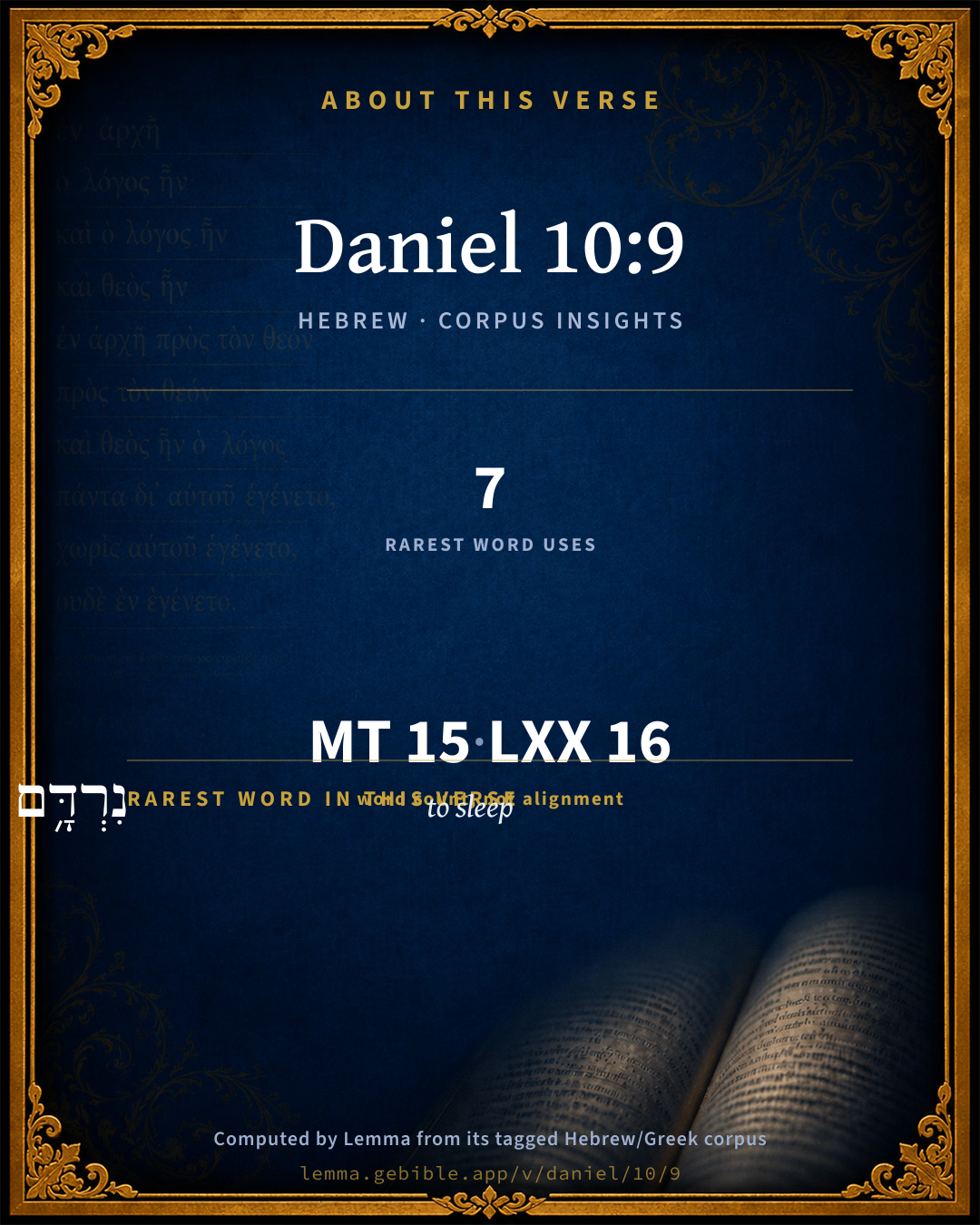
The rarest word here is נִרְדָּ֥ם to sleep H7290 — appearing just 7 times in the whole Hebrew Bible.

Shared distinctive vocabulary

נִרְדָּ֥ם to sleep H7290 occurs in 7 verses of the Hebrew Bible. Also found in:

Grammatical profile

  • 4 verbs
  • 7 nouns
  • 1 pronoun
  • 1 preposition
  • 2 particles

Verb forms

  • וָאֶשְׁמַ֖ע Qal · Sequential Imperfect
  • וּכְשָׁמְעִי֙ Qal · Infinitive Construct
  • הָיִ֛יתִי Qal · Perfect
  • נִרְדָּ֥ם Niphal · Participle Active

Repetition

Words recur within this verse — often emphatic in Hebrew:

  • וָאֶשְׁמַ֖ע to hear H8085 ×2
  • ק֣וֹל voice H6963 ×2
  • דְּבָרָ֑יו word H1697 ×2
  • פָּנַ֖י face H6440 ×2

Hebrew & Septuagint length

In English translation the verse runs 34 words from the Hebrew and 28 from the Septuagint (LXX English) — closely comparable.

A rough comparison of the two English renderings, which tokenize alike — not a word-level alignment.

Word counts can differ between the Hebrew and the Greek without any difference in meaning — e.g. the Hebrew direct-object marker אֵת has no separate Greek word, and Greek often adds the article ὁ.

In the original languages it is 15 Hebrew tokens and 16 Greek tokens — but the two are counted differently (Hebrew bundles its prefixes and suffixes into one token; the Greek is in lemma form), so that isn’t a like-for-like length.

Cross-references

8

Topical passages linked to Daniel 10:9 in the Treasury of Scripture Knowledge — connected by theme and wording, ordered by reader-vote popularity; previews shown in the World English Bible.

  • Daniel 8:18 Now as he was speaking with me, I fell into a deep sleep with my face toward the ground; but he touched me, and set me upright.
  • Genesis 15:12 When the sun was going down, a deep sleep fell on Abram. Now terror and great darkness fell on him.
  • Job 4:13 In thoughts from the visions of the night, When deep sleep falls on men,
  • Genesis 2:21 Yahweh God caused a deep sleep to fall on the man, and he slept; and he took one of his ribs, and closed up the flesh in its place.
  • Job 33:15 In a dream, in a vision of the night, When deep sleep falls on men, In slumbering on the bed;
  • Song of Solomon 5:2 I was asleep, but my heart was awake. It is the voice of my beloved who knocks: Open to me, my sister, my love, my dove, my undefiled; For my head is filled with dew, My hair with the dampness of the night.
  • Luke 9:32 Now Peter and those who were with him were heavy with sleep, but when they were fully awake, they saw his glory, and the two men who stood with him.
  • Luke 22:45 When he rose up from his prayer, he came to the disciples, and found them sleeping because of grief,

Cross-references courtesy of OpenBible.info (CC BY 4.0).

Hebrew and Greek witnesses Masoretic Hebrew ↔ Greek Septuagint

The same verse in the two great witnesses to the Old Testament, shown verse-for-verse.

These are two independent witnesses, not word-aligned to each other, and the Septuagint is shown in lemma (dictionary) form.

Hebrew Daniel 10:9 Masoretic · Westminster Leningrad Codex

וָאֶשְׁמַ֖ע אֶת ק֣וֹל דְּבָרָ֑יו וּכְשָׁמְעִי֙ אֶת ק֣וֹל דְּבָרָ֔יו וַאֲנִ֗י הָיִ֛יתִי נִרְדָּ֥ם עַל פָּנַ֖י וּפָנַ֥י אָֽרְצָה

Yet heard I the voice of his words; and when I heard the voice of his words, then was I fallen into a deep sleep on my face, with my face toward the ground.

World English Bible · Public Domain

Greek LXX Daniel 10:9 Septuagint · lemma form

καί οὐ ἀκούω ὁ φωνή λαλιά αὐτός ἐγώ εἰμί πίπτω ἐπί πρόσωπον ἐγώ ἐπί ὁ γῆ

Yet I heard the voice of his words: and when I heard him I was pricked in the heart, and I fell with my face to the earth.

LXX2012 (modern English Septuagint) · Public Domain

On this verse, The Pulpit Commentary discusses the Septuagint’s reading. Read the note in Commentary ↓

Hebrew: Westminster Leningrad Codex (CC BY 4.0). Greek: Septuagint (public domain); English from LXX2012 (modern English Septuagint) (Public Domain). How the Septuagint differs from the Hebrew →

Commentary

Notes on Daniel 10:9 from classic Christian and Jewish commentators (each source and its license shown beneath its notes). The classic Christian expositions comment on the surrounding passage and are grouped to its opening verse, so a note may address several verses; the Jewish commentaries on the Tanakh (Rashi and others) are per-verse, so they appear only where the commentator wrote on this verse.

Lemma curates 59 commentaries, every one of them public domain or Creative Commons licensed, each selected and text-cleaned for this edition rather than reprinted as found. About our sources →

Trapp's Complete Commentary

John Trapp

Dan 10:9 Yet heard I the voice of his words: and when I heard the voice of his words, then was I in a deep sleep on my face, and my face toward the ground.

Ver. 9. Yet heard I the voice of his words.] What these words were is not here expressed; but by comparing, they may be gathered to be the same with those, Dan 8:18, bidding Gabriel to draw near and speak unto the prophet.

Then was I in a deep sleep.] See Dan 8:18. The more the outward man is bound, the fitter he is for holy communion with God. {2Co 12:2-3}

John Trapp, A Commentary or Exposition upon All the Books of the Old and New Testament (1647–1656) — public domain. Text from a community e-Sword module.

Jamieson, Fausset & Brown

Robert Jamieson, A. R. Fausset & David Brown

voice of his words--the sound of his words.

was I in a deep sleep--"I sank into a deep sleep" [LENGKERKE].

Jamieson, Fausset & Brown — Commentary Critical and Explanatory on the Whole Bible (1871) — public domain (CC PDM 1.0). Text via the HelloAO Bible API.

Adam Clarke's Commentary

Verse 9. Was I in a deep sleep] I fell into a swoon.

Adam Clarke's Commentary on the Bible (1810–1826) — public domain. Text from a community e-Sword/MySword module.

John Calvin's Commentaries

In yesterday’s Lecture Daniel confessed himself astonished at the sight of the angel, and deprived of all inward strength. He afterwards adds, On hearing the sound of his words he threw himself on the ground; for this is the sense of the ninth verse, as we have just read it. He represents himself as being in a swoon and in the unconscious state which usually occurs when all our senses are paralyzed by excessive fear. While lying thus senselessly on the ground, Behold, he adds, hands touched me, and placed me upon my knees and the palms of my hands He mentions his being partially raised by the angel, not only through the sound of his voice, but by the touch of his hand. He implies that he was not yet raised to either the standing or sitting posture; he was only placed upon his knees with his hands upon the ground, this posture being the sign of his dejection. Thus he was partially relieved, and fear no longer seized upon either his mind or his limbs. From this passage we should learn that when prostrated by the voice of God, we cannot be restored otherwise than by his strength. We know the hand to be the symbol of strength. Unless God himself stretches out his hand to us, we shall always remain apparently dead. This is one lesson. The Prophet next adds the address of the angel to him, —

John Calvin's Commentaries (1540-1563) — public domain. Text from the Calvin Translation Society English edition (1840s-50s) via the Christian Classics Ethereal Library (ccel.org). Calvin's coverage is partial (roughly two-thirds of the Bible); uncommented books and verses are honest gaps, never fabricated. The 19th-century editor's footnotes and remarks are omitted so the notes are faithfully Calvin's own voice.

Ellicott's Commentary for English Readers

(9) His words.—He refers to the unrecorded words of Dan_10:6. (Comp. Dan_8:17-18.)

A Bible Commentary for English Readers, edited by Charles John Ellicott (1878–1897) — public domain. Text from a community e-Sword module.

The Cambridge Bible for Schools and Colleges

gen. ed. J. J. S. Perowne

9. And I heard the voice, &c.] or, the sound (twice): see on Dan_10:6. then was I in, &c.] R.V. then was I fallen into a deep sleep. The clause appears to describe, not the effect of the words which Daniel heard, but the state in which he already was, when he heard them. On the expression a deep (or dead) sleep, see on Dan_8:18.

on my face, with my face, &c.] cf. Dan_8:17-18.

The Cambridge Bible for Schools and Colleges (gen. ed. J. J. S. Perowne; Cambridge University Press, 1878–1918) — public domain. Text from a community e-Sword module.

John Gill's Exposition

Yet heard I the voice of his words,.... Though he was struck with so much awe, and his spirits so greatly depressed, and his body reduced to so low a condition; yet he was capable of attending to the voice, and of hearing the articulate sounds pronounced, and of understanding what was said:

and when I heard the voice of his words, then was I in a deep sleep on my face, and my face toward the ground; as soon as he heard his words, he fell upon his face to the ground, either in a way of worship and adoration, of prayer and supplication, as the Arabic version suggests; or through awe and reverence of the speaker, as well as through faintness of spirits; and these being quite exhausted, as it were, might be the reason of his falling into a deep sleep; unless it can be thought he was lulled into it, through the sweetness of the voice he had heard.

John Gill's Exposition of the Whole Bible (1746–1763) — public domain (CC PDM 1.0). Text via the HelloAO Bible API.

Albert Barnes' Notes on the Bible

Yet heard I the voice of his words - What the angel said when he appeared to him Daniel has not recorded. He says Dan 10:6 that the voice of his words was “like the voice of a multitude.” It is probable that those who were with him had heard that voice, and hearing it, and being struck with the remarkable character of the vision, they had suddenly fled in alarm. Daniel heard more distinctly what he said, though it does not yet appear that he had heard anything more than the sound of his voice.

And when I heard the voice of his words, then was I in a deep sleep on my face - Compare the notes at Dan 8:18. Lengerke renders this, “I sank into a deep sleep,” etc. This is undoubtedly the meaning, that when he heard this voice he was overcome, and sank prostrate and senseless upon the earth. The sense of the Hebrew may be thus expressed: “I became (הייתי hâyı̂ytı̂y) oppressed with sleep,” etc.

Albert Barnes' Notes on the Bible (1834–1885) — public domain. Text from a community e-Sword/MySword module.

Matthew Poole's English Annotations

Yet heard I the voice of his words; nevertheless he made me to hear: here was power in weakness, and yet this added to his fear and frailty.

Then was I in a deep sleep on my face, and my face toward the ground; as one that swooned, or as one that slumbered, and as one that adored the ground.

Matthew Poole's English Annotations on the Holy Bible (1683–1685) — public domain. Text from a community e-Sword/MySword module.

Whedon's Commentary on the Bible

Daniel D. Whedon

9. He almost or quite fainted away, as he had previously done at the sound of the awe-inspiring voice and at the deep mysteries of these divine revelations. (See notes Dan_8:18; Dan_8:27.)

Daniel D. Whedon (gen. ed.), Commentary on the Old and New Testaments (1874–1909) — public domain. Text from a community e-Sword module.

The Pulpit Commentary

Yet heard I the voice of his words: and when I heard the voice of his words, then was I in a deep sleep on my face, and my face toward the ground. The Septuagint rendering here is briefer than the Massoretic, "And I heard the sound of his speech (laliav, "talking"), and I was fallen upon my face upon the earth." The Septuagint translator seems to have read yTilpn (nephalti) instead of (nir"dam). Theodotion is somewhat nearer the Massoretic text, but renders nirdam by "stupefied." The Pesifitta is an accurate rendering of the text behind the Septuagint. Jerome agrees with Theodotion, rendering nirdam by consternatus; he strengthens the phrase, "my face toward the ground," by inserting haerebat. It would seem that nirdam is of doubtful authenticity. It may be said this was omitted because of the difficulty of imagining the prophet seeing while in a deep sleep. But a state of sleep does not preclude the possibility of seeing a vision. In the parallel passage (Dan_8:18) the LXX has no difficulty in translating, yTimdrni ejkoimhqhn. By assuming the reading of the LXX and the Peshitta to be correct, we make the process of events more natural; according to the Massoretic reading, though we have an account of his sense of weakness, we have no record that he fell to the ground, and yet we are told that he was "in a deep sleep, with his face toward the ground" The resemblance is very great to Job_4:12, "A thing was secretly brought to me, and mine ear received a little thereof in thoughts from the vision of the night, when sleep falleth on men (hmderT tardaymah)." If there has been imitation, the originality and beauty of the passage in Job render it certain that it is the original. It seems more likely to be a change introduced to bring the revelation to Daniel in line with other prophetic revelations. The attitude Daniel assumed was one which implied the deepest abasement the envoy of the great king kisses the ground at the feet of the envoy of the King of kings. Even the revelation given while sleep had fallen on the subject of the revelation, seems paralleled with what took place at the Transfiguration. Luk_9:32, "And Peter and those that were with him were heavy with sleep," yet it was when they were awaked that they saw the glory. So with Gethsemane. The Hebrew word is the same as that used when Eve was taken out of the side of Adam; he then was asleep a deep sleep had fallen on him, hmderT (tardaymah)." (For further illustrations, see Eze_1:28 Eze_3:23; Zec_4:1; Rev_1:17)

The Pulpit Commentary (1880–1919), ed. H.D.M. Spence-Jones & Joseph S. Exell — public domain. Text from a community e-Sword module.

Keil & Delitzsch

C. F. Keil & F. Delitzsch

When Daniel heard the voice, which according to v. 6 was like the noise of a multitude, he was stunned, and fell on his face to the ground, as Dan 8:17. Yet the expression here, נרדּם הייתי, is stronger than נבעתּי, Dan 8:17. Dan 10:10 shows how great was his amazement in the further description it gives. The touching of him by an unseen hand raised him up and caused him to reel on his knees and hands (תּניעני, vacillare me fecit), but did not enable him to stand erect. This he was first able to do after he heard the comfortable words, and was directed to mark the communication of the heavenly messenger. Regarding חמות אישׁ see under Dan 9:23, and for עמדך על עמד see at Dan 8:18. He now raises himself up, but still trembling (מרעיד). The עתּה now am I sent to thee, points to the delay of his coming spoken of in Dan 10:12.

Keil & Delitzsch — Biblical Commentary on the Old Testament (1861–1891) — public domain (CC PDM 1.0). Text via the HelloAO Bible API. (Old Testament only.)

Rashi

Rabbi Shlomo Yitzchaki (Rashi)

I fell into a sound sleep out of great fright.

Rashi on the Tanakh — English translations: “The Judaica Press complete Tanach with Rashi, translated by A. J. Rosenberg” (CC BY 4.0); “Pentateuch with Rashi's commentary by M. Rosenbaum and A.M. Silbermann, 1929-1934” (public domain); “The Metsudah Tanach series, Lakewood, N.J” (CC BY 4.0); and “The Book of Joshua, Metsudah Publications, 1997” (CC BY 4.0). Text via Sefaria.

Lesson kit

Teaching starters — assembled from the data on this page, not authored interpretation. Every prompt links to the verse data it draws on. Edit before teaching.

Daniel, in the Prophets, opens this verse with 15 words (10 distinct Hebrew lemmas). Its most distinctive word is râdam (“to sleep”). A historical commentator’s framing appears above. Read the whole chapter for the surrounding context.

Discussion questions

  1. How does “to sleep” (râdam) shape what this verse is saying?
  2. How does Judges 4:21, which shares the word «to sleep», read alongside this verse?
  3. What does the repetition of “to hear” (2× in this one verse) do in this verse?
  4. These translations render this verse differently. What is at stake in choosing one wording over another?
  5. «וָאֶשְׁמַ֖ע» is a Qal Sequential Imperfect verb. How does that grammatical form shape the action described?
  6. Compare how Trapp's Complete Commentary and Jamieson, Fausset & Brown read this verse. Where do they agree or differ?

Things to notice

Reading settings

Reading text

Shown beneath each verse's original-language words.

Old Testament
Old Testament edition

Read the OT as the Masoretic Hebrew (MT) or the Greek Septuagint (LXX).

English shown for the Greek Septuagint (in the Hebrew ↔ Greek comparison).

Comparing translations? Open the Compare panel on any verse page to stack up to four side by side.