
Deuteronomy 1:34

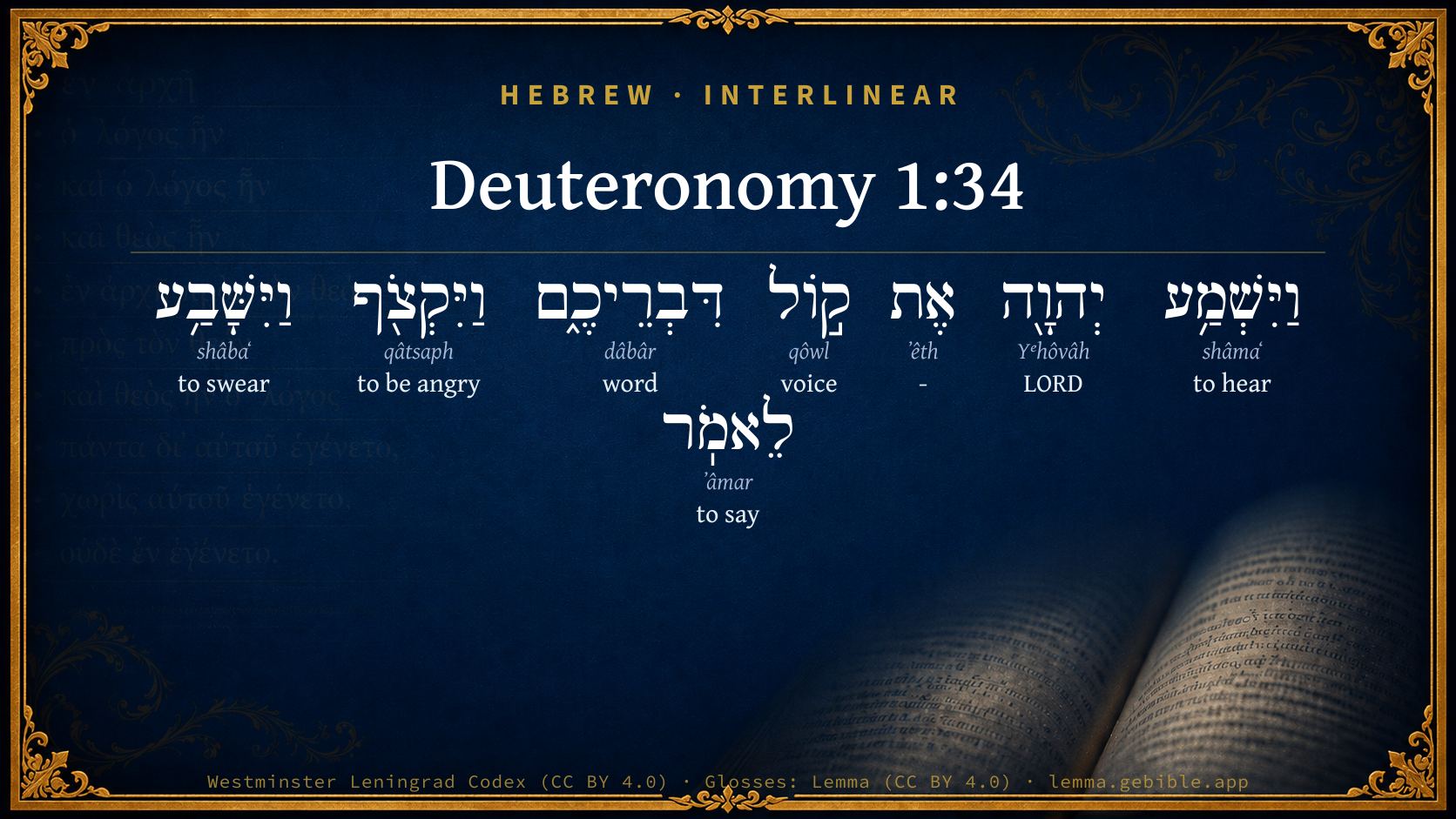
Hebrew (Westminster Leningrad Codex) Deuteronomy 1:34 appears in the Hebrew Old Testament. The text above is from the Westminster Leningrad Codex. Each word links to its Strong’s number, a concise gloss, and parsing drawn from the Open Scriptures Hebrew Bible morphology. Click any word for its full Brown-Driver-Briggs (BDB) entry.
Download image
Cite this verse

Deuteronomy 1:34 (World English Bible). Public Domain. Lemma interlinear Bible study tool, https://lemma.gebible.app/v/deuteronomy/1/34.

Show BibTeX & RIS
BibTeX
RIS
English Translation
Yahweh heard the voice of your words, and was angry, and swore, saying,
World English Bible · Public Domain
Download a study sheet

One document with this verse’s original text, its word-by-word gloss line, the meaning frame, cross-references with their text, attributed commentary, and full source and license credits — printable, and it pastes into notes with its structure intact.

This verse Autodidact and up

Study sheet (.html) Plain text (.txt)

A passage Seminary Student

Up to 50 verses in one chapter. A passage sheet keeps up to 6 commentary sources and 12 cross-references per verse, in the order this page ranks them, and says so on the sheet whenever that leaves anything out. Ask for a single verse and you get the Autodidact verse sheet above.

Everything on this page stays free to read, with no account — the sheet is a download of what is already on screen, not access to it.

Want to remove ads? Support Godless Engineer
Compare translations 3

The same verse in 3 English versions, stacked beneath the original-language interlinear above. Click any original word for its lexicon entry.

Each is an independent rendering of the whole verse — the interlinear is not word-aligned to these translations.

Highlighted words mark where these versions differ — a whole-verse word diff, not a word-by-word alignment.

  • World English Bible Public Domain
    Yahweh heard the voice of your words, and was angry, and swore, saying,
  • King James Version Public Domain
    And the LORD heard the voice of your words, and was wroth, and sware, saying,
  • unfoldingWord Literal Text CC BY-SA 4.0
    And Yahweh heard the sound of your words and was angry. And he swore, saying,

unfoldingWord Literal Text — © unfoldingWord, licensed CC BY-SA 4.0. Word-aligned USFM3 via Door43 (git.door43.org/unfoldingWord/en_ult).

Versions to compare (up to 4)

3 of 4 selected

Show all 18 translations

Every available English version of this verse, each an independent rendering of the whole verse.

  • World English Bible Public Domain
    Yahweh heard the voice of your words, and was angry, and swore, saying,
  • Berean Standard Bible Public Domain
    When the LORD heard your words, He grew angry and swore an oath, saying,
  • Majority Standard Bible Public Domain
    When the LORD heard your words, He grew angry and swore an oath, saying,
  • King James Version Public Domain
    And the LORD heard the voice of your words, and was wroth, and sware, saying,
  • American Standard Version (1901) Public Domain
    And Jehovah heard the voice of your words, and was wroth, and sware, saying,
  • Revised Version (1885) Public Domain
    And the LORD heard the voice of your words, and was wroth, and sware, saying,
  • Geneva Bible (1599) Public Domain
    Then the Lord heard the voyce of your wordes, and was wroth, and sware, saying,
  • Douay-Rheims (1899) Public Domain
    And yet for all this you did not believe the Lord your God,
  • Young's Literal Translation Public Domain
    `And Jehovah heareth the voice of your words, and is wroth, and sweareth, saying,
  • Literal Standard Version CC BY-SA 4.0
    And YHWH hears the voice of your words, and is angry, and swears, saying,
  • Unlocked Literal Bible CC BY-SA 4.0
    Yahweh heard the sound of your words and was angry; he swore and said,
  • unfoldingWord Literal Text CC BY-SA 4.0
    And Yahweh heard the sound of your words and was angry. And he swore, saying,
  • Darby Bible Public Domain
    And Jehovah heard the voice of your words, and was wroth, and swore, saying,
  • World Messianic Bible Public Domain
    The LORD heard the voice of your words and was angry, and swore, saying,
  • Webster's Bible Public Domain
    And the LORD heard the voice of your words, and was wroth, and swore, saying,
  • Free Bible Version CC BY-SA 4.0
    When the Lord heard what you were saying, he got angry and swore an oath:
  • Bible in Basic English Public Domain
    And the Lord, hearing your words, was angry, and said with an oath,
  • JPS Tanakh (1917) Public Domain
    And the LORD heard the voice of your words, and was wroth, and swore, saying:

Literal Standard Version (2020), Covenant Press — licensed CC BY-SA 4.0. Text via the HelloAO Bible API (eBible.org). Unlocked Literal Bible (unfoldingWord) — licensed CC BY-SA 4.0. Text via the HelloAO Bible API (eBible.org). unfoldingWord Literal Text — © unfoldingWord, licensed CC BY-SA 4.0. Word-aligned USFM3 via Door43 (git.door43.org/unfoldingWord/en_ult). Free Bible Version, Dr. Jonathan Gallagher — licensed CC BY-SA 4.0. Text via the HelloAO Bible API (eBible.org).

Word by word

More ways to search: Search by grammar → Find every occurrence → Compare this word →

Practice this passage: Drill this verse → Learn its vocabulary →

וַיִּקְצֹ֖ף
qâtsaph
H7107
“and · to be angry”
Conjunction + Verb, Qal, Sequential Imperfect, 3rd Person, Masculine, Singular
Part of Speech
Conjunction + Verb
Stem
Qal
Form
Sequential Imperfect
Person
3rd Person
Gender
Masculine
Number
Singular
Full BDB Definition

Origin: a primitive root

TWOT: 2058

to be displeased, be angry, fret oneself, be wroth - (Qal) to be wroth, to be full of wrath, to be furious - (Hiphil) to provoke to wrath or anger - (Hithpael) to put oneself in a rage, anger oneself
  1. וַיִּשְׁמַ֥ע shâmaʻ H8085 “and · to hear” Conjunction + Verb, Qal, Sequential Imperfect, 3rd Person, Masculine, Singular
  2. יְהוָ֖ה Yᵉhôvâh H3068 “LORD” Noun, Proper
  3. אֶת ʼêth H853 “-” Particle, Direct Object
  4. ק֣וֹל qôwl H6963 “voice of” Noun, Common, Masculine, Singular, Construct
  5. דִּבְרֵיכֶ֑ם dâbâr H1697 “words · your” Noun, Common, Masculine, Plural, Construct + Suffix, Personal, 2nd Person, Masculine, Plural
  6. וַיִּשָּׁבַ֥ע shâbaʻ H7650 “and · to swear” Conjunction + Verb, Niphal, Sequential Imperfect, 3rd Person, Masculine, Singular
  7. לֵאמֹֽר ʼâmar H559 “to say” Preposition + Verb, Qal, Infinitive Construct

About this verse

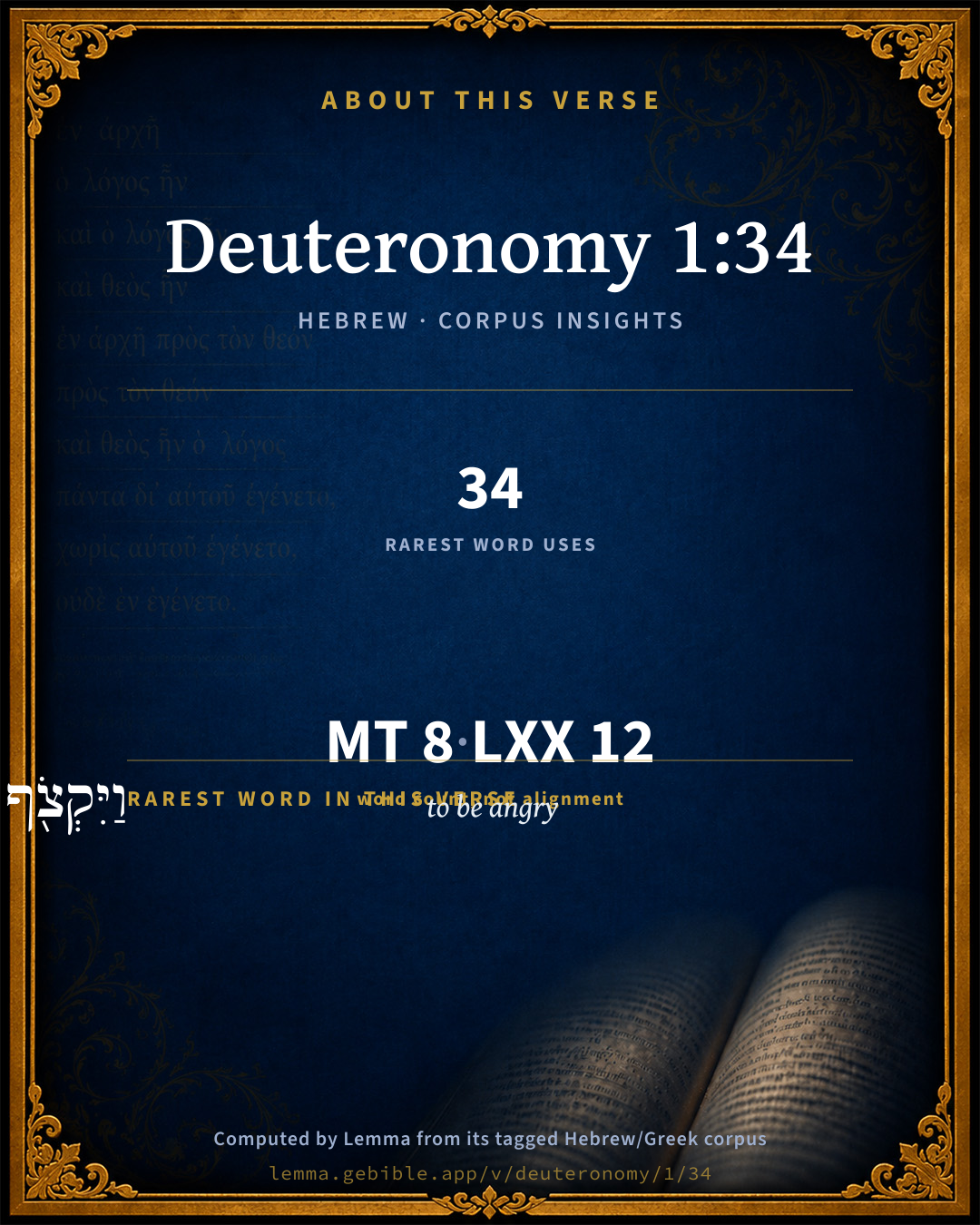
These counts appear in no published source. They are computed here, from the morphology-tagged text and Lemma’s own curated glosses. What Lemma adds →

8
words
8
distinct lemmas
Pentateuch
section

Shared distinctive vocabulary

וַיִּקְצֹ֖ף to be angry H7107 occurs in 32 verses of the Hebrew Bible. Also found in:

Grammatical profile

  • 4 verbs
  • 3 nouns
  • 1 particle

Verb forms

  • וַיִּשְׁמַ֥ע Qal · Sequential Imperfect
  • וַיִּקְצֹ֖ף Qal · Sequential Imperfect
  • וַיִּשָּׁבַ֥ע Niphal · Sequential Imperfect
  • לֵאמֹֽר Qal · Infinitive Construct

Hebrew & Septuagint length

In English translation the verse runs 13 words from the Hebrew and 16 from the Septuagint (LXX English) — closely comparable.

A rough comparison of the two English renderings, which tokenize alike — not a word-level alignment.

Word counts can differ between the Hebrew and the Greek without any difference in meaning — e.g. the Hebrew direct-object marker אֵת has no separate Greek word, and Greek often adds the article ὁ.

In the original languages it is 8 Hebrew tokens and 12 Greek tokens — but the two are counted differently (Hebrew bundles its prefixes and suffixes into one token; the Greek is in lemma form), so that isn’t a like-for-like length.

Cross-references

6

Topical passages linked to Deuteronomy 1:34 in the Treasury of Scripture Knowledge — connected by theme and wording, ordered by reader-vote popularity; previews shown in the World English Bible.

  • Numbers 14:22–30 because all those men who have seen my glory, and my signs, which I worked in Egypt and in the wilderness, yet have tempted me these ten times, and have not listened to my voice;
  • Hebrews 3:8–11 Don't harden your hearts, as in the provocation, Like as in the day of the trial in the wilderness,
  • Numbers 32:8–13 Thus did your fathers, when I sent them from Kadesh-barnea to see the land.
  • Deuteronomy 2:14–15 The days in which we came from Kadesh-barnea, until we were come over the brook Zered, were thirty-eight years; until all the generation of the men of war were consumed from the midst of the camp, as Yahweh swore to them.
  • Psalms 95:11 Therefore I swore in my wrath, "They won't enter into my rest."
  • Ezekiel 20:15 Moreover also I swore to them in the wilderness, that I would not bring them into the land which I had given them, flowing with milk and honey, which is the glory of all lands;

Cross-references courtesy of OpenBible.info (CC BY 4.0).

Hebrew and Greek witnesses Masoretic Hebrew ↔ Greek Septuagint

The same verse in the two great witnesses to the Old Testament, shown verse-for-verse.

These are two independent witnesses, not word-aligned to each other, and the Septuagint is shown in lemma (dictionary) form.

Hebrew Deuteronomy 1:34 Masoretic · Westminster Leningrad Codex

וַיִּשְׁמַ֥ע יְהוָ֖ה אֶת ק֣וֹל דִּבְרֵיכֶ֑ם וַיִּקְצֹ֖ף וַיִּשָּׁבַ֥ע לֵאמֹֽר

Yahweh heard the voice of your words, and was angry, and swore, saying,

World English Bible · Public Domain

Greek LXX Deuteronomy 1:34 Septuagint · lemma form

καί ἀκούω κύριος ὁ φωνή ὁ λόγος σύ καί παραὀξύνω ὄμνυμι λέγω

And the Lord heard the voice of your words, and being greatly provoked he swore, saying,

LXX2012 (modern English Septuagint) · Public Domain

Hebrew: Westminster Leningrad Codex (CC BY 4.0). Greek: Septuagint (public domain); English from LXX2012 (modern English Septuagint) (Public Domain). How the Septuagint differs from the Hebrew →

Targum (Aramaic paraphrase)

2

The Targum is the ancient Jewish Aramaic paraphrase of the Hebrew Scriptures — an interpretive translation, not the Hebrew text itself. Onkelos (literal) and Pseudo-Jonathan (expansive) render the Torah, and Jonathan the Prophets. Coverage is partial: where no permissively-licensed English translation exists for a verse, only the Aramaic is shown. This is verse-level text, not a word-by-word alignment to the Hebrew.

  1. Targum Onkelos Torah (Genesis–Deuteronomy)
    וּשְׁמִיעַ קֳדָם יְיָ יָת קַל פִּתְגָמֵיכוֹן וּרְגֵז וְקַיַם לְמֵימָר

    (no public-domain English translation for this verse)

    Targum Onkelos — Aramaic: “Onkelos Genesis” (public domain); “Onkelos Exodus” (public domain); “Onkelos Leviticus” (public domain); “Onkelos Numbers” (public domain); “Onkelos Deuteronomy” (public domain). English: “Sefaria Community Translation” (CC0 1.0 (public-domain dedication)); “J.W. Etheridge. The Targums of Onkelos and Jonathan Ben Uzziel on the Pentateuch. London: Longmans, Green, 1862” (public domain). Text via Sefaria.

  2. Targum Pseudo-Jonathan Torah (Genesis–Deuteronomy)
    וּשְׁמִיעַ קֳדָם יְיָ יַת קַל פִּתְגָמֵיכוֹן וּרְגַז וְקַיֵּים לְמֵימָר

    And the voice of your words was heard before the Lord, and He was displeased, and did make oath saying,

    Targum Pseudo-Jonathan — Aramaic: “Targum Jonathan on Genesis” (public domain); “Targum Jonathan on Exodus” (public domain); “Targum Jonathan on Leviticus” (public domain); “Targum Jonathan on Numbers” (public domain); “Targum Jonathan on Deuteronomy” (public domain). English: “The Targum of Jonathan ben Uzziel, trans. J. W. Etheridge, London, 1862” (public domain). Text via Sefaria.

Commentary

Notes on Deuteronomy 1:34 from classic Christian and Jewish commentators (each source and its license shown beneath its notes). The classic Christian expositions comment on the surrounding passage and are grouped to its opening verse, so a note may address several verses; the Jewish commentaries on the Tanakh (Rashi and others) are per-verse, so they appear only where the commentator wrote on this verse.

Lemma curates 59 commentaries, every one of them public domain or Creative Commons licensed, each selected and text-cleaned for this edition rather than reprinted as found. About our sources →

The Cambridge Bible for Schools and Colleges

gen. ed. J. J. S. Perowne

34. the voice of your words] So Deu_1:28 and not elsewhere.

34. and was wroth] Heb. wayyiḳṣoph, Deu_9:19 and twice in P, but not elsewhere of God in Pent. The causative form to provoke God only in Deu_9:7 f., Deu_9:32.

and sware] See on Deu_1:8.

34–40. God’s Anger and Judgements

Provoked by the people’s words (Deu_1:34) God swore none should see the good land (Deu_1:35) but Kaleb, son of Yephunneh; because he had fully followed Jehovah, to him and his children it should be given (Deu_1:36). Even with Moses was God angry for the people’s sake, saying, Thou shalt not come in thither (Deu_1:37); Joshua shall lead Israel to their heritage (Deu_1:38); and the people’s children possess it (Deu_1:39). Those addressed must turn back into the wilderness towards the Red Sea (Deu_1:40).—The parallel account, Num_14:10 a – Num_14:39, is divided (somewhat precariously) between JE and P. In Jeremiah , Deu_1:11-24; Deu_1:31 (?) Jehovah asks how long the people are to despise Him. He will smite and disinherit them, making of Moses himself a greater nation. Moses argues that other peoples will then say Jehovah is unable to carry Israel to the Land; and pleads His revealed mercy. Jehovah pardons, yet decrees that all who have seen His power but have not obeyed shall perish: only Kaleb who hath fully followed and his seed shall possess it, also the people’s little ones shall be brought in. In P, Deu_1:10 a, Deu_1:26-30; Deu_1:32-39 a, the divine glory descends on the tent of meeting and Jehovah asks how long He is to bear with this evil congregation whose murmuring He has heard. All from 20 years old and upwards shall perish except Kaleb and Joshua. This sentence is then expanded, and the spies who have brought an evil report are struck with the pestilence.

All these accounts agree in attributing to the people’s unbelief, after the report of the spies, a sentence of death on the adult generation, characteristically defined by P. The differences are (1) the usual distinctions of language (see notes below); (2) D and P omit Moses’ argument given by JE; P substitutes the descent of the glory of God; (3) JE and D except Kaleb front the doom, P Kaleb and Joshua (but an addition to D Deu_1:37-38 also excepts Joshua); (4) P alone (as usual) associates Aaron with Moses; (5) the addition to D extends God’s anger to Moses for the people’s sake; JE, on the contrary, declares God will make of Moses a greater people; while P (see on Deu_1:37) attributes Moses’ exclusion from the land to his own sin on an occasion 37 years after the present episode. Part of the analysis of Numbers 14 being precarious and the integrity of Deu_1:36-39 being doubtful we cannot say whether these differences of fact are reconcilable. Yet their coincidence with the distinctions of style and religious feeling among the three documents cannot be ignored; and the probability remains that here as elsewhere we have more or less independent traditions of the same event. Since Calvin, who in his harmony of the four last Bks of the Pent. removes Deu_1:37-38 from its context to a connection with Num_20:1-13, the explanation has been offered that the deuteronomic. passage is not chronological; but even this arbitrary act of literary criticism does not meet the difficulty of the statement that Jehovah was angry with Moses for the people’s sake.

The Cambridge Bible for Schools and Colleges (gen. ed. J. J. S. Perowne; Cambridge University Press, 1878–1918) — public domain. Text from a community e-Sword module.

Jamieson, Fausset & Brown

Robert Jamieson, A. R. Fausset & David Brown

the Lord heard the voice of your words, and was wroth--In consequence of this aggravated offense (unbelief followed by open rebellion), the Israelites were doomed, in the righteous judgment of God, to a life of wandering in that dreary wilderness till the whole adult generation had disappeared by death. The only exceptions mentioned are Caleb and Joshua, who was to be Moses' successor.

Jamieson, Fausset & Brown — Commentary Critical and Explanatory on the Whole Bible (1871) — public domain (CC PDM 1.0). Text via the HelloAO Bible API.

Adam Clarke's Commentary

Verse 34. The Lord - was wroth] That is, his justice was incensed, and he evidenced his displeasure against you; and he could not have been a just God if he had not done so.

Adam Clarke's Commentary on the Bible (1810–1826) — public domain. Text from a community e-Sword/MySword module.

Ellicott's Commentary for English Readers

(34) Was wroth, and sware.—See Psa_95:11, “I sware in my wrath, that they should not enter into my rest.”

A Bible Commentary for English Readers, edited by Charles John Ellicott (1878–1897) — public domain. Text from a community e-Sword module.

John Gill's Exposition

And the Lord heard the voice of your words,.... Of their murmurings against Moses and Aaron, and of their threatenings to them, Joshua and Caleb, and of their impious charge of hatred of them to God for bringing them out of Egypt, and of their rash wishes that they had died there or in the wilderness, and of their wicked scheme and proposal to make them a captain, and return to Egypt again:

and was wroth, and sware; by his life, himself; see Num 14:28,

saying; as follows.

John Gill's Exposition of the Whole Bible (1746–1763) — public domain (CC PDM 1.0). Text via the HelloAO Bible API.

Matthew Poole's English Annotations

The voice of your words, to wit, your murmurings, your unthankful, impatient, distrustful, and rebellious speeches and carriages.

Matthew Poole's English Annotations on the Holy Bible (1683–1685) — public domain. Text from a community e-Sword/MySword module.

The Pulpit Commentary

And the Lord heard the voice of your words, and he was wroth, and sware, etc.. (comp. Num_14:21-24)

Vers. 34-40. The excluded and the admitted.

I THE EXCLUDED.

1. That whole unbelieving generation, with two excerptions (ver. 35). Note:

(1) Their unbelief and disobedience did not frustrate God"s purpose of the occupation of the land. Canaan was occupied after all. So heaven will be peopled, the world conquered, and God"s work done, though we in our folly and sin rebel and stand aloof. (Mat_3:9) "It remaineth that some must enter in". (Heb_4:6)

(2) Their unbelief and disobedience effectually excluded themselves. God swore it in his wrath, and the sentence admitted of no reversal. A foreshadowing of the final exclusion from heaven of those who persistently disobey (Mat_7:21-24; Luk_13:24-29; Heb_4:11; Rev_22:11-16)

2. The holy Moses. (ver. 37; cf. on Deu_3:26 Deu_4:21 Deu_34:4) The exclusion of Moses will be more fully considered afterwards, but we learn from it here that God"s apparent severity is often greatest to his own people, (Amo_3:2) and that the share which others have had in leading us into sin does not abate our own responsibility in the commission of it. This greater apparent severity

(1) repels the charge of favoritism;

(2) gives a peculiarly impressive demonstration of the evil of sin;

(3) reminds us that sin in God"s people is more dishonoring to him than it is in others;

(4) warns the wicked. For if judgment begin at the righteous, "what shall the end be of them that obey not the gospel of God? And if the righteous scarcely be saved, where shall the ungodly and the sinner appear?". (1Pe_4:17, 1Pe_4:18)

II THE ADMITTED. These were to be:

1. The faithful two Caleb and Joshua (vers. 36, 38). The former is signalized as having "wholly followed the Lord," and Joshua was a man of like faith and staunchness in a time of general defection. Such persons God will singularly preserve and honor. Their place in heaven will be a high one. "We must, in a course of obedience to God"s will and of service to his honor, follow him universally, without dividing; uprightly, without dissembling; cheerfully, without disputing; and constantly, without declining; and this is following the Lord fully". (Matthew Henry, on Num_14:24)

2. The younger generation (ver. 39). Instead of the fathers, God would take the children. What a rebuke!

(1) of their groundless bars. "Your little ones, which ye said should be a prey.

(2) Of their unmanly cowardice. Their little children, types of all that was humanly feeble, would do the work they were afraid to attempt.

(3) Of their inconsiderate Selfishness. They were not ashamed to hand down to these children their own abandoned life-tasks, with all the work and peril, if also with all the reward and honor, attending their accomplishment. Was not this to make themselves objects of contempt to their own offspring? "Let no man take thy crown," least of all thine own child, J.O.

Vers. 34-46. The heirs of promise.

We have in this passage the result of unbelief. The dread of the people was lest their little ones should become a prey to their gigantic foes in Canaan. The Lord now declares that these little ones shall be the possessors of the land, while they themselves shall be denied an entrance, since they refused it when offered to them. The only exceptions are to be Joshua and Caleb, who made the good report and gave the good counsel. Even Moses is included in the doom of exclusion. The subsequent attempt and the subsequent tears had no effect in reversing the deserved sentence. We learn from this passage such practical lessons as these:

I GOD"S GRACIOUS OFFERS ARE NOT TO BE TRIFLED WITH. The Promised Land lay open to the Israelites, who had been mercifully guided to its gates. The all-important "Now," the time for decisive action had come, and it remained with them to determine whether they would go in and receive the blessing, or remain without. They preferred to delay, to trifle with the offer, and so the time went past. So sinners are offered pardon and acceptance as an immediate boon, (2Co_6:2) but when the offer is despised and trifled with, it may be withdrawn. (Pro_1:24-33)

II PRESUMPTION IS A POOR SUBSTITUTE FOR FAITH. When the people saw the mistake they had made, they would go up and fight in a spirit of presumptuous chagrin. They now fought without commissions. The result was disastrous defeat, and a hurling of them back from the gates of Palestine to the great and terrible wilderness. God was not with them in their presumption, since they would not follow him in humble faith. So may it be with sinners. Despised mercy may be succeeded by deserved defeat. The wild and proud efforts of presumption are in stalking contrast to the quiet courage of faith. Toil and tears may be insufficient to retrieve disaster when once courted by unbelief.

III JOSHUA AND CALEB"S GOOD FORTUNE SHOWED WHAT WAS POSSIBLE TO WHOLEHEARTED FAITH. These two spies, in wholly following the Lord and in counseling courage, showed a humble faith. They stood alone faithful in face of an unbelieving majority, and God gave them a corresponding assurance that they should enter into the land. They were greatly honored in being allowed to do so. And they are surely encouragements to believing souls throughout all time.

IV THE ASSURANCE OF THE CHILDREN THAT THEY SHOULD BE HEIRS OF THE LAND VINDICATED GOD"S PROCEDURE AND FAITHFULNESS. The little ones, for whom they feared, are selected as the heirs of premise. But they are to get the land after discipline and sorrow in the wilderness. God"s ways are not ours. Yet wisdom regulates them all. And the Divine grace was magnified in this arrangement. The Israelites, as they died in the wilderness, would be cheered by the thought that, though they were justly excluded from the land because of their unbelief, their children would receive the inheritance in the exercise of faith. The judgment on the fathers would be sanctified, like the sickness of Hymenseus and Alexander, (1Ti_1:20) and their spirits, let us hope, saved in the day of the Lord Jesus. R.M.E. (1Co_5:5)

The Pulpit Commentary (1880–1919), ed. H.D.M. Spence-Jones & Joseph S. Exell — public domain. Text from a community e-Sword module.

unfoldingWord translationNotes

Door43 World Missions Community

General Information:

Moses continues to remind the people of Israel what Yahweh said to them.

heard the sound of your words

"heard what you were saying"

he swore and said

God made a vow not to allow those who rebelled against him to enter the land he promised to give them.

will see

"will enter"

save Caleb

"except Caleb"

Jephunneh

This is the name of Caleb's father. (See: How to Translate Names)

he has wholly followed Yahweh

Yahweh speaks as if he were someone else. AT: "he has completely obeyed me" (See: Pronouns)

translationWords

Yahweh

word

anger

oath

evil

generation

Caleb

children

unfoldingWord translationNotes — © Distant Shores Media and the Door43 World Missions Community, licensed CC BY-SA 4.0. Source: git.door43.org/Door43/en_tn.

Lesson kit

Teaching starters — assembled from the data on this page, not authored interpretation. Every prompt links to the verse data it draws on. Edit before teaching.

Deuteronomy, in the Pentateuch, opens this verse with 8 words (8 distinct Hebrew lemmas). Its most distinctive word is qâtsaph (“to be angry”). A historical commentator’s framing appears above. Read the whole chapter for the surrounding context.

Discussion questions

  1. What does “to be angry” (qâtsaph) contribute to the verse as a whole?
  2. How does Genesis 40:2, which shares the word «to be angry», read alongside this verse?
  3. These translations render this verse differently; the difference is in the English rendering, not the original. What questions does that raise?
  4. «וַיִּשְׁמַ֥ע» is a Qal Sequential Imperfect verb. How does that grammatical form shape the action described?
  5. Compare how The Cambridge Bible for Schools and Colleges and Jamieson, Fausset & Brown read this verse. Where do they agree or differ?

Things to notice

Reading settings

Reading text

Shown beneath each verse's original-language words.

Old Testament
Old Testament edition

Read the OT as the Masoretic Hebrew (MT) or the Greek Septuagint (LXX).

English shown for the Greek Septuagint (in the Hebrew ↔ Greek comparison).

Comparing translations? Open the Compare panel on any verse page to stack up to four side by side.