
Ecclesiastes 12:4

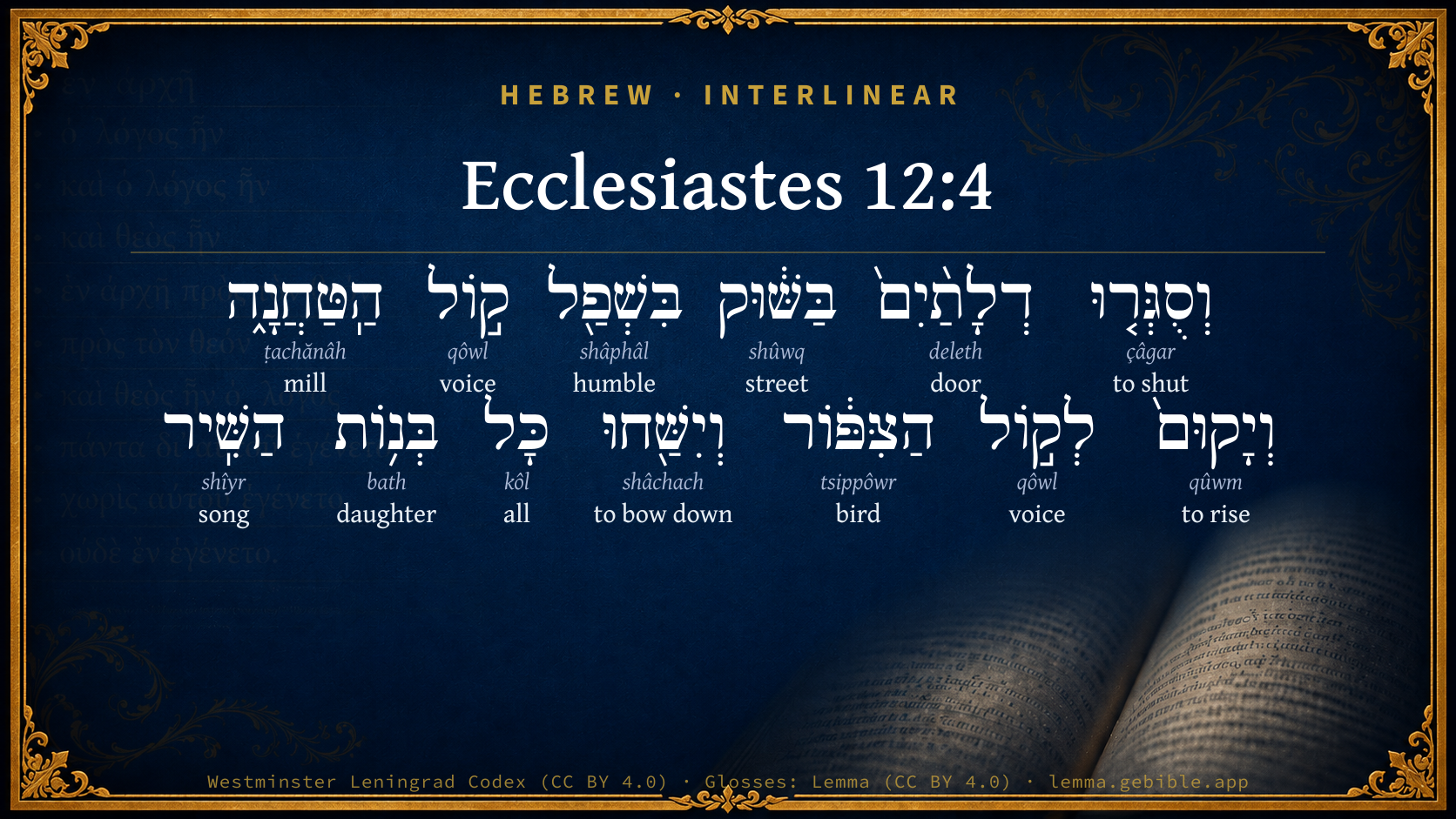
Hebrew (Westminster Leningrad Codex) Ecclesiastes 12:4 appears in the Hebrew Old Testament. The text above is from the Westminster Leningrad Codex. Each word links to its Strong’s number, a concise gloss, and parsing drawn from the Open Scriptures Hebrew Bible morphology. Click any word for its full Brown-Driver-Briggs (BDB) entry.
Download image
Cite this verse

Ecclesiastes 12:4 (World English Bible). Public Domain. Lemma interlinear Bible study tool, https://lemma.gebible.app/v/ecclesiastes/12/4.

Show BibTeX & RIS
BibTeX
RIS
English Translation
And the doors shall be shut in the street; When the sound of the grinding is low, And one shall rise up at the voice of a bird, And all the daughters of music shall be brought low;
World English Bible · Public Domain
Highlights
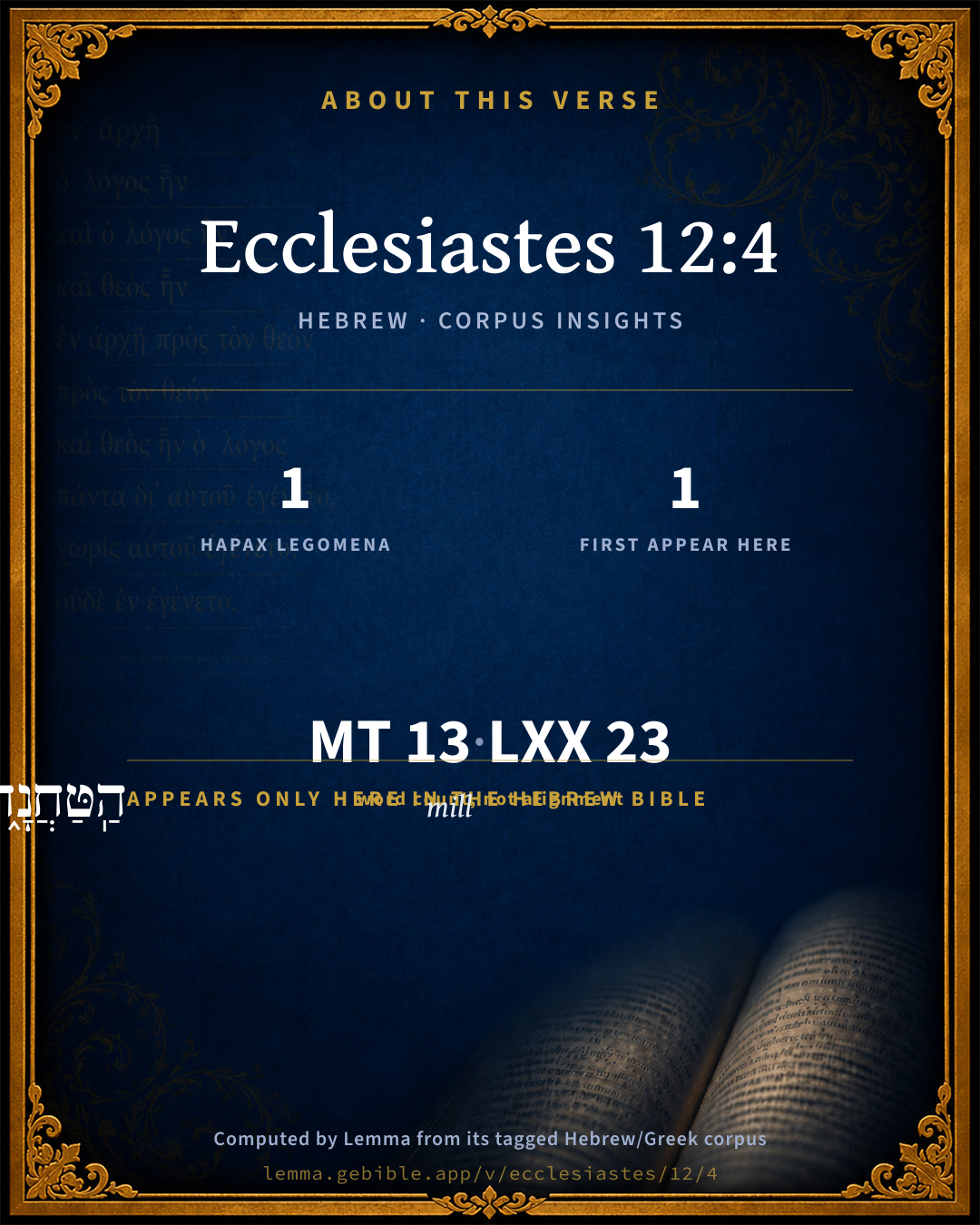
  • 1 hapax legomenon — only here in the Hebrew Bible
  • 1 first appearance in the Hebrew Bible
Full analysis ↓
Download a study sheet

One document with this verse’s original text, its word-by-word gloss line, the meaning frame, cross-references with their text, attributed commentary, and full source and license credits — printable, and it pastes into notes with its structure intact.

This verse Autodidact and up

Study sheet (.html) Plain text (.txt)

A passage Seminary Student

Up to 50 verses in one chapter. A passage sheet keeps up to 6 commentary sources and 12 cross-references per verse, in the order this page ranks them, and says so on the sheet whenever that leaves anything out. Ask for a single verse and you get the Autodidact verse sheet above.

Everything on this page stays free to read, with no account — the sheet is a download of what is already on screen, not access to it.

Want to remove ads? Support Godless Engineer
Compare translations 3

The same verse in 3 English versions, stacked beneath the original-language interlinear above. Click any original word for its lexicon entry.

Each is an independent rendering of the whole verse — the interlinear is not word-aligned to these translations.

Highlighted words mark where these versions differ — a whole-verse word diff, not a word-by-word alignment.

  • World English Bible Public Domain
    And the doors shall be shut in the street; When the sound of the grinding is low, And one shall rise up at the voice of a bird, And all the daughters of music shall be brought low;
  • King James Version Public Domain
    And the doors shall be shut in the streets, when the sound of the grinding is low, and he shall rise up at the voice of the bird, and all the daughters of musick shall be brought low;
  • unfoldingWord Literal Text CC BY-SA 4.0
    and doors will be shut in the street; when the sound of the grinding low, and a person rises at the sound of the bird, and all the daughters of song are stooped;

unfoldingWord Literal Text — © unfoldingWord, licensed CC BY-SA 4.0. Word-aligned USFM3 via Door43 (git.door43.org/unfoldingWord/en_ult).

Versions to compare (up to 4)

3 of 4 selected

Show all 18 translations

Every available English version of this verse, each an independent rendering of the whole verse.

  • World English Bible Public Domain
    And the doors shall be shut in the street; When the sound of the grinding is low, And one shall rise up at the voice of a bird, And all the daughters of music shall be brought low;
  • Berean Standard Bible Public Domain
    when the doors to the street are shut and the sound of the mill fades away, when one rises at the sound of a bird and all the daughters of song grow faint,
  • Majority Standard Bible Public Domain
    when the doors to the street are shut and the sound of the mill fades away, when one rises at the sound of a bird and all the daughters of song grow faint,
  • King James Version Public Domain
    And the doors shall be shut in the streets, when the sound of the grinding is low, and he shall rise up at the voice of the bird, and all the daughters of musick shall be brought low;
  • American Standard Version (1901) Public Domain
    and the doors shall be shut in the street; when the sound of the grinding is low, and one shall rise up at the voice of a bird, and all the daughters of music shall be brought low;
  • Revised Version (1885) Public Domain
    and the door shall be shut in the street; when the sound of the grinding is low, and one shall rise up at the voice of a bird, and all the daughters of music shall be brought low;
  • Geneva Bible (1599) Public Domain
    And the doores shall be shut without by the base sound of the grinding, and he shall rise vp at the voice of the birde: and all the daughters of singing shall be abased.
  • Douay-Rheims (1899) Public Domain
    And they shall shut the doors in the street, when the grinder's voice shall be low, and they shall rise up at the voice of the bird, and all the daughters of music shall grow deaf.
  • Young's Literal Translation Public Domain
    And doors have been shut in the street. When the noise of the grinding is low, And `one' riseth at the voice of the bird, And all daughters of song are bowed down.
  • Literal Standard Version CC BY-SA 4.0
    And doors have been shut in the street. When the noise of the grinding is low, || And [one] rises at the voice of the bird, || And all daughters of song are bowed down.
  • Unlocked Literal Bible CC BY-SA 4.0
    That will be the time when the doors are shut in the street, and the sound of grinding stops, when men are startled at the voice of a bird, and the singing of girls' voices fades away.
  • unfoldingWord Literal Text CC BY-SA 4.0
    and doors will be shut in the street; when the sound of the grinding low, and a person rises at the sound of the bird, and all the daughters of song are stooped;
  • Darby Bible Public Domain
    and the doors are shut toward the street; when the sound of the grinding is subdued, and they rise up at the voice of the bird, and all the daughters of song are brought low;
  • World Messianic Bible Public Domain
    and the doors shall be shut in the street; when the sound of the grinding is low, and one shall rise up at the voice of a bird, and all the daughters of music shall be brought low;
  • Webster's Bible Public Domain
    And the doors shall be shut in the streets, when the sound of the grinding shall be low, and he shall rise up at the voice of the bird, and all the daughters of music shall be brought low.
  • Free Bible Version CC BY-SA 4.0
    and the doors to the street are shut. Before the sound of the grinding mill grows low, and you wake up early when the birds are singing, but you can hardly hear them.
  • Bible in Basic English Public Domain
    When the doors are shut in the street, and the sound of the crushing is low, and the voice of the bird is soft, and the daughters of music will be made low;
  • JPS Tanakh (1917) Public Domain
    And the doors shall be shut in the street, when the sound of the grinding is low; and one shall start up at the voice of a bird, and all the daughters of music shall be brought low;

Literal Standard Version (2020), Covenant Press — licensed CC BY-SA 4.0. Text via the HelloAO Bible API (eBible.org). Unlocked Literal Bible (unfoldingWord) — licensed CC BY-SA 4.0. Text via the HelloAO Bible API (eBible.org). unfoldingWord Literal Text — © unfoldingWord, licensed CC BY-SA 4.0. Word-aligned USFM3 via Door43 (git.door43.org/unfoldingWord/en_ult). Free Bible Version, Dr. Jonathan Gallagher — licensed CC BY-SA 4.0. Text via the HelloAO Bible API (eBible.org).

Word by word

More ways to search: Search by grammar → Find every occurrence → Compare this word →

Practice this passage: Drill this verse → Learn its vocabulary →

הַֽטַּחֲנָ֑ה
ṭachănâh
H2913
“the · mill”
Particle, Definite Article + Noun, Common, Feminine, Singular, Absolute
Part of Speech
Particle + Noun
Type
Common
Gender
Feminine
Number
Singular
State
Absolute
Full BDB Definition

Origin: from H2912

TWOT: 802b

mill
  1. וְסֻגְּר֤וּ çâgar H5462 “and · to shut” Conjunction + Verb, Pual, Sequential Perfect, 3rd Person, Common, Plural
  2. דְלָתַ֨יִם֙ deleth H1817 “doors” Noun, Common, Feminine, Dual, Absolute
  3. בַּשּׁ֔וּק shûwq H7784 “in/at the · street” Preposition, Determined + Noun, Common, Masculine, Singular, Absolute
  4. בִּשְׁפַ֖ל shâphâl H8217 “in/at · humble” Preposition + Verb, Qal, Infinitive Construct
  5. ק֣וֹל qôwl H6963 “voice of” Noun, Common, Masculine, Singular, Construct
  6. וְיָקוּם֙ qûwm H6965 “and · to rise” Conjunction + Verb, Qal, Imperfect, 3rd Person, Masculine, Singular
  7. לְק֣וֹל qôwl H6963 “to/for · voice of” Preposition + Noun, Common, Masculine, Singular, Construct
  8. הַצִּפּ֔וֹר tsippôwr H6833 “the · bird” Particle, Definite Article + Noun, Common, Both, Singular, Absolute
  9. וְיִשַּׁ֖חוּ shâchach H7817 “and · to bow down” Conjunction + Verb, Niphal, Imperfect, 3rd Person, Masculine, Plural
  10. כָּל kôl H3605 “all of” Noun, Common, Masculine, Singular, Construct
  11. בְּנ֥וֹת bath H1323 “daughters of” Noun, Common, Feminine, Plural, Construct
  12. הַשִּֽׁיר shîyr H7892 “the · song” Particle, Definite Article + Noun, Common, Both, Singular, Absolute

About this verse

These counts appear in no published source. They are computed here, from the morphology-tagged text and Lemma’s own curated glosses. What Lemma adds →

13
words
12
distinct lemmas
Wisdom
section

Notable vocabulary

1 hapax legomenon — a word that appears only here in the entire Hebrew Bible:

  • הַֽטַּחֲנָ֑ה mill H2913

First appearance in Scripture

This word makes its first canonical appearance in the Hebrew Bible here:

  • הַֽטַּחֲנָ֑ה mill H2913

Shared distinctive vocabulary

בַּשּׁ֔וּק street H7784 occurs in 4 verses of the Hebrew Bible. Also found in:

Grammatical profile

  • 4 verbs
  • 9 nouns

Verb forms

  • וְסֻגְּר֤וּ Pual · Sequential Perfect
  • בִּשְׁפַ֖ל Qal · Infinitive Construct
  • וְיָקוּם֙ Qal · Imperfect
  • וְיִשַּׁ֖חוּ Niphal · Imperfect

Repetition

A word recurs within this verse — often emphatic in Hebrew:

  • ק֣וֹל voice H6963 ×2

Hebrew & Septuagint length

In English translation the verse runs 38 words from the Hebrew and 44 from the Septuagint (LXX English) — closely comparable.

A rough comparison of the two English renderings, which tokenize alike — not a word-level alignment.

Word counts can differ between the Hebrew and the Greek without any difference in meaning — e.g. the Hebrew direct-object marker אֵת has no separate Greek word, and Greek often adds the article ὁ.

In the original languages it is 13 Hebrew tokens and 23 Greek tokens — but the two are counted differently (Hebrew bundles its prefixes and suffixes into one token; the Greek is in lemma form), so that isn’t a like-for-like length.

Cross-references

3

Topical passages linked to Ecclesiastes 12:4 in the Treasury of Scripture Knowledge — connected by theme and wording, ordered by reader-vote popularity; previews shown in the World English Bible.

  • Jeremiah 25:10 Moreover I will take from them the voice of mirth and the voice of gladness, the voice of the bridegroom and the voice of the bride, the sound of the millstones, and the light of the lamp.
  • 2 Samuel 19:35 I am this day eighty years old: can I discern between good and bad? can your servant taste what I eat or what I drink? can I hear any more the voice of singing men and singing women? why then should your servant be yet a burden to my lord the king?
  • Revelation 18:22 The voice of harpists, minstrels, flute players, and trumpeters will be heard no more at all in you. No craftsman, of whatever craft, will be found any more at all in you. The sound of a mill will be heard no more at all in you.

Cross-references courtesy of OpenBible.info (CC BY 4.0).

Hebrew and Greek witnesses Masoretic Hebrew ↔ Greek Septuagint

The same verse in the two great witnesses to the Old Testament, shown verse-for-verse.

These are two independent witnesses, not word-aligned to each other, and the Septuagint is shown in lemma (dictionary) form.

Hebrew Ecclesiastes 12:4 Masoretic · Westminster Leningrad Codex

וְסֻגְּר֤וּ דְלָתַ֨יִם֙ בַּשּׁ֔וּק בִּשְׁפַ֖ל ק֣וֹל הַֽטַּחֲנָ֑ה וְיָקוּם֙ לְק֣וֹל הַצִּפּ֔וֹר וְיִשַּׁ֖חוּ כָּל בְּנ֥וֹת הַשִּֽׁיר

And the doors shall be shut in the street; When the sound of the grinding is low, And one shall rise up at the voice of a bird, And all the daughters of music shall be brought low;

World English Bible · Public Domain

Greek LXX Ecclesiastes 12:4 Septuagint · lemma form

καί κλείω θύρα ἐν ἀγορά ἐν ἀσθένεια φωνή ὁ ἀλήθω καί ἀναἵστημι εἰς φωνή ὁ στρουθίον καί ταπεινόω πᾶς ὁ θυγάτηρ ὁ ἆ

and they shall shut the doors in the marketplace, because of the weakness of the voice of her that grinds at the mill; and he shall rise up at the voice of the sparrow, and all the daughters of song shall be brought low;

LXX2012 (modern English Septuagint) · Public Domain

Hebrew: Westminster Leningrad Codex (CC BY 4.0). Greek: Septuagint (public domain); English from LXX2012 (modern English Septuagint) (Public Domain). How the Septuagint differs from the Hebrew →

Commentary

Notes on Ecclesiastes 12:4 from classic Christian and Jewish commentators (each source and its license shown beneath its notes). The classic Christian expositions comment on the surrounding passage and are grouped to its opening verse, so a note may address several verses; the Jewish commentaries on the Tanakh (Rashi and others) are per-verse, so they appear only where the commentator wrote on this verse.

Lemma curates 59 commentaries, every one of them public domain or Creative Commons licensed, each selected and text-cleaned for this edition rather than reprinted as found. About our sources →

Trapp's Complete Commentary

John Trapp

Ecc 12:4 And the doors shall be shut in the streets, when the sound of the grinding is low, and he shall rise up at the voice of the bird, and all the daughters of musick shall be brought low;

Ver. 4. And the doors shall be shut in the streets.] The ears shall grow deaf, the hearing weak, which hearing is caused by two bones within the inside of the ear, whereof one stands still and the other moves, like the two stones of a mill.

And he shall rise up at the voice of the bird.] Being awakened by every small noise; and this proceeds not from the quickness of the hearing, but from the badness of sleeping. For as Jerome speaketh, Frigescente iam sanguine, &c. :{a} The blood now growing cold, and the moisture being dried up, by which matters sleep should be nourished. The old man awakeneth with a little sound, and at midnight, when the cock croweth, he riseth speedily, {b} being not able often to turn his members in his bed. Thus he. Cocks crowing, saith another, unto old men is the scholar’s bell, that calls them to think of the things that are in God’s book every morning.

And all the daughters of music shall be brought low.] Old men, as they cannot sing tunably, but creak or scream (whence Homer compares them to grasshoppers, propter raucam vocem, for their unpleasant voice), so they can take no delight in the melodious notes of others, as old Barzillai confesseth; {2Sa 19:35} they discern not the harmony or distinction of sounds, neither are affected with music. {c} They must therefore labour to become temples of the Holy Ghost (in whose temple there never wants music), and sing psalms "with grace in their hearts," for, Non vex, sed votum; non musica chordula, nen cor; non clamans, non amans, psallit in aure Dei.

{a} Jerome, on this verse.

{b} Aλεκτωρ dicitur, quia nos a lecto exsuscitat.

{c} Nam quae cantante voluptas? - Juvenal.

John Trapp, A Commentary or Exposition upon All the Books of the Old and New Testament (1647–1656) — public domain. Text from a community e-Sword module.

The Biblical Illustrator

Joseph S. Exell

Ecc_12:4

The doors shall be shut in the streets.

Doors

Literally, double deers. This occurs in the description of the decrepitude of an old man: The keepers of the house (the arms) shall tremble, and the strong men (the legs) shall bow themselves, and the grinders (the teeth) cease because they are few, and those that leek out of the windows (our natural interest in the world) be darkened, and the double doors shall be shut in the street. By double doors is meant those bodily functions which have double organs--eyes, cars, nostrils, lips, the openings of sense and communication with the world. It is a great thing to have the house of the soul stored with good, with true thoughts, bright hopes, sweet loves, comfortable conscience, the various feed of Divine promises, and best of all is to have God, the source of all good, inside with us when the double doors no longer open. I once heard a man cursing with screeching rage his coming blindness, and a paralytic swearing at his fate with half-palsied tongue, struggling impotently like a convict resisting the shutting of the doors of his cell. But, on the other hand, some of the sweetest-tempered persons are blind or deaf. Beethoven was full of music though deaf; the music was stored there in his knowledge of harmony through previous study. Miltons mind was full of light, though he was blind; the vast stores of knowledge were laid in before the doers were closed. (J. M. Ludlow, D. D.)

The Biblical Illustrator, edited by Joseph S. Exell (c. 1880s–1900s) — public domain. Text from a community e-Sword module.

Joseph Benson's Commentary

Ecc 12:4. And the doors be shut in the streets — Or toward the streets: which lead into the street. This may be understood, either of the outward senses, which, as doors, let in outward objects to the soul; or, rather, of the mouth, or the two lips, here expressed by a word of the dual number, which, like a door, open or shut the way that leads into the streets or common passages of the body, as the gullet, stomach, and all the bowels; as also the wind-pipe and lungs, which also are principal instruments both of speaking and eating. And these are said to be shut, not absolutely, as if men did never eat, or drink, or speak, but comparatively, because men, in old age, grow dull and listless, having little appetite to eat, and are very frequently indisposed for discourse. When the sound of the grinding is low — When the teeth are loose and few, whereby both his speech is low, and the noise which he makes in eating is but small. And he shall rise — From his bed, being weary with lying, and unable to get sleep. At the voice of the bird — As soon as the birds begin to chirp, which is early in the morning, whereas young men can lie and sleep long. And all the daughters of music — All those senses or parts of the body, which are employed in music, shall be brought low — Shall be cast down from their former excellence, and become incapable either of making music, or of delighting in it.

Joseph Benson's Commentary on the Old and New Testaments (1811–1818) — public domain. Text from a community e-Sword module.

Keil & Delitzsch

C. F. Keil & F. Delitzsch

From the eyes the allegory proceeds to the mouth, and the repugnance of the old man to every noise disturbing his rest: "And the doors to the street are closed, when the mill sounds low; and he rises up at the voice of a bird; and all the daughters of song must lower themselves." By the door toward the street the Talm. and Midrash understand the pores or the emptying members of the body, - a meaning so far from being ignoble, that even in the Jewish morning prayer a Beracha is found in these words: "Blessed art Thou, O Lord our God, King of the world, who hast wisely formed man, and made for him manifold apertures and cavities. It is manifest and well known before the throne of Thy Majesty, that if one of these cavities is opened, or one of these apertures closed, it is impossible for him to exist and to stand before Thee; blessed art Thou, O Lord, the Physician of the body, and who doest wondrous words!" The words which follow הטּ ... בּשׁ are accordingly to be regarded as assigning a reason for this closing: the non-appearance of excretion has its reason in defective digestion in this, that the stomach does not grind (Talm.: וגו בשרקבן

(Note: Cf. Berachoth 61b: The stomach (קורקבן) grinds. As hamses is properly the caul of the ruminant, so this word קוּרקבן is the crop (bibl. מראה) of the bird.)

בשביל). But the dual דּלתים suggests a pair of similar and related members, and בּשּׁוּק a pair of members open before the eyes, and not such as modesty requires to be veiled. The Targum therefore understands the shutting of the doors properly; but the mills, after the indication lying in הטּ grinding maids, it understands of the organs of eating and tasting, for it translates: "thy feet will be fettered, so that thou canst not go out into the street; and appetite will fail thee." But that is an awkward amalgamation of the literal with the allegorical, which condemns itself by this, that it separates the close connection of the two expressions required by בּשׁפל, which also may be said of the reference of dlt' to the ears, into which no sound, even from the noisy market, penetrates (Gurlitt, Grtz). We have for דלתים a key, already found by Aben Ezra, in Job 41:2, where the jaws of the leviathan are called פּניו דּלתי; and as Herzf. and Hitz. explain, so Samuel Aripol in his Commentary, which appeared in Constantinople, 1855, rightly: "He calls the jaws דלתים, to denote that not two דלתות in two places, but in one place, are meant, after the manner of a door opening out to the street, which is large, and consists of two folds or wings, דלתות, which, like the lips (השׂפתים, better: the jaws), form a whole in two parts; and the meaning is, that at the time of old age the lips are closed and drawn in, because the teeth have disappeared, or, as the text says, because the noise of the mill is low, just because he has no teeth to grind with." The connection of סגּרוּ and בּשׁפל is, however, closer still: the jaws of an old man are closed externally, for the sound of the mill is low; i.e., since, when one masticates his food with the jaws of a toothless mouth, there is heard only a dull sound of this chewing (Mumpfelns, vid., Wiegand's Deut. W.B.), i.e., laborious masticating. He cannot any more crack or crunch and break his food, one hears only a dull munching and sucking. - The voice of the mouth (Bauer, Hitz., Gurlitt, Zckl.) cannot be the meaning of קול הט; the set of teeth (Gurlitt indeed substitutes, Ecc 12:3, the cavity of the mouth) is not the organ of voice, although it contributes to the formation of certain sounds of words, and is of importance for the full sound of the voice.

בּשּׁוּק, "to the street," is here = on the street side; שׁפל is, as at Pro 16:19, infin. (Symmachus: ἀχρειωθείσης τῆς φωνῆς; the Venet.: ἐν τῷ ταπεινῶσθαι τὴν φωνήν), and is to be understood after Isa 29:4; טחנה stands for רחים, as the vulgar Arab. tahûn and matḥana instead of the antiquated raḥâ. Winzer now supposes that the picture of the night is continued in 4b: et subsistit (vox molae) ad cantum galli, et submissius canunt cantatrices (viz., molitrices). Elster, with Umbreit, supposes the description of a storm continued: the sparrow rises up to cry, and all the singing birds sink down (flutter restlessly on the ground). And Taylor supposes the lament for the dead continued, paraphrasing: But the bird of evil omen [owl, or raven] raises his dirge, and the merry voice of the singing girls is silent.

These three pictures, however, are mere fancies, and are also evidently here forced upon the text; for יקוט קול cannot mean subsistit vox, but, on the contrary (cf. Hos 10:14), surgit (tollitur) vox; and יקום לקול cannot mean: it (the bird) raises itself to cry, which would have required יקום לתת קולו, or at least לקּול, after למלחמה קום, etc.; besides, it is to be presumed that צפור is genit., like קול עוגב and the like, not nom. of the subj. It is natural, with Hitz., Ewald, Heiligst., Zck., to refer qol tsippor to the peeping, whispering voice ("Childish treble" of Shakespeare) of the old man (cf. stiphtseph, Isa 29:4; Isa 38:14; Isa 10:14; Isa 8:19). But the translation: "And it (the voice) approaches a sparrow's voice," is inadmissible, since for ל קום the meaning, "to pass from one state to another," cannot be proved from Sa1 22:13; Mic 2:8; קום signifies there always "to rise up," and besides, qol tahhanah is not the voice of the mouth supplied with teeth, but the sound of the chewing of a toothless mouth. If leqol is connected with a verb of external movement, or of that of the soul, it always denotes the occasion of this movement, Num 16:34; Eze 27:28; Job 21:12; Hab 3:16. Influenced by this inalienable sense of the language, the Talm. explains צף ... ויקום by "even a bird awakes him." Thus also literally the Midrash, and accordingly the Targ. paraphrasing: "thou shalt awaken out of thy sleep for a bird, as for thieves breaking in at night." That is correct, only it is unnecessary to limit ויקוּם (or rather ויקום,

(Note: Vav with Cholem in H. F. Thus rightly, according to the Masora, which places it in the catalogue of those words which occur once with a higher (יקום) and once with a lower vowel (yקוּם), Mas. fin. 2a b, Ochlaweochla, No. 5; cf. also Aben Ezra's Comm. under Psa 80:19; Zachoth 23a, Safa berura 21b (where Lipmann is uncertain as to the meaning).)

which accords with the still continued subordination of Ecc 12:4 to the eo die quo of Ecc 12:3) to rising up from sleep, as if it were synonymous with ויעור: the old man is weak (nervously weak) and easily frightened, and on account of the deadening of his senses (after the figure of Ecc 12:2, the darkening of the five stars) is so liable to mistake, that if even a bird chirps, he is frightened by it out of his rest (cf. hēkim, Isa 14:9).

Also in the interpretation of the clause haשׁיר ... וישּׁחוּ, the ancients are in the right track. The Talm. explains: even all music and song appear to him like common chattering (שׂוּחה or, according to other readings, שׂיחה); the proper meaning of ychsw is thus Haggad. twisted. Less correctly the Midrash: בנות השיר are his lips, or they are the reins which think, and the heart decides (on this curious psychol. conception, cf. Chullin 11a, and particularly Berachoth 61a, together with my Psychol. p. 269). The reference to the internal organs if priori improbable throughout; the Targ. with the right tact decides in favour of the lips: "And thy lips are untuned, so that they can no more say (sing) songs." In this translation of the Talm. there are compounded, as frequently, two different interpretations, viz., that interpretation of בן השׁ, which is proved by the כל going before to be incorrect, because impossible; and the interpretation of these "daughters of song" of "songs," as if these were synonymous designations, as when in Arab. misfortunes are called banatu binasan, and the like (vid., Lane's Lex. I p. 263); בּת קול, which in Mish. denotes a separate voice (the voice of heaven), but in Syr. the separate word, may be compared. But ישׁחוּ (fut. Niph. of שׁחח) will not accord with this interpretation. For that בן השׁ denotes songs (Hitz., Heiligst.), or the sound of singing (Bttch.), or the words (Ewald) of the old man himself, which are now softened down so as to be scarcely audible, is yet too improbable; it is an insipid idea that the old man gives forth these feeble "daughters of song" from his mouth. We explain ישׁחו of a being bowed down, which is external to the old man, and accordingly understand benoth hashshir not of pieces of music (Aq. πάντα τὰ τῆς ᾠδῆς) which must be lowered to pianissimo, but according to the parallel already rightly acknowledge by Desvoeux, Sa2 19:36, where the aged Barzillai says that he has now no longer an ear for the voice of singing men and singing women, of singing birds (cf. בּר זמירא of a singing bird in the Syrian fables of Sophos, and banoth of the branches of a fruit tree, Gen 49:22), and, indeed, so that these are a figure of all creatures skilled in singing, and taking pleasure in it: all beings that are fond of singing, and to which it has become as a second nature, must lower themselves, viz., the voice of their song (Isa 29:4) (cf. the Kal, Psa 35:14, and to the modal sense of the fut. Ecc 10:10, יגּבּר, and Ecc 10:19, ישׂמּח), i.e., must timidly retire, they dare not make themselves heard, because the old man, who is terrified by the twittering of a little bird, cannot bear it.

Keil & Delitzsch — Biblical Commentary on the Old Testament (1861–1891) — public domain (CC PDM 1.0). Text via the HelloAO Bible API. (Old Testament only.)

Geneva Bible (1599)

Geneva Bible translators

When the jaws, shall scarce open, and not be able to chew anymore.

That is, the wind pipes, or the ears shall be deaf and not able to hear singing.

The lips, or mouth.

He shall not be able to sleep.

Geneva Bible (1599) marginal notes — public domain. Text via Bolls.life.

Jamieson, Fausset & Brown

Robert Jamieson, A. R. Fausset & David Brown

doors--the lips, which are closely shut together as doors, by old men in eating, for, if they did not do so, the food would drop out (Job 41:14; Psa 141:3; Mic 7:5).

in the streets--that is, toward the street, "the outer doors" [MAURER and WEISS].

sound of . . . grinding--The teeth being almost gone, and the lips "shut" in eating, the sound of mastication is scarcely heard.

the bird--the cock. In the East all mostly rise with the dawn. But the old are glad to rise from their sleepless couch, or painful slumbers still earlier, namely, when the cock crows, before dawn (Job 7:4) [HOLDEN]. The least noise awakens them [WEISS].

daughters of music--the organs that produce and that enjoy music; the voice and ear.

Jamieson, Fausset & Brown — Commentary Critical and Explanatory on the Whole Bible (1871) — public domain (CC PDM 1.0). Text via the HelloAO Bible API.

Adam Clarke's Commentary

Verse 4. And the doors shall be shut in the streets]

5. The doors - the lips, which are the doors by which the mouth is closed.

6. Be shut in the streets] The cavities of the cheeks and jaws, through which the food may be said to travel before it is fitted by mastication or chewing to go down the aesophagus into the stomach. The doors or lips are shut to hinder the food in chewing from dropping out; as the teeth, which prevented that before, are now lost.

7. The sound of the grinding is low] Little noise is now made in eating, because the teeth are either lost, or become so infirm as not to suffer their being pressed close together; and the mouth being kept shut to hinder the food from dropping out, the sound in eating is scarcely heard. The teeth are divided into three kinds: -

1) The dentes incisores, or cutting teeth, in the front of the jaw.

2) The dentes canini, or dog teeth, those in the sides of the jaws, for gnawing, or tearing and separating hard or tough substances. And,

3) Dentes molares, or grinding teeth, the posterior or double teeth, in both jaws, generally termed the grinders; because their office is to grind down the substances that have been cut by the fore teeth, separated into their parts or fibres by the dog teeth, and thus prepare it for digestion in the stomach.

8. He shall rise up at the voice of the bird] His sleep is not sound as it used to be; he slumbers rather than sleeps; and the crowing of the cock awakes him. And so much difficulty does he find to respire while in bed, that he is glad of the dawn to rise up and get some relief. The chirping ot the sparrow is sufficient to awake him.

9. All the daughters of music shall be brought low] The VOICE, that wonderful instrument, almost endless in the strength and variety of its tones, becomes feeble and squeaking, and merriment and pleasure are no more. The tones emitted are all of the querulous or mournful kind.

Adam Clarke's Commentary on the Bible (1810–1826) — public domain. Text from a community e-Sword/MySword module.

Ellicott's Commentary for English Readers

(4) The first two clauses continue the description of the afflicted house; all communication with the outer world broken off: the double doors towards the street shut, the cheerful noise of grinding not heard without (Jer_25:10-11; Rev_18:22). If a more minute explanation of the double doors is to be given, we may understand the verse as speaking of the closing of the lips on the falling away of the teeth. (See Job_41:14; Psa_141:3; Mic_5:7.)

He shall rise up.—No satisfactory explanation of this clause has been given. The following are three of the best interpretations that have been proposed: (1) The old man, whose state has been figuratively described before, is said to sleep so badly that the chirping of a bird will awake him. (2) His voice becomes feeble like the chirping of a bird (Isa_29:4). (3) The bird of ill omen raises its voice (Psa_102:6-7; Zep_2:14). Each of these interpretations is open to serious objections, which I do not state at length, having myself nothing better to propose.

A Bible Commentary for English Readers, edited by Charles John Ellicott (1878–1897) — public domain. Text from a community e-Sword module.

The Cambridge Bible for Schools and Colleges

gen. ed. J. J. S. Perowne

4. and the doors shall be shut in the streets] The picture of the city under the terror of the storm is continued. The gates of all houses are closed. None leave their houses; the noise of the mill ceases. The bird (probably the crane or the swallow) rises in the air with sharp cries (literally, for a cry). Even the “daughters of song” (the birds that sing most sweetly, the nightingale or thrush, or possibly the “singing women” of ch. Ecc_2:8, whose occupation is gone in a time of terror and dismay) crouch silently, or perhaps, chirp in a low tone. Few will dispute the vividness of the picture. The interpretation of the symbols becomes, however, more difficult than ever. The key is probably to be found in the thought that as we had the decay of bodily organs in the previous verse, so here we have that of bodily functions. The “doors” (the Hebrew is dual as representing what we call “folding doors”) are the apertures by which the life of processes of sensation and nutrition from its beginning to its end is carried on, and the failure of those processes in extreme age, or in the prostration of paralysis, is indicated by the “shutting” of the doors. What we may call the dual organs of the body, lips, eyes, ears, alike lose their old energies. The mill (a better rendering than “grinding”) is that which contains the “grinders” of Ecc_12:3, i.e. the mouth, by which that process begins, can no longer do its work of vocal utterance rightly. The words “he shall rise up at the voice of the bird” have for the most part been taken as describing the sleeplessness of age, the old man waking at a sparrow’s chirp, but this interpretation is open to the objections (1) that it abruptly introduces the old man as a personal subject in the sentence, while up to this point all has been figurative; and (2) that it makes the clause unmeaning in its relation to the picture of the terror-stricken city, below which we see that of the decay of man’s physical framework. Adopting the construction given above, we get that which answers to the “childish treble” of the old man’s voice, and find a distinct parallel to it in the elegy of Hezekiah “Like a crane or a swallow, so did I chatter” (Isa_38:14); the querulous moaning which in his case was the accompaniment of disease becoming, with the old or the paralysed, normal and continuous. The “daughters of song” are, according to the common Hebrew idiom, those that sing, birds or women, as the case may be. Here, their being “brought low,” i.e. their withdrawal from the stage of life, may symbolise the failure either of the power to sing, or of the power to enjoy the song of others. The words of Barzillai in 2Sa_19:35 paint the infirmities of age in nearly the same form, though in less figurative language. “Can thy servant taste what I eat or drink? Can I hear any more the voice of singing men or singing women?” The interpretations which find in the “daughters of song” either (1) the lips as employed in singing, or (2) the ears as drinking in the sounds of song, though each has found favour with many commentators, have less to commend them, and are open to the charge of introducing a needless and tame repetition of phenomena already described.

With the picture of old age thus far we may compare that, almost cynical in its unsparing minuteness, of Juvenal Sat. x. 200–239. A few of the more striking parallels may be selected as examples:

“Frangendus misero gingiva panis inermi.”

“Bread must be broken for the toothless gums.”

“Non eadem vini, atque cibi, torpente palato, Gaudia.”

“For the dulled palate wine and food have lost Their former savours.”

“Adspice partis

Nunc damnum alterius; nam quæ cantante voluptas,

Sit licet eximius citharœdus, sitve Seleucus,

Et quibus auratâ mos est fulgere lacernâ?

Quid refert, magni sedeat quâ parte theatri,

Qui vix cornicines exaudiet, atque tubarum

Concentus.”

“Now mark the loss of yet another sense:

What pleasure now is his at voice of song.

How choice soe’er the minstrel, artist famed,

Or those who love to walk in golden robes?

What matters where he sits in all the space

Of the wide theatre, who scarce can hear

The crash of horns and trumpets?”

Or again

“Ille humero, hic lumbis, hic coxâ debilis; ambos

Perdidit ille oculos, et luscis invidet; hujus

Pallida labra cibum accipiunt digitis alienis.

Ipse ad conspectum cœnæ diducere rictum

Suetus, hiat tantùm, ceu pullus hirundinis, ad quem

Ore volat pleno mater jejuna.”

“Shoulders, loins, hip, each failing in its strength

Now this man finds, now that, and one shall lose

Both eyes, and envy those that boast but one.…

And he who used, at sight of supper spread,

To grin with wide-oped jaw, now feebly gapes,

Like a young swallow, whom its mother bird

Feeds from her mouth filled, though she fast herself.”

The Cambridge Bible for Schools and Colleges (gen. ed. J. J. S. Perowne; Cambridge University Press, 1878–1918) — public domain. Text from a community e-Sword module.

John Gill's Exposition

And the doors shall be shut in the streets,.... The Midrash and Jarchi interpret these of the holes of the body; in which they are followed by our learned and ingenuous countryman, Dr. Smith; who, by them, understands the inlets and outlets of the body; and, by the "streets", the ways and passages through which the food goes, and nourishment is conveyed; and which may be said to be shut, when they cease from their use: but it seems much better, with Aben Ezra and others, to interpret them of the lips; which are sometimes called the doors of the mouth, or lips, Psa 141:3; which are opened both for speaking and eating; but, in aged persons, are much shut as to either; they do not choose to speak much, because of the disagreeableness of their voice, and difficulty of speech, through the shortness of breath, and the loss of teeth; nor do they open them much to eat, through want of appetite; and while eating, are obliged, for want of teeth, to keep their lips close, to retain their food from falling out; they mumble with their lips both in speaking and eating; and, particularly in public, aged persons care not to speak nor eat, for the reason following: though some understand it, more literally, of their having the doors of their houses shut, and keeping within, and not caring to go abroad in the streets, because of their infirmities so the Targum,

"thy feet shall be bound from going in the streets;''

when the sound of the grinding is low; which the above Jewish writers, and, after them, Dr. Smith, understand of the stomach, grinding, digesting, and concocting food, and of other parts through which it is conveyed, and the offices they perform; but sound or voice does not seem so well to agree with that; rather therefore this is to be understood, as before, of the grinding of the teeth, through the loss of which so much noise is not heard in eating as in young men, and the voice in speaking is lower; the Targum is,

"appetite of food shall depart from thee;''

and he shall rise up at the voice of the bird; that is, the aged person, the least noise awakes him out of sleep; and as he generally goes to bed soon, he rises early at cock crowing, or with the lark, as soon as the voice of that bird or any other, is heard; particularly the cock, which crows very early, and whose voice is heard the most early, and is by some writers (f) emphatically called the bird that calls men to their work;

and all the daughters of music shall be brought low; either those that make music, and are the instruments of it, as the lungs, the throat, the teeth, mouth, and lips, so the Targum and Midrash; or those that receive music, as the ears, and the several parts of them, the cavities of them, particularly the tympanum and auditory nerve; all which, through old age, are impaired, and become very unfit to be employed in making music, or in attending to it: the voice of singing men and singing women could not be heard with pleasure by old Barzillai, Sa2 19:36. These clauses are expressive of the weakness which generally old age brings on men; very few instances are there to the contrary; such as of Caleb, who, at eighty five years of age, was as strong as at forty; and of Moses, whose natural force abated not at an hundred and twenty; nor indeed as of Cyrus, who, when seventy years of age, and near his death, could not perceive that he was weaker then than in his youth (g).

(f) "Inque suum miseros excitat ales opus", Ovid. Amorum, l. 1. Eleg. 6. v. 66. "Cristatus ales", ib. Fast. l. 1. v. 455. (g) Cicero in Catone Majore, sive de Senectute, c. 8.

John Gill's Exposition of the Whole Bible (1746–1763) — public domain (CC PDM 1.0). Text via the HelloAO Bible API.

Albert Barnes' Notes on the Bible

And the doors ... is low - The house is viewed from without. The way of entry and exit is stopped: little or no sound issues forth to tell of life stirring within. The old man, as he grows older, has less in common with the rising generation; mutual interest and social contact decline. Some take the doors and the sound of the mill as figures of the lips and ears and of the speech.

He shall rise ... - Here the metaphor of the house passes out of sight. The verb may either be taken impersonally ( “they shall rise,” compare the next verse): or as definitely referring to an old man, who as the master of the house rises out of sleep at the first sound in the morning.

All the daughters of musick - i. e., Singing women Ecc 2:8.

Be brought low - i. e., Sound faintly in the ears of old age.

Albert Barnes' Notes on the Bible (1834–1885) — public domain. Text from a community e-Sword/MySword module.

Haydock's Catholic Bible Commentary

Doors. The lips, (Calmet) feet, (Chaldean) nostrils, (Vatable) or the trachea and pulmonary arteries. --- Bird. The cock-crowing; or at the least sound their slumbers are broken. --- Deaf. Hebrew, "be low." The ears cannot enjoy music, nor can the voice of the old people please, 2 Kings xix. 25.

George Leo Haydock (1774–1849), Haydock's Catholic Family Bible and Commentary, 1859 edition — public domain. Excludes Psalms (Douay-Rheims chapter numbering differs from Protestant) and Deuterocanonical books (Catholic canon only).

Matthew Poole's English Annotations

The doors be shut in the streets; or, towards the streets; which lead into the streets. This is understood either,

1. Literally; because men, when they are very old, keep much at home, and have neither strength nor inclination to go abroad. Or rather,

2. Allegorically, as all the other clauses are understood. And so the doors are either,

1. The outward senses, which, as doors, let in outward objects to the soul. Or rather,

2. The mouth, or the two lips, here expressed by a word of the dual number, which are oft called a door, both in Scripture, as Psa 141:3; Mic 7:5, and in other authors, which, like a door, open or shut the way which leads into the streets or common passages of the body, such as the gullet, and stomach, and all the bowels, as also the windpipe and lungs; which also are principal instruments both of speaking and eating. And these are said to be shut, not simply and absolutely, as if they did never eat, or drink, or speak; but comparatively, because men in extreme old age grow dull and listless, having little or no appetite to eat, and are very much indisposed for discourse, and speak but seldom.

When the sound of the grinding is low; or, because the sound, &c. So this may be added, not as a new symptom of old age, but only as the reason of the foregoing symptom. The sense is, When or because the teeth, called the grinders, Ecc 12:3, are loose and few, whereby both his speech is low, and the noise which he makes in eating is but small. And this is one great cause of his indisposedness both to eating and to speaking. Some understand this of concoction, which after a sort doth grind the meat in the stomach, and in the other parts appointed by God for that work. But that is transacted inwardly, and without all noise or sound.

He shall rise up, to wit, from his bed, being weary with lying, and unable to get sleep,

at the voice of the bird; either,

1. Upon the smallest noise; which doth not consist with that deafness incident to old men, and described in the next words. Or rather,

2. As soon as the birds begin to chirp, which is early in the morning, whereas children and young men can lie and sleep long in the morning.

The daughters of music; all those senses or parts of the body which are employed in music and song, as well those which make it, as the parts of and within the mouth, as those which receive it, to wit, the ears.

Shall be brought low; shall be cast down from their former excellency; they are become incapable either of making music, or of delighting in it.

Matthew Poole's English Annotations on the Holy Bible (1683–1685) — public domain. Text from a community e-Sword/MySword module.

Whedon's Commentary on the Bible

Daniel D. Whedon

4. The doors — The mouth. See Job_41:14. In or on the streets, as being the front door, with valves like the lips of a man.

Shut — By loss of teeth. No dental art was known to Koheleth.

Sound of the grinding is low — Not merely the mastication, but the whole digestive and vital processes are feeble and slow, so that the man’s whole bodily system is like an almost silent mill.

Rise up at the voice of the bird — Better rendered by critics, it, (not he,) referring to “sound,” amounts to the voice of a sparrow. That is, the vital processes of this human mill are so feeble that its grinding “sound” is not louder than a sparrow’s cheep. This grinding “sound” is heard in the “low” and cracked voice of the old man.

Daughters of music — Of man’s divine endowment of “music,” the notes and strains of the musician are the offspring or “daughters.” These are brought low, so that no true “music” can be poured forth.

Daniel D. Whedon (gen. ed.), Commentary on the Old and New Testaments (1874–1909) — public domain. Text from a community e-Sword module.

The Pulpit Commentary

The doors shall be shut in the streets. Hitherto the symbolism has been comparatively easy to interpret. With this verse inextricable difficulties seem to arise. Of course, in one view it is natural that in the bitter weather, or on the appearance of a tempest, the doors towards the street should be closed, and none should leave the house. But what are meant by the doors in the metaphorical house, the body of the aged man? Jewish expositors understood them to be the pores, or excretive apertures of the body, which lose their activity in old age which seems an unseemly allusion. Plumptre will have them to be the organs which carry on the processes of sensation and nutrition from the beginning to the end; but it seems a forced metaphor to call these "double-doors." More natural is it to see in the word, with its dual form, the mouth closed by the two lips. So a psalmist speaks of the mouth, the door of the lips. (Psa_141:3; comp. Mic_7:5) As it is only the external door of a house that could be employed in this metaphor, the addition, "in or, "towards" the streets," is accounted for. When the sound of the grinding is low. The sound of the grinding or the mill is weak and low when the teeth have ceased to masticate, and, instead of the crunching and grinding of food, nothing is heard but a munching and sucking. The falling in of the mouth over the toothless gums is represented as the closing of doors. To take the words in their literal sense is to make the author repeat himself, reiterating what he is supposed to have said before in speaking of the grinding-women all labor is lessened or stopped. The sound of grinding betokenedcheerfulness and prosperity; its cessation would be an ominous sign. (see Jer_25:10; Rev_18:22) Another interpretation considers this clause to express the imperfect vocal utterance of the old man; but it is hardly likely that the author would call speech "the voice of the grinding," or of the mill, as a metaphor for "mouth." And he shall rise up at the voice of the bird. This is a very difficult sentence, and has been very variously explained. It is usually taken to mean that the old man sleeps lightly and awakes (for "rises up" may mean no more than that) at the chirrup of a bird. The objection to this interpretation is that it destroys the figurative character of the description, introducing suddenly the personal subject. Of course, it has another signification in the picture of the terror-stricken household; and many interpreters who thus explain the allegory translate the clause differently. Thus Ginsburg renders, "The swallow rises to shriek," referring to the habits of that bird in stormy weather. But there are grammatical objections to this translation, as there are against another suggestion, "The bird (of ill omen) raises its voice." We need not do more than refer to the mystical elucidation which detects here a reference to the resurrection, the voice of the bird being the archangel"s trumpet which calls the dead from their graves. Retaining the allegory, we must translate the clause, "He or, "it," i.e. the voice rises to the bird"s voice;" the old man"s voice becomes a "childish treble," like the piping of a little bird. The relaxation of the muscles of the larynx and other vocal organs occasions a great difference in the pitch or power of tone. (compare what Hezekiah Isa_38:14, "Like a crane or a swallow so did I chatter," though there it is the low murmur of sorrow and complaint that is meant) And all the daughters of music shall be brought low. "The daughters of song" are the organs of speech, which ere now humbled and fail, so that the man cannot sing a note. Some think that the ears are meant, as St. Jerome writes, Et obsurdescent omnes filiae carminis, which may have some such notion. Others arrive at a similar signification from manipulation of the verb, thus eliciting the sense The sounds of singing-women or songbirds are dulled and lowered, are only heard as a faint, unmeaning murmur. This exposition rather contradicts what had preceded, viz. that the old man is awoke by the chirrup of a sparrow; for his ears must be very sensitive to be thus easily affected; unless, indeed, the "voice of the bird" is merely a note of time, equivalent to early cock-crowing. We must not omit Wright"s explanation, though it does not commend itself to our mind. He makes a new stanza begin here: "When one rises at the voice of the bird," and sees here a description of the approach of spring, as if the poet said, "When the young and lusty are enjoying the return of genial weather, and the concert of birds with which no musician can compete, the aged, sick in their chambers, are beset with fears and are sinking fast." We fail altogether to read this meaning in our text, wherein we recognize only a symbolical representation of the old man"s vocal powers. It is obvious to cite Juvenal"s minute and painful description of old age in "Sat.," 10:200, etc., and Shakespeare"s lines in "As You Like It" (act 2. sc. 7), where the reference to the voice is very striking

His big, manly voice, Turning again toward childish treble, pipes And whistles in his sound.

Cox paraphrases, "The song-birds drop silently into their nests," alarmed at the tempest.

The Pulpit Commentary (1880–1919), ed. H.D.M. Spence-Jones & Joseph S. Exell — public domain. Text from a community e-Sword module.

John Wesley's Explanatory Notes

In - Or, towards the streets: which lead into the streets. This may be understood either of the outward senses, which, as doors, let in outward objects to the soul: or rather the mouth, the two lips, here expressed by a word of the dual number, which like a door, open or shut the way that leads into the streets or common passages of the body; which also are principal instruments both of speaking and eating. And these are said to be shut, not absolutely, but comparatively, because men in old age grow dull and listless, having little appetite to eat, and are very frequently indisposed for discourse. When the sound - When the teeth are loose and few, whereby both his speech is low, and the noise which he makes in eating is but small. Shall rise - From his bed, being weary with lying, and unable to get sleep. The bird - As soon as the birds begin to chirp, which is early in the morning, whereas young men, can lie and sleep long. The daughters - All those senses which are employed in music. Brought low - Shall be cast down from their former excellency, and become incapable either of making musick, or of delighting in it.

John Wesley, Explanatory Notes Upon the Whole Bible (1754–1765) — public domain. Text via the GEBible commentary corpus.

unfoldingWord translationNotes

Door43 World Missions Community

General Information:

The writer continues his metaphor. (See: Metaphor)

the doors are shut in the street

This can be stated in active form. AT: "people shut the doors that lead to the street" (See: Active or Passive)

when men are startled at the voice of a bird

It is implied that the voice of the birds startle the men awake. This can be stated in active form. AT: "when the voice of a bird startles men awake" (See: Assumed Knowledge and Implicit Information and Active or Passive)

the singing of girls' voices fades away

Here "girls" may be a metaphor for the birds. AT: "the songs of the birds fade away" (See: Metaphor)

translationWords

voice

unfoldingWord translationNotes — © Distant Shores Media and the Door43 World Missions Community, licensed CC BY-SA 4.0. Source: git.door43.org/Door43/en_tn.

Rashi

Rabbi Shlomo Yitzchaki (Rashi)

And the doors shall be shut These are his orifices.

when the sound of the mill is low the sound of the mill grinding the food in his intestines, and that is the stomach.

and one shall rise at the voice of a bird For even the voice of a bird awakens him from his sleep since he has become old.

and all the songstresses shall be brought low Heb. וְיִשַּׁחוּ. All the sounds of musical instruments seem to him like conversation (שִׂיחָה). Its apparent meaning is like its simple interpretation, that יִשַּׁחוּ is like יִשְׁפָּלוּ, shall be brought low. All the singers and songstresses shall be low in his eyes, and so did Barzilai the Gileadite say to David, (II Sam. 19:36): “or can I still listen to the voice of singers and songstresses?”

Rashi on the Tanakh — English translations: “The Judaica Press complete Tanach with Rashi, translated by A. J. Rosenberg” (CC BY 4.0); “Pentateuch with Rashi's commentary by M. Rosenbaum and A.M. Silbermann, 1929-1934” (public domain); “The Metsudah Tanach series, Lakewood, N.J” (CC BY 4.0); and “The Book of Joshua, Metsudah Publications, 1997” (CC BY 4.0). Text via Sefaria.

Lesson kit

Teaching starters — assembled from the data on this page, not authored interpretation. Every prompt links to the verse data it draws on. Edit before teaching.

Ecclesiastes, in the Wisdom, opens this verse with 13 words (12 distinct Hebrew lemmas). Its most distinctive word is ṭachănâh (“mill”). A historical commentator’s framing appears above. Read the whole chapter for the surrounding context.

Discussion questions

  1. How does “mill” (ṭachănâh) shape what this verse is saying?
  2. 1 word here appears nowhere else in the Hebrew Bible. Why might the author reach for such rare wording?
  3. This is the first place “mill” appears in Scripture (first appears here). What does its debut here establish?
  4. How does Proverbs 7:8, which shares the word «street», read alongside this verse?
  5. What does the repetition of “voice” (2× in this one verse) do in this verse?
  6. These translations render this verse differently; the difference is in the English rendering, not the original. What questions does that raise?
  7. «וְסֻגְּר֤וּ» is a Pual Sequential Perfect verb. How does that grammatical form shape the action described?
  8. Compare how Trapp's Complete Commentary and The Biblical Illustrator read this verse. Where do they agree or differ?

Things to notice

  • 1 word in this verse appears nowhere else in the Hebrew Bible.
  • 1 word makes its first canonical appearance in Scripture here.
  • This verse counts 13 Hebrew ↔ 23 Greek words.
  • These translations choose different wording for 15 words in this verse.
  • “voice” occurs 2× in this single verse.

Reading settings

Reading text

Shown beneath each verse's original-language words.

Old Testament
Old Testament edition

Read the OT as the Masoretic Hebrew (MT) or the Greek Septuagint (LXX).

English shown for the Greek Septuagint (in the Hebrew ↔ Greek comparison).

Comparing translations? Open the Compare panel on any verse page to stack up to four side by side.