2 Samuel 13:14

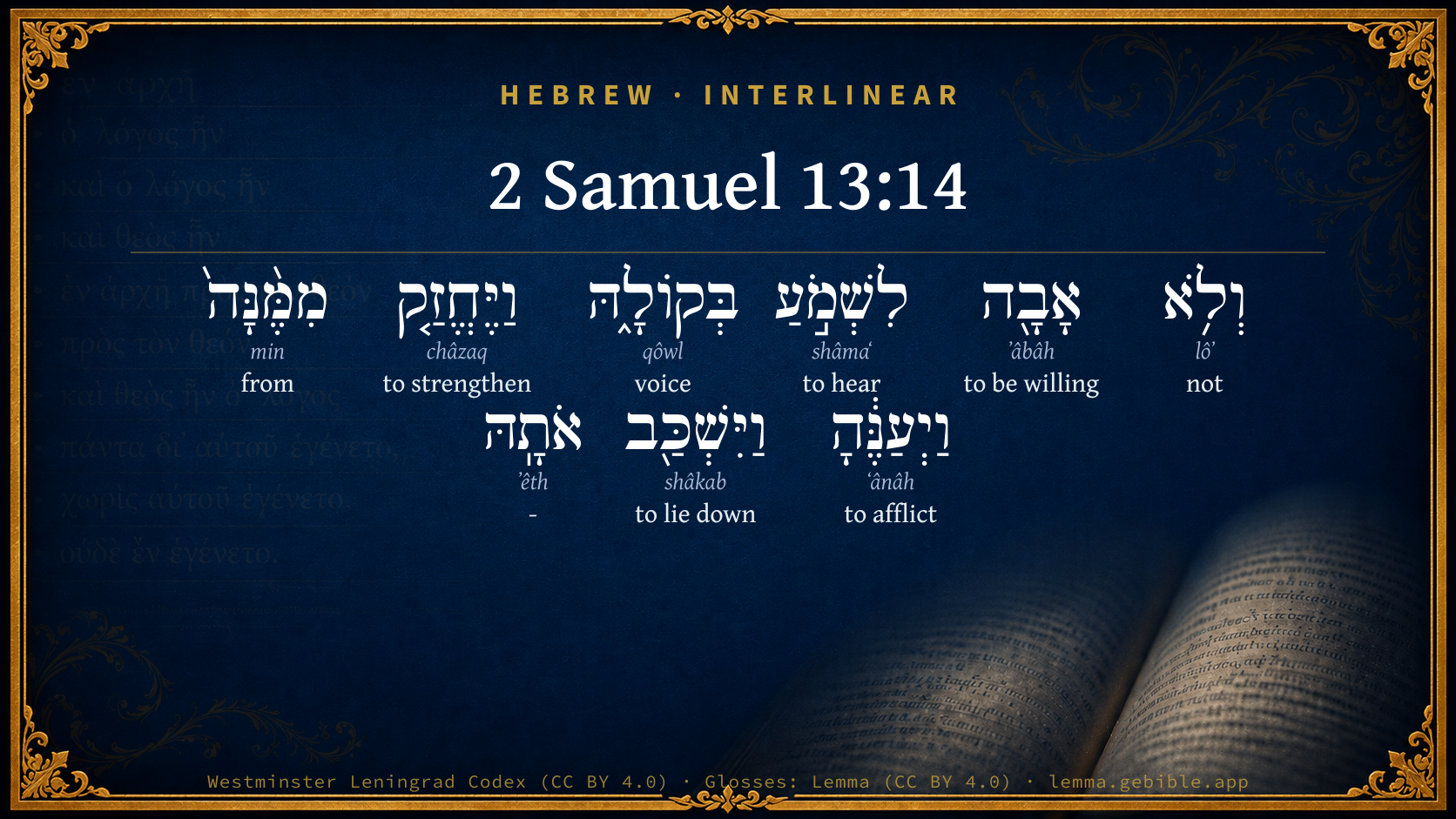
Hebrew (Westminster Leningrad Codex) 2 Samuel 13:14 appears in the Hebrew Old Testament. The text above is from the Westminster Leningrad Codex. Each word links to its Strong’s number, a concise gloss, and parsing drawn from the Open Scriptures Hebrew Bible morphology. Click any word for its full Brown-Driver-Briggs (BDB) entry.
Download image
Cite this verse

2 Samuel 13:14 (World English Bible). Public Domain. Lemma interlinear Bible study tool, https://lemma.gebible.app/v/2-samuel/13/14.

Show BibTeX & RIS
BibTeX
RIS
English Translation
However he would not listen to her voice; but being stronger than she, he forced her, and lay with her.
World English Bible · Public Domain
Download a study sheet

One document with this verse’s original text, its word-by-word gloss line, the meaning frame, cross-references with their text, attributed commentary, and full source and license credits — printable, and it pastes into notes with its structure intact.

This verse Autodidact and up

Study sheet (.html) Plain text (.txt)

A passage Seminary Student

Up to 50 verses in one chapter. A passage sheet keeps up to 6 commentary sources and 12 cross-references per verse, in the order this page ranks them, and says so on the sheet whenever that leaves anything out. Ask for a single verse and you get the Autodidact verse sheet above.

Everything on this page stays free to read, with no account — the sheet is a download of what is already on screen, not access to it.

Want to remove ads? Support Godless Engineer
Compare translations 3

The same verse in 3 English versions, stacked beneath the original-language interlinear above. Click any original word for its lexicon entry.

Each is an independent rendering of the whole verse — the interlinear is not word-aligned to these translations.

Highlighted words mark where these versions differ — a whole-verse word diff, not a word-by-word alignment.

  • World English Bible Public Domain
    However he would not listen to her voice; but being stronger than she, he forced her, and lay with her.
  • King James Version Public Domain
    Howbeit he would not hearken unto her voice: but, being stronger than she, forced her, and lay with her.
  • unfoldingWord Literal Text CC BY-SA 4.0
    But he was not willing to listen to her voice. And he was stronger than she, and he humbled her, and he lay with her.

unfoldingWord Literal Text — © unfoldingWord, licensed CC BY-SA 4.0. Word-aligned USFM3 via Door43 (git.door43.org/unfoldingWord/en_ult).

Versions to compare (up to 4)

3 of 4 selected

Show all 18 translations

Every available English version of this verse, each an independent rendering of the whole verse.

  • World English Bible Public Domain
    However he would not listen to her voice; but being stronger than she, he forced her, and lay with her.
  • Berean Standard Bible Public Domain
    But Amnon refused to listen to her, and being stronger, he violated her and lay with her.
  • Majority Standard Bible Public Domain
    But Amnon refused to listen to her, and being stronger, he violated her and lay with her.
  • King James Version Public Domain
    Howbeit he would not hearken unto her voice: but, being stronger than she, forced her, and lay with her.
  • American Standard Version (1901) Public Domain
    Howbeit he would not hearken unto her voice; but being stronger than she, he forced her, and lay with her.
  • Revised Version (1885) Public Domain
    Howbeit he would not hearken unto her voice: but being stronger than she, he forced her, and lay with her.
  • Geneva Bible (1599) Public Domain
    Howbeit he would not hearken vnto her voyce, but being stronger then she, forced her, and lay with her.
  • Douay-Rheims (1899) Public Domain
    But he would not hearken to her prayers, but being stronger overpowered her and lay with her.
  • Young's Literal Translation Public Domain
    And he hath not been willing to hearken to her voice, and is stronger than she, and humbleth her, and lieth with her.
  • Literal Standard Version CC BY-SA 4.0
    And he has not been willing to listen to her voice, and is stronger than she, and humbles her, and lies with her.
  • Unlocked Literal Bible CC BY-SA 4.0
    However Amnon would not listen to her. Since he was stronger than Tamar, he seized her and he slept with her.
  • unfoldingWord Literal Text CC BY-SA 4.0
    But he was not willing to listen to her voice. And he was stronger than she, and he humbled her, and he lay with her.
  • Darby Bible Public Domain
    But he would not hearken to her voice, and was stronger than she, and humbled her and lay with her.
  • World Messianic Bible Public Domain
    However, he would not listen to her voice; but being stronger than she, he forced her and lay with her.
  • Webster's Bible Public Domain
    Howbeit, he would not hearken to her voice: but being stronger than she, forced her, and lay with her.
  • Free Bible Version CC BY-SA 4.0
    But Amnon wouldn't listen to her, and because he was stronger than she was, he raped her.
  • Bible in Basic English Public Domain
    But he would not give attention to what she said: but being stronger than she, he took her by force, and had connection with her.
  • JPS Tanakh (1917) Public Domain
    Howbeit he would not hearken unto her voice; but being stronger than she, he forced her, and lay with her.

Literal Standard Version (2020), Covenant Press — licensed CC BY-SA 4.0. Text via the HelloAO Bible API (eBible.org). Unlocked Literal Bible (unfoldingWord) — licensed CC BY-SA 4.0. Text via the HelloAO Bible API (eBible.org). unfoldingWord Literal Text — © unfoldingWord, licensed CC BY-SA 4.0. Word-aligned USFM3 via Door43 (git.door43.org/unfoldingWord/en_ult). Free Bible Version, Dr. Jonathan Gallagher — licensed CC BY-SA 4.0. Text via the HelloAO Bible API (eBible.org).

Word by word

More ways to search: Search by grammar → Find every occurrence → Compare this word →

Practice this passage: Drill this verse → Learn its vocabulary →

אָבָ֖ה
ʼâbâh
H14
“to be willing”
Verb, Qal, Perfect, 3rd Person, Masculine, Singular
Part of Speech
Verb
Stem
Qal
Form
Perfect
Person
3rd Person
Gender
Masculine
Number
Singular
Full BDB Definition

Origin: a primitive root

TWOT: 3

to be willing, consent - (Qal) - to be willing - to consent, yield to, accept - to desire
  1. וְלֹ֥א lôʼ H3808 “and · not” Conjunction + Particle, Negative
  2. לִשְׁמֹ֣עַ shâmaʻ H8085 “to hear” Preposition + Verb, Qal, Infinitive Construct
  3. בְּקוֹלָ֑הּ qôwl H6963 “in/at · voice · her” Preposition + Noun, Common, Masculine, Singular, Construct + Suffix, Personal, 3rd Person, Feminine, Singular
  4. וַיֶּחֱזַ֤ק châzaq H2388 “and · to strengthen” Conjunction + Verb, Qal, Sequential Imperfect, 3rd Person, Masculine, Singular
  5. מִמֶּ֨נָּה֙ min H4480 “from · her” Preposition + Suffix, Personal, 3rd Person, Feminine, Singular
  6. וַיְעַנֶּ֔הָ ʻânâh H6031 “and · to afflict · her” Conjunction + Verb, Piel, Sequential Imperfect, 3rd Person, Masculine, Singular + Suffix, Personal, 3rd Person, Feminine, Singular
  7. וַיִּשְׁכַּ֖ב shâkab H7901 “and · to lie down” Conjunction + Verb, Qal, Sequential Imperfect, 3rd Person, Masculine, Singular
  8. אֹתָֽהּ ʼêth H853 “- · her” Particle, Direct Object + Suffix, Personal, 3rd Person, Feminine, Singular

About this verse

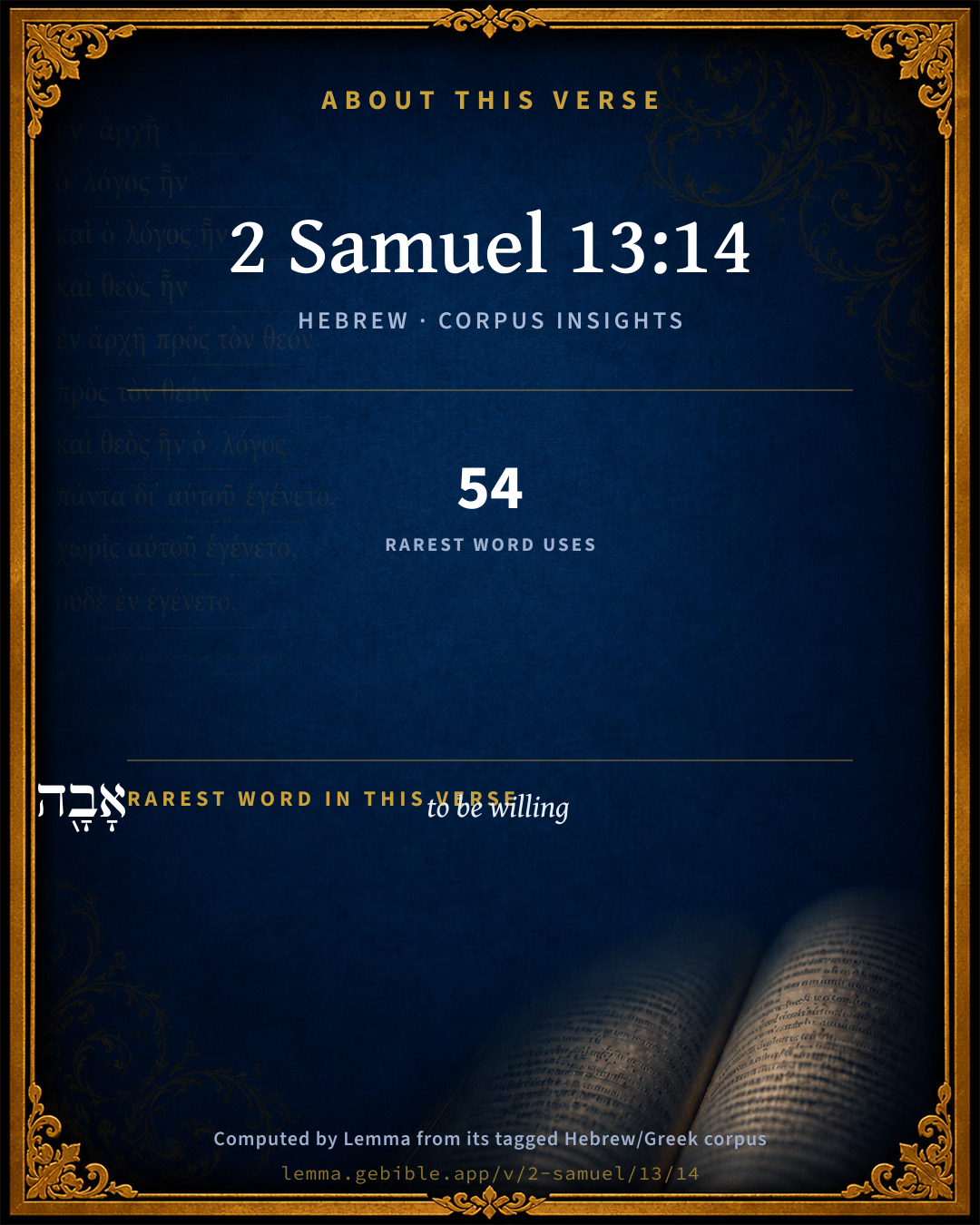
These counts appear in no published source. They are computed here, from the morphology-tagged text and Lemma’s own curated glosses. What Lemma adds →

9
words
9
distinct lemmas
Historical
section

Shared distinctive vocabulary

אָבָ֖ה to be willing H14 occurs in 52 verses of the Hebrew Bible. Also found in:

Grammatical profile

  • 5 verbs
  • 1 noun
  • 1 preposition
  • 2 particles

Verb forms

  • אָבָ֖ה Qal · Perfect
  • לִשְׁמֹ֣עַ Qal · Infinitive Construct
  • וַיֶּחֱזַ֤ק Qal · Sequential Imperfect
  • וַיְעַנֶּ֔הָ Piel · Sequential Imperfect
  • וַיִּשְׁכַּ֖ב Qal · Sequential Imperfect

Hebrew & Septuagint length

In English translation the verse runs 20 words from the Hebrew and 20 from the Septuagint (LXX English) — the same length.

A rough comparison of the two English renderings, which tokenize alike — not a word-level alignment.

Word counts can differ between the Hebrew and the Greek without any difference in meaning — e.g. the Hebrew direct-object marker אֵת has no separate Greek word, and Greek often adds the article ὁ.

Cross-references

4

Topical passages linked to 2 Samuel 13:14 in the Treasury of Scripture Knowledge — connected by theme and wording, ordered by reader-vote popularity; previews shown in the World English Bible.

  • 2 Samuel 12:11 This is what Yahweh says: 'Behold, I will raise up evil against you out of your own house; and I will take your wives before your eyes, and give them to your neighbor, and he will lie with your wives in the sight of this sun.
  • Deuteronomy 22:25–27 But if the man find the lady who is pledged to be married in the field, and the man force her, and lie with her; then the man only who lay with her shall die:
  • Judges 20:5 The men of Gibeah rose against me, and beset the house round about me by night; me they thought to have slain, and my concubine they forced, and she is dead.
  • Esther 7:8 Then the king returned out of the palace garden into the place of the banquet of wine; and Haman was fallen on the couch whereon Esther was. Then said the king, Will he even force the queen before me in the house? As the word went out of the king's mouth, they covered Haman's face.

Cross-references courtesy of OpenBible.info (CC BY 4.0).

Hebrew and Greek witnesses Masoretic Hebrew ↔ Greek Septuagint

The same verse in the two great witnesses to the Old Testament, shown verse-for-verse.

These are two independent witnesses, not word-aligned to each other, and the Septuagint is shown in lemma (dictionary) form.

Hebrew 2 Samuel 13:14 Masoretic · Westminster Leningrad Codex

וְלֹ֥א אָבָ֖ה לִשְׁמֹ֣עַ בְּקוֹלָ֑הּ וַיֶּחֱזַ֤ק מִמֶּ֨נָּה֙ וַיְעַנֶּ֔הָ וַיִּשְׁכַּ֖ב אֹתָֽהּ

However he would not listen to her voice; but being stronger than she, he forced her, and lay with her.

World English Bible · Public Domain

Greek LXX 2 Samuel 13:14 Septuagint · lemma form

καί οὐ θέλω αμνων ὁ ἀκούω ὁ φωνή αὐτός καί κραταιόω ὑπέρ αὐτός καί ταπεινόω αὐτός καί κοιμάω μετά αὐτός

But Amnon would not listen to her voice; and he prevailed against her, and humbled her, and lay with her.

LXX2012 (modern English Septuagint) · Public Domain

Hebrew: Westminster Leningrad Codex (CC BY 4.0). Greek: Septuagint (public domain); English from LXX2012 (modern English Septuagint) (Public Domain). How the Septuagint differs from the Hebrew →

Targum (Aramaic paraphrase)

1

The Targum is the ancient Jewish Aramaic paraphrase of the Hebrew Scriptures — an interpretive translation, not the Hebrew text itself. Onkelos (literal) and Pseudo-Jonathan (expansive) render the Torah, and Jonathan the Prophets. Coverage is partial: where no permissively-licensed English translation exists for a verse, only the Aramaic is shown. This is verse-level text, not a word-by-word alignment to the Hebrew.

  1. Targum Jonathan Prophets (Joshua–Malachi)
    וְלָא אֲבָא לְקַבָּלָא מִנָהּ וּתְקֵיף מִנָהּ וְעַנְיָהּ וּשְׁכִיב עִמָהּ:

    (no public-domain English translation for this verse)

    Targum Jonathan — Aramaic: “Mikraot Gedolot” (public domain). English: “Sefaria Community Translation” (CC0 1.0 (public-domain dedication)); “London "Chaldee Paraphrase," 1871” (public domain). Text via Sefaria.

Commentary

Notes on 2 Samuel 13:14 from classic Christian and Jewish commentators (each source and its license shown beneath its notes). The classic Christian expositions comment on the surrounding passage and are grouped to its opening verse, so a note may address several verses; the Jewish commentaries on the Tanakh (Rashi and others) are per-verse, so they appear only where the commentator wrote on this verse.

Lemma curates 59 commentaries, every one of them public domain or Creative Commons licensed, each selected and text-cleaned for this edition rather than reprinted as found. About our sources →

Trapp's Complete Commentary

John Trapp

2Sa 13:14 Howbeit he would not hearken unto her voice: but, being stronger than she, forced her, and lay with her.

Ver. 14. He forced her, and lay with her.] A double abomination, either of them deserving death; which because David inflicted not on him, God did. Where we may easily see a hand of justice. As David had committed adultery, made Uriah drunk, and then murdered him: so Amnon committeth incest, is made drunk, and then murdered.

John Trapp, A Commentary or Exposition upon All the Books of the Old and New Testament (1647–1656) — public domain. Text from a community e-Sword module.

Tyndale Open Study Notes

Tyndale Open Resources

13:14 since he was stronger: Tamar resisted as much as she could.

Tyndale Open Study Notes — © Tyndale Open Resources, licensed CC BY-SA 4.0. Text via the HelloAO Bible API.

John Gill's Exposition

Howbeit, he would not hearken unto her voice,.... His lust was so inflamed and enraged, that he could not attend to any arguments, though ever so forcible, that were offered to him:

but being stronger than she, forced her, and lay with her; whether she cried out or not, as the law directs in such cases, Deu 22:25; is not said; she might, and nobody hear her and come to her assistance; or she might not choose to expose her brother to his servants.

John Gill's Exposition of the Whole Bible (1746–1763) — public domain (CC PDM 1.0). Text via the HelloAO Bible API.

Lesson kit

Teaching starters — assembled from the data on this page, not authored interpretation. Every prompt links to the verse data it draws on. Edit before teaching.

2 Samuel, in the Historical, opens this verse with 9 words (9 distinct Hebrew lemmas). Its most distinctive word is ʼâbâh (“to be willing”). A historical commentator’s framing appears above. Read the whole chapter for the surrounding context.

Discussion questions

  1. The word ʼâbâh carries the sense “to be willing.” How does it shape the verse?
  2. Genesis 24:5 shares the word «to be willing» with this verse. How do the two illuminate each other?
  3. These translations render this verse differently; the difference is in the English rendering, not the original. What questions does that raise?
  4. The verb «אָבָ֖ה» is Qal Perfect. How does its form color the action?
  5. Reading how Trapp's Complete Commentary and Tyndale Open Study Notes read this verse, where do the two commentators agree and where do they part?

Things to notice

Reading settings

Reading text

Shown beneath each verse's original-language words.

Old Testament
Old Testament edition

Read the OT as the Masoretic Hebrew (MT) or the Greek Septuagint (LXX).

English shown for the Greek Septuagint (in the Hebrew ↔ Greek comparison).

Comparing translations? Open the Compare panel on any verse page to stack up to four side by side.