
Ezekiel 21:22

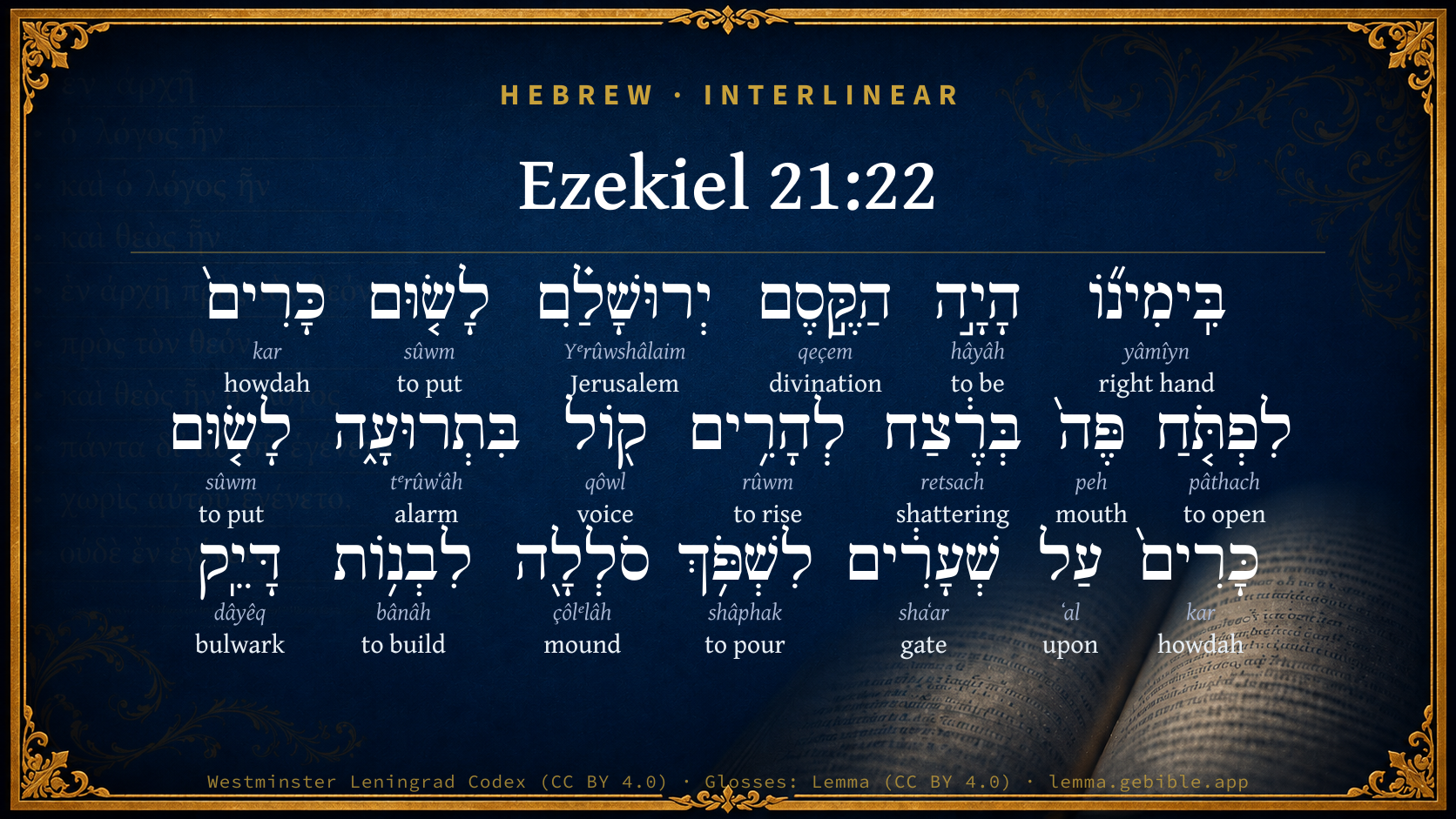
Hebrew (Westminster Leningrad Codex) Ezekiel 21:22 appears in the Hebrew Old Testament. The text above is from the Westminster Leningrad Codex. Each word links to its Strong’s number, a concise gloss, and parsing drawn from the Open Scriptures Hebrew Bible morphology. Click any word for its full Brown-Driver-Briggs (BDB) entry.
Download image
Cite this verse

Ezekiel 21:22 (World English Bible). Public Domain. Lemma interlinear Bible study tool, https://lemma.gebible.app/v/ezekiel/21/22.

Show BibTeX & RIS
BibTeX
RIS
English Translation
In his right hand was the divination [for] Jerusalem, to set battering rams, to open the mouth in the slaughter, to lift up the voice with shouting, to set battering rams against the gates, to cast up mounds, to build forts.
World English Bible · Public Domain
Download a study sheet

One document with this verse’s original text, its word-by-word gloss line, the meaning frame, cross-references with their text, attributed commentary, and full source and license credits — printable, and it pastes into notes with its structure intact.

This verse Autodidact and up

Study sheet (.html) Plain text (.txt)

A passage Seminary Student

Up to 50 verses in one chapter. A passage sheet keeps up to 6 commentary sources and 12 cross-references per verse, in the order this page ranks them, and says so on the sheet whenever that leaves anything out. Ask for a single verse and you get the Autodidact verse sheet above.

Everything on this page stays free to read, with no account — the sheet is a download of what is already on screen, not access to it.

Want to remove ads? Support Godless Engineer
Compare translations 3

The same verse in 3 English versions, stacked beneath the original-language interlinear above. Click any original word for its lexicon entry.

Each is an independent rendering of the whole verse — the interlinear is not word-aligned to these translations.

Highlighted words mark where these versions differ — a whole-verse word diff, not a word-by-word alignment.

  • World English Bible Public Domain
    In his right hand was the divination [for] Jerusalem, to set battering rams, to open the mouth in the slaughter, to lift up the voice with shouting, to set battering rams against the gates, to cast up mounds, to build forts.
  • King James Version Public Domain
    At his right hand was the divination for Jerusalem, to appoint captains, to open the mouth in the slaughter, to lift up the voice with shouting, to appoint battering rams against the gates, to cast a mount, and to build a fort.
  • unfoldingWord Literal Text CC BY-SA 4.0
    In his right hand will be an omen about Jerusalem, to set battering rams against it, to open his mouth to order the slaughter, to sound a war cry, to set battering rams against the gates, to build a ramp, and to erect siege towers.

unfoldingWord Literal Text — © unfoldingWord, licensed CC BY-SA 4.0. Word-aligned USFM3 via Door43 (git.door43.org/unfoldingWord/en_ult).

Versions to compare (up to 4)

3 of 4 selected

Show all 18 translations

Every available English version of this verse, each an independent rendering of the whole verse.

  • World English Bible Public Domain
    In his right hand was the divination [for] Jerusalem, to set battering rams, to open the mouth in the slaughter, to lift up the voice with shouting, to set battering rams against the gates, to cast up mounds, to build forts.
  • Berean Standard Bible Public Domain
    In his right hand appears the portent for Jerusalem, where he is to set up battering rams, to call for the slaughter, to lift a battle cry, to direct the battering rams against the gates, to build a ramp, and to erect a siege wall.
  • Majority Standard Bible Public Domain
    In his right hand appears the portent for Jerusalem, where he is to set up battering rams, to call for the slaughter, to lift a battle cry, to direct the battering rams against the gates, to build a ramp, and to erect a siege wall.
  • King James Version Public Domain
    At his right hand was the divination for Jerusalem, to appoint captains, to open the mouth in the slaughter, to lift up the voice with shouting, to appoint battering rams against the gates, to cast a mount, and to build a fort.
  • American Standard Version (1901) Public Domain
    In his right hand was the divination `for' Jerusalem, to set battering rams, to open the mouth in the slaughter, to lift up the voice with shouting, to set battering rams against the gates, to cast up mounds, to build forts.
  • Revised Version (1885) Public Domain
    In his right hand was the divination for Jerusalem, to set battering rams, to open the mouth in the slaughter, to lift up the voice with shouting, to set battering rams against the gates, to cast up mounts, to build forts.
  • Geneva Bible (1599) Public Domain
    At his right hand was the diuination for Ierusalem to appoint captaines, to open their mouth in the slaughter, and to lift vp their voyce with shouting, to laye engines of warre against the gates, to cast a mount, and to builde a fortresse.
  • Douay-Rheims (1899) Public Domain
    On his right hand was the divination for Jerusalem, to set battering rams, to open the mouth in slaughter, to lift up the voice in howling, to set engines against the gates, to cast up a mount, to build forts.
  • Young's Literal Translation Public Domain
    At his right hath been the divination -- Jerusalem, To place battering-rams, To open the mouth with slaughter, To lift up a voice with shouting, To place battering-rams against the gates, To pour out a mount, to build a fortification.
  • Literal Standard Version CC BY-SA 4.0
    The divination [for] Jerusalem has been at his right, || To place battering-rams, || To open the mouth with slaughter, || To lift up a voice with shouting, || To place battering-rams against the gates, || To pour out a mound, to build a fortification.
  • Unlocked Literal Bible CC BY-SA 4.0
    In his right hand will be an omen about Jerusalem, to set battering rams against it, to open his mouth to order the slaughter, to sound a war cry, to set battering rams against the gates, to build a ramp, and to erect siege towers.
  • unfoldingWord Literal Text CC BY-SA 4.0
    In his right hand will be an omen about Jerusalem, to set battering rams against it, to open his mouth to order the slaughter, to sound a war cry, to set battering rams against the gates, to build a ramp, and to erect siege towers.
  • Darby Bible Public Domain
    In his right hand is the lot of Jerusalem to appoint battering-rams, to open the mouth for bloodshed, to lift up the voice with shouting, to appoint battering-rams against the gates, to cast mounds, to build siege-towers.
  • World Messianic Bible Public Domain
    In his right hand was the lot for Jerusalem, to set battering rams, to open the mouth in the slaughter, to lift up the voice with shouting, to set battering rams against the gates, to cast up mounds, and to build forts.
  • Webster's Bible Public Domain
    At his right hand was the divination for Jerusalem, to appoint captains, to open the mouth in the slaughter, to lift up the voice with shouting, to appoint battering rams against the gates, to cast a mount, and to build a fort.
  • Free Bible Version CC BY-SA 4.0
    He holds the sign for Jerusalem in his right hand. This is where he is going to set up battering rams, to give the command to attack, to shout the war-cry. There he will order the battering rams to smash the gates, set up an attack ramp, and build a siege wall.
  • Bible in Basic English Public Domain
    At his right hand was the fate of Jerusalem, to give orders for destruction, to send up the war-cry, to put engines of war against the doors, lifting up earthworks, building walls.
  • JPS Tanakh (1917) Public Domain
    (21-27) In his right hand is the lot Jerusalem, to set battering rams, to open the mouth for the slaughter, to lift up the voice with shouting, to set battering rams against the gates, to cast up mounds, to build forts.

Literal Standard Version (2020), Covenant Press — licensed CC BY-SA 4.0. Text via the HelloAO Bible API (eBible.org). Unlocked Literal Bible (unfoldingWord) — licensed CC BY-SA 4.0. Text via the HelloAO Bible API (eBible.org). unfoldingWord Literal Text — © unfoldingWord, licensed CC BY-SA 4.0. Word-aligned USFM3 via Door43 (git.door43.org/unfoldingWord/en_ult). Free Bible Version, Dr. Jonathan Gallagher — licensed CC BY-SA 4.0. Text via the HelloAO Bible API (eBible.org).

Word by word

More ways to search: Search by grammar → Find every occurrence → Compare this word →

Practice this passage: Drill this verse → Learn its vocabulary →

בְּרֶ֔צַח
retsach
H7524
“in/at · shattering”
Preposition + Noun, Common, Masculine, Singular, Absolute
Part of Speech
Preposition + Noun
Type
Common
Gender
Masculine
Number
Singular
State
Absolute
Full BDB Definition

Origin: from H7523

TWOT: 2208a

shattering
  1. בִּֽימִינ֞וֹ yâmîyn H3225 “in/at · right hand · his” Preposition + Noun, Common, Feminine, Singular, Construct + Suffix, Personal, 3rd Person, Masculine, Singular
  2. הָיָ֣ה hâyâh H1961 “to be” Verb, Qal, Perfect, 3rd Person, Masculine, Singular
  3. הַקֶּ֣סֶם qeçem H7081 “the · divination” Particle, Definite Article + Noun, Common, Masculine, Singular, Absolute
  4. יְרוּשָׁלִַ֗ם Yᵉrûwshâlaim H3389 “Jerusalem” Noun, Proper
  5. לָשׂ֤וּם sûwm H7760 “to put” Preposition + Verb, Qal, Infinitive Construct
  6. כָּרִים֙ kar H3733 “howdahs” Noun, Common, Masculine, Plural, Absolute
  7. לִפְתֹּ֤חַ pâthach H6605 “to open” Preposition + Verb, Qal, Infinitive Construct
  8. פֶּה֙ peh H6310 “mouth” Noun, Common, Masculine, Singular, Absolute
  9. לְהָרִ֥ים rûwm H7311 “to rise” Preposition + Verb, Hiphil, Infinitive Construct
  10. ק֖וֹל qôwl H6963 “voice” Noun, Common, Masculine, Singular, Absolute
  11. בִּתְרוּעָ֑ה tᵉrûwʻâh H8643 “in/at · alarm” Preposition + Noun, Common, Feminine, Singular, Absolute
  12. לָשׂ֤וּם sûwm H7760 “to put” Preposition + Verb, Qal, Infinitive Construct
  13. כָּרִים֙ kar H3733 “howdahs” Noun, Common, Masculine, Plural, Absolute
  14. עַל ʻal H5921 “upon” Preposition
  15. שְׁעָרִ֔ים shaʻar H8179 “gates” Noun, Common, Masculine, Plural, Absolute
  16. לִשְׁפֹּ֥ךְ shâphak H8210 “to pour” Preposition + Verb, Qal, Infinitive Construct
  17. סֹלְלָ֖ה çôlᵉlâh H5550 “mound” Noun, Common, Feminine, Singular, Absolute
  18. לִבְנ֥וֹת bânâh H1129 “to build” Preposition + Verb, Qal, Infinitive Construct
  19. דָּיֵֽק dâyêq H1785 “bulwark” Noun, Common, Masculine, Singular, Absolute

About this verse

These counts appear in no published source. They are computed here, from the morphology-tagged text and Lemma’s own curated glosses. What Lemma adds →

20
words
18
distinct lemmas
Prophets
section

Notable vocabulary

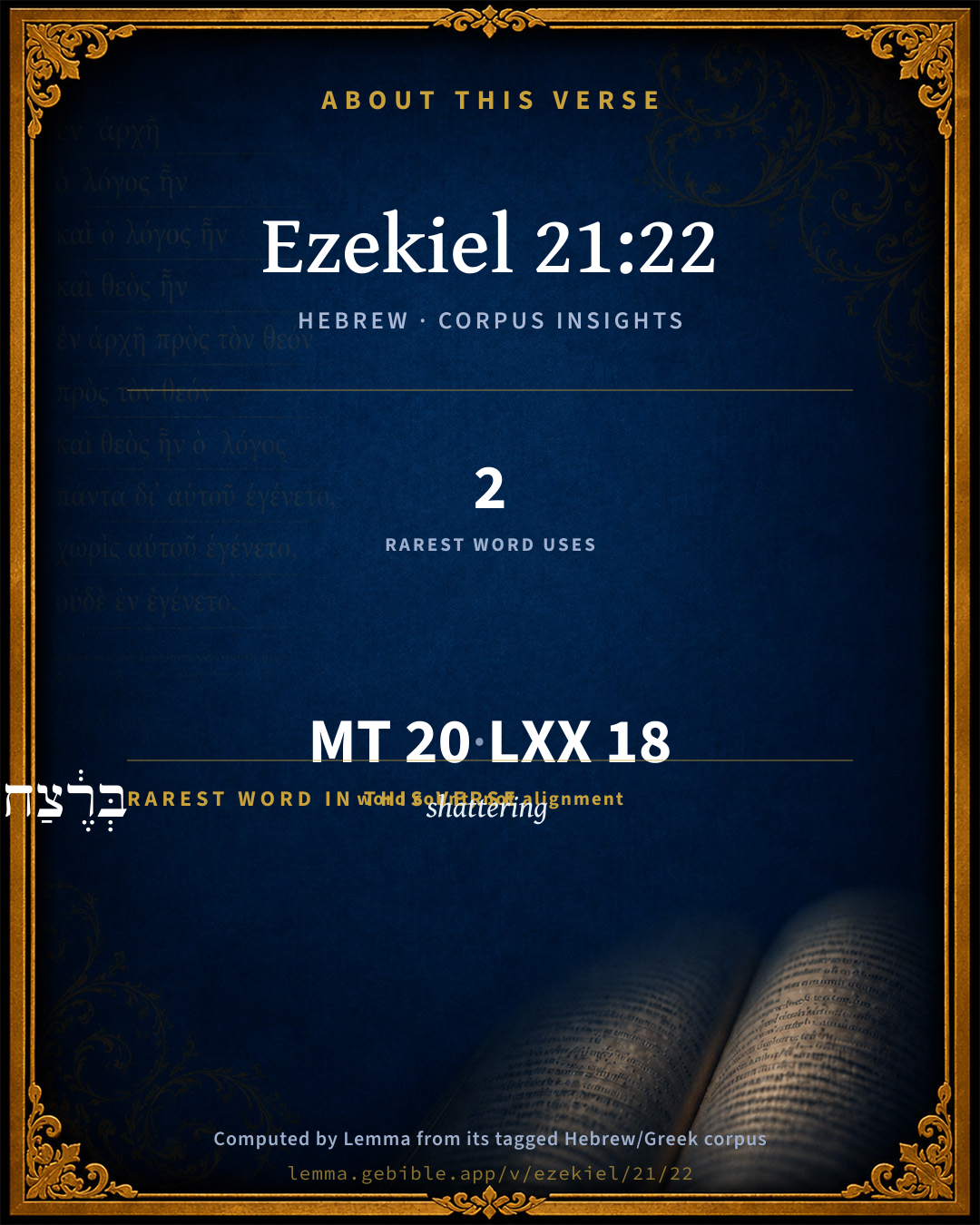
The rarest word here is בְּרֶ֔צַח shattering H7524 — appearing just 2 times in the whole Hebrew Bible.

Shared distinctive vocabulary

בְּרֶ֔צַח shattering H7524 occurs in 2 verses of the Hebrew Bible. Also found in:

Grammatical profile

  • 7 verbs
  • 12 nouns
  • 1 preposition

Verb forms

  • הָיָ֣ה Qal · Perfect
  • לָשׂ֤וּם Qal · Infinitive Construct
  • לִפְתֹּ֤חַ Qal · Infinitive Construct
  • לְהָרִ֥ים Hiphil · Infinitive Construct
  • לָשׂ֤וּם Qal · Infinitive Construct
  • לִשְׁפֹּ֥ךְ Qal · Infinitive Construct
  • לִבְנ֥וֹת Qal · Infinitive Construct

Repetition

Words recur within this verse — often emphatic in Hebrew:

  • לָשׂ֤וּם to put H7760 ×2
  • כָּרִים֙ howdah H3733 ×2

Hebrew & Septuagint length

In English translation the verse runs 41 words from the Hebrew and 41 from the Septuagint (LXX English) — the same length.

A rough comparison of the two English renderings, which tokenize alike — not a word-level alignment.

Word counts can differ between the Hebrew and the Greek without any difference in meaning — e.g. the Hebrew direct-object marker אֵת has no separate Greek word, and Greek often adds the article ὁ.

In the original languages it is 20 Hebrew tokens and 18 Greek tokens — but the two are counted differently (Hebrew bundles its prefixes and suffixes into one token; the Greek is in lemma form), so that isn’t a like-for-like length.

Cross-references

11

Topical passages linked to Ezekiel 21:22 in the Treasury of Scripture Knowledge — connected by theme and wording, ordered by reader-vote popularity; previews shown in the World English Bible.

  • Ezekiel 4:2 and lay siege against it, and build forts against it, and cast up a mound against it; set camps also against it, and plant battering rams against it round about.
  • Ezekiel 26:9 He shall set his battering engines against your walls, and with his axes he shall break down your towers.
  • Exodus 32:17–18 When Joshua heard the noise of the people as they shouted, he said to Moses, "There is the noise of war in the camp."
  • Joshua 6:10 Joshua commanded the people, saying, You shall not shout, nor let your voice be heard, neither shall any word proceed out of your mouth, until the day I bid you shout; then shall you shout.
  • Joshua 6:20 So the people shouted, and [the priests] blew the trumpets; and it happened, when the people heard the sound of the trumpet, that the people shouted with a great shout, and the wall fell down flat, so that the people went up into the city, every man straight before him, and they took the city.
  • 1 Samuel 17:20 David rose up early in the morning, and left the sheep with a keeper, and took, and went, as Jesse had commanded him; and he came to the place of the wagons, as the host which was going forth to the fight shouted for the battle.
  • Job 39:25 As often as the trumpet sounds he snorts, 'Aha!' He smells the battle afar off, The thunder of the captains, and the shouting.
  • Jeremiah 32:24 Behold, the mounds, they are come to the city to take it; and the city is given into the hand of the Chaldeans who fight against it, because of the sword, and of the famine, and of the pestilence; and what you have spoken has happened; and, behold, you see it.
  • Jeremiah 33:4 For thus says Yahweh, the God of Israel, concerning the houses of this city, and concerning the houses of the kings of Judah, which are broken down [to make a defense] against the mounds and against the sword;
  • Jeremiah 51:14 Yahweh of Hosts has sworn by himself, [saying], Surely I will fill you with men, as with the canker-worm; and they shall lift up a shout against you.
  • Jeremiah 52:4 It happened in the ninth year of his reign, in the tenth month, in the tenth day of the month, that Nebuchadrezzar king of Babylon came, he and all his army, against Jerusalem, and encamped against it; and they built forts against it round about.

Cross-references courtesy of OpenBible.info (CC BY 4.0).

Hebrew and Greek witnesses Masoretic Hebrew ↔ Greek Septuagint

The same verse in the two great witnesses to the Old Testament, shown verse-for-verse.

These are two independent witnesses, not word-aligned to each other, and the Septuagint is shown in lemma (dictionary) form.

Hebrew Ezekiel 21:22 Masoretic · Westminster Leningrad Codex

בִּֽימִינ֞וֹ הָיָ֣ה הַקֶּ֣סֶם יְרוּשָׁלִַ֗ם לָשׂ֤וּם כָּרִים֙ לִפְתֹּ֤חַ פֶּה֙ בְּרֶ֔צַח לְהָרִ֥ים ק֖וֹל בִּתְרוּעָ֑ה לָשׂ֤וּם כָּרִים֙ עַל שְׁעָרִ֔ים לִשְׁפֹּ֥ךְ סֹלְלָ֖ה לִבְנ֥וֹת דָּיֵֽק

In his right hand was the divination [for] Jerusalem, to set battering rams, to open the mouth in the slaughter, to lift up the voice with shouting, to set battering rams against the gates, to cast up mounds, to build forts.

World English Bible · Public Domain

Greek LXX Ezekiel 21:22 Septuagint · lemma form

καί ἐγώ δέ κροτέω χείρ ἐγώ πρός χείρ ἐγώ καί ἐν ἀποἵημι ὁ θυμός ἐγώ ἐγώ κύριος λαλέω

On his right was the divination against Jerusalem, to cast a mound, to open the mouth in shouting, to lift up the voice with crying, to cast a mound against her gates, to cast up a heap, and to build forts.

LXX2012 (modern English Septuagint) · Public Domain

Hebrew: Westminster Leningrad Codex (CC BY 4.0). Greek: Septuagint (public domain); English from LXX2012 (modern English Septuagint) (Public Domain). How the Septuagint differs from the Hebrew →

Targum (Aramaic paraphrase)

1

The Targum is the ancient Jewish Aramaic paraphrase of the Hebrew Scriptures — an interpretive translation, not the Hebrew text itself. Onkelos (literal) and Pseudo-Jonathan (expansive) render the Torah, and Jonathan the Prophets. Coverage is partial: where no permissively-licensed English translation exists for a verse, only the Aramaic is shown. This is verse-level text, not a word-by-word alignment to the Hebrew.

  1. Targum Jonathan Prophets (Joshua–Malachi)
    וְאַף אֲנָא אַיְתֵי פּוּרְעֲנוּת עַל פּוּרְעֲנוּת וַאֲנִיחַ חֵימְתִי אֲנָא יְיָ גְזַרֵית בְּמֵימְרִי:

    (no public-domain English translation for this verse)

    Targum Jonathan — Aramaic: “Mikraot Gedolot” (public domain). English: “Sefaria Community Translation” (CC0 1.0 (public-domain dedication)); “London "Chaldee Paraphrase," 1871” (public domain). Text via Sefaria.

Commentary

Notes on Ezekiel 21:22 from classic Christian and Jewish commentators (each source and its license shown beneath its notes). The classic Christian expositions comment on the surrounding passage and are grouped to its opening verse, so a note may address several verses; the Jewish commentaries on the Tanakh (Rashi and others) are per-verse, so they appear only where the commentator wrote on this verse.

Lemma curates 59 commentaries, every one of them public domain or Creative Commons licensed, each selected and text-cleaned for this edition rather than reprinted as found. About our sources →

Trapp's Complete Commentary

John Trapp

Eze 21:22 At his right hand was the divination for Jerusalem, to appoint captains, to open the mouth in the slaughter, to lift up the voice with shouting, to appoint [battering] rams against the gates, to cast a mount, [and] to build a fort.

Ver. 22. To appoint captains.] Heb., Rans; fierce and forward, to lead on their soldiers, let them get off as they could.

To open their mouth.] To storm and take it by an onslaught, and with a general slaughter, non sine barritu militari, vociferatione, et clangore insolenti.

John Trapp, A Commentary or Exposition upon All the Books of the Old and New Testament (1647–1656) — public domain. Text from a community e-Sword module.

Jamieson, Fausset & Brown

Robert Jamieson, A. R. Fausset & David Brown

Rather, "In his right hand was [is] the divination," that is, he holds up in his right hand the arrow marked with "Jerusalem," to encourage his army to march for it.

captains--The Margin, "battering-rams," adopted by FAIRBAIRN, is less appropriate, for "battering-rams" follow presently after [GROTIUS].

open the mouth in . . . slaughter--that is, commanding slaughter: raising the war cry of death. Not as GESENIUS, "to open the mouth with the war shout."

Jamieson, Fausset & Brown — Commentary Critical and Explanatory on the Whole Bible (1871) — public domain (CC PDM 1.0). Text via the HelloAO Bible API.

Adam Clarke's Commentary

Verse 22. At his right hand was the divination for Jerusalem] He had probably written on two arrows; one, Jerusalem; the other, Riblath; the third, left blank. He drew, and that on which Jerusalem was written came to his hand; in consequence of which he marched immediately against that city. It was ripe for destruction; and had he marched before or after, it would have fallen; but he never considered himself as sure of the conquest till now.

Adam Clarke's Commentary on the Bible (1810–1826) — public domain. Text from a community e-Sword/MySword module.

Ellicott's Commentary for English Readers

(22) At his right hand was.—This is too exactly literal. The sense is, into his right hand came the divination which determined his course towards Jerusalem. “Captains” should be as in the margin, battering. rams (see Eze_4:2), for the siege of Jerusalem; the same word is so translated farther on in this verse. The remaining clauses portray the operations of the attack.

A Bible Commentary for English Readers, edited by Charles John Ellicott (1878–1897) — public domain. Text from a community e-Sword module.

The Cambridge Bible for Schools and Colleges

gen. ed. J. J. S. Perowne

22. at his right hand] in his right hand is the lot (or, oracle) “Jerusalem,” to set battering rams, to open the mouth with a cry. Though “battering rams” occurs again in the verse the word can have no other sense, such as “captains.” The word “cry” seems required by the parallel “shouting;” the letters have probably been transposed. On the apparatus of siege, cf. ch. Eze_4:2.

The Cambridge Bible for Schools and Colleges (gen. ed. J. J. S. Perowne; Cambridge University Press, 1878–1918) — public domain. Text from a community e-Sword module.

John Gill's Exposition

Therefore thus saith the Lord God,.... Because of their vain confidence, added to their perjury and perfidy:

because ye have made your iniquity to be remembered; their old sins, by committing new ones, both against the Lord, and against the king of Babylon:

in that your transgressions are discovered, so that in all your doings your sins do appear; both in their religious and civil actions; in the worship of God, and in their covenants and agreements with men; their sins were exposed and manifest to all, not only to God, who was provoked thereby, but to men, to the nations round about; particularly to Nebuchadnezzar, who was enraged by them:

because, I say, that they are come to remembrance; both before the Lord, and the king of Babylon:

ye shall be taken with the hand; as easily as a bird is, when in the snare. The Targum is,

"ye shall be delivered into the hand of the king of Babylon;''

which is no doubt the sense of the passage.

John Gill's Exposition of the Whole Bible (1746–1763) — public domain (CC PDM 1.0). Text via the HelloAO Bible API.

Haydock's Catholic Bible Commentary

Right of one going by Thapsacus and Damascus, and not through the Desert Arabia, for thus Rabbath would have been to the right. God permitted this divination to succeed in his wrath. The devil pushed the Chaldeans forward, lest the Jews might be converted. (Calmet) --- I they had attacked Rabbath first, they would probably have succeeded, as they did five years after. But the time of vengeance was come for Jerusalem, (Haydock) and they were directed to assault it. (Worthington) --- Voice: the din of war, (Haydock) or of soldiers, trumpets, &c.

George Leo Haydock (1774–1849), Haydock's Catholic Family Bible and Commentary, 1859 edition — public domain. Excludes Psalms (Douay-Rheims chapter numbering differs from Protestant) and Deuterocanonical books (Catholic canon only).

Matthew Poole's English Annotations

Either the divination which concerned Jerusalem was managed on his right hand, that way the arrows were thrown, the images stood, and sacrifices were offered; or else the lot drawn with the right hand of the priest came forth for Jerusalem. The promising lot, encouraging tokens, were those which directed this superstitious, idolatrous kin to attack Jerusalem first, and this by the overruling providence of God, who determined by infinite wisdom what seemed to blind men to be the event designed by their divinations.

To appoint; now Nebuchadnezzar sets all in order pursuant to his observance of the diviners.

Captains; the commanders of his forces, and their particular charges in the march and siege; he did, it is probable, assign them by lot, as is ordinary where greatest dangers attend the charges.

To open the mouth; to assault the city where breaches were made, and storm the battered walls, to slay the defenders, and to run the hazard of being slain by them.

With shouting; so all the barbarous, fierce nations did with shouts and hideous noises assault and fight their enemies, and with this they hoped to terrify and amaze them, and so more easily master them; and so these Babylonians did, as may be collected from Psa 137:7; Jer 51:14, where Babylon shall be repaid her shouts.

Battering rams; engines made to beat down walls; and they had this name from the iron or brass head, which usually was at the end of it, like unto the head of a ram.

Against the gates, which might more easily be broken and beat down.

To cast a mount: in a siege of some length mounts must be raised to offend the besieged by shooting from the tops of them into the city, and to defend the besiegers; and the toil and danger hereof seems here to be cast on both overseers and labourors too by lot.

To build a fort; wooden towers now all these works being thus by lot disposed, the wary tyrant prevents the murmurs of his commanders and soldiers, and insinuates a courage into them by the pretences of assured success, and his idols approving them.

Matthew Poole's English Annotations on the Holy Bible (1683–1685) — public domain. Text from a community e-Sword/MySword module.

Whedon's Commentary on the Bible

Daniel D. Whedon

22. At his right hand, etc. — Rather, in his right hand is the lot Jerusalem, to set battering-rams, etc. The oracle has decided that his siege implements shall be set against Jerusalem instead of Rabbah. The capture of the Ammonite city may come later (Eze_25:4).

Daniel D. Whedon (gen. ed.), Commentary on the Old and New Testaments (1874–1909) — public domain. Text from a community e-Sword module.

The Pulpit Commentary

At his right hand was, etc.; better, into his right hand came, etc.; sc. the arrow marked for Jerusalem was that which came into the king"s hand as the quiver was shaken. To appoint captains; better, battering rams, in both clauses. The same Hebrew word is used in both. (see note on Eze_4:2) The verse paints the engineering operations of the besiegers, following on the issue of the divination. (For the mount, Isa_37:33)

The Pulpit Commentary (1880–1919), ed. H.D.M. Spence-Jones & Joseph S. Exell — public domain. Text from a community e-Sword module.

Rashi

Rabbi Shlomo Yitzchaki (Rashi)

I, too, shall clap My hands I say to you, “Clap your hands one upon the other,” and “I, too,” like you, lament over them, and I “shall clap My hands” one upon the other, but My fury burns within Me, “and I shall give it rest.”

Rashi on the Tanakh — English translations: “The Judaica Press complete Tanach with Rashi, translated by A. J. Rosenberg” (CC BY 4.0); “Pentateuch with Rashi's commentary by M. Rosenbaum and A.M. Silbermann, 1929-1934” (public domain); “The Metsudah Tanach series, Lakewood, N.J” (CC BY 4.0); and “The Book of Joshua, Metsudah Publications, 1997” (CC BY 4.0). Text via Sefaria.

Lesson kit

Teaching starters — assembled from the data on this page, not authored interpretation. Every prompt links to the verse data it draws on. Edit before teaching.

Ezekiel, in the Prophets, opens this verse with 20 words (18 distinct Hebrew lemmas). Its most distinctive word is retsach (“shattering”). A historical commentator’s framing appears above. Read the whole chapter for the surrounding context.

Discussion questions

  1. The word retsach carries the sense “shattering.” How does it shape the verse?
  2. Psalms 42:10 shares the word «shattering» with this verse. How do the two illuminate each other?
  3. “to put” occurs 2× in this one verse. What is the effect of the repetition?
  4. These translations render this verse differently. What is at stake in choosing one wording over another?
  5. The verb «הָיָ֣ה» is Qal Perfect. How does its form color the action?
  6. Reading how Trapp's Complete Commentary and Jamieson, Fausset & Brown read this verse, where do the two commentators agree and where do they part?

Things to notice

Reading settings

Reading text

Shown beneath each verse's original-language words.

Old Testament
Old Testament edition

Read the OT as the Masoretic Hebrew (MT) or the Greek Septuagint (LXX).

English shown for the Greek Septuagint (in the Hebrew ↔ Greek comparison).

Comparing translations? Open the Compare panel on any verse page to stack up to four side by side.