Exodus 4:8

Hebrew (Westminster Leningrad Codex) Exodus 4:8 appears in the Hebrew Old Testament. The text above is from the Westminster Leningrad Codex. Each word links to its Strong’s number, a concise gloss, and parsing drawn from the Open Scriptures Hebrew Bible morphology. Click any word for its full Brown-Driver-Briggs (BDB) entry.
Download image
Cite this verse

Exodus 4:8 (World English Bible). Public Domain. Lemma interlinear Bible study tool, https://lemma.gebible.app/v/exodus/4/8.

Show BibTeX & RIS
BibTeX
RIS
English Translation
"It will happen, if they will neither believe you nor listen to the voice of the first sign, that they will believe the voice of the latter sign.
World English Bible · Public Domain
Download a study sheet

One document with this verse’s original text, its word-by-word gloss line, the meaning frame, cross-references with their text, attributed commentary, and full source and license credits — printable, and it pastes into notes with its structure intact.

This verse Autodidact and up

Study sheet (.html) Plain text (.txt)

A passage Seminary Student

Up to 50 verses in one chapter. A passage sheet keeps up to 6 commentary sources and 12 cross-references per verse, in the order this page ranks them, and says so on the sheet whenever that leaves anything out. Ask for a single verse and you get the Autodidact verse sheet above.

Everything on this page stays free to read, with no account — the sheet is a download of what is already on screen, not access to it.

Want to remove ads? Support Godless Engineer
Compare translations 3

The same verse in 3 English versions, stacked beneath the original-language interlinear above. Click any original word for its lexicon entry.

Each is an independent rendering of the whole verse — the interlinear is not word-aligned to these translations.

Highlighted words mark where these versions differ — a whole-verse word diff, not a word-by-word alignment.

  • World English Bible Public Domain
    "It will happen, if they will neither believe you nor listen to the voice of the first sign, that they will believe the voice of the latter sign.
  • King James Version Public Domain
    And it shall come to pass, if they will not believe thee, neither hearken to the voice of the first sign, that they will believe the voice of the latter sign.
  • unfoldingWord Literal Text CC BY-SA 4.0
    “And it will be, if they do not believe you, and they do not listen to the voice of the first sign, then they will believe the voice of the following sign.

unfoldingWord Literal Text — © unfoldingWord, licensed CC BY-SA 4.0. Word-aligned USFM3 via Door43 (git.door43.org/unfoldingWord/en_ult).

Versions to compare (up to 4)

3 of 4 selected

Show all 18 translations

Every available English version of this verse, each an independent rendering of the whole verse.

  • World English Bible Public Domain
    "It will happen, if they will neither believe you nor listen to the voice of the first sign, that they will believe the voice of the latter sign.
  • Berean Standard Bible Public Domain
    And the LORD said, “If they refuse to believe you or heed the witness of the first sign, they may believe that of the second.
  • Majority Standard Bible Public Domain
    And the LORD said, “If they refuse to believe you or heed the witness of the first sign, they may believe that of the second.
  • King James Version Public Domain
    And it shall come to pass, if they will not believe thee, neither hearken to the voice of the first sign, that they will believe the voice of the latter sign.
  • American Standard Version (1901) Public Domain
    And it shall come to pass, if they will not believe thee, neither hearken to the voice of the first sign, that they will believe the voice of the latter sign.
  • Revised Version (1885) Public Domain
    And it shall come to pass, if they will not believe thee, neither hearken to the voice of the first sign, that they will believe the voice of the latter sign.
  • Geneva Bible (1599) Public Domain
    So shall it be, if they wil not beleeue thee, neither obey the voyce of ye first signe, yet shall they beleeue for the voyce of the seconde signe.
  • Douay-Rheims (1899) Public Domain
    If they will not believe thee, saith he, nor hear the voice of the former sign, they will believe the word of the latter sign.
  • Young's Literal Translation Public Domain
    `-- and it hath come to pass, if they do not give credence to thee, and hearken not to the voice of the first sign, that they have given credence to the voice of the latter sign.
  • Literal Standard Version CC BY-SA 4.0
    “and it has come to pass, if they do not give credence to you, and do not listen to the voice of the first sign, that they have given credence to the voice of the latter sign.
  • Unlocked Literal Bible CC BY-SA 4.0
    Yahweh said, “If they do not believe you—if they do not pay attention to the first sign of my power or believe in it, then they will believe the second sign.
  • unfoldingWord Literal Text CC BY-SA 4.0
    “And it will be, if they do not believe you, and they do not listen to the voice of the first sign, then they will believe the voice of the following sign.
  • Darby Bible Public Domain
    And it shall come to pass, if they will not believe thee, neither hearken to the voice of the first sign, that they will believe the voice of the other sign.
  • World Messianic Bible Public Domain
    “It will happen, if they will not believe you or listen to the voice of the first sign, that they will believe the voice of the latter sign.
  • Webster's Bible Public Domain
    And it shall come to pass, if they will not believe thee, neither hearken to the voice of the first sign, that they will believe the voice of the latter sign.
  • Free Bible Version CC BY-SA 4.0
    “If they don't believe you and they're not convinced by the first sign, they'll believe because of the second sign,” the Lord explained.
  • Bible in Basic English Public Domain
    And if they do not have faith in you or give ear to the voice of the first sign, they will have faith in the second sign.
  • JPS Tanakh (1917) Public Domain
    And it shall come to pass, if they will not believe thee, neither hearken to the voice of the first sign, that they will believe the voice of the latter sign.

Literal Standard Version (2020), Covenant Press — licensed CC BY-SA 4.0. Text via the HelloAO Bible API (eBible.org). Unlocked Literal Bible (unfoldingWord) — licensed CC BY-SA 4.0. Text via the HelloAO Bible API (eBible.org). unfoldingWord Literal Text — © unfoldingWord, licensed CC BY-SA 4.0. Word-aligned USFM3 via Door43 (git.door43.org/unfoldingWord/en_ult). Free Bible Version, Dr. Jonathan Gallagher — licensed CC BY-SA 4.0. Text via the HelloAO Bible API (eBible.org).

Word by word

More ways to search: Search by grammar → Find every occurrence → Compare this word →

Practice this passage: Drill this verse → Learn its vocabulary →

הָאַחֲרֽוֹן
ʼachărôwn
H314
“the · behind”
Particle, Definite Article + Adjective, Adjective, Masculine, Singular, Absolute
Part of Speech
Particle + Adjective
Type
Adjective
Gender
Masculine
Number
Singular
State
Absolute
Full BDB Definition

Origin: from H309

TWOT: 68e

behind, following, subsequent, western - behind, hindermost, western (of location) - later, subsequent, latter, last (of time)
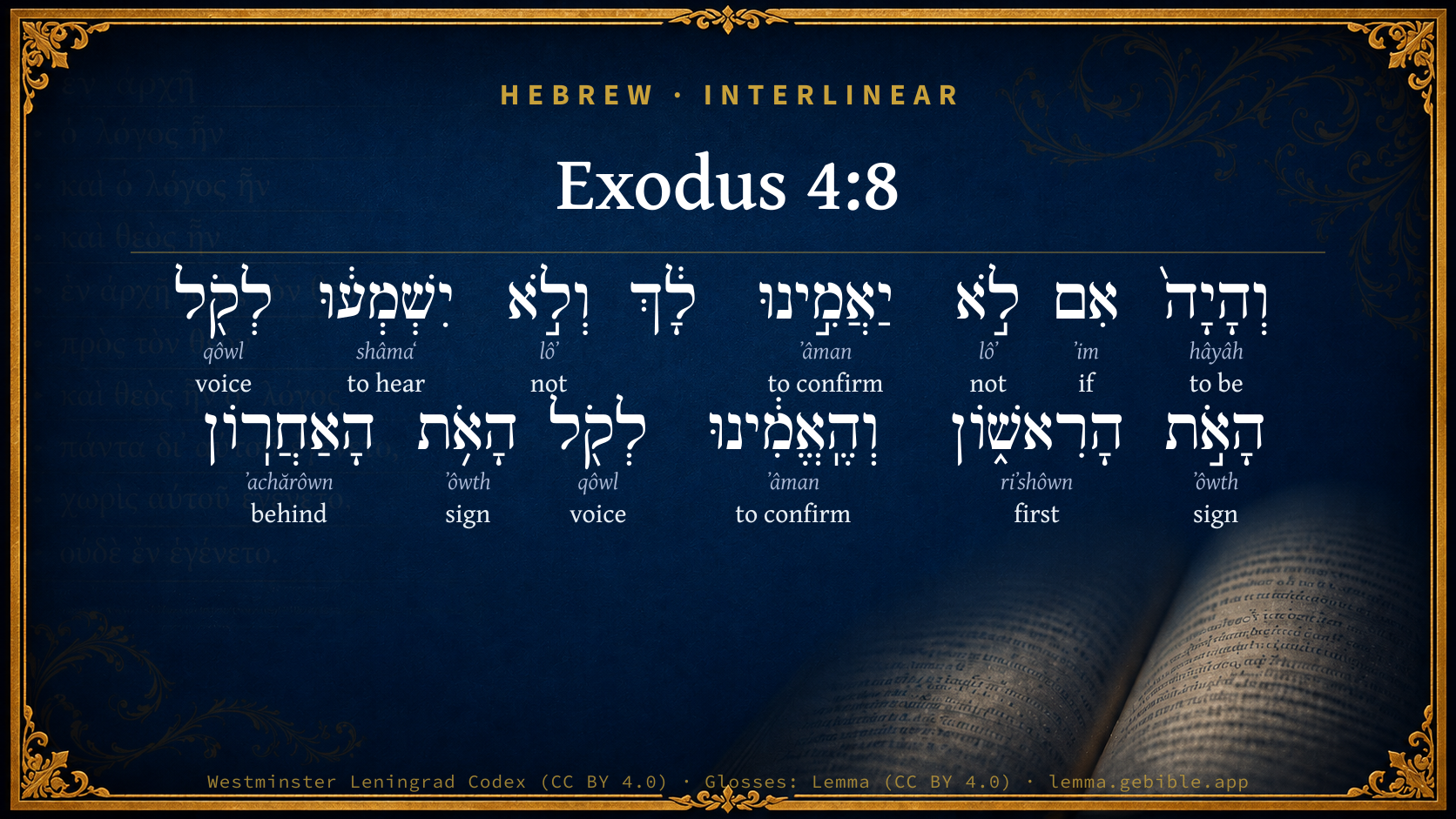
  1. וְהָיָה֙ hâyâh H1961 “and · to be” Conjunction + Verb, Qal, Sequential Perfect, 3rd Person, Masculine, Singular
  2. אִם ʼim H518 “if” Conjunction
  3. לֹ֣א lôʼ H3808 “not” Particle, Negative
  4. יַאֲמִ֣ינוּ ʼâman H539 “to confirm” Verb, Hiphil, Imperfect, 3rd Person, Masculine, Plural
  5. וְלֹ֣א lôʼ H3808 “and · not” Conjunction + Particle, Negative
  6. יִשְׁמְע֔וּ shâmaʻ H8085 “to hear” Verb, Qal, Imperfect, 3rd Person, Masculine, Plural
  7. לְקֹ֖ל qôwl H6963 “to/for · voice of” Preposition + Noun, Common, Masculine, Singular, Construct
  8. הָאֹ֣ת ʼôwth H226 “the · sign” Particle, Definite Article + Noun, Common, Both, Singular, Absolute
  9. הָרִאשׁ֑וֹן riʼshôwn H7223 “the · first” Particle, Definite Article + Adjective, Ordinal number, Masculine, Singular, Absolute
  10. וְהֶֽאֱמִ֔ינוּ ʼâman H539 “and · to confirm” Conjunction + Verb, Hiphil, Sequential Perfect, 3rd Person, Common, Plural
  11. לְקֹ֖ל qôwl H6963 “to/for · voice of” Preposition + Noun, Common, Masculine, Singular, Construct
  12. הָאֹ֥ת ʼôwth H226 “the · sign” Particle, Definite Article + Noun, Common, Both, Singular, Absolute

About this verse

These counts appear in no published source. They are computed here, from the morphology-tagged text and Lemma’s own curated glosses. What Lemma adds →

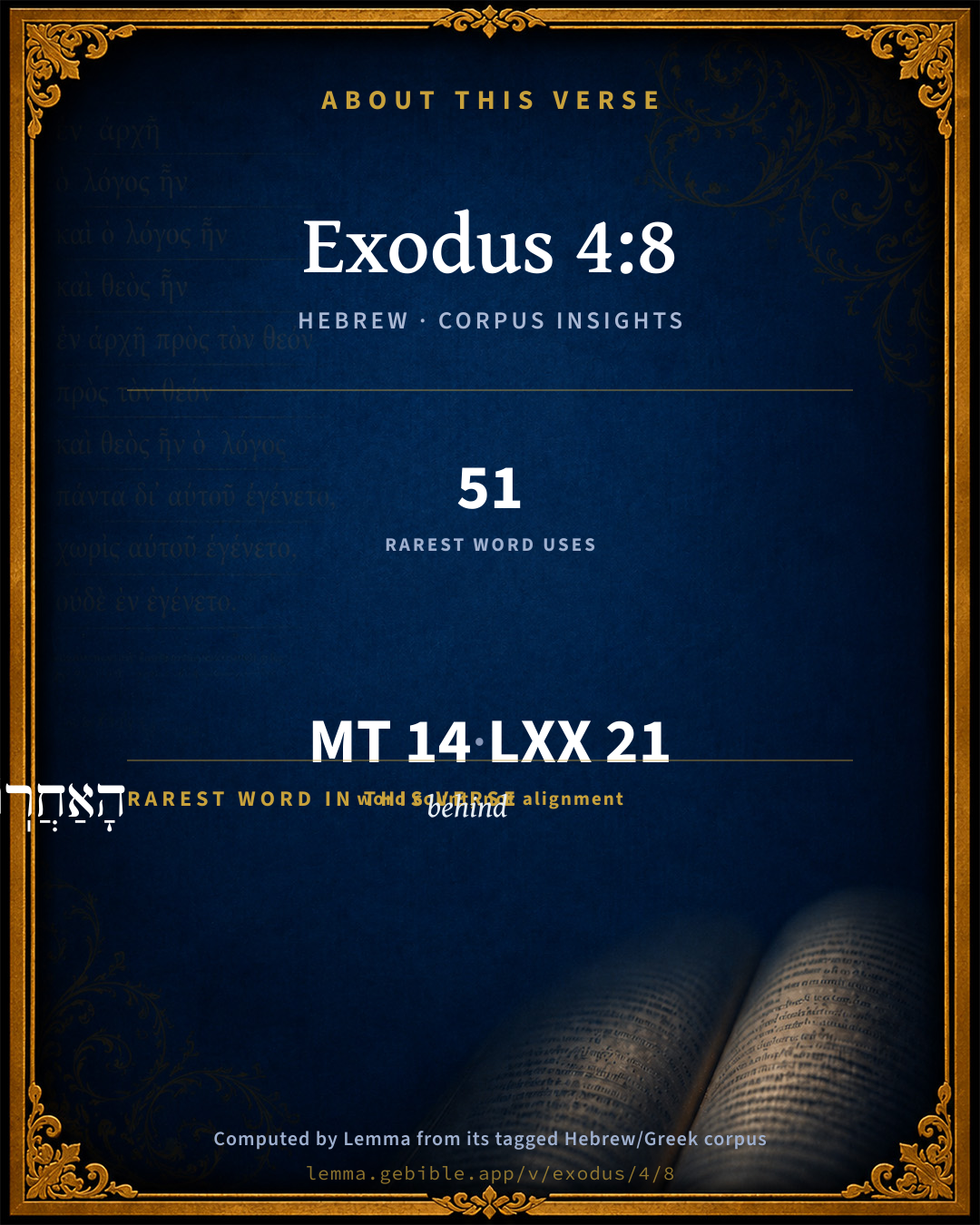
14
words
9
distinct lemmas
Pentateuch
section

Shared distinctive vocabulary

הָאַחֲרֽוֹן behind H314 occurs in 48 verses of the Hebrew Bible. Also found in:

Grammatical profile

  • 4 verbs
  • 4 nouns
  • 2 adjectives
  • 1 preposition
  • 1 conjunction
  • 2 particles

Verb forms

  • וְהָיָה֙ Qal · Sequential Perfect
  • יַאֲמִ֣ינוּ Hiphil · Imperfect
  • יִשְׁמְע֔וּ Qal · Imperfect
  • וְהֶֽאֱמִ֔ינוּ Hiphil · Sequential Perfect

Repetition

Words recur within this verse — often emphatic in Hebrew:

  • יַאֲמִ֣ינוּ to confirm H539 ×2
  • לְקֹ֖ל voice H6963 ×2
  • הָאֹ֣ת sign H226 ×2
  • לֹ֣א not H3808 ×2

Hebrew & Septuagint length

In English translation the verse runs 28 words from the Hebrew and 28 from the Septuagint (LXX English) — the same length.

A rough comparison of the two English renderings, which tokenize alike — not a word-level alignment.

Word counts can differ between the Hebrew and the Greek without any difference in meaning — e.g. the Hebrew direct-object marker אֵת has no separate Greek word, and Greek often adds the article ὁ.

In the original languages it is 14 Hebrew tokens and 21 Greek tokens — but the two are counted differently (Hebrew bundles its prefixes and suffixes into one token; the Greek is in lemma form), so that isn’t a like-for-like length.

Cross-references

5

Topical passages linked to Exodus 4:8 in the Treasury of Scripture Knowledge — connected by theme and wording, ordered by reader-vote popularity; previews shown in the World English Bible.

  • Exodus 4:30–31 Aaron spoke all the words which Yahweh had spoken to Moses, and did the signs in the sight of the people.
  • Deuteronomy 32:39 See now that I, even I, am he, There is no god with me: I kill, and I make alive; I wound, and I heal; There is none who can deliver out of my hand.
  • Isaiah 28:10 For it is precept on precept, precept on precept; line on line, line on line; here a little, there a little.
  • 2 Kings 5:7 It happened, when the king of Israel had read the letter, that he tore his clothes, and said, Am I God, to kill and to make alive, that this man does send to me to recover a man of his leprosy? but consider, I pray you, and see how he seeks a quarrel against me.
  • Job 5:18 For he wounds, and binds up; He injures, and his hands make whole.

Cross-references courtesy of OpenBible.info (CC BY 4.0).

Hebrew and Greek witnesses Masoretic Hebrew ↔ Greek Septuagint

The same verse in the two great witnesses to the Old Testament, shown verse-for-verse.

These are two independent witnesses, not word-aligned to each other, and the Septuagint is shown in lemma (dictionary) form.

Hebrew Exodus 4:8 Masoretic · Westminster Leningrad Codex

וְהָיָה֙ אִם לֹ֣א יַאֲמִ֣ינוּ לָ֔ךְ וְלֹ֣א יִשְׁמְע֔וּ לְקֹ֖ל הָאֹ֣ת הָרִאשׁ֑וֹן וְהֶֽאֱמִ֔ינוּ לְקֹ֖ל הָאֹ֥ת הָאַחֲרֽוֹן

"It will happen, if they will neither believe you nor listen to the voice of the first sign, that they will believe the voice of the latter sign.

World English Bible · Public Domain

Greek LXX Exodus 4:8 Septuagint · lemma form

ἐάν δέ μή πιστεύω σύ μηδέ εἰςἀκούω ὁ φωνή ὁ σημεῖον ὁ πρῶτος πιστεύω σύ ὁ φωνή ὁ σημεῖον ὁ ἔσχατο

And if they will not believe you, nor listen to the voice of the first sign, they will believe you because of the voice of the second sign.

LXX2012 (modern English Septuagint) · Public Domain

Hebrew: Westminster Leningrad Codex (CC BY 4.0). Greek: Septuagint (public domain); English from LXX2012 (modern English Septuagint) (Public Domain). How the Septuagint differs from the Hebrew →

Targum (Aramaic paraphrase)

2

The Targum is the ancient Jewish Aramaic paraphrase of the Hebrew Scriptures — an interpretive translation, not the Hebrew text itself. Onkelos (literal) and Pseudo-Jonathan (expansive) render the Torah, and Jonathan the Prophets. Coverage is partial: where no permissively-licensed English translation exists for a verse, only the Aramaic is shown. This is verse-level text, not a word-by-word alignment to the Hebrew.

  1. Targum Onkelos Torah (Genesis–Deuteronomy)
    וִיהֵי אִם לָא יְהֵמְנוּן לָךְ וְלָא יְקַבְּלוּן לְקַל אָתָא קַדְמָאָה וִיהֵמְנוּן לְקַל אָתָא בַתְרָאָה:

    (no public-domain English translation for this verse)

    Targum Onkelos — Aramaic: “Onkelos Genesis” (public domain); “Onkelos Exodus” (public domain); “Onkelos Leviticus” (public domain); “Onkelos Numbers” (public domain); “Onkelos Deuteronomy” (public domain). English: “Sefaria Community Translation” (CC0 1.0 (public-domain dedication)); “J.W. Etheridge. The Targums of Onkelos and Jonathan Ben Uzziel on the Pentateuch. London: Longmans, Green, 1862” (public domain). Text via Sefaria.

  2. Targum Pseudo-Jonathan Torah (Genesis–Deuteronomy)
    וִיהֵי אִם לָא יְהֵימְנוּן לָךְ וְלָא יְקַבְּלוּן לְקַל אָתָא קַדְמָאָה וִיהֵמְנוּן לְקַל אָתָא בַּתְרָאָה

    (no public-domain English translation for this verse)

    Targum Pseudo-Jonathan — Aramaic: “Targum Jonathan on Genesis” (public domain); “Targum Jonathan on Exodus” (public domain); “Targum Jonathan on Leviticus” (public domain); “Targum Jonathan on Numbers” (public domain); “Targum Jonathan on Deuteronomy” (public domain). English: “The Targum of Jonathan ben Uzziel, trans. J. W. Etheridge, London, 1862” (public domain). Text via Sefaria.

Commentary

Notes on Exodus 4:8 from classic Christian and Jewish commentators (each source and its license shown beneath its notes). The classic Christian expositions comment on the surrounding passage and are grouped to its opening verse, so a note may address several verses; the Jewish commentaries on the Tanakh (Rashi and others) are per-verse, so they appear only where the commentator wrote on this verse.

Lemma curates 59 commentaries, every one of them public domain or Creative Commons licensed, each selected and text-cleaned for this edition rather than reprinted as found. About our sources →

Trapp's Complete Commentary

John Trapp

Exo 4:8 And it shall come to pass, if they will not believe thee, neither hearken to the voice of the first sign, that they will believe the voice of the latter sign.

Ver. 8. The voice of the first sign.] God’s signs have a voice, and words. {Psa 105:27} They speak not only to our eyes, but ears; as those many prodigies did before the last desolation of Jerusalem; as the terrible tempest at Rome in 1516, - the same year that Luther began to stir, - that so struck the church where Pope Leo was creating his cardinals, that it removed the child Jesus out of the lap of his mother, and the keys out of St Peter’s hand. So the two suns seen in London at the coming in of King Philip on Feb. 15, 1553: the new star in Cassiopeia in 1572: the prodigious comet {a} in 1618, &c.

{a} Oυδεις κωμητης οστις ου κακον φερει.

John Trapp, A Commentary or Exposition upon All the Books of the Old and New Testament (1647–1656) — public domain. Text from a community e-Sword module.

The Biblical Illustrator

Joseph S. Exell

Exo_4:8-9

They will believe the voice of the latter sign.

The paralysis of doubt

A man needs not to be a thorough unbeliever, overtly renouncing all allegiance to revealed truth, in order to become useless in the pulpit and religiously powerless in society. He needs only to put a note of interrogation after some of the articles of his creed. That is enough, without absolutely erasing them. The hesitant is as impotent for spiritual good as the heretic. The man who is shooting for the Queens cup may as well attempt to hold his rifle with a paralysed arm as take aim with a trembling hand. That tremor will be fatal to success in hitting the mark. Truth uttered questioningly and apologetically will prove an arrow of conviction to no mans soul. This, it seems to me, rather than absolute and pronounced infidelity, is the bane and weakness of the age. It pervades the pulpit and the pew. From the former, doctrines may be still propounded with logical accuracy, with great precision of definition, with much beauty and felicity of illustration, but with not enough of conviction to drive them forcibly home. The rifle is a beautiful piece of mechanism, but there is something amiss with the powder. (J. Halsey.)

The Divine treatment of human doubt

I. The Divine being recognizes the probability that men will not welcome the truth upon its first presentation to them. Yet the message proclaimed by Moses was--

1. Adapted to their condition Announcing freedom. The tendency of all unbelief is to intensify slavery of moral nature.

2. Wonderfully simple.

3. Divinely authenticated. Miracles will not convince a sceptic.

II. The Divine being mercifully makes provision for the conviction and persuasion of men in reference to the reality of the truth proclaimed, notwithstanding their confirmed unbelief. This method of treatment is--

1. Considerate. Every facility given for complete investigation.

2. Merciful. Sign after sign.

3. Condescending.

III. The persistent unbelief of men is likely to awaken evidences of truth indicative of the divine displeasure (Exo_4:9).

1. Evidences that recall past sorrows. Reminding of murder of children in river.

2. Evidences prophetic of future woe. Indicating a strange and unhappy change in their condition, if they embraced not the message of Moses. (J. S. Exell, M. A.)

The voice of the first sign

1. It speaks of the thraldom of man.

2. It speaks of the inability of man to liberate himself therefrom.

3. It speaks of the agency that God has provided for the freedom of man.

4. It speaks of the strange unwillingness of man to credit the tidings of freedom. (J. S. Exell, M. A.)

Miracles

1. Miracles at first may miss their end, and not persuade men to faith.

2. Second miracles may do that which the first failed to effect.

3. Gods word and promise alone can make miracles themselves effectual means of faith.

4. Miracles have voices which should command faith and obedience. (J. S. Exell, M. A.)

Ministers exposed to unbelief

That a true minister, notwithstanding--

1. His call.

2. His spiritual preparation.

3. His knowledge of the Divine name.

4. His supreme moral power, and--

5. Intimate communion with God--is exposed to the unbelief of those whom he seeks to benefit. (J. S. Exell, M. A.)

The obstinacy of unbelief

It will reject the truth.

1. In opposition to the word of him by whom it is brought.

2. In opposition to the Divine power by which it is accompanied.

3. In opposition to the benevolent design it contemplates.

4. In opposition to accumulative demonstration. (J. S. Exell, M. A.)

The folly of rejecting the gospel of emancipation

One can hardly conceive a poor wayworn wretch, as he lies on the arid waste, punting with blackened lips and swollen tongue, striking the kind travellers flask from his hand, and spilling the precious water among the blistering sands. The slave boy--now an African bishop--exulted gleefully when a British cruiser snapped the fetters from his youthful limbs and bore him to free Liberia. Can folly surpass that insensate madness which makes the sinner spurn the clear, cool, crystal drops of life, and perversely traverse the wilds of sin? Can madness outrival that supreme folly which leads the hapless bondsman of sin to hug the chains of condemnation, and obstinately kiss the fetters of wrath?

The Biblical Illustrator, edited by Joseph S. Exell (c. 1880s–1900s) — public domain. Text from a community e-Sword module.

Joseph Benson's Commentary

Exo 4:8. The voice of the first sign — The expression here is peculiarly proper and forcible; for God’s works have a voice as well as his word, to which we ought diligently to attend. And these miracles spoke aloud in the ear of reason, and said, Believe in him whom God hath sent. Bishop Warburton observes here (see Divine Legation, book 4, sect. 4) that “in the first ages of the world, men being obliged to supply the deficiencies of language by significant signs, mutual converse was carried on by a mixed discourse of words and actions. Hence came the eastern phrase of the voice of the sign; and use and custom improving what had arisen out of necessity into ornament, this practice subsisted long after the necessity was over, especially in the East, the natural temperament of the people in that part of the world inclining them to a mode of conversation which exercised their vivacity by motion, and gratified it by a perpetual representation of material images.”

Joseph Benson's Commentary on the Old and New Testaments (1811–1818) — public domain. Text from a community e-Sword module.

Geneva Bible (1599)

Geneva Bible translators

Or, the words confirmed by the first sign.

Geneva Bible (1599) marginal notes — public domain. Text via Bolls.life.

Adam Clarke's Commentary

Verse 8. If they will not believe - the voice of the first sign, c.] Probably intimating that some would be more difficult to be persuaded than others: some would yield to the evidence of the first miracle others would hesitate till they had seen the second; and others would not believe till they had seen the water of the Nile turned into blood, when poured upon the dry land; Ex 4:9.

Adam Clarke's Commentary on the Bible (1810–1826) — public domain. Text from a community e-Sword/MySword module.

Ellicott's Commentary for English Readers

(8) The voice of the first sign.—Not “the voice of Moses witnessed to by the first sign” (Rosenmüller), but the voice, which the sign itself might be regarded as uttering. (Comp. Psa_105:27, where Moses and Aaron are said to have proclaimed “the words of God’s signs.”) A miracle speaks to men.

They will believe, i.e., most of them. Accustomed to the tricks of the serpent charmers (see Exo_7:11 and comment ad loc.), the Israelites might be unmoved by the sight of the first miracle. They were then to be shown the second, which would be much more astonishing to them, having no parallel in their experience. This would persuade the greater number. As some, however, might still doubt, a third sign was provided. God is patient with all reasonable doubt.

A Bible Commentary for English Readers, edited by Charles John Ellicott (1878–1897) — public domain. Text from a community e-Sword module.

John Gill's Exposition

And it shall come to pass, if they will not believe thee,.... Will not give credit to the commission he had from God, but question the truth of it:

neither hearken to the voice of the first sign; which miracle wrought, spoke plain enough that he that wrought it, or for whose sake it was wrought, must be one come from God, or such a miracle would never be wrought by him or for him; but should any of the Israelites be still incredulous, it is supposed:

that they will believe the voice of the latter sign; which had a voice in it commanding belief that he was a messenger of God; the first sign respects his rod, the other his hand.

John Gill's Exposition of the Whole Bible (1746–1763) — public domain (CC PDM 1.0). Text via the HelloAO Bible API.

Matthew Poole's English Annotations

To the voice of the first sign; to the voice or word of God delivered and confirmed by the first sign. For Moses did not make dumb shows before them, but acquainted them with the mind of God therein. Or he saith

the voice, to note that God’s works have a voice to speak to us, which we must diligently observe. See Mic 6:9.

Matthew Poole's English Annotations on the Holy Bible (1683–1685) — public domain. Text from a community e-Sword/MySword module.

Whedon's Commentary on the Bible

Daniel D. Whedon

8. First sign… latter sign — These signs are God’s voiceless but visible words to the people. But, like all other words, they may be heard or not, at the hearer’s option. No conceivable miracle can compel conviction. When Christ arose “some doubted.”

Daniel D. Whedon (gen. ed.), Commentary on the Old and New Testaments (1874–1909) — public domain. Text from a community e-Sword module.

The Pulpit Commentary

The voice of the first sign. Some understand "the voice of Moses as he gave them the first sign;" but it is better to regard the sign itself as speaking to them. According to the sacred writers everything that can teach us anything day, night, the heavens, the firmament, the beasts, the fowls of the air, the fishes, nay, the very stones have a voice. They teach us, speak to us, declare to us, cry out aloud, lift up their voice, shout, sing, proclaim God"s will, whether man will hear or whether he will forbear. (see Psa_19:1-3; Job_12:7, Job_12:3; Hab_2:11; Luk_19:40, etc.) Equally, or rather much more, must a miracle be regarded as having a voice. God speaks to us by it.

The Pulpit Commentary (1880–1919), ed. H.D.M. Spence-Jones & Joseph S. Exell — public domain. Text from a community e-Sword module.

John Wesley's Explanatory Notes

The voice of the first sign - God's works have a voice to speak to us, which we must diligently observe.

John Wesley, Explanatory Notes Upon the Whole Bible (1754–1765) — public domain. Text via the GEBible commentary corpus.

unfoldingWord translationNotes

Door43 World Missions Community

pay attention

"acknowledge" or "accept"

translationWords

Yahweh

believe

sign

power

unfoldingWord translationNotes — © Distant Shores Media and the Door43 World Missions Community, licensed CC BY-SA 4.0. Source: git.door43.org/Door43/en_tn.

Rashi

Rabbi Shlomo Yitzchaki (Rashi)

והאמינו לקל האת האחרון THEY WILL BELIEVE THE VOICE OF THE LATTER SIGN — As soon as you say to them, “On your account have I been smitten — because I uttered slander about you”, they will believe you, for they are already experienced in this: that those who combine to harm them are smitten by plagues, e. g., Pharaoh and Abimelech who were punished on Sarah’s account.

Rashi on the Tanakh — English translations: “The Judaica Press complete Tanach with Rashi, translated by A. J. Rosenberg” (CC BY 4.0); “Pentateuch with Rashi's commentary by M. Rosenbaum and A.M. Silbermann, 1929-1934” (public domain); “The Metsudah Tanach series, Lakewood, N.J” (CC BY 4.0); and “The Book of Joshua, Metsudah Publications, 1997” (CC BY 4.0). Text via Sefaria.

Lesson kit

Teaching starters — assembled from the data on this page, not authored interpretation. Every prompt links to the verse data it draws on. Edit before teaching.

Exodus, in the Pentateuch, opens this verse with 14 words (9 distinct Hebrew lemmas). Its most distinctive word is ʼachărôwn (“behind”). A historical commentator’s framing appears above. Read the whole chapter for the surrounding context.

Discussion questions

  1. What does “behind” (ʼachărôwn) contribute to the verse as a whole?
  2. Genesis 33:2 shares the word «behind» with this verse. How do the two illuminate each other?
  3. “to confirm” occurs 2× in this one verse. What is the effect of the repetition?
  4. The translations on this page render this verse differently — a whole-verse word diff, not a word-by-word alignment. What might account for the different wordings?
  5. The verb «וְהָיָה֙» is Qal Sequential Perfect. How does its form color the action?
  6. Reading how Trapp's Complete Commentary and The Biblical Illustrator read this verse, where do the two commentators agree and where do they part?

Things to notice

Reading settings

Reading text

Shown beneath each verse's original-language words.

Old Testament
Old Testament edition

Read the OT as the Masoretic Hebrew (MT) or the Greek Septuagint (LXX).

English shown for the Greek Septuagint (in the Hebrew ↔ Greek comparison).

Comparing translations? Open the Compare panel on any verse page to stack up to four side by side.