

2 Kings 6:32

Hebrew (Westminster Leningrad Codex) 2 Kings 6:32 appears in the Hebrew Old Testament. The text above is from the Westminster Leningrad Codex. Each word links to its Strong’s number, a concise gloss, and parsing drawn from the Open Scriptures Hebrew Bible morphology. Click any word for its full Brown-Driver-Briggs (BDB) entry.
Download image
Cite this verse

2 Kings 6:32 (World English Bible). Public Domain. Lemma interlinear Bible study tool, https://lemma.gebible.app/v/2-kings/6/32.

Show BibTeX & RIS
BibTeX
RIS
English Translation
But Elisha was sitting in his house, and the elders were sitting with him; and [the king] sent a man from before him: but before the messenger came to him, he said to the elders, See you how this son of a murderer has sent to take away my head? behold, when the messenger comes, shut the door, and hold the door fast against him: isn't the sound of his master's feet behind him?
World English Bible · Public Domain
Download a study sheet

One document with this verse’s original text, its word-by-word gloss line, the meaning frame, cross-references with their text, attributed commentary, and full source and license credits — printable, and it pastes into notes with its structure intact.

This verse Autodidact and up

Study sheet (.html) Plain text (.txt)

A passage Seminary Student

Up to 50 verses in one chapter. A passage sheet keeps up to 6 commentary sources and 12 cross-references per verse, in the order this page ranks them, and says so on the sheet whenever that leaves anything out. Ask for a single verse and you get the Autodidact verse sheet above.

Everything on this page stays free to read, with no account — the sheet is a download of what is already on screen, not access to it.

Want to remove ads? Support Godless Engineer
Compare translations 3

The same verse in 3 English versions, stacked beneath the original-language interlinear above. Click any original word for its lexicon entry.

Each is an independent rendering of the whole verse — the interlinear is not word-aligned to these translations.

Highlighted words mark where these versions differ — a whole-verse word diff, not a word-by-word alignment.

  • World English Bible Public Domain
    But Elisha was sitting in his house, and the elders were sitting with him; and [the king] sent a man from before him: but before the messenger came to him, he said to the elders, See you how this son of a murderer has sent to take away my head? behold, when the messenger comes, shut the door, and hold the door fast against him: isn't the sound of his master's feet behind him?
  • King James Version Public Domain
    But Elisha sat in his house, and the elders sat with him; and the king sent a man from before him: but ere the messenger came to him, he said to the elders, See ye how this son of a murderer hath sent to take away mine head? look, when the messenger cometh, shut the door, and hold him fast at the door: is not the sound of his master's feet behind him?
  • unfoldingWord Literal Text CC BY-SA 4.0
    And Elisha was sitting in his house, and the elders were sitting with him. And he sent a man from his face. Before the messenger came to him, then he, he said to the elders, “Do you see that this son of a murderer has sent to remove my head? See, when the messenger comes, shut the door, and you shall press him with the door. the sound of the feet of his master not behind him?”

unfoldingWord Literal Text — © unfoldingWord, licensed CC BY-SA 4.0. Word-aligned USFM3 via Door43 (git.door43.org/unfoldingWord/en_ult).

Versions to compare (up to 4)

3 of 4 selected

Show all 18 translations

Every available English version of this verse, each an independent rendering of the whole verse.

  • World English Bible Public Domain
    But Elisha was sitting in his house, and the elders were sitting with him; and [the king] sent a man from before him: but before the messenger came to him, he said to the elders, See you how this son of a murderer has sent to take away my head? behold, when the messenger comes, shut the door, and hold the door fast against him: isn't the sound of his master's feet behind him?
  • Berean Standard Bible Public Domain
    Now Elisha was sitting in his house, and the elders were sitting with him. The king sent a messenger ahead, but before he arrived, Elisha said to the elders, “Do you see how this murderer has sent someone to cut off my head? Look, when the messenger comes, shut the door to keep him out. Is not the sound of his master’s footsteps behind him?”
  • Majority Standard Bible Public Domain
    Now Elisha was sitting in his house, and the elders were sitting with him. The king sent a messenger ahead, but before he arrived, Elisha said to the elders, “Do you see how this murderer has sent someone to cut off my head? Look, when the messenger comes, shut the door to keep him out. Is not the sound of his master’s footsteps behind him?”
  • King James Version Public Domain
    But Elisha sat in his house, and the elders sat with him; and the king sent a man from before him: but ere the messenger came to him, he said to the elders, See ye how this son of a murderer hath sent to take away mine head? look, when the messenger cometh, shut the door, and hold him fast at the door: is not the sound of his master's feet behind him?
  • American Standard Version (1901) Public Domain
    But Elisha was sitting in his house, and the elders were sitting with him; and `the king' sent a man from before him: but ere the messenger came to him, he said to the elders, See ye how this son of a murderer hath sent to take away my head? look, when the messenger cometh, shut the door, and hold the door fast against him: is not the sound of his master's feet behind him?
  • Revised Version (1885) Public Domain
    But Elisha sat in his house; and the elders sat with him; and the king sent a man from before him: but ere the messenger came to him, he said to the elders, See ye how this son of a murderer hath sent to take away mine head? look, when the messenger cometh, shut the door, and hold the door fast against him: is not the sound of his master’s feet behind him.?
  • Geneva Bible (1599) Public Domain
    (Nowe Elisha sate in his house, and the Elders sate with him.) And the King sent a man before him: but before the messenger came to him, he saide to the Elders, See ye not howe this murtherers sonne hath sent to take away mine head? take heede when the messenger commeth, and shut the doore and handle him roughly at the doore: is not the sounde of his masters feete behinde him?
  • Douay-Rheims (1899) Public Domain
    But Eliseus sat in his house, and the ancients sat with him. So he sent a man before: and before that messenger came, he said to the ancients: Do you know that this son of a murderer hath sent to cut off my head? Look then, when the messenger shall come, shut the door, and suffer him not to come in: for behold the sound of his master's feet is behind him.
  • Young's Literal Translation Public Domain
    And Elisha is sitting in his house, and the elders are sitting with him, and `the king' sendeth a man from before him; before the messenger doth come unto him, even he himself said unto the elders, `Have ye seen that this son of the murderer hath sent to turn aside my head? see, at the coming in of the messenger, shut the door, and ye have held him fast at the door, is not the sound of the feet of his lord behind him?'
  • Literal Standard Version CC BY-SA 4.0
    And Elisha is sitting in his house, and the elderly are sitting with him, and [the king] sends a man from before him; before the messenger comes to him, even he himself said to the elderly, “Have you seen that this son of the murderer has sent [him] to turn aside my head? See, at the coming in of the messenger, shut the door, and you have held him fast at the door, is not the sound of the feet of his lord behind him?”
  • Unlocked Literal Bible CC BY-SA 4.0
    But Elisha was sitting in his house, and the elders were sitting with him. The king sent a man from before him, but when the messenger came to Elisha, he said to the elders, “See how this son of a murderer has sent to take away my head? Look, when the messenger comes, shut the door, and hold the door shut against him. Is not the sound of his master's feet behind him?”
  • unfoldingWord Literal Text CC BY-SA 4.0
    And Elisha was sitting in his house, and the elders were sitting with him. And he sent a man from his face. Before the messenger came to him, then he, he said to the elders, “Do you see that this son of a murderer has sent to remove my head? See, when the messenger comes, shut the door, and you shall press him with the door. the sound of the feet of his master not behind him?”
  • Darby Bible Public Domain
    And Elisha sat in his house, and the elders sat with him. And [the king] sent a man before him. Before the messenger came to him, he himself said to the elders, Do ye see how this son of a murderer has sent to take away my head? See, when the messenger comes; shut the door, and keep him off with the door: is not the sound of his master's feet behind him?
  • World Messianic Bible Public Domain
    But Elisha was sitting in his house, and the elders were sitting with him. Then the king sent a man from before him; but before the messenger came to him, he said to the elders, “Do you see how this son of a murderer has sent to take away my head? Behold, when the messenger comes, shut the door, and hold the door shut against him. Isn’t the sound of his master’s feet behind him?”
  • Webster's Bible Public Domain
    But Elisha sat in his house, and the elders sat with him; and the king sent a man from before him: but ere the messenger came to him, he said to the elders, See ye how this son of a murderer hath sent to take away my head? look, when the messenger cometh, shut the door, and hold him fast at the door: is not the sound of his master's feet behind him?
  • Free Bible Version CC BY-SA 4.0
    Elisha was sitting in his house with the elders. The king had sent a messenger on ahead, but before he got there, Elisha told the elders, “Can you see how this murderer is sending someone to cut off my head? So, as soon as the messenger arrives, close the door and hold it shut against him. Isn't that the sound of his master's footsteps following him?”
  • Bible in Basic English Public Domain
    But Elisha was in his house, and the responsible men were seated there with him; and before the king got there, Elisha said to those who were with him, Do you see how this cruel and violent man has sent to take away my life?
  • JPS Tanakh (1917) Public Domain
    But Elisha sat in his house, and the elders sat with him; and the king sent a man from before him; but ere the messenger came to him, he said to the elders: 'See ye how this son of a murderer hath sent to take away my head? look, when the messenger cometh, shut the door, and hold the door fast against him; is not the sound of his master's feet behind him?'

Literal Standard Version (2020), Covenant Press — licensed CC BY-SA 4.0. Text via the HelloAO Bible API (eBible.org). Unlocked Literal Bible (unfoldingWord) — licensed CC BY-SA 4.0. Text via the HelloAO Bible API (eBible.org). unfoldingWord Literal Text — © unfoldingWord, licensed CC BY-SA 4.0. Word-aligned USFM3 via Door43 (git.door43.org/unfoldingWord/en_ult). Free Bible Version, Dr. Jonathan Gallagher — licensed CC BY-SA 4.0. Text via the HelloAO Bible API (eBible.org).

Word by word

More ways to search: Search by grammar → Find every occurrence → Compare this word →

Practice this passage: Drill this verse → Learn its vocabulary →

וּלְחַצְתֶּ֤ם
lâchats
H3905
“and · to oppress”
Conjunction + Verb, Qal, Sequential Perfect, 2nd Person, Masculine, Plural
Part of Speech
Conjunction + Verb
Stem
Qal
Form
Sequential Perfect
Person
2nd Person
Gender
Masculine
Number
Plural
Full BDB Definition

Origin: a primitive root

TWOT: 1106

to squeeze, press, oppress - (Qal) - to squeeze, press - to oppress - (Niphal) to squeeze oneself
  1. וֶאֱלִישָׁע֙ ʼĔlîyshâʻ H477 “and · Elisha” Conjunction + Noun, Proper
  2. יֹשֵׁ֣ב yâshab H3427 “dwelling” Verb, Qal, Participle Active, Masculine, Singular, Absolute
  3. בְּבֵית֔וֹ bayith H1004 “in/at · house · his” Preposition + Noun, Common, Masculine, Singular, Construct + Suffix, Personal, 3rd Person, Masculine, Singular
  4. וְהַזְּקֵנִ֖ים zâqên H2205 “and · the · old” Conjunction + Particle, Definite Article + Adjective, Adjective, Masculine, Plural, Absolute
  5. יֹשְׁבִ֣ים yâshab H3427 “dwelling” Verb, Qal, Participle Active, Masculine, Plural, Absolute
  6. אִתּ֑וֹ ʼêth H854 “with · him” Preposition + Suffix, Personal, 3rd Person, Masculine, Singular
  7. וַיִּשְׁלַ֨ח shâlach H7971 “and · to send” Conjunction + Verb, Qal, Sequential Imperfect, 3rd Person, Masculine, Singular
  8. אִ֜ישׁ ʼîysh H376 “man” Noun, Common, Masculine, Singular, Absolute
  9. מִלְּפָנָ֗יו pânîym H6440 “from · to/for · face(s) · his” Preposition + Preposition + Noun, Common, Both, Plural, Construct + Suffix, Personal, 3rd Person, Masculine, Singular
  10. בְּטֶ֣רֶם ṭerem H2962 “in/at · before” Preposition + Adverb
  11. יָבֹא֩ bôwʼ H935 “to enter” Verb, Qal, Imperfect, 3rd Person, Masculine, Singular
  12. הַמַּלְאָ֨ךְ mălʼâk H4397 “the · messenger” Particle, Definite Article + Noun, Common, Masculine, Singular, Absolute
  13. אֵלָ֜יו ʼêl H413 “to · him” Preposition + Suffix, Personal, 3rd Person, Masculine, Singular
  14. וְה֣וּא hûwʼ H1931 “and · he” Conjunction + Pronoun, Personal, 3rd Person, Masculine, Singular
  15. אָמַ֣ר ʼâmar H559 “to say” Verb, Qal, Perfect, 3rd Person, Masculine, Singular
  16. אֶל ʼêl H413 “to” Preposition
  17. הַזְּקֵנִ֗ים zâqên H2205 “the · old” Particle, Definite Article + Adjective, Adjective, Masculine, Plural, Absolute
  18. הַרְּאִיתֶם֙ râʼâh H7200 “to see” Particle, Interrogative + Verb, Qal, Perfect, 2nd Person, Masculine, Plural
  19. כִּֽי kîy H3588 “that” Conjunction
  20. שָׁלַ֞ח shâlach H7971 “to send” Verb, Qal, Perfect, 3rd Person, Masculine, Singular
  21. בֶּן bên H1121 “son of” Noun, Common, Masculine, Singular, Construct
  22. הַֽמְרַצֵּ֤חַ râtsach H7523 “the · murdering” Particle, Definite Article + Verb, Piel, Participle Active, Masculine, Singular, Absolute
  23. הַזֶּה֙ zeh H2088 “the · this” Particle, Definite Article + Pronoun, Demonstrative, Masculine, Singular
  24. לְהָסִ֣יר çûwr H5493 “to turn aside” Preposition + Verb, Hiphil, Infinitive Construct
  25. אֶת ʼêth H853 “-” Particle, Direct Object
  26. רֹאשִׁ֔י rôʼsh H7218 “head · my” Noun, Common, Masculine, Singular, Construct + Suffix, Personal, 1st Person, Common, Singular
  27. רְא֣וּ râʼâh H7200 “see” Verb, Qal, Imperative, 2nd Person, Masculine, Plural
  28. כְּבֹ֣א bôwʼ H935 “like/as · to enter” Preposition + Verb, Qal, Infinitive Construct
  29. הַמַּלְאָ֗ךְ mălʼâk H4397 “the · messenger” Particle, Definite Article + Noun, Common, Masculine, Singular, Absolute
  30. סִגְר֤וּ çâgar H5462 “shut” Verb, Qal, Imperative, 2nd Person, Masculine, Plural
  31. הַדֶּ֨לֶת֙ deleth H1817 “the · door” Particle, Definite Article + Noun, Common, Feminine, Singular, Absolute
  32. אֹתוֹ֙ ʼêth H853 “- · him” Particle, Direct Object + Suffix, Personal, 3rd Person, Masculine, Singular
  33. בַּדֶּ֔לֶת deleth H1817 “in/at the · door” Preposition, Determined + Noun, Common, Feminine, Singular, Absolute
  34. הֲל֗וֹא lôʼ H3808 “not” Particle, Interrogative + Particle, Negative
  35. ק֛וֹל qôwl H6963 “voice of” Noun, Common, Masculine, Singular, Construct
  36. רַגְלֵ֥י regel H7272 “feet of” Noun, Common, Feminine, Dual, Construct
  37. אֲדֹנָ֖יו ʼâdôwn H113 “lords · his” Noun, Common, Masculine, Plural, Construct + Suffix, Personal, 3rd Person, Masculine, Singular
  38. אַחֲרָֽיו ʼachar H310 “after · him” Preposition + Suffix, Personal, 3rd Person, Masculine, Singular

About this verse

These counts appear in no published source. They are computed here, from the morphology-tagged text and Lemma’s own curated glosses. What Lemma adds →

39
words
30
distinct lemmas
Historical
section

Notable vocabulary

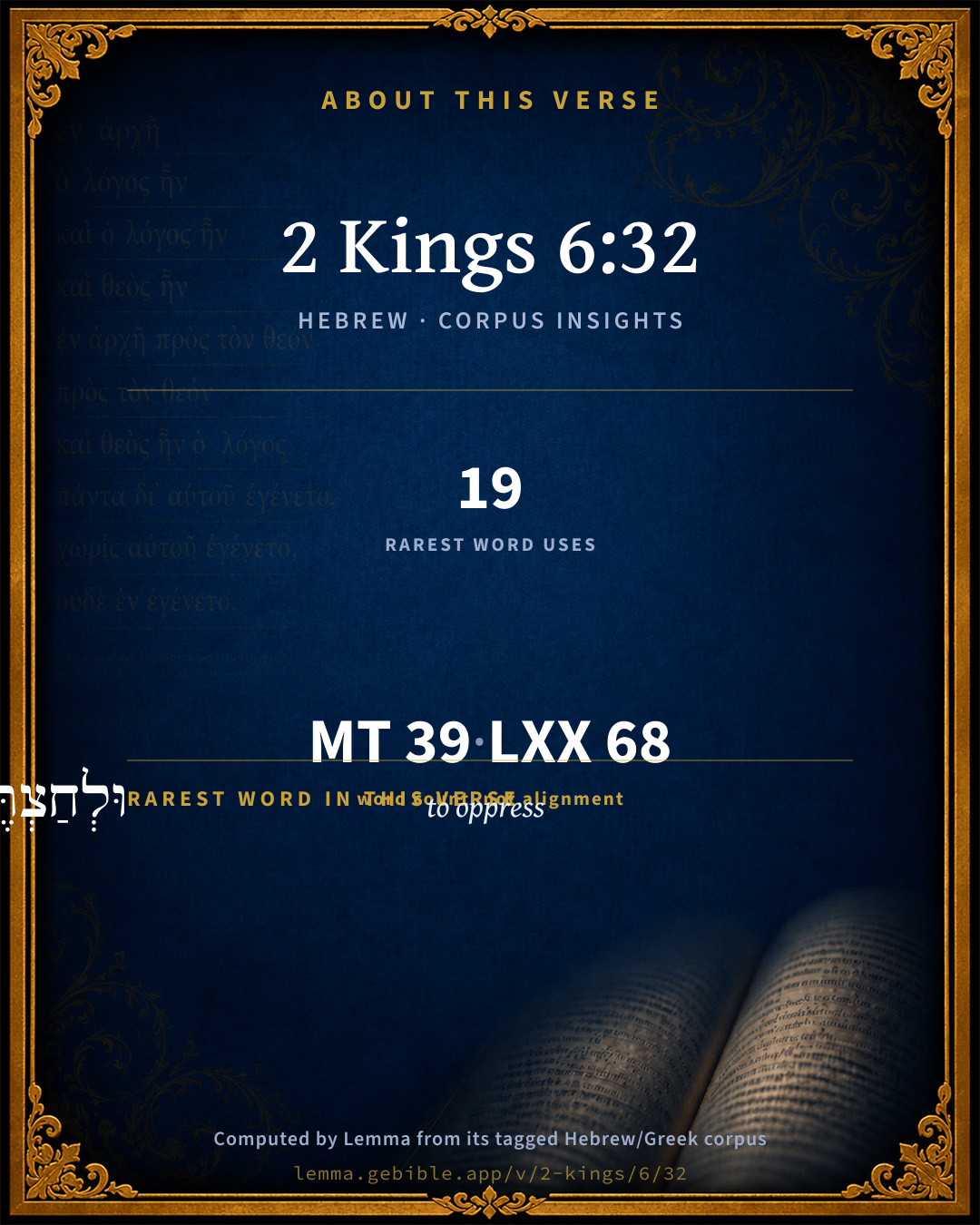
The rarest word here is וּלְחַצְתֶּ֤ם to oppress H3905 — appearing just 19 times in the whole Hebrew Bible.

Shared distinctive vocabulary

וּלְחַצְתֶּ֤ם to oppress H3905 occurs in 18 verses of the Hebrew Bible. Also found in:

Grammatical profile

  • 13 verbs
  • 13 nouns
  • 2 adjectives
  • 2 pronouns
  • 4 prepositions
  • 1 conjunction
  • 1 adverb
  • 3 particles

Verb forms

  • יֹשֵׁ֣ב Qal · Participle Active
  • יֹשְׁבִ֣ים Qal · Participle Active
  • וַיִּשְׁלַ֨ח Qal · Sequential Imperfect
  • יָבֹא֩ Qal · Imperfect
  • אָמַ֣ר Qal · Perfect
  • הַרְּאִיתֶם֙ Qal · Perfect
  • שָׁלַ֞ח Qal · Perfect
  • הַֽמְרַצֵּ֤חַ Piel · Participle Active
  • לְהָסִ֣יר Hiphil · Infinitive Construct
  • רְא֣וּ Qal · Imperative
  • כְּבֹ֣א Qal · Infinitive Construct
  • סִגְר֤וּ Qal · Imperative
  • וּלְחַצְתֶּ֤ם Qal · Sequential Perfect

Repetition

Words recur within this verse — often emphatic in Hebrew:

  • יֹשֵׁ֣ב to dwell H3427 ×2
  • וְהַזְּקֵנִ֖ים old H2205 ×2
  • וַיִּשְׁלַ֨ח to send H7971 ×2
  • יָבֹא֩ to enter H935 ×2
  • הַמַּלְאָ֨ךְ messenger H4397 ×2
  • הַרְּאִיתֶם֙ to see H7200 ×2
  • הַדֶּ֨לֶת֙ door H1817 ×2
  • אֵלָ֜יו to H413 ×2

Hebrew & Septuagint length

In English translation the verse runs 74 words from the Hebrew and 79 from the Septuagint (LXX English) — closely comparable.

A rough comparison of the two English renderings, which tokenize alike — not a word-level alignment.

Word counts can differ between the Hebrew and the Greek without any difference in meaning — e.g. the Hebrew direct-object marker אֵת has no separate Greek word, and Greek often adds the article ὁ.

In the original languages it is 39 Hebrew tokens and 68 Greek tokens — but the two are counted differently (Hebrew bundles its prefixes and suffixes into one token; the Greek is in lemma form), so that isn’t a like-for-like length.

Cross-references

12

Topical passages linked to 2 Kings 6:32 in the Treasury of Scripture Knowledge — connected by theme and wording, ordered by reader-vote popularity; previews shown in the World English Bible.

  • 1 Kings 18:4 for it was so, when Jezebel cut off the prophets of Yahweh, that Obadiah took one hundred prophets, and hid them by fifty in a cave, and fed them with bread and water.)
  • Ezekiel 8:1 It happened in the sixth year, in the sixth [month], in the fifth [day] of the month, as I sat in my house, and the elders of Judah sat before me, that the hand of the Lord Yahweh fell there on me.
  • Ezekiel 14:1 Then came certain of the elders of Israel to me, and sat before me.
  • Ezekiel 20:1 It happened in the seventh year, in the fifth [month], the tenth [day] of the month, that certain of the elders of Israel came to inquire of Yahweh, and sat before me.
  • 1 Kings 18:13–14 Wasn't it told my lord what I did when Jezebel killed the prophets of Yahweh, how I hid one hundred men of Yahweh's prophets by fifty in a cave, and fed them with bread and water?
  • 1 Kings 21:10 and set two men, base fellows, before him, and let them testify against him, saying, You did curse God and the king. Then carry him out, and stone him to death.
  • 1 Kings 14:6 It was so, when Ahijah heard the sound of her feet, as she came in at the door, that he said, Come in, you wife of Jeroboam; why feign you yourself to be another? for I am sent to you with heavy news.
  • 1 Kings 21:13 The two men, the base fellows, came in and sat before him: and the base fellows bore witness against him, even against Naboth, in the presence of the people, saying, Naboth did curse God and the king. Then they carried him forth out of the city, and stoned him to death with stones.
  • 2 Kings 6:12 One of his servants said, No, my lord, O king; but Elisha, the prophet who is in Israel, tells the king of Israel the words that you speak in your bedchamber.
  • Ezekiel 33:31 They come to you as the people comes, and they sit before you as my people, and they hear your words, but don't do them; for with their mouth they show much love, but their heart goes after their gain.
  • Luke 13:32 He said to them, "Go and tell that fox, 'Behold, I cast out demons and perform cures today and tomorrow, and the third day I complete my mission.
  • 2 Kings 5:26 He said to him, Didn't my heart go with you, when the man turned from his chariot to meet you? Is it a time to receive money, and to receive garments, and olive groves and vineyards, and sheep and oxen, and men-servants and maid-servants?

Cross-references courtesy of OpenBible.info (CC BY 4.0).

Hebrew and Greek witnesses Masoretic Hebrew ↔ Greek Septuagint

The same verse in the two great witnesses to the Old Testament, shown verse-for-verse.

These are two independent witnesses, not word-aligned to each other, and the Septuagint is shown in lemma (dictionary) form.

Hebrew 2 Kings 6:32 Masoretic · Westminster Leningrad Codex

וֶאֱלִישָׁע֙ יֹשֵׁ֣ב בְּבֵית֔וֹ וְהַזְּקֵנִ֖ים יֹשְׁבִ֣ים אִתּ֑וֹ וַיִּשְׁלַ֨ח אִ֜ישׁ מִלְּפָנָ֗יו בְּטֶ֣רֶם יָבֹא֩ הַמַּלְאָ֨ךְ אֵלָ֜יו וְה֣וּא אָמַ֣ר אֶל הַזְּקֵנִ֗ים הַרְּאִיתֶם֙ כִּֽי שָׁלַ֞ח בֶּן הַֽמְרַצֵּ֤חַ הַזֶּה֙ לְהָסִ֣יר אֶת רֹאשִׁ֔י רְא֣וּ כְּבֹ֣א הַמַּלְאָ֗ךְ סִגְר֤וּ הַדֶּ֨לֶת֙ וּלְחַצְתֶּ֤ם אֹתוֹ֙ בַּדֶּ֔לֶת הֲל֗וֹא ק֛וֹל רַגְלֵ֥י אֲדֹנָ֖יו אַחֲרָֽיו

But Elisha was sitting in his house, and the elders were sitting with him; and [the king] sent a man from before him: but before the messenger came to him, he said to the elders, See you how this son of a murderer has sent to take away my head? behold, when the messenger comes, shut the door, and hold the door fast against him: isn't the sound of his master's feet behind him?

World English Bible · Public Domain

Greek LXX 2 Kings 6:32 Septuagint · lemma form

καί ελισαιε καταἧμαι ἐν ὁ οἶκος αὐτός καί ὁ πρεσβύτερος καταἧμαι μετά αὐτός καί ἀποστέλλω ἀνήρ πρό πρόσωπον αὐτός πρίν ἔρχομαι ὁ ἄγγελος πρός αὐτός καί αὐτός εἶπον πρός ὁ πρεσβύτερος εἰ οἶδα ὅτι ἀποστέλλω ὁ υἱός ὁ φονευτής οὗτος ἀποαἱρέω ὁ κεφαλή ἐγώ ὁράω ὡς ἄν ἔρχομαι ὁ ἄγγελος ἀποκλείω ὁ θύρα καί παραθλίβω αὐτός ἐν ὁ θύρα οὐ φωνή ὁ πούς ὁ κύριος αὐτός κατόπισθεν αὐτός

And Elisaie was sitting in his house, and the elders were sitting with him; and the king sent a man before him: before the messenger came to him, he also said to the elders, Do you⌃ see that this son of a murderer has sent to take away my head? See, as soon as the messenger shall have come, shut the door, and forcibly detain him at the door: is not the sound of his master's feet behind him?

LXX2012 (modern English Septuagint) · Public Domain

On this verse, The Pulpit Commentary discusses the Septuagint’s reading. Read the note in Commentary ↓

Hebrew: Westminster Leningrad Codex (CC BY 4.0). Greek: Septuagint (public domain); English from LXX2012 (modern English Septuagint) (Public Domain). How the Septuagint differs from the Hebrew →

Targum (Aramaic paraphrase)

1

The Targum is the ancient Jewish Aramaic paraphrase of the Hebrew Scriptures — an interpretive translation, not the Hebrew text itself. Onkelos (literal) and Pseudo-Jonathan (expansive) render the Torah, and Jonathan the Prophets. Coverage is partial: where no permissively-licensed English translation exists for a verse, only the Aramaic is shown. This is verse-level text, not a word-by-word alignment to the Hebrew.

  1. Targum Jonathan Prophets (Joshua–Malachi)
    וֶאֱלִישָׁע יָתֵיב בְּבֵיתֵיהּ וְסָבַיָא יַתְבִין עִמֵיהּ וּשְׁלַח גַבְרָא קֳדָמוֹהִי עַד לָא יֵתֵי אִזְגַדָא לְוָתֵיהּ וְהוּא אֲמַר לְסָבַיָא הַחֲזֵיתוּן אֲרֵי שְׁלַח בַּר קְטוֹלָא הָדֵין לְאַעְדָאָה יַת רֵישִׁי חֲזוֹ כְּמֵיתֵי אִזְגַדָא אֲחוּד דָשָׁא וּתְדַחֲקוּן יָתֵיהּ בְּדָשָׁא הֲלָא קַל רִגְלֵי רִבּוֹנֵיהּ בַּתְרוֹהִי:

    (no public-domain English translation for this verse)

    Targum Jonathan — Aramaic: “Mikraot Gedolot” (public domain). English: “Sefaria Community Translation” (CC0 1.0 (public-domain dedication)); “London "Chaldee Paraphrase," 1871” (public domain). Text via Sefaria.

Commentary

Notes on 2 Kings 6:32 from classic Christian and Jewish commentators (each source and its license shown beneath its notes). The classic Christian expositions comment on the surrounding passage and are grouped to its opening verse, so a note may address several verses; the Jewish commentaries on the Tanakh (Rashi and others) are per-verse, so they appear only where the commentator wrote on this verse.

Lemma curates 59 commentaries, every one of them public domain or Creative Commons licensed, each selected and text-cleaned for this edition rather than reprinted as found. About our sources →

The Cambridge Bible for Schools and Colleges

gen. ed. J. J. S. Perowne

Chs. 2Ki_6:32 to 2Ki_7:2. A messenger is sent to put Elisha to death. Elisha foretells a sudden plenty in Samaria (Not in Chronicles)

32. But Elisha sat in his house] His counsels had been productive of little result, but he is less disturbed than others, having a ground for his trust which they had not found.

and the elders sat with him] These must be understood to be the chief men of the city, who had come for his advice, having no other helper to flee unto.

and the king sent a man] One of those who were in waiting to obey his orders and who had heard his threat against Elisha.

he said to the elders] i.e. Elisha, divinely forwarned of the impending danger, explains to his companions what the king’s design against him was.

this son of a murderer] ‘Still is Naboth’s blood laid in Jehoram’s dish’ (Bp Hall). The prophet speaks as though the messenger were already in sight, so vivid is his own spiritual consciousness of what the king has set afoot.

hold him fast at the door] R.V. hold the door fast against him. The literal rendering is given on the margin of R.V., ‘Thrust him back with the door’. The doors in Oriental houses mostly opened outwards, so that if pushed from within they would come against any one that stood on the outside, and drive him backwards. Beside knowing of the king’s threat, Elisha seems to have been aware that he had almost immediately changed his purpose, and was hurrying after the messenger to prevent his order from being executed. Hence he explains to the elders that the king’s footsteps are to be heard close upon those of his servant. When they supposed, as they would from the fulfilment of the first part of his words, that Elisha knew exactly what was coming, they would be ready, although they were Jehoram’s servants, to stop the messenger so long as to see whether the king did really arrive. That the king did come we learn from 2Ki_7:17.

The Cambridge Bible for Schools and Colleges (gen. ed. J. J. S. Perowne; Cambridge University Press, 1878–1918) — public domain. Text from a community e-Sword module.

Trapp's Complete Commentary

John Trapp

2Ki 6:32 But Elisha sat in his house, and the elders sat with him; and [the king] sent a man from before him: but ere the messenger came to him, he said to the elders, See ye how this son of a murderer hath sent to take away mine head? look, when the messenger cometh, shut the door, and hold him fast at the door: [is] not the sound of his master’s feet behind him?

Ver. 32. The king sent a man.] An executioner.

See ye how this son of a murderer.] To wit, Of Ahab, that slaughter man of God’s servants; and Joram doth patrissare, take after him notably. See Mat 23:35.

Is not the sound, &c.] The king repenting, came with a countermand.

John Trapp, A Commentary or Exposition upon All the Books of the Old and New Testament (1647–1656) — public domain. Text from a community e-Sword module.

Joseph Benson's Commentary

2Ki 6:32. Elisha sat in his house — In the house where he lodged; for it is probable he had no house of his own, having forsaken all to follow Elijah. And the elders sat with him — Either the sons of the prophets, or rather some good and godly men, such as are frequently termed elders in the prophecy of Ezekiel, who bore some office either in the court, army, or city, as seems probable from the prophet’s desiring their help and protection. For though Jehoram was a wicked man, and most of his officers, probably, as wicked as himself; yet, as Poole justly observes, we cannot doubt but there were some among them whom his holy life, powerful ministry, and glorious miracles, with the great benefits procured by him for the public, had won to God and the true religion; at least to the profession of it, among whom Jehu might be one; and these were here sitting with him, either to receive counsel and comfort from him in this distressing time, or to solicit him to use his power with God for their relief; which he accordingly did, and pronounced the joyful news which follows in the beginning of the next chapter. The king sent a man before him — One of his guard, or some other officer, to take away his head, as it follows. But ere the messenger came, he said, &c. — Being admonished by God of his danger. See how this son of a murderer — The genuine son of that wicked Ahab, the murderer of the Lord’s prophets. This expression may seem very harsh and unfit, nor is it to be drawn into imitation by others: but it must be considered that he was an extraordinary prophet, intrusted with a power in some sort superior to that of Jehoram, and had authority to control and rebuke him in the name of the King of kings. Shut the door, and hold him — That he may not break in upon me, and take away my life, before the king comes. Is not the sound of his master’s feet behind him? — You shall not need to hold him long, for the king is just at his heels. It is probable he was coming, either to recall his rash order, or, at least, to debate the matter with the prophet, and obtain relief.

Joseph Benson's Commentary on the Old and New Testaments (1811–1818) — public domain. Text from a community e-Sword module.

Tyndale Open Study Notes

Tyndale Open Resources

6:32 Elisha was aware that Joram was sending a messenger to assassinate him and that the king was not far behind.

Tyndale Open Study Notes — © Tyndale Open Resources, licensed CC BY-SA 4.0. Text via the HelloAO Bible API.

Geneva Bible (1599)

Geneva Bible translators

Meaning, Jehoram Ahab’s son, who killed the Prophets, and caused Naboth to be stoned.

Geneva Bible (1599) marginal notes — public domain. Text via Bolls.life.

Jamieson, Fausset & Brown

Robert Jamieson, A. R. Fausset & David Brown

But Elisha sat in his house, and the elders sat with him--The latter clause of Kg2 6:33, which contains the king's impatient exclamation, enables us to account for the impetuous order he issued for the beheading of Elisha. Though Jehoram was a wicked king and most of his courtiers would resemble their master, many had been won over, through the prophet's influence, to the true religion. A meeting, probably a prayer-meeting, of those was held in the house where he lodged, for he had none of his own (Kg1 19:20-21); and them he not only apprised of the king's design against himself, but disclosed to them the proof of a premeditated deliverance.

Next: 2 Kings Chapter 7

Jamieson, Fausset & Brown — Commentary Critical and Explanatory on the Whole Bible (1871) — public domain (CC PDM 1.0). Text via the HelloAO Bible API.

Adam Clarke's Commentary

Verse 32. This son of a murderer] Jehoram, the son of Ahab and Jezebel. But Ahab is called a murderer because of the murder of Naboth.

Shut the door] He was obliged to make use of this method for his personal safety, as the king was highly incensed.

The sound of his master's feet behind him?] That is, King Jehoram is following his messenger, that he may see him take off my head.

Adam Clarke's Commentary on the Bible (1810–1826) — public domain. Text from a community e-Sword/MySword module.

Ellicott's Commentary for English Readers

(32) But Elisha sat . . . with him.—Rather, Now Elisha was sitting in his house, and the elders were sitting with him. This shows the important position which the prophet occupied at the time. The elders, who were the nobles and chiefs of Samaria, were gathered round him in his house to learn the will of Jehovah, and to receive comfort and counsel from his lips. (Comp. the way in which Zedekiah and his princes consulted Jeremiah during the last siege of Jerusalem—Jer_21:1-2; Jer_38:14, seq.)

And the king sent a man.—To behead the prophet, according to his oath.

From before him.—Comp. 2Ki_5:16; 2Ki_3:14; 1Ki_10:8. One of the royal attendants—probably a soldier of the guard—is meant.

But ere.—“But” is wanting in the Hebrew. (The conjunction wĕ has, perhaps, fallen out after the preceding w.)

He said to the elders.—Elisha foreknew what was about to happen. (Comp. 2Ki_5:26.) The he is emphatic: “He (the prophet) said.”

This son of a murderer.—Referring to Ahab’s murder of Naboth (1Ki_21:19) and the prophets of Jehovah; as if to say, “The son takes after his father” (filius patrissat). At the same time, we must not forget the idiom by which a man is called a son of any quality or disposition which he evinces. (Comp. “son of Belial,” “sons of pride,” “sons of wickedness;” 2Sa_7:10; Job_41:34).

Hold him fast at the door.—Literally, press him back with the door. The door opened inwards, and the prophet bade his friends the elders hold the door against the messenger of death.

Is not the sound . . . behind him?—Elisha’s reason for bidding the elders hold the door. He foresaw that Jehoram would hasten in person after his messenger, to see that his savage order was carried out. (Bähr and Keil think, with Josephus, that Jehoram repented, and hurried off to restrain the sword of his minister.)

A Bible Commentary for English Readers, edited by Charles John Ellicott (1878–1897) — public domain. Text from a community e-Sword module.

Albert Barnes' Notes on the Bible

But Elisha sat ... - Translate, “And Elisha was sitting in his house, and all the elders were sitting with him, when the king sent, etc.”

The “elders,” - either “the elders of the city” or “the elders of the land,” - who may have been in session at Samaria now, as they had been at the time of a former siege 1Ki 20:7 - had gone to Elisha for his advice or assistance. Their imminent peril drove them to acknowledge the power of Yahweh, and to consult with His prophet.

This son of a murderer - i. e. of Ahab, the murderer, not only of Naboth, but also of all the prophets of the Lord (marginal reference), whom be allowed Jezebel to slay.

Hold him fast at the door - The elders, public officials, not private friends of Elisha, could not have been expected to resist the entrance of the executioner at the mere request of the prophet. He therefore assigns a reason for his request - “the king is coming in person, either to confirm or revoke his order - will they detain the headsman until his arrival?”

Albert Barnes' Notes on the Bible (1834–1885) — public domain. Text from a community e-Sword/MySword module.

Haydock's Catholic Bible Commentary

Murderer. Achab had slain Naboth, and Jezabel had destroyed the prophets. (Calmet)

George Leo Haydock (1774–1849), Haydock's Catholic Family Bible and Commentary, 1859 edition — public domain. Excludes Psalms (Douay-Rheims chapter numbering differs from Protestant) and Deuterocanonical books (Catholic canon only).

Matthew Poole's English Annotations

In his house; in the house where he lodged; for he had no house of his own, having forsaken all when he followed Elijah, 1Ki 19:20,21.

The elders; so they might be called, either, first, from their age; or rather, secondly, from their office, which was either ecclesiastical or civil: so they were either the sons of the prophets; or rather, some godly men who were then in some power and office, either in the court, or army, or city, as may seem probable from what he requires of them. And though Jehoram was a wicked king, and most of his officers probably like himself; yet there were some of them, whom Elisha’s holy life, and powerful ministry, and glorious miracles, and the great and public benefits procured by him, had won to God, and to the true religion, at least to the profession of it, among which Jehu might be one: and these were here sitting with him, either to receive comfort and counsel from him in this distressed time, or rather to solicit him to use his power with God for their relief; which accordingly he doth, and in compliance with them, not out of any fear of the king, (from which he very well knew by frequent experience, and certain assurance, that God both could and would deliver him,) he gives the following answer, 2Ki 7:1.

A man from before him, or, one of them who stood before his face, one of his guard, or some other officer, to take away his head, as it follows.

He said to the elders; being admonished by God of his danger.

This son of a murderer; the genuine son of that wicked Ahab the murderer of the Lord’s prophets, 1Ki 18:4; 21:9; whose son he is not by birth only, but also by his manners and bloody disposition. Compare Joh 8:44. This expression may seem very harsh and unfit; nor is it to be drawn into imitation by others; but it must be considered that he was an extraordinary prophet, intrusted with a power in some sort superior to that of Jehoram, and had authority to control and rebuke him in the name of the King of kings.

To take away mine head; to kill me, before he hear what I have to say.

Hold him fast; not the king, but the messenger, who was last mentioned; that he may not break in upon me, and take away my life, before the king comes.

Is not the sound of his master’s feet behind him? you shall not need to hold him long, for the king is just at his heels, coming, as is probable, either to recall his rash and furious sentence, or at least to debate the matter with the prophet, and to procure relief.

Matthew Poole's English Annotations on the Holy Bible (1683–1685) — public domain. Text from a community e-Sword/MySword module.

Whedon's Commentary on the Bible

Daniel D. Whedon

32. Sat in his house — His own house in Samaria, where he was dwelling when Naaman sought his help. 2Ki_5:9.

The elders sat with him — They were probably consulting together on the state of the city, and were providentially present to witness the scene that is here recorded.

This son of a murderer — Son of Jezebel, who murdered the prophets of the Lord, (1Ki_18:4,) and of Ahab, who by his silence and submission to her will sanctioned her wickedness. More directly still was Ahab the murderer of Naboth. 1Ki_21:19. So now Jehoram was in heart the murderer, when he sent this messenger to behead Elisha.

His master’s feet behind him — This verse and the following are obscure from their brevity. They seem to be an abridgment of a fuller narrative. It seems that immediately after the king had despatched the messenger to behead Elisha he repented of his rash action, and hastened, in company with one of his officers, to countermand his order and prevent its execution.

Daniel D. Whedon (gen. ed.), Commentary on the Old and New Testaments (1874–1909) — public domain. Text from a community e-Sword module.

The Pulpit Commentary

But Elisha sat in his house, and the elders sat with him; and the king sent a man from before him. It is best to translate, Now Elisha was sitting in his house, and the elders were sitting with him, when the king sent a man from before him. Elisha had a house in Samaria, where he ordinarily resided, and from which he made his circuits. He happened to be sitting there, and the elders of the city to be sitting with him, when Jehoram sent "a man from before him," i.e. one of the court officials, to put him to death. The "elders" had probably assembled at Elisha"s house to consult with him on the critical situation of affairs, and (if possible) obtain from him some miraculous assistance. But ere the messenger came to him; he said to the elders, See ye how this son of a murderer hath sent to take away mine head; Elisha was supernaturally warned of what was about to take place that an executioner was coming almost immediately to take away his life, and that the king himself would arrive shortly after. He calls the king "this son of a murderer," or rather "this son of the murderer," with reference to Ahab, the great murderer of the time, who had sanctioned all Jezebel"s cruelties-the general massacre of the prophets of Jehovah, (1Ki_18:13) the judicial murder of Naboth, (1Ki_21:9-13) the attempt to kill Elijah (1Ki_19:2) and had, by a fierce and long continued persecution, reduced the worshippers of Jehovah in Israel to the scanty number of seven thousand. (1Ki_19:18) Jehoram had now shown that he inherited the bloodthirsty disposition of his father, and had justly earned the epithet which Elisha bestowed on him.

Look, when the messenger cometh, shut the door, and hold him fast at the door. Keil renders the last clause, "force him back at the door;" the LXX "press upon him in the doorway paraqliyate aujtorathey were not to allow him to enter the apartment. Is not the sound of his master"s feet behind him? Elisha adds this as a reason why the elders should stop the messenger. He could not in a general way have expected them to resist the king"s will as declared by his representative; but he might reasonably ask a short respite, if the king was just about to arrive at the house, to confirm the order that he had given, or to revoke it.

Princes may be resisted when they are bent upon wrong-doing.

There was a time when princes were flattered, by being told that they "could do no wrong;" that "a divinity hedged them in;" that their subjects were bound to render them, under all circumstances, an absolute and unqualified obedience. But this is certainly not scriptural teaching. The higher powers are to be obeyed in their lawful commands, but not in their unlawful ones. When Pharaoh, King of Egypt, commanded the midwives to put to death all the male children borne by the Hebrew women, "the midwives feared God, and did not as the King of Egypt commanded them, but saved the men children alive"; (Exo_1:17) and God rewarded them for so acting: "Therefore God dealt well with the midwives... and because they feared God, he made them houses". (Exo_1:20, Exo_1:21) So now Elisha, the prophet of God, bids the elders resist the king"s messenger him fast," and not let him execute the king"s commands. Again,the higher powers, the great council of the Sanhedrin, commanded Peter and John, shortly after the Day of Pentecost, "not to speak at all nor preach in the Name of Jesus"; (Act_4:18) to whom the apostles replied, "Whether it be right in the sight of God to hearken unto you more than unto God, judge ye. For we cannot but speak the things which we have seen and heard". (Act_4:19, Act_4:20) Resistance to lawful authority, when it commands unlawful acts, is an important part of a Christian man"s duty, and ought to be inculcated just as much as obedience to lawful authority when it commands lawful acts.

The Pulpit Commentary (1880–1919), ed. H.D.M. Spence-Jones & Joseph S. Exell — public domain. Text from a community e-Sword module.

John Wesley's Explanatory Notes

He said - Being admonished by God of his danger. This son - The genuine son of that wicked Ahab the murderer of the Lord's prophets. This expression may seem very harsh and unfit; nor is it to be drawn into imitation by others: but it must be considered, that he was an extraordinary prophet, intrusted with a power in some sort superior to that of Joram, and had authority to control and rebuke him in the name of the king of kings. Hold him - That he may not break in upon me, and take away my life, before the king comes.

John Wesley, Explanatory Notes Upon the Whole Bible (1754–1765) — public domain. Text via the GEBible commentary corpus.

unfoldingWord translationNotes

Door43 World Missions Community

The king sent a man from before him

"To be before the king" means to be one of his servants. AT: "The king of Israel sent one of his servants as a messenger" (See: Idiom)

when the messenger came to Elisha, he said to the elders

Here Elisha is speaking to the elders right before the king's messenger arrived. AT: "when the messenger had almost arrived, Elisha said to the elders" (See: Assumed Knowledge and Implicit Information)

See how this son of a murderer has sent to take away my head?

Elisha uses this rhetorical question to draw attention to the kings messenger and to insult the king. This can be written as a statement. AT: "See, this son of a murderer has sent someone to remove my head!" (See: Rhetorical Question)

son of a murderer

This means that the king of Israel has the characteristics of a murderer. AT: "this man who is like a murderer" or "that murderer" (See: Idiom)

has sent to

It is understood that he sent a person. AT: "has sent someone to" (See: Ellipsis)

to take away my head

This means to behead him. AT: "to cut off my head" or "to behead me" (See: Euphemism)

Look, when

Elisha uses this word here to draw the elder's attention to what he says next. AT: "Listen to what I want you to do: when"

hold the door shut against him

If a door is shut against someone it means that it is closed and that they may not enter through it. AT: "hold the door shut so that he cannot come in" (See: Idiom)

Is not the sound of his master's feet behind him?

Elisha uses this question to assure the elders that the king is coming not far behind him. This rhetorical question may be written as a statement. AT: "The sound of his master's feet is right behind him." or "The king will be coming along soon after he arrives." (See: Rhetorical Question)

behold, the messenger

The word "behold" alerts us to the arrival of the messenger.

the messenger came down to him

The messenger arrived, and so did the king, as Elisha had said he would. The phrase "came down to him" means that they arrived at the place where he was. AT: "the messenger and the king arrived" (See: Assumed Knowledge and Implicit Information and Idiom)

Behold

"Pay attention, because what I am about to say is both true and important"

this trouble

"Indeed, this trouble." The word "behold" here adds emphasis to what follows. The phrase "this trouble" refers to the famine in Samaria and the suffering it caused.

Why should I wait for Yahweh any longer?

This king use this rhetorical question to emphasize that he does not believe that Yahweh is going to help them. This can be written as a statement. AT: "Why should I continue to wait for Yahweh to help us?" or "I will not wait any longer for help from Yahweh!" (See: Assumed Knowledge and Implicit Information and Rhetorical Question)

translationWords

elder

son

lord

unfoldingWord translationNotes — © Distant Shores Media and the Door43 World Missions Community, licensed CC BY-SA 4.0. Source: git.door43.org/Door43/en_tn.

Rashi

Rabbi Shlomo Yitzchaki (Rashi)

And he sent a man from his presence. The king sent [a man] to kill him, and before the messenger had come to Elisha, it was revealed to him through the Divine Spirit, and he said to the elders, etc., [after which Scripture states,] “and behold the messenger was coming down to him,” and the king was after him.

Rashi on the Tanakh — English translations: “The Judaica Press complete Tanach with Rashi, translated by A. J. Rosenberg” (CC BY 4.0); “Pentateuch with Rashi's commentary by M. Rosenbaum and A.M. Silbermann, 1929-1934” (public domain); “The Metsudah Tanach series, Lakewood, N.J” (CC BY 4.0); and “The Book of Joshua, Metsudah Publications, 1997” (CC BY 4.0). Text via Sefaria.

Lesson kit

Teaching starters — assembled from the data on this page, not authored interpretation. Every prompt links to the verse data it draws on. Edit before teaching.

2 Kings, in the Historical, opens this verse with 39 words (30 distinct Hebrew lemmas). Its most distinctive word is lâchats (“to oppress”). A historical commentator’s framing appears above. Read the whole chapter for the surrounding context.

Discussion questions

  1. How does “to oppress” (lâchats) shape what this verse is saying?
  2. How does Exodus 3:9, which shares the word «to oppress», read alongside this verse?
  3. What does the repetition of “to dwell” (2× in this one verse) do in this verse?
  4. These translations render this verse differently; the difference is in the English rendering, not the original. What questions does that raise?
  5. «יֹשֵׁ֣ב» is a Qal Participle Active verb. How does that grammatical form shape the action described?
  6. Compare how The Cambridge Bible for Schools and Colleges and Trapp's Complete Commentary read this verse. Where do they agree or differ?

Things to notice

Reading settings

Reading text

Shown beneath each verse's original-language words.

Old Testament
Old Testament edition

Read the OT as the Masoretic Hebrew (MT) or the Greek Septuagint (LXX).

English shown for the Greek Septuagint (in the Hebrew ↔ Greek comparison).

Comparing translations? Open the Compare panel on any verse page to stack up to four side by side.