

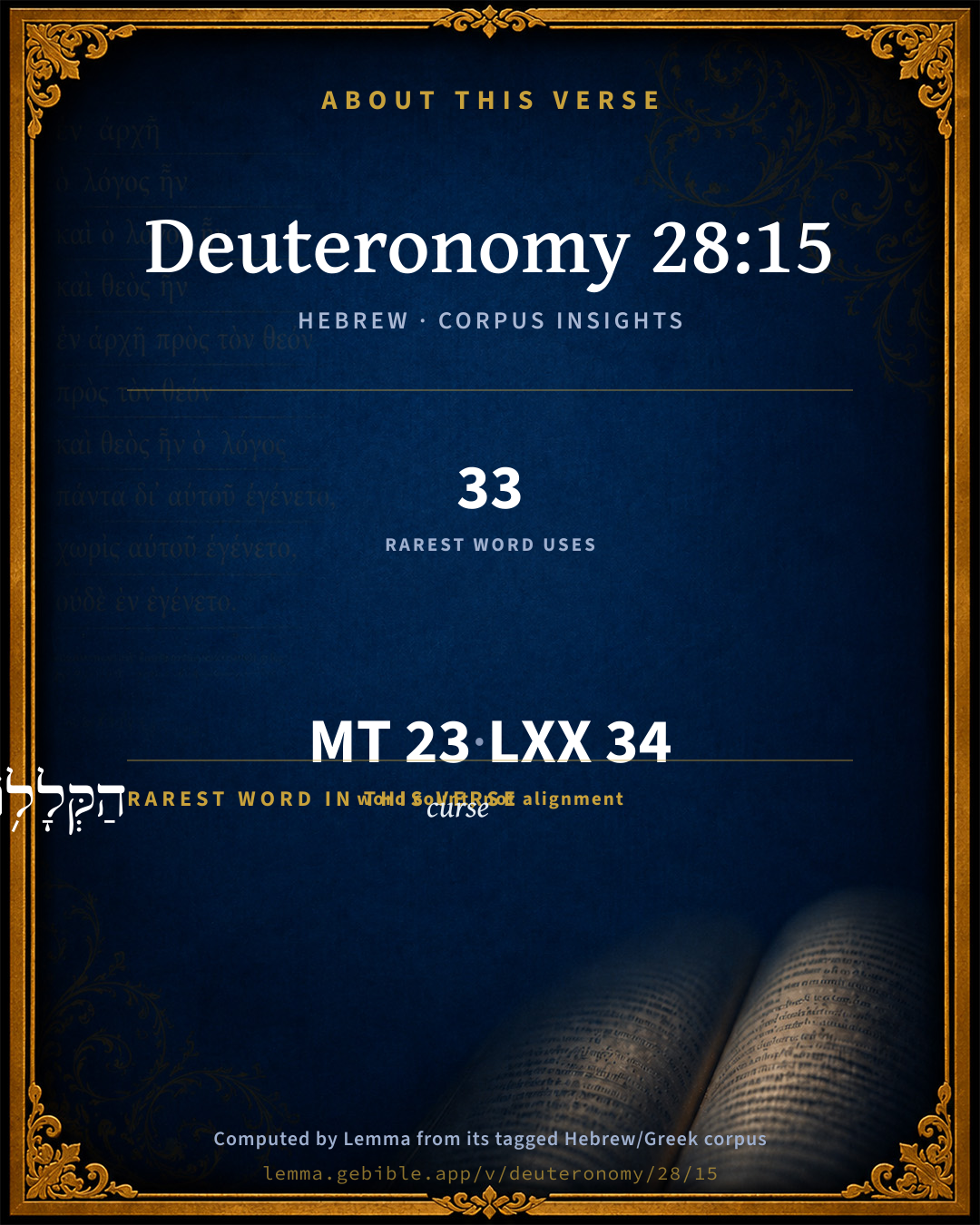
Deuteronomy 28:15

Hebrew (Westminster Leningrad Codex) Deuteronomy 28:15 appears in the Hebrew Old Testament. The text above is from the Westminster Leningrad Codex. Each word links to its Strong’s number, a concise gloss, and parsing drawn from the Open Scriptures Hebrew Bible morphology. Click any word for its full Brown-Driver-Briggs (BDB) entry.
Download image
Cite this verse

Deuteronomy 28:15 (World English Bible). Public Domain. Lemma interlinear Bible study tool, https://lemma.gebible.app/v/deuteronomy/28/15.

Show BibTeX & RIS
BibTeX
RIS
English Translation
But it shall come to pass, if you will not listen to the voice of Yahweh your God, to observe to do all his commandments and his statutes which I command you this day, that all these curses shall come on you, and overtake you.
World English Bible · Public Domain
Download a study sheet

One document with this verse’s original text, its word-by-word gloss line, the meaning frame, cross-references with their text, attributed commentary, and full source and license credits — printable, and it pastes into notes with its structure intact.

This verse Autodidact and up

Study sheet (.html) Plain text (.txt)

A passage Seminary Student

Up to 50 verses in one chapter. A passage sheet keeps up to 6 commentary sources and 12 cross-references per verse, in the order this page ranks them, and says so on the sheet whenever that leaves anything out. Ask for a single verse and you get the Autodidact verse sheet above.

Everything on this page stays free to read, with no account — the sheet is a download of what is already on screen, not access to it.

Want to remove ads? Support Godless Engineer
Compare translations 3

The same verse in 3 English versions, stacked beneath the original-language interlinear above. Click any original word for its lexicon entry.

Each is an independent rendering of the whole verse — the interlinear is not word-aligned to these translations.

Highlighted words mark where these versions differ — a whole-verse word diff, not a word-by-word alignment.

  • World English Bible Public Domain
    But it shall come to pass, if you will not listen to the voice of Yahweh your God, to observe to do all his commandments and his statutes which I command you this day, that all these curses shall come on you, and overtake you.
  • King James Version Public Domain
    But it shall come to pass, if thou wilt not hearken unto the voice of the LORD thy God, to observe to do all his commandments and his statutes which I command thee this day; that all these curses shall come upon thee, and overtake thee:
  • unfoldingWord Literal Text CC BY-SA 4.0
    And it will happen, if you do not listen to the voice of Yahweh your God, to keep doing all his commandments and his statutes that I am commanding you today, then all these curses will come upon you and reach you.

unfoldingWord Literal Text — © unfoldingWord, licensed CC BY-SA 4.0. Word-aligned USFM3 via Door43 (git.door43.org/unfoldingWord/en_ult).

Versions to compare (up to 4)

3 of 4 selected

Show all 18 translations

Every available English version of this verse, each an independent rendering of the whole verse.

  • World English Bible Public Domain
    But it shall come to pass, if you will not listen to the voice of Yahweh your God, to observe to do all his commandments and his statutes which I command you this day, that all these curses shall come on you, and overtake you.
  • Berean Standard Bible Public Domain
    If, however, you do not obey the LORD your God by carefully following all His commandments and statutes I am giving you today, all these curses will come upon you and overtake you:
  • Majority Standard Bible Public Domain
    If, however, you do not obey the LORD your God by carefully following all His commandments and statutes I am giving you today, all these curses will come upon you and overtake you:
  • King James Version Public Domain
    But it shall come to pass, if thou wilt not hearken unto the voice of the LORD thy God, to observe to do all his commandments and his statutes which I command thee this day; that all these curses shall come upon thee, and overtake thee:
  • American Standard Version (1901) Public Domain
    But it shall come to pass, if thou wilt not hearken unto the voice of Jehovah thy God, to observe to do all his commandments and his statutes which I command thee this day, that all these curses shall come upon thee, and overtake thee.
  • Revised Version (1885) Public Domain
    But it shall come to pass, if thou wilt not hearken unto the voice of the LORD thy God, to observe to do all his commandments and his statutes which I command thee this day; that all these curses shall come upon thee, and overtake thee.
  • Geneva Bible (1599) Public Domain
    But if thou wilt not obey the voyce of the Lord thy God, to keepe and to do all his commandementes and his ordinances, which I command thee this day, then al these curses shall come vpon thee, and ouertake thee.
  • Douay-Rheims (1899) Public Domain
    But if thou wilt not hear the voice of the Lord thy God, to keep and to do all his commandments and ceremonies, which I command thee this day, all these curses shall come upon thee, and overtake thee.
  • Young's Literal Translation Public Domain
    `And it hath been, if thou dost not hearken unto the voice of Jehovah thy God to observe to do all His commands, and His statutes, which I am commanding thee to-day, that all these revilings have come upon thee, and overtaken thee:
  • Literal Standard Version CC BY-SA 4.0
    And it has been, if you do not listen to the voice of your God YHWH, to observe to do all His commands and His statutes which I am commanding you today, that all these revilings have come on you and overtaken you:
  • Unlocked Literal Bible CC BY-SA 4.0
    But if you do not listen to the voice of Yahweh your God, so as to keep all his commandments and his statutes that I am commanding you today, then all these curses will come on you and overtake you.
  • unfoldingWord Literal Text CC BY-SA 4.0
    And it will happen, if you do not listen to the voice of Yahweh your God, to keep doing all his commandments and his statutes that I am commanding you today, then all these curses will come upon you and reach you.
  • Darby Bible Public Domain
    But it shall come to pass if thou wilt not hearken unto the voice of Jehovah thy God, to take heed to do all his commandments and his statutes which I command thee this day, that all these curses shall come upon thee and overtake thee.
  • World Messianic Bible Public Domain
    But it shall come to pass, if you will not listen to the LORD your God’s voice, to observe to do all his commandments and his statutes which I command you today, that all these curses will come on you and overtake you.
  • Webster's Bible Public Domain
    But it shall come to pass, if thou wilt not hearken to the voice of the LORD thy God, to observe to do all his commandments and his statutes which I command thee this day; that all these curses shall come upon thee, and overtake thee:
  • Free Bible Version CC BY-SA 4.0
    But if you don't obey the Lord your God by following carefully all his commandments and regulations I'm giving you today, then you will experience all the following curses and more:
  • Bible in Basic English Public Domain
    But if you do not give ear to the voice of the Lord your God, and take care to do all his orders and his laws which I give you today, then all these curses will come on you and overtake you:
  • JPS Tanakh (1917) Public Domain
    But it shall come to pass, if thou wilt not hearken unto the voice of the LORD thy God, to observe to do all His commandments and His statutes which I command thee this day; that all these curses shall come upon thee, and overtake thee.

Literal Standard Version (2020), Covenant Press — licensed CC BY-SA 4.0. Text via the HelloAO Bible API (eBible.org). Unlocked Literal Bible (unfoldingWord) — licensed CC BY-SA 4.0. Text via the HelloAO Bible API (eBible.org). unfoldingWord Literal Text — © unfoldingWord, licensed CC BY-SA 4.0. Word-aligned USFM3 via Door43 (git.door43.org/unfoldingWord/en_ult). Free Bible Version, Dr. Jonathan Gallagher — licensed CC BY-SA 4.0. Text via the HelloAO Bible API (eBible.org).

Word by word

More ways to search: Search by grammar → Find every occurrence → Compare this word →

Practice this passage: Drill this verse → Learn its vocabulary →

הַקְּלָל֥וֹת
qᵉlâlâh
H7045
“the · curses”
Particle, Definite Article + Noun, Common, Feminine, Plural, Absolute
Part of Speech
Particle + Noun
Type
Common
Gender
Feminine
Number
Plural
State
Absolute
Full BDB Definition

Origin: from H7043

TWOT: 2028d

curse, vilification, execration
  1. וְהָיָ֗ה hâyâh H1961 “and · to be” Conjunction + Verb, Qal, Sequential Perfect, 3rd Person, Masculine, Singular
  2. אִם ʼim H518 “if” Conjunction
  3. לֹ֤א lôʼ H3808 “not” Particle, Negative
  4. תִשְׁמַע֙ shâmaʻ H8085 “to hear” Verb, Qal, Imperfect, 2nd Person, Masculine, Singular
  5. בְּקוֹל֙ qôwl H6963 “in/at · voice of” Preposition + Noun, Common, Masculine, Singular, Construct
  6. יְהוָ֣ה Yᵉhôvâh H3068 “LORD” Noun, Proper
  7. אֱלֹהֶ֔יךָ ʼĕlôhîym H430 “God(s) · your” Noun, Common, Masculine, Plural, Construct + Suffix, Personal, 2nd Person, Masculine, Singular
  8. לִשְׁמֹ֤ר shâmar H8104 “to keep” Preposition + Verb, Qal, Infinitive Construct
  9. לַעֲשׂוֹת֙ ʻâsâh H6213 “to do” Preposition + Verb, Qal, Infinitive Construct
  10. אֶת ʼêth H853 “-” Particle, Direct Object
  11. כָּל kôl H3605 “all of” Noun, Common, Masculine, Singular, Construct
  12. מִצְוֺתָ֣יו mitsvâh H4687 “commandments · his” Noun, Common, Feminine, Plural, Construct + Suffix, Personal, 3rd Person, Masculine, Singular
  13. וְחֻקֹּתָ֔יו chuqqâh H2708 “and · statutes · his” Conjunction + Noun, Common, Both, Plural, Construct + Suffix, Personal, 3rd Person, Masculine, Singular
  14. אֲשֶׁ֛ר ʼăsher H834 “which” Particle, Relative
  15. אָנֹכִ֥י ʼânôkîy H595 “I” Pronoun, Personal, 1st Person, Common, Singular
  16. מְצַוְּךָ֖ tsâvâh H6680 “commanding · you” Verb, Piel, Participle Active, Masculine, Singular, Construct + Suffix, Personal, 2nd Person, Masculine, Singular
  17. הַיּ֑וֹם yôwm H3117 “the · day” Particle, Definite Article + Noun, Common, Masculine, Singular, Absolute
  18. וּבָ֧אוּ bôwʼ H935 “and · to enter” Conjunction + Verb, Qal, Sequential Perfect, 3rd Person, Common, Plural
  19. עָלֶ֛יךָ ʻal H5921 “upon · you” Preposition + Suffix, Personal, 2nd Person, Masculine, Singular
  20. כָּל kôl H3605 “all of” Noun, Common, Masculine, Singular, Construct
  21. הָאֵ֖לֶּה ʼêl-leh H428 “the · these” Particle, Definite Article + Pronoun, Demonstrative, Common, Plural
  22. וְהִשִּׂיגֽוּךָ nâsag H5381 “and · to overtake · you” Conjunction + Verb, Hiphil, Sequential Perfect, 3rd Person, Common, Plural + Suffix, Personal, 2nd Person, Masculine, Singular

About this verse

These counts appear in no published source. They are computed here, from the morphology-tagged text and Lemma’s own curated glosses. What Lemma adds →

23
words
22
distinct lemmas
Pentateuch
section

Shared distinctive vocabulary

הַקְּלָל֥וֹת curse H7045 occurs in 33 verses of the Hebrew Bible. Also found in:

Grammatical profile

  • 7 verbs
  • 9 nouns
  • 2 pronouns
  • 1 preposition
  • 1 conjunction
  • 3 particles

Verb forms

  • וְהָיָ֗ה Qal · Sequential Perfect
  • תִשְׁמַע֙ Qal · Imperfect
  • לִשְׁמֹ֤ר Qal · Infinitive Construct
  • לַעֲשׂוֹת֙ Qal · Infinitive Construct
  • מְצַוְּךָ֖ Piel · Participle Active
  • וּבָ֧אוּ Qal · Sequential Perfect
  • וְהִשִּׂיגֽוּךָ Hiphil · Sequential Perfect

Repetition

A word recurs within this verse — often emphatic in Hebrew:

Hebrew & Septuagint length

In English translation the verse runs 45 words from the Hebrew and 43 from the Septuagint (LXX English) — closely comparable.

A rough comparison of the two English renderings, which tokenize alike — not a word-level alignment.

Word counts can differ between the Hebrew and the Greek without any difference in meaning — e.g. the Hebrew direct-object marker אֵת has no separate Greek word, and Greek often adds the article ὁ.

In the original languages it is 23 Hebrew tokens and 34 Greek tokens — but the two are counted differently (Hebrew bundles its prefixes and suffixes into one token; the Greek is in lemma form), so that isn’t a like-for-like length.

Cross-references

11

Topical passages linked to Deuteronomy 28:15 in the Treasury of Scripture Knowledge — connected by theme and wording, ordered by reader-vote popularity; previews shown in the World English Bible.

  • Malachi 2:2 If you will not listen, and if you will not lay it to heart, to give glory to my name," says Yahweh of Hosts, "then will I send the curse on you, and I will curse your blessings. Indeed, I have cursed them already, because you do not lay it to heart.
  • Deuteronomy 28:2 and all these blessings shall come on you, and overtake you, if you shall listen to the voice of Yahweh your God.
  • Leviticus 26:14–46 "'But if you will not listen to me, and will not do all these commandments;
  • Deuteronomy 29:20 Yahweh will not pardon him, but then the anger of Yahweh and his jealousy will smoke against that man, and all the curse that is written in this book shall lie on him, and Yahweh will blot out his name from under the sky.
  • Lamentations 2:17 Yahweh has done that which he purposed; he has fulfilled his word that he commanded in the days of old; He has thrown down, and has not pitied: He has caused the enemy to rejoice over you; he has exalted the horn of your adversaries.
  • Romans 2:8–9 but to those who are self-seeking, and don't obey the truth, but obey unrighteousness, will be wrath and indignation,
  • Joshua 23:15 It shall happen, that as all the good things are come on you of which Yahweh your God spoke to you, so will Yahweh bring on you all the evil things, until he have destroyed you from off this good land which Yahweh your God has given you.
  • Daniel 9:11–13 Yes, all Israel have transgressed your law, even turning aside, that they should not obey your voice: therefore has the curse been poured out on us, and the oath that is written in the law of Moses the servant of God; for we have sinned against him.
  • Deuteronomy 27:15–26 Cursed be the man who makes an engraved or molten image, an abomination to Yahweh, the work of the hands of the craftsman, and sets it up in secret. All the people shall answer and say, Amen.
  • Galatians 3:10 For as many as are of the works of the law are under a curse. For it is written, "Cursed is everyone who doesn't continue in all things that are written in the book of the law, to do them."
  • Isaiah 3:11 Woe to the wicked! Disaster is upon them; For the deeds of his hands will be paid back to him.

Cross-references courtesy of OpenBible.info (CC BY 4.0).

Hebrew and Greek witnesses Masoretic Hebrew ↔ Greek Septuagint

The same verse in the two great witnesses to the Old Testament, shown verse-for-verse.

These are two independent witnesses, not word-aligned to each other, and the Septuagint is shown in lemma (dictionary) form.

Hebrew Deuteronomy 28:15 Masoretic · Westminster Leningrad Codex

וְהָיָ֗ה אִם לֹ֤א תִשְׁמַע֙ בְּקוֹל֙ יְהוָ֣ה אֱלֹהֶ֔יךָ לִשְׁמֹ֤ר לַעֲשׂוֹת֙ אֶת כָּל מִצְוֺתָ֣יו וְחֻקֹּתָ֔יו אֲשֶׁ֛ר אָנֹכִ֥י מְצַוְּךָ֖ הַיּ֑וֹם וּבָ֧אוּ עָלֶ֛יךָ כָּל הַקְּלָל֥וֹת הָאֵ֖לֶּה וְהִשִּׂיגֽוּךָ

But it shall come to pass, if you will not listen to the voice of Yahweh your God, to observe to do all his commandments and his statutes which I command you this day, that all these curses shall come on you, and overtake you.

World English Bible · Public Domain

Greek LXX Deuteronomy 28:15 Septuagint · lemma form

καί εἰμί ἐάν μή εἰςἀκούω ὁ φωνή κύριος ὁ θεός σύ φυλάσσω καί ποιέω πᾶς ὁ ἐντολή αὐτός ὅσος ἐγώ ἐντέλλομαι σύ σήμερον καί ἔρχομαι ἐπί σύ πᾶς ὁ κατάρα οὗτος καί καταλαμβάνω σύ

But it shall come to pass, if you will not listen to the voice of the Lord your God, to observe all his commandments, as many as I charge you this day, then all these curses shall come on you, and overtake you.

LXX2012 (modern English Septuagint) · Public Domain

On this verse, Keil & Delitzsch discusses the Septuagint’s reading. Read the note in Commentary ↓

Hebrew: Westminster Leningrad Codex (CC BY 4.0). Greek: Septuagint (public domain); English from LXX2012 (modern English Septuagint) (Public Domain). How the Septuagint differs from the Hebrew →

Targum (Aramaic paraphrase)

2

The Targum is the ancient Jewish Aramaic paraphrase of the Hebrew Scriptures — an interpretive translation, not the Hebrew text itself. Onkelos (literal) and Pseudo-Jonathan (expansive) render the Torah, and Jonathan the Prophets. Coverage is partial: where no permissively-licensed English translation exists for a verse, only the Aramaic is shown. This is verse-level text, not a word-by-word alignment to the Hebrew.

  1. Targum Onkelos Torah (Genesis–Deuteronomy)
    וִיהֵי אִם לָא תְקַבַּל בְּמֵימְרָא דַיְיָ אֱלָהָךְ לְמִטַר לְמֶעְבַּד יָת כָּל פִּקוּדוֹהִי וּקְיָמוֹהִי דִי אֲנָא מְפַקְדָךְ יוֹמָא דֵין וְיֵיתוּן עֲלָךְ כָּל לְוָטַיָא הָאִלֵין וְיִדְבְּקֻנָךְ

    (no public-domain English translation for this verse)

    Targum Onkelos — Aramaic: “Onkelos Genesis” (public domain); “Onkelos Exodus” (public domain); “Onkelos Leviticus” (public domain); “Onkelos Numbers” (public domain); “Onkelos Deuteronomy” (public domain). English: “Sefaria Community Translation” (CC0 1.0 (public-domain dedication)); “J.W. Etheridge. The Targums of Onkelos and Jonathan Ben Uzziel on the Pentateuch. London: Longmans, Green, 1862” (public domain). Text via Sefaria.

  2. Targum Pseudo-Jonathan Torah (Genesis–Deuteronomy)
    כַּד פָּתַח משֶׁה נְבִיָא לְמֵימָר פִּתְגָמֵי אוֹכְחוּתָא הָאִלֵין אִתְרְגִישַׁת אַרְעָא וּשְׁמַיָא זָעוּ שִׁמְשָׁא וְסִיהֲרָא קָדְרוֹן וְכוֹכְבַיָא כְנָשׁוּ זִיוְוהוֹן אַבְהַת עַלְמָא צְוָוחִין מִבֵּית קְבוּרְתְּהֶן וְכָל בִּרְיָיתָא שָׁתְקִין וְאִלָנַיָיא לָא טִלְטֵל זָאזֵיהוֹן עַנְיַין אַבְהַת עַלְמָא וְאָמְרִין חֲבוֹל עַל בְּנֵינָן כַּד יְחוֹבִין וְיִמְטוּן עֲלֵיהוֹן לְוָוטַיָא אִלֵין הֵיךְ יָכְלִין לְסוֹבָרוּתְהוֹן וְדִלְמָא יֶעֱבַד בְּהוֹן שֵׁצְיוּ וְלָא תְהֵי זְכוּתִין מְגַנָא עֲלֵיהוֹן וְלָא יֶהֱוֵי גַבְרָא דִיקוּם וִיצַלֵי אַמָטוּלְתְּהוֹן בְּרַת קָלָא נָפְלַת מִן שְׁמֵי מְרוֹמָא וְכֵן אֲמָרַת לָא תִדְחֲלוּן אַבְהַת עַלְמָא דַאֲפִילוּ פָּסְקָא זְכוּתְהוֹן דְכָל דָרַיָא זְכוּתְכוֹן לָא יִפְסוֹק וּקְיָימָא דְקַיֵימִית עִמְכוֹן לָא מְבַטְלָא וּתְהֵי מְגַנָא עֲלֵיהוֹן עָנֵי משֶׁה נְבִיָא וַאֲמַר אַף עַל גַב דַאֲנָא מוֹכַח יַתְכוֹן עַל תְּנָאָה מִתְוַוכְּחִין לְמֵימָר דְאִין לָא תְקַבְּלוּן לְמֵימְרָא דַיְיָ אֱלָהָכוֹן דְלָא לְמִטוּר לְמֶעֱבַד יַת כָּל פִּקוּדֵי וּקְיָמֵי דַאֲנָא מְפַקֵיד לְכוֹן יוֹמָא דֵין וְיֵיתוּן עִילַוֵיכוֹן כֻּלְהוֹן לְוָטַיָא הָאִלֵין וְיִדְבְּקוּנְכוֹן

    When Mosheh the prophet began to pronounce the words of threatening the earth trembled, the heavens were moved, the sun and moon were darkened, the stars withdrew their beams, the fathers of the world cried from their sepulchres, while all creatures were silent, the very trees waved not their branches. The fathers of the world answered and said, Woe to our children should they sin, and bring these maledictions upon them; for how will they bear them? lest destruction be executed on them, and no merit of ours protect, and there be no man to stand and intercede on their behalf! Then fell the Bath-kol from the high heavens, and said, Fear not, ye fathers of the world; if the merit of all generations should fail, yours shall not; and the covenant which I have confirmed with you shall not be annulled, but will (still) overshadow them. Mosheh the prophet answered and said, Whomsoever I threaten I threaten conditionally, saying, If you hearken not to the Word of the Lord your God in neither observing nor doing all my commandments and statutes which I command you this day, then shall all these maledictions come upon and cleave unto you.

    Targum Pseudo-Jonathan — Aramaic: “Targum Jonathan on Genesis” (public domain); “Targum Jonathan on Exodus” (public domain); “Targum Jonathan on Leviticus” (public domain); “Targum Jonathan on Numbers” (public domain); “Targum Jonathan on Deuteronomy” (public domain). English: “The Targum of Jonathan ben Uzziel, trans. J. W. Etheridge, London, 1862” (public domain). Text via Sefaria.

Commentary

Notes on Deuteronomy 28:15 from classic Christian and Jewish commentators (each source and its license shown beneath its notes). The classic Christian expositions comment on the surrounding passage and are grouped to its opening verse, so a note may address several verses; the Jewish commentaries on the Tanakh (Rashi and others) are per-verse, so they appear only where the commentator wrote on this verse.

Lemma curates 59 commentaries, every one of them public domain or Creative Commons licensed, each selected and text-cleaned for this edition rather than reprinted as found. About our sources →

Matthew Henry's Commentary

Having viewed the bright side of the cloud, which is towards the obedient, we have now presented to us the dark side, which is towards the disobedient. If we do not keep God's commandments, we not only come short of the blessing promised, but we lay ourselves under the curse, which is as comprehensive of all misery as the blessing is of all happiness. Observe,

I. The equity of this curse. It is not a curse causeless, nor for some light cause; God seeks not occasion against us, nor is he apt to quarrel with us. That which is here mentioned as bringing the curse is, 1. Despising God, refusing to hearken to his voice (Deu 28:15), which bespeaks the highest contempt imaginable, as if what he said were not worth the heeding, or we were not under any obligation to him. 2. Disobeying him, not doing his commandments, or not observing to do them. None fall under his curse but those that rebel against his command. 3. Deserting him. "It is because of the wickedness of thy doings, not only whereby thou hast slighted me, but whereby thou hast forsaken me," Deu 28:20. God never casts us off till we first cast him off. It intimates that their idolatry, by which they forsook the true God for false gods, would be their destroying sin more than any other.

II. The extent and efficacy of this curse.

1. In general, it is declared, "All these curses shall come upon thee from above, and shall overtake thee; though thou endeavour to escape them, it is to no purpose to attempt it, they shall follow thee whithersoever thou goest, and seize thee, overtake thee, and overcome thee," Deu 28:15. It is said of the sinner, when God's wrath is in pursuit of him, that he would fain flee out of his hand (Job 27:22), but he cannot; if he flee from the iron weapon, yet the bow of steel shall reach him and strike him through. There is no running from God but by running to him, no fleeing from his justice but by fleeing to his mercy. See Psa 21:7, Psa 21:8. (1.) Wherever the sinner goes, the curse of God follows him; wherever he is, it rests upon him. He is cursed in the city and in the field, Deu 28:16. The strength of the city cannot shelter him from it, the pleasant air of the country is no fence against these pestilential steams. He is cursed (Deu 28:19) when he comes in, for the curse is upon the house of the wicked (Pro 3:33), and he is cursed when he goes out, for he cannot leave that curse behind him, nor get rid of it, which has entered into his bowels like water and like oil into his bones. (2.). Whatever he has is under a curse: Cursed is the ground for his sake, and all that is on it, or comes out of it, and so he is cursed from the ground, as Cain, Gen 4:11. The basket and store are cursed, Deu 28:17, Deu 28:18. All his enjoyments being forfeited by him are in a manner forbidden to him, as cursed things, which he has no title to. To those whose mind and conscience are defiled every thing else is so, Tit 1:15. They are all embittered to him; he cannot take any true comfort in them, for the wrath of God mixes itself with them, and he is so far from having any security of the continuance of them that, if his eyes be open, he may see them all condemned and ready to be confiscated, and with them all his joys and all his hopes gone for ever. (3.) Whatever he does is under a curse too. It is a curse in all that he sets his hand to (Deu 28:20), a constant disappointment, which those are subject to that set their hearts upon the world, and expect their happiness in it, and which cannot but be a constant vexation. This curse is just the reverse of the blessing in the former part of the chapter. Thus whatever bliss there is in heaven there is not only the want of it, but the contrary to it, in hell. Isa 65:13, My servants shall eat, but you shall be hungry.

2. Many particular judgments are here enumerated, which would be the fruits of the curse, and with which God would punish the people of the Jews for their apostasy and disobedience. These judgments threatened are of divers kinds, for God has many arrows in his quiver, four sore judgments (Eze 14:21), and many more. They are represented as very terrible, and the descriptions of them are exceedingly lively and affecting, that men, knowing these terrors of the Lord, might, if possible, be persuaded. The threatenings of the same judgment are several times repeated, that they might make the more deep and lasting impressions, and to intimate that, if men persisted in their disobedience, the judgment which they thought was over, and of which they said, "Surely the bitterness of it is past," would return with double force; for when God judges he will overcome. (1.) Bodily diseases are here threatened, that they should be epidemical in their land. These God sometimes makes use of for the chastisement and improvement of his own people. Lord, behold, he whom thou lovest is sick. But here they are threatened to be brought upon his enemies as tokens of his wrath, and designed for their ruin. So that according to the temper of our spirits, under sickness, accordingly it is to us a blessing or a curse. But, whatever sickness may be to particular persons, it is certain that epidemical diseases raging among a people are national judgments, and are so to be accounted. He here threatens, [1.] Painful diseases (Deu 28:35), a sore botch, beginning in the legs and knees, but spreading, like Job's boils, from heat to foot. [2.] Shameful diseases (v. 27), the botch of Egypt (such boils and blains as the Egyptians had been plagued with, when God brought Israel from among them), and the emerods and scab, vile diseases, the just punishment of those who by sin had made themselves vile. [3.] Mortal diseases, the pestilence (v. 21), the consumption (put for all chronical diseases), and the fever (for all acute diseases), v. 22. See Lev 26:16. And all incurable, Deu 28:27. (2.) Famine, and scarcity of provisions; and this, [1.] For want of rain (Deu 28:23, Deu 28:24): Thy heaven over thy head, that part that is over thy land, shall be as dry as brass, while the heavens over other countries shall distil their dews; and, when the heaven is as brass, the earth of course will be as iron, so hard and unfruitful. Instead of rain, the dust shall be blown out of the highways into the field, and spoil the little that there is of the fruits of the earth. [2.] By destroying insects. The locust should destroy the corn, so that they should not have so much as their seed again, Deu 28:38, Deu 28:42. And the fruit of the vine, which should make glad their hearts, should all be worm-eaten, Deu 28:39. and the olive, some way or other, should be made to cast its fruit, Deu 28:40. The heathen use many superstitious customs in honour of their idol-gods for preserving the fruits of the earth; but Moses tells Israel that the only way they had to preserve them was to keep God's commandments; for he is a God that will not be sported with, like their idols, but will be served in spirit and truth. This threatening we find fulfilled in Israel, Kg1 17:1; Jer 14:1, etc.; Joe 1:4. (3.) That they should be smitten before their enemies in war, who, it is likely, would be the more cruel to them, when they had them at their mercy, for the severity they had used against the nations of Canaan, which their neighbours in after-ages would be apt to remember against them, Deu 28:25. It would make their flight the more shameful, and the more grievous, that they might have triumphed over their enemies if they had but been faithful to their God. The carcases of those that were slain in war, or died in captivity among strangers, should be meat for the fowls (Deu 28:26); and an Israelite, having forfeited the favour of his God, should have so little humanity shown him as that no man should drive them away, so odious would God's curse make him to all mankind. (4.) That they should be infatuated in all their counsels, so as not to discern their own interest, nor bring any thing to pass for the public good: The Lord shall smite thee with madness and blindness, Deu 28:28, Deu 28:29. Note, God's judgments can reach the minds of men to fill them with darkness and horror, as well as their bodies and estates; and those are the sorest of all judgments which make men a terror to themselves, and their own destroyers. That which they contrived to secure themselves by should still turn to their prejudice. Thus we often find that the allies they confided in distressed them and strengthened them not, Ch2 28:20. Those that will not walk in God's counsels are justly left to be ruined by their own; and those that are wilfully blind to their duty deserve to be made blind to their interest, and, seeing they loved darkness rather than light, let them grope at noon-day as in the dark. (5.) That they should be plundered of all their enjoyments, stripped of all by the proud and imperious conqueror, such as Benhadad was to Ahab, Kg1 20:5, Kg1 20:6. Not only their houses and vineyards should be taken from them, but their wives and children, Deu 28:30, Deu 28:32. Their dearest comforts, which they took most pleasure in, and promised themselves most from, should be the entertainment and triumph of their enemies. As they had dwelt in houses which they built not, and eaten of vineyards which they planted not (Deu 6:10, Deu 6:11), so others should do by them. Their oxen, asses, and sheep, like Job's, should be taken away before their eyes, and they should not be able to recover them, v. 31. And all the fruit of their land and labours should be devoured and eaten up by the enemy; so that they and theirs would want necessaries, while their enemies were revelling with that which they had laboured for. (6.) That they should be carried captives into a far country; nay, into all the kingdoms of the earth, v. 25. Their sons and daughters, whom they promised themselves comfort in, should go into captivity (v. 41), and they themselves at length, and their king in whom they promised themselves safety and settlement, v. 36. This was fully accomplished when the ten tribes first were carried captive into Assyria (Kg2 17:6), and not long after the two tribes into Babylon, and two of their kings, Kg2 24:14, Kg2 24:15; Kg2 25:7, Kg2 25:21. That which is mentioned as an aggravation of their captivity is that they should go into an unknown country, the language and customs of which would be very uncouth, and their treatment among them barbarous, and there they should serve other gods, that is, be compelled to do so by their enemies, as they were in Babylon, Dan 3:6. Note, God often makes men's sin their punishment, and chooses their delusions. You shall serve other gods, that is, "You shall serve those that do serve them;" a nation is often in scripture called by the name of its gods, as Jer 48:7. They had made idolaters their associates, and now god made idolaters their oppressors. (7.) That those who remained should be insulted and tyrannized over by strangers, Deu 28:43, Deu 28:44. So the ten tribes were by the colonies which the king of Assyria sent to take possession of their land, Kg2 17:24. Or this may be meant of the gradual encroachments which the strangers within their gates should make upon them, so as insensibly to worm them out of their estates. We read of the fulfilling of this, Hos 7:9, Strangers have devoured his strength. Foreigners ate the bread out of the mouths of trueborn Israelites, by which they were justly chastised for introducing strange gods. (8.) That their reputation among their neighbours should be quite sunk, and those that had been a name, and a praise, should be an astonishment, a proverb, and a by-word, Deu 28:37. Some have observed the fulfilling of this threatening in their present state; for, when we would express the most perfidious and barbarous treatment, we say, None but a Jew would have done so. Thus is sin a reproach to any people. (9.) To complete their misery, it is threatened that they should be put quite out of the possession of their minds by all these troubles (Deu 28:34): Thou shalt be mad for the sight of thy eyes, that is, quite bereaved of all comfort and hope, and abandoned to utter despair. Those that walk by sight, and not by faith, are in danger of losing reason itself, when every thing about them looks frightful; and their condition is woeful indeed that are mad for the sight of their eyes.

Matthew Henry's Commentary on the Whole Bible (1708–1710) — public domain (CC PDM 1.0). Text via the HelloAO Bible API.

Ellicott's Commentary for English Readers

Deu_28:15-48. THE CURSE OF DISOBEDIENCE.

(15) But it shall come to pass.—The following verses to the end of 48 are the contrast to the first fourteen, which declare the blessings of obedience.

A Bible Commentary for English Readers, edited by Charles John Ellicott (1878–1897) — public domain. Text from a community e-Sword module.

The Cambridge Bible for Schools and Colleges

gen. ed. J. J. S. Perowne

15–20. For the terminology see notes on Deu_28:1-7.

20a forms with 25 a clear antithesis to Deu_28:7, but is more elaborate than the latter. For cursing cp. Mal_2:2; Mal_3:9; for discomfiture see on Deu_7:23; rebuke is found only here. On for to do (lit. which thou shalt do) see Deu_14:29; until thou be destroyed, cp. Deu_28:24; Deu_28:45; Deu_28:51; Deu_28:61, Deu_7:23.

20b (from and until thou perish) is taken by some as an expansion. On perish quickly see Deu_4:16, Deu_11:17; for evil of thy doings cp. Hos_9:15, Isa_1:16, Jer_4:4 + Jer_4:17 times. Forsaken me, yet Moses is the speaker, cp. Deu_7:4.

15–46. The Curses

The opening Deu_28:15-20, correspond to the blessings in Deu_28:1-7, except that there are no antitheses to Deu_28:1 b and Deu_28:2 b, and that the curse on basket and kneading-bowl precedes that on fruit of thy body, etc. Then the Discourse leaves the limits it had observed in the remainder of the blessings, Deu_28:8-14, and while here and there it gives the exact contrast of these blessings (cp. Deu_28:23 f. with Deu_28:12 a, Deu_28:25 with Deu_28:7 b, Deu_28:37 and Deu_28:46 with Deu_28:10, Deu_28:43 f. with Deu_28:12 b, Deu_28:13 a), the rest is a detailed antithesis to the summary blessing in 11; and diseases, calamities to man and beast, failures of seed and harvest, losses of children and property, and even exile, are set forth in detail.

The opinion that Deu_28:26-37 and Deu_28:41 are later additions is plausible, not because they contain predictions of exile but because they elaborate the rest; and this rest, Deu_28:21-25 (or 26), Deu_28:38-40 and Deu_28:42-46, more nearly corresponds to Deu_28:8-14. In view of the repeating style of D it is impossible to say whether some even of those vv. are original or expansions; there are no sufficient grounds for the detailed analysis by Steuernagel.

The Cambridge Bible for Schools and Colleges (gen. ed. J. J. S. Perowne; Cambridge University Press, 1878–1918) — public domain. Text from a community e-Sword module.

Trapp's Complete Commentary

John Trapp

Deu 28:15 But it shall come to pass, if thou wilt not hearken unto the voice of the LORD thy God, to observe to do all his commandments and his statutes which I command thee this day; that all these curses shall come upon thee, and overtake thee:

Ver. 15. All these curses shall come.] Far more curses are mentioned than blessings. Such is the baseness of our natures, that we are sooner terrified with menaces than moved with mercies. See we may here how the curse of God haunts the wicked, as it were a fury, in all his ways. In the city it attends him, in the country it hovers over him; coming in it accompanies him, going forth it follows him, and in travel it is his comrade: if it distaste not his dough, or empty his basket, yet will it fill his store with strife, or mingle the wrath of God with his sweetest morsels. It is a moth in his wardrobe, murrain among his cattle, mildew in his field, rot among his sheep, and ofttimes makes the fruit of his loins his greatest heartbreak, so that he is ready to wish with Augustus, Utinam aut caelebs vivissem, aut orbus periissem; Oh that I had either never married, or died childless!

John Trapp, A Commentary or Exposition upon All the Books of the Old and New Testament (1647–1656) — public domain. Text from a community e-Sword module.

Albert Barnes' Notes on the Bible

The curses correspond in form and number Deu 28:15-19 to the blessings Deu 28:3-6, and the special modes in which these threats should be executed are described in five groups of denunciations Deut. 28:20-68.

Deu 28:20-26

First series of judgments. The curse of God should rest on all they did, and should issue in manifold forms of disease, in famine, and in defeat in war.

Deu 28:20

Vexation - Rather, confusion: the word in the original is used Deu 7:23; 1Sa 14:20 for the panic and disorder with which the curse of God smites His foes.

Deu 28:22

“Blasting” denotes (compare Gen 41:23) the result of the scorching east wind; “mildew” that of an untimely blight falling on the green ear, withering it and marring its produce.

Deu 28:24

When the heat is very great the atmosphere in Palestine is often filled with dust and sand; the wind is a burning sirocco, and the air comparable to the glowing heat at the mouth of a furnace.

Deu 28:25

Shalt be removed - See the margin. The threat differs from that in Lev 26:33, which refers to a dispersion of the people among the pagan. Here it is meant that they should be tossed to and fro at the will of others, driven from one country to another without any certain settlement.

Deu 28:27-37

Second series of judgments on the body, mind, and outward circumstances of the sinners.

Deu 28:27

The “botch” (rather “boil;” see Exo 9:9), the “emerods” or tumors 1Sa 5:6, 1Sa 5:9, the “scab” and “itch” represent the various forms of the loathsome skin diseases which are common in Syria and Egypt.

Deu 28:28

Mental maladies shah be added to those sore bodily plagues, and should Deu 28:29-34 reduce the sufferers to powerlessness before their enemies and oppressors.

Blindness - Most probably mental blindness; compare Lam 4:14; Zep 1:17; 2Co 3:14 ff.

Deu 28:30-33

See the marginal references for the fulfillment of these judgments.

Deu 28:38-48

Third series of judgments, affecting every kind of labor and enterprise until it had accomplished the total ruin of the nation, and its subjection to its enemies.

Deu 28:39

Worms - i. e. the vine-weevil. Naturalists prescribed elaborate precautions against its ravages.

Deu 28:40

Cast ... - Some prefer “shall be spoiled” or “plundered.”

Deu 28:43, Deu 28:44

Contrast Deu 28:12 and Deu 28:13.

Deu 28:46

Forever - Yet “the remnant” Rom 9:27; Rom 11:5 would by faith and obedience become a holy seed.

Deu 28:49-58

Fourth series of judgments, descriptive of the calamities and horrors which should ensue when Israel should be subjugated by its foreign foes.

Deu 28:49

The description (compare the marginal references) applies undoubtedly to the Chaldeans, and in a degree to other nations also whom God raised up as ministers of vengeance upon apostate Israel (e. g. the Medes). But it only needs to read this part of the denunciation, and to compare it with the narrative of Josephus, to see that its full and exact accomplishment took place in the wars of Vespasian and Titus against the Jews, as indeed the Jews themselves generally admit.

The eagle - The Roman ensign; compare Mat 24:28; and consult throughout this passage the marginal references.

Deu 28:54

Evil - i. e. grudging; compare Deu 15:9.

Deu 28:57

Young one - The “afterbirth” (see the margin). The Hebrew text in fact suggests an extremity of horror which the King James Version fails to exhibit. Compare 2Ki 6:29.

Deu 28:58-68

Fifth series of judgments. The uprooting of Israel from the promised land, and its dispersion among other nations. Examine the marginal references.

Deu 28:58

In this book - i. e. in the book of the Law, or the Pentateuch in so far as it contains commands of God to Israel. Deuteronomy is included, but not exclusively intended. So Deu 28:61; compare Deu 27:3 and note, Deu 31:9.

Deu 28:66

Thy life shall hang in doubt before thee - i. e. shall be hanging as it were on a thread, and that before thine own eyes. The fathers regard this passage as suggesting in a secondary or mystical sense Christ hanging on the cross, as the life of the Jews who would not believe in Him.

Deu 28:68

This is the climax. As the Exodus from Egypt was as it were the birth of the nation into its covenant relationship with God, so the return to the house of bondage is in like manner the death of it. The mode of conveyance, “in ships,” is added to heighten the contrast. They crossed the sea from Egypt with a high hand. the waves being parted before them. They should go back again cooped up in slaveships.

There ye shall be sold - Rather, “there shall ye offer yourselves, or be offered for sale.” This denunciation was literally fulfilled on more than one occasion: most signally when many thousand Jews were sold into slavery and sent into Egypt by Titus; but also under Hadrian, when numbers were sold at Rachel’s grave Gen 35:19.

No man shall buy you - i. e. no one shall venture even to employ you as slaves, regarding you as accursed of God, and to be shunned in everything.

Albert Barnes' Notes on the Bible (1834–1885) — public domain. Text from a community e-Sword/MySword module.

The Biblical Illustrator

Joseph S. Exell

Deu_28:15-19

If thou wilt not hearken.

Blessing and cursing-an Ash Wednesday sermon

Does the Commination Service curse men? Are these good people (who are certainly right in their horror of cursing) right in the accusations which they bring against it? I cannot but think that they mistake when they say that the Commination Service curses men. For to curse a man is to pray that God may vent His anger on the man by punishing him. But I find no such prayer and wish in any word of the Commination Service. Its form is not Cursed be he that doeth such and such things, but Cursed is he that doeth them. Does this seem to you a small difference? A fine-drawn question of words? Is it, then, a small difference whether I say to my fellow man, I hope and pray that you may be stricken with disease, or whether I say, You are stricken with disease, whether you know it or not? I warn you of it, and I warn you to go to the physician! For so great, and no less, is the difference.

I. We know that the words of the text came true. We know that the Jews did perish out of their native land, as the author of this book foretold, in consequence of doing that against which Moses warned them. We know also that they did not perish by any miraculous intervention of providence, but simply as any other nation would have perished--by profligacy, internal weakness, civil war, and, at last, by foreign conquest. We know that their destruction was the natural consequence of their own folly. Why are we to suppose that the prophet meant anything but that? He foretells the result. Why are we to suppose that he did not foresee the means by which that result would happen? For even in this life the door of mercy may be shut, and we may cry in vain for mercy when it is the time for justice. This is not merely a doctrine: it is a fact; a common, patent fact. Men do wrong, and escape, again and again, the just punishment of their deeds; but how often there are cases in which a man does not escape; when he is filled with the fruit of his own devices, and left to the misery which he has earned; when the covetous and dishonest man ruins himself past all recovery; when the profligate is left in a shameful old age, with worn-out body and defiled mind, to rot into an unhonoured grave; when the hypocrite who has tampered with his conscience is left without any conscience at all. They have chosen the curse, and the curse is come upon them to the uttermost. So it is. Is the Commination Service uncharitable, is the preacher uncharitable, when they tell men so?

II. Truly terrible and heart-searching for the wrong-doer is the message--God does not curse thee: thou hast cursed thyself. God will not go out of His way to punish thee; thou hast gone out of His way, and thereby thou art punishing thyself. Just as, by abusing the body, thou bringest a curse upon it; so by abusing thy soul. God does not break His laws to punish drunkenness or gluttony. The laws of nature, the beneficent laws of life, nutrition, growth, and health, they punish thee; and kill by the very same means by which they make alive. And so with thy soul, thy character, thy humanity.

III. Let us believe that Gods good laws and Gods good order are in themselves and of themselves the curse and punishment of every sin of ours; and that Ash Wednesday, returning year after year, whether we be glad or sorry, good or evil, bears witness to that most awful and yet most blessed fact. (C. Kingsley, M. A.)

The prophecy

1. Look, first, at the intensity of the sufferings which it denounces upon the Jewish race. The prophet seems to labour under the weight of the theme, and strives to give it adequate expression, as though it were beyond his power. There is scarcely anything that could go to heighten human anguish bodily and mental that is not thrown into the frightful conglomeration, to make up such an assemblage of miseries as was hardly ever elsewhere known or imagined. Dantes pictures are terrific, but they are dispersed and distributed into portions, and every man has his own torment, from which other sufferers are exempt. But Moses concentrates his, and pours them all in one terrible mixture on the same devoted head. War, pestilence, and famine in their extremest terrors combine to swell the bitter grief, until they rise to those intolerable anguishes in which the bonds of society are dissolved, human sympathies are quenched, natural affection obliterated, and society transformed into a herd of ravening wolves, preying on one another without conscience and without pity. And this horrid state of things is to be without respite, affording no moment of relief; so that men are driven to madness, and rave with the frantic incoherence of despair. And now, if we turn to the page of history, we find the correspondence exact to a wonderful degree. No more revolting picture of human misery, and of the demoralisation and unhumanising effect of extreme distress is anywhere to be found in the annals of the world than that which is exhibited in the last days of Jerusalem as the accounts of it have come down to us. What in the prophecy might have seemed antecedently impossible, the faithful record of history has shown to be possible, because actual.

2. Look next at their dispersion, almost as wonderful as their miseries. This, too, Moses explicitly foretells (Deu_28:64-65). Alone of peoples that inhabit the earth, foreigners everywhere, having no country that they call their own, and dwelling in all countries as a distinct element in their society, nay, always a society that adheres to general society only by a kind of parasitical life, sucking strength from its substance without assimilating to its character, it is a sort of mistletoe that drapes the branches of trees, and lives upon their sap, but sends no roots into the earth to draw from the soil a life of its own.

3. And now, finally, look at his preservation. I mean his preservation as a Jew. His physiognomy everywhere tells the tale of his lineage. And yet never was a people so unfavourably situated for the preservation of its identity. They did not go out in colonies to any considerable extent. Units they have been, floating like waifs and strays upon the great ocean of human society. Yet wherever he strays, there is the Jew, unabsorbed, unamalgamated, unmistakably a Jew. National bounds hedge in nations, and with some admixtures preserve substantially national marks and qualities. But this is a nation that has no such protection, without a country, without a home. Yet it remains a nation; and there is not another nation in all the limits of civilisation today that can boast so pure a blood, so unmixed and genuine a pedigree.

1. A lesson of danger. If the Israelites were punished beyond other men, it was because they had been favoured beyond other men. Privilege and responsibility are correspondent and parallel. The sins of Christians are far worse than the like sins of heathens, more criminal, more dangerous (Rom_11:20-21).

2. A lesson of duty. None can look upon the ancient people of God in their fallen condition, it might seem, without sensibility and compassion. God has made their fall an occasion of benefit to the Gentile world. We have obtained mercy through their unbelief. The fall broke through the wall that threatened to confine Christianity within the narrow precincts of Jewish pride and prejudice, and gave it to have free course and be glorified. Surely, however, it becomes us not to look coldly or scornfully on the disfranchised heir. (R. A. Hallam, D. D.)

The dispersion of the Jews

Davison, in his Discourses on Prophecy, uses the following beautiful illustration when speaking of modern Jews. Present in all countries, with a home in none; intermixed, and yet separated; and neither amalgamated nor lost, but, like those mountain streams which are said to pass through lakes of another kind of water, and keep a native quality to repel commixture; they hold communication without union, and may be traced as rivers without banks, in the midst of the alien element which surrounds them.

The Biblical Illustrator, edited by Joseph S. Exell (c. 1880s–1900s) — public domain. Text from a community e-Sword module.

Joseph Benson's Commentary

Deu 28:15. These curses shall overtake thee — So that thou shalt not be able to escape them, as thou shalt vainly hope and endeavour to do. There is no running from God, but by running to him; no fleeing from his justice, but by fleeing to his mercy.

Joseph Benson's Commentary on the Old and New Testaments (1811–1818) — public domain. Text from a community e-Sword module.

Whedon's Commentary on the Bible

Daniel D. Whedon

CURSES THREATENED FOR DISOBEDIENCE, Deu_28:15-68.

15. All these curses — Here begins a startling enumeration of curses which will fall upon the people if they fail to keep the commandments of Jehovah.

Daniel D. Whedon (gen. ed.), Commentary on the Old and New Testaments (1874–1909) — public domain. Text from a community e-Sword module.

Keil & Delitzsch

C. F. Keil & F. Delitzsch

The Curse, in case Israel should not hearken to the voice of its God, to keep His commandments. After the announcement that all these (the following) curses would come upon the disobedient nation (Deu 28:15), the curse is proclaimed in all its extent, as covering all the relations of life, in a sixfold repetition of the word "cursed" (Deu 28:16-19, as above in Deu 28:3-6); and the fulfilment of this threat in plagues and diseases, drought and famine, war, devastation of the land, and captivity of the people, is so depicted, that the infliction of these punishments stands out to view in ever increasing extent and fearfulness. We are not to record this, however, as a gradual heightening of the judgments of God, in proportion to the increasing rebellion of Israel, as in Lev 26:14., although it is obvious that the punishments threatened did not fall upon the nation all at once.

Deu 28:16-19

Deu 28:16-19 correspond precisely to Deu 28:3-6, so as to set forth the curse as the counterpart of the blessing, except that the basket and kneading-trough are mentioned before the fruit of the body.

Deu 28:20-22

The first view, in which the bursting of the threatened curse upon the disobedient people is proclaimed in all its forms. First of all, quite generally in Deu 28:20. "The Lord will send the curse against thee, consternation and threatening in every undertaking of thy hand which thou carriest out (see Deu 12:7), till thou be destroyed, till thou perish quickly, because of the wickedness of thy doings, because thou hast forsaken Me." The three words, מארה, מהוּמה, and מגערת, are synonymous, and are connected together to strengthen the thought. מארה, curse or malediction; המּהוּמה, the consternation produced by the curse of God, namely, the confusion with which God smites His foes (see at Deu 7:23); המּגערה is the threatening word of the divine wrath. - Then Deu 28:21. in detail. "The Lord will make the pestilence fasten upon (cleave to) thee, till He hath destroyed thee out of the land...to smite thee with giddiness and fever (cf. Lev 26:16), inflammation, burning, and sword, blasting of corn, and mildew (of the seed);" seven diseases therefore (seven as the stamp of the words of God), whilst pestilence in particular is mentioned first, as the most terrible enemy of life. דּלּקת, from דּלק to burn, and חרחר, from חרר to glow, signify inflammatory diseases, burning fevers; the distinction between these and קדּחת cannot be determined. Instead of חרב, the sword as the instrument of death, used to designate slaughter and death, the Vulgate, Arabic, and Samaritan have adopted the reading חרב, aestus, heat (Gen 31:40), or drought, according to which there would be four evils mentioned by which human life is attacked, and three which are injurious to the corn. But as the lxx, Jon., Syr., and others read חרב, this alteration is very questionable, especially as the reading can be fully defended in this connection; and one objection to the alteration is, that drought is threatened for the first time in Deu 28:23, Deu 28:24. שׁדּפון, from שׁדף to singe or blacken, and ירקון, from ירק to be yellowish, refer to two diseases which attack the corn: the former to the withering or burning of the ears, caused by the east wind (Gen 41:23); the other to the effect produced by a warm wind in Arabia, by which the green ears are turned yellow, so that they bear no grains of corn.

Deu 28:23-24

To this should be added terrible drought, without a drop of rain from heaven (cf. Lev 26:19). Instead of rain, dust and ashes should fall from heaven. נתן construed with a double accusative: to make the rain of the land into dust and ashes, to give it in the form of dust and ashes. When the heat is very great, the air in Palestine is often full of dust and sand, the wind assuming the form of a burning sirocco, so that the air resembles the glowing heat at the mouth of a furnace (Robinson, ii. 504).

Deu 28:25-26

Defeat in battle, the very opposite of the blessing promised in Deu 28:7. Israel should become לזעוה, "a moving to and fro," i.e., so to speak, "a ball for all the kingdoms of the earth to play with" (Schultz). זעוה, here and at Eze 23:46, is not a transposed and later form of זועה, which has a different meaning in Isa 28:19, but the original uncontracted form, which was afterwards condensed into זועה; for this, and not זועה, is the way in which the Chethib should be read in Jer 15:4; Jer 24:9; Jer 29:18; Jer 34:17, and Ch2 29:8, where this threat is repeated (vid., Ewald, 53, b.). The corpses of those who were slain by the foe should serve as food for the birds of prey and wild beasts - the greatest ignominy that could fall upon the dead, and therefore frequently held out as a threat against the ungodly (Jer 7:33; Jer 16:4; Kg1 14:11, etc.).

Deu 28:27-34

The second view depicts still further the visitation of God both by diseases of body and soul, and also by plunder and oppression on the part of their enemies. - In Deu 28:27 four incurable diseases of the body are threatened: the ulcer of Egypt (see at Exo 9:9), i.e., the form of leprosy peculiar to Egypt, elephantiasis (Aegypti peculiare malum: Plin. xxvi. c. 1, s. 5), which differed from lepra tuberosa, however, or tubercular leprosy (Deu 28:35; cf. Job 2:7), in degree only, and not in its essential characteristics (see Tobler, mediz. Topogr. v. Jerus. p. 51). עפלים, from עפל, a swelling, rising, signifies a tumour, and according to the Rabbins a disease of the anus: in men, tumor in posticis partibus; in women, durius quoddam οἴδημα in utero. It was with this disease that the Philistines were smitten (Sa1 5:1-12). גּרב (see Lev 21:20) and חרס, from חרס, to scrape or scratch, also a kind of itch, of which there are several forms in Syria and Egypt.

Deu 28:28-29

In addition to this, there would come idiocy, blindness, and confusion of mind, - three psychical maladies; for although עוּרון signifies primarily bodily blindness, the position of the word between idiocy and confusion of heart, i.e., of the understanding, points to mental blindness here.

Deu 28:29-34

Deu 28:29 leads to the same conclusion, where it is stated that Israel would grope in the bright noon-day, like a blind man in the dark, and not make his ways prosper, i.e., not hit upon the right road which led to the goal and to salvation, would have no good fortune or success in its undertakings (cf. Psa 37:7). Being thus smitten in body and soul, it would be only (אך as in Deu 16:15), i.e., utterly, oppressed and spoiled evermore. These words introduce the picture of the other calamity, viz., the plundering of the nation and the land by enemies (Deu 28:30-33). Wife, house, vineyard, ox, ass, and sheep would be taken away by the foe; sons and daughters would be carried away into captivity before the eyes of the people, who would see it and pine after the children, i.e., with sorrow and longing after them; "and thy hand shall not be to thee towards God," i.e., all power and help will fail thee. (On this proverbial expression, see Gen 31:29; and on חלּל, in Gen 31:30, see at Deu 20:6.) - In Deu 28:33, Deu 28:34, this threat is summed up in the following manner: the fruit of the field and all their productions would be devoured by a strange nation, and Israel would be only oppressed and crushed to pieces all its days, and become mad on account of what its eyes would be compelled to see.

Deu 28:35-46

The third view. - With the words, "the Lord will smite thee," Moses resumes in Deu 28:35 the threat of Deu 28:27, to set forth the calamities already threatened under a new aspect, namely, as signs of the rejection of Israel from covenant fellowship with the Lord.

Deu 28:35

The Lord would smite the people with grievous abscesses in the knees and thighs, that should be incurable, even from the sole of the foot to the crown of the head. רע שׁחין ר is the so-called joint-leprosy, a form of the lepra tuberosa (vid., Pruner, p. 167). From the clause, however, "from the sole of thy foot unto the top of thy head," it is evident that the threat is not to be restricted to this species of leprosy, since "the upper parts of the body often remain in a perfectly normal state in cases of leprosy in the joints; and after the diseased parts have fallen off, the patients recover their previous health to a certain degree" (Pruner). Moses mentions this as being a disease of such a nature, that it would render it utterly impossible for those who were afflicted with it either to stand or walk, and then heightens the threat by adding the words, "from the sole of the foot to the top of the head." Leprosy excluded from fellowship with the Lord, and deprived the nation of the character of a nation of God.

Deu 28:36-37

The loss of their spiritual character would be followed by the dissolution of the covenant fellowship. This thought connects Deu 28:36 with Deu 28:35, and not the thought that Israel being afflicted with leprosy would be obliged to go into captivity, and in this state would become an object of abhorrence to the heathen (Schultz). The Lord would bring the nation and its king to a foreign nation that it did not know, and thrust them into bondage, so that it would be obliged to serve other gods - wood and stone (vid., Deu 4:28), - and would become an object of disgust, a proverb, and a byword to all nations whither God should drive it (vid., Kg1 9:7; Jer 24:9).

Deu 28:38-39

Even in their own land the curse would fall upon every kind of labour and enterprise. Much seed would give little to reap, because the locust would devour the seed; the planting and dressing of the vineyard would furnish no wine to drink, because the worm would devour the vine. תּולעת is probably the ἴψ or ἴξ of the Greeks, the convolvulus of the Romans, our vine-weevil.

Deu 28:40

They would have many olive-trees in the land, but not anoint themselves with oil, because the olive-tree would be rooted out or plundered (ישּׁל, Niphal of שׁלל, as in Deu 19:5, not the Kal of נשׁל, which cannot be shown to have the intransitive meaning elabi).

Deu 28:41

Sons and daughters would they beget, but not keep, because they would have to go into captivity.

Deu 28:42

All the trees and fruits of the land would the buzzer take possession of. צלצל, from צלל to buzz, a rhetorical epithet applied to locusts, not the grasshopper, which does not injure the fruits of the tree or ground sufficiently for the term ירשׁ, "to take possession of," to be applicable to it.

Deu 28:43

Israel would be utterly impoverished, and would sink lower and lower, whilst the stranger in the midst of it would, on the contrary, get above it very high; not indeed "because he had no possession, but was dependent upon resources of other kinds" (Schultz), but rather because he would be exempted with all his possessions from the curse of God, just as the Israelites had been exempted from the plagues which came upon the Egyptians (Exo 9:6-7, Exo 9:26).

Deu 28:44-46

The opposite of Deu 28:12 and Deu 28:13 would come to pass. - In Deu 28:46 the address returns to its commencement in Deu 28:15, with the terrible threat, "These curses shall be upon thee for a sign and for a wonder, and upon thy seed for ever," for the purpose of making a pause, if not of bringing the whole to a close. The curses were for a sign and wonder (מופת, that which excites astonishment and terror), inasmuch as their magnitude and terrible character manifested most clearly the supernatural interposition of God (vid., Deu 29:23). "For ever" applies to the generation smitten by the curse, which would remain for ever rejected, though without involving the perpetual rejection of the whole nation, or the impossibility of the conversion and restoration of a remnant, or of a holy seed (Isa 10:22; Isa 6:13; Rom 9:27; Rom 11:5).

Deu 28:47-57

The fourth view. - Although in what precedes every side of the national life has been brought under the curse, yet love to his people, and the desire to preserve them from the curse, by holding up before them the dreadful severity of the wrath of God, impel the faithful servant of the Lord to go still further, and depict more minutely still the dreadful horrors consequent upon Israel being given up to the power of the heathen, and first of all in Deu 28:47-57 the horrible calamities which would burst upon Israel on the conquest of the land and its fortresses by its foes.

Deu 28:47-48

Because it had not served the Lord its God with joy and gladness of heart, "for the abundance of all," i.e., for the abundance of all the blessings bestowed upon it by its God, it would serve its enemies in hunger, and thirst, and nakedness, and want of everything, and wear an iron yoke, i.e., be obliged to perform the hardest tributary service till it was destroyed (השׁמיד for השׁמיד, as in Deu 7:24).

Deu 28:49-50

The Lord would bring against it from afar a barbarous, hardhearted nation, which knew not pity. "From afar" is still further strengthened by the addition of the words, "from the end of the earth." The greater the distance off, the more terrible does the foe appear. He flies thence like an eagle, which plunges with violence upon its prey, and carries it off with its claws; and Israel does not understand its language, so as to be able to soften its barbarity, or come to any terms. A people "firm, hard of face," i.e., upon whom nothing makes an impression (vid., Isa 50:7), - a description of the audacity and shamelessness of its appearance (Dan 8:23; cf. Pro 7:13; Pro 21:29), which spares neither old men nor boys. This description no doubt applies to the Chaldeans, who are described as flying eagles in Hab 1:6., Jer 48:40; Jer 49:22; Eze 17:3, Eze 17:7, as in the verses before us; but it applies to other enemies of Israel beside these, namely to the great imperial powers generally, the Assyrians, Chaldeans, and Romans, whom the Lord raised up as the executors of His curse upon His rebellious people. Isaiah therefore depicts the Assyrians in a similar manner, namely, as a people with an unintelligible language (Deu 5:26; Deu 28:11; Deu 33:19), and describes the cruelty of the Medes in Deu 13:17-18, with an unmistakeable allusion to Deu 28:50 of the present threat.

Deu 28:51-52

This foe would consume all the fruit of the cattle and the land, i.e., everything which the nation had acquired through agriculture and the breeding of stock, without leaving it anything, until it was utterly destroyed (see Deu 7:13), and would oppress, i.e., besiege it in all its gates (towns, vid., Deu 12:12), till the lofty and strong walls upon which they relied should fall (ירד as in Deu 20:20).

Deu 28:53

It would so distress Israel, that in their distress and siege they would be driven to eat the fruit of their body, and the flesh of their own children (with regard to the fulfilment of this, see the remarks on Lev 26:29). - This horrible distress is depicted still more fully in Deu 28:54-57, where the words, "in the siege and in the straitness," etc. (Deu 28:53), are repeated as a refrain, with their appalling sound, in Deu 28:55 and Deu 28:57.

Deu 28:54-55

The effeminate and luxurious man would look with ill-favour upon his brother, the wife of his bosom, and his remaining children, "to give" (so that he would not give) to one of them of the flesh of his children which he was consuming, because there was nothing left to him in the siege. "His eye shall be evil," i.e., look with envy or ill-favour (cf. Deu 15:9). השׁאיר מבּלי, on account of there not being anything left for himself. כּל with בּלי signifies literally "all not," i.e., nothing at all. השׁאיר, an infinitive, as in Deu 3:3 (see at Deu 28:48).

Deu 28:56-57

The delicate and luxurious woman, who had not attempted to put her feet to the ground (had always been carried therefore either upon a litter or an ass: cf. Jdg 5:10, and Arvieux, Sitten der Beduinen Ar. p. 143), from tenderness and delicacy - her eye would look with envy upon the husband of her bosom and her children, and that (vav expl.) because of (for) her after-birth, which cometh out from between her feet, and because of her children which she bears (sc., during the siege); "for she will eat them secretly in the want of everything," that is to say, first of all attempt to appease her hunger with the after-birth, and then, when there was no more left, with her own children. To such an awful height would the famine rise!

Deu 28:58-68

The fifth and last view. - And yet these horrible calamities would not be the end of the distress. The full measure of the divine curse would be poured out upon Israel, when its disobedience had become hardened into disregard of the glorious and fearful name of the Lord its God. To point this out, Moses describes the resistance of the people in Deu 28:58; not, as in Deu 28:15 and Deu 28:45, as not hearkening to the voice of the Lord to keep all His commandments, which he (Moses) had commanded this day, or which Jehovah had commanded (Deu 28:45), but as "not observing to do all the words which are written in this book, to fear the glorified and fearful name," (viz.) Jehovah its God. "This book" is not Deuteronomy, even if we should assume that Moses had not first of all delivered the discourses in this book to the people and then written them down, but had first of all written them down and then read them to the people (see at Deu 31:9), but the book of the law, i.e., the Pentateuch, so far as it was already written. This is evident from Deu 28:60, Deu 28:61, according to which the grievous diseases of Egypt were written in this book of the law, which points to the book of Exodus, where grievous diseases occur among the Egyptian plagues. In fact, Moses could not have thought of merely laying the people under the obligation to keep the laws of the book of Deuteronomy, since this book does not contain all the essential laws of the covenant, and was never intended to form an independent book of the law. The infinitive clause, "to fear," etc., serves to explain the previous clause, "to do," etc., whether we regard the two clauses as co-ordinate, or the second as subordinate to the first. Doing all the commandments of the law must show and prove itself in fearing the revealed name of the Lord. Where this fear is wanting, the outward observance of the commandments can only be a pharisaic work-righteousness, which is equivalent to a transgress of the law. But the object of this fear was not to be a God, according to human ideas of the nature and working of God; it was to be "this glorified and fearful name," i.e., Jehovah the absolute God, as He glories Himself and shows Himself to be fearful in His doings upon earth. "The name," as in Lev 24:11. נכבּד in a reflective sense, as in Exo 14:4, Exo 14:17-18; Lev 10:3.

Deu 28:59-60

If Israel should not do this, the Lord would make its strokes and the strokes of its seed wonderful, i.e., would visit the people and their descendants with extraordinary strokes, with great and lasting strokes, and with evil and lasting diseases (Deu 28:60), and would bring all the pestilences of Egypt upon it. השׁיב, to turn back, inasmuch as Israel was set free from them by the deliverance out of Egypt. מדוה is construed with the plural as a collective noun.

Deu 28:61

Also every disease and every stroke that was not written in this book of the law, - not only those that were written in the book of the law, but those also that did not stand therein. The diseases of Egypt that were written in the book of the law include the murrain of cattle, the boils and blains, and the death of the first-born (Exo 9:1-10; Exo 12:29); and the strokes (מכּה) the rest of the plagues, viz., the frogs, gnats, dog-flies, hail, locusts, and darkness (Ex 8-10). יעלּם, an uncommon and harder form of יעלם (Jdg 16:3; cf. Ewald, 138, a.).

Deu 28:62

Israel would be almost annihilated thereby. "Ye will be left in few people (a small number; cf. Deu 26:5), whereas ye were as numerous as the stars of heaven."

Deu 28:63

Yea, the Lord would find His pleasure in the destruction and annihilation of Israel, as He had previously rejoiced in blessing and multiplying it. With this bold anthropomorphic expression Moses seeks to remove from the nation the last prop of false confidence in the mercy of God. Greatly as the sin of man troubles God, and little as the pleasure may be which He has in the death of the wicked, yet the holiness of His love demands the punishment and destruction of those who despise the riches of His goodness and long-suffering; so that He displays His glory in the judgment and destruction of the wicked no less than in blessing and prospering the righteous.

Deu 28:63-64

Those who had not succumbed to the plagues and strokes of God, would be torn from the land of their inheritance, and scattered among all nations to the end of the earth, and there be compelled to serve other gods, which are wood and stone, which have no life and no sensation, and therefore can hear no prayer, and cannot deliver out of any distress (cf. Deu 4:27.).

Deu 28:65-66

When banished thus among all nations, Israel would find no ease or rest, not even rest for the sole of its foot, i.e., no place where it could quietly set its foot, and remain and have peace in its heart. To this extreme distress of homeless banishment there would be added "a trembling heart, failing of the eyes (the light of life), and despair of soul" (vid., Lev 26:36.).

Deu 28:66

"Thy life will be hung up before thee," i.e., will be like some valued object, hanging by a thin thread before thine eyes, which any moment might tear down (Knobel), that is to say, will be ever hanging in the greatest danger. "Thou wilt not believe in thy life," i.e., thou wilt despair of its preservation (cf. Job. Deu 24:22).

(Note: "I have never seen a passage which describes more clearly the misery of a guilty conscience, in words and thoughts so fitting and appropriate. For this is just the way in which a man is affected, who knows that God is offended, i.e., who is harassed with the consciousness of sin"' (Luther).)

Deu 28:67

In the morning they would wish it were evening, and in the evening would wish it were morning, from perpetual dread of what each day or night would bring.

Deu 28:68

Last of all, Moses mentions the worst, namely, their being taken back to Egypt into ignominious slavery. "If the exodus was the birth of the nation of God as such, return would be its death" (Schultz). "In ships:" i.e., in a way which would cut off every possibility of escape. The clause, "by the way whereof I spake unto thee, thou shalt see it no more again," is not a more precise explanation of the expression "in ships," for it was not in ships that Israel came out of Egypt, but by land, through the desert; on the contrary, it simply serves to strengthen the announcement, "The Lord shall bring thee into Egypt again," namely, in the sense that God would cause them to take a road which they would never have been again if they had continued in faithful dependence upon the Lord. This was the way to Egypt, in reality such a return to this land as Israel ought never to have experienced, namely, a return to slavery. "There shall ye be sold to your enemies as servants and maids, and there shall be no buyer," i.e., no one will buy you as slaves. This clause, which indicates the utmost contempt, is quite sufficient to overthrow the opinion of Ewald, Riehm, and others, already referred to at pp. 928, 929, namely, that this verse refers to Psammetichus, who procured some Israelitish infantry from Manasseh. Egypt is simply mentioned as a land where Israel had lived in ignominious bondage. "As a fulfilment of a certain kind, we might no doubt adduce the fact that Titus sent 17,000 adult Jews to Egypt to perform hard labour there, and had those who were under 17 years of age publicly sold (Josephus, de bell. Jud. vi. 9, 2), and also that under Hadrian Jews without number were sold at Rachel's grave (Jerome, ad Jer 31). But the word of God is not so contracted, that it can be limited to one single fact. The curses were fulfilled in the time of the Romans in Egypt (vid., Philo in Flacc., and leg. ad Caium), but they were also fulfilled in a horrible manner during the middle ages (vid., Depping, die Juden im Mittelalter); and they are still in course of fulfilment, even though they are frequently less sensibly felt" (Schultz).

Keil & Delitzsch — Biblical Commentary on the Old Testament (1861–1891) — public domain (CC PDM 1.0). Text via the HelloAO Bible API. (Old Testament only.)

Jamieson, Fausset & Brown

Robert Jamieson, A. R. Fausset & David Brown

But . . . if thou wilt not hearken unto the voice of the Lord--Curses that were to follow them in the event of disobedience are now enumerated, and they are almost exact counterparts of the blessings which were described in the preceding context as the reward of a faithful adherence to the covenant.

Jamieson, Fausset & Brown — Commentary Critical and Explanatory on the Whole Bible (1871) — public domain (CC PDM 1.0). Text via the HelloAO Bible API.

John Gill's Exposition

Cursed shalt thou be in the city, and cursed shalt thou be in the field. In Deu 28:16 the curses are delivered out in form, as the reverse of the blessings in Deu 28:3; and by observing what the blessings mean, the sense of the curses may easily be understood, the one being directly opposite to the other. See Gill on Deu 28:3.

.

Deuteronomy 28:17

deu 28:17

deu 28:17

deu 28:17Cursed shall be thy basket and thy store. See Gill on Deu 28:5, Deu 28:16.

John Gill's Exposition of the Whole Bible (1746–1763) — public domain (CC PDM 1.0). Text via the HelloAO Bible API.

Haydock's Catholic Bible Commentary

All these curses, &c. Thus God dealt with the transgressors of his law in the Old Testament: but now he often suffers sinners to prosper in this world, rewarding them for some little good they have done, and reserving their punishment for the other world.

George Leo Haydock (1774–1849), Haydock's Catholic Family Bible and Commentary, 1859 edition — public domain. Excludes Psalms (Douay-Rheims chapter numbering differs from Protestant) and Deuterocanonical books (Catholic canon only).

Matthew Poole's English Annotations

So as thou shalt not be able to escape them, as thou shalt vainly hope and endeavour to do.

Matthew Poole's English Annotations on the Holy Bible (1683–1685) — public domain. Text from a community e-Sword/MySword module.

The Pulpit Commentary

Vers. 15-68. The curse. In case of disobedience and apostasy, not only would the blessing be withheld, but a curse would descend, blighting, destructive, and ruinous. As the blessing was set forth in six announcements (vers. 3-6), the curse is proclaimed in form and number corresponding (vers. 16-19). The curse thus appears as the exact counterpart of the blessing. The different forms in which the threatened curse should break forth are then detailed in five groups.

Vers. 15-68. Love veiled in frown.

Probably many may think that this is one of the most awful chapters in the Word of God. Certainly we are not aware of any other in which there is such a long succession of warnings, increasing in terror as they advance. In fact, Matthew Henry tells us of a wicked man who was so enraged at reading this chapter that he tore the leaf out of his Bible! Impotent rage! Impotent as if, when a man dreaded an eclipse of the sun, he were to tear up the announcements thereof. It would come for all that! So here; there are two historical facts, viz. that the children of Israel did depart from their God, and, that all these curses did befall them. Some are unspent even yet. Hence this chapter is a standing proof of the accuracy of the foresight which dictated its prophecies. But while we thus get, on the one hand, a verification of the words, and so a proof of their Divine origin, another question is raised, viz. How are all these terrible realities consistent with the love of God? Now, far be it from us to attempt any vindication of the ways of God. He is infinitely beyond any need of that. What he does is right, whether we can see it to he so or no. One thing only do we aim at now: that is, to guard men against any misinterpretation of those ways, and to point them to such teachings concerning them as God has given to us. Our theme is Love veiled in frown; or, the terrors of the Lord a necessity of his infinite love.

I There are some in every nation whom it is absolutely necessary to sway by deterrents, and in the infancy of a nation fear is more potent than faith.

II God has a curse as well as a blessing. His love is not a mere desire to make men as easy as possible. It is, first of all, a righteous love. When love has to deal only with righteousness, its benevolent aspect only will be seen; but when sin has to be dealt with, the case is very different.

III It should be deeply graven in our souls that the black-looking and lowering storm-cloud of Divine wrath, though we call it "the curse of God," must never be thought of in any way which would be inconsistent with his pure and perfect love. The wrath of God is holy love frowning on wrong.

IV When once the wrath of God is incurred, the sinner cannot elude it, any more than he can retreat from his own shadow.

V Given the actuality of sin, and a far-seeing eye can with certainty descry some of the consequences thereof; an infinite eye can discern them all. (The list of predicted evils in this chapter may with great advantage be arranged and classified. All have been realized. See also the Times, November 18, 1880, for an account of the present anti-Semitic agitation in Germany.)

VI We know that God has no pleasure in the death of the wicked, but his vindication of his own laws is essential to guard righteousness as with a wall of fire! Hence

VII The truest kindness is seen in the enunciation of the most alarming warnings which can be given. The truest love is that which is most faithful. Hence it will often seem the most stern.

VIII A like holy guard to that which is here thrown around the Law of God is also thrown around the gospel. Just as, on the one hand, this Law did not and could not annul the promise which had been made to Abraham and his seed, even so, on the other hand, not even the richness and glory of the gospel of our Lord Jesus Christ can ever annul the action of these stern, retributive laws of God"s providence on those who continue in sin, and who reject the redemption brought in by the Son of God. (see Heb 9:, Heb_9:10)

Vers. 15-48. The curse.

Like the blessing, the curse is a reality. It cleaves to the sinner, pursues him, hunts him down, ruins and slays him (ver. 45). Does some one say, "An exploded superstition"? If so, it is a superstition in the belief of which mankind has shown itself singularly unanimous. View its reality as attested:

1. By conscience. The criminal cannot divest himself of the belief that avenging powers are following on his track.

2. By experience. "Rarely," says Horace, "has Punishment, though lame, failed to overtake the criminal fleeing before her." Greek tragedy rests on an induction from the facts of life.

3. By mythology. It was a conviction, true alike to conscience and the facts of life, which the Greeks sought to personify in the Erinyes, in Nemesis, and in Ate, who clung to a man or to a family in punishment for some half-forgotten crime.

4. By literature, which is full of the recognition of avenging powers. The Bible confirms the substance of this varied teaching, but lifts the subject out of the region of mythology. Jehovah alone has power to bless and curse. The blessings and curses of men have no efficacy save as he gives it to them. His blessings and curses are part of the moral government of the world, and turn exclusively on moral conditions. This is the contrast between the Bible and the heathen idea of a curse. The curse was a prominent part of heathen sorcery, but was wrought with charms and incantations. Protection against it was sought, not in a life of virtue, but in counter-charms and amulets in conjurations more powerful than those of the enemy. The Bible countenances no such superstitions. Incantations are valueless. A curse is futile against those whom God has blessed. (Num_23:20-23)

The Bible doctrine is:

1. Simple.

2. Rational.

3. Ethical.

That of heathenism (with its modern survivals, the evil eye, charms, witches, etc.) is conspicuously the reverse.

I THE CURSE IN ITS NATURE.

1. A natural fruit of sin. Natural process is not the whole. But a larger place may be allowed it than it had in the blessing. The blessing is "gift;" sin"s fruit is of "debt (Rom_6:23) Conceivably, yet without miracle, God might have withheld from virtue its appropriate outward reward. But no power, even that of God, could prevent the sinner from reaping wretchedness and woe as a result of sin. "The righteous shall be recompensed in the earth; much more the wicked and the sinner". (Pro_11:31) The wiser course is not to oppose God to the laws of our moral nature, but to recognize him in them, and to draw from them a knowledge of his character and will. These, like all punitive laws, are the executors of his judgments. The sinner, having placed himself in conflict with the laws of life, of society, and of the outward universe, necessarily suffers in mind, body, and estate. Sin introduces discord, disorder, lawlessness, into the soul. It blinds and infatuates (vers. 28, 29). It makes wretched. This wretchedness is aggravated:

(1) By remorse and self-reproach.

(2) By sense of Divine anger.

(3) By opprobrium of society.

(4) By imaginative terrors.

Sin poisons the fountains of health, and induces diseases (vers. 22, 27, 35). The internal anarchy spreads outwards. The bonds of society are loosened; wealth accumulates in the hands of the few; the unhappy toilers, oppressed and spoiled, sink deeper and deeper in debt and wretchedness. At this stage the nation becomes an easy prey to the first strong power that cares to pounce upon it (vers. 29-38).

2. An effect of hostile action on the part of God. We fail of a complete view if we look only at the hostile relation of the sinner to God, and leave out of account the hostile relation which God assumes to the sinner. It is not merely that the sinner gets into conflict with himself and with the world around him, but nature and providence, under the direction of a hostile will, take up an antagonistic relation to him. Their movements are no longer for his good, but hostile and retributive (vers. 20-24). So the mental maladies of ver. 28 are more than the merely natural effects of sin (cf. 1Ki_22:22) "The inquiring mind," says Dr. M"Cosh, "will discover designed combinations, many and wonderful, between the various events of Divine providence. What singular unions of two streams at the proper place to help on the exertions of the great and good! What curious intersections of cords to catch the wicked, as in a net, when they are prowling as wild beasts! By strange but most apposite correspondences, human strength, when set against the will of God, is made to waste away under his indignation, burning against it, as, in heathen story, Meleager wasted away as the stick burned which his mother held in the fire." Laws of nature are the warp, Divine providence the woof, of this awful garment of the curse with which the sinner clothes himself.

II THE CURSE IN ITS OPERATION. Pictured in these verses in ample and vivid detail. The counterpart of the blessing (vers. 15-26). Takes effect in misfortune (ver. 20), sore diseases (vers. 21, 22), scouring by natural agencies (vers. 23, 24), invasions by enemies (vers. 25, 26). Action and reaction lead to the reproduction of these evils in aggravated forms. To worse bodily plagues (ver. 27) are superadded mental maladies (vers. 28, 29), issuing in renewed panic and defeat in war (ver. 29), with innumerable resultant calamities (vers. 30-33). Confusion and anarchy unite with oppression to produce madness of heart (ver. 34), disease pursues its ravages in forms of increasing malignity (ver. 35), and the nation ultimately sinks in total ruin (vers. 36, 37). Meanwhile, co-operating with these causes to reduce it to subjection, the curse has been working in all labor and enterprise, thwarting, blasting, destroying. (vers. 43, 44; cf. Amo_4:6-12; Hag_1:5-12; Mal_2:2) The full terribleness of the Divine curse, however, is only brought out in the New Testament. As the re-laden of God to the soul goes deeper than life in the world, so it extends beyond it. The worse part of the curse is the sinking of the soul in its own corruptions, with the drying up of its possibilities of life, peace, and joy, under the weight of the Divine displeasure an experience of "indignation and wrath, tribulation and anguish, upon every soul of man that doeth evil, of the Jew first, and also of the Gentile". (Rom_2:8, Rom_2:9) Happily, no man in this life knows what the full extent of that curse is. (Isa_57:16) A remedial system is in operation, in virtue of which no soul is utterly deserted of grace, and even the natural workings of sin are manifoldly checked, limited, and counteracted. Space is thus given for repentance, and salvation is possible. The end, however, if the riches of this goodness and forbearance are despised, will only be the more terrible. (Rom_2:3-10)

III THE CURSE IS ITS CAUSES. Sin, disobedience (vers. 45, 46). The curses written in this book were literally fulfilled. Israel would not serve the Lord with joyfulness and gladness of heart, therefore sad retribution! she had to serve her enemies "in hunger, and in thirst, and in nakedness, and in want of all things". (ver. 48; cf. the prodigal son Luk_15:14-17) All sin ends in bondage. Nations that imitate Israel in her sins may expect to be made like her in her punishment. J.O.

Vers. 15-68. A nation becoming a beacon.

If Mount Gerizim had the weight cf. the people on the side of the blessing, Mount Ebal had certainly the weight of the deliverance. No wonder the Law was to be written on its rocky tablets, since the major part of the Law consists in such denunciation of possible disobedience as might serve to render it improbable. As Dr. Arnold has said, "As if, too, warning were far more required than encouragement, we find that the blessings promised for obedience bear a small proportion in point of length to the curses denounced against disobedience." We shall try to sum up the evils here threatened against Israel in case of their disobedience, and then point out their practical and present application.

I DEGRADATION OF CITY LIFE. If the massing of people gives advantages to religious effort, it gives corresponding advantages to sin. Temptation becomes intensified. The leaven of corruption gets speedily through the compacter mass. The very mention of the city and its sins and sorrows brings a frightful panorama before us. Ignorance, drunkenness, irreligion, licentiousness, all these are found in their most fearful forms in cities. No wonder that such a man as Dr. Guthrie delivered a series of special sermons on the subject. Now, the Jews are threatened with a curse upon their city life in case of their disobedience. Chorazin, Bethsaida, and Capernaum are but samples of doomed cities through the disobedience of the people. (Mat_11:20-24)

II AGRICULTURE will be cursed because of their disobedience. The land of promise will become, through drought and carelessness, a barren waste, like the worn-out lands of slave-holding people, which once were glorious virgin soil. And travelers have no difficulty in believing that Palestine is under the curse of God. The threat of Deuteronomy has become a sad reality, and the land stands as a witness to the faithfulness of God to his threatenings.

III A curse was to rest upon THEIR CHILDREN. No more terrible form of judgment can be supposed than this. Parents are touched deepest in their children. Hence it must have been a great trial for the wayward Jews to find their children deteriorating through their sin, and carrying in their persons the curse of God. Population dwindled, and instead of being the countless people they once were, they have become so small that it is one of the wonders of the world that they maintain their separate existence.

IV DISEASES of the most frightful kind were to come upon them. Now, it would seem that certain diseases were peculiar to Egypt, and of these the Israelites were particularly afraid. Now, the Lord threatens them with all the diseases of Egypt, of which they were so afraid (vers. 27, 35, 60). The diseases with which the human frame is visited are certainly manifold and terrible. To attach them to sin in a way of natural law only makes the judgment the more terrible. Of course we cannot say special sickness is proof positive of special sin; but we can say that but for sin there would have been no suffering and no sickness; and that sin deserves all that is sent. The frightful character of the sickness and sorrows God sends is the expression of his detestation of man"s sin.

V FAMINE was a still worse curse. To perish with hunger because of the scarcity of food is terrible. To waste away for want of due nourishment is terrible. Yet this the Lord threatened, and ultimately sent as the history tells us.

VI WAR AND SIEGE. The worst enemy of mankind is man. Of all judgments war is worst. And the siege endured in Jerusalem twice over transcends all others recorded in history. Of minor sieges at Samaria and elsewhere we need not speak. According to Josephus, eleven hundred thousand Jews perished in the course of the siege of Jerusalem under Titus by sword, pestilence, or famine. "Besides these eleven hundred thousand, ninety-seven thousand were taken prisoners; and these were reserved, not for the light sufferings commonly undergone by prisoners of war in our days, but for the horrors of the slave-market, and for a life of perpetual bondage." It is believed that direct reference is made to the Roman eagles in vers. 49, 50, etc., and it is known that women ate their children in the terrible siege.

VII DISPERSION AND BONDAGE. To those with national spirit dispersion must have been terrible. Emigration is now deemed bad enough, even though it may be to a better inheritance. But the Jewish dispersion threatened was captivity which we know came upon them at different times. The Babylonish Captivity was acknowledged by them to be in consequence of their sins, the recognized curse of God. And even after their return in part to Palestine, they came in for bondage to the yoke of Rome, and felt the yoke of iron on them.

VIII The OFFSCOURING OF ALL THINGS unto this day. The Jews were threatened with such a scattering among the nations as would make them universally despised. And they have become so. Even yet, notwithstanding toleration and Jewish money-grubbing, the nation has not secured the respect of mankind. As Byron wrote

Tribes of the wandering foot and weary breast, How shall ye flee away and be at rest! The wild dove hath her nest, the fox his cave, Mankind their country Israel but the grave!

Such in brief are the judgments threatened, and, as history shows us, faithfully executed. The nation constitutes the beacon of history the most terrible evidence of the perils of disobedience! The following lessons of a practical character are surely taught:

1. Of those to whom much is given shall much be required. No nation was so favored; but, neglecting its opportunities, no nation has been so cursed. It has been more tolerable for Tyre and Sidon, and for Sodom and Gomorrha, than for the Jews.

2. It is terrible when judgment has to begin at the house of God. This is the meaning of the melancholy history. It is a tragedy at the house of God. (1Pe_4:17) "Let him that thinketh he standeth take heed, lest he fall.

1. The prophetic threatening did not prevent their apostasy. Though as we believe, having their possible career through disobedience to direct judgment so carefully sketched, the prophecy lay for ages as a sealed, if not a neglected book. We think, with the rich man in Hades, that categorical warning would reform any of our brethren, no matter how abandoned, but find it a mistake. (Luk_16:27-31) He who knows the end from the beginning has by his prophecy demonstrated that warning is often despised just in proportion to its particularity and faithfulness.

2. The judgment on earth is an image of a more terrible judgment beyond. "For us, each of us," said Dr. Arnold, "if we do fail of the grace of God there is reserved a misery of which indeed the words of the text are no more than a feeble picture. There is a state in which they who are condemned to it shall forever say in the morning. Would God it were even! and at even, Would God it were morning! for the fear of their heart wherewith they shall fear, and the sight of their eyes which they shall see." In forecasting what the doom of the impenitent shall be, we would do well to remember what God has done to sinners in the present life. Imagination may picture postmortem pardons and insist on sentiment determining the doom of disobedience, even when perpetuated; but the history of judgment here on earth should make every sane man fear to speak lightly of the judgment beyond. May God preserve us all from such an experience, through the blood and merits of Jesus! R.M.E.

Vers. 15-44. The Nemesis of disloyalty.

It is instructive that Moses dilates with far greater fullness on the curses attached to disloyalty than on the rewards of disobedience. In the childhood of the world people were more under the influence of fear than of hope, more deterred by threatening than drawn by promise. The message of Moses was admirably adapted to the people"s need.

I THE EQUITY OF THESE CURSES.

1. Disobedience under such circumstances of privilege was eminently base and blameworthy. Disloyalty had no excuse. To refuse to hearken to the Creator"s voice was sheer obstinacy, which could plead no extenuation.

2. It was perjury. They had sworn to be loyal subjects. They had acknowledged the just terms of the covenant, and had entered Canaan on the terms of pledged obedience.

3. It was rebellion against their accepted King. If such flagrant rebellion escaped with impunity, God would be dishonored in the eyes of the universe.

4. The curses were their own choice. They knew clearly what the fruits of disobedience were. They had seen the fruits in others" fate in the Egyptians, in their brethren, in the Canaanites. If they should choose other gods, they should be led into captivity, and there they should "serve other gods, wood and stone.

5. The curses were the natural evolution of their crimes. Sin is the seed of which penalty is the fruit. If they forsook God; God would forsake them. What could be more equitable? Men say, "Depart from me; I desire not the knowledge of thy ways." God says, "Depart from me; I never knew you.

II THE EXTENT OF THE CURSE.

1. It is a complete reversal of the purpose of God. His purpose had been to bless to bless abundantly. But sin changes the light into gloom, sweetness into bitterness, summer into winter, food into poison. At every point and through every moment the sinner is in direct and absolute antagonism with God.

2. Every earthly possession becomes an instrument of pain. The body, which is the organic instrument by which the soul has intercourse with the material world, furnishes a thousand avenues for pain. Our children are intended as channels of joy; they become channels of sorrow. Every possession becomes a source of anxiety and care. Every occupation bears a harvest of disappointment. Blight is upon all the summer fruit. Black portents fill every quarter of the sky.

3. The natural elements become agents of woe. The sun becomes as a fiery oven, while no cloud tempers the scorching heat. Fierce winds fill the heated air with fine dust, which afflicts the eye with disease and blindness. Inflammation of the blood and fever follow. The air is charged with pestilence, and men breathe it with every inspiration. Material nature fights for God.

4. The curse includes disordered reason. Nor can we wonder. The delicate organs of the mind are sustained in vigor by God, and if he withdraw his hand, madness swiftly follows.

5. In proportion to the previous exaltation becomes the degradation. It is better not to be raised to eminence than to be lifted up and then cast down. This would be a stigma of reproach in the eyes of all the nations.

III THE CERTAINTY OF THE CURSE. "It shall come to pass.

1. It is fixed by an inherent necessity. The law of Nemesis is embedded in the constitution of the universe. As surely as night succeeds to day, as surely as fire melts wax, so surely does penalty follow sin. Every dynamic force in nature is in league with righteousness against sin.

2. It is made certain by Jehovahs word. His word is a part of himself; and as his nature is unchangeable, so no word of his can ever be revoked. This is his prerogative: "I am Jehovah; I change not.

3. It is made sure by the holiness of God. For God to treat sin with levity or with impunity would be to do violence to his own nature would be to act against himself. In the light of holiness sin must be consumed; and if it inhere ineradicably in the sinner, then must the sinner be consumed likewise. So long as God is holy he must, by the essential quality of his nature, pursue sin unto the death. D.

The Pulpit Commentary (1880–1919), ed. H.D.M. Spence-Jones & Joseph S. Exell — public domain. Text from a community e-Sword module.

John Wesley's Explanatory Notes

Overtake thee - So that thou shalt not be able to escape them, as thou shalt vainly hope and endeavour to do. There is no running from God, but by running to him; no flying from his justice, but by flying to his mercy.

John Wesley, Explanatory Notes Upon the Whole Bible (1754–1765) — public domain. Text via the GEBible commentary corpus.

Kretzmann's Popular Commentary

Paul E. Kretzmann

The Curses of Disobedience

v. 15. But it shall come to pass, if thou wilt not hearken unto the voice of the Lord, thy God, to observe to do all His commandments and His statutes which I command thee this day, that all these curses, namely, those enumerated in the second part of the Chapter, shall come upon thee and overtake thee, like the victorious enemies seeking to take as many captives as possible.

v. 16. Cursed shalt thou be in the city, and cursed shalt thou be in the field.

v. 17. Cursed shall be thy basket and thy store.

v. 18. Cursed shall be the fruit of thy body, and the fruit of thy land, the increase of thy kine, and the flocks of thy sheep.

v. 19. Cursed shalt thou be when thou comest in, and cursed shalt thou be when thou goest out. These four verses correspond exactly to Deu 28:3-6, in order to emphasize the curse as the direct opposite of the blessing.

v. 20. The Lord shall send upon thee cursing, His emphatic execration, vexation, the dismay and consternation following the divine curse, and rebuke, the threat of His holy wrath, in all that thou settest thine hand unto for to do, in every plan and in every undertaking, until thou be destroyed, and until thou perish quickly, the judgment of God striking down the offenders suddenly, because of the wickedness of thy doings, whereby thou hast forsaken Me. After this introductory summary a more detailed enumeration of the various punishments is given.

v. 21. The Lord shall make the pestilence cleave unto thee, until He have consumed thee from off the land whither thou goest to possess it. The most severe and the most dreaded disease is named first, to increase the effectiveness of the description.

v. 22. The Lord shall smite thee with a consumption, the terrible white plague, the scourge of the world, and with a fever, Lev 26:16, and with an inflammation, fever attended with a very high temperature, and with an extreme burning, and with the sword, or drought, and with blasting, which would dry up the grain in the fields, and with mildew, the untimely blight falling on the green ear and turning it yellow; and they shall pursue thee until thou perish.

v. 23. And thy heaven that is over thy head shall be brass, not sending forth one drop of rain, Lev 26:19, as often happened in the later history of Israel, and the earth that is under thee shall be iron, not yielding SO much as an ear of grain.

v. 24. The Lord shall make the rain of thy land powder and dust, in the form of severe dust storms, accompanied by a burning wind, as they sometimes sweep over Palestine; from heaven shall it come upon thee until thou be destroyed.

v. 25. The Lord shall cause thee to be smitten before thine enemies; thou shalt go out one way against them, and flee seven ways before them, this being the reverse of the blessing spoken of in v. 7; and shalt be removed into all the kingdoms of the earth, literally, "for a removing," or, for a football, namely, for all the kingdoms of the earth to play with, 2Ch 29:8.

v. 26. And thy carcass shall be meat unto all fowls of the air and unto the beasts of the earth, the greatest shame and disgrace which could strike a dead person, Jer 7:33; Jer 16:4, and no man shall fray them away, scare away the birds and beasts, of prey from their gruesome meal.

v. 27. The Lord will smite thee with the botch of Egypt, a form of leprosy which was very common in Egypt, and with the emerods, painful ulcers, and with the scab, and with the itch, both disagreeable skin diseases, whereof thou canst not be healed; all medical skill would avail nothing when the virulence of the cases would be a punishment of the Lord.

v. 28. The Lord shall smite thee with madness, an insanity which shut off all sane consciousness, and blindness, and astonishment of heart, a disease which interfered with the proper functioning of the heart.

v. 29. And thou shalt grope at noonday, at the time when objects should be doubly clear, as the blind gropeth in darkness, and thou shalt not prosper in thy ways, utterly unable to find the way which would lead to success; and thou shalt be only oppressed and spoiled evermore, and no man shall save thee. The utter ruin of the individual and of the entire country is here depicted.

v. 30. Thou shalt betroth a wife, and another man shall lie with her, thus deflowering the bride-to-be and bringing sorrow to him who was her husband before God; thou shalt build an house, and thou shalt not dwell there in; thou shalt plant a vineyard, and shalt not gather the grapes thereof, the owner would not retain it in his possession till the fifth year, when he might enjoy the fruit.

v. 31. Thine ox shall be slain before thine eyes, and thou shalt not eat thereof; thine ass shall be violently taken away from before thy face, and shall not be restored to thee; thy sheep shall be given unto thine enemies, and thou shalt have none to rescue them.

v. 32. thy sons and thy daughters shall be given unto another people, dragged away into shameful slavery, and thine eyes shall look, and fail with longing for them all the day long; and there shall be no might in thine hand, the parents would be altogether helpless, unable to rescue their children. This section is now summarized.

v. 33. The fruit of thy land and all thy labors shall a nation which thou knowest not eat up; and thou shalt be only oppressed and crushed alway,

v. 34. so that thou shalt be mad, driven to insanity, for the sight of thine eyes which thou shalt see. The threat of v. 27 is now once more taken up.

v. 35. The Lord shall smite thee in the knees and in the legs with a sore botch, a leprosy of all the joints, that cannot be healed, from the sole of thy foot unto the top of thy head, for the ulcers spread out from the joints.

v. 36. The Lord shall bring thee, and the king which thou shalt set over thee, unto a nation which neither thou nor thy fathers have known; and there shalt thou serve other gods, wood and stone, seduced into idolatry of the most flagrant kind.

v. 37. And thou Shalt become an astonishment, an object which would cause horror, a proverb, one whose example would be cited in proverbial sayings, and a byword, an object of raillery, among all nations whither the Lord shall lead thee. Details of the curse as it would strike Canaan are now given.

v. 38. Thou shalt carry much seed out into the field, and shalt gather but little in; for the locust shall consume it, Joe 1:4.

v. 39. Thou shalt plant vineyards and dress them, do the work of a husbandman with painstaking care, but shalt neither drink of the wine, nor gather the grapes; for the worms shall eat them. Throughout this section the Hebrew brings out the contrast much more strongly by placing the object first.

v. 40. Thou shalt have olive-trees throughout all thy coasts, but thou shalt not anoint thyself with the oil; for thine olive shall cast his fruit, or it would be rooted out and its fruit scattered by strong winds.

v. 41. Thou shalt beget sons and daughters, but thou shalt not enjoy them, literally, "they shall not be thine"; for they shall go into captivity.

v. 42. All thy trees and fruit of thy land shall the locust consume, take possession of and enjoy as they choose, utterly destroy.

v. 43. The stranger that is within thee shall get up above thee very high, growing richer and more influential right along; and thou shalt come down very low, becoming impoverished in the same degree as the other increases in wealth.

v. 44. He shall lend to thee, and thou shalt not lend to him; he shall be the head, and thou shalt be the tail. So the opposite of Deu 28:12-13 would come to pass.

v. 45. Moreover, all these curses shall come upon thee, and shall pursue thee, and overtake thee, like a relentless, vindictive enemy, till thou be destroyed because thou hearkenedst not unto the voice of the Lord, thy God, to keep His commandments and His statutes which He commanded thee;

v. 46. and they shall be upon thee for a sign and for a wonder, and upon thy seed forever. The curses are spoken of as arousing astonishment and horror, because they so plainly show the direct interference of the Lord in punishing the disobedience of the people. The punishment is now presented from still another angle.

v. 47. Because thou servedst not the Lord, thy God, with joyfullness and with gladness of heart for the abundance of all things, for the Lord, from the beginning, had blessed His people in an unusually rich amount,

v. 48. therefore shalt thou serve thine enemies which the Lord shall send against thee, in hunger, and in thirst, and in nakedness, and in want of all things; and he, the enemy, shall put a yoke of iron upon thy neck until he have destroyed thee. Since they would have rejected the Lord with the richness of His goodness, He would compel them to accept the alternative of the enemies’ sore oppression.

v. 49. The Lord shall bring a nation against thee from far, from the end of the earth, as swift as the eagle flieth, as he pounces down suddenly upon his prey; a nation whose tongue thou shalt not understand, and therefore be unable to communicate with the enemy and to plead for a merciful treatment on his part;

v. 50. a nation of fierce countenance, beyond every impression of mercy, which shall not regard the person of the old, nor show favor to the young, striking down indiscriminately whatever happens to be in the way;

v. 51. and he shall eat the fruit of thy cattle and the fruit of thy land, until thou be destroyed; which also shall not leave thee either corn, wine, or oil, or the increase of thy kine, or flocks of thy sheep, until he have destroyed thee. This description fits all the great world powers, through whom the Lord carried out His punishment upon the disobedient and rebellious Israel, Assyrians, Egyptians, Chaldeans, and Romans.

v. 52. And he shall besiege thee in all thy gates, every city in the entire land, until thy high and fenced walls, solid and fortified as they are, come down, wherein thou trustedst, throughout all thy land; and he shall besiege thee in all thy gates through out all thy land, which the Lord, thy God, hath given thee. The campaign is thus described as being both comprehensive and exhaustive. To such extremities would the people be reduced that the means resorted to for the purpose of maintaining life would be almost unbelievably horrible.

v. 53. And thou shalt eat the fruit of thine own body, the flesh of thy sons and of thy daughters, which the Lord, thy God, hath given thee, a most revolting form of cannibalism, in the siege and in the straitness wherewith thine enemies shall distress thee, these words being repeated in a horrible refrain in Deu 28:55; Deu 28:57;

v. 54. so that them an that is tender among you, having avoided hardships of every kind all his life, and very delicate, his eye shall be evil toward his brother, and toward the wife of his bosom, and toward the remnant of his children which he shall leave, he who formerly was satisfied only with the finest delicacies and despised ordinary food, would now grudge those nearest to him a share in the loathsome meal, the flesh of his own children;

v. 55. so that he will not give to any of them of the flesh of his children whom he shall eat; because he hath nothing left him in the siege and in the straitness wherewith thine enemies shall distress thee in all thy gates. Cf Lev 26:29.

v. 56. The tender and delicate woman among you, which would not adventure to set the sole of her foot upon the ground for delicateness and tenderness, insisting upon riding some beast of burden for even the shortest distances or reclining upon the cushions of a litter, her eye shall be evil toward the husband of her bosom, and toward her son, and toward her daughter,

v. 57. and toward, rather, because of, her young one, the afterbirth, that cometh out from between her feet, and toward her children which she shall bear, namely, during the siege, for these she would keep for her own food; for she shall eat them for want of all things secretly in the siege and straitness wherewith thine enemy shall distress thee in thy gates. This was literally fulfilled, 2Ki 6:28-29; and Josephus relates an instance from the siege of Jerusalem. And still the measure of the curse is not full.

v. 58. If thou wilt not observe to do all the words of this Law that are written in this book, the precepts as they were contained in the five books, including Deuteronomy, that thou mayest fear this glorious and fearful name, the Lord, thy God, Lev 24:11; Exo 14:4-17; Lev 10:3,

v. 59. then the Lord will make thy plagues wonderful and the plagues of thy seed, visit them with unheard-of diseases, even great plagues, and of long continuance, and sore sicknesses, and of long continuance.

v. 60. Moreover, he will bring upon thee all the diseases of Egypt, the sicknesses included in the ten great plagues, which thou wast afraid of; and they shall cleave unto thee. The Israelites had been delivered from them by the departure out of Egypt, but the Lord would now deliberately turn the diseases back upon them.

v. 61. Also every sickness and every plague which is not written in the book of this Law, them will the Lord bring upon thee until thou be destroyed.

v. 62. And ye shall be left few in number, whereas ye were as the stars of heaven for multitude, because thou wouldest not obey the voice of the Lord, thy God. And still more strongly the Lord puts His threat, as if He felt vindictive satisfaction in punishing the sinners.

v. 63. And it shall come to pass that, as the Lord rejoiced over you to do you good and to multiply you, so the Lord will rejoice over you to destroy you and to bring you to naught; and ye shall be plucked from off the land whither thou goest to possess it. Thus the last prop of the people which held up a false confidence and a false conception of the mercy of God was knocked away; for the righteousness and holiness of God demands the punishment of all those that despise the riches of His goodness and long-suffering.

v. 64. And the Lord shall scatter thee among all people, from the one end of the earth even unto the other, a threat which was also literally fulfilled, as the history of the Jews shows; and there thou shalt serve other gods, which neither thou nor thy fathers have known, even wood and stone.

v. 65. And among these nations shalt thou find no ease, neither shall the sole of thy foot have rest, a homeless people, always feeling the curse of the exile; but the Lord shall give thee there a trembling heart and failing of eyes and sorrow of mind, Lev 26:36 ff. ;

v. 66. and thy life shall hang in doubt before thee, like a precious treasure hanging suspended by a very thin thread and ever in danger of being lost; and thou shalt fear day and night, and shalt have none assurance of thy life, despairing continually of its preservation;

v. 67. in the morning thou shalt say, Would God it were even! and at even thou shalt say, Would God it were morning! for the fear of thine heart wherewith thou shalt fear, and for the sight of thine eyes which thou shalt see. The uncertainty of their fate would keep them in a continuous state of fear and terror.

v. 68. And the Lord shall bring thee into Egypt again with ships, stored away in slave ships, and with no possibility of escape, by the way whereof I spake unto thee, Thou shalt see it no more again, Deu 17:16; and there ye shall be sold unto your enemies for bondmen and bondwomen, put up for sale in the slave-market, and no man shall buy you, for their look, by the curse of God, would frighten the buyer away. It would mean the lowest stage of degradation. This curse was fulfilled at the time of the Romans, in Egypt, but all the others were also fulfilled in a terrible manner during the Middle Ages, and even in modern times. The fate of Israel is a constant warning: Be not deceived, God is not mocked; for whatsoever a man soweth, that shall he also reap.

Paul E. Kretzmann, Popular Commentary of the Bible (1921–1924) — public domain. Text from a community e-Sword module.

unfoldingWord translationNotes

Door43 World Missions Community

General Information:

Moses speaks to the Israelites as if they were one man, so the words "you" and "your" here are singular. (See: Forms of You)

But if

Here Moses starts describing the curses the people will receive if they disobey.

the voice of Yahweh your God

Here the metonym "voice of Yahweh" means what Yahweh says. AT: "what Yahweh your God is saying" (See: Metonymy)

then all these curses will come on you and overtake you

Moses describes the curses as a person who would attack them by surprise or chase and catch them. AT: "Yahweh will curse you like this in ways that will completely surprise you, and it will be as if you cannot escape having him curse you" (See: Metaphor and Personification)

come on you and overtake you

See how you translated this in Deuteronomy 28:2.

translationWords

God

command

statute

curse

unfoldingWord translationNotes — © Distant Shores Media and the Door43 World Missions Community, licensed CC BY-SA 4.0. Source: git.door43.org/Door43/en_tn.

Lesson kit

Teaching starters — assembled from the data on this page, not authored interpretation. Every prompt links to the verse data it draws on. Edit before teaching.

Deuteronomy, in the Pentateuch, opens this verse with 23 words (22 distinct Hebrew lemmas). Its most distinctive word is qᵉlâlâh (“curse”). A historical commentator’s framing appears above. Read the whole chapter for the surrounding context.

Discussion questions

  1. How does “curse” (qᵉlâlâh) shape what this verse is saying?
  2. How does Genesis 27:12, which shares the word «curse», read alongside this verse?
  3. What does the repetition of “all” (2× in this one verse) do in this verse?
  4. The translations on this page render this verse differently — a whole-verse word diff, not a word-by-word alignment. What might account for the different wordings?
  5. «וְהָיָ֗ה» is a Qal Sequential Perfect verb. How does that grammatical form shape the action described?
  6. Compare how Matthew Henry's Commentary and Ellicott's Commentary for English Readers read this verse. Where do they agree or differ?

Things to notice

Reading settings

Reading text

Shown beneath each verse's original-language words.

Old Testament
Old Testament edition

Read the OT as the Masoretic Hebrew (MT) or the Greek Septuagint (LXX).

English shown for the Greek Septuagint (in the Hebrew ↔ Greek comparison).

Comparing translations? Open the Compare panel on any verse page to stack up to four side by side.