
2 Kings 18:28

Hebrew (Westminster Leningrad Codex) 2 Kings 18:28 appears in the Hebrew Old Testament. The text above is from the Westminster Leningrad Codex. Each word links to its Strong’s number, a concise gloss, and parsing drawn from the Open Scriptures Hebrew Bible morphology. Click any word for its full Brown-Driver-Briggs (BDB) entry.
Download image
Cite this verse

2 Kings 18:28 (World English Bible). Public Domain. Lemma interlinear Bible study tool, https://lemma.gebible.app/v/2-kings/18/28.

Show BibTeX & RIS
BibTeX
RIS
English Translation
Then Rabshakeh stood, and cried with a loud voice in the Jews' language, and spoke, saying, Hear you the word of the great king, the king of Assyria.
World English Bible · Public Domain
Download a study sheet

One document with this verse’s original text, its word-by-word gloss line, the meaning frame, cross-references with their text, attributed commentary, and full source and license credits — printable, and it pastes into notes with its structure intact.

This verse Autodidact and up

Study sheet (.html) Plain text (.txt)

A passage Seminary Student

Up to 50 verses in one chapter. A passage sheet keeps up to 6 commentary sources and 12 cross-references per verse, in the order this page ranks them, and says so on the sheet whenever that leaves anything out. Ask for a single verse and you get the Autodidact verse sheet above.

Everything on this page stays free to read, with no account — the sheet is a download of what is already on screen, not access to it.

Want to remove ads? Support Godless Engineer
Compare translations 3

The same verse in 3 English versions, stacked beneath the original-language interlinear above. Click any original word for its lexicon entry.

Each is an independent rendering of the whole verse — the interlinear is not word-aligned to these translations.

Highlighted words mark where these versions differ — a whole-verse word diff, not a word-by-word alignment.

  • World English Bible Public Domain
    Then Rabshakeh stood, and cried with a loud voice in the Jews' language, and spoke, saying, Hear you the word of the great king, the king of Assyria.
  • King James Version Public Domain
    Then Rabshakeh stood and cried with a loud voice in the Jews' language, and spake, saying, Hear the word of the great king, the king of Assyria:
  • unfoldingWord Literal Text CC BY-SA 4.0
    And the Rabshakeh stood, and he called out in a great voice in Judean. And he spoke and said, “Hear the word of the great king, the king of Assyria.

unfoldingWord Literal Text — © unfoldingWord, licensed CC BY-SA 4.0. Word-aligned USFM3 via Door43 (git.door43.org/unfoldingWord/en_ult).

Versions to compare (up to 4)

3 of 4 selected

Show all 18 translations

Every available English version of this verse, each an independent rendering of the whole verse.

  • World English Bible Public Domain
    Then Rabshakeh stood, and cried with a loud voice in the Jews' language, and spoke, saying, Hear you the word of the great king, the king of Assyria.
  • Berean Standard Bible Public Domain
    Then the Rabshakeh stood and called out loudly in Hebrew: “Hear the word of the great king, the king of Assyria!
  • Majority Standard Bible Public Domain
    Then the Rabshakeh stood and called out loudly in Hebrew: “Hear the word of the great king, the king of Assyria!
  • King James Version Public Domain
    Then Rabshakeh stood and cried with a loud voice in the Jews' language, and spake, saying, Hear the word of the great king, the king of Assyria:
  • American Standard Version (1901) Public Domain
    Then Rabshakeh stood, and cried with a loud voice in the Jews' language, and spake, saying, Hear ye the word of the great king, the king of Assyria.
  • Revised Version (1885) Public Domain
    Then Rabshakeh stood, and cried with a loud voice in the Jews’ language, and spake, saying, Hear ye the word of the great king, the king of Assyria.
  • Geneva Bible (1599) Public Domain
    So Rabshakeh stoode and cryed with a loude voyce in the Iewes language, and spake, saying, Heare the wordes of the great King, of the king of Asshur.
  • Douay-Rheims (1899) Public Domain
    Then Rabsaces stood, and cried out with a loud voice in the Jews' language, and said: Hear the words of the great king, the king of the Assyrians.
  • Young's Literal Translation Public Domain
    And the chief of the butlers standeth and calleth with a great voice `in' Jewish, and speaketh and saith, `Hear ye a word of the great king, the king of Asshur:
  • Literal Standard Version CC BY-SA 4.0
    And the chief of the butlers stands and calls with a great voice [in] Jewish, and speaks and says, “Hear a word of the great king, the king of Asshur—
  • Unlocked Literal Bible CC BY-SA 4.0
    Then the chief commander stood and shouted in a loud voice in the Jews' language, saying, “Listen to the word of the great king, the king of Assyria.
  • unfoldingWord Literal Text CC BY-SA 4.0
    And the Rabshakeh stood, and he called out in a great voice in Judean. And he spoke and said, “Hear the word of the great king, the king of Assyria.
  • Darby Bible Public Domain
    And Rab-shakeh stood and cried with a loud voice in the Jewish [language], and spoke and said, Hear the word of the great king, the king of Assyria!
  • World Messianic Bible Public Domain
    Then Rabshakeh stood and cried with a loud voice in the Jews’ language, and spoke, saying, “Hear the word of the great king, the king of Assyria.
  • Webster's Bible Public Domain
    Then Rab-shakeh stood and cried with a loud voice in the Jews language, and spoke, saying, Hear the word of the great king, the king of Assyria:
  • Free Bible Version CC BY-SA 4.0
    Then the army general shouted out in Hebrew, “Listen to this from the great king, the king of Assyria!
  • Bible in Basic English Public Domain
    Then the Rab-shakeh got up and said with a loud voice in the Jews' language, Give ear to the words of the great king, the king of Assyria;
  • JPS Tanakh (1917) Public Domain
    Then Rab-shakeh stood, and cried with a loud voice in the Jews' language, and spoke, saying: 'Hear ye the word of the great king, the king of Assyria.

Literal Standard Version (2020), Covenant Press — licensed CC BY-SA 4.0. Text via the HelloAO Bible API (eBible.org). Unlocked Literal Bible (unfoldingWord) — licensed CC BY-SA 4.0. Text via the HelloAO Bible API (eBible.org). unfoldingWord Literal Text — © unfoldingWord, licensed CC BY-SA 4.0. Word-aligned USFM3 via Door43 (git.door43.org/unfoldingWord/en_ult). Free Bible Version, Dr. Jonathan Gallagher — licensed CC BY-SA 4.0. Text via the HelloAO Bible API (eBible.org).

Word by word

More ways to search: Search by grammar → Find every occurrence → Compare this word →

Practice this passage: Drill this verse → Learn its vocabulary →

יְהוּדִ֑ית
Yᵉhûwdîyth
H3066
“Hebrew”
Noun, Gentilic, Feminine, Singular, Absolute
Part of Speech
Noun
Type
Gentilic
Gender
Feminine
Number
Singular
State
Absolute
Full BDB Definition

Origin: from H3064

TWOT: 850b

in the Jewish language, in Hebrew
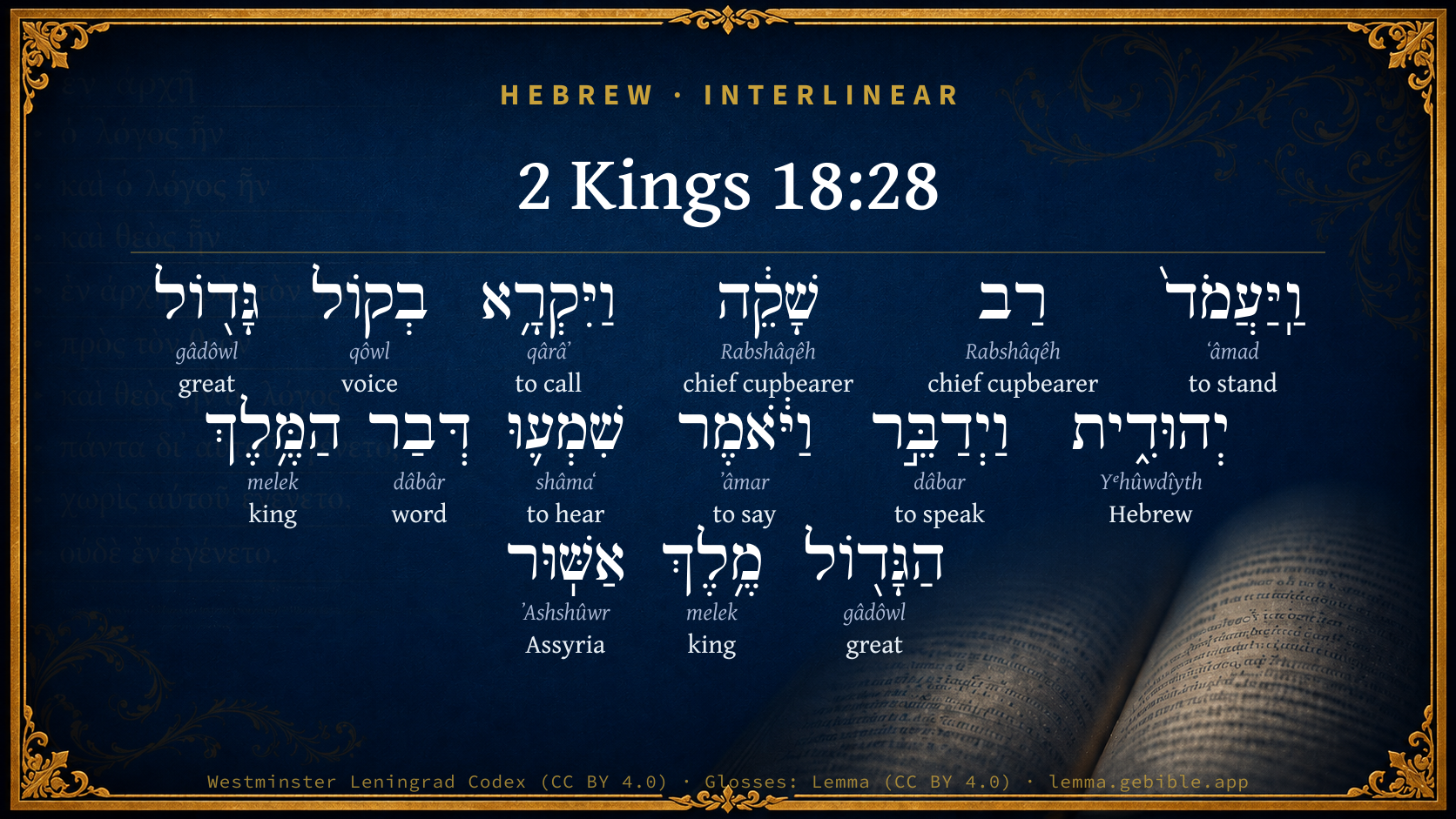
  1. וַֽיַּעֲמֹד֙ ʻâmad H5975 “and · to stand” Conjunction + Verb, Qal, Sequential Imperfect, 3rd Person, Masculine, Singular
  2. רַב Rabshâqêh H7262 “chief cupbearer of” Noun, Common, Masculine, Singular, Construct
  3. שָׁקֵ֔ה Rabshâqêh H7262 “chief cupbearer” Noun, Proper
  4. וַיִּקְרָ֥א qârâʼ H7121 “and · to call” Conjunction + Verb, Qal, Sequential Imperfect, 3rd Person, Masculine, Singular
  5. בְקוֹל qôwl H6963 “in/at · voice” Preposition + Noun, Common, Masculine, Singular, Absolute
  6. גָּד֖וֹל gâdôwl H1419 “great” Adjective, Adjective, Masculine, Singular, Absolute
  7. וַיְדַבֵּ֣ר dâbar H1696 “and · to speak” Conjunction + Verb, Piel, Sequential Imperfect, 3rd Person, Masculine, Singular
  8. וַיֹּ֔אמֶר ʼâmar H559 “and · to say” Conjunction + Verb, Qal, Sequential Imperfect, 3rd Person, Masculine, Singular
  9. שִׁמְע֛וּ shâmaʻ H8085 “hear” Verb, Qal, Imperative, 2nd Person, Masculine, Plural
  10. דְּבַר dâbâr H1697 “word of” Noun, Common, Masculine, Singular, Construct
  11. הַמֶּ֥לֶךְ melek H4428 “the · king” Particle, Definite Article + Noun, Common, Masculine, Singular, Absolute
  12. הַגָּד֖וֹל gâdôwl H1419 “the · great” Particle, Definite Article + Adjective, Adjective, Masculine, Singular, Absolute
  13. מֶ֥לֶךְ melek H4428 “king of” Noun, Common, Masculine, Singular, Construct
  14. אַשּֽׁוּר ʼAshshûwr H804 “Assyria” Noun, Proper

About this verse

These counts appear in no published source. They are computed here, from the morphology-tagged text and Lemma’s own curated glosses. What Lemma adds →

15
words
12
distinct lemmas
Historical
section

Notable vocabulary

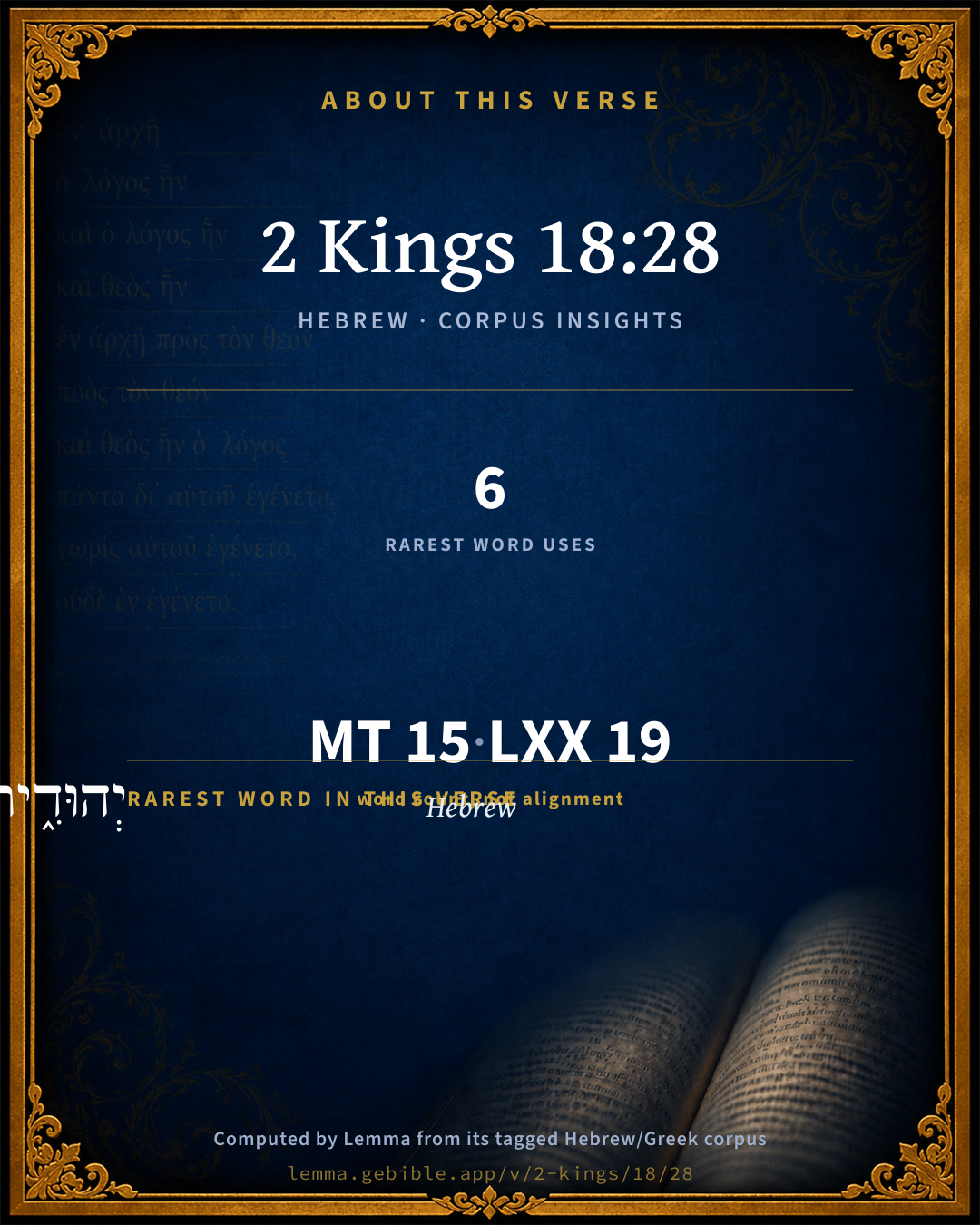
The rarest word here is יְהוּדִ֑ית Hebrew H3066 — appearing just 6 times in the whole Hebrew Bible.

Shared distinctive vocabulary

יְהוּדִ֑ית Hebrew H3066 occurs in 6 verses of the Hebrew Bible. Also found in:

Grammatical profile

  • 5 verbs
  • 8 nouns
  • 2 adjectives

Verb forms

  • וַֽיַּעֲמֹד֙ Qal · Sequential Imperfect
  • וַיִּקְרָ֥א Qal · Sequential Imperfect
  • וַיְדַבֵּ֣ר Piel · Sequential Imperfect
  • וַיֹּ֔אמֶר Qal · Sequential Imperfect
  • שִׁמְע֛וּ Qal · Imperative

Repetition

Words recur within this verse — often emphatic in Hebrew:

  • רַב chief cupbearer H7262 ×2
  • גָּד֖וֹל great H1419 ×2
  • הַמֶּ֥לֶךְ king H4428 ×2

Hebrew & Septuagint length

In English translation the verse runs 28 words from the Hebrew and 27 from the Septuagint (LXX English) — closely comparable.

A rough comparison of the two English renderings, which tokenize alike — not a word-level alignment.

Word counts can differ between the Hebrew and the Greek without any difference in meaning — e.g. the Hebrew direct-object marker אֵת has no separate Greek word, and Greek often adds the article ὁ.

In the original languages it is 15 Hebrew tokens and 19 Greek tokens — but the two are counted differently (Hebrew bundles its prefixes and suffixes into one token; the Greek is in lemma form), so that isn’t a like-for-like length.

Cross-references

9

Topical passages linked to 2 Kings 18:28 in the Treasury of Scripture Knowledge — connected by theme and wording, ordered by reader-vote popularity; previews shown in the World English Bible.

  • Isaiah 36:13–18 Then Rabshakeh stood, and cried with a loud voice in the Jews' language, and said, Hear you the words of the great king, the king of Assyria.
  • 2 Kings 18:19 Rabshakeh said to them, Say you now to Hezekiah, Thus says the great king, the king of Assyria, What confidence is this in which you trust?
  • 2 Chronicles 32:18 They cried with a loud voice in the Jews' language to the people of Jerusalem who were on the wall, to frighten them, and to trouble them; that they might take the city.
  • Ezra 7:12 Artaxerxes, king of kings, to Ezra the priest, the scribe of the law of the God of heaven, perfect and so forth.
  • Psalms 47:2 For Yahweh Most High is awesome. He is a great King over all the earth.
  • Isaiah 10:8–13 For he says, Aren't my princes all of them kings?
  • Ezekiel 29:3 speak, and say, Thus says the Lord Yahweh: Behold, I am against you, Pharaoh king of Egypt, the great monster that lies in the midst of his rivers, that has said, My river is my own, and I have made it for myself.
  • Ezekiel 31:3–10 Behold, the Assyrian was a cedar in Lebanon with beautiful branches, and with a forest-like shade, and of high stature; and its top was among the thick boughs.
  • Revelation 19:6 I heard something like the voice of a great multitude, and like the voice of many waters, and like the voice of mighty thunders, saying, "Hallelujah! For the Lord our God, the Almighty, reigns!

Cross-references courtesy of OpenBible.info (CC BY 4.0).

Hebrew and Greek witnesses Masoretic Hebrew ↔ Greek Septuagint

The same verse in the two great witnesses to the Old Testament, shown verse-for-verse.

These are two independent witnesses, not word-aligned to each other, and the Septuagint is shown in lemma (dictionary) form.

Hebrew 2 Kings 18:28 Masoretic · Westminster Leningrad Codex

וַֽיַּעֲמֹד֙ רַב שָׁקֵ֔ה וַיִּקְרָ֥א בְקוֹל גָּד֖וֹל יְהוּדִ֑ית וַיְדַבֵּ֣ר וַיֹּ֔אמֶר שִׁמְע֛וּ דְּבַר הַמֶּ֥לֶךְ הַגָּד֖וֹל מֶ֥לֶךְ אַשּֽׁוּר

Then Rabshakeh stood, and cried with a loud voice in the Jews' language, and spoke, saying, Hear you the word of the great king, the king of Assyria.

World English Bible · Public Domain

Greek LXX 2 Kings 18:28 Septuagint · lemma form

καί ἵστημι ραψακης καί βοάω φωνή μέγας ἰουδαϊστί καί λαλέω καί εἶπον ἀκούω ὁ λόγος ὁ μέγας βασιλεύς ἀσσύριος

And Rapsakes stood, and cried with a loud voice in the Jewish language, and spoke, and said, Hear the words of the great king of the Assyrians:

LXX2012 (modern English Septuagint) · Public Domain

On this verse, Ellicott's Commentary for English Readers discusses the Septuagint’s reading. Read the note in Commentary ↓

Hebrew: Westminster Leningrad Codex (CC BY 4.0). Greek: Septuagint (public domain); English from LXX2012 (modern English Septuagint) (Public Domain). How the Septuagint differs from the Hebrew →

Targum (Aramaic paraphrase)

1

The Targum is the ancient Jewish Aramaic paraphrase of the Hebrew Scriptures — an interpretive translation, not the Hebrew text itself. Onkelos (literal) and Pseudo-Jonathan (expansive) render the Torah, and Jonathan the Prophets. Coverage is partial: where no permissively-licensed English translation exists for a verse, only the Aramaic is shown. This is verse-level text, not a word-by-word alignment to the Hebrew.

  1. Targum Jonathan Prophets (Joshua–Malachi)
    וְקָם רַבְשָׁקֵה וּקְרָא בְּקַל רַב יְהוּדִית וּמַלֵיל וַאֲמַר שְׁמָעוּ פִּתְגָמָא דְמַלְכָּא דְרַבְּתָנָא מַלְכָּא דְאַתּוּר:

    (no public-domain English translation for this verse)

    Targum Jonathan — Aramaic: “Mikraot Gedolot” (public domain). English: “Sefaria Community Translation” (CC0 1.0 (public-domain dedication)); “London "Chaldee Paraphrase," 1871” (public domain). Text via Sefaria.

Commentary

Notes on 2 Kings 18:28 from classic Christian and Jewish commentators (each source and its license shown beneath its notes). The classic Christian expositions comment on the surrounding passage and are grouped to its opening verse, so a note may address several verses; the Jewish commentaries on the Tanakh (Rashi and others) are per-verse, so they appear only where the commentator wrote on this verse.

Lemma curates 59 commentaries, every one of them public domain or Creative Commons licensed, each selected and text-cleaned for this edition rather than reprinted as found. About our sources →

Trapp's Complete Commentary

John Trapp

2Ki 18:28 Then Rabshakeh stood and cried with a loud voice in the Jews’ language, and spake, saying, Hear the word of the great king, the king of Assyria:

Ver. 28. Hear the word of the great king.] See on 2Ki 18:19.

John Trapp, A Commentary or Exposition upon All the Books of the Old and New Testament (1647–1656) — public domain. Text from a community e-Sword module.

Tyndale Open Study Notes

Tyndale Open Resources

18:28-30 The chief of staff ignored the request of Hezekiah’s delegation and shouted in Hebrew, hoping to arouse fear among the people of Jerusalem.

Tyndale Open Study Notes — © Tyndale Open Resources, licensed CC BY-SA 4.0. Text via the HelloAO Bible API.

Adam Clarke's Commentary

Verse 28. Hear the word of the great king - of Assyria] This was all intended to cause the people to revolt from their allegiance to their king.

Adam Clarke's Commentary on the Bible (1810–1826) — public domain. Text from a community e-Sword/MySword module.

Ellicott's Commentary for English Readers

(28) Stood.—Came forward, i.e., nearer to the wall. (Comp. 1Ki_8:22.)

The word.—LXX. and Vulg., words; so Isaiah.

A Bible Commentary for English Readers, edited by Charles John Ellicott (1878–1897) — public domain. Text from a community e-Sword module.

The Cambridge Bible for Schools and Colleges

gen. ed. J. J. S. Perowne

28. with a loud voice] To prove that it was to the people on the wall that his message was sent. If he could provoke them to desert their king, Jerusalem would soon be in the power of the Assyrians.

The Cambridge Bible for Schools and Colleges (gen. ed. J. J. S. Perowne; Cambridge University Press, 1878–1918) — public domain. Text from a community e-Sword module.

Matthew Poole's English Annotations

In the Jews’ language, that he might affright the people into a compliance with him, which he perceived Eliakim and his brethren endeavour to prevent.

Matthew Poole's English Annotations on the Holy Bible (1683–1685) — public domain. Text from a community e-Sword/MySword module.

Whedon's Commentary on the Bible

Daniel D. Whedon

28. Stood and cried — He stationed himself more conspicuously before the eyes of the men on the wall, and elevated his voice so as to be distinctly heard by them.

Daniel D. Whedon (gen. ed.), Commentary on the Old and New Testaments (1874–1909) — public domain. Text from a community e-Sword module.

The Pulpit Commentary

Then Rabshakeh stood and cried with aloud voice in the Jews" language, and spake, saying. Rabshakeh had probably been sitting before. He now stood up to attract attention, and raised his voice to be the better heard. Still speaking Hebrew, and not Aramaic, he addressed himself directly to the people on the wall, soldiers and others, doing the very opposite to what he had been requested to do, and outraging all propriety. History scarcely presents any other instance of such coarse and barefaced effrontery, unless the affronts put upon a Danubian principality by the envoy of a "great Power" may be regarded as constituting a parallel. Hear the word of the great king, the King of Assyria. It is scarcely likely that Sennacherib had anticipated his envoy"s action, much less directed it, and told him exactly what he was to say. But Rabshakeh thinks his words will have more effect if he represents them as those of his master.

The Pulpit Commentary (1880–1919), ed. H.D.M. Spence-Jones & Joseph S. Exell — public domain. Text from a community e-Sword module.

John Wesley's Explanatory Notes

Jews language - The tradition of the Jews is, that Rabshaketh was an apostate Jew. If so, his ignorance of the God of Israel was the less excusable, and his enmity the less strange: for apostates are usually the most bitter and spiteful enemies.

John Wesley, Explanatory Notes Upon the Whole Bible (1754–1765) — public domain. Text via the GEBible commentary corpus.

unfoldingWord translationNotes

Door43 World Missions Community

from my power

"my power" is metonymy for the ability of the king himself. AT: "from me" or "from the power of my army" (See: Metonymy)

this city will not be given into the hand of the king of Assyria

This can be expressed in an active form. AT: "Yahweh will never allow the king of Assyria's army to take this city" (See: Active or Passive)

the hand

"Hand" is metonymy for control, authority and power. (See: Metonymy)

translationWords

Jew

word

deceive

power

trust

Yahweh

unfoldingWord translationNotes — © Distant Shores Media and the Door43 World Missions Community, licensed CC BY-SA 4.0. Source: git.door43.org/Door43/en_tn.

Lesson kit

Teaching starters — assembled from the data on this page, not authored interpretation. Every prompt links to the verse data it draws on. Edit before teaching.

2 Kings, in the Historical, opens this verse with 15 words (12 distinct Hebrew lemmas). Its most distinctive word is Yᵉhûwdîyth (“Hebrew”). A historical commentator’s framing appears above. Read the whole chapter for the surrounding context.

Discussion questions

  1. What does “Hebrew” (Yᵉhûwdîyth) contribute to the verse as a whole?
  2. How does 2 Kings 18:26, which shares the word «Hebrew», read alongside this verse?
  3. What does the repetition of “chief cupbearer” (2× in this one verse) do in this verse?
  4. These translations render this verse differently; the difference is in the English rendering, not the original. What questions does that raise?
  5. «וַֽיַּעֲמֹד֙» is a Qal Sequential Imperfect verb. How does that grammatical form shape the action described?
  6. Compare how Trapp's Complete Commentary and Tyndale Open Study Notes read this verse. Where do they agree or differ?

Things to notice

Reading settings

Reading text

Shown beneath each verse's original-language words.

Old Testament
Old Testament edition

Read the OT as the Masoretic Hebrew (MT) or the Greek Septuagint (LXX).

English shown for the Greek Septuagint (in the Hebrew ↔ Greek comparison).

Comparing translations? Open the Compare panel on any verse page to stack up to four side by side.