
Deuteronomy 27:14

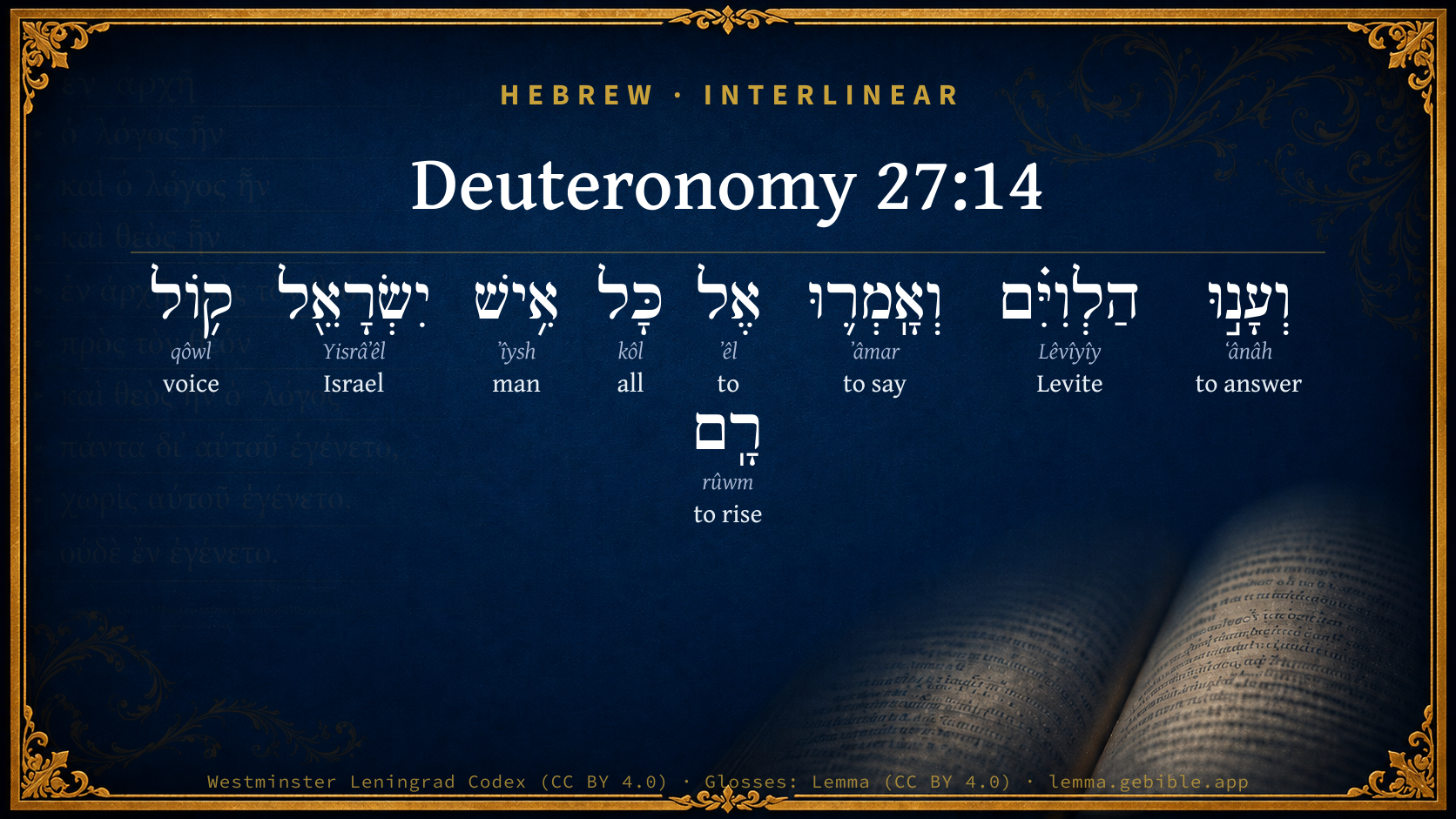
Hebrew (Westminster Leningrad Codex) Deuteronomy 27:14 appears in the Hebrew Old Testament. The text above is from the Westminster Leningrad Codex. Each word links to its Strong’s number, a concise gloss, and parsing drawn from the Open Scriptures Hebrew Bible morphology. Click any word for its full Brown-Driver-Briggs (BDB) entry.
Download image
Cite this verse

Deuteronomy 27:14 (World English Bible). Public Domain. Lemma interlinear Bible study tool, https://lemma.gebible.app/v/deuteronomy/27/14.

Show BibTeX & RIS
BibTeX
RIS
English Translation
The Levites shall answer, and tell all the men of Israel with a loud voice,
World English Bible · Public Domain
Download a study sheet

One document with this verse’s original text, its word-by-word gloss line, the meaning frame, cross-references with their text, attributed commentary, and full source and license credits — printable, and it pastes into notes with its structure intact.

This verse Autodidact and up

Study sheet (.html) Plain text (.txt)

A passage Seminary Student

Up to 50 verses in one chapter. A passage sheet keeps up to 6 commentary sources and 12 cross-references per verse, in the order this page ranks them, and says so on the sheet whenever that leaves anything out. Ask for a single verse and you get the Autodidact verse sheet above.

Everything on this page stays free to read, with no account — the sheet is a download of what is already on screen, not access to it.

Want to remove ads? Support Godless Engineer
Compare translations 3

The same verse in 3 English versions, stacked beneath the original-language interlinear above. Click any original word for its lexicon entry.

Each is an independent rendering of the whole verse — the interlinear is not word-aligned to these translations.

Highlighted words mark where these versions differ — a whole-verse word diff, not a word-by-word alignment.

  • World English Bible Public Domain
    The Levites shall answer, and tell all the men of Israel with a loud voice,
  • King James Version Public Domain
    And the Levites shall speak, and say unto all the men of Israel with a loud voice,
  • unfoldingWord Literal Text CC BY-SA 4.0
    And the Levites shall respond and say to all the men of Israel a loud voice,

unfoldingWord Literal Text — © unfoldingWord, licensed CC BY-SA 4.0. Word-aligned USFM3 via Door43 (git.door43.org/unfoldingWord/en_ult).

Versions to compare (up to 4)

3 of 4 selected

Show all 18 translations

Every available English version of this verse, each an independent rendering of the whole verse.

  • World English Bible Public Domain
    The Levites shall answer, and tell all the men of Israel with a loud voice,
  • Berean Standard Bible Public Domain
    Then the Levites shall proclaim in a loud voice to every Israelite:
  • Majority Standard Bible Public Domain
    Then the Levites shall proclaim in a loud voice to every Israelite:
  • King James Version Public Domain
    And the Levites shall speak, and say unto all the men of Israel with a loud voice,
  • American Standard Version (1901) Public Domain
    And the Levites shall answer, and say unto all the men of Israel with a loud voice,
  • Revised Version (1885) Public Domain
    And the Levites shall answer, and say unto all the men of Israel with a loud voice,
  • Geneva Bible (1599) Public Domain
    And the Leuites shall answere and say vnto all the men of Israel with a loude voyce,
  • Douay-Rheims (1899) Public Domain
    And the Levites shall pronounce, and say to all the men of Israel with a loud voice:
  • Young's Literal Translation Public Domain
    `And the Levites have answered and said unto every man of Israel -- a loud voice:
  • Literal Standard Version CC BY-SA 4.0
    And the Levites have answered and said to every man of Israel [with] a loud voice:
  • Unlocked Literal Bible CC BY-SA 4.0
    The Levites will answer and say to all the men of Israel in a loud voice:
  • unfoldingWord Literal Text CC BY-SA 4.0
    And the Levites shall respond and say to all the men of Israel a loud voice,
  • Darby Bible Public Domain
    And the Levites shall declare and say unto all the men of Israel with a loud voice:
  • World Messianic Bible Public Domain
    With a loud voice, the Levites shall say to all the men of Israel,
  • Webster's Bible Public Domain
    And the Levites shall speak, and say to all the men of Israel with a loud voice,
  • Free Bible Version CC BY-SA 4.0
    Then the Levites will shout in a loud voice so every Israelite can hear:
  • Bible in Basic English Public Domain
    Then the Levites are to say in a loud voice to all the men of Israel,
  • JPS Tanakh (1917) Public Domain
    And the Levites shall speak, and say unto all the men of Israel with a loud voice:

Literal Standard Version (2020), Covenant Press — licensed CC BY-SA 4.0. Text via the HelloAO Bible API (eBible.org). Unlocked Literal Bible (unfoldingWord) — licensed CC BY-SA 4.0. Text via the HelloAO Bible API (eBible.org). unfoldingWord Literal Text — © unfoldingWord, licensed CC BY-SA 4.0. Word-aligned USFM3 via Door43 (git.door43.org/unfoldingWord/en_ult). Free Bible Version, Dr. Jonathan Gallagher — licensed CC BY-SA 4.0. Text via the HelloAO Bible API (eBible.org).

Word by word

More ways to search: Search by grammar → Find every occurrence → Compare this word →

Practice this passage: Drill this verse → Learn its vocabulary →

רָֽם
rûwm
H7311
“rising”
Verb, Qal, Participle Active, Masculine, Singular, Absolute
Part of Speech
Verb
Stem
Qal
Form
Participle Active
Gender
Masculine
Number
Singular
State
Absolute
Full BDB Definition

Origin: a primitive root

TWOT: 2133

to rise, rise up, be high, be lofty, be exalted - (Qal) - to be high, be set on high - to be raised, be uplifted, be exalted - to be lifted, rise - (Polel) - to raise or rear (children), cause to grow up - to lift up, raise, exalt - to exalt, extol - (Polal) to be lifted up - (Hiphil) - to raise, lift, lift up, take up, set up, erect, exalt, set on high - to lift up (and take away), remove - to lift off and present, contribute, offer, contribute - (Hophal) to be taken off, be abolished - (Hithpolel) to exalt oneself, magnify oneself - (Qal) to be rotten, be wormy
  1. וְעָנ֣וּ ʻânâh H6030 “and · to answer” Conjunction + Verb, Qal, Sequential Perfect, 3rd Person, Common, Plural
  2. הַלְוִיִּ֗ם Lêvîyîy H3881 “the · Levites” Particle, Definite Article + Noun, Gentilic, Masculine, Plural, Absolute
  3. וְאָֽמְר֛וּ ʼâmar H559 “and · to say” Conjunction + Verb, Qal, Sequential Perfect, 3rd Person, Common, Plural
  4. אֶל ʼêl H413 “to” Preposition
  5. כָּל kôl H3605 “all of” Noun, Common, Masculine, Singular, Construct
  6. אִ֥ישׁ ʼîysh H376 “man of” Noun, Common, Masculine, Singular, Construct
  7. יִשְׂרָאֵ֖ל Yisrâʼêl H3478 “Israel” Noun, Proper
  8. ק֥וֹל qôwl H6963 “voice” Noun, Common, Masculine, Singular, Absolute

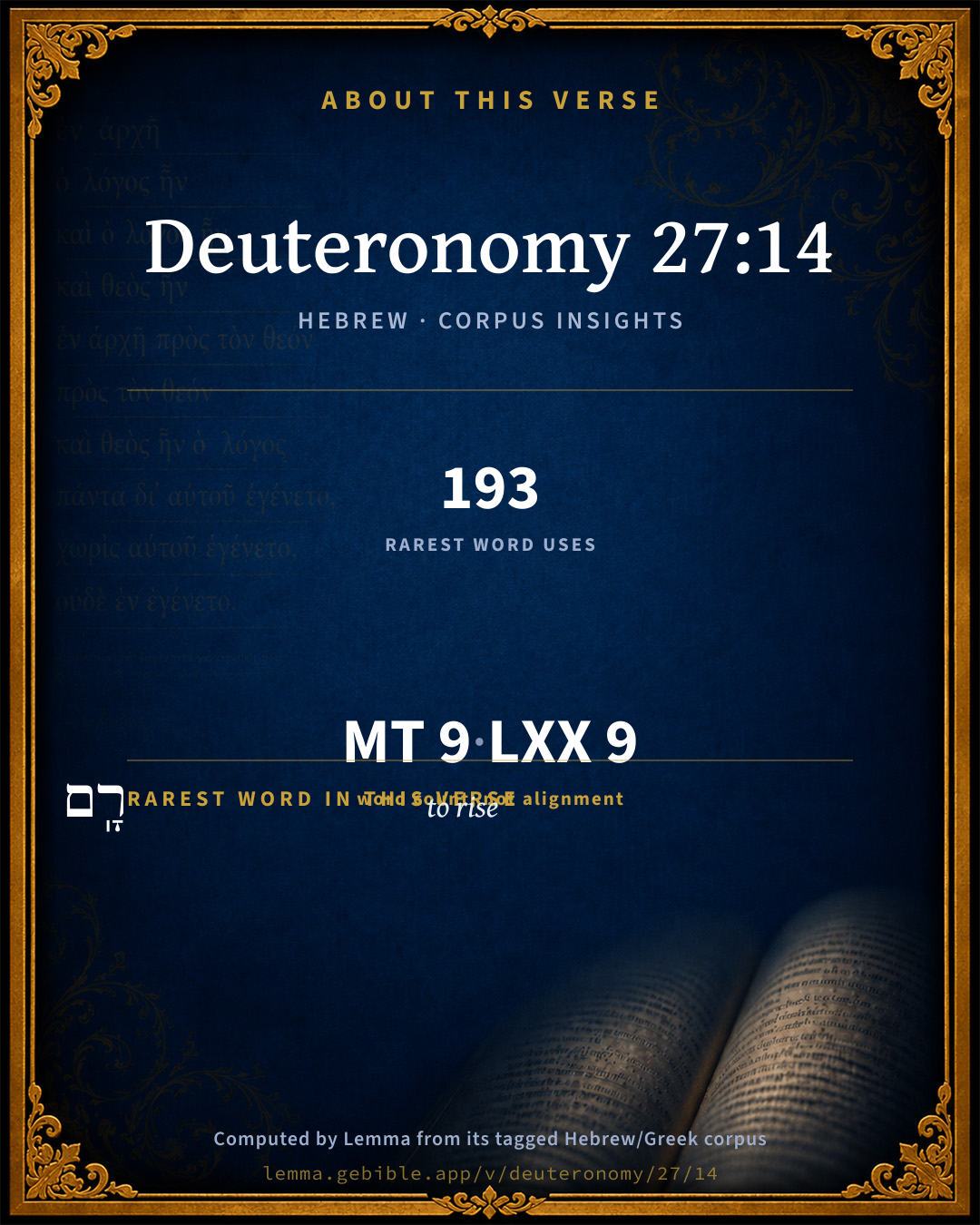
About this verse

These counts appear in no published source. They are computed here, from the morphology-tagged text and Lemma’s own curated glosses. What Lemma adds →

9
words
9
distinct lemmas
Pentateuch
section

Grammatical profile

  • 3 verbs
  • 5 nouns
  • 1 preposition

Verb forms

  • וְעָנ֣וּ Qal · Sequential Perfect
  • וְאָֽמְר֛וּ Qal · Sequential Perfect
  • רָֽם Qal · Participle Active

Hebrew & Septuagint length

In English translation the verse runs 15 words from the Hebrew and 14 from the Septuagint (LXX English) — closely comparable.

A rough comparison of the two English renderings, which tokenize alike — not a word-level alignment.

Word counts can differ between the Hebrew and the Greek without any difference in meaning — e.g. the Hebrew direct-object marker אֵת has no separate Greek word, and Greek often adds the article ὁ.

In the original languages it is 9 Hebrew tokens and 9 Greek tokens — but the two are counted differently (Hebrew bundles its prefixes and suffixes into one token; the Greek is in lemma form), so that isn’t a like-for-like length.

Cross-references

5

Topical passages linked to Deuteronomy 27:14 in the Treasury of Scripture Knowledge — connected by theme and wording, ordered by reader-vote popularity; previews shown in the World English Bible.

  • Daniel 9:11 Yes, all Israel have transgressed your law, even turning aside, that they should not obey your voice: therefore has the curse been poured out on us, and the oath that is written in the law of Moses the servant of God; for we have sinned against him.
  • Deuteronomy 33:9–10 Who said of his father, and of his mother, I have not seen him; Neither did he acknowledge his brothers, Nor knew he his own children: For they have observed your word, Keep your covenant.
  • Joshua 8:33 All Israel, and their elders and officers, and their judges, stood on this side of the ark and on that side before the priests the Levites, who bore the ark of the covenant of Yahweh, as well the foreigner as the native; half of them in front of Mount Gerizim, and half of them in front of Mount Ebal; as Moses the servant of Yahweh had commanded at the first, that they should bless the people of Israel.
  • Nehemiah 8:7–8 Also Jeshua, and Bani, and Sherebiah, Jamin, Akkub, Shabbethai, Hodiah, Maaseiah, Kelita, Azariah, Jozabad, Hanan, Pelaiah, and the Levites, caused the people to understand the law: and the people [stood] in their place.
  • Malachi 2:7–9 For the priest's lips should keep knowledge, and they should seek the law at his mouth; for he is the messenger of Yahweh of Hosts.

Cross-references courtesy of OpenBible.info (CC BY 4.0).

Hebrew and Greek witnesses Masoretic Hebrew ↔ Greek Septuagint

The same verse in the two great witnesses to the Old Testament, shown verse-for-verse.

These are two independent witnesses, not word-aligned to each other, and the Septuagint is shown in lemma (dictionary) form.

Hebrew Deuteronomy 27:14 Masoretic · Westminster Leningrad Codex

וְעָנ֣וּ הַלְוִיִּ֗ם וְאָֽמְר֛וּ אֶל כָּל אִ֥ישׁ יִשְׂרָאֵ֖ל ק֥וֹל רָֽם

The Levites shall answer, and tell all the men of Israel with a loud voice,

World English Bible · Public Domain

Greek LXX Deuteronomy 27:14 Septuagint · lemma form

καί ἀποκρίνω ὁ λευίτης εἶπον πᾶς ἰσραήλ φωνή μέγας

And the Levites shall answer and say to all Israel with a loud voice,

LXX2012 (modern English Septuagint) · Public Domain

Hebrew: Westminster Leningrad Codex (CC BY 4.0). Greek: Septuagint (public domain); English from LXX2012 (modern English Septuagint) (Public Domain). How the Septuagint differs from the Hebrew →

Targum (Aramaic paraphrase)

2

The Targum is the ancient Jewish Aramaic paraphrase of the Hebrew Scriptures — an interpretive translation, not the Hebrew text itself. Onkelos (literal) and Pseudo-Jonathan (expansive) render the Torah, and Jonathan the Prophets. Coverage is partial: where no permissively-licensed English translation exists for a verse, only the Aramaic is shown. This is verse-level text, not a word-by-word alignment to the Hebrew.

  1. Targum Onkelos Torah (Genesis–Deuteronomy)
    וִיתִיבוּן לֵוָאֵי וְיֵימְרוּן לְכָל אֱנַשׁ יִשְׂרָאֵל קָלָא רָמָא

    (no public-domain English translation for this verse)

    Targum Onkelos — Aramaic: “Onkelos Genesis” (public domain); “Onkelos Exodus” (public domain); “Onkelos Leviticus” (public domain); “Onkelos Numbers” (public domain); “Onkelos Deuteronomy” (public domain). English: “Sefaria Community Translation” (CC0 1.0 (public-domain dedication)); “J.W. Etheridge. The Targums of Onkelos and Jonathan Ben Uzziel on the Pentateuch. London: Longmans, Green, 1862” (public domain). Text via Sefaria.

  2. Targum Pseudo-Jonathan Torah (Genesis–Deuteronomy)
    וְיִכְרְזוּן לֵיוָאֵי וְיֵימְרוּן לְכָל אֵינַשׁ יִשְרָאֵל בְּקָלָא רָמָא

    And the Levites proclaimed and said to every man of Israel with a high voice:

    Targum Pseudo-Jonathan — Aramaic: “Targum Jonathan on Genesis” (public domain); “Targum Jonathan on Exodus” (public domain); “Targum Jonathan on Leviticus” (public domain); “Targum Jonathan on Numbers” (public domain); “Targum Jonathan on Deuteronomy” (public domain). English: “The Targum of Jonathan ben Uzziel, trans. J. W. Etheridge, London, 1862” (public domain). Text via Sefaria.

Commentary

Notes on Deuteronomy 27:14 from classic Christian and Jewish commentators (each source and its license shown beneath its notes). The classic Christian expositions comment on the surrounding passage and are grouped to its opening verse, so a note may address several verses; the Jewish commentaries on the Tanakh (Rashi and others) are per-verse, so they appear only where the commentator wrote on this verse.

Lemma curates 59 commentaries, every one of them public domain or Creative Commons licensed, each selected and text-cleaned for this edition rather than reprinted as found. About our sources →

Joseph Benson's Commentary

Deu 27:14. The Levites — Some of the Levites, namely, the priests, who bare the ark, as it is expressed Jos 8:33, for the body of the Levites stood upon mount Gerizim, Deu 27:12. But these stood in the valley between Gerizim and Ebal, looking toward the one or the other mountain as they pronounced either the blessings or the curses.

Joseph Benson's Commentary on the Old and New Testaments (1811–1818) — public domain. Text from a community e-Sword module.

Tyndale Open Study Notes

Tyndale Open Resources

27:14 The Levites as a group were stationed on Mount Gerizim (27:12). The Ark of the Covenant accompanied them, and they offered sacrifices (Josh 8:30-35). It was part of the Levites’ role to teach and proclaim the Torah (Deut 33:10; see study note on 6:8; see also Lev 10:11).

Tyndale Open Study Notes — © Tyndale Open Resources, licensed CC BY-SA 4.0. Text via the HelloAO Bible API.

The Cambridge Bible for Schools and Colleges

gen. ed. J. J. S. Perowne

14. answer] As in Deu_21:7, solemnly pronounce.

with a loud voice] Lit. a high voice, not elsewhere in the O.T. Cp. Deu_5:19, a great voice.

14–26. Appointment of the Levites to Curse

According to 11–13 both a blessing and a curse were to be pronounced, here we have only curses, twelve in number. There Levi was one of six tribes appointed to bless; here the Levites, in religious distinction from all the other tribes, are to pronounce the curses. Further, the 12 curses are not confined to sins dealt with in the Code of D; the objects of only 7 are forbidden in D, of 6 in E, Exo_20:2-23, of 1 in J, Exodus 34, and of as many as Deu_27:9 in H, Leviticus 17-26. The inferences are reasonable that this passage is not from the same hand as the preceding (i.e. not from E) and not from D.

The inclusion of so many sins forbidden only in H does not necessarily imply that the list of curses is exilic (Berth.). It may be from a source independent of all those documents, some national or local liturgy; and Meyer—Luther (Die Israeliten, 552) suggest that it was in use at the sanctuary of Shechem. Nor is the hand which introduced it here that of D, but of a late editor, for note the simple term Levites instead of D’s the priests the Levites and the phrase unto all the men of Israel, found elsewhere only in Jos_10:24 in a passage with many editorial elements. D’s phrase is all Israel (see, above Deu_27:9).

The Cambridge Bible for Schools and Colleges (gen. ed. J. J. S. Perowne; Cambridge University Press, 1878–1918) — public domain. Text from a community e-Sword module.

John Gill's Exposition

And the Levites shall speak, and say unto all the men of Israel,.... Rather, "answer (e) and say"; not the whole tribe of Levi, for that stood on Mount Gerizim to bless, Deu 27:12; but the priests of that tribe who were placed in the valley, between the two mountains, and pronounced both the blessings and the curses in the hearing of all the tribes of Israel, to which they were to answer Amen; and that they might plainly hear, they expressed their words

with a loud voice, clearly and distinctly, as follow.

(e) "respondebunt", Montanus.

John Gill's Exposition of the Whole Bible (1746–1763) — public domain (CC PDM 1.0). Text via the HelloAO Bible API.

Haydock's Catholic Bible Commentary

Pronounce. Hebrew, "answer," as the older Protestant editions, 1540, &c., had it; though "our last translators, 1613, says Kennicott, in this, as in several other instances, altered for the worse," shall speak. A select company of Levites in the valley repeated what had been declared from Hebal.

George Leo Haydock (1774–1849), Haydock's Catholic Family Bible and Commentary, 1859 edition — public domain. Excludes Psalms (Douay-Rheims chapter numbering differs from Protestant) and Deuterocanonical books (Catholic canon only).

Matthew Poole's English Annotations

The Levites, i.e. some of the Levites, to wit, the priests,

which bare the ark, as it is expressed, Jos 8:33, for the body of the Levites stood upon Mount Gerizim, Deu 27:12; but these stood in the valley between Gerizim and Ebal, looking towards the one or the other mountain as they pronounced either the blessings or the curses, as may be gathered from Jos 8:33.

With a loud voice; so as they might be heard by a great number of the people, by whom the rest were informed and directed by some signal when they should answer.

Matthew Poole's English Annotations on the Holy Bible (1683–1685) — public domain. Text from a community e-Sword/MySword module.

Whedon's Commentary on the Bible

Daniel D. Whedon

14-26. The Levites shall speak — These twelve curses were to be pronounced against transgressors of the law. The first is against those who make graven or molten images. Comp. Exo_20:4. The second is against those who are lacking in respect to parents. Comp. Exo_21:17 and Lev_19:3. The third is against those who remove boundaries. Comp. Deu_19:14. The fourth, against those who lead the blind astray. Comp. Lev_19:14. The fifth, against those who wrong the stranger, the orphan, or the widow. Comp. Deu_24:17. The sixth, against unchastity in respect to the wife of the father. Lev_18:8. The seventh is against unnatural crime. Comp. Lev_18:8. The eighth, against unchastity in the case of incest with a sister. Comp. Lev_18:9. The ninth is also against unchastity. In this case with the mother-in-law or other near relative. Comp. Lev_18:17. The tenth is against the secret murder of a neighbour. Comp. Deu_19:11. The eleventh, against the one who takes a bribe to judicially condemn the innocent. Comp. Exo_23:7-8. Finally, the twelfth is to be pronounced against him who does not keep the law. This condemns every act of transgression.

Daniel D. Whedon (gen. ed.), Commentary on the Old and New Testaments (1874–1909) — public domain. Text from a community e-Sword module.

The Pulpit Commentary

The Levites standing probably in some convenient spot midway between the two mountains (cf. Jos_8:33) were to pronounce with a loud voice the blessing and the curse, so that all might hear; and the people were to give their assent, and take to themselves, as it were, the blessing or the curse as uttered, by a solemn Amen. By the Levites here are intended, not the sons of Levi generally, but that portion of them which belonged to the priesthood, and bare the ark of the covenant. (Jos_8:33)

The Pulpit Commentary (1880–1919), ed. H.D.M. Spence-Jones & Joseph S. Exell — public domain. Text from a community e-Sword module.

John Wesley's Explanatory Notes

The Levites - Some of the Levites, namely, the priests, who bare the ark, as it is expressed Josh. viii, 33, for the body of the Levites stood upon mount Gerizzim, ver. 12. But these stood in the valley between Gerizzim and Ebal, looking towards the one or the other mountain as they pronounced either the blessings or the curses.

John Wesley, Explanatory Notes Upon the Whole Bible (1754–1765) — public domain. Text via the GEBible commentary corpus.

Keil & Delitzsch

C. F. Keil & F. Delitzsch

"And the Levites shall lift up and speak to all the men of Israel with a high (loud) voice:" i.e., they shall pronounce the different formularies of blessing and cursing, turning towards the tribes to whom these utterances apply; and all the men of Israel shall answer "Amen," to take to themselves the blessing and the curse, as uttered by them; just as in the case of the priestly blessing in Num 5:22, and in connection with every oath, in which the person swearing took upon himself the oath that was pronounced, by replying "Amen." "The Levites" are not all the members of the tribe of Levi, but those "in whom the spiritual character of Levi was most decidedly manifested" (Baumgarten), i.e., the levitical priests, as the guardians and teachers of the law, and those who carried the ark of the covenant (Jos 8:33). From the passage in Joshua, where the fulfilment of the Mosaic injunctions is recorded, we learn that the Levitical priests stationed themselves in the centre between the two mountains, with the ark of the covenant, and that the people took up their position, on both sides, opposite to the ark, viz., six tribes on Gerizim, and six on Ebal. The priests, who stood in the midst, by the ark of the covenant, then pronounced the different formularies of blessing and cursing, to which the six tribes answered "Amen." From the expression "all the men of Israel," it is perfectly evident that in this particular ceremony the people were not represented by their elders or heads, but were present in the persons of all their adult men who were over twenty years of age; and with this Jos 8:33, when rightly interpreted, fully harmonizes.

Keil & Delitzsch — Biblical Commentary on the Old Testament (1861–1891) — public domain (CC PDM 1.0). Text via the HelloAO Bible API. (Old Testament only.)

Lesson kit

Teaching starters — assembled from the data on this page, not authored interpretation. Every prompt links to the verse data it draws on. Edit before teaching.

Deuteronomy, in the Pentateuch, opens this verse with 9 words (9 distinct Hebrew lemmas). Its most distinctive word is rûwm (“to rise”). A historical commentator’s framing appears above. Read the whole chapter for the surrounding context.

Discussion questions

  1. How does “to rise” (rûwm) shape what this verse is saying?
  2. How does Daniel 9:11, which shares this passage’s theme, read alongside this verse?
  3. The translations on this page render this verse differently — a whole-verse word diff, not a word-by-word alignment. What might account for the different wordings?
  4. «וְעָנ֣וּ» is a Qal Sequential Perfect verb. How does that grammatical form shape the action described?
  5. Compare how Joseph Benson's Commentary and Tyndale Open Study Notes read this verse. Where do they agree or differ?

Things to notice

Reading settings

Reading text

Shown beneath each verse's original-language words.

Old Testament
Old Testament edition

Read the OT as the Masoretic Hebrew (MT) or the Greek Septuagint (LXX).

English shown for the Greek Septuagint (in the Hebrew ↔ Greek comparison).

Comparing translations? Open the Compare panel on any verse page to stack up to four side by side.