Deuteronomy 28:62

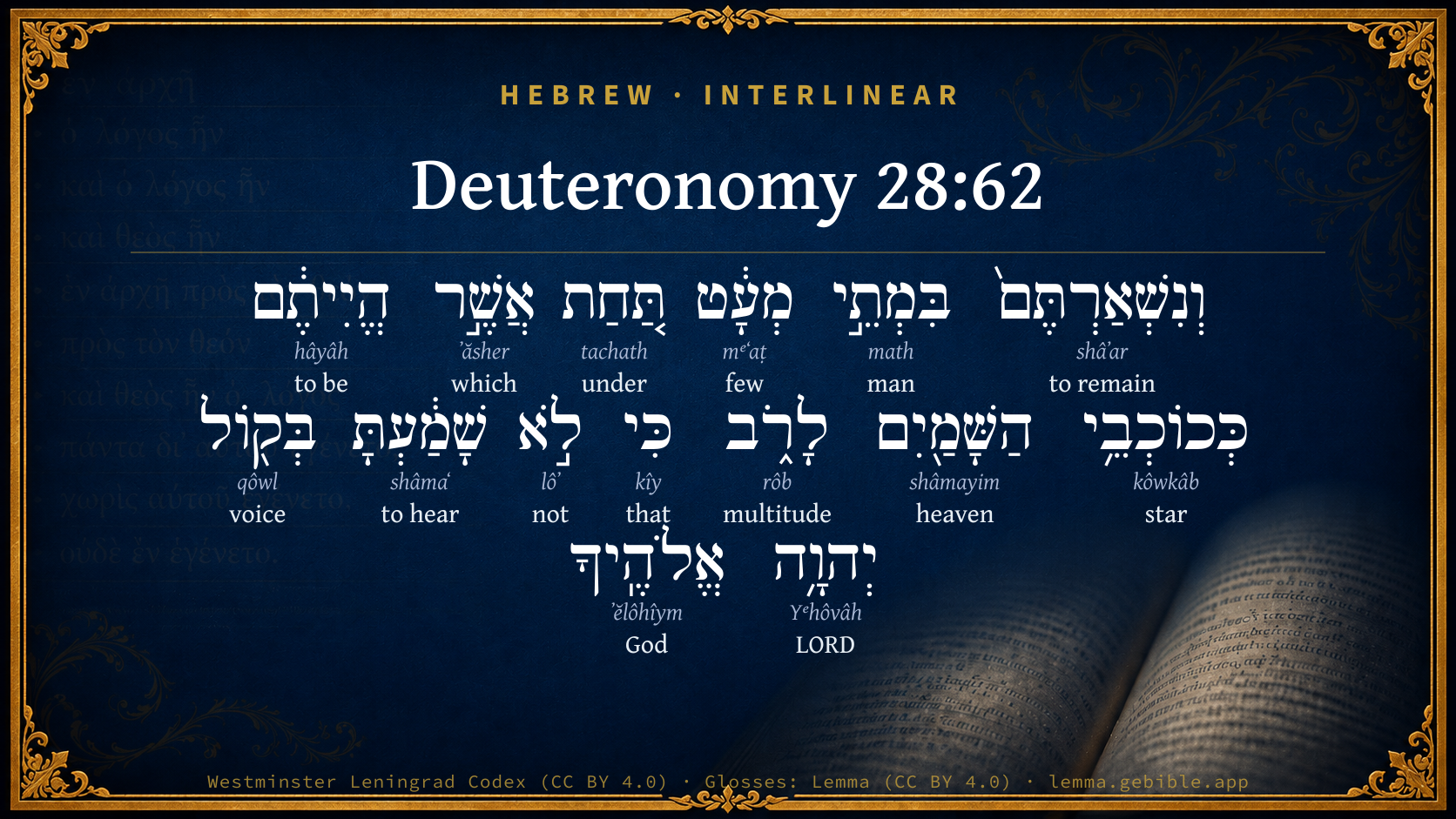
Hebrew (Westminster Leningrad Codex) Deuteronomy 28:62 appears in the Hebrew Old Testament. The text above is from the Westminster Leningrad Codex. Each word links to its Strong’s number, a concise gloss, and parsing drawn from the Open Scriptures Hebrew Bible morphology. Click any word for its full Brown-Driver-Briggs (BDB) entry.
Download image
Cite this verse

Deuteronomy 28:62 (World English Bible). Public Domain. Lemma interlinear Bible study tool, https://lemma.gebible.app/v/deuteronomy/28/62.

Show BibTeX & RIS
BibTeX
RIS
English Translation
You shall be left few in number, whereas you were as the stars of the sky for multitude; because you didn't listen to the voice of Yahweh your God.
World English Bible · Public Domain
Download a study sheet

One document with this verse’s original text, its word-by-word gloss line, the meaning frame, cross-references with their text, attributed commentary, and full source and license credits — printable, and it pastes into notes with its structure intact.

This verse Autodidact and up

Study sheet (.html) Plain text (.txt)

A passage Seminary Student

Up to 50 verses in one chapter. A passage sheet keeps up to 6 commentary sources and 12 cross-references per verse, in the order this page ranks them, and says so on the sheet whenever that leaves anything out. Ask for a single verse and you get the Autodidact verse sheet above.

Everything on this page stays free to read, with no account — the sheet is a download of what is already on screen, not access to it.

Want to remove ads? Support Godless Engineer
Compare translations 3

The same verse in 3 English versions, stacked beneath the original-language interlinear above. Click any original word for its lexicon entry.

Each is an independent rendering of the whole verse — the interlinear is not word-aligned to these translations.

Highlighted words mark where these versions differ — a whole-verse word diff, not a word-by-word alignment.

  • World English Bible Public Domain
    You shall be left few in number, whereas you were as the stars of the sky for multitude; because you didn't listen to the voice of Yahweh your God.
  • King James Version Public Domain
    And ye shall be left few in number, whereas ye were as the stars of heaven for multitude; because thou wouldest not obey the voice of the LORD thy God.
  • unfoldingWord Literal Text CC BY-SA 4.0
    And you shall remain few in number, although you were like the stars of the heavens in number, because you did not listen to the voice of Yahweh your God.

unfoldingWord Literal Text — © unfoldingWord, licensed CC BY-SA 4.0. Word-aligned USFM3 via Door43 (git.door43.org/unfoldingWord/en_ult).

Versions to compare (up to 4)

3 of 4 selected

Show all 18 translations

Every available English version of this verse, each an independent rendering of the whole verse.

  • World English Bible Public Domain
    You shall be left few in number, whereas you were as the stars of the sky for multitude; because you didn't listen to the voice of Yahweh your God.
  • Berean Standard Bible Public Domain
    You who were as numerous as the stars in the sky will be left few in number, because you would not obey the voice of the LORD your God.
  • Majority Standard Bible Public Domain
    You who were as numerous as the stars in the sky will be left few in number, because you would not obey the voice of the LORD your God.
  • King James Version Public Domain
    And ye shall be left few in number, whereas ye were as the stars of heaven for multitude; because thou wouldest not obey the voice of the LORD thy God.
  • American Standard Version (1901) Public Domain
    And ye shall be left few in number, whereas ye were as the stars of heaven for multitude; because thou didst not hearken unto the voice of Jehovah thy God.
  • Revised Version (1885) Public Domain
    And ye shall be left few in number, whereas ye were as the stars of heaven for multitude; because thou didst not hearken unto the voice of the LORD thy God.
  • Geneva Bible (1599) Public Domain
    And ye shall be left few in nomber, where ye were as the starres of heauen in multitude, because thou wouldest not obey the voyce of the Lord thy God.
  • Douay-Rheims (1899) Public Domain
    And you shall remain few in number, who before were as the stars of heaven for multitude, because thou heardst not the voice of the Lord thy God.
  • Young's Literal Translation Public Domain
    and ye have been left with few men, instead of which ye have been as stars of the heavens for multitude, because thou hast not hearkened to the voice of Jehovah thy God.
  • Literal Standard Version CC BY-SA 4.0
    and you have been left with few men, whereas that you would have been as stars of the heavens for multitude, for you have not listened to the voice of your God YHWH.
  • Unlocked Literal Bible CC BY-SA 4.0
    You will be left few in number, although you were like the stars of the heavens in number, because you did not listen to the voice of Yahweh your God.
  • unfoldingWord Literal Text CC BY-SA 4.0
    And you shall remain few in number, although you were like the stars of the heavens in number, because you did not listen to the voice of Yahweh your God.
  • Darby Bible Public Domain
    And ye shall be left a small company, whereas ye were as the stars of heaven for multitude; because thou hast not hearkened to the voice of Jehovah thy God.
  • World Messianic Bible Public Domain
    You will be left few in number, even though you were as the stars of the sky for multitude, because you didn’t listen to the LORD your God’s voice.
  • Webster's Bible Public Domain
    And ye shall be left few in number, whereas ye were as the stars of heaven for multitude; because thou wouldst not obey the voice of the LORD thy God.
  • Free Bible Version CC BY-SA 4.0
    You who grew as numerous as the stars in the sky will end up as only a few, because you would not obey what Lord your God told you.
  • Bible in Basic English Public Domain
    And you will become a very small band, though your numbers were like the stars of heaven; because you did not give ear to the voice of the Lord your God.
  • JPS Tanakh (1917) Public Domain
    And ye shall be left few in number, whereas ye were as the stars of heaven for multitude; because thou didst not hearken unto the voice of the LORD thy God.

Literal Standard Version (2020), Covenant Press — licensed CC BY-SA 4.0. Text via the HelloAO Bible API (eBible.org). Unlocked Literal Bible (unfoldingWord) — licensed CC BY-SA 4.0. Text via the HelloAO Bible API (eBible.org). unfoldingWord Literal Text — © unfoldingWord, licensed CC BY-SA 4.0. Word-aligned USFM3 via Door43 (git.door43.org/unfoldingWord/en_ult). Free Bible Version, Dr. Jonathan Gallagher — licensed CC BY-SA 4.0. Text via the HelloAO Bible API (eBible.org).

Word by word

More ways to search: Search by grammar → Find every occurrence → Compare this word →

Practice this passage: Drill this verse → Learn its vocabulary →

בִּמְתֵ֣י
math
H4962
“in/at · men of”
Preposition + Noun, Common, Masculine, Plural, Construct
Part of Speech
Preposition + Noun
Type
Common
Gender
Masculine
Number
Plural
State
Construct
Full BDB Definition

Origin: from the same as H4970

TWOT: 1263

male, man - males, men - few men (in prose) - less emphasis on sex - men (poetic) - less emphasis on sex
  1. וְנִשְׁאַרְתֶּם֙ shâʼar H7604 “and · to remain” Conjunction + Verb, Niphal, Sequential Perfect, 2nd Person, Masculine, Plural
  2. מְעָ֔ט mᵉʻaṭ H4592 “few” Noun, Common, Masculine, Singular, Absolute
  3. תַּ֚חַת tachath H8478 “under” Preposition
  4. אֲשֶׁ֣ר ʼăsher H834 “which” Particle, Relative
  5. הֱיִיתֶ֔ם hâyâh H1961 “to be” Verb, Qal, Perfect, 2nd Person, Masculine, Plural
  6. כְּכוֹכְבֵ֥י kôwkâb H3556 “like/as · stars of” Preposition + Noun, Common, Masculine, Plural, Construct
  7. הַשָּׁמַ֖יִם shâmayim H8064 “the · heaven(s)” Particle, Definite Article + Noun, Common, Masculine, Plural, Absolute
  8. לָרֹ֑ב rôb H7230 “to/for · multitude” Preposition + Noun, Common, Both, Singular, Absolute
  9. כִּי kîy H3588 “that” Conjunction
  10. לֹ֣א lôʼ H3808 “not” Particle, Negative
  11. שָׁמַ֔עְתָּ shâmaʻ H8085 “to hear” Verb, Qal, Perfect, 2nd Person, Masculine, Singular
  12. בְּק֖וֹל qôwl H6963 “in/at · voice of” Preposition + Noun, Common, Masculine, Singular, Construct
  13. יְהוָ֥ה Yᵉhôvâh H3068 “LORD” Noun, Proper
  14. אֱלֹהֶֽיךָ ʼĕlôhîym H430 “God(s) · your” Noun, Common, Masculine, Plural, Construct + Suffix, Personal, 2nd Person, Masculine, Singular

About this verse

These counts appear in no published source. They are computed here, from the morphology-tagged text and Lemma’s own curated glosses. What Lemma adds →

15
words
15
distinct lemmas
Pentateuch
section

Notable vocabulary

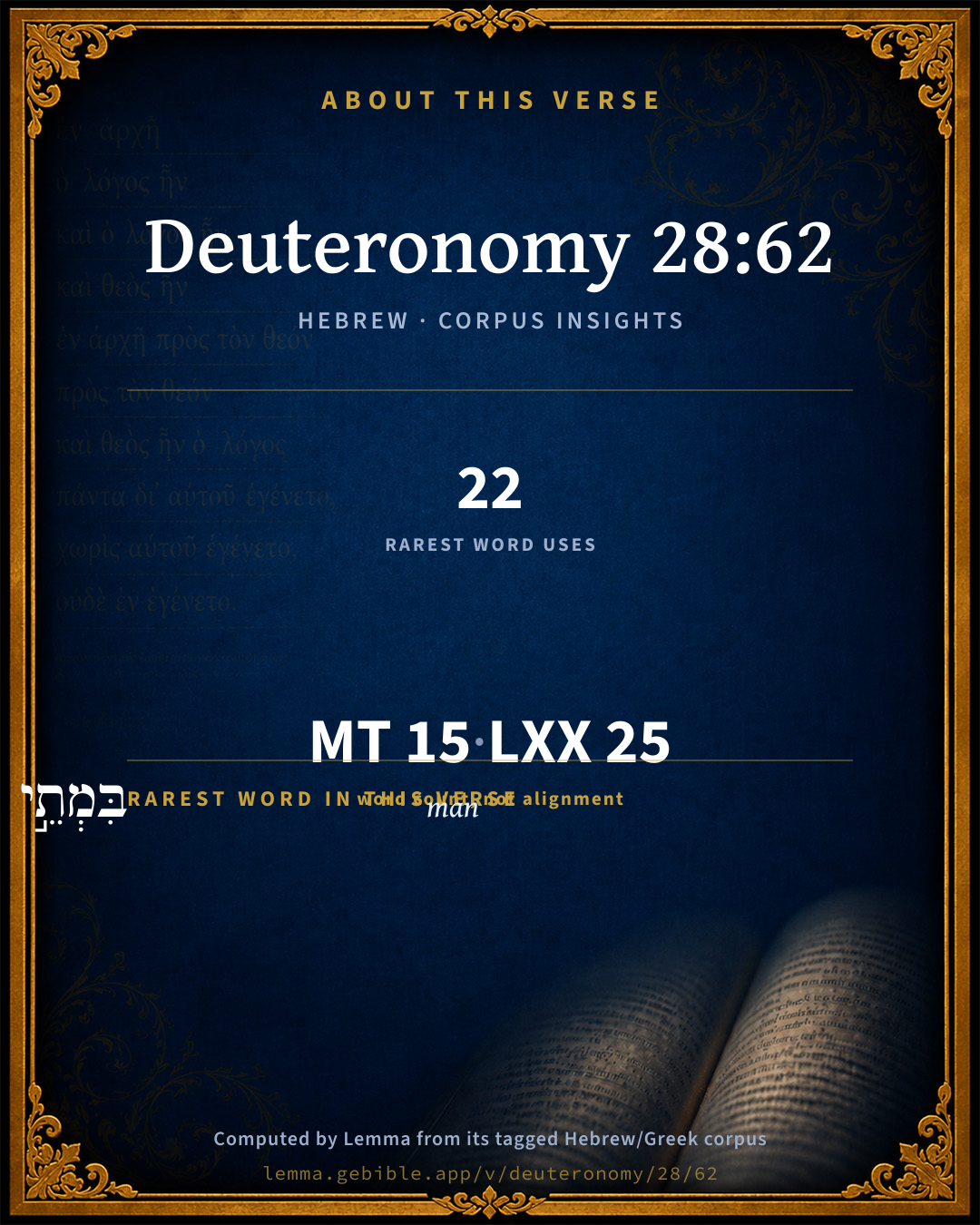
The rarest word here is בִּמְתֵ֣י man H4962 — appearing just 22 times in the whole Hebrew Bible.

Shared distinctive vocabulary

בִּמְתֵ֣י man H4962 occurs in 21 verses of the Hebrew Bible. Also found in:

Grammatical profile

  • 3 verbs
  • 8 nouns
  • 1 preposition
  • 1 conjunction
  • 2 particles

Verb forms

  • וְנִשְׁאַרְתֶּם֙ Niphal · Sequential Perfect
  • הֱיִיתֶ֔ם Qal · Perfect
  • שָׁמַ֔עְתָּ Qal · Perfect

Hebrew & Septuagint length

In English translation the verse runs 29 words from the Hebrew and 32 from the Septuagint (LXX English) — closely comparable.

A rough comparison of the two English renderings, which tokenize alike — not a word-level alignment.

Word counts can differ between the Hebrew and the Greek without any difference in meaning — e.g. the Hebrew direct-object marker אֵת has no separate Greek word, and Greek often adds the article ὁ.

In the original languages it is 15 Hebrew tokens and 25 Greek tokens — but the two are counted differently (Hebrew bundles its prefixes and suffixes into one token; the Greek is in lemma form), so that isn’t a like-for-like length.

Cross-references

13

Topical passages linked to Deuteronomy 28:62 in the Treasury of Scripture Knowledge — connected by theme and wording, ordered by reader-vote popularity; previews shown in the World English Bible.

  • Deuteronomy 4:27 Yahweh will scatter you among the peoples, and you shall be left few in number among the nations, where Yahweh shall lead you away.
  • Deuteronomy 10:22 Your fathers went down into Egypt with seventy persons; and now Yahweh your God has made you as the stars of the sky for multitude.
  • Nehemiah 9:23 Their children also multiplied you as the stars of the sky, and brought them into the land concerning which you did say to their fathers, that they should go in to possess it.
  • 2 Kings 24:14 He carried away all Jerusalem, and all the princes, and all the mighty men of valor, even ten thousand captives, and all the craftsmen and the smiths; none remained, save the poorest sort of the people of the land.
  • Nehemiah 7:4 Now the city was wide and large; but the people were few therein, and the houses were not built.
  • Isaiah 24:6 Therefore has the curse devoured the earth, and those who dwell therein are found guilty: therefore the inhabitants of the earth are burned, and few men left.
  • Jeremiah 42:2 and said to Jeremiah the prophet, Let, we pray you, our supplication be presented before you, and pray for us to Yahweh your God, even for all this remnant; for we are left but a few of many, as your eyes do see us:
  • Mark 13:20 Unless the Lord had shortened the days, no flesh would have been saved; but for the sake of the chosen ones, whom he picked out, he shortened the days.
  • Romans 9:27–29 Isaiah cries concerning Israel, "If the number of the children of Israel are as the sand of the sea, It is the remnant who will be saved;
  • Leviticus 26:22 I will send the wild animals among you, which will rob you of your children, destroy your cattle, and make you few in number; and your roads will become desolate.
  • 2 Kings 13:7 For he didn't leave to Jehoahaz of the people save fifty horsemen, and ten chariots, and ten thousand footmen; for the king of Syria destroyed them, and made them like the dust in threshing.
  • Isaiah 1:9 Unless Yahweh of hosts had left to us a very small remnant, We would have been as Sodom; We would have been like Gomorrah.
  • Jeremiah 52:28–30 This is the people whom Nebuchadrezzar carried away captive: in the seventh year three thousand twenty-three Jews;

Cross-references courtesy of OpenBible.info (CC BY 4.0).

Hebrew and Greek witnesses Masoretic Hebrew ↔ Greek Septuagint

The same verse in the two great witnesses to the Old Testament, shown verse-for-verse.

These are two independent witnesses, not word-aligned to each other, and the Septuagint is shown in lemma (dictionary) form.

Hebrew Deuteronomy 28:62 Masoretic · Westminster Leningrad Codex

וְנִשְׁאַרְתֶּם֙ בִּמְתֵ֣י מְעָ֔ט תַּ֚חַת אֲשֶׁ֣ר הֱיִיתֶ֔ם כְּכוֹכְבֵ֥י הַשָּׁמַ֖יִם לָרֹ֑ב כִּי לֹ֣א שָׁמַ֔עְתָּ בְּק֖וֹל יְהוָ֥ה אֱלֹהֶֽיךָ

You shall be left few in number, whereas you were as the stars of the sky for multitude; because you didn't listen to the voice of Yahweh your God.

World English Bible · Public Domain

Greek LXX Deuteronomy 28:62 Septuagint · lemma form

καί καταλείπω ἐν ἀριθμός βραχύς ἀντί ὅς ὅτι εἰμί ὡσεί ὁ ἄστρον ὁ οὐρανός ὁ πλῆθος ὅτι οὐ εἰςἀκούω ὁ φωνή κύριος ὁ θεός σύ

And you⌃ shall be left few in number, whereas you⌃ were as the stars of the sky in multitude; because you did not listen to the voice of the Lord your God.

LXX2012 (modern English Septuagint) · Public Domain

On this verse, The Cambridge Bible for Schools and Colleges discusses the Septuagint’s reading. Read the note in Commentary ↓

Hebrew: Westminster Leningrad Codex (CC BY 4.0). Greek: Septuagint (public domain); English from LXX2012 (modern English Septuagint) (Public Domain). How the Septuagint differs from the Hebrew →

Targum (Aramaic paraphrase)

2

The Targum is the ancient Jewish Aramaic paraphrase of the Hebrew Scriptures — an interpretive translation, not the Hebrew text itself. Onkelos (literal) and Pseudo-Jonathan (expansive) render the Torah, and Jonathan the Prophets. Coverage is partial: where no permissively-licensed English translation exists for a verse, only the Aramaic is shown. This is verse-level text, not a word-by-word alignment to the Hebrew.

  1. Targum Onkelos Torah (Genesis–Deuteronomy)
    וְתִשְׁתַּאֲרוּן בְּעַם זְעֵר חֳלָף דִי הֲוֵיתוּן כְּכוֹכְבֵי שְׁמַיָא לְמִסְגֵי אֲרֵי לָא קַבֶּלְתָּא לְמֵימְרָא דַיְיָ אֱלָהָךְ

    (no public-domain English translation for this verse)

    Targum Onkelos — Aramaic: “Onkelos Genesis” (public domain); “Onkelos Exodus” (public domain); “Onkelos Leviticus” (public domain); “Onkelos Numbers” (public domain); “Onkelos Deuteronomy” (public domain). English: “Sefaria Community Translation” (CC0 1.0 (public-domain dedication)); “J.W. Etheridge. The Targums of Onkelos and Jonathan Ben Uzziel on the Pentateuch. London: Longmans, Green, 1862” (public domain). Text via Sefaria.

  2. Targum Pseudo-Jonathan Torah (Genesis–Deuteronomy)
    וְתִשְׁתַּיְירוּן בְּאוּמָה קַלִילָא חוֹלַף דִי הֲוֵיתוּן הֵי כְכוֹכְבֵי שְׁמַיָא לְסוֹגֵי אֲרוּם לָא קַבֵּילְתּוּן לְמֵימְרָא דַיְיָ אֱלָהָכוֹן

    And you who were as the stars of heaven for multitude will be left a few people, because you hearkened not to the Word of the Lord your God.

    Targum Pseudo-Jonathan — Aramaic: “Targum Jonathan on Genesis” (public domain); “Targum Jonathan on Exodus” (public domain); “Targum Jonathan on Leviticus” (public domain); “Targum Jonathan on Numbers” (public domain); “Targum Jonathan on Deuteronomy” (public domain). English: “The Targum of Jonathan ben Uzziel, trans. J. W. Etheridge, London, 1862” (public domain). Text via Sefaria.

Commentary

Notes on Deuteronomy 28:62 from classic Christian and Jewish commentators (each source and its license shown beneath its notes). The classic Christian expositions comment on the surrounding passage and are grouped to its opening verse, so a note may address several verses; the Jewish commentaries on the Tanakh (Rashi and others) are per-verse, so they appear only where the commentator wrote on this verse.

Lemma curates 59 commentaries, every one of them public domain or Creative Commons licensed, each selected and text-cleaned for this edition rather than reprinted as found. About our sources →

The Cambridge Bible for Schools and Colleges

gen. ed. J. J. S. Perowne

62, 63. The only vv. in this ch. (except Deu_28:68 b) in which the Pl. address occurs. The text, including the change to Sg. in the final clauses of both vv., is on the whole confirmed by LXX. Sam., some LXX codd. and Luc. give Deu_28:62 b in Pl. The change to Pl. is explicable logically in Deu_28:62, where the number of the people is being dealt with; but this reason does not account for the Pl. in Deu_28:63. The Sg., whither thou goest in to possess it, is characteristic of the Sg passages, and therefore is not due to the attraction of the Sg. in the next v.

The Cambridge Bible for Schools and Colleges (gen. ed. J. J. S. Perowne; Cambridge University Press, 1878–1918) — public domain. Text from a community e-Sword module.

Trapp's Complete Commentary

John Trapp

Deu 28:62 And ye shall be left few in number, whereas ye were as the stars of heaven for multitude; because thou wouldest not obey the voice of the LORD thy God.

Ver. 62. And ye shall be left few in number.] And so "shall know my breach of covenant," because ye broke first.

John Trapp, A Commentary or Exposition upon All the Books of the Old and New Testament (1647–1656) — public domain. Text from a community e-Sword module.

Joseph Benson's Commentary

Deu 28:62. Ye shall be left few in number — “Not to mention here any other of the calamities and slaughters which the Jews have undergone, there was in the last siege of Jerusalem, by Titus, an infinite multitude, saith Josephus, who perished by famine; and he computes that, during the whole siege, the number of those who were destroyed by that and by the war amounted to eleven hundred thousand, the people being assembled from all parts to celebrate the passover. And the same author hath given us an account of one million two hundred and forty thousand four hundred and ninety destroyed in Jerusalem and other parts of Judea, besides ninety-nine thousand two hundred made prisoners, as Basnage has reckoned them up from that historian’s account.” — Bp. Newton. Another Jewish writer relates that there were above one hundred and sixteen thousand dead bodies of the rich and honourable men of Jerusalem carried out at one gate of the city during the siege, besides those which were carried out at other gates, and thrown over the wall. But when the city was taken, the massacre was dreadful. Titus would have put an end to it, but could not. His men killed all, except the most vigorous, whom they shut up in the porch of the women. The youngest and most beautiful of these were reserved to grace Titus’s triumph. Those above seventeen years of age were sent bound into Egypt, to be employed in some public works there; and great numbers of others were sent into several cities of Syria, and other provinces, to be exposed on the public theatres, to exhibit fights, or to be devoured by wild beasts. So that the whole number of Jews who perished in this war is computed at upward of one million four hundred thousand. Besides these, however, a vast number perished in caves, woods, wildernesses, common sewers, &c., of whom no computation could be made. — Encycl. Brit. Add to the above, that the slaughter was very great which was afterward made of them in the wars of Julius Severus, sent against them by Adrian, when fifty of their strongest fortresses were razed, and nine hundred and eighty- five of their most noble and populous towns were sacked and consumed by fire, insomuch that, as Dion expresses it, “all Judea was in a manner laid waste, and left as a desert.” But indeed there is no nation on earth that hath been exposed to so many persecutions and massacres. Their history abounds with them. And if God had not given them a promise of a numerous posterity, the whole race would many times have been extirpated.

Joseph Benson's Commentary on the Old and New Testaments (1811–1818) — public domain. Text from a community e-Sword module.

Jamieson, Fausset & Brown

Robert Jamieson, A. R. Fausset & David Brown

ye shall be left few in number--There has been, ever since the destruction of Jerusalem, only an inconsiderable remnant of Jews existing in that land--aliens in the land of their fathers; and of all classes of the inhabitants they are the most degraded and miserable beings, dependent for their support on contributions from other lands.

Jamieson, Fausset & Brown — Commentary Critical and Explanatory on the Whole Bible (1871) — public domain (CC PDM 1.0). Text via the HelloAO Bible API.

John Gill's Exposition

And thy life shall hang in doubt before thee,.... Whether it shall be spared or not by the enemy:

and thou shalt fear day and night; being in continual dread of being killed:

and shalt have none assurance of thy life; of its being continued a moment scarcely, but live in constant fear and expectation of its being taken away.

John Gill's Exposition of the Whole Bible (1746–1763) — public domain (CC PDM 1.0). Text via the HelloAO Bible API.

The Pulpit Commentary

cf. Deu_4:27 Deu_10:22; Neh_9:23.

The Pulpit Commentary (1880–1919), ed. H.D.M. Spence-Jones & Joseph S. Exell — public domain. Text from a community e-Sword module.

Rashi

Rabbi Shlomo Yitzchaki (Rashi)

ונשארתם במתי מעט תחת וגו׳ AND YOU SHALL REMAIN FEW IN NUMBER WHEREAS [YOU WERE ONCE AS NUMEROUS AS THE STARS OF HEAVEN] — i.e. a few instead of many.

Rashi on the Tanakh — English translations: “The Judaica Press complete Tanach with Rashi, translated by A. J. Rosenberg” (CC BY 4.0); “Pentateuch with Rashi's commentary by M. Rosenbaum and A.M. Silbermann, 1929-1934” (public domain); “The Metsudah Tanach series, Lakewood, N.J” (CC BY 4.0); and “The Book of Joshua, Metsudah Publications, 1997” (CC BY 4.0). Text via Sefaria.

Lesson kit

Teaching starters — assembled from the data on this page, not authored interpretation. Every prompt links to the verse data it draws on. Edit before teaching.

Deuteronomy, in the Pentateuch, opens this verse with 15 words (15 distinct Hebrew lemmas). Its most distinctive word is math (“man”). A historical commentator’s framing appears above. Read the whole chapter for the surrounding context.

Discussion questions

  1. What does “man” (math) contribute to the verse as a whole?
  2. How does Genesis 34:30, which shares the word «man», read alongside this verse?
  3. The translations on this page render this verse differently — a whole-verse word diff, not a word-by-word alignment. What might account for the different wordings?
  4. «וְנִשְׁאַרְתֶּם֙» is a Niphal Sequential Perfect verb. How does that grammatical form shape the action described?
  5. Compare how The Cambridge Bible for Schools and Colleges and Trapp's Complete Commentary read this verse. Where do they agree or differ?

Things to notice

Reading settings

Reading text

Shown beneath each verse's original-language words.

Old Testament
Old Testament edition

Read the OT as the Masoretic Hebrew (MT) or the Greek Septuagint (LXX).

English shown for the Greek Septuagint (in the Hebrew ↔ Greek comparison).

Comparing translations? Open the Compare panel on any verse page to stack up to four side by side.