
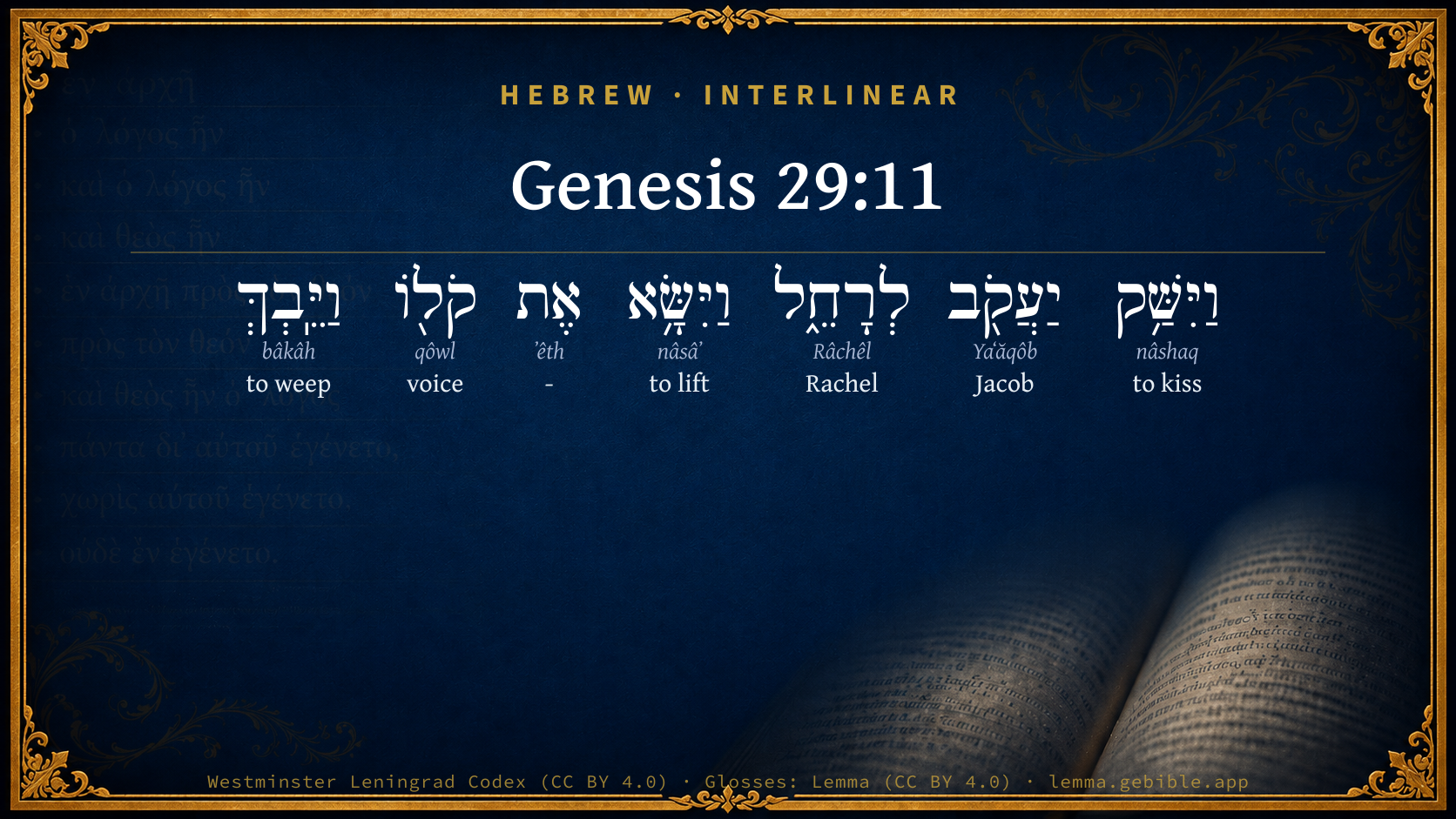
Genesis 29:11

Hebrew (Westminster Leningrad Codex) Genesis 29:11 appears in the Hebrew Old Testament. The text above is from the Westminster Leningrad Codex. Each word links to its Strong’s number, a concise gloss, and parsing drawn from the Open Scriptures Hebrew Bible morphology. Click any word for its full Brown-Driver-Briggs (BDB) entry.
Download image
Cite this verse

Genesis 29:11 (World English Bible). Public Domain. Lemma interlinear Bible study tool, https://lemma.gebible.app/v/genesis/29/11.

Show BibTeX & RIS
BibTeX
RIS
English Translation
Jacob kissed Rachel, and lifted up his voice, and wept.
World English Bible · Public Domain
Download a study sheet

One document with this verse’s original text, its word-by-word gloss line, the meaning frame, cross-references with their text, attributed commentary, and full source and license credits — printable, and it pastes into notes with its structure intact.

This verse Autodidact and up

Study sheet (.html) Plain text (.txt)

A passage Seminary Student

Up to 50 verses in one chapter. A passage sheet keeps up to 6 commentary sources and 12 cross-references per verse, in the order this page ranks them, and says so on the sheet whenever that leaves anything out. Ask for a single verse and you get the Autodidact verse sheet above.

Everything on this page stays free to read, with no account — the sheet is a download of what is already on screen, not access to it.

Want to remove ads? Support Godless Engineer
Compare translations 3

The same verse in 3 English versions, stacked beneath the original-language interlinear above. Click any original word for its lexicon entry.

Each is an independent rendering of the whole verse — the interlinear is not word-aligned to these translations.

Highlighted words mark where these versions differ — a whole-verse word diff, not a word-by-word alignment.

  • World English Bible Public Domain
    Jacob kissed Rachel, and lifted up his voice, and wept.
  • King James Version Public Domain
    And Jacob kissed Rachel, and lifted up his voice, and wept.
  • unfoldingWord Literal Text CC BY-SA 4.0
    Then Jacob kissed Rachel and lifted his voice and cried.

unfoldingWord Literal Text — © unfoldingWord, licensed CC BY-SA 4.0. Word-aligned USFM3 via Door43 (git.door43.org/unfoldingWord/en_ult).

Versions to compare (up to 4)

3 of 4 selected

Show all 18 translations

Every available English version of this verse, each an independent rendering of the whole verse.

  • World English Bible Public Domain
    Jacob kissed Rachel, and lifted up his voice, and wept.
  • Berean Standard Bible Public Domain
    Then Jacob kissed Rachel and wept aloud.
  • Majority Standard Bible Public Domain
    Then Jacob kissed Rachel and wept aloud.
  • King James Version Public Domain
    And Jacob kissed Rachel, and lifted up his voice, and wept.
  • American Standard Version (1901) Public Domain
    And Jacob kissed Rachel, and lifted up his voice, and wept.
  • Revised Version (1885) Public Domain
    And Jacob kissed Rachel, and lifted up his voice, and wept.
  • Geneva Bible (1599) Public Domain
    And Iaakob kissed Rahel, and lift vp his voyce and wept.
  • Douay-Rheims (1899) Public Domain
    And having watered the flock, he kissed her: and lifting up his voice, wept.
  • Young's Literal Translation Public Domain
    And Jacob kisseth Rachel, and lifteth up his voice, and weepeth,
  • Literal Standard Version CC BY-SA 4.0
    And Jacob kisses Rachel, and lifts up his voice, and weeps,
  • Unlocked Literal Bible CC BY-SA 4.0
    Jacob kissed Rachel and wept loudly.
  • unfoldingWord Literal Text CC BY-SA 4.0
    Then Jacob kissed Rachel and lifted his voice and cried.
  • Darby Bible Public Domain
    And Jacob kissed Rachel, and lifted up his voice and wept.
  • World Messianic Bible Public Domain
    Jacob kissed Rachel, and lifted up his voice, and wept.
  • Webster's Bible Public Domain
    And Jacob kissed Rachel, and lifted up his voice, and wept.
  • Free Bible Version CC BY-SA 4.0
    Then Jacob kissed Rachel and wept for joy.
  • Bible in Basic English Public Domain
    And weeping for joy, Jacob gave Rachel a kiss.
  • JPS Tanakh (1917) Public Domain
    And Jacob kissed Rachel, and lifted up his voice, and wept.

Literal Standard Version (2020), Covenant Press — licensed CC BY-SA 4.0. Text via the HelloAO Bible API (eBible.org). Unlocked Literal Bible (unfoldingWord) — licensed CC BY-SA 4.0. Text via the HelloAO Bible API (eBible.org). unfoldingWord Literal Text — © unfoldingWord, licensed CC BY-SA 4.0. Word-aligned USFM3 via Door43 (git.door43.org/unfoldingWord/en_ult). Free Bible Version, Dr. Jonathan Gallagher — licensed CC BY-SA 4.0. Text via the HelloAO Bible API (eBible.org).

Word by word

More ways to search: Search by grammar → Find every occurrence → Compare this word →

Practice this passage: Drill this verse → Learn its vocabulary →

וַיִּשַּׁ֥ק
nâshaq
H5401
“and · to kiss”
Conjunction + Verb, Qal, Sequential Imperfect, 3rd Person, Masculine, Singular
Part of Speech
Conjunction + Verb
Stem
Qal
Form
Sequential Imperfect
Person
3rd Person
Gender
Masculine
Number
Singular
Full BDB Definition

Origin: a primitive root [identical with H5400 , through the idea of fastening up

TWOT: 1435 , 1436

to put together, kiss - (Qal) to kiss - (Piel) to kiss - (Hiphil) to touch gently - to handle, be equipped with - (Qal) to be equipped
  1. יַעֲקֹ֖ב Yaʻăqôb H3290 “Jacob” Noun, Proper
  2. לְרָחֵ֑ל Râchêl H7354 “to/for · Rachel” Preposition + Noun, Proper
  3. וַיִּשָּׂ֥א nâsâʼ H5375 “and · to lift” Conjunction + Verb, Qal, Sequential Imperfect, 3rd Person, Masculine, Singular
  4. אֶת ʼêth H853 “-” Particle, Direct Object
  5. קֹל֖וֹ qôwl H6963 “voice · his” Noun, Common, Masculine, Singular, Construct + Suffix, Personal, 3rd Person, Masculine, Singular
  6. וַיֵּֽבְךְּ bâkâh H1058 “and · to weep” Conjunction + Verb, Qal, Sequential Imperfect, 3rd Person, Masculine, Singular

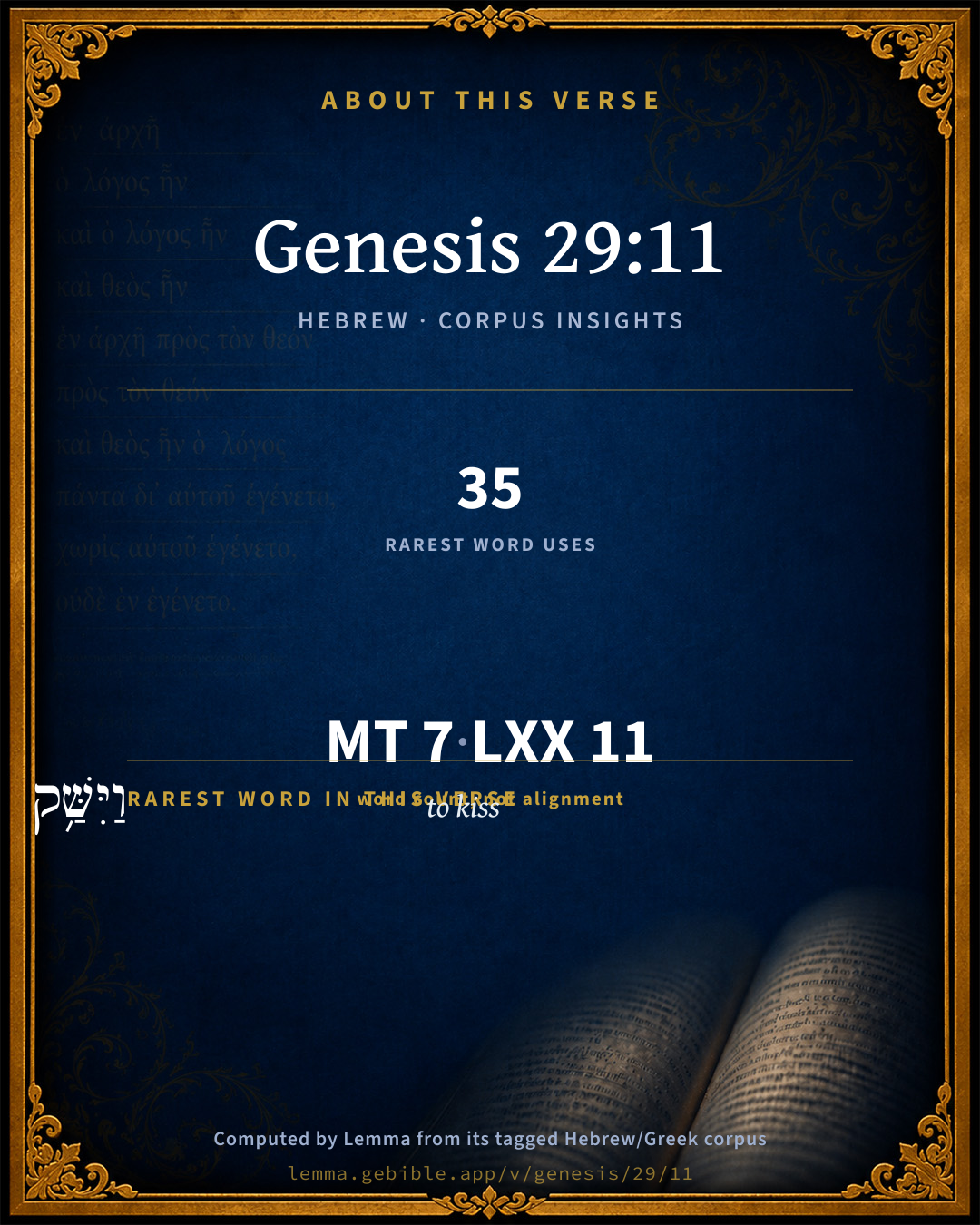
About this verse

These counts appear in no published source. They are computed here, from the morphology-tagged text and Lemma’s own curated glosses. What Lemma adds →

7
words
7
distinct lemmas
Pentateuch
section

Shared distinctive vocabulary

וַיִּשַּׁ֥ק to kiss H5401 occurs in 35 verses of the Hebrew Bible. Also found in:

Grammatical profile

  • 3 verbs
  • 3 nouns
  • 1 particle

Verb forms

  • וַיִּשַּׁ֥ק Qal · Sequential Imperfect
  • וַיִּשָּׂ֥א Qal · Sequential Imperfect
  • וַיֵּֽבְךְּ Qal · Sequential Imperfect

Hebrew & Septuagint length

In English translation the verse runs 10 words from the Hebrew and 12 from the Septuagint (LXX English) — closely comparable.

A rough comparison of the two English renderings, which tokenize alike — not a word-level alignment.

Word counts can differ between the Hebrew and the Greek without any difference in meaning — e.g. the Hebrew direct-object marker אֵת has no separate Greek word, and Greek often adds the article ὁ.

In the original languages it is 7 Hebrew tokens and 11 Greek tokens — but the two are counted differently (Hebrew bundles its prefixes and suffixes into one token; the Greek is in lemma form), so that isn’t a like-for-like length.

Cross-references

9

Topical passages linked to Genesis 29:11 in the Treasury of Scripture Knowledge — connected by theme and wording, ordered by reader-vote popularity; previews shown in the World English Bible.

  • Genesis 33:4 Esau ran to meet him, embraced him, fell on his neck, kissed him, and they wept.
  • Genesis 43:30 Joseph made haste; for his heart yearned over his brother: and he sought a place to weep; and he entered into his room, and wept there.
  • Genesis 45:2 He wept aloud. The Egyptians heard, and the house of Pharaoh heard.
  • Genesis 45:14–15 He fell on his brother Benjamin's neck, and wept, and Benjamin wept on his neck.
  • Genesis 27:26 His father Isaac said to him, "Come near now, and kiss me, my son."
  • Genesis 29:13 It happened, when Laban heard the news of Jacob, his sister's son, that he ran to meet Jacob, and embraced him, and kissed him, and brought him to his house. Jacob told Laban all these things.
  • Exodus 4:27 Yahweh said to Aaron, "Go into the wilderness to meet Moses." He went, and met him on God's mountain, and kissed him.
  • Exodus 18:7 Moses went out to meet his father-in-law, and bowed and kissed him. They asked each other of their welfare, and they came into the tent.
  • Romans 16:16 Greet one another with a holy kiss. The assemblies of Christ greet you.

Cross-references courtesy of OpenBible.info (CC BY 4.0).

Hebrew and Greek witnesses Masoretic Hebrew ↔ Greek Septuagint

The same verse in the two great witnesses to the Old Testament, shown verse-for-verse.

These are two independent witnesses, not word-aligned to each other, and the Septuagint is shown in lemma (dictionary) form.

Hebrew Genesis 29:11 Masoretic · Westminster Leningrad Codex

וַיִּשַּׁ֥ק יַעֲקֹ֖ב לְרָחֵ֑ל וַיִּשָּׂ֥א אֶת קֹל֖וֹ וַיֵּֽבְךְּ

Jacob kissed Rachel, and lifted up his voice, and wept.

World English Bible · Public Domain

Greek LXX Genesis 29:11 Septuagint · lemma form

καί φιλέω ἰακώβ ὁ ραχηλ καί βοάω ὁ φωνή αὐτός κλαίω

And Jacob kissed Rachel, and cried with a loud voice and wept.

LXX2012 (modern English Septuagint) · Public Domain

Hebrew: Westminster Leningrad Codex (CC BY 4.0). Greek: Septuagint (public domain); English from LXX2012 (modern English Septuagint) (Public Domain). How the Septuagint differs from the Hebrew →

Targum (Aramaic paraphrase)

2

The Targum is the ancient Jewish Aramaic paraphrase of the Hebrew Scriptures — an interpretive translation, not the Hebrew text itself. Onkelos (literal) and Pseudo-Jonathan (expansive) render the Torah, and Jonathan the Prophets. Coverage is partial: where no permissively-licensed English translation exists for a verse, only the Aramaic is shown. This is verse-level text, not a word-by-word alignment to the Hebrew.

  1. Targum Onkelos Torah (Genesis–Deuteronomy)
    וּנְשַׁק יַעֲקֹב לְרָחֵל וַאֲרֵם יָת קָלֵהּ וּבְכָא

    (no public-domain English translation for this verse)

    Targum Onkelos — Aramaic: “Onkelos Genesis” (public domain); “Onkelos Exodus” (public domain); “Onkelos Leviticus” (public domain); “Onkelos Numbers” (public domain); “Onkelos Deuteronomy” (public domain). English: “Sefaria Community Translation” (CC0 1.0 (public-domain dedication)); “J.W. Etheridge. The Targums of Onkelos and Jonathan Ben Uzziel on the Pentateuch. London: Longmans, Green, 1862” (public domain). Text via Sefaria.

  2. Targum Pseudo-Jonathan Torah (Genesis–Deuteronomy)
    וּנְשַׁק יַעֲקב לְרָחֵל וַאֲרֵים יַת קָלֵיהּ וּבְכָא

    And Jakob kissed Rahel, and lifted up his voice and wept.

    Targum Pseudo-Jonathan — Aramaic: “Targum Jonathan on Genesis” (public domain); “Targum Jonathan on Exodus” (public domain); “Targum Jonathan on Leviticus” (public domain); “Targum Jonathan on Numbers” (public domain); “Targum Jonathan on Deuteronomy” (public domain). English: “The Targum of Jonathan ben Uzziel, trans. J. W. Etheridge, London, 1862” (public domain). Text via Sefaria.

Commentary

Notes on Genesis 29:11 from classic Christian and Jewish commentators (each source and its license shown beneath its notes). The classic Christian expositions comment on the surrounding passage and are grouped to its opening verse, so a note may address several verses; the Jewish commentaries on the Tanakh (Rashi and others) are per-verse, so they appear only where the commentator wrote on this verse.

Lemma curates 59 commentaries, every one of them public domain or Creative Commons licensed, each selected and text-cleaned for this edition rather than reprinted as found. About our sources →

Trapp's Complete Commentary

John Trapp

Gen 29:11 And Jacob kissed Rachel, and lifted up his voice, and wept.

Ver. 11. Lifted up his voice, and wept.] For joy, that he had so happily lighted upon his kinswoman. It argued also his great affection, and passion of mind, for her sake; love is ecstatical; nec iuris se sinit esse sui. Animus est ubi amat, non ubi animat. {a} He kisseth Rachel, as if he would have transfused his soul into her: and wept aloud; not as those vain lovers, who ut flerent, oculos erudiere suos :nor as the Brasileans, {b} whose faculty is such, that tears are for a present salutation, and as soon gone, as if they had said, How do you? but as Joseph wept over Benjamin; the prodigal’s father over him, &c.

{a} Ovid. Amor., lib. ii.

{b} Magni. in Geogr.

John Trapp, A Commentary or Exposition upon All the Books of the Old and New Testament (1647–1656) — public domain. Text from a community e-Sword module.

Tyndale Open Study Notes

Tyndale Open Resources

29:11 Jacob kissed Rachel: Kissing relatives was a proper greeting (29:13; cp. Song 8:1).

Tyndale Open Study Notes — © Tyndale Open Resources, licensed CC BY-SA 4.0. Text via the HelloAO Bible API.

Adam Clarke's Commentary

Verse 11. Jacob kissed Rachel] A simple and pure method by which the primitive inhabitants of the earth testified their friendship to each other, first abused by hypocrites, who pretended affection while their vile hearts meditated terror, (see the case of Joab,) and afterwards disgraced by refiners on morals, who, while they pretended to stumble at those innocent expressions of affection and friendship, were capable of committing the grossest acts of impurity.

And lifted up his voice] It may be, in thanksgiving to God for the favour he had shown him, in conducting him thus far in peace and safety.

And wept.] From a sense of the goodness of his heavenly Father, and his own unworthiness of the success with which he had been favoured. The same expressions of kindness and pure affection are repeated on the part of Laban, Ge 29:13.

Adam Clarke's Commentary on the Bible (1810–1826) — public domain. Text from a community e-Sword/MySword module.

Ellicott's Commentary for English Readers

(11) Jacob kissed Rachel . . . and wept.—Jacob first made himself, useful to Rachel, and then discloses to her who he is, claims her as a cousin, and kisses her. Then, overcome with joy at this happy termination of his long journey, and at finding himself among relatives, he can restrain his feelings no longer, but bursts into tears. In this outburst of emotion we see the commencement of his lifelong affection for the beautiful child whom he thus opportunely met.

A Bible Commentary for English Readers, edited by Charles John Ellicott (1878–1897) — public domain. Text from a community e-Sword module.

The Cambridge Bible for Schools and Colleges

gen. ed. J. J. S. Perowne

11. Jacob kissed … wept] This demonstrative display of feeling is Homeric in its simplicity. The suddenness of Jacob’s opportune meeting with his relatives, the removal of doubt and anxiety from his mind on entering a strange country, and the apparition of his young and fair cousin, had all deeply stirred his emotional nature. Cf. the tears of Joseph, Gen_45:2; Gen_45:14.

The Cambridge Bible for Schools and Colleges (gen. ed. J. J. S. Perowne; Cambridge University Press, 1878–1918) — public domain. Text from a community e-Sword module.

John Gill's Exposition

And Jacob kissed Rachel,.... Which he did in a way of courtesy and civility; this was done after he had acquainted her with his relation to her; he saluted her upon that:

and lifted up his voice, and wept; for joy at the providence of God that had brought him so opportunely to the place, and at the sight of a person so nearly related to him; and who he hoped would be his wife, and was the person designed of God for him.

John Gill's Exposition of the Whole Bible (1746–1763) — public domain (CC PDM 1.0). Text via the HelloAO Bible API.

Haydock's Catholic Bible Commentary

Kissed her, according to the custom of the country, (chap. xxiv. 26,) having told her who he was. He was not so young, that she could suspect him guilty of an unbecoming levity, being above 77 years old, chap. xxvii. 1. (Haydock) --- In that age of simplicity, beautiful maids might converse with shepherds, without suspicion or danger. (Menochius) --- Wept, through tenderness, and perhaps on account of his present inability to make her a suitable present. (Calmet)

George Leo Haydock (1774–1849), Haydock's Catholic Family Bible and Commentary, 1859 edition — public domain. Excludes Psalms (Douay-Rheims chapter numbering differs from Protestant) and Deuterocanonical books (Catholic canon only).

Matthew Poole's English Annotations

Jacob kissed Rachel, as the custom of friends then was, both at their first meeting, as Ge 29:13; Ge 33:4; Ex 4:27; 18:7, and at their departure, as Ru 1:14; 1Sa 20:41; 1Ki 19:20.

Wept tears of joy, like those Ge 33:4, at the gracious providence of God to him, which had brought him safe to his desired place, and so happily and strangely conducted him to that person and family which was so desirable and dear to him.

Matthew Poole's English Annotations on the Holy Bible (1683–1685) — public domain. Text from a community e-Sword/MySword module.

Whedon's Commentary on the Bible

Daniel D. Whedon

11. Kissed… and wept — “Delight and sorrow mingled in his heart, and, overwhelmed by his feelings, he paid his tribute to nature by a spontaneous flood of tears.” — Kalisch.

Daniel D. Whedon (gen. ed.), Commentary on the Old and New Testaments (1874–1909) — public domain. Text from a community e-Sword module.

The Pulpit Commentary

And Jacob kissed Rachel, in demonstration of his cousinly affection. If Jacob had not yet discovered who he was to the fair shepherdess, his behavior must have filled her with surprise, even allowing for the unaffected simplicity of the times; but the fact that she does not resent his conduct as an undue liberty perhaps suggests that he had first informed her of his relationship to the inmates of Laban s house (Calvin). On kissing vide Gen_27:26and lifted up his voice, and wept partly for joy in finding his relatives; (cf. Gen_43:30 Gen_45:2, Gen_45:14, Gen_45:15) partly in grateful acknowledgment of God"s kindness in conducting him to his mother s brother"s house.

The Pulpit Commentary (1880–1919), ed. H.D.M. Spence-Jones & Joseph S. Exell — public domain. Text from a community e-Sword module.

unfoldingWord translationNotes

Door43 World Missions Community

Jacob kissed Rachel

In ancient Near East, it is common to greet a relative with a kiss. However, it is normally done between men. If your language has an affectionate greeting for a relative, use that. If not, use what is appropriate.

wept loudly

Jacob weeps because he is so happy. The full meaning of this statement can be made explicit. (See: Assumed Knowledge and Implicit Information)

her father's relative

"related to her father"

translationWords

kiss

Rachel

Rebekah

son

unfoldingWord translationNotes — © Distant Shores Media and the Door43 World Missions Community, licensed CC BY-SA 4.0. Source: git.door43.org/Door43/en_tn.

Rashi

Rabbi Shlomo Yitzchaki (Rashi)

ויבך AND HE WEPT- because he foresaw by the Holy Spirit that she would not be buried with him in the cave of Machpelah (Genesis Rabbah 70:12). Another explanation is: he wept because he came with empty hands. He thought: Eliezer, my grandfather’s servant, had with him rings, bracelets and all good things, whilst I have nothing with me (Genesis Rabbah 70:12). This was because Eliphaz Esau’s son pursued Jacob by his father’s order to kill him, and overtook him. But because Eliphaz had been brought up on Isaac’s lap, (cp. Deuteronomy Rabbah 2:13) he withheld his hand. He said to him (Jacob), “But what shall I do as regards my father’s order?” Jacob replied, “Take all I have and you can say that I am dead for a poor man may be accounted as dead" (Nedarim 64b).

Rashi on the Tanakh — English translations: “The Judaica Press complete Tanach with Rashi, translated by A. J. Rosenberg” (CC BY 4.0); “Pentateuch with Rashi's commentary by M. Rosenbaum and A.M. Silbermann, 1929-1934” (public domain); “The Metsudah Tanach series, Lakewood, N.J” (CC BY 4.0); and “The Book of Joshua, Metsudah Publications, 1997” (CC BY 4.0). Text via Sefaria.

Sforno

Rabbi Ovadia Sforno

And cried in a loud voice. He was pained that he did not merit marrying her in his youth so that by now he would have had grown up children.

Sforno on the Tanakh — English translation: “Yalkut, Sifsei Chachomim Chumash, Metsudah Publications, 2009” (CC BY 4.0). Text via Sefaria.

Radak

Rabbi David Kimhi (Radak)

וישק, since she had realised that Yaakov had done all this on her account, she accepted his kiss. Furthermore, he had told them כי אחי אביה הוא, i.e. a son of her father’s sister, a son of Rivkah, who was known to all the people of Charan to have become married to Yitzchok.

ויבך, he wept for joy. When close relatives meet after not having seen each other for a while, their emotional cup runs over so that they find it hard to control their feelings and they give way to them by crying for joy.

Radak on the Tanakh — English translations: “Sefaria Community Translation” (CC0 1.0 (public-domain dedication)); “Eliyahu Munk, HaChut Hameshulash” (CC BY 4.0); “Rabbi Mike Feuer, Jerusalem Anthology” (CC BY 4.0); and “R. David Kimhi on the first book of Psalms, Translated by R.G. Finch, London, 1919” (public domain). Text via Sefaria.

Lesson kit

Teaching starters — assembled from the data on this page, not authored interpretation. Every prompt links to the verse data it draws on. Edit before teaching.

Genesis, in the Pentateuch, opens this verse with 7 words (7 distinct Hebrew lemmas). Its most distinctive word is nâshaq (“to kiss”). A historical commentator’s framing appears above. Read the whole chapter for the surrounding context.

Discussion questions

  1. The word nâshaq carries the sense “to kiss.” How does it shape the verse?
  2. How does Genesis 27:26, which shares the word «to kiss», read alongside this verse?
  3. These translations render this verse differently. What is at stake in choosing one wording over another?
  4. «וַיִּשַּׁ֥ק» is a Qal Sequential Imperfect verb. How does that grammatical form shape the action described?
  5. Compare how Trapp's Complete Commentary and Tyndale Open Study Notes read this verse. Where do they agree or differ?

Things to notice

Reading settings

Reading text

Shown beneath each verse's original-language words.

Old Testament
Old Testament edition

Read the OT as the Masoretic Hebrew (MT) or the Greek Septuagint (LXX).

English shown for the Greek Septuagint (in the Hebrew ↔ Greek comparison).

Comparing translations? Open the Compare panel on any verse page to stack up to four side by side.