
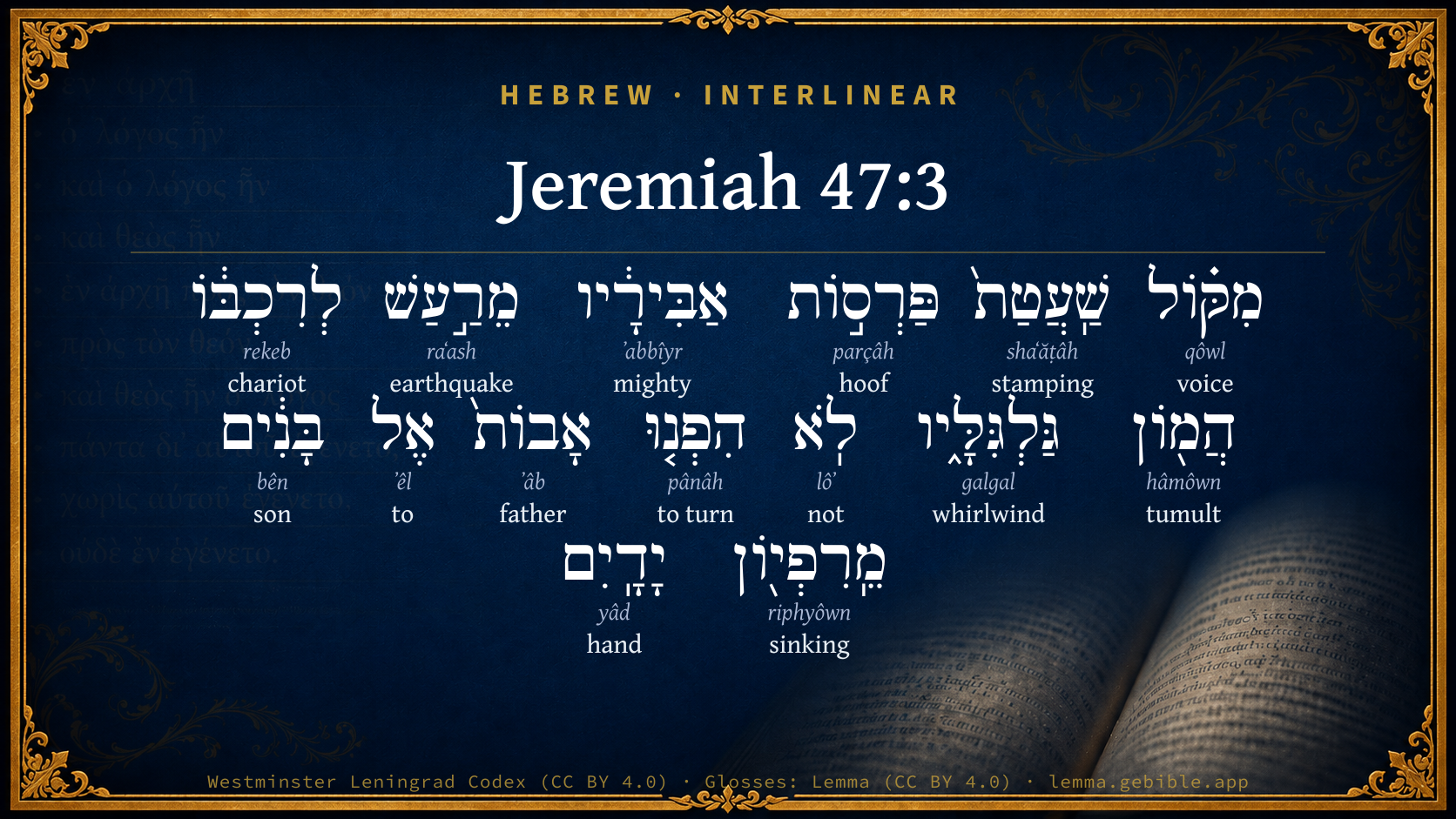
Jeremiah 47:3

Hebrew (Westminster Leningrad Codex) Jeremiah 47:3 appears in the Hebrew Old Testament. The text above is from the Westminster Leningrad Codex. Each word links to its Strong’s number, a concise gloss, and parsing drawn from the Open Scriptures Hebrew Bible morphology. Click any word for its full Brown-Driver-Briggs (BDB) entry.
Download image
Cite this verse

Jeremiah 47:3 (World English Bible). Public Domain. Lemma interlinear Bible study tool, https://lemma.gebible.app/v/jeremiah/47/3.

Show BibTeX & RIS
BibTeX
RIS
English Translation
At the noise of the stamping of the hoofs of his strong ones, at the rushing of his chariots, at the rumbling of his wheels, the fathers don't look back to their children for feebleness of hands;
World English Bible · Public Domain
Highlights
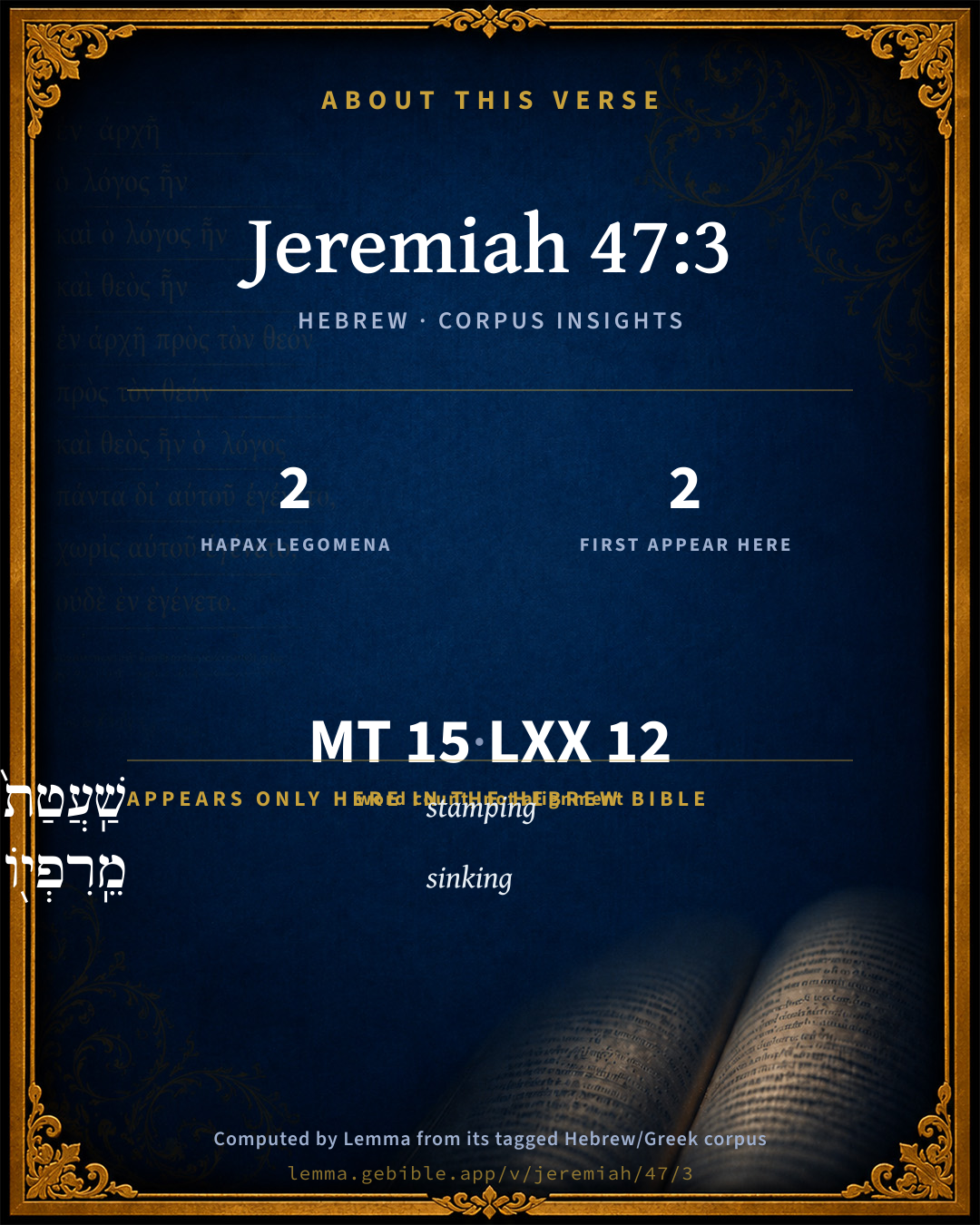
  • 2 hapax legomena — only here in the Hebrew Bible
  • 2 first appearances in the Hebrew Bible
Full analysis ↓
Download a study sheet

One document with this verse’s original text, its word-by-word gloss line, the meaning frame, cross-references with their text, attributed commentary, and full source and license credits — printable, and it pastes into notes with its structure intact.

This verse Autodidact and up

Study sheet (.html) Plain text (.txt)

A passage Seminary Student

Up to 50 verses in one chapter. A passage sheet keeps up to 6 commentary sources and 12 cross-references per verse, in the order this page ranks them, and says so on the sheet whenever that leaves anything out. Ask for a single verse and you get the Autodidact verse sheet above.

Everything on this page stays free to read, with no account — the sheet is a download of what is already on screen, not access to it.

Want to remove ads? Support Godless Engineer
Compare translations 3

The same verse in 3 English versions, stacked beneath the original-language interlinear above. Click any original word for its lexicon entry.

Each is an independent rendering of the whole verse — the interlinear is not word-aligned to these translations.

Highlighted words mark where these versions differ — a whole-verse word diff, not a word-by-word alignment.

  • World English Bible Public Domain
    At the noise of the stamping of the hoofs of his strong ones, at the rushing of his chariots, at the rumbling of his wheels, the fathers don't look back to their children for feebleness of hands;
  • King James Version Public Domain
    At the noise of the stamping of the hoofs of his strong horses, at the rushing of his chariots, and at the rumbling of his wheels, the fathers shall not look back to their children for feebleness of hands;
  • unfoldingWord Literal Text CC BY-SA 4.0
    At the sound of the stamping of their strong horses’ hooves, at the roar of their chariots and the noise of their wheels, fathers will not help their children because of their own weakness.

unfoldingWord Literal Text — © unfoldingWord, licensed CC BY-SA 4.0. Word-aligned USFM3 via Door43 (git.door43.org/unfoldingWord/en_ult).

Versions to compare (up to 4)

3 of 4 selected

Show all 18 translations

Every available English version of this verse, each an independent rendering of the whole verse.

  • World English Bible Public Domain
    At the noise of the stamping of the hoofs of his strong ones, at the rushing of his chariots, at the rumbling of his wheels, the fathers don't look back to their children for feebleness of hands;
  • Berean Standard Bible Public Domain
    at the sound of the galloping hooves of stallions, the rumbling of chariots, and the clatter of their wheels. The fathers will not turn back for their sons; their hands will hang limp.
  • Majority Standard Bible Public Domain
    at the sound of the galloping hooves of stallions, the rumbling of chariots, and the clatter of their wheels. The fathers will not turn back for their sons; their hands will hang limp.
  • King James Version Public Domain
    At the noise of the stamping of the hoofs of his strong horses, at the rushing of his chariots, and at the rumbling of his wheels, the fathers shall not look back to their children for feebleness of hands;
  • American Standard Version (1901) Public Domain
    At the noise of the stamping of the hoofs of his strong ones, at the rushing of his chariots, at the rumbling of his wheels, the fathers look not back to their children for feebleness of hands;
  • Revised Version (1885) Public Domain
    At the noise of the stamping of the hoofs of his strong ones, at the rushing of his chariots, at the rumbling of his wheels, the fathers look not back to their children for feebleness of hands;
  • Geneva Bible (1599) Public Domain
    At the noise and stamping of ye hoofes of his strong horses, at the noise of his charets, and at the rumbling of his wheeles: ye fathers shall not looke backe to their children, for feeblenes of handes,
  • Douay-Rheims (1899) Public Domain
    At the noise of the marching of arms, and of his soldiers, at the rushing of his chariots, and the multitude of his wheels. The fathers have not looked back to the children, for feebleness of hands,
  • Young's Literal Translation Public Domain
    From the sound of the stamping of the hoofs of his mighty ones, From the rushing of his chariot, the noise of his wheels, Fathers have not turned unto sons, From feebleness of hands,
  • Literal Standard Version CC BY-SA 4.0
    From the sound of the stamping of the hooves of his mighty ones, || From the rushing of his chariot, || The noise of his wheels, || Fathers have not turned to sons, || From feebleness of hands,
  • Unlocked Literal Bible CC BY-SA 4.0
    At the sound of the stamping of their strong horses' hooves, at the roar of their chariots and the noise of their wheels, fathers will not help their children because of their own weakness.
  • unfoldingWord Literal Text CC BY-SA 4.0
    At the sound of the stamping of their strong horses’ hooves, at the roar of their chariots and the noise of their wheels, fathers will not help their children because of their own weakness.
  • Darby Bible Public Domain
    at the noise of the stamping of the hoofs of his steeds, at the rushing of his chariots, at the rumbling of his wheels: fathers shall not look back for [their] children, from feebleness of hands;
  • World Messianic Bible Public Domain
    At the noise of the stamping of the hoofs of his strong ones, at the rushing of his chariots, at the rumbling of his wheels, the fathers don’t look back for their children because their hands are so feeble,
  • Webster's Bible Public Domain
    At the noise of the stamping of the hoofs of his strong horses, at the rushing of his chariots, and at the rumbling of his wheels, the fathers shall not look back to their children for feebleness of hands:
  • Free Bible Version CC BY-SA 4.0
    as they hear the sound of stallions charging, the rattling of chariots and the rumble of their wheels. Fathers won't go back to help their sons—they have no strength because they're terrified.
  • Bible in Basic English Public Domain
    At the noise of the stamping of the feet of his war-horses, at the rushing of his carriages and the thunder of his wheels, fathers will give no thought to their children, because their hands are feeble;
  • JPS Tanakh (1917) Public Domain
    At the noise of the stamping of the hoofs of his strong ones, at the rushing of his chariots, at the rumbling of his wheels, the fathers look not back to their children for feebleness of hands;

Literal Standard Version (2020), Covenant Press — licensed CC BY-SA 4.0. Text via the HelloAO Bible API (eBible.org). Unlocked Literal Bible (unfoldingWord) — licensed CC BY-SA 4.0. Text via the HelloAO Bible API (eBible.org). unfoldingWord Literal Text — © unfoldingWord, licensed CC BY-SA 4.0. Word-aligned USFM3 via Door43 (git.door43.org/unfoldingWord/en_ult). Free Bible Version, Dr. Jonathan Gallagher — licensed CC BY-SA 4.0. Text via the HelloAO Bible API (eBible.org).

Word by word

More ways to search: Search by grammar → Find every occurrence → Compare this word →

Practice this passage: Drill this verse → Learn its vocabulary →

שַֽׁעֲטַת֙
shaʻăṭâh
H8161
“stamping of”
Noun, Common, Feminine, Singular, Construct
Part of Speech
Noun
Type
Common
Gender
Feminine
Number
Singular
State
Construct
Full BDB Definition

Origin: from an unused root meaning to stamp

TWOT: 2430a

stamping (of hoofs), crushing noise
  1. מִקּ֗וֹל qôwl H6963 “from · voice of” Preposition + Noun, Common, Masculine, Singular, Construct
  2. פַּרְס֣וֹת parçâh H6541 “hooves of” Noun, Common, Feminine, Plural, Construct
  3. אַבִּירָ֔יו ʼabbîyr H47 “mighty · his” Adjective, Adjective, Masculine, Plural, Construct + Suffix, Personal, 3rd Person, Masculine, Singular
  4. מֵרַ֣עַשׁ raʻash H7494 “from · earthquake of” Preposition + Noun, Common, Masculine, Singular, Construct
  5. לְרִכְבּ֔וֹ rekeb H7393 “to/for · chariot · his” Preposition + Noun, Common, Masculine, Singular, Construct + Suffix, Personal, 3rd Person, Masculine, Singular
  6. הֲמ֖וֹן hâmôwn H1995 “tumult of” Noun, Common, Masculine, Singular, Construct
  7. גַּלְגִּלָּ֑יו galgal H1534 “whirlwinds · his” Noun, Common, Masculine, Plural, Construct + Suffix, Personal, 3rd Person, Masculine, Singular
  8. לֹֽא lôʼ H3808 “not” Particle, Negative
  9. הִפְנ֤וּ pânâh H6437 “to turn” Verb, Hiphil, Perfect, 3rd Person, Common, Plural
  10. אָבוֹת֙ ʼâb H1 “fathers” Noun, Common, Masculine, Plural, Absolute
  11. אֶל ʼêl H413 “to” Preposition
  12. בָּנִ֔ים bên H1121 “sons” Noun, Common, Masculine, Plural, Absolute
  13. מֵֽרִפְי֖וֹן riphyôwn H7510 “from · sinking of” Preposition + Noun, Common, Masculine, Singular, Construct
  14. יָדָֽיִם yâd H3027 “hands” Noun, Common, Both, Dual, Absolute

About this verse

These counts appear in no published source. They are computed here, from the morphology-tagged text and Lemma’s own curated glosses. What Lemma adds →

15
words
15
distinct lemmas
Prophets
section

Notable vocabulary

2 hapax legomena — words that appear only here in the entire Hebrew Bible:

  • שַֽׁעֲטַת֙ stamping H8161
  • מֵֽרִפְי֖וֹן sinking H7510

First appearance in Scripture

These words make their first canonical appearance in the Hebrew Bible here:

  • שַֽׁעֲטַת֙ stamping H8161
  • מֵֽרִפְי֖וֹן sinking H7510

Shared distinctive vocabulary

גַּלְגִּלָּ֑יו whirlwind H1534 occurs in 11 verses of the Hebrew Bible. Also found in:

Grammatical profile

  • 1 verb
  • 11 nouns
  • 1 adjective
  • 1 preposition
  • 1 particle

Verb forms

  • הִפְנ֤וּ Hiphil · Perfect

Hebrew & Septuagint length

In the original languages it is 15 Hebrew tokens and 12 Greek tokens — but the two are counted differently (Hebrew bundles its prefixes and suffixes into one token; the Greek is in lemma form), so that isn’t a like-for-like length.

Cross-references

9

Topical passages linked to Jeremiah 47:3 in the Treasury of Scripture Knowledge — connected by theme and wording, ordered by reader-vote popularity; previews shown in the World English Bible.

  • Judges 5:22 Then did the horse hoofs stamp By reason of the prancings, the prancings of their strong ones.
  • Jeremiah 8:16 The snorting of his horses is heard from Dan: at the sound of the neighing of his strong ones the whole land trembles; for they are come, and have devoured the land and all that is in it; the city and those who dwell therein.
  • Deuteronomy 28:54–55 The man who is tender among you, and very delicate, his eye shall be evil toward his brother, and toward the wife of his bosom, and toward the remnant of his children whom he has remaining;
  • Job 39:19–25 "Have you given the horse might? Have you clothed his neck with a quivering mane?
  • Jeremiah 46:9 Go up, you horses; and rage, you chariots; and let the mighty men go forth: Cush and Put, who handle the shield; and the Ludim, who handle and bend the bow.
  • Lamentations 4:3–4 Even the jackals draw out the breast, they give suck to their young ones: The daughter of my people is become cruel, like the ostriches in the wilderness.
  • Ezekiel 26:10–11 By reason of the abundance of his horses their dust shall cover you: your walls shall shake at the noise of the horsemen, and of the wagons, and of the chariots, when he shall enter into your gates, as men enter into a city in which is made a breach.
  • Nahum 2:4 The chariots rage in the streets. They rush back and forth in the broad ways. Their appearance is like torches. They run like the lightnings.
  • Nahum 3:2–3 The noise of the whip, the noise of the rattling of wheels, prancing horses, and bounding chariots,

Cross-references courtesy of OpenBible.info (CC BY 4.0).

Hebrew and Greek witnesses Masoretic Hebrew ↔ Greek Septuagint

The same verse in the two great witnesses to the Old Testament, shown verse-for-verse.

These are two independent witnesses, not word-aligned to each other, and the Septuagint is shown in lemma (dictionary) form.

Hebrew Jeremiah 47:3 Masoretic · Westminster Leningrad Codex

מִקּ֗וֹל שַֽׁעֲטַת֙ פַּרְס֣וֹת אַבִּירָ֔יו מֵרַ֣עַשׁ לְרִכְבּ֔וֹ הֲמ֖וֹן גַּלְגִּלָּ֑יו לֹֽא הִפְנ֤וּ אָבוֹת֙ אֶל בָּנִ֔ים מֵֽרִפְי֖וֹן יָדָֽיִם

At the noise of the stamping of the hoofs of his strong ones, at the rushing of his chariots, at the rumbling of his wheels, the fathers don't look back to their children for feebleness of hands;

World English Bible · Public Domain

Greek LXX Structure differs

In the Septuagint, Jeremiah is about an eighth shorter than the Hebrew and arranges its material differently — the Oracles Against the Nations (Hebrew chapters 46–51) appear in the middle of the Greek book, after 25:13. Because the chapter and verse boundaries do not line up, a verse-for-verse comparison with the Hebrew is not shown.

A verse-for-verse comparison isn’t shown here because the chapters and verses don’t line up. Switch to the LXX edition with the MT / LXX toggle above to read the Greek directly.

Hebrew: Westminster Leningrad Codex (CC BY 4.0). Greek: Septuagint (public domain); English from a public-domain English Septuagint. How the Septuagint differs from the Hebrew →

Targum (Aramaic paraphrase)

1

The Targum is the ancient Jewish Aramaic paraphrase of the Hebrew Scriptures — an interpretive translation, not the Hebrew text itself. Onkelos (literal) and Pseudo-Jonathan (expansive) render the Torah, and Jonathan the Prophets. Coverage is partial: where no permissively-licensed English translation exists for a verse, only the Aramaic is shown. This is verse-level text, not a word-by-word alignment to the Hebrew.

  1. Targum Jonathan Prophets (Joshua–Malachi)
    מִקַל מַפְסוּעִית פַּרְעַת גִבָּרוֹהִי מִזִיעַ לִרְתִיכוֹהִי אִתְרְגוּשַׁת גַלְגַלוֹהִי לָא מִתְפְּנָן אַבְהָן לְרַחָמָא עַל בְּנִין מֵאִתְרַשְׁלוֹת יְדִין:

    (no public-domain English translation for this verse)

    Targum Jonathan — Aramaic: “Mikraot Gedolot” (public domain). English: “Sefaria Community Translation” (CC0 1.0 (public-domain dedication)); “London "Chaldee Paraphrase," 1871” (public domain). Text via Sefaria.

Commentary

Notes on Jeremiah 47:3 from classic Christian and Jewish commentators (each source and its license shown beneath its notes). The classic Christian expositions comment on the surrounding passage and are grouped to its opening verse, so a note may address several verses; the Jewish commentaries on the Tanakh (Rashi and others) are per-verse, so they appear only where the commentator wrote on this verse.

Lemma curates 59 commentaries, every one of them public domain or Creative Commons licensed, each selected and text-cleaned for this edition rather than reprinted as found. About our sources →

Trapp's Complete Commentary

John Trapp

Jer 47:3 At the noise of the stamping of the hoofs of his strong [horses], at the rushing of his chariots, [and at] the rumbling of his wheels, the fathers shall not look back to [their] children for feebleness of hands;

Ver. 3. The fathers shall not look back to their children.] Though never so dear to them - φιλτατα the Greeks call them, and the Latins have their filius of φιλος - but shall be solicitous of their own lives only. Qui de Deo ne tantillum quidem fuerant solliciti.

For feebleness of hands.] Through fear and fail of vital spirits, so as to forget natural affection also.

John Trapp, A Commentary or Exposition upon All the Books of the Old and New Testament (1647–1656) — public domain. Text from a community e-Sword module.

Geneva Bible (1599)

Geneva Bible translators

The great fear shall take away their natural affection.

Their heart shall so fail them.

Geneva Bible (1599) marginal notes — public domain. Text via Bolls.life.

Jamieson, Fausset & Brown

Robert Jamieson, A. R. Fausset & David Brown

(Compare Jer 4:29).

fathers . . . not look back to . . . children--Each shall think only of his own safety, not even the fathers regarding their own children. So desperate shall be the calamity that men shall divest themselves of the natural affections.

for feebleness of hands--The hands, the principal instruments of action, shall have lost all power; their whole hope shall be in their feet.

Jamieson, Fausset & Brown — Commentary Critical and Explanatory on the Whole Bible (1871) — public domain (CC PDM 1.0). Text via the HelloAO Bible API.

Adam Clarke's Commentary

Verse 3. The stamping of the hoofs] At the galloping sound, -

Quadrupedante putrem sonitu quatit ungula campum,

is a line of Virgil, (AEn. viii. 596,) much celebrated; and quoted here by Blayney, where the galloping sound of the horses' hoofs is heard. In the stamping of the horses, the rushing of the chariots, and the rumbling of the wheels, our translators intended to convey the sense by the sound of the words; and they have not been unsuccessful. Their translation of the original is at the same time sufficiently literal.

The fathers shall not look back] Though their children are left behind, they have neither strength nor courage to go back to bring them off.

Adam Clarke's Commentary on the Bible (1810–1826) — public domain. Text from a community e-Sword/MySword module.

John Calvin's Commentaries

He continues the same subject; for he says, that so grievous would be the calamity, that fathers would not have a care for their children, which is a proof of extreme sorrow; for men even in adversity do not divest themselves of their natural feelings. When a father has children, he would willingly undergo ten deaths, if necessary, in order to save their life; but when men forget that they are parents, it is a proof, as I have said, of the greatest grief, as though men, having changed their nature, were become logs of wood. But the Prophet expresses the cause, not only of sorrow, but also of anxiety; From the voice, he says, of the noise of the hoofs of his valiant ones; he does not name the horses, but פרסות, peresut, refer to horses; hoofs, he says, shall make a great noise by stamping. And then such would be the commotion by the driving of chariots, and such a tumult would the revolving wheels create, that fathers, being astonished, would not. look on their children At length, he adds, through dissolution of hands By dissolution of hands he means loss of courage or fainting. For as vigor spreads from the heart through every part of the body, so also the bands are the chief instruments of all actions. When therefore the bands are relaxed and become feeble, it follows that men become as it were inanimate. The Prophet now means that the Philistines would become like the dead, so as not to move, no, not even their fingers; and why? because they would be so terrified by the stamping of horses, by the commotion of chariots, and by the rumbling of wheels, that they would lose their senses. It follows, —

John Calvin's Commentaries (1540-1563) — public domain. Text from the Calvin Translation Society English edition (1840s-50s) via the Christian Classics Ethereal Library (ccel.org). Calvin's coverage is partial (roughly two-thirds of the Bible); uncommented books and verses are honest gaps, never fabricated. The 19th-century editor's footnotes and remarks are omitted so the notes are faithfully Calvin's own voice.

Ellicott's Commentary for English Readers

(3) The fathers shall not look back to their children.—The selfishness of panic was to reach its highest point, and to crush out the instincts of natural affection. Even fathers would be content to save themselves, regardless of their children’s lives.

A Bible Commentary for English Readers, edited by Charles John Ellicott (1878–1897) — public domain. Text from a community e-Sword module.

The Cambridge Bible for Schools and Colleges

gen. ed. J. J. S. Perowne

3. At the noise … wheels] Gi. omits all three clauses, Co. the middle one; both objecting on metrical grounds.

strong ones] See on Jer_8:16.

The Cambridge Bible for Schools and Colleges (gen. ed. J. J. S. Perowne; Cambridge University Press, 1878–1918) — public domain. Text from a community e-Sword module.

John Gill's Exposition

At the noise of the stamping of the hoofs of his strong horses,.... The noise of the cavalry of Nebuchadnezzar's army, as they came marching on towards the country of the Philistines; who, being mounted on strong prancing horses, made a great noise as they came along, and were heard at a distance:

at the rushing of his chariots, and at the rumbling, of his wheels; the rattling and clatter the chariot wheels made; in which rode the chief officers and generals, with other mighty men: chariots were much used in war in those times:

the fathers shall not look back to their children for feebleness of hands; they should be so frightened at the approach of the enemy, and flee with much precipitancy to provide for their own safety, that they should not think of their children, or stay to deliver and save them, the most near and dear unto them; being so terrified as not to be able to lift up their hands to defend themselves, and protect their children. The Targum is,

"the fathers shall not look back to have mercy on their children;''

in their fright should forget their natural affection to them, and not so much as look back with an eye of pity and compassion on them; so intent upon their own deliverance and safety.

John Gill's Exposition of the Whole Bible (1746–1763) — public domain (CC PDM 1.0). Text via the HelloAO Bible API.

Albert Barnes' Notes on the Bible

His strong horses - War-horses, chargers.

The rushing of his chariots - Rather, the rattling, the crashing noise which they make as they advance.

For feebleness of hands - The Philistines flee in such panic that a father would not even turn round to see whether his sons were effecting their escape or not.

Albert Barnes' Notes on the Bible (1834–1885) — public domain. Text from a community e-Sword/MySword module.

Haydock's Catholic Bible Commentary

Marching. Literally, "pomp," (Haydock) or warlike apparatus. (Haydock) --- Protestants, "stamping of the hoofs of his strong horses, at," &c. (Haydock) --- Children. Fear makes one forget the nearest relations, while each one provides for himself, chap. ix. 4., Micheas vii. 5., and Matthew x. 35.

George Leo Haydock (1774–1849), Haydock's Catholic Family Bible and Commentary, 1859 edition — public domain. Excludes Psalms (Douay-Rheims chapter numbering differs from Protestant) and Deuterocanonical books (Catholic canon only).

Matthew Poole's English Annotations

This is all but a description of the march of an army, so terrible as should make parents forget their natural affection, and flee away to save themselves, looking upon themselves as lost, and unable to protect their children.

Matthew Poole's English Annotations on the Holy Bible (1683–1685) — public domain. Text from a community e-Sword/MySword module.

Whedon's Commentary on the Bible

Daniel D. Whedon

3. Strong horses — War horses.

The fathers shall not look back — Nothing could more impressively set forth the appalling danger and terror. So fearful would be the panic that the parent would not pause to see whether his children were effecting their escape.

Daniel D. Whedon (gen. ed.), Commentary on the Old and New Testaments (1874–1909) — public domain. Text from a community e-Sword module.

The Pulpit Commentary

A fine specimen of Hebrew word painting. The rushing of his chariots. "Rushing" has the sense of the German rauschen, to make a rustling, murmuring sound. It is used (but as the equivalent of a different Hebrew word) in the Authorized Version of Jer_18:12, 13 of the confused sound made by an army in motion. In the present passage, the Hebrew word means something more definite than that in Isaiah, l.c.; it is the "crashing" of an earthquake, or (as here) the "rattling" of chariots. The rumbling of his wheels. "Rumbling" is a happy equivalent. The Hebrew (hamon) is the word referred to in the preceding note as meaning an indefinite confused sound. The fathers shall not look back to their children, etc. An awful picture, and still more effective in the concise language of the original. The Hebrew Scriptures excel (as still more strikingly, but with too great a want of moderation, does the Koran) in the sublime of terror. So overpowering shall the panic be that fathers will not even turn an eye to their helpless children. Observe, it is said "the fathers," not "the mothers." The picture is poetically finer than that in Deu_28:56, Deu_28:57, because the shade of colouring is a degree softer. Feebleness of hands. A common expression for the enervation produced by extreme terror. (see Jer_6:24 Isa_13:7 Eze_7:17 Nah_2:11)

The Pulpit Commentary (1880–1919), ed. H.D.M. Spence-Jones & Joseph S. Exell — public domain. Text from a community e-Sword module.

unfoldingWord translationNotes

Door43 World Missions Community

At the sound of the stamping of their strong horses' hooves, at the roar of their chariots and the noise of their wheels

Together these represent the sounds of an oncoming army. (See: Parallelism)

at the roar of their chariots and the noise of their wheels

These two phrase have similar meanings and they are combined to emphasize the loud noise they will make. AT: "at the very loud sound of the wheels of the chariots" (See: Doublet)

For the day is coming that will devastate all of the Philistines, to cut off from Tyre

This speaks of a day as if it were something that travels and arrives in a place. AT: "For on that day, the enemy army will devastate all of the Philistines and cut off from Tyre" (See: Metaphor)

to cut off from Tyre and Sidon every survivor who wants to help them

Removing someone is spoken of as if they were cut off the way a person may cut a branch from a tree or a piece of cloth from a garment. AT: "to remove anyone who may want to help Tyre and Sidon" (See: Metaphor)

Caphtor

This is the name of an island of the northern region of the Philistines. (See: How to Translate Names)

translationWords

horse

hoof

chariot

ancestor

children

devastate

Philistines

cut off

Tyre

Sidon

unfoldingWord translationNotes — © Distant Shores Media and the Door43 World Missions Community, licensed CC BY-SA 4.0. Source: git.door43.org/Door43/en_tn.

Rashi

Rabbi Shlomo Yitzchaki (Rashi)

the stamping Heb. שעטת. There is no similar [word in Scripture]. And Jonathan rendered it: from the steps.

from the noise of his chariots Heb. מרעש לרכבו [lit.] from the noise to his chariots.

his wheels The wheels of his chariots.

fathers did not turn to sons to save them.

Rashi on the Tanakh — English translations: “The Judaica Press complete Tanach with Rashi, translated by A. J. Rosenberg” (CC BY 4.0); “Pentateuch with Rashi's commentary by M. Rosenbaum and A.M. Silbermann, 1929-1934” (public domain); “The Metsudah Tanach series, Lakewood, N.J” (CC BY 4.0); and “The Book of Joshua, Metsudah Publications, 1997” (CC BY 4.0). Text via Sefaria.

Lesson kit

Teaching starters — assembled from the data on this page, not authored interpretation. Every prompt links to the verse data it draws on. Edit before teaching.

Jeremiah, in the Prophets, opens this verse with 15 words (15 distinct Hebrew lemmas). Its most distinctive word is shaʻăṭâh (“stamping”). A historical commentator’s framing appears above. Read the whole chapter for the surrounding context.

Discussion questions

  1. What does “stamping” (shaʻăṭâh) contribute to the verse as a whole?
  2. 2 words here appear nowhere else in the Hebrew Bible. Why might the author reach for such rare wording?
  3. 2 words make their first appearance in Scripture here. What does this debut establish?
  4. How does Psalms 77:18, which shares the word «whirlwind», read alongside this verse?
  5. These translations render this verse differently. What is at stake in choosing one wording over another?
  6. «הִפְנ֤וּ» is a Hiphil Perfect verb. How does that grammatical form shape the action described?
  7. Compare how Trapp's Complete Commentary and Geneva Bible (1599) read this verse. Where do they agree or differ?

Things to notice

Reading settings

Reading text

Shown beneath each verse's original-language words.

Old Testament
Old Testament edition

Read the OT as the Masoretic Hebrew (MT) or the Greek Septuagint (LXX).

English shown for the Greek Septuagint (in the Hebrew ↔ Greek comparison).

Comparing translations? Open the Compare panel on any verse page to stack up to four side by side.