
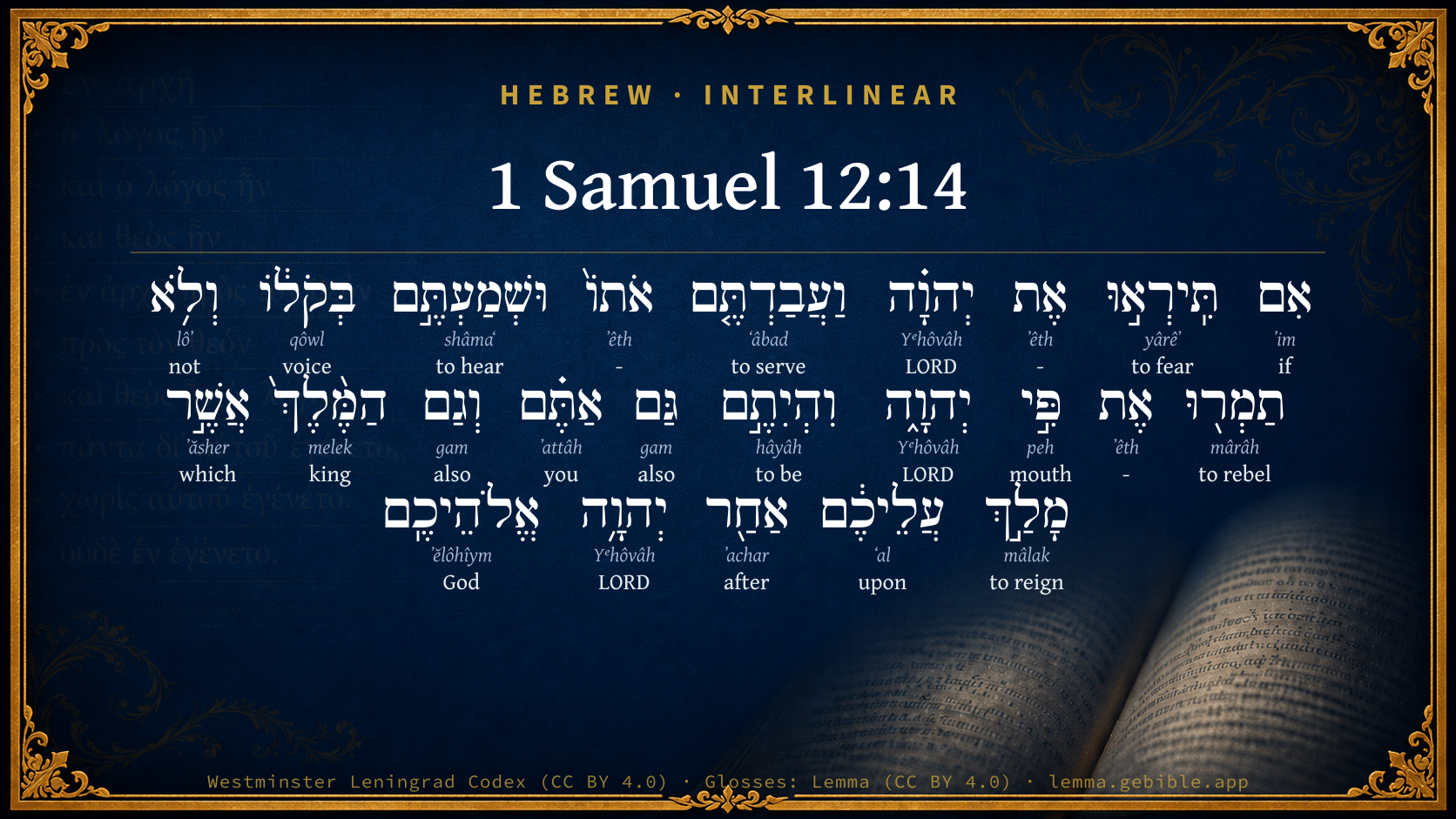
1 Samuel 12:14

Hebrew (Westminster Leningrad Codex) 1 Samuel 12:14 appears in the Hebrew Old Testament. The text above is from the Westminster Leningrad Codex. Each word links to its Strong’s number, a concise gloss, and parsing drawn from the Open Scriptures Hebrew Bible morphology. Click any word for its full Brown-Driver-Briggs (BDB) entry.
Download image
Cite this verse

1 Samuel 12:14 (World English Bible). Public Domain. Lemma interlinear Bible study tool, https://lemma.gebible.app/v/1-samuel/12/14.

Show BibTeX & RIS
BibTeX
RIS
English Translation
If you will fear Yahweh, and serve him, and listen to his voice, and not rebel against the commandment of Yahweh, and both you and also the king who reigns over you are followers of Yahweh your God, [well]:
World English Bible · Public Domain
Download a study sheet

One document with this verse’s original text, its word-by-word gloss line, the meaning frame, cross-references with their text, attributed commentary, and full source and license credits — printable, and it pastes into notes with its structure intact.

This verse Autodidact and up

Study sheet (.html) Plain text (.txt)

A passage Seminary Student

Up to 50 verses in one chapter. A passage sheet keeps up to 6 commentary sources and 12 cross-references per verse, in the order this page ranks them, and says so on the sheet whenever that leaves anything out. Ask for a single verse and you get the Autodidact verse sheet above.

Everything on this page stays free to read, with no account — the sheet is a download of what is already on screen, not access to it.

Want to remove ads? Support Godless Engineer
Compare translations 3

The same verse in 3 English versions, stacked beneath the original-language interlinear above. Click any original word for its lexicon entry.

Each is an independent rendering of the whole verse — the interlinear is not word-aligned to these translations.

Highlighted words mark where these versions differ — a whole-verse word diff, not a word-by-word alignment.

  • World English Bible Public Domain
    If you will fear Yahweh, and serve him, and listen to his voice, and not rebel against the commandment of Yahweh, and both you and also the king who reigns over you are followers of Yahweh your God, [well]:
  • King James Version Public Domain
    If ye will fear the LORD, and serve him, and obey his voice, and not rebel against the commandment of the LORD, then shall both ye and also the king that reigneth over you continue following the LORD your God:
  • unfoldingWord Literal Text CC BY-SA 4.0
    If you fear Yahweh and serve him and listen to his voice and do not rebel against the mouth of Yahweh, then you will be, both you and the king who reigns over you, after Yahweh your God.

unfoldingWord Literal Text — © unfoldingWord, licensed CC BY-SA 4.0. Word-aligned USFM3 via Door43 (git.door43.org/unfoldingWord/en_ult).

Versions to compare (up to 4)

3 of 4 selected

Show all 18 translations

Every available English version of this verse, each an independent rendering of the whole verse.

  • World English Bible Public Domain
    If you will fear Yahweh, and serve him, and listen to his voice, and not rebel against the commandment of Yahweh, and both you and also the king who reigns over you are followers of Yahweh your God, [well]:
  • Berean Standard Bible Public Domain
    If you fear the LORD and serve Him and obey His voice, and if you do not rebel against the command of the LORD, and if both you and the king who reigns over you follow the LORD your God, then all will be well.
  • Majority Standard Bible Public Domain
    If you fear the LORD and serve Him and obey His voice, and if you do not rebel against the command of the LORD, and if both you and the king who rules over you follow the LORD your God, then all will be well.
  • King James Version Public Domain
    If ye will fear the LORD, and serve him, and obey his voice, and not rebel against the commandment of the LORD, then shall both ye and also the king that reigneth over you continue following the LORD your God:
  • American Standard Version (1901) Public Domain
    If ye will fear Jehovah, and serve him, and hearken unto his voice, and not rebel against the commandment of Jehovah, and both ye and also the king that reigneth over you be followers of Jehovah your God, `well':
  • Revised Version (1885) Public Domain
    If ye will fear the LORD, and serve him, and hearken unto his voice, and not rebel against the commandment of the LORD, and both ye and also the king that reigneth over you be followers of the LORD your God, well:
  • Geneva Bible (1599) Public Domain
    If ye wil feare the Lord and serue him, and heare his voyce, and not disobey the worde of the Lord, both yee, and the King that reigneth ouer you, shall follow the Lord your God.
  • Douay-Rheims (1899) Public Domain
    If you will fear the Lord, and serve him, and hearken to his voice, and not provoke the mouth of the Lord: then shall both you, and the king who reigneth over you, be followers of the Lord your God.
  • Young's Literal Translation Public Domain
    `If ye fear Jehovah, and have served Him, and hearkened to His voice, then ye do not provoke the mouth of Jehovah, and ye have been -- both ye and the king who hath reigned over you -- after Jehovah your God.
  • Literal Standard Version CC BY-SA 4.0
    If you fear YHWH, and have served Him, and listened to His voice, then you do not provoke the mouth of YHWH, and you have been—both you and the king who has reigned over you—after your God YHWH.
  • Unlocked Literal Bible CC BY-SA 4.0
    If you fear Yahweh, serve him, obey his voice, and not rebel against the command of Yahweh, then both you and the king who reigns over you will be followers of Yahweh your God.
  • unfoldingWord Literal Text CC BY-SA 4.0
    If you fear Yahweh and serve him and listen to his voice and do not rebel against the mouth of Yahweh, then you will be, both you and the king who reigns over you, after Yahweh your God.
  • Darby Bible Public Domain
    If ye fear Jehovah, and serve him, and hearken to his voice, and rebel not against the commandment of Jehovah, then both ye and the king also that reigns over you shall continue following Jehovah your God.
  • World Messianic Bible Public Domain
    If you will fear the LORD, and serve him, and listen to his voice, and not rebel against the commandment of the LORD, then both you and also the king who reigns over you are followers of the LORD your God.
  • Webster's Bible Public Domain
    If ye will fear the LORD, and serve him, and obey his voice, and not rebel against the commandment of the LORD, then shall both ye, and also the king that reigneth over you continue following the LORD your God.
  • Free Bible Version CC BY-SA 4.0
    If you honor the Lord, worship him, do what he tells you, and don't rebel against the Lord's instructions, and if both you and your king follow the Lord your God, then good!
  • Bible in Basic English Public Domain
    If in the fear of the Lord you are his servants, hearing his voice and not going against the orders of the Lord, but being true to the Lord your God, you and the king ruling over you, then all will be well:
  • JPS Tanakh (1917) Public Domain
    If ye will fear the LORD, and serve Him, and hearken unto His voice, and not rebel against the commandment of the LORD, and both ye and also the king that reigneth over you be followers of the LORD your God —;

Literal Standard Version (2020), Covenant Press — licensed CC BY-SA 4.0. Text via the HelloAO Bible API (eBible.org). Unlocked Literal Bible (unfoldingWord) — licensed CC BY-SA 4.0. Text via the HelloAO Bible API (eBible.org). unfoldingWord Literal Text — © unfoldingWord, licensed CC BY-SA 4.0. Word-aligned USFM3 via Door43 (git.door43.org/unfoldingWord/en_ult). Free Bible Version, Dr. Jonathan Gallagher — licensed CC BY-SA 4.0. Text via the HelloAO Bible API (eBible.org).

Word by word

More ways to search: Search by grammar → Find every occurrence → Compare this word →

Practice this passage: Drill this verse → Learn its vocabulary →

תַמְר֖וּ
mârâh
H4784
“to rebel”
Verb, Hiphil, Imperfect, 2nd Person, Masculine, Plural
Part of Speech
Verb
Stem
Hiphil
Form
Imperfect
Person
2nd Person
Gender
Masculine
Number
Plural
Full BDB Definition

Origin: a primitive root

TWOT: 1242

to be contentious, be rebellious, be refractory, be disobedient towards, be rebellious against - (Qal) to be disobedient, be rebellious - towards father - towards God - (Hiphil) to show rebelliousness, show disobedience, disobey
  1. אִם ʼim H518 “if” Conjunction
  2. תִּֽירְא֣וּ yârêʼ H3372 “to fear” Verb, Qal, Imperfect, 2nd Person, Masculine, Plural
  3. אֶת ʼêth H853 “-” Particle, Direct Object
  4. יְהוָ֗ה Yᵉhôvâh H3068 “LORD” Noun, Proper
  5. וַעֲבַדְתֶּ֤ם ʻâbad H5647 “and · to serve” Conjunction + Verb, Qal, Sequential Perfect, 2nd Person, Masculine, Plural
  6. אֹתוֹ֙ ʼêth H853 “- · him” Particle, Direct Object + Suffix, Personal, 3rd Person, Masculine, Singular
  7. וּשְׁמַעְתֶּ֣ם shâmaʻ H8085 “and · to hear” Conjunction + Verb, Qal, Sequential Perfect, 2nd Person, Masculine, Plural
  8. בְּקֹל֔וֹ qôwl H6963 “in/at · voice · his” Preposition + Noun, Common, Masculine, Singular, Construct + Suffix, Personal, 3rd Person, Masculine, Singular
  9. וְלֹ֥א lôʼ H3808 “and · not” Conjunction + Particle, Negative
  10. אֶת ʼêth H853 “-” Particle, Direct Object
  11. פִּ֣י peh H6310 “mouth of” Noun, Common, Masculine, Singular, Construct
  12. יְהוָ֑ה Yᵉhôvâh H3068 “LORD” Noun, Proper
  13. וִהְיִתֶ֣ם hâyâh H1961 “and · to be” Conjunction + Verb, Qal, Sequential Perfect, 2nd Person, Masculine, Plural
  14. גַּם gam H1571 “also” Particle, Accusative
  15. אַתֶּ֗ם ʼattâh H859 “you” Pronoun, Personal, 2nd Person, Masculine, Plural
  16. וְגַם gam H1571 “and · also” Conjunction + Particle, Accusative
  17. הַמֶּ֨לֶךְ֙ melek H4428 “the · king” Particle, Definite Article + Noun, Common, Masculine, Singular, Absolute
  18. אֲשֶׁ֣ר ʼăsher H834 “which” Particle, Relative
  19. מָלַ֣ךְ mâlak H4427 “to reign” Verb, Qal, Perfect, 3rd Person, Masculine, Singular
  20. עֲלֵיכֶ֔ם ʻal H5921 “upon · you” Preposition + Suffix, Personal, 2nd Person, Masculine, Plural
  21. אַחַ֖ר ʼachar H310 “after” Preposition
  22. יְהוָ֥ה Yᵉhôvâh H3068 “LORD” Noun, Proper
  23. אֱלֹהֵיכֶֽם ʼĕlôhîym H430 “God(s) · your” Noun, Common, Masculine, Plural, Construct + Suffix, Personal, 2nd Person, Masculine, Plural

About this verse

These counts appear in no published source. They are computed here, from the morphology-tagged text and Lemma’s own curated glosses. What Lemma adds →

24
words
19
distinct lemmas
Historical
section

Shared distinctive vocabulary

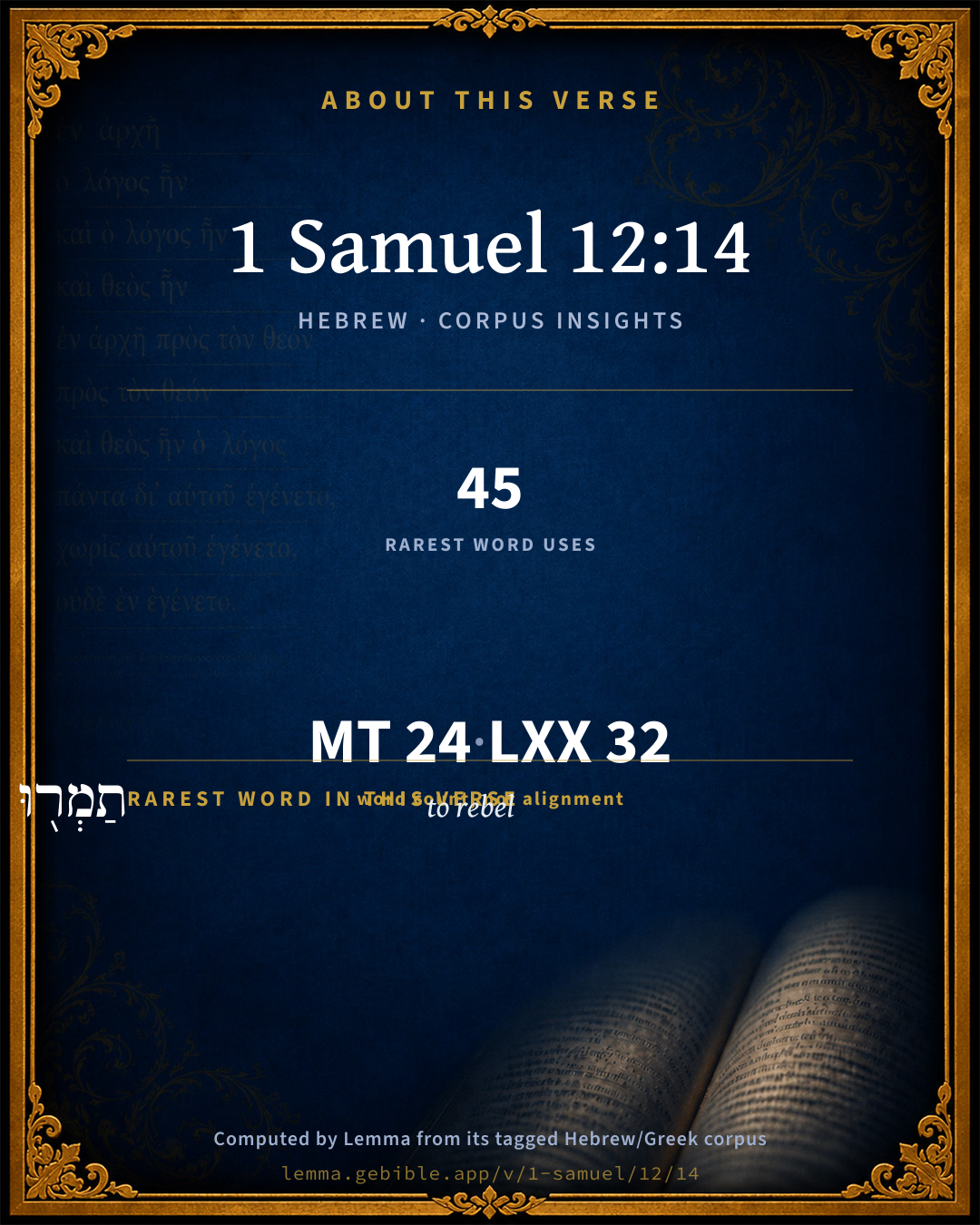
תַמְר֖וּ to rebel H4784 occurs in 44 verses of the Hebrew Bible. Also found in:

Grammatical profile

  • 6 verbs
  • 7 nouns
  • 1 pronoun
  • 2 prepositions
  • 1 conjunction
  • 7 particles

Verb forms

  • תִּֽירְא֣וּ Qal · Imperfect
  • וַעֲבַדְתֶּ֤ם Qal · Sequential Perfect
  • וּשְׁמַעְתֶּ֣ם Qal · Sequential Perfect
  • תַמְר֖וּ Hiphil · Imperfect
  • וִהְיִתֶ֣ם Qal · Sequential Perfect
  • מָלַ֣ךְ Qal · Perfect

Repetition

Words recur within this verse — often emphatic in Hebrew:

  • יְהוָ֗ה LORD H3068 ×3
  • גַּם also H1571 ×2

Hebrew & Septuagint length

In English translation the verse runs 39 words from the Hebrew and 36 from the Septuagint (LXX English) — closely comparable.

A rough comparison of the two English renderings, which tokenize alike — not a word-level alignment.

Word counts can differ between the Hebrew and the Greek without any difference in meaning — e.g. the Hebrew direct-object marker אֵת has no separate Greek word, and Greek often adds the article ὁ.

In the original languages it is 24 Hebrew tokens and 32 Greek tokens — but the two are counted differently (Hebrew bundles its prefixes and suffixes into one token; the Greek is in lemma form), so that isn’t a like-for-like length.

Cross-references

7

Topical passages linked to 1 Samuel 12:14 in the Treasury of Scripture Knowledge — connected by theme and wording, ordered by reader-vote popularity; previews shown in the World English Bible.

  • Joshua 24:14 Now therefore fear Yahweh, and serve him in sincerity and in truth; and put away the gods which your fathers served beyond the River, and in Egypt; and serve you Yahweh.
  • Deuteronomy 28:1–14 It shall happen, if you shall listen diligently to the voice of Yahweh your God, to observe to do all his commandments which I command you this day, who Yahweh your God will set you on high above all the nations of the earth:
  • Leviticus 20:1–13 Yahweh spoke to Moses, saying,
  • Joshua 24:20 If you forsake Yahweh, and serve foreign gods, then he will turn and do you evil, and consume you, after that he has done you good.
  • Psalms 81:12–15 So I let them go after the stubbornness of their hearts, That they might walk in their own counsels.
  • Isaiah 3:10 Tell the righteous "Good!" For they shall eat the fruit of their deeds.
  • Romans 2:7 to those who by patience in well-doing seek for glory and honor and incorruptibility, eternal life;

Cross-references courtesy of OpenBible.info (CC BY 4.0).

Hebrew and Greek witnesses Masoretic Hebrew ↔ Greek Septuagint

The same verse in the two great witnesses to the Old Testament, shown verse-for-verse.

These are two independent witnesses, not word-aligned to each other, and the Septuagint is shown in lemma (dictionary) form.

Hebrew 1 Samuel 12:14 Masoretic · Westminster Leningrad Codex

אִם תִּֽירְא֣וּ אֶת יְהוָ֗ה וַעֲבַדְתֶּ֤ם אֹתוֹ֙ וּשְׁמַעְתֶּ֣ם בְּקֹל֔וֹ וְלֹ֥א תַמְר֖וּ אֶת פִּ֣י יְהוָ֑ה וִהְיִתֶ֣ם גַּם אַתֶּ֗ם וְגַם הַמֶּ֨לֶךְ֙ אֲשֶׁ֣ר מָלַ֣ךְ עֲלֵיכֶ֔ם אַחַ֖ר יְהוָ֥ה אֱלֹהֵיכֶֽם

If you will fear Yahweh, and serve him, and listen to his voice, and not rebel against the commandment of Yahweh, and both you and also the king who reigns over you are followers of Yahweh your God, [well]:

World English Bible · Public Domain

Greek LXX 1 Samuel 12:14 Septuagint · lemma form

ἐάν φοβέω ὁ κύριος καί δουλεύω αὐτός καί ἀκούω ὁ φωνή αὐτός καί μή ἐρίζω ὁ στόμα κύριος καί εἰμί καί σύ καί ὁ βασιλεύς ὁ βασιλεύω ἐπί σύ ὀπίσω κύριος πορεύομαι

If you⌃ should fear the Lord, and serve him, and listen to his voice, and not resist the mouth of the Lord, and you⌃ and your king that reigns over you should follow the Lord, well.

LXX2012 (modern English Septuagint) · Public Domain

On this verse, Trapp's Complete Commentary discusses the Septuagint’s reading. Read the note in Commentary ↓

Hebrew: Westminster Leningrad Codex (CC BY 4.0). Greek: Septuagint (public domain); English from LXX2012 (modern English Septuagint) (Public Domain). How the Septuagint differs from the Hebrew →

Targum (Aramaic paraphrase)

1

The Targum is the ancient Jewish Aramaic paraphrase of the Hebrew Scriptures — an interpretive translation, not the Hebrew text itself. Onkelos (literal) and Pseudo-Jonathan (expansive) render the Torah, and Jonathan the Prophets. Coverage is partial: where no permissively-licensed English translation exists for a verse, only the Aramaic is shown. This is verse-level text, not a word-by-word alignment to the Hebrew.

  1. Targum Jonathan Prophets (Joshua–Malachi)
    אִם תִּדְחֲלוּ קֳדָם יְיָ וְתִפְלְחוּן קֳדָמוֹהִי וּתְקַבְּלוּן לְמֵימְרֵיהּ וְלָא תְסָרְבוּן עַל מֵימְרָא דַייָ וְתֶהֱווּן אַף אַתּוּן וְאַף מַלְכָּא דִמְלַךְ עֲלֵיכוֹן בָּתַר פּוּלְחָנָא דַייָ אֱלָהָכוֹן:

    (no public-domain English translation for this verse)

    Targum Jonathan — Aramaic: “Mikraot Gedolot” (public domain). English: “Sefaria Community Translation” (CC0 1.0 (public-domain dedication)); “London "Chaldee Paraphrase," 1871” (public domain). Text via Sefaria.

Commentary

Notes on 1 Samuel 12:14 from classic Christian and Jewish commentators (each source and its license shown beneath its notes). The classic Christian expositions comment on the surrounding passage and are grouped to its opening verse, so a note may address several verses; the Jewish commentaries on the Tanakh (Rashi and others) are per-verse, so they appear only where the commentator wrote on this verse.

Lemma curates 59 commentaries, every one of them public domain or Creative Commons licensed, each selected and text-cleaned for this edition rather than reprinted as found. About our sources →

Trapp's Complete Commentary

John Trapp

1Sa 12:14 If ye will fear the LORD, and serve him, and obey his voice, and not rebel against the commandment of the LORD, then shall both ye and also the king that reigneth over you continue following the LORD your God:

Ver. 14. If ye will fear the Lord, and serve him.] Here is a precedent for preachers, who must one while chide their people, another while counsel them, another while comfort them, and always pray for them. They must turn themselves into all shapes and fashions of spirit and of speech to bring men home to God.

Continue following the Lord your God.] The Septuagint adds, And he will deliver you.

John Trapp, A Commentary or Exposition upon All the Books of the Old and New Testament (1647–1656) — public domain. Text from a community e-Sword module.

The Biblical Illustrator

Joseph S. Exell

1Sa_12:14

Continue following the Lord your God.

Continuity in service

It has been said that one reason (perhaps the chief one) why the late Emperor of Brazil was dethroned by his own subjects, was because he was a man of peaceful pursuits and tastes, fond of literature, science and art, and the society of learned men. Hence his government was too tame for his people. There was not enough of the Napoleonic spirit about him, not enough glitter and show, and martial array and warrior spirit, as if the chief end of a king was to assume a fighting attitude, and challenge everybody to mortal combat. The man, be he sovereign or subject, who labours in such peaceful pursuits as tend to develop the intelligence and material resources of a country, is a far greater benefactor of the race than all the despots who have ever cursed the world with their combativeness. But people sometimes, in their mad frenzy and folly, drive away their best advisers, or commit the blunder of selling their friends and buying their enemies. The clamour for a king showed deep ingratitude to Samuel, after all he had done for them, and all the evils he had saved them from. But Memory soon, of service done, deserteth the ingrate. They had a pretext, it is true, in the bad conduct of Samuels sons, and of this they failed not to take advantage. But Samuel had not himself abdicated the office of Judge, though his sons were associated with him as helpers. There was also in their demand a spirit of rebellion against the order of governors God Himself had set over them, and a spirit of inordinate ambition and pride in desiring to be like the rest of the nations round about them. Having equipped the vessel of the State, and arranged and settled the new form of government, he assembled all the people at Gilgal, that he might give them some counsels, cautions, and warnings as to the future. He reminds them of his own past career amongst them from his childhood. This was a glorious testimony to the justice, integrity, and humanity of the prophets rule. Happy the ruler, by whatever name he may be called, king, emperor, or president, about whom such testimony can be borne, and happy the people, if they only knew it, who are blest with such rulers. King and people had now entered on a new career under the most favourable auspices, and what they needed most was the spirit of continuity--Continue following the Lord your God. That is a beautiful prayer, in which we desire that all our works may be begun, continued, and ended in God, that thus living, and walking, and working, we may glorify His holy name, and finally by His mercy obtain everlasting life. It is not enough--though it is something--to begin well. We must continue and advance, and not be wearied in well-doing. Sometimes a year or a day is well begun, and people resolve to amend their lives, and determine to turn over a new page in lifes book. Like the Galatians, they run well for a while. Continuity, or perseverance in human affairs is one great secret of success. Let the motto of the German soldier be yours, inmer vorwarts (ever forward). The influence of birth, fortune, and patronage sinks into insignificance, compared with enthusiasm, diligence, and perseverance. Inducements to evil there will be in plenty. The devil, the father of evil, will ply all his arts to succeed in our overthrow. Let us always be ready and prepared for him. For some days past, said an eminent servant of God, I have been unusually harassed by temptations of various kinds, and am often led to inquire, Why am I thus? So it is still: the Christian soldier is not only drilled and equipped, he is also placed in the field, and his qualities tried. Mans duty is simply to do as God tells him, neither adding to nor diminishing the Divine rule. But, in our ignorance and blindness, and presumption, we are for superseding or improving Gods plan. It is not the high enterprise He desires, so much as the quiet, continuance in well-doing. Many of us would rather choose to climb the mountain side than plod along, steadily and wearily, miles of level road. Many would be willing, no doubt, to serve Him if they only might do it in their own way. But the thing God requires most of us all is to have no will but His. If any man will come after Me, let him deny himself, and take up his cross, and follow Me. This is but an expansion by the Saviour of the warning advice of Samuel. (J. Reid.)

Persistent following after the Lord

Let those tempted to depart from the Lord remember the answer of Christian to Apollyon, when the latter sought to persuade him to turn back, and forsake his Lord: O thou destroying Apollyon, to speak truth, I like his service, his wages, his servants, his government, his company, and country, better than thine; and, therefore, leave off to persuade me further: I am his servant, and I will follow him.

The Biblical Illustrator, edited by Joseph S. Exell (c. 1880s–1900s) — public domain. Text from a community e-Sword module.

Joseph Benson's Commentary

1Sa 12:14. Then, &c. — Hebrew, then shall ye be (that is, walk, or go) after the Lord; that is, God shall still go before you, as he hath hitherto done, as your leader or governor, to direct, protect, and deliver you; and he will not forsake you, as you have given him just cause to do. Sometimes this phrase of going after the Lord, signifies a man’s obedience to God; but here it is otherwise to be understood, and denotes not a duty to be performed, but a privilege to be received upon the performance of their duty; because it is opposed to a threatening denounced in case of disobedience, in the next verse.

Joseph Benson's Commentary on the Old and New Testaments (1811–1818) — public domain. Text from a community e-Sword module.

Tyndale Open Study Notes

Tyndale Open Resources

12:14-15 To show that even under a monarchy Israel must still keep its covenant with the Lord—who was always to be their true king—Samuel echoed language from the Sinai covenant (e.g., Exod 19:5-6; Lev 26; Deut 30:11-20).

12:14 Worship is meaningless if it does not result in obedience.

Tyndale Open Study Notes — © Tyndale Open Resources, licensed CC BY-SA 4.0. Text via the HelloAO Bible API.

Geneva Bible (1599)

Geneva Bible translators

Ye shall be preserved as they that follow the Lord’s will.

Geneva Bible (1599) marginal notes — public domain. Text via Bolls.life.

Adam Clarke's Commentary

Verse 14. If ye will fear the Lord, &c.] On condition that ye rebel no more, God will take you and your king under his merciful protection, and he and his kingdom shall be confirmed and continued.

Adam Clarke's Commentary on the Bible (1810–1826) — public domain. Text from a community e-Sword/MySword module.

Ellicott's Commentary for English Readers

(14) If ye will fear the Lord . . .—The English Version has missed the point of the original Hebrew of this passage. It should run, “If ye will fear the Lord, &c., . . . and if both ye and the king that reigneth over you will follow the Lord your God, it shall be well with you.” Dean Payne Smith has well caught the spirit of the passage in his note: “Samuel piled up one upon another the conditions of their happiness, and then from the depth of his emotion breaks off, leaving the blessed consequences of their obedience unsaid.” The intense wish, “O that you would only fear the Lord! O that you and your king would only continue following!” is contained in the Hebrew particle which introduces these ejaculatory sentences. A similar unfinished sentence will be found in St. Luk_19:42, where the apodosis is left to be supplied.

Samuel, with mournful earnestness, would drive home to the hearts of the people and their new king the great truth that the past, full of sin and sorrow, was forgiven—that even their present act, which seemed to border on ingratitude to that Mighty One who deigned to concern Himself with the interests of this fickle people, would bring no evil consequences in its track, if only the people and their king would in the future obey the glorious voice of the Eternal.

A Bible Commentary for English Readers, edited by Charles John Ellicott (1878–1897) — public domain. Text from a community e-Sword module.

The Cambridge Bible for Schools and Colleges

gen. ed. J. J. S. Perowne

14. If ye will fear, &c.] Better, “If ye will fear Jehovah, and serve him, and obey his voice, and not rebel against the commandment of Jehovah, and both ye and also the king who reigneth over you continue following after Jehovah your God, [it shall be well with you]: but if, &c.” The apodosis must be supplied from the context, as in Exo_32:32.

The Cambridge Bible for Schools and Colleges (gen. ed. J. J. S. Perowne; Cambridge University Press, 1878–1918) — public domain. Text from a community e-Sword module.

John Gill's Exposition

If ye will fear the Lord, and serve him, and obey his voice,.... All worship and service of God, and obedience to his word and ordinances, should spring from fear and reverence of him; and therefore the whole of worship, both external and internal, is sometimes expressed by the fear of the Lord:

and not rebel against the commandment of the Lord; break it, and thereby exasperate him, and provoke him to wrath and bitterness:

then shall both ye, and also the king that reigneth over you, continue following the Lord your God; the Targum is,"after the worship of the Lord your God;''which was their duty to do, and is expressed in the preceding clauses; and this therefore is rather a promise of some benefit and privilege to their duty, and to encourage them to it, since it stands opposed to the threatening of punishment in the next verse; and the words in the original are, "then shall ye &c. be after the Lord your God" (l): that is, though they had in effect rejected the Lord from being their King, by asking and having one; yet notwithstanding, if they and their king were obedient to the commands of the Lord, he would not cast them off; but they should follow him as their guide, leader, and director, and he would protect and defend them as a shepherd does his sheep that follow after him; so Jarchi takes it to be a promise of long life and happiness to them and their king,"ye shall be established to length of days, both ye and the king.''

(l) "eritis post Dominum", Pagninus, Montanus, Tigurine version, Piscator.

John Gill's Exposition of the Whole Bible (1746–1763) — public domain (CC PDM 1.0). Text via the HelloAO Bible API.

Haydock's Catholic Bible Commentary

Of the Lord, causing him to look upon you and treat you with indignation. (Calmet) --- Septuagint, "and do not contend with the mouth," or against the orders of the Lord, which cannot fail to excite his displeasure. (Menochius) --- If you prove faithful under this new form of government, though it be less agreeable to God, he will still protect you. (Haydock)

George Leo Haydock (1774–1849), Haydock's Catholic Family Bible and Commentary, 1859 edition — public domain. Excludes Psalms (Douay-Rheims chapter numbering differs from Protestant) and Deuterocanonical books (Catholic canon only).

Matthew Poole's English Annotations

Heb. Then shall ye be (i.e. walk, or go) after the Lord, i.e. God shall still go before you, as he hath hitherto done, as your Leader or Governor, to direct, protect, and deliver you; and he will not forsake you, as you have given him just cause to do. Sometimes this phrase of going after the Lord signifies a man’s obedience to God; but here it is otherwise to be understood; (as it is no new thing for the same phrase in several places to be understood in quite different senses;) and it notes not a duty to be performed, but a promise of a privilege to be received upon the performance of their duty, because it is opposed to a threatening denounced in case of disobedience in the next verse.

Matthew Poole's English Annotations on the Holy Bible (1683–1685) — public domain. Text from a community e-Sword/MySword module.

Whedon's Commentary on the Bible

Daniel D. Whedon

14. Both ye and also the king — There was no necessary evil in their having a king, and if both king and subjects reverence God, the nation shall be as prosperous and happy as ever. Some other form of government might have been better; but if the king and people will meet the true conditions of national permanence, the monarchy shall be blessed and honoured. A failure to recognise and observe the commandments of God will sooner or later ruin any nation, no matter what its form of government.

Daniel D. Whedon (gen. ed.), Commentary on the Old and New Testaments (1874–1909) — public domain. Text from a community e-Sword module.

The Pulpit Commentary

If ye will fear, etc. This verse, like Luk_19:42, is left unfinished, and we must supply well, as in Exo_32:32. For the verse cannot be translated as in the A.V, but is as follows: "If ye will fear Jehovah, and serve him, and obey his voice, and not rebel against the commandment (Hebrew, the mouth) of Jehovah, and if both ye and the king that reigneth over you will follow Jehovah your God, it shall be well. Samuel piles up one upon another the conditions of their happiness, and then from the depth of his emotion breaks off, leaving the blessed consequences of their obedience unsaid. "To follow Jehovah" implies willing and active service as his attendants, going with him where he will, and being ever ready to obey his voice.

The Pulpit Commentary (1880–1919), ed. H.D.M. Spence-Jones & Joseph S. Exell — public domain. Text from a community e-Sword module.

John Wesley's Explanatory Notes

Then, &c. - Hebrew. then shall-ye-be, (that is, walk, or go) after the Lord; that is, God shall still go before you, as he hath hitherto done, as your leader or governor, to direct, protect, and deliver you; and he will not forsake you, as you have given him just cause to do. Sometimes this phrase of going after the Lord, signifies a man's obedience to God; but here it is otherwise to be understood, and it notes not a duty to be performed, but a privilege to be received upon the performance of their duty; because it is opposed to a threatening denounced in case of disobedience, in the next verse.

John Wesley, Explanatory Notes Upon the Whole Bible (1754–1765) — public domain. Text via the GEBible commentary corpus.

Scofield Reference Notes

C. I. Scofield

fear

(See Scofield "Psa 19:9").

The Scofield Reference Bible (1917 edition), notes by C. I. Scofield — public domain. Text from a community e-Sword module.

unfoldingWord translationNotes

Door43 World Missions Community

fear ... serve ... obey ... not rebel

These similar words are used to emphasize how important this is. (See: Parallelism)

Yahweh's hand will be against you, as it was against your ancestors

This speaks of Yahweh punishing the people as his "hand" being against them. The word "hand" here represents Yahweh's power and control. AT: "Yahweh will punish you, just as he punished your ancestors" (See: Metonymy)

translationWords

fear

Yahweh

obey

voice

rebel

command

reign

hand

unfoldingWord translationNotes — © Distant Shores Media and the Door43 World Missions Community, licensed CC BY-SA 4.0. Source: git.door43.org/Door43/en_tn.

Rashi

Rabbi Shlomo Yitzchaki (Rashi)

Then both you. You will live to a ripe old age, both you and the king.

Rashi on the Tanakh — English translations: “The Judaica Press complete Tanach with Rashi, translated by A. J. Rosenberg” (CC BY 4.0); “Pentateuch with Rashi's commentary by M. Rosenbaum and A.M. Silbermann, 1929-1934” (public domain); “The Metsudah Tanach series, Lakewood, N.J” (CC BY 4.0); and “The Book of Joshua, Metsudah Publications, 1997” (CC BY 4.0). Text via Sefaria.

Lesson kit

Teaching starters — assembled from the data on this page, not authored interpretation. Every prompt links to the verse data it draws on. Edit before teaching.

1 Samuel, in the Historical, opens this verse with 24 words (19 distinct Hebrew lemmas). Its most distinctive word is mârâh (“to rebel”). A historical commentator’s framing appears above. Read the whole chapter for the surrounding context.

Discussion questions

  1. The word mârâh carries the sense “to rebel.” How does it shape the verse?
  2. Numbers 20:10 shares the word «to rebel» with this verse. How do the two illuminate each other?
  3. “LORD” occurs 3× in this one verse. What is the effect of the repetition?
  4. These translations render this verse differently; the difference is in the English rendering, not the original. What questions does that raise?
  5. The verb «תִּֽירְא֣וּ» is Qal Imperfect. How does its form color the action?
  6. Reading how Trapp's Complete Commentary and The Biblical Illustrator read this verse, where do the two commentators agree and where do they part?

Things to notice

Reading settings

Reading text

Shown beneath each verse's original-language words.

Old Testament
Old Testament edition

Read the OT as the Masoretic Hebrew (MT) or the Greek Septuagint (LXX).

English shown for the Greek Septuagint (in the Hebrew ↔ Greek comparison).

Comparing translations? Open the Compare panel on any verse page to stack up to four side by side.