Isaiah 15:4

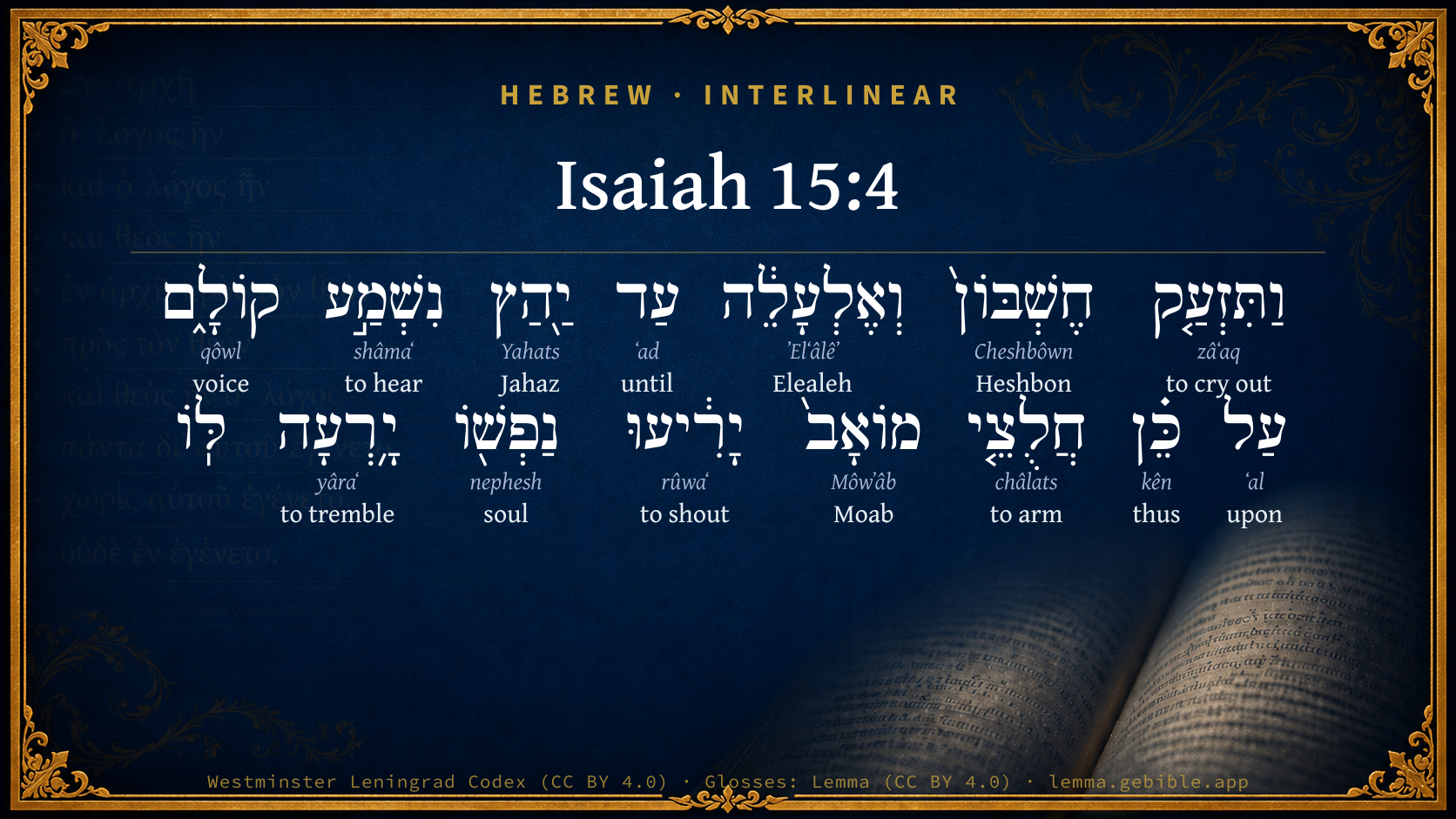
Hebrew (Westminster Leningrad Codex) Isaiah 15:4 appears in the Hebrew Old Testament. The text above is from the Westminster Leningrad Codex. Each word links to its Strong’s number, a concise gloss, and parsing drawn from the Open Scriptures Hebrew Bible morphology. Click any word for its full Brown-Driver-Briggs (BDB) entry.
Download image
Cite this verse

Isaiah 15:4 (World English Bible). Public Domain. Lemma interlinear Bible study tool, https://lemma.gebible.app/v/isaiah/15/4.

Show BibTeX & RIS
BibTeX
RIS
English Translation
Heshbon cries out, and Elealeh; their voice is heard even to Jahaz: therefore the armed men of Moab cry aloud; his soul trembles within him.
World English Bible · Public Domain
Download a study sheet

One document with this verse’s original text, its word-by-word gloss line, the meaning frame, cross-references with their text, attributed commentary, and full source and license credits — printable, and it pastes into notes with its structure intact.

This verse Autodidact and up

Study sheet (.html) Plain text (.txt)

A passage Seminary Student

Up to 50 verses in one chapter. A passage sheet keeps up to 6 commentary sources and 12 cross-references per verse, in the order this page ranks them, and says so on the sheet whenever that leaves anything out. Ask for a single verse and you get the Autodidact verse sheet above.

Everything on this page stays free to read, with no account — the sheet is a download of what is already on screen, not access to it.

Want to remove ads? Support Godless Engineer
Compare translations 3

The same verse in 3 English versions, stacked beneath the original-language interlinear above. Click any original word for its lexicon entry.

Each is an independent rendering of the whole verse — the interlinear is not word-aligned to these translations.

Highlighted words mark where these versions differ — a whole-verse word diff, not a word-by-word alignment.

  • World English Bible Public Domain
    Heshbon cries out, and Elealeh; their voice is heard even to Jahaz: therefore the armed men of Moab cry aloud; his soul trembles within him.
  • King James Version Public Domain
    And Heshbon shall cry, and Elealeh: their voice shall be heard even unto Jahaz: therefore the armed soldiers of Moab shall cry out; his life shall be grievous unto him.
  • unfoldingWord Literal Text CC BY-SA 4.0
    And Heshbon and Elealeh cry out; their voice is heard as far as Jahaz. Therefore the armed of Moab shout; his soul trembles within him.

unfoldingWord Literal Text — © unfoldingWord, licensed CC BY-SA 4.0. Word-aligned USFM3 via Door43 (git.door43.org/unfoldingWord/en_ult).

Versions to compare (up to 4)

3 of 4 selected

Show all 18 translations

Every available English version of this verse, each an independent rendering of the whole verse.

  • World English Bible Public Domain
    Heshbon cries out, and Elealeh; their voice is heard even to Jahaz: therefore the armed men of Moab cry aloud; his soul trembles within him.
  • Berean Standard Bible Public Domain
    Heshbon and Elealeh cry out; their voices are heard as far as Jahaz. Therefore the soldiers of Moab cry out; their souls tremble within.
  • Majority Standard Bible Public Domain
    Heshbon and Elealeh cry out; their voices are heard as far as Jahaz. Therefore the soldiers of Moab cry out; their souls tremble within.
  • King James Version Public Domain
    And Heshbon shall cry, and Elealeh: their voice shall be heard even unto Jahaz: therefore the armed soldiers of Moab shall cry out; his life shall be grievous unto him.
  • American Standard Version (1901) Public Domain
    And Heshbon crieth out, and Elealeh; their voice is heard even unto Jahaz: therefore the armed men of Moab cry aloud; his soul trembleth within him.
  • Revised Version (1885) Public Domain
    And Heshbon crieth out, and Elealeh; their voice is heard even unto Jahaz: therefore the armed men of Moab cry aloud; his soul trembleth within him.
  • Geneva Bible (1599) Public Domain
    And Heshbon shall crie, and Elealeh: their voyce shall bee heard vnto Iahaz: therefore the warriers of Moab shall showt: the soule of euery one shall lament in him selfe.
  • Douay-Rheims (1899) Public Domain
    Hesebon shall cry, and Eleale, their voice is heard even to Jasa. For this shall the well appointed men of Moab howl, his soul shall howl to itself.
  • Young's Literal Translation Public Domain
    And cry doth Heshbon and Elealeh, Unto Jahaz heard hath been their voice, Therefore the armed ones of Moab do shout, His life hath been grievous to him.
  • Literal Standard Version CC BY-SA 4.0
    And Heshbon and Elealeh cry, || Their voice has been heard to Jahaz, || Therefore the armed ones of Moab shout, || His life has been grievous to him.
  • Unlocked Literal Bible CC BY-SA 4.0
    Heshbon and Elealeh call out for help; their sound is heard as far as Jahaz. So the armed men of Moab call out for help; they tremble within themselves.
  • unfoldingWord Literal Text CC BY-SA 4.0
    And Heshbon and Elealeh cry out; their voice is heard as far as Jahaz. Therefore the armed of Moab shout; his soul trembles within him.
  • Darby Bible Public Domain
    And Heshbon crieth, and Elealeh: their voice is heard unto Jahaz. Therefore the armed men of Moab cry out: his soul trembleth in him.
  • World Messianic Bible Public Domain
    Heshbon cries out with Elealeh. Their voice is heard even to Jahaz. Therefore the armed men of Moab cry aloud. Their souls tremble within them.
  • Webster's Bible Public Domain
    And Heshbon shall cry, and Elealeh: their voice shall be heard even to Jahaz: therefore the armed soldiers of Moab shall cry out; his life shall be grievous to him.
  • Free Bible Version CC BY-SA 4.0
    The people of Heshbon and Elealeh cry out in sadness, their voices heard as far as Jahaz. That's why even the bravest soldiers of Moab shout—because they're so terrified.
  • Bible in Basic English Public Domain
    Heshbon is crying out, and Elealeh; their voice is sounding even to Jahaz: for this cause the heart of Moab is shaking; his soul is shaking with fear.
  • JPS Tanakh (1917) Public Domain
    And Heshbon crieth out, and Elealeh; their voice is heard even unto Jahaz; therefore the armed men of Moab cry aloud; his soul is faint within him.

Literal Standard Version (2020), Covenant Press — licensed CC BY-SA 4.0. Text via the HelloAO Bible API (eBible.org). Unlocked Literal Bible (unfoldingWord) — licensed CC BY-SA 4.0. Text via the HelloAO Bible API (eBible.org). unfoldingWord Literal Text — © unfoldingWord, licensed CC BY-SA 4.0. Word-aligned USFM3 via Door43 (git.door43.org/unfoldingWord/en_ult). Free Bible Version, Dr. Jonathan Gallagher — licensed CC BY-SA 4.0. Text via the HelloAO Bible API (eBible.org).

Word by word

More ways to search: Search by grammar → Find every occurrence → Compare this word →

Practice this passage: Drill this verse → Learn its vocabulary →

יָ֥רְעָה
yâraʻ
H3415
“to tremble”
Verb, Qal, Perfect, 3rd Person, Feminine, Singular
Part of Speech
Verb
Stem
Qal
Form
Perfect
Person
3rd Person
Gender
Feminine
Number
Singular
Full BDB Definition

Origin: a primitive root

TWOT: 917

(Qal) to tremble, quiver
  1. וַתִּזְעַ֤ק zâʻaq H2199 “and · to cry out” Conjunction + Verb, Qal, Sequential Imperfect, 3rd Person, Feminine, Singular
  2. חֶשְׁבּוֹן֙ Cheshbôwn H2809 “Heshbon” Noun, Proper
  3. וְאֶלְעָלֵ֔ה ʼElʻâlêʼ H500 “and · Elealeh” Conjunction + Noun, Proper
  4. עַד ʻad H5704 “until” Preposition
  5. יַ֖הַץ Yahats H3096 “Jahaz” Noun, Proper
  6. נִשְׁמַ֣ע shâmaʻ H8085 “to hear” Verb, Niphal, Perfect, 3rd Person, Masculine, Singular
  7. קוֹלָ֑ם qôwl H6963 “voice · their” Noun, Common, Masculine, Singular, Construct + Suffix, Personal, 3rd Person, Masculine, Plural
  8. עַל ʻal H5921 “upon” Preposition
  9. כֵּ֗ן kên H3651 “thus” Particle, Demonstrative
  10. חֲלֻצֵ֤י châlats H2502 “armed” Verb, Qal, Participle Passive, Masculine, Plural, Construct
  11. מוֹאָב֙ Môwʼâb H4124 “Moab” Noun, Proper
  12. יָרִ֔יעוּ rûwaʻ H7321 “to shout” Verb, Hiphil, Imperfect, 3rd Person, Masculine, Plural
  13. נַפְשׁ֖וֹ nephesh H5315 “soul · his” Noun, Common, Both, Singular, Construct + Suffix, Personal, 3rd Person, Masculine, Singular

About this verse

These counts appear in no published source. They are computed here, from the morphology-tagged text and Lemma’s own curated glosses. What Lemma adds →

15
words
14
distinct lemmas
Prophets
section

Notable vocabulary

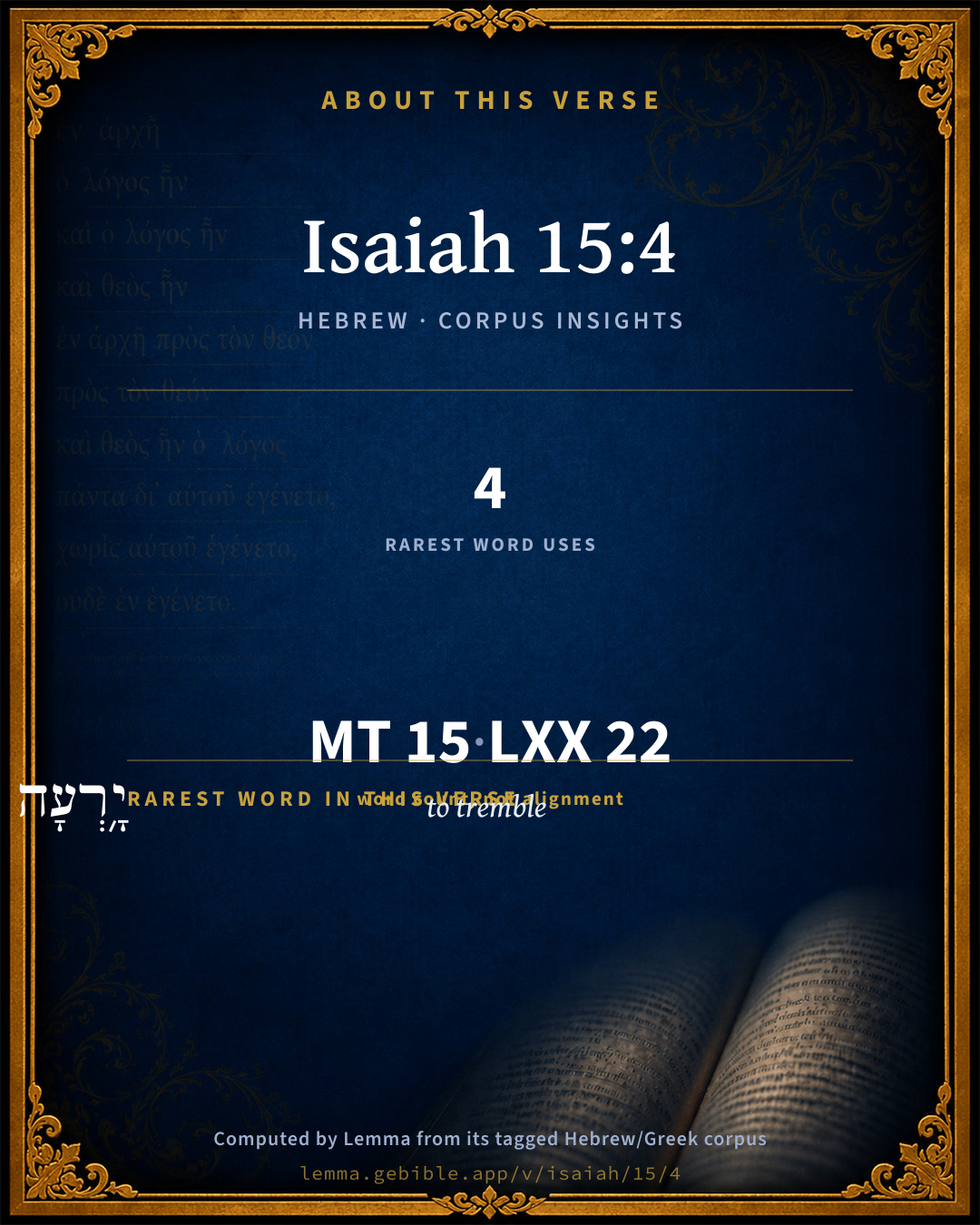
The rarest word here is יָ֥רְעָה to tremble H3415 — appearing just 4 times in the whole Hebrew Bible.

Shared distinctive vocabulary

יָ֥רְעָה to tremble H3415 occurs in 4 verses of the Hebrew Bible. Also found in:

Grammatical profile

  • 5 verbs
  • 6 nouns
  • 3 prepositions
  • 1 particle

Verb forms

  • וַתִּזְעַ֤ק Qal · Sequential Imperfect
  • נִשְׁמַ֣ע Niphal · Perfect
  • חֲלֻצֵ֤י Qal · Participle Passive
  • יָרִ֔יעוּ Hiphil · Imperfect
  • יָ֥רְעָה Qal · Perfect

Hebrew & Septuagint length

In English translation the verse runs 25 words from the Hebrew and 26 from the Septuagint (LXX English) — closely comparable.

A rough comparison of the two English renderings, which tokenize alike — not a word-level alignment.

Word counts can differ between the Hebrew and the Greek without any difference in meaning — e.g. the Hebrew direct-object marker אֵת has no separate Greek word, and Greek often adds the article ὁ.

In the original languages it is 15 Hebrew tokens and 22 Greek tokens — but the two are counted differently (Hebrew bundles its prefixes and suffixes into one token; the Greek is in lemma form), so that isn’t a like-for-like length.

Cross-references

17

Topical passages linked to Isaiah 15:4 in the Treasury of Scripture Knowledge — connected by theme and wording, ordered by reader-vote popularity; previews shown in the World English Bible.

  • Jeremiah 48:34 From the cry of Heshbon even to Elealeh, even to Jahaz have they uttered their voice, from Zoar even to Horonaim, to Eglath Shelishiyah: for the waters of Nimrim also shall become desolate.
  • Genesis 27:46 Rebekah said to Isaac, "I am weary of my life because of the daughters of Heth. If Jacob takes a wife of the daughters of Heth, such as these, of the daughters of the land, what good will my life do me?"
  • Numbers 11:15 If you deal thus with me, please kill me out of hand, if I have found favor in your sight; and let me not see my wretchedness.
  • Numbers 21:23 Sihon would not allow Israel to pass through his border: but Sihon gathered all his people together, and went out against Israel into the wilderness, and came to Jahaz; and he fought against Israel.
  • Numbers 32:3–4 Ataroth, and Dibon, and Jazer, and Nimrah, and Heshbon, and Elealeh, and Sebam, and Nebo, and Beon,
  • Deuteronomy 2:32 Then Sihon came out against us, he and all his people, to battle at Jahaz.
  • Joshua 13:18 and Jahaz, and Kedemoth, and Mephaath,
  • Judges 11:20 But Sihon didn't trust Israel to pass through his border; but Sihon gathered all his people together, and encamped in Jahaz, and fought against Israel.
  • 1 Kings 19:4 But he himself went a day's journey into the wilderness, and came and sat down under a juniper tree: and he requested for himself that he might die, and said, It is enough; now, O Yahweh, take away my life; for I am not better than my fathers.
  • Job 3:20–22 "Why is light given to him who is in misery, Life to the bitter in soul,
  • Job 7:15–16 So that my soul chooses strangling, Death rather than my bones.
  • Isaiah 16:8–9 For the fields of Heshbon languish, [and] the vine of Sibmah; the lords of the nations have broken down the choice branches of it, which reached even to Jazer, which wandered into the wilderness; its shoots were spread abroad, they passed over the sea.
  • Jeremiah 8:3 Death shall be chosen rather than life by all the residue that remain of this evil family, that remain in all the places where I have driven them, says Yahweh of Hosts.
  • Jeremiah 20:18 Why came I forth out of the womb to see labor and sorrow, that my days should be consumed with shame?
  • Jonah 4:3 Therefore now, Yahweh, take, I beg you, my life from me; for it is better for me to die than to live."
  • Jonah 4:8 It happened, when the sun arose, that God prepared a sultry east wind; and the sun beat on Jonah's head, so that he fainted, and requested for himself that he might die, and said, "It is better for me to die than to live."
  • Revelation 9:6 In those days people will seek death, and will in no way find it. They will desire to die, and death will flee from them.

Cross-references courtesy of OpenBible.info (CC BY 4.0).

Hebrew and Greek witnesses Masoretic Hebrew ↔ Greek Septuagint

The same verse in the two great witnesses to the Old Testament, shown verse-for-verse.

These are two independent witnesses, not word-aligned to each other, and the Septuagint is shown in lemma (dictionary) form.

Hebrew Isaiah 15:4 Masoretic · Westminster Leningrad Codex

וַתִּזְעַ֤ק חֶשְׁבּוֹן֙ וְאֶלְעָלֵ֔ה עַד יַ֖הַץ נִשְׁמַ֣ע קוֹלָ֑ם עַל כֵּ֗ן חֲלֻצֵ֤י מוֹאָב֙ יָרִ֔יעוּ נַפְשׁ֖וֹ יָ֥רְעָה לּֽוֹ

Heshbon cries out, and Elealeh; their voice is heard even to Jahaz: therefore the armed men of Moab cry aloud; his soul trembles within him.

World English Bible · Public Domain

Greek LXX Isaiah 15:4 Septuagint · lemma form

ὅτι κράζω εσεβων καί ελεαλη ἕως ιασσα ἀκούω ὁ φωνή αὐτός διά οὗτος ὁ ὀσφύς ὁ μωαβῖτις βοάω ὁ ψυχή αὐτός γιγνώσκω

For Esebon and Eleale have cried: their voice was heard to Jassa: therefore the loins of the region of Moab cry aloud; her soul shall know.

LXX2012 (modern English Septuagint) · Public Domain

On this verse, Adam Clarke's Commentary discusses the Septuagint’s reading. Read the note in Commentary ↓

Hebrew: Westminster Leningrad Codex (CC BY 4.0). Greek: Septuagint (public domain); English from LXX2012 (modern English Septuagint) (Public Domain). How the Septuagint differs from the Hebrew →

Targum (Aramaic paraphrase)

1

The Targum is the ancient Jewish Aramaic paraphrase of the Hebrew Scriptures — an interpretive translation, not the Hebrew text itself. Onkelos (literal) and Pseudo-Jonathan (expansive) render the Torah, and Jonathan the Prophets. Coverage is partial: where no permissively-licensed English translation exists for a verse, only the Aramaic is shown. This is verse-level text, not a word-by-word alignment to the Hebrew.

  1. Targum Jonathan Prophets (Joshua–Malachi)
    וּצְוָחוּ יַתְבֵי חֶשְׁבּוֹן וְאֶלְעָלֵה עַד יַהַץ אִשְׁתְּמַע קַלְהוֹן עַל כֵּן מְזַרְזֵי מוֹאָב מְיַלְלִין וְעַל נַפְשֵׁיהוֹן מְצַוְחִין:

    And the inhabitants of Heshbon and Elealeh shall cry out aloud; unto Jahats is their voice heard: therefore the armed of Moab are howling, and crying out aloud for their souls.

    Targum Jonathan — Aramaic: “Mikraot Gedolot” (public domain). English: “Sefaria Community Translation” (CC0 1.0 (public-domain dedication)); “London "Chaldee Paraphrase," 1871” (public domain). Text via Sefaria.

Commentary

Notes on Isaiah 15:4 from classic Christian and Jewish commentators (each source and its license shown beneath its notes). The classic Christian expositions comment on the surrounding passage and are grouped to its opening verse, so a note may address several verses; the Jewish commentaries on the Tanakh (Rashi and others) are per-verse, so they appear only where the commentator wrote on this verse.

Lemma curates 59 commentaries, every one of them public domain or Creative Commons licensed, each selected and text-cleaned for this edition rather than reprinted as found. About our sources →

Trapp's Complete Commentary

John Trapp

Isa 15:4 And Heshbon shall cry, and Elealeh: their voice shall be heard [even] unto Jahaz: therefore the armed soldiers of Moab shall cry out; his life shall be grievous unto him.

Ver. 4. And Heshbon shall cry, and Elealeh.] See on Isa 15:2.

The armed soldiers of Moab shall cry out.] As being faint hearted and unwilling to fight, because to no purpose.

His life shall be grievous to him.] Heb., His soul shall be ill-affected to him, or, for himself; that is, say some, all his care shall be for himself; let others shift as they can.

John Trapp, A Commentary or Exposition upon All the Books of the Old and New Testament (1647–1656) — public domain. Text from a community e-Sword module.

Joseph Benson's Commentary

Isa 15:4. And Heshbon shall cry, and Elealeh — Two other Moabitish cities; of which see Num 21:25-26; Num 32:3; Num 32:37. Their voice shall be heard unto Jahaz — Another city in the utmost borders of Moab. The armed soldiers shall cry out — Even the warriors themselves, who should defend the state, shall lose all their spirit and courage, and join in the general lamentation and dismay: see Jer 48:34; Jer 48:41. His life shall be grievous unto him — The Moabites shall generally long for death, to free them from those dreadful calamities which they perceive unavoidably coming upon them.

Joseph Benson's Commentary on the Old and New Testaments (1811–1818) — public domain. Text from a community e-Sword module.

Tyndale Open Study Notes

Tyndale Open Resources

15:4 Heshbon was the former capital of Sihon (Num 21:23-26). • Elealeh was located close to Heshbon. • Jahaz was between Heshbon and the Arnon River (see Jer 48:34).

Tyndale Open Study Notes — © Tyndale Open Resources, licensed CC BY-SA 4.0. Text via the HelloAO Bible API.

Jamieson, Fausset & Brown

Robert Jamieson, A. R. Fausset & David Brown

Heshbon--an Amorite city, twenty miles east of Jordan; taken by Moab after the carrying away of Israel (compare Jer. 48:1-47).

Elealeh--near Heshbon, in Reuben.

Jahaz--east of Jordan, in Reuben. Near it Moses defeated Sihon.

therefore--because of the sudden overthrow of their cities. Even the armed men, instead of fighting in defense of their land, shall join in the general cry.

life, &c.--rather, "his soul is grieved" (Sa1 1:8) [MAURER].

Jamieson, Fausset & Brown — Commentary Critical and Explanatory on the Whole Bible (1871) — public domain (CC PDM 1.0). Text via the HelloAO Bible API.

Adam Clarke's Commentary

Verse 4. The armed soldiers - "The very loins"] So the Septuagint, ἡ οσφυς, and the Syriac. They cry out violently, with their utmost force.

Adam Clarke's Commentary on the Bible (1810–1826) — public domain. Text from a community e-Sword/MySword module.

Ellicott's Commentary for English Readers

(4) And Heshbon shall cry, and Elealeh . . .—Of the places thus named (1) Heshbon (now Heshan) was twenty miles east of the Jordan, on a line from the northern extremity of the Dead Sea. It is first mentioned as in the power of Sihon king of the Amorites (Num_21:26). On his overthrow it was assigned to the tribe of Reuben (Num_32:37), and became a city of the Levites (Jos_21:39). It had probably fallen into the hands of the Moabites, to whom it had originally belonged (Num_21:26). Its ruins exhibit architecture of various periods, Jewish, Roman, and Saracenic; (2) Elealeh, obviously near Heshbon, had shared its fate (Num_32:3; Num_32:37). The ancient name still attaches to its ruins in the form El-A’al; (3) Jahaz was the scene of the battle between Sihon and the Israelites (Num_21:23; Deu_2:32; Jdg_11:20), and was also within the region assigned to Reuben (Jos_13:10) north of the Arnon. The language of Isaiah implies that it was at some distance from the other two cities. Their cry was to be heard even there. In the Moabite inscription it appears as annexed to Dibon (Records of the Past, xi. 167). Eusebius (Onomast.) names it as between Medeba and Debus, the latter name being probably identical with Dibon. The panic is intensified by the fact that even the “armed soldiers” of Moab are powerless to help, and can only join in the ineffectual wailing.

A Bible Commentary for English Readers, edited by Charles John Ellicott (1878–1897) — public domain. Text from a community e-Sword module.

The Cambridge Bible for Schools and Colleges

gen. ed. J. J. S. Perowne

4. (Cf. Jer_48:34.) Heshbon and Elealeh (often mentioned together) are respectively about 4 and 6 miles N.E. of Nebo. Heshbon, once the capital of the Amorites (Num_21:26) and afterwards an Israelitish city (Num_32:37; Jos_13:17; Jos_21:39), is at the time of the prophecy in the possession of Moab. The site of Jahaz, where Sihon gave battle to the Israelites (Num_21:23), has not been discovered; probably it was some distance south from Heshbon.

the armed soldiers of Moab shall cry out] omit “shall” with R.V. Cf. ch. Isa_33:7. The “heroes of Moab” are mentioned in a similar plight in Jer_48:41.

his life shall be grievous unto him] Rather, as in R.V., his soul trembleth within him (ethical dative).

The Cambridge Bible for Schools and Colleges (gen. ed. J. J. S. Perowne; Cambridge University Press, 1878–1918) — public domain. Text from a community e-Sword module.

John Gill's Exposition

And Heshbon shall cry, and Elealeh,.... Two other cities in the land of Moab. The first of these was the city of Sihon king of the Amorites, who took it from the Moabites, Num 21:25 it came into the hands of the Reubenites, Num 32:3 and afterwards was again possessed by the Moabites, Jer 48:2. Josephus (t) calls it Essebon, and mentions it among the cities of Moab; it goes by the name of Esbuta in Ptolemy (u); and is called Esbus by Jerom (w), who says it was a famous city of Arabia in his time, in the mountains over against Jericho, twenty miles distant from Jordan; hence we read of the Arabian Esbonites in Pliny (x). Elealeh was another city of Moab, very near to Heshbon and frequently mentioned with it, Isa 16:9. Jerom says (y) that in his time it was a large village, a mile from Esbus, or Heshbon. By these two places are meant the inhabitants of them, as the Targum paraphrases it, who cried for and lamented the desolation that was coming, or was come upon them:

their voice shall be heard even unto Jahaz; sometimes called Jahazah, Jos 13:18 it was a frontier town, at the utmost borders of the land, Num 21:23 hence the cry of the inhabitants of the above cities is said to reach to it, which expresses the utter destruction that should be made; see Jer 48:34 this is thought to be the same place Ptolemy (z) calls Ziza. Jerom (a) calls it Jazza, as it is in the Septuagint here, and says that in his time it was shown between Medaba and Deblathai.

Therefore the armed soldiers of Moab shall cry out; not as when they go to battle, with courage and cheerfulness, as some have thought; but through fear, and as in great terror and distress; and so it signifies, that not only the weak and unarmed inhabitants, men and women, should be in the utmost confusion and consternation, but the soldiers that should fight for them, and defend them; who were accoutred, or "harnessed", as the word signifies, and were "girt" and prepared for war, as the Targum renders it; even these would be dispirited, and have no heart to fight, but lament their sad case:

his life shall be grievous to everyone; the life of every Moabite would be a burden to him; he would choose death rather than life; so great the calamity: or the life of every soldier; or "his soul shall cry out", grieve or mourn for "himself" (b); for his own unhappy case; he shall only be concerned for himself, how to save himself, or make his escape; having none for others, for whose defence he was set, and for whom he was to fight; but would have no concern for his king or country, only for himself.

(t) Antiqu. l. 13. c. 15. sect. 4. (u) Geograph. l. 5. c. 17. P. 137. (w) De locis Hebraicis, fol. 90. M. (x) Nat. Hist. l. 5. c. 11. (y) De locis Hebraicis, fol. 90. M. (z) Geograph. l. 5. c. 17. p. 137. (a) De locis Hebraicis, fol. 92. F. (b) "anima ejus vociferabit sibi", Pagninus & Montanus.

John Gill's Exposition of the Whole Bible (1746–1763) — public domain (CC PDM 1.0). Text via the HelloAO Bible API.

Albert Barnes' Notes on the Bible

And Heshbon shall cry - This was a celebrated city of the Amorites, twenty miles east of the Jordan Jos 13:17. It was formerly conquered from the Moabiltes by Sihon, and became his capital, and was taken by the Israelites a little before the death of Moses Num 21:25. After the carrying away of the ten tribes it was recovered by the Moabites. Jeremiah Jer 48:2 calls it ‘the pride of Moab.’ The town still subsists under the same name, and is described by Burckhardt. He says, it is situated on a hill, southwest from El Aal (Elealeh). ‘Here are the ruins of an ancient town, together with the remains of some edifices built with small stones; a few broken shafts of columns are still standing, a number of deep wells cut in the rock, and a large reservoir of water for the summer supply the inhabitants.’ (“Travels in Syria,” p. 365.)

And Elealeh - This was a town of Reuben about a mile from Heshbon Num 32:37. Burckhardt visited this place. Its present name is El Aal. ‘It stands on the summit of a hill, and takes its name from its situation - Aal, meaning “the high.” It commands the whole plain, and the view from the top of the hill is very extensive, comprehending the whole of the southern Belka. El Aal was surrounded by a well built wall, of which some parts yet remain. Among the ruins are a number of large cisterns, fragments of walls, and the foundations of houses, but nothing worthy of notice. The plain around it is alternately chalk and flint.’ (“Travels in Syria,” p. 365.)

Even unto Jahaz - This was a city east of Jordan, near to which Moses defeated Sihon. It was given to Reuben Deu 2:32, and was situated a short distance north of Ar, the capital of Moab.

The armed soldiers of Moab - The consternation shall reach the very army. They shall lose their courage, and instead of defending the nation, they shall join in the general weeping and lamentation.

His life shall be grievous - As we say of a person who is overwhelmed with calamities, that his life is wearisome, so, says the prophet, shall it be with the whole nation of Moab.

Albert Barnes' Notes on the Bible (1834–1885) — public domain. Text from a community e-Sword/MySword module.

Haydock's Catholic Bible Commentary

Itself. Every one shall deplore his own distress.

George Leo Haydock (1774–1849), Haydock's Catholic Family Bible and Commentary, 1859 edition — public domain. Excludes Psalms (Douay-Rheims chapter numbering differs from Protestant) and Deuterocanonical books (Catholic canon only).

Matthew Poole's English Annotations

Heshbon and Elealeh; two other Moabitish cities; of which see Num 21:25,26; 32:3,37.

Jahaz another city in the utmost borders of Moab, Num 21:23, called also Jahazah, Jos 21:36.

The armed soldiers, who should be, and use to be, the most courageous.

His life shall be grievous unto him; the Moabites shall generally long for death, to free themselves from those dreadful calamities which they perceive unavoidably coming upon them.

Matthew Poole's English Annotations on the Holy Bible (1683–1685) — public domain. Text from a community e-Sword/MySword module.

Whedon's Commentary on the Bible

Daniel D. Whedon

4. Heshbon, and other cities north, and back to the south again, join in the cry. Heshbon, an ancient royal residence of the Amorites, (Num_21:26, seq.,) on falling into the hands of the Israelites, was assigned to Reuben, (Jos_13:17;) then to Gad as a city of the Levites.

Jahaz — This place would seem to have lain eastward toward the desert, as may be inferred from Num_21:23, and Deu_2:32, for it was from there that Sihon marched down into the wilderness against the Israelite warriors who conquered him.

Daniel D. Whedon (gen. ed.), Commentary on the Old and New Testaments (1874–1909) — public domain. Text from a community e-Sword module.

The Pulpit Commentary

Heshbon shall cry. Heshbon, now Hesban, lay about twenty miles east of the Jordan, nearly on the parallel of its embouchure into the Dead Sea. It was the capital city of Sihon, (Num_21:21) who took it from the Moabites. On the partition of Palestine among the tribes of Israel, it was assigned to Reuben; (Num_32:37 Jos_13:17) but at a later time we find it reckoned to Gad. (1Ch_6:81) We do not know at what time Moab recovered Heshbon, but may conjecture that it was one of the conquests of Mesha, though it is not mentioned on the Moabite Stone. And Elealeh. Elealeh is commonly united with Heshbon. (Num_32:3, 37 Isa_16:9 Jer_48:34) It is probably identical with the modern El-A"al, a ruined town on the top of a rounded hill, little more than a mile north of Hesban. Even unto Jahaz. Jahaz lay considerably to the south of Hesh-ben, probably not very far north of the Arnon. It must have been in the vicinity of Dibon, since Mesha, on taking it from the Israelites, annexed it to the territory of that city (Moabite Stone, II 19-21). It was the scene of the great battle between Sihon and the Israelites under Moses. (Num_21:23) His life shall be grievous unto him; rather, his soul shall be grieved within him. The Moabite people is personified (Cheyne).

The Pulpit Commentary (1880–1919), ed. H.D.M. Spence-Jones & Joseph S. Exell — public domain. Text from a community e-Sword module.

John Wesley's Explanatory Notes

Heshbon - Two other Moabitish cities. Jahaz - Another city in the utmost borders of Moab. Soldiers - Who use to be the most courageous.

John Wesley, Explanatory Notes Upon the Whole Bible (1754–1765) — public domain. Text via the GEBible commentary corpus.

J. A. Alexander on Isaiah

Joseph Addison Alexander

“And Heshbon cries and Elealeh, even to Jahaz is their voice heard, therefore the warriors of Moab cry, his soul is distressed to him (or in him).” Heshbon, a royal city of the Amorites, assigned to Reuben and to Gad at different times, or to both jointly, famous for its fish-pools, a celebrated town in the days of Eusebius, the ruins of which are still in existence under the slightly altered name of Hesban. Elealeh, often mentioned with it, was also assigned to the tribe of Reuben. Eusebius describes these towns as near together in the highlands of Gilead, opposite to Jericho. Robinson and Smith, while at the latter place, conversed with an Arab chief, who pointed out to them the Wady Hesban, near which far up in the mountain is the ruined place of the same name, the ancient Heshbon. Half an hour north-east of this lies another ruin called El Al, the ancient Elealeh. (Palestine II 278.)

Joseph Addison Alexander, The Prophecies of Isaiah (1846–1847; New York: Scribner, 1870–1878) — public domain. Text from a community e-Sword module.

Rashi

Rabbi Shlomo Yitzchaki (Rashi)

because the armed men of Moab shall cry in alarm Since the armed men of Moab shall cry out towards the battle, and the soul of Moab shall cry out for itself, like one mourning for himself.

Rashi on the Tanakh — English translations: “The Judaica Press complete Tanach with Rashi, translated by A. J. Rosenberg” (CC BY 4.0); “Pentateuch with Rashi's commentary by M. Rosenbaum and A.M. Silbermann, 1929-1934” (public domain); “The Metsudah Tanach series, Lakewood, N.J” (CC BY 4.0); and “The Book of Joshua, Metsudah Publications, 1997” (CC BY 4.0). Text via Sefaria.

Ibn Ezra

Rabbi Abraham ibn Ezra

נפשו ירעה לו His soul shall cry out unto him. The soul of Moab shall cry out unto him, or the soul of every one of the armed soldiers will shout and say.

Ibn Ezra on the Tanakh — English translations: “Sefaria Community Translation” (CC0 1.0 (public-domain dedication)); “Yalkut, Sifsei Chachomim Chumash, Metsudah Publications, 2009” (CC BY 4.0); and “Commentary of Ibn Ezra on Isaiah - trans. by M. Friedlander, 1873” (public domain). Text via Sefaria.

Lesson kit

Teaching starters — assembled from the data on this page, not authored interpretation. Every prompt links to the verse data it draws on. Edit before teaching.

Isaiah, in the Prophets, opens this verse with 15 words (14 distinct Hebrew lemmas). Its most distinctive word is yâraʻ (“to tremble”). A historical commentator’s framing appears above. Read the whole chapter for the surrounding context.

Discussion questions

  1. What does “to tremble” (yâraʻ) contribute to the verse as a whole?
  2. How does 1 Samuel 1:8, which shares the word «to tremble», read alongside this verse?
  3. These translations render this verse differently. What is at stake in choosing one wording over another?
  4. «וַתִּזְעַ֤ק» is a Qal Sequential Imperfect verb. How does that grammatical form shape the action described?
  5. Compare how Trapp's Complete Commentary and Joseph Benson's Commentary read this verse. Where do they agree or differ?

Things to notice

Reading settings

Reading text

Shown beneath each verse's original-language words.

Old Testament
Old Testament edition

Read the OT as the Masoretic Hebrew (MT) or the Greek Septuagint (LXX).

English shown for the Greek Septuagint (in the Hebrew ↔ Greek comparison).

Comparing translations? Open the Compare panel on any verse page to stack up to four side by side.