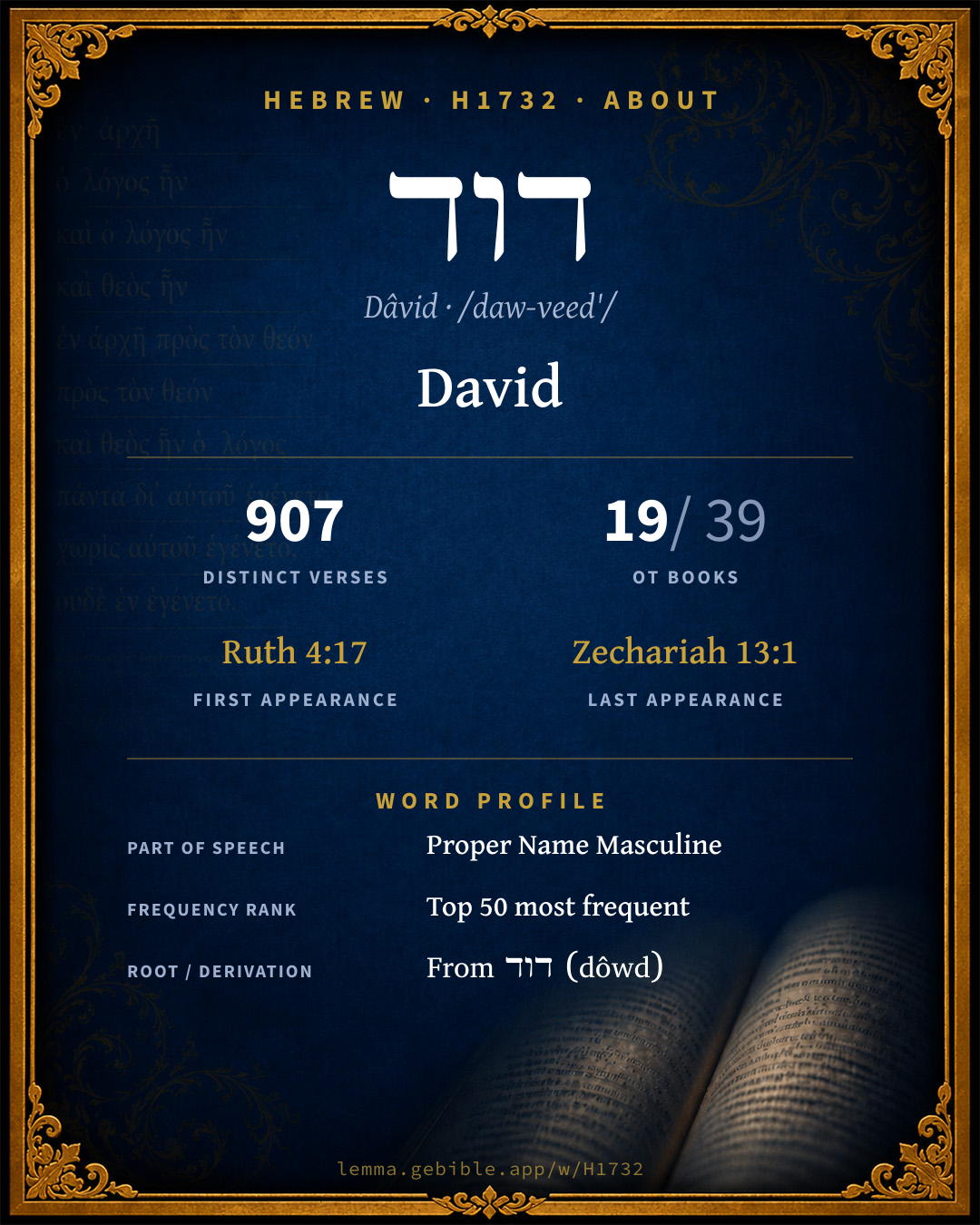
דָּוִד
David
BDB lists 2 entries for ‘David’ fuller range ↓
Full lexicon entry — Brown-Driver-Briggs (BDB)
From Brown-Driver-Briggs (BDB)
Where this word appears
Grammar key — what these labels mean
Part of speech
- Noun
- A naming word — a person, place, thing, or idea.
Noun type
- Proper
- A name of a specific person, place, or people (e.g. Abraham, Zion, Israel).
Page 4 of 5 — showing verses 601–800 of 907 distinct verses where H1732 appears, across 19 books. Click any verse to open its interlinear word-by-word view. Verse text shown in the World English Bible for context — . Each verse’s Hebrew form is shown with its reference; the English is not keyword-highlighted, since the data carries no word-level English alignment. Use “Compare translations” on any verse to read it across multiple English versions. This concordance covers the Hebrew Bible; Septuagint (Greek Old Testament) occurrences are not indexed here.
1 Chronicles 157 verses
- 1 Chronicles 14:14 דָּוִיד֙ n Proper David inquired again of God; and God said to him, You shall not go up after them: turn away from them, and come on them over against the mulberry trees.
- 1 Chronicles 14:16 דָּוִ֔יד n Proper David did as God commanded him: and they struck the host of the Philistines from Gibeon even to Gezer.
- 1 Chronicles 14:17 דָּוִ֖יד n Proper The fame of David went out into all lands; and Yahweh brought the fear of him on all nations.
- 1 Chronicles 15:1 דָּוִ֑יד n Proper [David] made him houses in the city of David; and he prepared a place for the ark of God, and pitched for it a tent.
- 1 Chronicles 15:2 דָּוִ֔יד n Proper Then David said, None ought to carry the ark of God but the Levites: for them has Yahweh chosen to carry the ark of God, and to minister to him forever.
- 1 Chronicles 15:3 דָּוִ֛יד n Proper David assembled all Israel at Jerusalem, to bring up the ark of Yahweh to its place, which he had prepared for it.
- 1 Chronicles 15:4 דָּוִ֛יד n Proper David gathered together the sons of Aaron, and the Levites:
- 1 Chronicles 15:11 דָוִ֔יד n Proper David called for Zadok and Abiathar the priests, and for the Levites, for Uriel, Asaiah, and Joel, Shemaiah, and Eliel, and Amminadab,
- 1 Chronicles 15:16 דָּוִיד֮ n Proper David spoke to the chief of the Levites to appoint their brothers the singers, with instruments of music, psalteries and harps and cymbals, sounding aloud and lifting up the voice with joy.
- 1 Chronicles 15:25 דָוִ֛יד n Proper So David, and the elders of Israel, and the captains over thousands, went to bring up the ark of the covenant of Yahweh out of the house of Obed-edom with joy.
- 1 Chronicles 15:27 וְ/דָוִ֞יד דָּוִ֖יד conj + n Proper n Proper David was clothed with a robe of fine linen, and all the Levites who bore the ark, and the singers, and Chenaniah the master of the song [with] the singers: and David had on him an ephod of linen.
- 1 Chronicles 15:29 דָּוִ֑יד דָּוִיד֙ n Proper n Proper It happened, as the ark of the covenant of Yahweh came to the city of David, that Michal the daughter of Saul looked out at the window, and saw king David dancing and playing; and she despised him in her heart.
- 1 Chronicles 16:1 דָּוִ֑יד n Proper They brought in the ark of God, and set it in the midst of the tent that David had pitched for it: and they offered burnt offerings and peace-offerings before God.
- 1 Chronicles 16:2 דָּוִ֔יד n Proper When David had made an end of offering the burnt offering and the peace-offerings, he blessed the people in the name of Yahweh.
- 1 Chronicles 16:7 דָּוִיד֙ n Proper Then on that day David first ordained to give thanks to Yahweh, by the hand of Asaph and his brothers.
- 1 Chronicles 16:43 דָּוִ֖יד n Proper All the people departed every man to his house: and David returned to bless his house.
- 1 Chronicles 17:1 דָּוִ֖יד דָּוִ֜יד n Proper n Proper It happened, when David lived in his house, that David said to Nathan the prophet, Behold, I dwell in a house of cedar, but the ark of the covenant of Yahweh [dwells] under curtains.
- 1 Chronicles 17:2 דָּוִ֔יד n Proper Nathan said to David, Do all that is in your heart; for God is with you.
- 1 Chronicles 17:4 דָּוִ֣יד n Proper Go and tell David my servant, Thus says Yahweh, You shall not build me a house to dwell in:
- 1 Chronicles 17:7 לְ/דָוִ֗יד prep + n Proper Now therefore thus shall you tell my servant David, Thus says Yahweh of Hosts, I took you from the sheep pen, from following the sheep, that you should be prince over my people Israel:
- 1 Chronicles 17:15 דָּוִֽיד n Proper According to all these words, and according to all this vision, so did Nathan speak to David.
- 1 Chronicles 17:16 דָּוִ֔יד n Proper Then David the king went in, and sat before Yahweh; and he said, Who am I, Yahweh God, and what is my house, that you have brought me thus far?
- 1 Chronicles 17:18 דָּוִ֛יד n Proper What can David [say] yet more to you concerning the honor which is done to your servant? for you know your servant.
- 1 Chronicles 17:24 דָּוִ֥יד n Proper Let your name be established and magnified forever, saying, Yahweh of Hosts is the God of Israel, even a God to Israel: and the house of David your servant is established before you.
- 1 Chronicles 18:1 דָּוִ֛יד n Proper After this it happened, that David struck the Philistines, and subdued them, and took Gath and its towns out of the hand of the Philistines.
- 1 Chronicles 18:2 לְ/דָוִ֔יד prep + n Proper He struck Moab; and the Moabites became servants to David, and brought tribute.
- 1 Chronicles 18:3 דָּוִ֛יד n Proper David struck Hadarezer king of Zobah to Hamath, as he went to establish his dominion by the river Euphrates.
- 1 Chronicles 18:4 דָּוִ֨יד דָּוִיד֙ n Proper n Proper David took from him one thousand chariots, and seven thousand horsemen, and twenty thousand footmen; and David hamstrung all the chariot horses, but reserved of them for one hundred chariots.
- 1 Chronicles 18:5 דָּוִיד֙ n Proper When the Syrians of Damascus came to help Hadarezer king of Zobah, David struck of the Syrians twenty-two thousand men.
- 1 Chronicles 18:6 דָּוִיד֙ לְ/דָוִ֔יד לְ/דָוִ֔יד n Proper prep + n Proper prep + n Proper Then David put [garrisons] in Syria of Damascus; and the Syrians became servants to David, and brought tribute. Yahweh gave victory to David wherever he went.
- 1 Chronicles 18:7 דָּוִ֗יד n Proper David took the shields of gold that were on the servants of Hadarezer, and brought them to Jerusalem.
- 1 Chronicles 18:8 דָּוִ֛יד n Proper From Tibhath and from Cun, cities of Hadarezer, David took very much brass, with which Solomon made the brazen sea, and the pillars, and the vessels of brass.
- 1 Chronicles 18:9 דָוִ֔יד n Proper When Tou king of Hamath heard that David had struck all the host of Hadarezer king of Zobah,
- 1 Chronicles 18:10 דָּ֠וִיד n Proper he sent Hadoram his son to king David, to Greet him, and to bless him, because he had fought against Hadarezer and struck him; (for Hadarezer had wars with Tou;) and [he had with him] all manner of vessels of gold and silver and brass.
- 1 Chronicles 18:11 דָּוִיד֙ n Proper These also did king David dedicate to Yahweh, with the silver and the gold that he carried away from all the nations; from Edom, and from Moab, and from the children of Ammon, and from the Philistines, and from Amalek.
- 1 Chronicles 18:13 לְ/דָוִ֑יד דָּוִ֔יד prep + n Proper n Proper He put garrisons in Edom; and all the Edomites became servants to David. Yahweh gave victory to David wherever he went.
- 1 Chronicles 18:14 דָּוִ֖יד n Proper David reigned over all Israel; and he executed justice and righteousness to all his people.
- 1 Chronicles 18:17 דָוִ֥יד n Proper and Benaiah the son of Jehoiada was over the Cherethites and the Pelethites; and the sons of David were chief about the king.
- 1 Chronicles 19:2 דָּוִ֜יד דָּוִ֛יד דָוִ֜יד n Proper n Proper n Proper David said, I will show kindness to Hanun the son of Nahash, because his father shown kindness to me. So David sent messengers to comfort him concerning his father. David's servants came into the land of the children of Ammon to Hanun, to comfort him.
- 1 Chronicles 19:3 דָּוִ֤יד n Proper But the princes of the children of Ammon said to Hanun, Think you that David does honor your father, in that he has sent comforters to you? Aren't his servants come to you to search, and to overthrow, and to spy out the land?
- 1 Chronicles 19:4 דָוִיד֙ n Proper So Hanun took David's servants, and shaved them, and cut off their garments in the middle, even to their buttocks, and sent them away.
- 1 Chronicles 19:5 לְ/דָוִ֤יד prep + n Proper Then there went certain persons, and told David how the men were served. He sent to meet them; for the men were greatly ashamed. The king said, Stay at Jericho until your beards be grown, and then return.
- 1 Chronicles 19:6 דָּוִ֑יד n Proper When the children of Ammon saw that they had made themselves odious to David, Hanun and the children of Ammon sent one thousand talents of silver to hire them chariots and horsemen out of Mesopotamia, and out of Arammaacah, and out of Zobah.
- 1 Chronicles 19:8 דָּוִ֑יד n Proper When David heard of it, he sent Joab, and all the host of the mighty men.
- 1 Chronicles 19:17 לְ/דָוִ֗יד דָּוִ֜יד prep + n Proper n Proper It was told David; and he gathered all Israel together, and passed over the Jordan, and came on them, and set the battle in array against them. So when David had put the battle in array against the Syrians, they fought with him.
- 1 Chronicles 19:18 דָּוִ֜יד n Proper The Syrians fled before Israel; and David killed of the Syrians [the men of] seven thousand chariots, and forty thousand footmen, and killed Shophach the captain of the host.
- 1 Chronicles 19:19 דָּוִ֖יד n Proper When the servants of Hadarezer saw that they were put to the worse before Israel, they made peace with David, and served him: neither would the Syrians help the children of Ammon any more.
- 1 Chronicles 20:1 וְ/דָוִ֖יד conj + n Proper It happened, at the time of the return of the year, at the time when kings go out [to battle], that Joab led forth the army, and wasted the country of the children of Ammon, and came and besieged Rabbah. But David stayed at Jerusalem. Joab struck Rabbah, and overthrew it.
- 1 Chronicles 20:2 דָּוִ֣יד דָּוִ֑יד n Proper n Proper David took the crown of their king from off his head, and found it to weigh a talent of gold, and there were precious stones in it; and it was set on David's head: and he brought forth the spoil of the city, exceeding much.
- 1 Chronicles 20:3 דָוִ֔יד דָּוִ֛יד n Proper n Proper He brought forth the people who were therein, and cut [them] with saws, and with harrows of iron, and with axes. Thus did David to all the cities of the children of Ammon. David and all the people returned to Jerusalem.
- 1 Chronicles 20:7 דָוִֽיד n Proper When he defied Israel, Jonathan the son of Shimea David's brother killed him.
- 1 Chronicles 20:8 דָּוִ֖יד n Proper These were born to the giant in Gath; and they fell by the hand of David, and by the hand of his servants.
- 1 Chronicles 21:1 דָּוִ֔יד n Proper Satan stood up against Israel, and moved David to number Israel.
- 1 Chronicles 21:2 דָּוִ֤יד n Proper David said to Joab and to the princes of the people, Go, number Israel from Beersheba even to Dan; and bring me word, that I may know the sum of them.
- 1 Chronicles 21:5 דָּוִ֑יד n Proper Joab gave up the sum of the numbering of the people to David. All those of Israel were one million one hundred thousand men who drew sword: and in Judah were four hundred seventy thousand men who drew sword.
- 1 Chronicles 21:8 דָּוִיד֙ n Proper David said to God, I have sinned greatly, in that I have done this thing: but now, put away, I beg you, the iniquity of your servant; for I have done very foolishly.
- 1 Chronicles 21:9 דָוִ֖יד n Proper Yahweh spoke to Gad, David's seer, saying,
- 1 Chronicles 21:10 דָּוִ֜יד n Proper Go and speak to David, saying, Thus says Yahweh, I offer you three things: choose you one of them, that I may do it to you.
- 1 Chronicles 21:11 דָּוִ֑יד n Proper So Gad came to David, and said to him, Thus says Yahweh, Take which you will:
- 1 Chronicles 21:13 דָּוִ֛יד n Proper David said to Gad, I am in a great strait: let me fall, I pray, into the hand of Yahweh; for very great are his mercies: and let me not fall into the hand of man.
- 1 Chronicles 21:16 דָוִ֜יד דָּוִ֧יד n Proper n Proper David lifted up his eyes, and saw the angel of Yahweh standing between earth and the sky, having a drawn sword in his hand stretched out over Jerusalem. Then David and the elders, clothed in sackcloth, fell on their faces.
- 1 Chronicles 21:17 דָּוִ֣יד n Proper David said to God, Isn't it I who commanded the people to be numbered? It is even I who have sinned and done very wickedly; but these sheep, what have they done? Please let your hand, O Yahweh my God, be against me, and against my father's house; but not against your people, that they should be plagued.
- 1 Chronicles 21:18 לְ/דָוִ֑יד דָוִ֗יד prep + n Proper n Proper Then the angel of Yahweh commanded Gad to tell David, that David should go up, and raise an altar to Yahweh in the threshing floor of Ornan the Jebusite.
- 1 Chronicles 21:19 דָּוִיד֙ n Proper David went up at the saying of Gad, which he spoke in the name of Yahweh.
- 1 Chronicles 21:21 דָוִ֖יד דָּוִ֔יד לְ/דָוִ֛יד n Proper n Proper prep + n Proper As David came to Ornan, Ornan looked and saw David, and went out of the threshing floor, and bowed himself to David with his face to the ground.
- 1 Chronicles 21:22 דָּוִ֜יד n Proper Then David said to Ornan, Give me the place of this threshing floor, that I may build thereon an altar to Yahweh: for the full price shall you give it me, that the plague may be stayed from the people.
- 1 Chronicles 21:23 דָּוִיד֙ n Proper Ornan said to David, Take it to you, and let my lord the king do that which is good in his eyes: behold, I give [you] the oxen for burnt offerings, and the threshing instruments for wood, and the wheat for the meal-offering; I give it all.
- 1 Chronicles 21:24 דָּוִיד֙ n Proper King David said to Ornan, No; but I will most assuredly buy it for the full price: for I will not take that which is your for Yahweh, nor offer a burnt-offering without cost.
- 1 Chronicles 21:25 דָּוִ֛יד n Proper So David gave to Ornan for the place six hundred shekels of gold by weight.
- 1 Chronicles 21:26 דָּוִ֤יד n Proper David built there an altar to Yahweh, and offered burnt offerings and peace-offerings, and called on Yahweh; and he answered him from the sky by fire on the altar of burnt offering.
- 1 Chronicles 21:28 דָּוִיד֙ n Proper At that time, when David saw that Yahweh had answered him in the threshing floor of Ornan the Jebusite, then he sacrificed there.
- 1 Chronicles 21:30 דָּוִ֛יד n Proper But David couldn't go before it to inquire of God; for he was afraid because of the sword of the angel of Yahweh.
- 1 Chronicles 22:1 דָּוִ֔יד n Proper Then David said, This is the house of Yahweh God, and this is the altar of burnt-offering for Israel.
- 1 Chronicles 22:2 דָּוִ֔יד n Proper David commanded to gather together the foreigners who were in the land of Israel; and he set masons to hew worked stones to build the house of God.
- 1 Chronicles 22:3 דָּוִ֑יד n Proper David prepared iron in abundance for the nails for the doors of the gates, and for the couplings; and brass in abundance without weight;
- 1 Chronicles 22:4 לְ/דָוִֽיד prep + n Proper and cedar trees without number: for the Sidonians and they of Tyre brought cedar trees in abundance to David.
- 1 Chronicles 22:5 דָּוִ֗יד דָּוִ֛יד n Proper n Proper David said, Solomon my son is young and tender, and the house that is to be built for Yahweh must be exceedingly magnificent, of fame and of glory throughout all countries: I will therefore make preparation for it. So David prepared abundantly before his death.
- 1 Chronicles 22:7 דָּוִ֖יד n Proper David said to Solomon his son, As for me, it was in my heart to build a house to the name of Yahweh my God.
- 1 Chronicles 22:17 דָּוִיד֙ n Proper David also commanded all the princes of Israel to help Solomon his son, [saying],
- 1 Chronicles 23:1 וְ/דָוִ֥יד conj + n Proper Now David was old and full of days; and he made Solomon his son king over Israel.
- 1 Chronicles 23:6 דָּוִ֖יד n Proper David divided them into divisions according to the sons of Levi: Gershon, Kohath, and Merari.
- 1 Chronicles 23:25 דָּוִ֔יד n Proper For David said, Yahweh, the God of Israel, has given rest to his people; and he dwells in Jerusalem forever:
- 1 Chronicles 23:27 דָוִיד֙ n Proper For by the last words of David the sons of Levi were numbered, from twenty years old and upward.
- 1 Chronicles 24:3 דָּוִ֔יד n Proper David with Zadok of the sons of Eleazar, and Ahimelech of the sons of Ithamar, divided them according to their ordering in their service.
- 1 Chronicles 24:31 דָוִ֤יד n Proper These likewise cast lots even as their brothers the sons of Aaron in the presence of David the king, and Zadok, and Ahimelech, and the heads of the fathers' [houses] of the priests and of the Levites; the fathers' [houses] of the chief even as those of his younger brother.
- 1 Chronicles 25:1 דָּוִיד֩ n Proper Moreover, David and the captains of the host set apart for the service certain of the sons of Asaph, and of Heman, and of Jeduthun, who should prophesy with harps, with psalteries, and with cymbals: and the number of those who did the work according to their service was:
- 1 Chronicles 26:26 דָּוִ֣יד n Proper This Shelomoth and his brothers were over all the treasures of the dedicated things, which David the king, and the heads of the fathers' [houses], the captains over thousands and hundreds, and the captains of the host, had dedicated.
- 1 Chronicles 26:31 דָּוִיד֙ n Proper Of the Hebronites was Jerijah the chief, even of the Hebronites, according to their generations by fathers' [houses]. In the fortieth year of the reign of David they were sought for, and there were found among them mighty men of valor at Jazer of Gilead.
- 1 Chronicles 26:32 דָּוִ֣יד n Proper His brothers, men of valor, were two thousand seven hundred, heads of fathers' [houses], whom king David made overseers over the Reubenites, and the Gadites, and the half-tribe of the Manassites, for every matter pertaining to God, and for the affairs of the king.
- 1 Chronicles 27:18 דָוִ֑יד n Proper of Judah, Elihu, one of the brothers of David: of Issachar, Omri the son of Michael:
- 1 Chronicles 27:23 דָוִיד֙ n Proper But David didn't take the number of them from twenty years old and under, because Yahweh had said he would increase Israel like the stars of the sky.
- 1 Chronicles 27:24 דָּוִֽיד n Proper Joab the son of Zeruiah began to number, but didn't finish; and there came wrath for this on Israel; neither was the number put into the account in the chronicles of king David.
- 1 Chronicles 27:31 דָּוִֽיד n Proper All these were the rulers of the substance which was king David's.
- 1 Chronicles 27:32 דָּוִיד֙ n Proper Also Jonathan, David's uncle, was a counselor, a man of understanding, and a scribe: and Jehiel the son of Hachmoni was with the king's sons:
- 1 Chronicles 28:1 דָּוִ֣יד n Proper David assembled all the princes of Israel, the princes of the tribes, and the captains of the companies who served the king by division, and the captains of thousands, and the captains of hundreds, and the rulers over all the substance and possessions of the king and of his sons, with the officers, and the mighty men, even all the mighty men of valor, to Jerusalem.
- 1 Chronicles 28:2 דָּוִ֤יד n Proper Then David the king stood up on his feet, and said, Hear me, my brothers, and my people: as for me, it was in my heart to build a house of rest for the ark of the covenant of Yahweh, and for the footstool of our God; and I had made ready for the building.
- 1 Chronicles 28:11 דָּוִ֣יד n Proper Then David gave to Solomon his son the pattern of the porch [of the temple], and of the houses of it, and of the treasuries of it, and of the upper rooms of it, and of the inner chambers of it, and of the place of the mercy seat;
- 1 Chronicles 28:20 דָּוִ֜יד n Proper David said to Solomon his son, Be strong and of good courage, and do it: don't be afraid, nor be dismayed; for Yahweh God, even my God, is with you; he will not fail you, nor forsake you, until all the work for the service of the house of Yahweh is finished.
- 1 Chronicles 29:1 דָּוִ֤יד n Proper David the king said to all the assembly, Solomon my son, whom alone God has chosen, is yet young and tender, and the work is great; for the palace is not for man, but for Yahweh God.
- 1 Chronicles 29:9 דָּוִ֣יד n Proper Then the people rejoiced, because they offered willingly, because with a perfect heart they offered willingly to Yahweh: and David the king also rejoiced with great joy.
- 1 Chronicles 29:10 דָּוִיד֙ דָּוִ֗יד n Proper n Proper Therefore David blessed Yahweh before all the assembly; and David said, You are blessed, Yahweh, the God of Israel our father, forever and ever.
- 1 Chronicles 29:20 דָּוִיד֙ n Proper David said to all the assembly, Now bless Yahweh your God. All the assembly blessed Yahweh, the God of their fathers, and bowed down their heads, and worshiped Yahweh, and the king.
- 1 Chronicles 29:22 דָּוִ֔יד n Proper and ate and drink before Yahweh on that day with great gladness. They made Solomon the son of David king the second time, and anointed him to Yahweh to be prince, and Zadok to be priest.
- 1 Chronicles 29:23 דָּוִ֥יד n Proper Then Solomon sat on the throne of Yahweh as king instead of David his father, and prospered; and all Israel obeyed him.
- 1 Chronicles 29:24 דָּוִ֑יד n Proper All the princes, the mighty men, and also all of the sons of king David submitted themselves to Solomon the king.
- 1 Chronicles 29:26 וְ/דָוִיד֙ conj + n Proper Now David the son of Jesse reigned over all Israel.
- 1 Chronicles 29:29 דָּוִ֣יד n Proper Now the acts of David the king, first and last, behold, they are written in the history of Samuel the seer, and in the history of Nathan the prophet, and in the history of Gad the seer,
2 Chronicles 66 verses
- 2 Chronicles 1:1 דָּוִ֖יד n Proper Solomon the son of David was strengthened in his kingdom, and Yahweh his God was with him, and magnified him exceedingly.
- 2 Chronicles 1:4 דָוִיד֙ דָּוִ֑יד n Proper n Proper But David had brought the ark of God up from Kiriath Jearim to [the place] that David had prepared for it; for he had pitched a tent for it at Jerusalem.
- 2 Chronicles 1:8 דָּוִ֥יד n Proper Solomon said to God, You have shown great loving kindness to David my father, and have made me king in his place.
- 2 Chronicles 1:9 דָּוִ֣יד n Proper Now, Yahweh God, let your promise to David my father be established; for you have made me king over a people like the dust of the earth in multitude.
- 2 Chronicles 2:3 דָּוִ֣יד n Proper Solomon sent to Huram the king of Tyre, saying, As you dealt with David my father, and sent him cedars to build him a house in which to dwell, [even so deal with me].
- 2 Chronicles 2:7 דָּוִ֥יד n Proper Now therefore send me a man skillful to work in gold, and in silver, and in brass, and in iron, and in purple, and crimson, and blue, and who knows how to engrave [all manner of] engravings, [to be] with the skillful men who are with me in Judah and in Jerusalem, whom David my father did provide.
- 2 Chronicles 2:12 לְ/דָוִ֨יד prep + n Proper Huram said moreover, Blessed be Yahweh, the God of Israel, that made heaven and earth, who has given to David the king a wise son, endowed with discretion and understanding, that should build a house for Yahweh, and a house for his kingdom.
- 2 Chronicles 2:14 דָּוִ֥יד n Proper the son of a woman of the daughters of Dan; and his father was a man of Tyre, skillful to work in gold, and in silver, in brass, in iron, in stone, and in timber, in purple, in blue, and in fine linen, and in crimson, also to engrave any manner of engraving, and to devise any device; that there may be [a place] appointed to him with your skillful men, and with the skillful men of my lord David your father.
- 2 Chronicles 2:17 דָּוִ֣יד n Proper Solomon numbered all the foreigners who were in the land of Israel, after the numbering with which David his father had numbered them; and they were found one hundred fifty-three thousand six hundred.
- 2 Chronicles 3:1 לְ/דָוִ֣יד דָּוִ֔יד prep + n Proper n Proper Then Solomon began to build the house of Yahweh at Jerusalem on Mount Moriah, where [Yahweh] appeared to David his father, which he made ready in the place that David had appointed, in the threshing floor of Ornan the Jebusite.
- 2 Chronicles 5:1 דָּוִ֣יד n Proper Thus all the work that Solomon did for the house of Yahweh was finished. Solomon brought in the things that David his father had dedicated, even the silver, and the gold, and all the vessels, and put them in the treasuries of the house of God.
- 2 Chronicles 5:2 דָּוִ֖יד n Proper Then Solomon assembled the elders of Israel, and all the heads of the tribes, the princes of the fathers' [houses] of the children of Israel, to Jerusalem, to bring up the ark of the covenant of Yahweh out of the city of David, which is Zion.
- 2 Chronicles 6:4 דָּוִ֣יד n Proper He said, Blessed be Yahweh, the God of Israel, who spoke with his mouth to David my father, and has with his hands fulfilled it, saying,
- 2 Chronicles 6:6 בְּ/דָוִ֔יד prep + n Proper but I have chosen Jerusalem, that my name might be there; and have chosen David to be over my people Israel.
- 2 Chronicles 6:7 דָּוִ֣יד n Proper Now it was in the heart of David my father to build a house for the name of Yahweh, the God of Israel.
- 2 Chronicles 6:8 דָּוִ֣יד n Proper But Yahweh said to David my father, Whereas it was in your heart to build a house for my name, you did well that it was in your heart:
- 2 Chronicles 6:10 דָּוִ֨יד n Proper Yahweh has performed his word that he spoke; for I am risen up in the room of David my father, and sit on the throne of Israel, as Yahweh promised, and have built the house for the name of Yahweh, the God of Israel.
- 2 Chronicles 6:15 דָּוִ֣יד n Proper who have kept with your servant David my father that which you did promise him: yes, you spoke with your mouth, and have fulfilled it with your hand, as it is this day.
- 2 Chronicles 6:16 דָוִ֤יד n Proper Now therefore, Yahweh, the God of Israel, keep with your servant David my father that which you have promised him, saying, There shall not fail you a man in my sight to sit on the throne of Israel, if only your children take heed to their way, to walk in my law as you have walked before me.
- 2 Chronicles 6:17 לְ/דָוִֽיד prep + n Proper Now therefore, Yahweh, the God of Israel, let your word be verified, which you spoke to your servant David.
- 2 Chronicles 6:42 דָּוִ֥יד n Proper Yahweh God, don't turn away the face of your anointed: remember [your] loving kindnesses to David your servant.
- 2 Chronicles 7:6 דָּוִ֣יד דָּוִ֖יד n Proper n Proper The priests stood, according to their offices; the Levites also with instruments of music of Yahweh, which David the king had made to give thanks to Yahweh, (for his loving kindness endures for ever), when David praised by their ministry: and the priests sounded trumpets before them; and all Israel stood.
- 2 Chronicles 7:10 לְ/דָוִ֣יד prep + n Proper On the three and twentieth day of the seventh month he sent the people away to their tents, joyful and glad of heart for the goodness that Yahweh had shown to David, and to Solomon, and to Israel his people.
- 2 Chronicles 7:17 דָּוִ֣יד n Proper As for you, if you will walk before me as David your father walked, and do according to all that I have commanded you, and will keep my statutes and my ordinances;
- 2 Chronicles 7:18 לְ/דָוִ֤יד prep + n Proper then I will establish the throne of your kingdom, according as I covenanted with David your father, saying, There shall not fail you a man to be ruler in Israel.
- 2 Chronicles 8:11 דָּוִ֔יד דָּוִ֣יד n Proper n Proper Solomon brought up the daughter of Pharaoh out of the city of David to the house that he had built for her; for he said, My wife shall not dwell in the house of David king of Israel, because the places are holy, whereunto the ark of Yahweh has come.
- 2 Chronicles 8:14 דָּֽוִיד דָּוִ֥יד n Proper n Proper He appointed, according to the ordinance of David his father, the divisions of the priests to their service, and the Levites to their offices, to praise, and to minister before the priests, as the duty of every day required; the doorkeepers also by their divisions at every gate: for so had David the man of God commanded.
- 2 Chronicles 9:31 דָּוִ֣יד n Proper Solomon slept with his fathers, and he was buried in the city of David his father: and Rehoboam his son reigned in his place.
- 2 Chronicles 10:16 בְּ/דָוִ֜יד דָּוִ֑יד prep + n Proper n Proper When all Israel saw that the king didn't listen to them, the people answered the king, saying, What portion have we in David? neither have we inheritance in the son of Jesse: every man to your tents, Israel: now see to your own house, David. So all Israel departed to their tents.
- 2 Chronicles 10:19 דָּוִ֔יד n Proper So Israel rebelled against the house of David to this day.
- 2 Chronicles 11:17 דָּוִ֛יד n Proper So they strengthened the kingdom of Judah, and made Rehoboam the son of Solomon strong, three years; for they walked three years in the way of David and Solomon.
- 2 Chronicles 11:18 דָּוִ֑יד n Proper Rehoboam took him a wife, Mahalath the daughter of Jerimoth the son of David, [and of] Abihail the daughter of Eliab the son of Jesse;
- 2 Chronicles 12:16 דָּוִ֑יד n Proper Rehoboam slept with his fathers, and was buried in the city of David: and Abijah his son reigned in his place.
- 2 Chronicles 13:5 לְ/דָוִ֛יד prep + n Proper Ought you not to know that Yahweh, the God of Israel, gave the kingdom over Israel to David forever, even to him and to his sons by a covenant of salt?
- 2 Chronicles 13:6 דָּוִ֑יד n Proper Yet Jeroboam the son of Nebat, the servant of Solomon the son of David, rose up, and rebelled against his lord.
- 2 Chronicles 13:8 דָוִ֑יד n Proper Now you think to withstand the kingdom of Yahweh in the hand of the sons of David; and you are a great multitude, and there are with you the golden calves which Jeroboam made you for gods.
- 2 Chronicles 14:1 דָּוִ֔יד n Proper So Abijah slept with his fathers, and they buried him in the city of David; and Asa his son reigned in his place. In his days the land was quiet ten years.
- 2 Chronicles 16:14 דָּוִיד֒ n Proper They buried him in his own tombs, which he had hewn out for himself in the city of David, and laid him in the bed which was filled with sweet odors and various kinds [of spices] prepared by the perfumers' are: and they made a very great burning for him.
- 2 Chronicles 17:3 דָּוִ֤יד n Proper Yahweh was with Jehoshaphat, because he walked in the first ways of his father David, and didn't seek the Baals,
- 2 Chronicles 21:1 דָּוִ֑יד n Proper Jehoshaphat slept with his fathers, and was buried with his fathers in the city of David: and Jehoram his son reigned in his place.
- 2 Chronicles 21:7 דָּוִ֔יד לְ/דָוִ֑יד n Proper prep + n Proper However Yahweh would not destroy the house of David, because of the covenant that he had made with David, and as he promised to give a lamp to him and to his children always.
- 2 Chronicles 21:12 דָּוִ֣יד n Proper There came a writing to him from Elijah the prophet, saying, Thus says Yahweh, the God of David your father, Because you have not walked in the ways of Jehoshaphat your father, nor in the ways of Asa king of Judah,
- 2 Chronicles 21:20 דָּוִ֔יד n Proper Thirty-two years old was he when he began to reign, and he reigned in Jerusalem eight years: and he departed without being desired; and they buried him in the city of David, but not in the tombs of the kings.
- 2 Chronicles 23:3 דָוִֽיד n Proper All the assembly made a covenant with the king in the house of God. He said to them, Behold, the king's son shall reign, as Yahweh has spoken concerning the sons of David.
- 2 Chronicles 23:9 דָּוִ֑יד n Proper Jehoiada the priest delivered to the captains of hundreds the spears, and bucklers, and shields, that had been king David's, which were in the house of God.
- 2 Chronicles 23:18 דָּוִיד֮ דָוִֽיד n Proper n Proper Jehoiada appointed the officers of the house of Yahweh under the hand of the priests the Levites, whom David had distributed in the house of Yahweh, to offer the burnt offerings of Yahweh, as it is written in the law of Moses, with rejoicing and with singing, according to the order of David.
- 2 Chronicles 24:16 דָּוִ֖יד n Proper They buried him in the city of David among the kings, because he had done good in Israel, and toward God and his house.
- 2 Chronicles 24:25 דָּוִ֔יד n Proper When they were departed for him (for they left him very sick), his own servants conspired against him for the blood of the sons of Jehoiada the priest, and killed him on his bed, and he died; and they buried him in the city of David, but they didn't bury him in the tombs of the kings.
- 2 Chronicles 27:9 דָּוִ֑יד n Proper Jotham slept with his fathers, and they buried him in the city of David: and Ahaz his son reigned in his place.
- 2 Chronicles 28:1 כְּ/דָוִ֥יד prep + n Proper Ahaz was twenty years old when he began to reign; and he reigned sixteen years in Jerusalem: and he didn't do that which was right in the eyes of Yahweh, like David his father;
- 2 Chronicles 29:2 דָּוִ֥יד n Proper He did that which was right in the eyes of Yahweh, according to all that David his father had done.
- 2 Chronicles 29:25 דָּוִ֛יד n Proper He set the Levites in the house of Yahweh with cymbals, with psalteries, and with harps, according to the commandment of David, and of Gad the king's seer, and Nathan the prophet; for the commandment was of Yahweh by his prophets.
- 2 Chronicles 29:26 דָוִ֔יד n Proper The Levites stood with the instruments of David, and the priests with the trumpets.
- 2 Chronicles 29:27 דָּוִ֥יד n Proper Hezekiah commanded to offer the burnt offering on the altar. When the burnt offering began, the song of Yahweh began also, and the trumpets, together with the instruments of David king of Israel.
- 2 Chronicles 29:30 דָוִ֖יד n Proper Moreover Hezekiah the king and the princes commanded the Levites to sing praises to Yahweh with the words of David, and of Asaph the seer. They sang praises with gladness, and they bowed their heads and worshiped.
- 2 Chronicles 30:26 דָּוִיד֙ n Proper So there was great joy in Jerusalem; for since the time of Solomon the son of David king of Israel there was not the like in Jerusalem.
- 2 Chronicles 32:5 דָּוִ֑יד n Proper He took courage, and built up all the wall that was broken down, and raised [it] up to the towers, and the other wall outside, and strengthened Millo [in] the city of David, and made weapons and shields in abundance.
- 2 Chronicles 32:30 דָּוִ֑יד n Proper This same Hezekiah also stopped the upper spring of the waters of Gihon, and brought them straight down on the west side of the city of David. Hezekiah prospered in all his works.
- 2 Chronicles 32:33 דָוִיד֒ n Proper Hezekiah slept with his fathers, and they buried him in the ascent of the tombs of the sons of David: and all Judah and the inhabitants of Jerusalem did him honor at his death. Manasseh his son reigned in his place.
- 2 Chronicles 33:7 דָּוִיד֙ n Proper He set the engraved image of the idol, which he had made, in the house of God, of which God said to David and to Solomon his son, In this house, and in Jerusalem, which I have chosen out of all the tribes of Israel, will I put my name forever:
- 2 Chronicles 33:14 דָּוִ֡יד n Proper Now after this he built an outer wall to the city of David, on the west side of Gihon, in the valley, even to the entrance at the fish gate; and he compassed Ophel about [with it], and raised it up to a very great height: and he put valiant captains in all the fortified cities of Judah.
- 2 Chronicles 34:2 דָּוִ֣יד n Proper He did that which was right in the eyes of Yahweh, and walked in the ways of David his father, and didn't turn aside to the right hand or to the left.
- 2 Chronicles 34:3 דָּוִ֣יד n Proper For in the eighth year of his reign, while he was yet young, he began to seek after the God of David his father; and in the twelfth year he began to purge Judah and Jerusalem from the high places, and the Asherim, and the engraved images, and the molten images.
- 2 Chronicles 35:3 דָּוִיד֙ n Proper He said to the Levites who taught all Israel, who were holy to Yahweh, Put the holy ark in the house which Solomon the son of David king of Israel did build; there shall no more be a burden on your shoulders: now serve Yahweh your God, and his people Israel.
- 2 Chronicles 35:4 דָּוִיד֙ n Proper Prepare yourselves after your fathers' houses by your divisions, according to the writing of David king of Israel, and according to the writing of Solomon his son.
- 2 Chronicles 35:15 דָּוִיד֙ n Proper The singers the sons of Asaph were in their place, according to the commandment of David, and Asaph, and Heman, and Jeduthun the king's seer; and the porters were at every gate: they didn't need to depart from their service; for their brothers the Levites prepared for them.
Ezra 3 verses
- Ezra 3:10 דָּוִ֥יד n Proper When the builders laid the foundation of the temple of Yahweh, they set the priests in their clothing with trumpets, and the Levites the sons of Asaph with cymbals, to praise Yahweh, after the order of David king of Israel.
- Ezra 8:2 דָוִ֖יד n Proper Of the sons of Phinehas, Gershom. Of the sons of Ithamar, Daniel. Of the sons of David, Hattush.
- Ezra 8:20 דָּוִ֤יד n Proper and of the Nethinim, whom David and the princes had given for the service of the Levites, two hundred and twenty Nethinim: all of them were mentioned by name.
Nehemiah 7 verses
- Nehemiah 3:15 דָּוִֽיד n Proper The spring gate repaired Shallun the son of Colhozeh, the ruler of the district of Mizpah; he built it, and covered it, and set up the doors of it, the bolts of it, and the bars of it, and the wall of the pool of Shelah by the king's garden, even to the stairs that go down from the city of David.
- Nehemiah 3:16 דָוִ֔יד n Proper After him repaired Nehemiah the son of Azbuk, the ruler of half the district of Beth Zur, to the place over against the tombs of David, and to the pool that was made, and to the house of the mighty men.
- Nehemiah 12:24 דָּוִ֣יד n Proper The chiefs of the Levites: Hashabiah, Sherebiah, and Jeshua the son of Kadmiel, with their brothers over against them, to praise and give thanks, according to the commandment of David the man of God, watch next to watch.
- Nehemiah 12:36 דָּוִ֖יד n Proper and his brothers, Shemaiah, and Azarel, Milalai, Gilalai, Maai, Nethanel, and Judah, Hanani, with the musical instruments of David the man of God; and Ezra the scribe was before them.
- Nehemiah 12:37 דָּוִ֔יד דָּוִ֔יד n Proper n Proper By the spring gate, and straight before them, they went up by the stairs of the city of David, at the ascent of the wall, above the house of David, even to the water gate eastward.
- Nehemiah 12:45 דָּוִ֖יד n Proper They kept the charge of their God, and the charge of the purification, and [so did] the singers and the porters, according to the commandment of David, and of Solomon his son.
- Nehemiah 12:46 דָוִ֛יד n Proper For in the days of David and Asaph of old there was a chief of the singers, and songs of praise and thanksgiving to God.
Psalms 84 verses
- Psalms 3:1 לְ/דָוִ֑ד prep + n Proper Yahweh, how my adversaries have increased! Many are those who rise up against me.
- Psalms 4:1 לְ/דָוִֽד prep + n Proper Answer me when I call, God of my righteousness. Give me relief from my distress. Have mercy on me, and hear my prayer.
- Psalms 5:1 לְ/דָוִֽד prep + n Proper Give ear to my words, Yahweh. Consider my meditation.
- Psalms 6:1 לְ/דָוִֽד prep + n Proper Yahweh, don't rebuke me in your anger, Neither discipline me in your wrath.
- Psalms 7:1 לְ/דָ֫וִ֥ד prep + n Proper Yahweh, my God, I take refuge in you. Save me from all those who pursue me, and deliver me,
- Psalms 8:1 לְ/דָוִֽד prep + n Proper Yahweh, our Lord, how majestic is your name in all the earth, Who has set your glory above the heavens!
- Psalms 9:1 לְ/דָוִֽד prep + n Proper I will give thanks to Yahweh with my whole heart. I will tell of all your marvelous works.
- Psalms 11:1 לְ/דָ֫וִ֥ד prep + n Proper In Yahweh, I take refuge. How can you say to my soul, "Flee as a bird to your mountain!"
- Psalms 12:1 לְ/דָוִֽד prep + n Proper Help, Yahweh; for the godly man ceases. For the faithful fail from among the children of men.
- Psalms 13:1 לְ/דָוִֽד prep + n Proper How long, Yahweh? Will you forget me forever? How long will you hide your face from me?
- Psalms 14:1 לְ/דָ֫וִ֥ד prep + n Proper The fool has said in his heart, "There is no God." They are corrupt. They have done abominable works. There is none who does good.
- Psalms 15:1 לְ/דָ֫וִ֥ד prep + n Proper Yahweh, who shall dwell in your sanctuary? Who shall live on your holy hill?
- Psalms 16:1 לְ/דָוִ֑ד prep + n Proper Preserve me, God, for in you do I take refuge.
- Psalms 17:1 לְ/דָ֫וִ֥ד prep + n Proper Hear, Yahweh, my righteous plea; Give ear to my prayer, that doesn't go out of deceitful lips.
- Psalms 18:1 לְ/דָ֫וִ֥ד prep + n Proper I love you, Yahweh, my strength.
- Psalms 18:50 לְ/דָוִ֥ד prep + n Proper He gives great deliverance to his king, And shows loving kindness to his anointed, To David and to his seed, forevermore.
- Psalms 19:1 לְ/דָוִֽד prep + n Proper The heavens declare the glory of God. The expanse shows his handiwork.
About this entry
At a glance — auto-summarized from this page’s data, not written by a person. Every figure links to its source below. This summary describes the numbers; it doesn’t interpret them.
The Hebrew name דוד centers on the idea of “David.” Debuting at Ruth 4:17, it then recurs through the corpus. It appears 907 verses across 19 books of the Hebrew Bible, among its most common vocabulary. The word gravitates to 1 Samuel (25%), then 2 Samuel and 1 Chronicles. Dig into 907-verse concordance and the renderings breakdown below.
Gloss history
Strong's 1890 vs modern scholarship
About this word
Strong's H1732 catalogs a Hebrew word from the Hebrew Old Testament.
These counts are not copied from any lexicon or concordance. They are computed here, from the morphology-tagged Hebrew Old Testament. What Lemma adds →
- 907
- distinct verses
- The word appears in 907 distinct verses.
- 19 / 39
- OT books
- The word appears in 19 of 39 Old Testament books.
- #39
- by frequency
- Top 50 most frequent Hebrew words (rank 39 of 8,640 Hebrew words by occurrence).
View all 907 occurrences in the concordance →
Most concentrated in
- 1 Samuel 231 verses 25%
- 2 Samuel 225 verses 25%
- 1 Chronicles 157 verses 17%
By section of the Old Testament
By traditional corpus
Conventional, traditional groupings — biblical authorship is debated, so this is a traditional corpus grouping, not an authorship claim. Each share is this word’s portion of its verses in that division of the Hebrew canon. Each figure is a share of the word’s 907 distinct verses.
- Prophets (Nevi'im) 585 verses · 64%
- Writings (Ketuvim) 322 verses · 36%
How translations render this word
Counts come from each version’s own published word-to-Strong’s tagging or interlinear alignment — an approximate guide to how each version renders this word, not a word-level alignment the data otherwise carries. Because each total is that version’s own tagged count, the per-version totals vary from one another and need not match the appearance or distinct-verse counts above. These counts may also differ from a printed concordance because Lemma counts each distinctly tagged rendering and does not collapse phrase taggings into a single head-word total. This is a fixed set of word-tagged versions (KJV, ASV, BSB, ULT) and does not change with the reading translation you choose elsewhere. Each version’s license is shown beside its name below (and on Sources).
- King James Version: David 906×, David's 42×, Psalm of david 22×
- American Standard Version: David 855×, Came to pass 8×, Now david 8×
- Berean Standard Bible: David 875×, David’s 64×, He 22×
- unfoldingWord Literal Text: David 995×, Like david 7×, Now david 7×
King James Version Public Domain
Renders H1732 across 1,076 tagged occurrences — most commonly:
Plus other, less common renderings. Plus 47 renderings that appear only once — usually multi-word phrases or single function words the recovered tagging swept in, not distinct renderings.
American Standard Version Public Domain
Renders H1732 across 999 tagged occurrences — most commonly:
Plus other, less common renderings. Plus 66 renderings that appear only once — usually multi-word phrases or single function words the recovered tagging swept in, not distinct renderings.
Berean Standard Bible Public Domain
Renders H1732 across 1,039 tagged occurrences — most commonly:
Plus other, less common renderings. Plus 29 renderings that appear only once — usually multi-word phrases or single function words the recovered tagging swept in, not distinct renderings. Not rendered by a distinct English word in 35 further occurrences.
unfoldingWord Literal Text CC BY-SA 4.0
Renders H1732 across 1,027 tagged occurrences — most commonly:
Plus 9 renderings that appear only once — usually multi-word phrases or single function words the recovered tagging swept in, not distinct renderings.
10 senses and sub-senses in the full BDB
What do BDB’s symbols mean?
BDB uses these scholarly abbreviations:
| Symbol | Meaning |
|---|---|
| 𝔊 | the Septuagint (the ancient Greek translation, LXX) |
| 𝔙 | the Vulgate (the Latin translation) |
| 𝔖 | the Syriac version (the Peshitta) |
| 𝔗 | the Targum (the Aramaic translation) |
| ψ | the Psalms |
| √ | root (the underlying root or stem) |
| ‖ | parallel passage (a synonymous or contrasted parallel) |
| † | the dagger: every passage where the word occurs is cited |
The 10 senses and sub-senses the full Brown-Driver-Briggs lexicon distinguishes for this word, in lexicon order (not ranked by frequency), with BDB’s own verbatim wording and sub-sense lettering. Shown in Hebrew script with BDB’s own scholarly abbreviations. The condensed entry is in the Lexicon Entry tab. See also the Forms in the corpus table below.
- a. עִיר ד׳ (according to SayceMod. Rev. l.c. orig. city of god Dod[o]) = stronghold or citadel of Zion, 2 S 5:7, 9 = 1 Ch 11:5, 7, 2 S 6:10, 12, 16 = 1 Ch 13:13; 15:1, 29, cf. Is 22:9; especially of burial of kings 1 K 2:10; 3:1, 8:1 = 2 Ch 5:2, 1 K 9:24 = 2 Ch 8:11, 1 K 11:27 v 43 = 2 Ch 9:31, 1 K 14:31; 15:8 = 2 Ch 12:16; 13:23, 1 K 15:24 = 2 Ch 16:14, 1 K 22:50 = 2 Ch 21:1, 2 K 8:24 = 2 Ch 21:20, 2 K 9:28; 12:22 = 2 Ch 24:25, 2 K 14:20; 15:7, v 38 = 2 Ch 27:9, 2 K 16:20; burial of Jehoiada 2 Ch 24:16; further 2 Ch 32:5, 30; 33:14 Ne 12:37; cf. also קִרְיַת חָנָה ד׳ Is 29:1. e.g. 2 Samuel 5:7
- b. בֵּית ד׳ 2 S 3:1, 6 + (cf. בַּיִת 5 c). e.g. 2 Samuel 3:1
- c. אֹהֶל ד׳ Is 16:5 (cf. אֹהֶל 2). e.g. Isaiah 16:5
- d. סֻכַּת ד׳ Am 9:11 (cf. סֻכָּה sub סכך). e.g. Amos 9:11
- e. כִּסֵּא ד׳ 2 S 3:10 cf. 1 K 1:37; 2:12, 24, 45 Is 9:6 Je 17:25; 22:2, 30; 29:16; 36:30 cf. 13:13; 22:4, (cf. also כִּסֵּא). e.g. 2 Samuel 3:10
- f. קִבְרֵי ד׳ Ne 3:16 cf. 2 Ch 32:33 קִבְרֵי בְנֵי־ד׳ (cf. קֶבֶר). e.g. Nehemiah 3:16
- g. מִגְדַּל ד׳ Ct 4:4. e.g. Song of Solomon 4:4
- h. כְּלְי־שִׁיר ד׳ אישׁ האלהים Ne 12:36. e.g. Nehemiah 12:36
- i. אֱלֹהֵי ד׳ 2 K 20:5 + (cf. אֱלֹהִים 4 b). e.g. 2 Kings 20:5
- j. חַסְדֵי ד׳ 2 Ch 6:42 Is 55:3 (cf. 2 S 7:15 1 K 3:6 ψ 89:50 2 Ch 1:8 etc.).—(On text note the foll.:—דָּוִד 1 S 30:20a del. 𝔊 𝔙 We Dr; 2 S 3:5 read prob. name of a former husband of Eglah We Dr; 2 S 13:39 read רוּחַ Wep. 223 Dr; 2 S 19:44 read בְּכוֹר (for בדוד) 𝔊 The We Dr; insert דָּוִד 2 S 9:11; 15:32 & 24:15 𝔊 We Dr; in 1 Ch 18:12 ψ 60:1 אבשׁי & יואב are less orig. than דָּוִד 2 S 8:13 We Dr). e.g. 2 Chronicles 6:42
Senses from the full Brown-Driver-Briggs lexicon (Brown, Driver, Briggs; Oxford 1906 — public domain), digitized via Sefaria, supplemented by the OpenScriptures HebrewLexicon (CC BY 4.0). Full attribution on Sources.
Word origin
n.pr.m. David, son of יִשַׂי, king of Israel, whose dynasty remained on the throne of Jerusalem till the Babylonian exile (cf. 2 S 7:11–15 etc.) (beloved one? cf. BaNB 189; according to Sayce Mod. Rev. 1884, 158 ff. Rel.Bab. 53, 56 f. orig. Dodo, title of sun-god worshipped in Isr. cf. דודה n. divin. among E. Jordan Israelites MI12)—דָּוִד always Ru Sa Ki (except 1 K 3:14; 11:4, 36) ψ Pr Ec Is Je; also 1 Ch 13:6 Ez 34:24; 37:24, 25 (c. 790 times); דָּוִיד always Zc Ch (except 1 Ch 13:6) Ezr Ne; also Am 6:5 (where gloss according to Peters Hbr Apr. 1886, p. 175) 9:11 Ho 3:5 Ez 34:23 1 K 3:14; 11:4, 36 Ct 4:4 (c. 276 times);—first named 1 S 16:13; cf. also Ru 4:17, 22 2 S 1:1 +, 1 K 1:1 +, 2:1 +, etc. (v. supra); in titles of ψ 3–9, 11–32, 34–41, 51–65, 68–70, 86, 101, 103, 108–110, 122, 124, 131, 133, 138–145 (73 in all); also in ψ 18:51 (= 2 S 22:51) 72:20; 89:36, 50; 122:5; 132:1, 11, 17; ד׳ עַבְדִּי (י׳ speaks) 2 S 3:18; 7:5, 8 = 1 Ch 17:4, 7 cf. v 26 = 1 Ch 17:24, also 1 K 8:24, 25, 26(×2) = 2 Ch 6:15, 16, 17, 42, 1 K 11:13, 32, 34, 36, 38; 14:8 2 K 8:19; 19:34 = Is 37:35, 2 K 20:6; cf. further ψ 18:1; 36:1 (both titles cf. supr.) 78:70; 89:4, 21; 132:10; 144:10 Je 33:21, 22, 26; so also as represented in coming (Messianic) ruler Ez 34:23, 24; 37:24, 25, cf. Ho 3:5 Je 30:9 (v. עֶבֶד). Phrases are:
— Brown-Driver-Briggs (Oxford 1906, public domain), digitized via Sefaria, supplemented by the OpenScriptures HebrewLexicon (CC BY 4.0). See Sources.
Derived from דוד (dôwd) (H1730) — beloved.
Jastrow Dictionary
A second Hebrew/Aramaic lexicon for comparison, covering Aramaic and post-biblical (Talmudic, Targumic, Midrashic) usage that the biblical-Hebrew BDB does not. Matched by lemma rather than by Strong’s number, so a lemma may carry more than one Jastrow headword (shown separately below), and the entries cover usage well beyond the Bible.
דָּוִד
- (b. h.) pr. n. m. David, King of Israel. Ber. 4ᵃ; a. v. fr.—בן ד׳ or ד׳ (= משיח) the son of David (the David of the future), the redeemer of Israel from captivity. Snh. 98ᵇ ד׳ אחר a second David. R. Hash. 25ᵃ (a secret watchword) ד׳ מלך וכ׳ David, the King of Israel, is alive &c. Y. Ber. II, 5ᵃ top. Yeb. 62ᵃ; a. fr.
דּוֹד
- (b. h.)
- 1. friend, lover, beloved; (allegor.) the Lord, as the beloved of Israel. Cant. R. to I, 4, v. גִּנּוּן; a. e.
- 2. uncle, father’s brother. Sifra K’dosh. Par. 10, ch. XI; Yeb. 54ᵇ.—Fem. דּוֹדָה, דֹּדָה aunt. Ib.—Pl. דּוֹדִים 1) friends, related. Y. Snh. XI, 30ᵃ bot.; Y. Ber. I, 3ᵇ bot. (ref. to Cant. I, 2) ד׳ דברי וכ׳ the words of the scholars are related to the words of the Law; Cant. R. to l. c. Ab. Zar. 35ᵃ דברי דודים Ms. M. (ed. דודיך) the words of the friends (the scholars); Num. R. s. 14. Gen. R. s. 37 בני דוֹדֵיהֶן וכ׳ cousins (related nation).—2) (abstr. noun) friendship, love. Ab. Zar. II, 5 (29ᵇ) do you read כי טובים דּוֹדֶיךָ מיין … דּוֹדַיִיךְ מיין Ms. M. (v. Rabb. D. S. a. l. a. Cant. R. l. c.) better is thy (God’s) love, or thy (Israel’s) love? e.g. Song of Solomon 1:2
A Dictionary of the Targumim, the Talmud Babli and Yerushalmi, and the Midrashic Literature (Marcus Jastrow; London, Luzac, 1903) — Public Domain. Digitized via Sefaria. Digitized via Sefaria. Full attribution on Sources.
Forms in the corpus
The 129 distinct written forms H1732 takes in the Hebrew Bible, most frequent first — each parse links to that state’s occurrences in the concordance. Hebrew forms include their vowel points and cantillation, so a single lemma takes many written forms.
| Form | Parsing | Example | Uses |
|---|---|---|---|
| דָּוִ֔ד | Noun, Proper | Ecclesiastes 1:1 | 73 |
| דָּוִד֙ | Noun, Proper | 1 Kings 1:1 | 64 |
| דָּוִ֑ד | Noun, Proper | 1 Kings 1:38 | 52 |
| דָּוִ֖ד | Noun, Proper | 1 Kings 1:31 | 52 |
| דָּוִ֗ד | Noun, Proper | 1 Kings 1:13 | 40 |
| דָּוִ֛ד | Noun, Proper | 1 Samuel 16:23 | 35 |
| דָּוִ֣ד | Noun, Proper | Hosea 3:5 | 32 |
| דָּוִ֔יד | Noun, Proper | 1 Chronicles 11:6 | 29 |
| דָּוִיד֙ | Noun, Proper | 1 Chronicles 11:5 | 29 |
| דָּוִ֜ד | Noun, Proper | 1 Samuel 17:20 | 28 |
| לְ/דָוִֽד | Noun, Proper | 1 Samuel 25:8 | 28 |
| דָוִ֖ד | Noun, Proper | Ezekiel 34:24 | 26 |
| דָּוִ֣יד | Noun, Proper | 1 Chronicles 17:4 | 26 |
| דָּוִ֖יד | Noun, Proper | Amos 9:11 | 25 |
| דָּוִ֑יד | Noun, Proper | 1 Chronicles 11:18 | 23 |
| דָּוִֽד | Noun, Proper | 1 Kings 1:37 | 22 |
| דָוִ֔ד | Noun, Proper | 1 Samuel 18:23 | 19 |
| דָוִד֙ | Noun, Proper | Ezekiel 37:24 | 18 |
| דָּוִ֤ד | Noun, Proper | 1 Kings 5:5 | 18 |
| דָּוִ֛יד | Noun, Proper | 1 Chronicles 6:31 | 17 |
| דָּוִ֨ד | Noun, Proper | 1 Kings 8:20 | 17 |
| דָוִ֗ד | Noun, Proper | 1 Kings 2:45 | 15 |
| דָּוִ֥ד | Noun, Proper | 1 Kings 6:12 | 15 |
| לְ/דָ֫וִ֥ד | Noun, Proper | Psalms 7:1 | 15 |
| לְ/דָוִ֑ד | Noun, Proper | 1 Kings 1:8 | 14 |
| דָּוִ֥יד | Noun, Proper | Ezra 3:10 | 13 |
| דָוִ֜ד | Noun, Proper | 1 Samuel 18:5 | 12 |
| דָּוִ֤יד | Noun, Proper | Ezra 8:20 | 12 |
| לְ/דָוִ֔ד | Noun, Proper | 1 Kings 11:38 | 11 |
| דָוִ֑ד | Noun, Proper | 1 Samuel 18:12 | 10 |
| דָּוִ֜יד | Noun, Proper | 1 Chronicles 11:13 | 10 |
| דָּוִֽיד | Noun, Proper | 1 Chronicles 4:31 | 10 |
| וְ/דָוִ֖ד | Noun, Proper | 1 Samuel 17:14 | 10 |
| לְ/דָוִ֗ד | Noun, Proper | 1 Samuel 18:25 | 10 |
| לְ/דָוִ֖ד | Noun, Proper | 1 Kings 5:1 | 9 |
| לְ/דָוִ֣ד | Noun, Proper | 1 Kings 2:44 | 9 |
| לְ/דָוִ֥ד | Noun, Proper | 2 Samuel 22:51 | 8 |
| לְ/דָוִ֨ד | Noun, Proper | Jeremiah 13:13 | 8 |
| דָוִֽד | Noun, Proper | 1 Samuel 20:16 | 7 |
| דָוִיד֙ | Noun, Proper | 1 Chronicles 11:18 | 7 |
| דָּוִד֒ | Noun, Proper | 1 Samuel 17:37 | 7 |
| דָוִ֔יד | Noun, Proper | 1 Chronicles 7:2 | 6 |
| דָּוִ֗יד | Noun, Proper | 1 Chronicles 12:19 | 6 |
| וְ/דָוִד֙ | Noun, Proper | 1 Samuel 24:3 | 6 |
| לְ/דָוִ֔יד | Noun, Proper | 1 Chronicles 11:5 | 6 |
| לְ/דָוִד֙ | Noun, Proper | 1 Kings 5:7 | 6 |
| דָוִ֖יד | Noun, Proper | Ezra 8:2 | 5 |
| דָוִ֛ד | Noun, Proper | 1 Kings 15:5 | 5 |
| דָּוִד֮ | Noun, Proper | 1 Kings 1:47 | 5 |
| וְ/דָוִ֣ד | Noun, Proper | Ezekiel 37:25 | 5 |
| דָוִ֑יד | Noun, Proper | Ezekiel 34:23 | 4 |
| דָוִ֤ד | Noun, Proper | 1 Kings 8:25 | 4 |
| וְ/דָוִ֛ד | Noun, Proper | 1 Samuel 17:15 | 4 |
| לְ/דָוִ֑יד | Noun, Proper | 1 Chronicles 11:11 | 4 |
| בְּ/דָוִ֣ד | Noun, Proper | 1 Samuel 19:10 | 3 |
| דָוִֽיד | Noun, Proper | 1 Chronicles 20:7 | 3 |
| דָּ֠וִד | Noun, Proper | 1 Samuel 17:51 | 3 |
| דָּוִ֧ד | Noun, Proper | 2 Samuel 3:20 | 3 |
| דָּוִ֧יד | Noun, Proper | 1 Chronicles 11:4 | 3 |
| דָּוִיד֒ | Noun, Proper | 1 Chronicles 14:1 | 3 |
The 60 most common forms are shown; 69 rarer forms follow in the full concordance.
Same root — word family
Other BDB entries built from the same root as H1732, grouped by Strong’s listed origin. These share a root / origin per the lexicon — not necessarily a shared meaning. Each links to that word’s own entry.
Derives from
Shares the same root
Proper names from this root
People and places named from this root — a name, not an additional meaning of the word.
Compare all same-root words → Showing 4 of 9 — not the complete family. 3 of the same-root words are proper names (people or places). They share a root, not necessarily a meaning.
Bible dictionary
Public-domain dictionary articles matched to this entry by name (David). A biblical name can be shared by more than one person or place, so an article may treat several.
Easton's Bible Dictionary · M. G. Easton, 1897
Beloved, the eighth and youngest son of Jesse, a citizen of Bethlehem. His father seems to have been a man in humble life. His mother's name is not recorded. Some think she was the Nahash of 2 Sam. 17:25. As to his personal appearance, we only know that he was red-haired, with beautiful eyes and a fair face (1 Sam. 16:12; 17:42).
His early occupation was that of tending his father's sheep on the uplands of Judah. From what we know of his after history, doubtless he frequently beguiled his time, when thus engaged, with his shepherd's flute, while he drank in the many lessons taught him by the varied scenes spread around him. His first recorded exploits were his encounters with the wild beasts of the field. He mentions that with his own unaided hand he slew a lion and also a bear, when they came out against his flock, beating them to death in open conflict with his club (1 Sam. 17:34, 35).
While David, in the freshness of ruddy youth, was thus engaged with his flocks, Samuel paid an unexpected visit to Bethlehem, having been guided thither by divine direction (1 Sam. 16:1-13). There he offered up sacrifice, and called the elders of Israel and Jesse's family to the sacrificial meal. Among all who appeared before him he failed to discover the one he sought. David was sent for, and the prophet immediately recognized him as the chosen of God, chosen to succeed Saul, who was now departing from the ways of God, on the throne of the kingdom. He accordingly, in anticipation, poured on his head the anointing oil. David went back again to his shepherd life, but "the Spirit of the Lord came upon David from that day forward," and "the Spirit of the Lord departed from Saul" (1 Sam. 16:13, 14).
Not long after this David was sent for to soothe with his harp the troubled spirit of Saul, who suffered from a strange melancholy dejection. He played before the king so skilfully that Saul was greatly cheered, and began to entertain great affection for the young shepherd. After this he went home to Bethlehem. But he soon again came into prominence. The armies of the Philistines and of Israel were in battle array in the valley of Elah, some 16 miles south-west of Bethlehem; and David was sent by his father with provisions for his three brothers, who were then fighting on the side of the king. On his arrival in the camp of Israel, David (now about twenty years of age) was made aware of the state of matters when the champion of the Philistines, Goliath of Gath, came forth to defy Israel. David took his sling, and with a well-trained aim threw a stone "out of the brook," which struck the giant's forehead, so that he fell senseless to the ground. David then ran and slew him, and cut off his head with his own sword (1 Sam. 17). The result was a great victory to the Israelites, who pursued the Philistines to the gates of Gath and Ekron.
David's popularity consequent on this heroic exploit awakened Saul's jealousy (1 Sam. 18:6-16), which he showed in various ways. He conceived a bitter hatred toward him, and by various stratagems sought his death (1 Sam. 18-30). The deep-laid plots of the enraged king, who could not fail to observe that David "prospered exceedingly," all proved futile, and only endeared the young hero the more to the people, and very specially to Jonathan, Saul's son, between whom and David a life-long warm friendship was formed.
A fugitive. To escape from the vengeance of Saul, David fled to Ramah (1 Sam. 19:12-18) to Samuel, who received him, and he dwelt among the sons of the prophets, who were there under Samuel's training. It is supposed by some that the sixth, seventh, and eleventh Psalms were composed by him at this time. This place was only 3 miles from the residence of Saul, who soon discovered whither the fugitive had gone, and tried ineffectually to bring him back. Jonathan made a fruitless effort to bring his father to a better state of mind toward David (1 Sam. 20), who, being made aware of the fact, saw no hope of safety but in flight to a distance. We accordingly find him first at Nob (21:1-9) and then at Gath, the chief city of the Philistines. The king of the Philistines would not admit him into his service, as he expected that he would, and David accordingly now betook himself to the stronghold of Adullam (22:1-4; 1 Chr. 12:8-18). Here in a short time 400 men gathered around him and acknowledged him as their leader. It was at this time that David, amid the harassment and perils of his position, cried, "Oh that one would give me drink of the water of the well of Bethlehem;" when three of his heroes broke through the lines of the Philistines and brought him the water for which he longed (2 Sam. 23:13-17), but which he would not drink.
In his rage at the failure of all his efforts to seize David, Saul gave orders for the massacre of the entire priestly family at Nob, "persons who wore a linen ephod", to the number of eighty-five persons, who were put to death by Doeg the Edomite. The sad tidings of the massacre were brought to David by Abiathar, a son of Ahimelech, the only one who escaped. Comp. Ps. 52.
Hearing that Keilah, a town on the western frontier, was harassed by the Philistines, David with his men relieved it (1 Sam. 23:1-14); and then, for fear of Saul, he fled to the strongholds in the "hill country" of Judah. Comp. Ps. 31. While encamped there, in the forest in the district of Ziph, he was visited by Jonathan, who spoke to him words of encouragement (23:16-18). The two now parted never to meet again. Saul continued his pursuit of David, who narrowly escaped from him at this time, and fled to the crags and ravines of Engedi, on the western shore of the Dead Sea (1 Sam. 23:29). Here Saul, who still pursued him with his army, narrowly escaped, through the generous forbearance of David, and was greatly affected by what David had done for him. He returned home from pursuing him, and David betook himself to Maon, where, with his 600 men, he maintained himself by contributions gathered from the district. Here occurred the incident connected with Nabal and his wife Abigail (1 Sam. 25), whom David married after Nabal's death.
Saul again went forth (1 Sam. 26) in pursuit of David, who had hid himself "in the hill Hachilah, which is before Jeshimon," in the wilderness of Ziph, and was a second time spared through his forbearance. He returned home, professing shame and penitence for the way in which he had treated David, and predicting his elevation to the throne.
Fighting against Israel. Harassed by the necessity of moving from place to place through fear of Saul, David once more sought refuge among the Philistines (1 Sam. 27). He was welcomed by the king, who assigned him Ziklag as his residence. Here David lived among his followers for some time as an independent chief engaged in frequent war with the Amalekites and other tribes on the south of Judah.
Achish summoned David with his men to join his army against Saul; but the lords of the Philistines were suspicious of David's loyalty, and therefore he was sent back to Ziklag, which he found to his dismay may had been pillaged and burnt during his brief absence. David pursued after the raiders, the Amalekites, and completely routed them. On his return to Ziklag tidings reached him of Saul's death (2 Sam. 1). An Amalekite brought Saul's crown and bracelet and laid them at his feet. David and his men rent their clothes and mourned for Saul, who had been defeated in battle near Mount Gilboa. David composed a beautiful elegy, the most beautiful of all extant Hebrew odes, a "lamentation over Saul and over Jonathan his son" (2 Sam. 1:18-27). It bore the title of "The Bow," and was to be taught to the children, that the memory of Saul and Jonathan might be preserved among them. "Behold, it is written in the book of Jasher" (q.v.).
David king over Judah. David and his men now set out for Hebron under divine direction (2 Sam. 2:1-4). There they were cordially welcomed, and he was at once anointed as king. He was now about thirty years of age.
But his title to the throne was not undisputed. Abner took Ish-bosheth, Saul's only remaining son, over the Jordan to Mahanaim, and there crowned him as king. Then began a civil war in Israel. The first encounter between the two opposing armies, led on the one side by Abner, and on the other by Joab, took place at the pool of Gibeon. It resulted in the defeat of Abner. Other encounters, however, between Israel and Judah followed (2 Sam. 3:1, 5), but still success was on the side of David. For the space of seven and a half years David reigned in Hebron. Abner now sided with David, and sought to promote his advancement; but was treacherously put to death by Joab in revenge for his having slain his brother Asahel at Gibeon (3:22-39). This was greatly to David's regret. He mourned for the death of Abner. Shortly after this Ish-bosheth was also treacherously put to death by two Canaanites of Beeroth; and there being now no rival, David was anointed king over all Israel (4:1-12).
David king over all Israel (2 Sam. 5:1-5; 1 Chr. 11:1-3). The elders of Israel now repaired to Hebron and offered allegiance to David in name of all the people, among whom the greatest enthusiasm prevailed. He was anointed king over all Israel, and sought out a new seat of government, more suitable than Hebron, as the capital of his empire. At this time there was a Jebusite fortress, "the stronghold", on the hill of Zion, called also Jebus. This David took from the Jebusites, and made it Israel's capital, and established here his residence, and afterwards built for himself a palace by the aid of Tyrian tradesmen. The Philistines, who had for some time observed a kind of truce, now made war against David; but were defeated in battle at a place afterwards called, in remembrance of the victory, Baal-perazim. Again they invaded the land, and were a second time routed by him. He thus delivered Israel from their enemies.
David now resolved to bring up the ark of the covenant to his new capital (2 Sam. 6). It was in the house of Abinadab at Kirjath-jearim, about 7 miles from Jerusalem, where it had been for many years, from the time when the Philistines had sent it home (1 Sam. 6; 7). In consequence of the death of Uzzah (for it was a divine ordinance that only the Levites should handle the ark, Num. 4), who had put forth his hand to steady the ark when the cart in which it was being conveyed shook by reason of the roughness of the road, David stayed the procession, and conveyed the ark into the house of Obed-edom, a Philistine from Gath. After three months David brought the ark from the house of Obed-edom up to Jerusalem. Comp. Ps. 24. Here it was placed in a new tent or tabernacle which David erected for the purpose. About seventy years had passed since it had stood in the tabernacle at Shiloh. The old tabernacle was now at Gibeah, at which Zadok ministered. David now (1 Chr. 16) carefully set in order all the ritual of divine worship at Jerusalem, along with Abiathar the high priest. A new religious era began. The service of praise was for the first time introduced into public worship. Zion became henceforth "God's holy hill."
David's wars. David now entered on a series of conquests which greatly extended and strengthened his kingdom (2 Sam. 8). In a few years the whole territory from the Euphrates to the river of Egypt, and from Gaza on the west to Thapsacus on the east, was under his sway (2 Sam. 8:3-13; 10).
David's fall. He had now reached the height of his glory. He ruled over a vast empire, and his capital was enriched with the spoils of many lands. But in the midst of all this success he fell, and his character became stained with the sin of adultery (2 Sam. 11:2-27). It has been noted as characteristic of the Bible that while his military triumphs are recorded in a few verses, the sad story of his fall is given in detail, a story full of warning, and therefore recorded. This crime, in the attempt to conceal it, led to anoter. He was guilty of murder. Uriah, whom he had foully wronged, an officer of the Gibborim, the corps of heros (23:39), was, by his order, "set in the front of the hottest battle" at the siege of Rabbah, in order that he might be put to death. Nathan the prophet (2 Sam. 7:1-17; 12:1-23) was sent by God to bring home his crimes to the conscience of the guilty monarch. He became a true penitent. He bitterly bewailed his sins before God. The thirty-second and fifty-first Psalms reveal the deep struggles of his soul, and his spiritual recovery.
Bathsheba became his wife after Uriah's death. Her first-born son died, according to the word of the prophet. She gave birth to a second son, whom David called Solomon, and who ultimately succeeded him on the throne (2 Sam. 12:24, 25).
Peace. After the successful termination of all his wars, David formed the idea of building a temple for the ark of God. This he was not permitted to carry into execution, because he had been a man of war. God, however, sent Nathan to him with a gracious message (2 Sam. 7:1-16). On receiving it he went into the sanctuary, the tent where the ark was, and sat before the Lord, and poured out his heart in words of devout thanksgiving (18-29). The building of the temple was reserved for his son Solomon, who would be a man of peace (1 Chr. 22:9; 28:3).
A cloudy evening. Hitherto David's carrer had been one of great prosperity and success. Now cloudy and dark days came. His eldest son Amnon, whose mother was Ahinoam of Jezreel, was guilty of a great and shameful crime (2 Sam. 13). This was the beginning of the disasters of his later years. After two years Absalom terribly avenged the crime against Tamar, and put Amnon to death. This brought sore trouble to David's heart. Absalom, afraid of the consequences of his guilt, fled to Geshur beyond Jordan, where he remained for three years, when he was brought back through the intrigue of Joab (2 Sam. 14).
After this there fell upon the land the calamity of three years' famine (2 Sam. 21:1-14). This was soon after followed by a pestilence, brought upon the land as a punishment for David's sinful pride in numbering the people (2 Sam. 24), in which no fewer than 70,000 perished in the space of three days.
Rebellion of Absalom. The personal respect for David was sadly lowered by the incident of Bathsheba. There was a strong popular sentiment against the taking of the census, and the outburst of the plague in connection with it deepened the feeling of jealously that had begun to manifest itself among some of the tribes against David. Absalom, taking full advantage of this state of things, gradually gained over the people, and at length openly rebelled against his father, and usurped the throne. Ahithophel was Absalom's chief counsellor. The revolt began in Hebron, the capital of Judah. Absalom was there proclaimed king. David was now in imminent danger, and he left Jerusalem (2 Sam. 15:13-20), and once more became a fugitive. It was a momentous day in Israel. The incidents of it are recorded with a fulness of detail greater than of any other day in Old Testament history. David fled with his followers to Mahanarm, on the east of Jordan. An unnatural civil war broke out. After a few weeks the rival armies were mustered and organized. They met in hostile array at the wood of Ephraim (2 Sam. 18:1-8). Absalom's army was defeated, and himself put to death by the hand of Joab (9-18). The tidings of the death of his rebellious son filled the heart of David with the most poignant grief. He "went up to the chamber over the gate, and wept" (33), giving utterance to the heart-broken cry, "Would God I had died for thee, O Absalom, my son, my son!" Peace was now restored, and David returned to Jerusalem and resumed the direction of affairs. An unhappy dispute arose between the men of Judah and the men of Israel (19:41-43). Sheba, a Benjamite, headed a revolt of the men of Israel. He was pursued to Abelbeth-maachah, and was there put to death, and so the revolt came to an end.
The end. After the suppression of the rebellion of Absalom and that of Sheba, ten comparatively peaceful years of David's life passed away. During those years he seems to have been principally engaged in accumulating treasures of every kind for the great temple at Jerusalem, which it was reserved to his successor to build (1 Chr. 22; 28; 29), a house which was to be "exceeding magnifical, of fame and of glory throughout all countries" (22:5). The exciting and laborious life he had spent, and the dangers and trials through which he had passed, had left him an enfeebled man, prematurely old. It became apparent that his life was now drawing to its close. A new palace conspiracy broke out as to who should be his successor. Joab favoured Adonijah. The chiefs of his party met at the "Fuller's spring," in the valley of Kidron, to proclaim him king; but Nathan hastened on a decision on the part of David in favour of Solomon, and so the aim of Adonijah's party failed. Solomon was brought to Jerusalem, and was anointed king and seated on his father's throne (1 Kings 1:11-53). David's last words are a grand utterance, revealing his unfailing faith in God, and his joyful confidence in his gracious covenant promises (2 Sam. 23:1-7).
After a reign of forty years and six months (2 Sam. 5:5; 1 Chr. 3:4) David died (B.C. 1015) at the age of seventy years, "and was buried in the city of David." His tomb is still pointed out on Mount Zion.
Both in his prophetical and in his regal character David was a type of the Messiah (1 Sam. 16:13). The book of Psalms commonly bears the title of the "Psalms of David," from the circumstance that he was the largest contributor (about eighty psalms) to the collection. (See PSALMS.)
"The greatness of David was felt when he was gone. He had lived in harmony with both the priesthood and the prophets; a sure sign that the spirit of his government had been throughly loyal to the higher aims of the theocracy. The nation had not been oppressed by him, but had been left in the free enjoyment of its ancient liberties. As far as his power went he had striven to act justly to all (2 Sam. 8:15). His weak indulgence to his sons, and his own great sin besides, had been bitterly atoned, and were forgotten at his death in the remembrance of his long-tried worth. He had reigned thirty-three years in Jerusalem and seven and a half at Hebron (2 Sam. 5:5). Israel at his accession had reached the lowest point of national depression; its new-born unity rudely dissolved; its territory assailed by the Philistines. But he had left it an imperial power, with dominions like those of Egypt or Assyria. The sceptre of Solomon was already, before his father's death, owned from the Mediterranean to the Euphrates, and from the Orontes to the Red Sea.", Geikie's Hours etc., iii.
Smith's Bible Dictionary · William Smith, 1863
(well-beloved), the son of Jesse. His life may be divided into three portions:
+ His youth before his introduction to the court of Saul; + His relations with Saul; + His reign. + The early life of David contains in many important respects the antecedents of his future career. It appears that David was the youngest son, probably the youngest child, of a family of ten, and was born in Bethlehem B.C. 1085. The first time that David appears in history at once admits us to the whole family circle. The annual sacrificial feast is being held when Samuel appears, sent by God to anoint one of Jesse's sons as they pass before him, (1 Samuel 16:6-10) Samuel sends for the youngest, David, who was "keeping the sheep," and anoints him. (1 Samuel 16:11-13) As David stood before Samuel we are enabled to fix his appearance at once in our minds. He was of short stature, with red or auburn hair, such as is not unfrequently seen in his countrymen of the East at the present day. In later life he wore a beard. His bright eyes are specially mentioned, (1 Samuel 16:12) and generally he was remarkable for the grace of his figure and countenance ("fair of eyes," "comely," "goodly,") (1 Samuel 16:12,18; 17:42) well made and of immense strength and agility. His swiftness and activity made him like a wild gazelle, his feet like hart's feet, and his arms strong enough to break a bow of steel. (Psalms 18:33,34) After the anointing David resumes his accustomed duties, and the next we know of him he is summoned to the court to chase away the king's madness by music, (1 Samuel 16:14-19) and in the successful effort of David's harp we have the first glimpse into that genius for music and poetry which was afterwards consecrated in the Psalms. After this he returned to the old shepherd life again. One incident alone of his solitary shepherd life has come down to us--his conflict with the lion and the bear in defence of his father's flocks. (1 Samuel 17:34,35) It was some years after this that David suddenly appears before his brothers in the camp of the army, and hears the defiant challenge of the Philistine giant Goliath. With his shepherd's sling and five small pebbles he goes forth and defeats the giant. (1 Samuel 17:40-51) + Relations with Saul.--We now enter on a new aspect of David's life. The victory over Goliath had been a turning point of his career. Saul inquired his parentage, and took him finally to his court. Jonathan was inspired by the romantic friendship which bound the two youths together to the end of their lives. Unfortunately David's fame proved the foundation of that unhappy jealousy of Saul towards him which, mingling with the king's constitutional malady, poisoned his whole future relations to David. His position in Saul's court seems to have been first armor-bearer, (1 Samuel 16:21; 18:2) then captain over a thousand, (1 Samuel 18:13) and finally, on his marriage with Michal, the king's second daughter, he was raised to the high office of captain of the king's body-guard, second only, if not equal, to Abner, the captain of the host, and Jonathan, the heir apparent. David was not chiefly known for his successful exploits against the Philistines, by one of which he won his wife, and rove back the Philistine power with a blow from which it only rallied at the disastrous close of Saul's reign. He also still performed from time to time the office of minstrel; but the successive attempts of Saul upon his life convinced him that he was in constant danger. He had two faithful allies, however, in the court--the son of Saul, his friend Jonathan, and the daughter of Saul, his wife Michal. Warned by the one and assisted by the other, he escaped by night, and was from thenceforward a fugitive. He at first found a home at the court of Achish, among the Philistines; but his stay was short. Discovered possibly by "the sword of Goliath," his presence revived the national enmity of the Philistines against their former conqueror, and he only escaped by feigning madness. (1 Samuel 21:13) His first retreat was the cave of Adullam. In this vicinity he was joined by his whole family, (1 Samuel 22:1) and by a motley crowd of debtors and discontented men, (1 Samuel 22:2) which formed the nucleus of his army. David's life for the next few years was made up of a succession of startling incidents. He secures an important ally in Abiathar, (1 Samuel 23:6) his band of 400 at Adullam soon increased to 600, (1 Samuel 23:13) he is hunted by Saul from place to place like a partridge. (1 Samuel 23:14,22,25-29; 24:1-22; 26) He marries Abigail and Ahinoam. (1 Samuel 25:42,43) Finally comes the new of the battle of Gilboa and the death of Saul and Jonathan. 1Sam 31. The reception of the tidings of the death of his rival and of his friend, the solemn mourning, the vent of his indignation against the bearer of the message, the pathetic lamentation that followed, will close the second period of David's life. (2 Samuel 1:1-27) + David's reign.-- + As king of Judah at Hebron, 7 1/2 years. (2 Samuel 2:1; 2 Samuel 5:5) Here David was first formally anointed king. (2 Samuel 2:4) To Judah his dominion was nominally confined. Gradually his power increased, and during the two years which followed the elevation of Ish-bosheth a series of skirmishes took place between the two kingdoms. Then rapidly followed the successive murders of Abner and of Ish-bosheth. (2 Samuel 3:30; 4:5) The throne, so long waiting for him, was now vacant, and the united voice of the whole people at once called him to occupy it. For the third time David was anointed king, and a festival of three days celebrated the joyful event. (1 Chronicles 12:39) One of David's first acts after becoming king was to secure Jerusalem, which he seized from the Jebusites and fixed the royal residence there. Fortifications were added by the king and by Joab, and it was known by the special name of the "city of David." (2 Samuel 5:9; 1 Chronicles 11:7) The ark was now removed from its obscurity at Kirjath-jearim with marked solemnity, and conveyed to Jerusalem. The erection of the new capital at Jerusalem introduces us to a new era in David's life and in the history of the monarchy. He became a king on the scale of the great Oriental sovereigns of Egypt and Persia, with a regular administration and organization of court and camp; and he also founded an imperial dominion which for the first time realize the prophetic description of the bounds of the chosen people. (Genesis 15:18-21) During the succeeding ten years the nations bordering on his kingdom caused David more or less trouble, but during this time he reduced to a state of permanent subjection the Philistines on the west, (2 Samuel 8:1) the Moabites on the east, (2 Samuel 8:2) by the exploits of Benaiah, (2 Samuel 23:20) the Syrians on the northeast as far as the Euphrates, (2 Samuel 8:3) the Edomites, (2 Samuel 8:14) on the south; and finally the Ammonites, who had broken their ancient alliance, and made one grand resistance to the advance of his empire. (2 Samuel 10:1-19; 12:26-31) Three great calamities may be selected as marking the beginning, middle and close of David's otherwise prosperous reign, which appear to be intimated in the question of Gad, (2 Samuel 24:13) "a three-years famine, a three-months flight or a three-days pestilence." a. Of these the first (the three-years famine) introduces us to the last notices of David's relations with the house of Saul, already referred to. b. The second group of incidents contains the tragedy of David's life, which grew in all its parts out of the polygamy, with its evil consequences, into which he had plunged on becoming king. Underneath the splendor of his last glorious campaign against the Ammonites was a dark story, known probably at that time only to a very few--the double crime of adultery with Bath-sheba and the virtual murder of Uriah. The clouds from this time gathered over David's fortunes, and henceforward "the sword never departed from his house." (2 Samuel 12:10) The outrage on his daughter Tamar, the murder of his eldest son Amnon, and then the revolt of his best-beloved Absalom, brought on the crisis which once more sent him forth as wanderer, as in the days when he fled from Saul. (2 Samuel 15:18) The final battle of Absalom's rebellion was fought in the "forest of Ephraim," and terminated in the accident which led to the young man's death; and, though nearly heartbroken at the loss of his son, David again reigned in undisturbed peace at Jerusalem. (2 Samuel 20:1-22) c. The closing period of David's life, with the exception of one great calamity, may be considered as a gradual preparation for the reign of his successor. This calamity was the three-days pestilence which visited Jerusalem at the warning of the prophet Gad. The occasion which led to this warning was the census of the people taken by Joab at the king's orders, (2 Samuel 24:1-9; 1 Chronicles 21:1-7; 27:23,24) which was for some reason sinful in God's sight. 2Sam 24. A formidable conspiracy to interrupt the succession broke out in the last days of David's reign; but the plot was stifled, and Solomon's inauguration took place under his father's auspices. (1 Kings 1:1-53) By this time David's infirmities had grown upon him. His last song is preserved--a striking union of the ideal of a just ruler which he had placed before him and of the difficulties which he had felt in realizing it. (2 Samuel 23:1-7) His last words to his successor are general exhortations to his duty. (1 Kings 2:1-9) He died, according to Josephus, at the age of 70, and "was buried in the city of David." After the return from the captivity, "the sepulchres of David" were still pointed out "between Siloah and the house of the mighty men," or "the guard-house." (Nehemiah 3:16) His tomb, which became the general sepulchre of the kings of Judah, was pointed out in the latest times of the Jewish people. The edifice shown as such from the Crusades to the present day is on the southern hill of modern Jerusalem commonly called Mount Zion, under the so-called "Coenaculum;" but it cannot be identified with the tomb of David, which was emphatically within the walls.
Hitchcock's Bible Names Dictionary · Roswell D. Hitchcock, 1869
well-beloved, dear
Classic public-domain reference works; full attribution on Sources.
Septuagint verse parallels
This word appears in 848 verses that also exist in the Greek Old Testament (Septuagint), out of the 907 Hebrew verses it occurs in. You can read those verses in Greek by switching the Old Testament edition to the Septuagint.
Read these verses in the Septuagint
- Ruth 4:17
- 1 Samuel 16:13
- 2 Samuel 1:1
- 1 Kings 1:1
- 2 Kings 8:19
- 1 Chronicles 2:15
- 2 Chronicles 1:1
- Ezra 3:10
- Psalms 3:1
- Proverbs 1:1
- Ecclesiastes 1:1
- Song of Solomon 4:4
This is a verse-level parallel only — the same verses exist in both the Hebrew and Greek Old Testaments. No word-level Hebrew↔Greek correspondence is claimed: the data carries no such alignment, so no Greek word is shown as this Hebrew word’s translation. Coverage is not total — the Septuagint omits the deuterocanon and renumbers the Psalms, so some Hebrew verses have no direct Greek parallel.