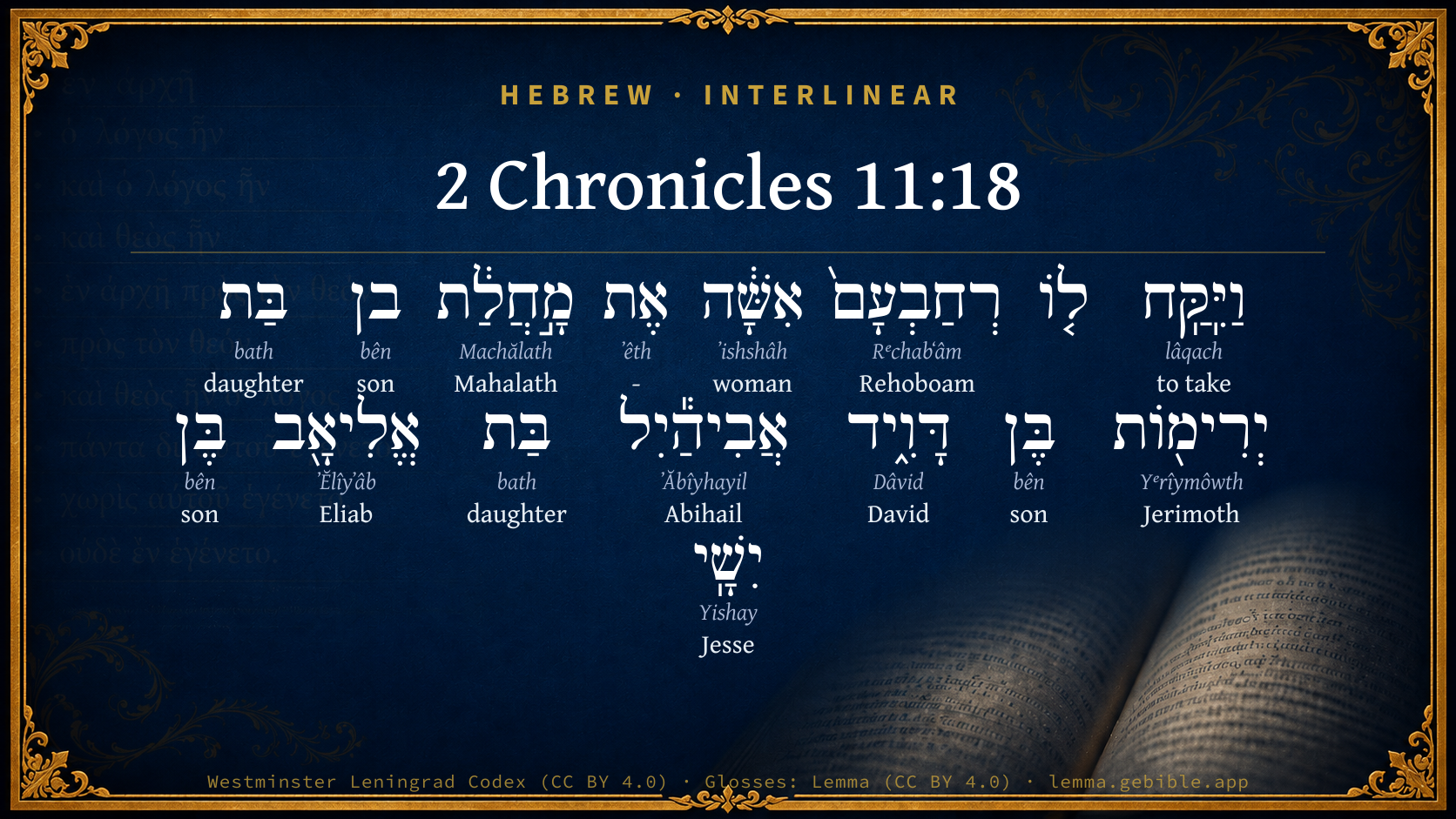
2 Chronicles 11:18

Hebrew (Westminster Leningrad Codex) 2 Chronicles 11:18 appears in the Hebrew Old Testament. The text above is from the Westminster Leningrad Codex. Each word links to its Strong’s number, a concise gloss, and parsing drawn from the Open Scriptures Hebrew Bible morphology. Click any word for its full Brown-Driver-Briggs (BDB) entry.
Download image
Cite this verse

2 Chronicles 11:18 (World English Bible). Public Domain. Lemma interlinear Bible study tool, https://lemma.gebible.app/v/2-chronicles/11/18.

Show BibTeX & RIS
BibTeX
RIS
English Translation
Rehoboam took him a wife, Mahalath the daughter of Jerimoth the son of David, [and of] Abihail the daughter of Eliab the son of Jesse;
World English Bible · Public Domain
Download a study sheet

One document with this verse’s original text, its word-by-word gloss line, the meaning frame, cross-references with their text, attributed commentary, and full source and license credits — printable, and it pastes into notes with its structure intact.

This verse Autodidact and up

Study sheet (.html) Plain text (.txt)

A passage Seminary Student

Up to 50 verses in one chapter. A passage sheet keeps up to 6 commentary sources and 12 cross-references per verse, in the order this page ranks them, and says so on the sheet whenever that leaves anything out. Ask for a single verse and you get the Autodidact verse sheet above.

Everything on this page stays free to read, with no account — the sheet is a download of what is already on screen, not access to it.

Want to remove ads? Support Godless Engineer
Compare translations 3

The same verse in 3 English versions, stacked beneath the original-language interlinear above. Click any original word for its lexicon entry.

Each is an independent rendering of the whole verse — the interlinear is not word-aligned to these translations.

Highlighted words mark where these versions differ — a whole-verse word diff, not a word-by-word alignment.

  • World English Bible Public Domain
    Rehoboam took him a wife, Mahalath the daughter of Jerimoth the son of David, [and of] Abihail the daughter of Eliab the son of Jesse;
  • King James Version Public Domain
    And Rehoboam took him Mahalath the daughter of Jerimoth the son of David to wife, and Abihail the daughter of Eliab the son of Jesse;
  • unfoldingWord Literal Text CC BY-SA 4.0
    And Rehoboam took for himself a wife: Mahalath, the daughter of Jerimoth, the son of David, Abihail, the daughter of Eliab, the son of Jesse.

unfoldingWord Literal Text — © unfoldingWord, licensed CC BY-SA 4.0. Word-aligned USFM3 via Door43 (git.door43.org/unfoldingWord/en_ult).

Versions to compare (up to 4)

3 of 4 selected

Show all 18 translations

Every available English version of this verse, each an independent rendering of the whole verse.

  • World English Bible Public Domain
    Rehoboam took him a wife, Mahalath the daughter of Jerimoth the son of David, [and of] Abihail the daughter of Eliab the son of Jesse;
  • Berean Standard Bible Public Domain
    And Rehoboam married Mahalath, who was the daughter of David’s son Jerimoth and of Abihail, the daughter of Jesse’s son Eliab.
  • Majority Standard Bible Public Domain
    And Rehoboam married Mahalath, who was the daughter of David’s son Jerimoth and of Abihail, the daughter of Jesse’s son Eliab.
  • King James Version Public Domain
    And Rehoboam took him Mahalath the daughter of Jerimoth the son of David to wife, and Abihail the daughter of Eliab the son of Jesse;
  • American Standard Version (1901) Public Domain
    And Rehoboam took him a wife, Mahalath the daughter of Jerimoth the son of David, `and of' Abihail the daughter of Eliab the son of Jesse;
  • Revised Version (1885) Public Domain
    And Rehoboam took him a wife; Mahalath the daughter of Jerimoth the son of David, and of Abihail the daughter of Eliab the son of Jesse;
  • Geneva Bible (1599) Public Domain
    And Rehoboam tooke him Mahalath ye daughter of Ierimoth the sonne of Dauid to wife, and Abihail the daughter of Eliab the sonne of Ishai,
  • Douay-Rheims (1899) Public Domain
    And Roboam took to wife Mahalath, the daughter of Jerimoth the son of David: and Abihail the daughter of Eliab the son of Isai.
  • Young's Literal Translation Public Domain
    And Rehoboam taketh to him a wife, Mahalath, child of Jerimoth son of David, `and' Abigail daughter of Eliab, son of Jesse.
  • Literal Standard Version CC BY-SA 4.0
    And Rehoboam takes a wife for himself, Mahalath, child of Jerimoth son of David, [and of] Abigail daughter of Eliab son of Jesse.
  • Unlocked Literal Bible CC BY-SA 4.0
    Rehoboam took a wife for himself: Mahalath, the daughter of Jerimoth, David's son, and of Abihail, the daughter of Eliab, Jesse's son.
  • unfoldingWord Literal Text CC BY-SA 4.0
    And Rehoboam took for himself a wife: Mahalath, the daughter of Jerimoth, the son of David, Abihail, the daughter of Eliab, the son of Jesse.
  • Darby Bible Public Domain
    And Rehoboam took Mahalath the daughter of Jerimoth the son of David as wife, [and of] Abihail the daughter of Eliab the son of Jesse.
  • World Messianic Bible Public Domain
    Rehoboam took a wife for himself, Mahalath the daughter of Jerimoth the son of David and of Abihail the daughter of Eliab the son of Jesse.
  • Webster's Bible Public Domain
    And Rehoboam took to himself Mahalath the daughter of Jerimoth the son of David for a wife, and Abihail the daughter of Eliab the son of Jesse;
  • Free Bible Version CC BY-SA 4.0
    Rehoboam married Mahalath, who was the daughter of David's son Jerimoth and of Abihail, the daughter of Eliab, son of Jesse.
  • Bible in Basic English Public Domain
    And Rehoboam took as his wife Mahalath, the daughter of Jerimoth, the son of David and of Abihail, the daughter of Eliab, the son of Jesse;
  • JPS Tanakh (1917) Public Domain
    And Rehoboam took him a wife, Mahalath the daughter of Jerimoth the son of David, and of Abihail the daughter of Eliab the son of Jesse;

Literal Standard Version (2020), Covenant Press — licensed CC BY-SA 4.0. Text via the HelloAO Bible API (eBible.org). Unlocked Literal Bible (unfoldingWord) — licensed CC BY-SA 4.0. Text via the HelloAO Bible API (eBible.org). unfoldingWord Literal Text — © unfoldingWord, licensed CC BY-SA 4.0. Word-aligned USFM3 via Door43 (git.door43.org/unfoldingWord/en_ult). Free Bible Version, Dr. Jonathan Gallagher — licensed CC BY-SA 4.0. Text via the HelloAO Bible API (eBible.org).

Word by word

More ways to search: Search by grammar → Find every occurrence → Compare this word →

Practice this passage: Drill this verse → Learn its vocabulary →

מָ֣חֲלַ֔ת
Machălath
H4258
“Mahalath”
Noun, Proper
Part of Speech
Noun
Type
Proper
Full BDB Definition

Origin: the same as H4257

TWOT: None

Mahalath = "stringed instrument" - daughter of Jerimoth son of king David and wife, evidently the - daughter of Ishmael and wife of Esau
  1. וַיִּֽקַּֽח lâqach H3947 “and · to take” Conjunction + Verb, Qal, Sequential Imperfect, 3rd Person, Masculine, Singular
  2. רְחַבְעָם֙ Rᵉchabʻâm H7346 “Rehoboam” Noun, Proper
  3. אִשָּׁ֔ה ʼishshâh H802 “woman” Noun, Common, Feminine, Singular, Absolute
  4. אֶת ʼêth H853 “-” Particle, Direct Object
  5. בן bên H1121 “son of” Noun, Common, Masculine, Singular, Construct
  6. בַּת bath H1323 “daughter of” Noun, Common, Feminine, Singular, Construct
  7. יְרִימ֖וֹת Yᵉrîymôwth H3406 “Jerimoth” Noun, Proper
  8. בֶּן bên H1121 “son of” Noun, Common, Masculine, Singular, Construct
  9. דָּוִ֑יד Dâvid H1732 “David” Noun, Proper
  10. אֲבִיהַ֕יִל ʼĂbîyhayil H32 “Abihail” Noun, Proper
  11. בַּת bath H1323 “daughter of” Noun, Common, Feminine, Singular, Construct
  12. אֱלִיאָ֖ב ʼĔlîyʼâb H446 “Eliab” Noun, Proper
  13. בֶּן bên H1121 “son of” Noun, Common, Masculine, Singular, Construct
  14. יִשָֽׁי Yishay H3448 “Jesse” Noun, Proper

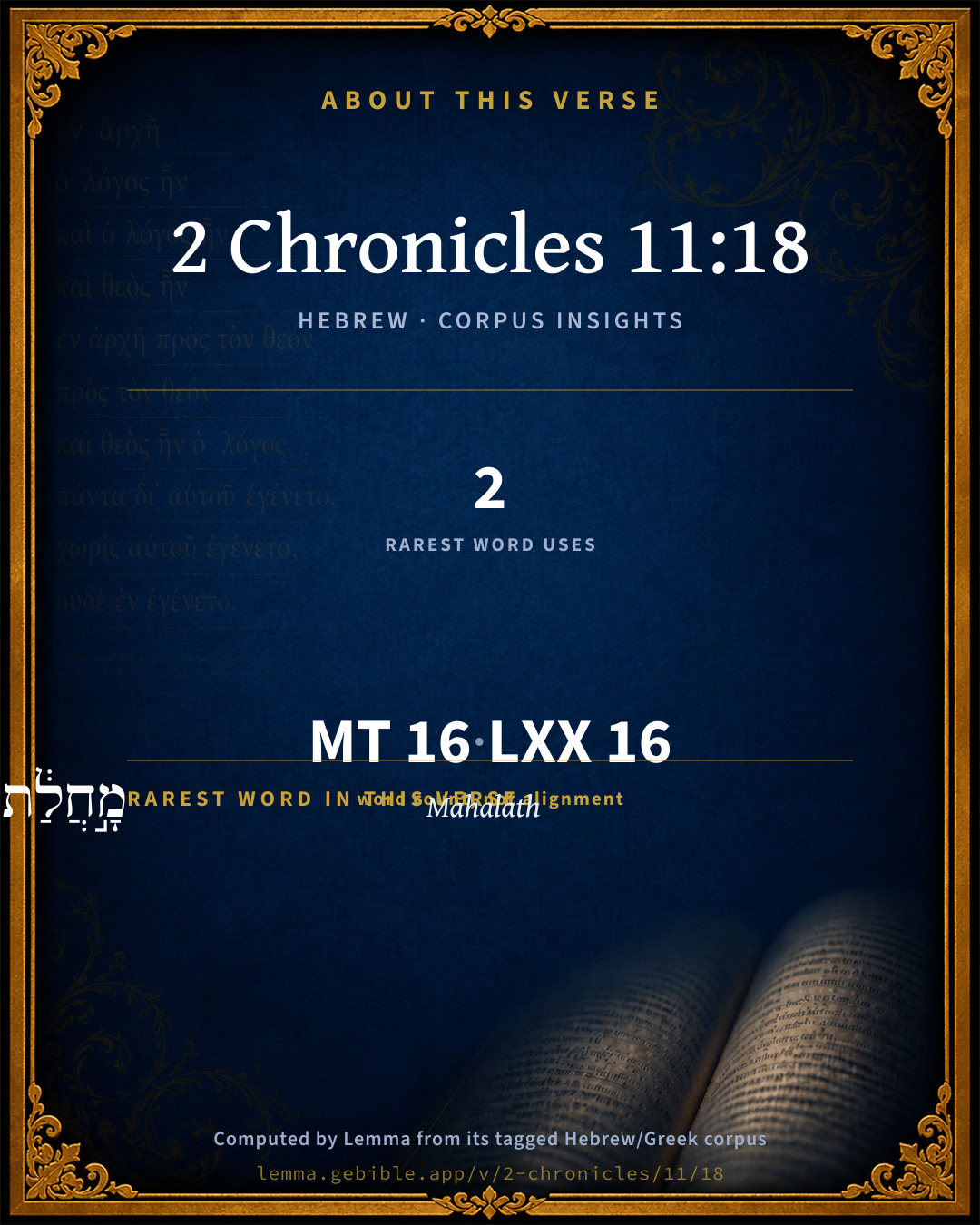
About this verse

These counts appear in no published source. They are computed here, from the morphology-tagged text and Lemma’s own curated glosses. What Lemma adds →

16
words
12
distinct lemmas
Historical
section

Notable vocabulary

The rarest word here is מָ֣חֲלַ֔ת Mahalath H4258 — appearing just 2 times in the whole Hebrew Bible.

Shared distinctive vocabulary

מָ֣חֲלַ֔ת Mahalath H4258 occurs in 2 verses of the Hebrew Bible. Also found in:

Grammatical profile

  • 1 verb
  • 13 nouns
  • 1 preposition
  • 1 particle

Verb forms

  • וַיִּֽקַּֽח Qal · Sequential Imperfect

Repetition

Words recur within this verse — often emphatic in Hebrew:

Hebrew & Septuagint length

In English translation the verse runs 25 words from the Hebrew and 25 from the Septuagint (LXX English) — the same length.

A rough comparison of the two English renderings, which tokenize alike — not a word-level alignment.

Word counts can differ between the Hebrew and the Greek without any difference in meaning — e.g. the Hebrew direct-object marker אֵת has no separate Greek word, and Greek often adds the article ὁ.

In the original languages it is 16 Hebrew tokens and 16 Greek tokens — but the two are counted differently (Hebrew bundles its prefixes and suffixes into one token; the Greek is in lemma form), so that isn’t a like-for-like length.

Cross-references

5

Topical passages linked to 2 Chronicles 11:18 in the Treasury of Scripture Knowledge — connected by theme and wording, ordered by reader-vote popularity; previews shown in the World English Bible.

  • 1 Samuel 16:6 It happened, when they had come, that he looked at Eliab, and said, Surely Yahweh's anointed is before him.
  • 1 Samuel 17:13 The three eldest sons of Jesse had gone after Saul to the battle: and the names of his three sons who went to the battle were Eliab the firstborn, and next to him Abinadab, and the third Shammah.
  • 1 Samuel 17:28 Eliab his eldest brother heard when he spoke to the men; and Eliab's anger was kindled against David, and he said, Why are you come down? and with whom have you left those few sheep in the wilderness? I know your pride, and the naughtiness of your heart; for you have come down that you might see the battle.
  • 1 Chronicles 27:18 of Judah, Elihu, one of the brothers of David: of Issachar, Omri the son of Michael:
  • 1 Chronicles 2:13 and Jesse became the father of his firstborn Eliab, and Abinadab the second, and Shimea the third,

Cross-references courtesy of OpenBible.info (CC BY 4.0).

Hebrew and Greek witnesses Masoretic Hebrew ↔ Greek Septuagint

The same verse in the two great witnesses to the Old Testament, shown verse-for-verse.

These are two independent witnesses, not word-aligned to each other, and the Septuagint is shown in lemma (dictionary) form.

Hebrew 2 Chronicles 11:18 Masoretic · Westminster Leningrad Codex

וַיִּֽקַּֽח ל֤וֹ רְחַבְעָם֙ אִשָּׁ֔ה אֶת מָ֣חֲלַ֔ת בן בַּת יְרִימ֖וֹת בֶּן דָּוִ֑יד אֲבִיהַ֕יִל בַּת אֱלִיאָ֖ב בֶּן יִשָֽׁי

Rehoboam took him a wife, Mahalath the daughter of Jerimoth the son of David, [and of] Abihail the daughter of Eliab the son of Jesse;

World English Bible · Public Domain

Greek LXX 2 Chronicles 11:18 Septuagint · lemma form

καί λαμβάνω ἑαυτοῦ ροβοαμ γυνή ὁ μολλαθ θυγάτηρ ιεριμουθ υἱός δαυίδ αβαιαν θυγάτηρ ελιαβ ὁ ιεσσαι

And Roboam took to himself for a wife, Moolath daughter of Jerimuth the son of David, and Abigaia daughter of Heliab the son of Jessae.

LXX2012 (modern English Septuagint) · Public Domain

On this verse, Ellicott's Commentary for English Readers discusses the Septuagint’s reading. Read the note in Commentary ↓

Hebrew: Westminster Leningrad Codex (CC BY 4.0). Greek: Septuagint (public domain); English from LXX2012 (modern English Septuagint) (Public Domain). How the Septuagint differs from the Hebrew →

Commentary

Notes on 2 Chronicles 11:18 from classic Christian and Jewish commentators (each source and its license shown beneath its notes). The classic Christian expositions comment on the surrounding passage and are grouped to its opening verse, so a note may address several verses; the Jewish commentaries on the Tanakh (Rashi and others) are per-verse, so they appear only where the commentator wrote on this verse.

Lemma curates 59 commentaries, every one of them public domain or Creative Commons licensed, each selected and text-cleaned for this edition rather than reprinted as found. About our sources →

Jamieson, Fausset & Brown

Robert Jamieson, A. R. Fausset & David Brown

HIS WIVES AND CHILDREN. (Ch2 11:18-23)

Rehoboam took Mahalath--The names of her father and mother are given. Jerimoth, the father, must have been the son of one of David's concubines (Ch1 3:9). Abihail was, of course, his cousin, previous to their marriage.

Jamieson, Fausset & Brown — Commentary Critical and Explanatory on the Whole Bible (1871) — public domain (CC PDM 1.0). Text via the HelloAO Bible API.

Ellicott's Commentary for English Readers

PARTICULAES CONCERNING REHOBOAM’S FAMILY

(2Ch_11:18-23).

This record also is wanting in the Book of Kings. It appears to have been derived from the sources designated in 2Ch_12:15.

(18) The daughter.—So rightly, LXX., Vulg., and many Hebrew MSS. for the ordinary reading son.

Of Jerimoth the son of David—Jerimoth does not occur in the list of David’s sons (1Ch_3:1-8), unless we suppose the name to be a corruption of “Ithream.” Probably he was one of “the sons of the concubines” (1Ch_3:9).

And Abihail.—The and is not in the present Hebrew text, but is supplied by the LXX. “And of Abihail” is probably the meaning, so that both of Mahalath’s parents are named. The LXX. and Vulg. make Abihail a second wife of Rehoboam; but 2Ch_11:19-20, as well as the construction of the sentence, make it evident that only one wife is mentioned here. A daughter of David’s eldest brother could hardly become the wife of David’s grandson.

Eliab the son of Jesse.—1Sa_17:13; 1Ch_2:13.

A Bible Commentary for English Readers, edited by Charles John Ellicott (1878–1897) — public domain. Text from a community e-Sword module.

Trapp's Complete Commentary

John Trapp

2Ch 11:18 And Rehoboam took him Mahalath the daughter of Jerimoth the son of David to wife, [and] Abihail the daughter of Eliab the son of Jesse;

Ver. 18. The daughter of Jerimoth the son of David.] By some concubine likely. See 1Ch 3:9.

The daughter of Eliab.] All his three wives here mentioned were of David’s family, and of his own kindred.

John Trapp, A Commentary or Exposition upon All the Books of the Old and New Testament (1647–1656) — public domain. Text from a community e-Sword module.

Tyndale Open Study Notes

Tyndale Open Resources

11:18-22 The numbers of Rehoboam’s wives and children are probably the total from his entire reign rather than those accumulated by his fifth year. Rehoboam loved his second wife more than his first, so he violated the right of primogeniture (inheritance belonging to the firstborn son, Deut 21:15-17) by making Abijah . . . the next king in what might have been co-regency. This action secured an orderly succession.

Tyndale Open Study Notes — © Tyndale Open Resources, licensed CC BY-SA 4.0. Text via the HelloAO Bible API.

Adam Clarke's Commentary

Verse 18. Took him Mahalath] By marrying thus in the family of David, he strengthened his right to the Jewish throne.

Adam Clarke's Commentary on the Bible (1810–1826) — public domain. Text from a community e-Sword/MySword module.

The Cambridge Bible for Schools and Colleges

gen. ed. J. J. S. Perowne

18. Jerimoth] Nothing is known regarding a son of David of this name. He may have been the son of a concubine (1Ch_3:9).

and Abihail] R.V. and of Abihail. The verse accordingly speaks of one wife only, Mahalath, whose parents were Jerimoth and Abihail. The verb in 2Ch_11:19 is in the singular; cp. 2Ch_11:20 (after her).

Eliab] David’s eldest brother; 1Sa_16:6; 1Sa_17:13.

The Cambridge Bible for Schools and Colleges (gen. ed. J. J. S. Perowne; Cambridge University Press, 1878–1918) — public domain. Text from a community e-Sword module.

John Gill's Exposition

And after he took Maacah the daughter of Absalom,.... Thought by some to be Absalom the son of David, his father's brother, and his uncle, and so married his cousin; but Absalom seems to have had but one daughter, whose name was Tamar, Sa2 14:27, and the name of this man is different from his; he is called Abishalom, Kg1 15:2.

and Uriel of Gibeah; Ch2 13:2, of the tribe of Benjamin, whereas Absalom was of the tribe of Judah:

which bare him Abijah, and Attai, and Ziza, and Shelomith: Abijah the firstborn, and who was successor in the kingdom, is the same with Abijam, Kg1 14:31 of the rest we nowhere else read.

John Gill's Exposition of the Whole Bible (1746–1763) — public domain (CC PDM 1.0). Text via the HelloAO Bible API.

Albert Barnes' Notes on the Bible

This is probably an extract from the “genealogies” of Iddo 2Ch 12:15.

As Jerimoth is not mentioned among the legitimate sons of David 1Ch 3:1-8; 1Ch 14:4-7, he must have been the child of a concubine.

Abihail was probably the “grand-daughter,” not “daughter,” of Eliab 1Sa 16:6; 1Sa 17:13; 1Ch 2:13.

Albert Barnes' Notes on the Bible (1834–1885) — public domain. Text from a community e-Sword/MySword module.

Haydock's Catholic Bible Commentary

Daughter. Hebrew ban, "the son." But bath, "daughter," (Haydock) occurs properly in some manuscripts, as in the ancient versions. Leusden has here this very odd note: "perhaps by ban, (with a pathah) here both sexes may be understood." Forte per ban hic intelligitur uterque sexus. (Kennicott) --- Protestants substitute, "daughter." (Haydock)

George Leo Haydock (1774–1849), Haydock's Catholic Family Bible and Commentary, 1859 edition — public domain. Excludes Psalms (Douay-Rheims chapter numbering differs from Protestant) and Deuterocanonical books (Catholic canon only).

Whedon's Commentary on the Bible

Daniel D. Whedon

18. Jerimoth the son of David — Since Jerimoth is nowhere else mentioned among the sons of David, he is generally supposed to have been a son of one of David’s concubines.

Daniel D. Whedon (gen. ed.), Commentary on the Old and New Testaments (1874–1909) — public domain. Text from a community e-Sword module.

The Pulpit Commentary

The "Speaker"s Commentary" opportunely suggests the probability that we may be indebted here to Iddo"s "genealogies". (2Ch_12:15) The word daughter here is a correction of the Keri, the Chethiv having been "son," This Jerimoth is the seventh out of a list of eight men of the same name mentioned in the two books of Chronicles. He is not given as one of the children of David"s proper wives in either 1Ch_3:1-8 or 1Ch_14:4-7; Jerome says it was the Jewish tradition that he was the son of a concubine of David. It is just possible that Jerimoth and Ithream were two names of the same person. Abihail was second cousin of Mahalath. It is not quite clear whether Abihail were wife of Jerimoth and mother of Mahalath, or a second wife now mentioned of Rehoboam. The contents of the next verse not differencing the children there mentioned, and assigning her own to each wife of Rehoboam, if these were two wives of his, favours the former supposition (our Hebrew text being "and she bare," not "which bare"). When it is said that Abthail was the daughter of Eliab, the meaning probably is, as again in ver. 20, granddaughter. (For Eiiab, see 1Sa_16:6 1Sa_17:13; 1Ch_2:13)

Vers. 18-23.

Spiritual admixture.

After reading the first fourteen verses of the last chapter (ch. 10.), we hardly expect to come across the words, concerning Rehoboam, and he dealt wisely (ver. 23). But this king, though he could certainly be very foolish, was not all folly; like most men, he was a spiritual admixture. We look at

I THE SINGULAR SPIRITUAL ADMIXTURE WE FIND IN HIM. The account we have of him is not a long one; it is contained in two or three short chapters, but in these we count seven wise and four foolish actions. We find him (see above)very wise in taking time and in consulting others before giving an important decision on a critical occasion; most foolish in heeding the counsel of the young men; foolish in sending his minister that "was over the tribute" amongst those who were complaining bitterly of their taxation; (2Ch_10:18) wise in hearkening to and heeding the Divine prohibition of war (ver. 4); wise in fortifying and storing the strongholds on the frontier (vers. 5-12); wise in welcoming to Judah the priests and people whom Jeroboam had driven away; very foolish indeed in "desiring many wives" (ver. 23) and in establishing so large a harem (ver. 21); wise in choosing so many from the stock of David and in dispersing his sons about his small kingdom, where they could not quarrel among themselves, but be of some service to him; wise in "walking in the way of David" (ver. 17); foolish in departing therefrom after three years of obedience.

II THE SPIRITUAL ADMIXTURE THERE IS IN US. We find that good men have:

1. Those virtues and failings which seem to go together. They have, as wesay, "the faults of their virtues." With much strength and earnestness goes severity in the judgment of other people; with much meekness goes inactivity; with much vivacity and picturesqueness of style goes laxity, if not unveraciousness; with much good-naturedness goes carelessness, etc.

2. Failings which do not naturally accompany virtues. Of some good manwhose general integrity we cordially acknowledge, whose excellency and usefulness (perhaps) we even admire, we have to admit reluctantly that he is very vain, or very proud, or very blunt, or very careless; or we have to confess that there is some other defect in his character, perhaps more than one shortcoming. In truth, we have to confront the truths, viz.:

1. That Christian character is an admixture. It is good not unmarked withevil; it is rectitude not without some occasional swerving to the right hand or to the left; it is rather an earnest aspiration or an honest and devout endeavour than a complete attainment; it is a battle that will end in victory, but it is not (yet) the victory; it is a race, and not the runner clasping the goal and receiving the prize.

2. That it behoves us to take heed how we judge. One failing does not unchristianize a character; it is what is in the depth, and not what is on the surface, that decides our position; the "spirit we are of," and not the proprieties of behaviour.

3. That we do well to consider how much alloy is mixed with the pure goldof our own character. C.

Vers. 18-23.

A royal polygamist.

I REHOBOAM"S WIVES.

1. The number of them. In all eighteen wives and sixty concubines. Solomon had seven hundred wives, princesses, and three hundred concubines. (1Ki_11:3) David even had more wives and concubines than was good for him. (2Sa_3:2-5 2Sa_5:13 2Sa_12:8) Oriental monarchs generally had well-filled harems. Rameses II had a hundred and nineteen children (sixty sons and fifty-nine daughters), "which gives ground for supposing a great number of concubines, besides his lawful wives" (Brugsch, vol. 2. p. 115). Poly- gamy was also permitted to, and practised by, the monarchs of Assyria, whose palaces accordingly were guarded by a whole army of eunuchs Sayce, "Assyria, its Princes, Priests, and People," p. 129).

2. The chief of them.

(1) "Mahalath, the daughter of David"s son Jerimoth," who was probably a son of one of David"s concubines, as Jerimoth is wanting in the list of David"s sons; (1Ch_3:1-8) "Abihail, the daughter of Eliab, the son of Jesse", (1Ch_2:13) is not a second wife of Rehoboam"s (LXX) as the words "which bare" (ver. 19) and "after her" (ver. 20) show, but Mahalath"s mother, who was thus David"s niece, as Mahalath"s father was David"s grandson. Mahalath was probably the first wedded of Rehoboam"s spouses.

(2) "Maachah, the daughter of Absalom." Called also "Micaiah, the daughter of Uriel of Gibeah" (ch. 13:2), or of Abishalom, (1Ki_15:2) Maachah was probably the daughter of Tamar, whose husband was the above Uriel or Abishalom, and whose father was Absalom. (2Sa_14:27) If Mahalath was the first of Rehoboam"s wives, Maachah

was the favourite, probably on account of beauty and fascinating manners inherited from her grandfather. (2Sa_14:25 2Sa_15:6)

II REHOBOAM"S CHILDREN.

1. The number of his sons. Twenty-eight, among whom were

(1) the sons of Mahalath, nowhere else mentioned, "Jeush, Shamariah, and Zaham," men not distinguished for their own sakes, and hardly worthy of further notice for their father"s sake; and

(2) the sons of Maachah, "Abijah, or Abijam, (1Ki_15:1) and Attai, and Ziza, and Shelomith," of whom only the first emerged from obscurity. Rehoboam"s daughters are not named, but only numbered. In those days woman had not attained the place which was her due, and which has since been assigned her by Christianity.

2. The favourite amongst his sons. Abijah. Though not the firstborn, Rehoboam designated him as successor to the throne, no doubt to the injury and displeasure of the firstborn; but in doing so, if he obeyed not the, (Deu_21:16) he at least followed the example of David, who preferred Bathsheba"s son Solomon to the throne, instead of his firstborn, Amnon the son of Ahinoam the Jezreelitess. He also made Abijah ruler among his brethren, set him at their head, appointed him as governor over them in the various state offices they held, and entrusted to him the crown treasures and the strongest cities (Josephus, "Ant.," 8:10. 1).

3. The treatment of his other sons. He "dealt wisely" with them.

(1) He dispersed them abroad among the different garrison cities, giving them commands in these, so that by their separation from one another and their occupation with military duties they might have neither time nor opportunity to conspire with Jeroboam, or any other monarch, against Abijah or himself.

(2) He provided for them abundant maintenance, i.e. a living suitable to their princely rank, so that no temptation to discontent might assail them. Rehoboam probably knew that if his sons had their bellies well filled their souls would be at ease.

(3) He sought for them many wives. Whether these were chosen out of the different districts where the sons held commands, in order to bring his sons into closer connection with the inhabitants of the same (Ewald, "History of Israel," vol. 4. p. 47), the certainty is that the practice of polygamy in which he encouraged them would not tend to increase their warlike energy.

LESSONS.

1. The misery as well as sin of polygamy, leading as it does to dividedaffections and unjustifiable partialities.

2. The duty of dealing wisely with children, but not after the fashion ofRehoboam. W.

The Pulpit Commentary (1880–1919), ed. H.D.M. Spence-Jones & Joseph S. Exell — public domain. Text from a community e-Sword module.

unfoldingWord translationNotes

Door43 World Missions Community

Mahalath ... Abihail

These are the names of women. (See: How to Translate Names)

Jerimoth ... Eliab ... Jeush, Shemariah, and Zaham

These are the names of men. (See: How to Translate Names)

translationWords

Jesse

unfoldingWord translationNotes — © Distant Shores Media and the Door43 World Missions Community, licensed CC BY-SA 4.0. Source: git.door43.org/Door43/en_tn.

Rashi

Rabbi Shlomo Yitzchaki (Rashi)

Abihail the daughter of Eliab Like: and Abihail, similar to (Jer. 11:19): “And I was like a lamb and a bull (כְּכֶבֶשׂ אַלּוּף).” The following was the reason that Samuel the seer erred when Jesse passed Eliab before Samuel, and he [Samuel] said, (I Sam. 16:6): “Surely before the Lord is His anointed.” This is the one about whom the Holy One, blessed be He, is destined to say, “Arise, anoint him, for this is he.” But Samuel erred about him, for he saw Eliab’s daughter as Rehoboam’s wife, the queen, and because of the following matter, Samuel was punished: When Saul asked him, (ibid. 9: 18) “Which is the house of the seer?” Samuel replied, “I am the seer,” in which case he did not answer him with humility, saying, “What do you wish.” [Therefore,] the Holy One, blessed be He, said to him, “By your life, you are destined to see, and you will not know what you see,” for he erred concerning Eliab and his daughter the queen.

Rashi on the Tanakh — English translations: “The Judaica Press complete Tanach with Rashi, translated by A. J. Rosenberg” (CC BY 4.0); “Pentateuch with Rashi's commentary by M. Rosenbaum and A.M. Silbermann, 1929-1934” (public domain); “The Metsudah Tanach series, Lakewood, N.J” (CC BY 4.0); and “The Book of Joshua, Metsudah Publications, 1997” (CC BY 4.0). Text via Sefaria.

Lesson kit

Teaching starters — assembled from the data on this page, not authored interpretation. Every prompt links to the verse data it draws on. Edit before teaching.

2 Chronicles, in the Historical, opens this verse with 16 words (12 distinct Hebrew lemmas). Its most distinctive word is Machălath (“Mahalath”). A historical commentator’s framing appears above. Read the whole chapter for the surrounding context.

Discussion questions

  1. The word Machălath carries the sense “Mahalath.” How does it shape the verse?
  2. How does Genesis 28:9, which shares the word «Mahalath», read alongside this verse?
  3. What does the repetition of “son” (3× in this one verse) do in this verse?
  4. These translations render this verse differently; the difference is in the English rendering, not the original. What questions does that raise?
  5. «וַיִּֽקַּֽח» is a Qal Sequential Imperfect verb. How does that grammatical form shape the action described?
  6. Compare how Jamieson, Fausset & Brown and Ellicott's Commentary for English Readers read this verse. Where do they agree or differ?

Things to notice

Reading settings

Reading text

Shown beneath each verse's original-language words.

Old Testament
Old Testament edition

Read the OT as the Masoretic Hebrew (MT) or the Greek Septuagint (LXX).

English shown for the Greek Septuagint (in the Hebrew ↔ Greek comparison).

Comparing translations? Open the Compare panel on any verse page to stack up to four side by side.