
1 Chronicles 21:25

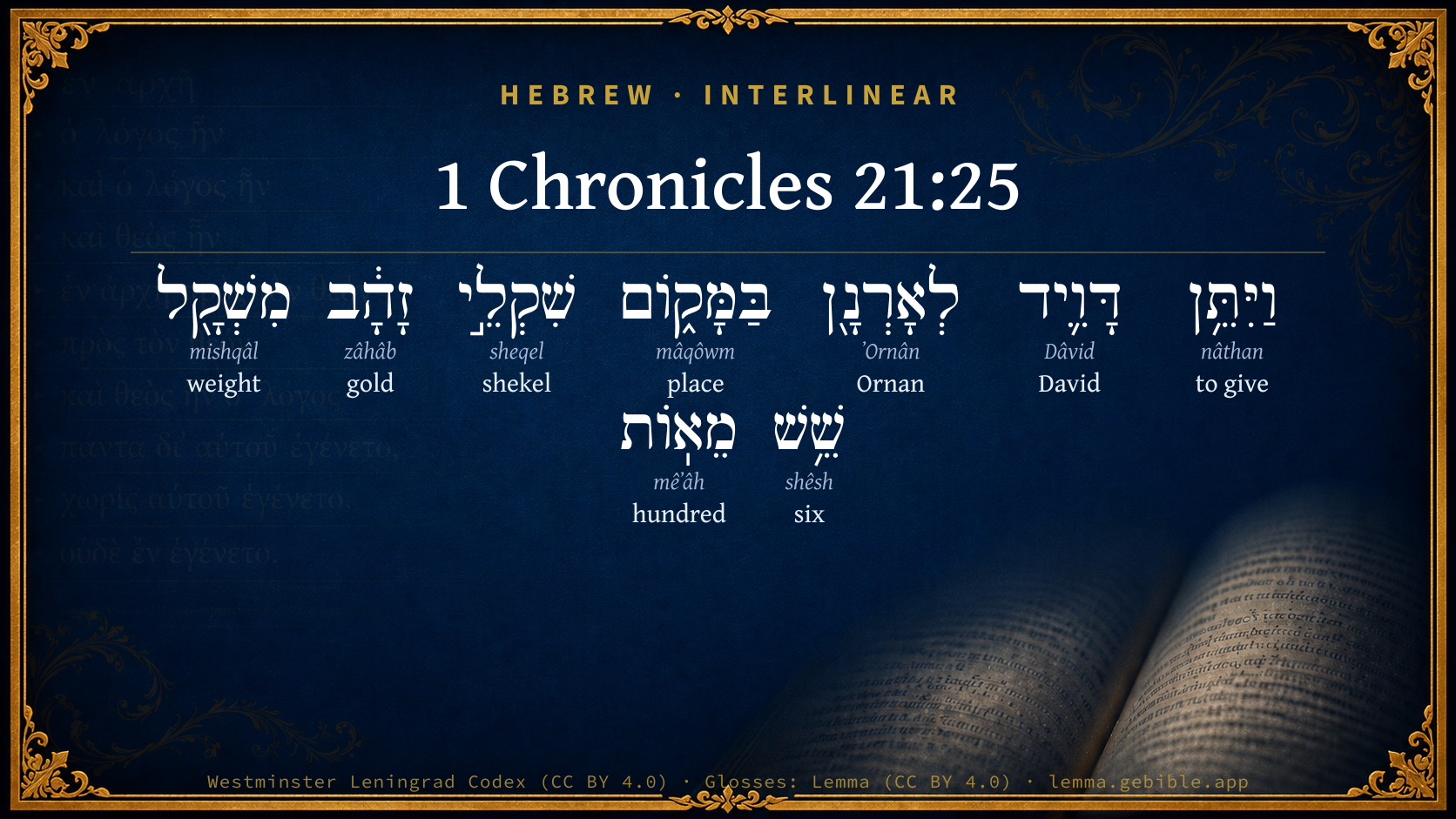
Hebrew (Westminster Leningrad Codex) 1 Chronicles 21:25 appears in the Hebrew Old Testament. The text above is from the Westminster Leningrad Codex. Each word links to its Strong’s number, a concise gloss, and parsing drawn from the Open Scriptures Hebrew Bible morphology. Click any word for its full Brown-Driver-Briggs (BDB) entry.
Download image
Cite this verse

1 Chronicles 21:25 (World English Bible). Public Domain. Lemma interlinear Bible study tool, https://lemma.gebible.app/v/1-chronicles/21/25.

Show BibTeX & RIS
BibTeX
RIS
English Translation
So David gave to Ornan for the place six hundred shekels of gold by weight.
World English Bible · Public Domain
Download a study sheet

One document with this verse’s original text, its word-by-word gloss line, the meaning frame, cross-references with their text, attributed commentary, and full source and license credits — printable, and it pastes into notes with its structure intact.

This verse Autodidact and up

Study sheet (.html) Plain text (.txt)

A passage Seminary Student

Up to 50 verses in one chapter. A passage sheet keeps up to 6 commentary sources and 12 cross-references per verse, in the order this page ranks them, and says so on the sheet whenever that leaves anything out. Ask for a single verse and you get the Autodidact verse sheet above.

Everything on this page stays free to read, with no account — the sheet is a download of what is already on screen, not access to it.

Want to remove ads? Support Godless Engineer
Compare translations 3

The same verse in 3 English versions, stacked beneath the original-language interlinear above. Click any original word for its lexicon entry.

Each is an independent rendering of the whole verse — the interlinear is not word-aligned to these translations.

Highlighted words mark where these versions differ — a whole-verse word diff, not a word-by-word alignment.

  • World English Bible Public Domain
    So David gave to Ornan for the place six hundred shekels of gold by weight.
  • King James Version Public Domain
    So David gave to Ornan for the place six hundred shekels of gold by weight.
  • unfoldingWord Literal Text CC BY-SA 4.0
    And David gave to Ornan 600 shekels of gold by weight for the place.

unfoldingWord Literal Text — © unfoldingWord, licensed CC BY-SA 4.0. Word-aligned USFM3 via Door43 (git.door43.org/unfoldingWord/en_ult).

Versions to compare (up to 4)

3 of 4 selected

Show all 18 translations

Every available English version of this verse, each an independent rendering of the whole verse.

  • World English Bible Public Domain
    So David gave to Ornan for the place six hundred shekels of gold by weight.
  • Berean Standard Bible Public Domain
    So David paid Ornan six hundred shekels of gold for the site.
  • Majority Standard Bible Public Domain
    So David paid Ornan six hundred shekels of gold for the site.
  • King James Version Public Domain
    So David gave to Ornan for the place six hundred shekels of gold by weight.
  • American Standard Version (1901) Public Domain
    So David gave to Ornan for the place six hundred shekels of gold by weight.
  • Revised Version (1885) Public Domain
    So David gave to Ornan for the place six hundred shekels of gold by weight.
  • Geneva Bible (1599) Public Domain
    So Dauid gaue to Ornan for that place sixe hundreth shekels of golde by weight.
  • Douay-Rheims (1899) Public Domain
    And king David said to him: It shall not be so, but I will give thee money as much se it is worth: for I must not take it from thee, and so offer to the Lord holocausts free cost.
  • Young's Literal Translation Public Domain
    And David giveth to Ornan for the place shekels of gold `in' weight six hundred;
  • Literal Standard Version CC BY-SA 4.0
    And David gives to Ornan six hundred shekels of gold [in] weight for the place;
  • Unlocked Literal Bible CC BY-SA 4.0
    So David paid six hundred shekels of gold for the place.
  • unfoldingWord Literal Text CC BY-SA 4.0
    And David gave to Ornan 600 shekels of gold by weight for the place.
  • Darby Bible Public Domain
    And David gave to Ornan for the place in shekels of gold the weight of six hundred [shekels].
  • World Messianic Bible Public Domain
    So David gave to Ornan six hundred shekels of gold by weight for the place.
  • Webster's Bible Public Domain
    So David gave to Ornan for the place six hundred shekels of gold by weight.
  • Free Bible Version CC BY-SA 4.0
    So David paid Ornan six hundred shekels of gold for the place.
  • Bible in Basic English Public Domain
    So David gave Ornan six hundred shekels of gold by weight for the place.
  • JPS Tanakh (1917) Public Domain
    So David gave to Ornan for the place six hundred shekels of gold by weight.

Literal Standard Version (2020), Covenant Press — licensed CC BY-SA 4.0. Text via the HelloAO Bible API (eBible.org). Unlocked Literal Bible (unfoldingWord) — licensed CC BY-SA 4.0. Text via the HelloAO Bible API (eBible.org). unfoldingWord Literal Text — © unfoldingWord, licensed CC BY-SA 4.0. Word-aligned USFM3 via Door43 (git.door43.org/unfoldingWord/en_ult). Free Bible Version, Dr. Jonathan Gallagher — licensed CC BY-SA 4.0. Text via the HelloAO Bible API (eBible.org).

Word by word

More ways to search: Search by grammar → Find every occurrence → Compare this word →

Practice this passage: Drill this verse → Learn its vocabulary →

About this verse

These counts appear in no published source. They are computed here, from the morphology-tagged text and Lemma’s own curated glosses. What Lemma adds →

9
words
9
distinct lemmas
Historical
section

Notable vocabulary

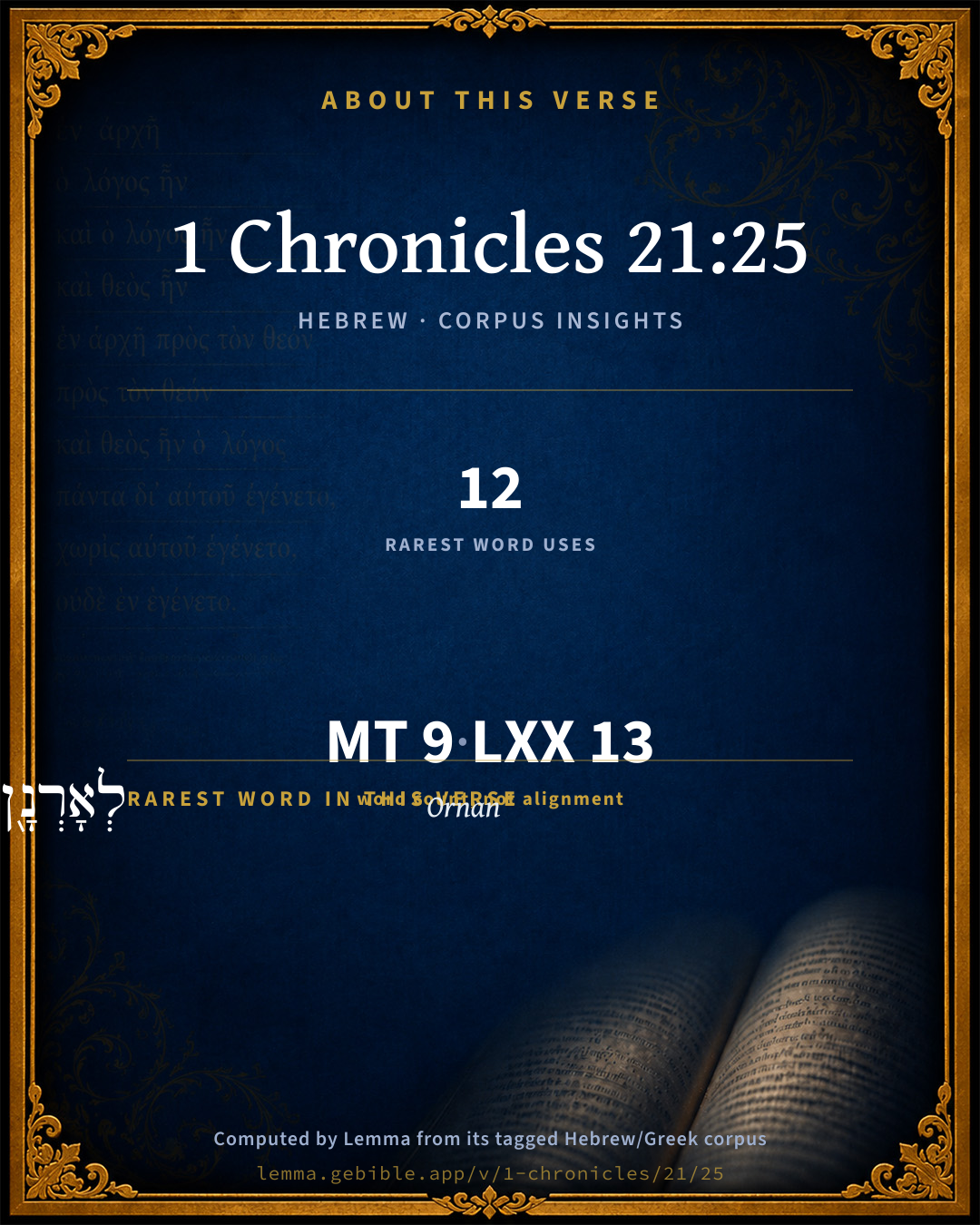
The rarest word here is לְאָרְנָ֖ן Ornan H771 — appearing just 12 times in the whole Hebrew Bible.

Shared distinctive vocabulary

לְאָרְנָ֖ן Ornan H771 occurs in 10 verses of the Hebrew Bible. Also found in:

Grammatical profile

  • 1 verb
  • 6 nouns
  • 2 adjectives

Verb forms

  • וַיִּתֵּ֥ן Qal · Sequential Imperfect

Hebrew & Septuagint length

In English translation the verse runs 15 words from the Hebrew and 15 from the Septuagint (LXX English) — the same length.

A rough comparison of the two English renderings, which tokenize alike — not a word-level alignment.

Word counts can differ between the Hebrew and the Greek without any difference in meaning — e.g. the Hebrew direct-object marker אֵת has no separate Greek word, and Greek often adds the article ὁ.

In the original languages it is 9 Hebrew tokens and 13 Greek tokens — but the two are counted differently (Hebrew bundles its prefixes and suffixes into one token; the Greek is in lemma form), so that isn’t a like-for-like length.

Cross-references

1

Topical passages linked to 1 Chronicles 21:25 in the Treasury of Scripture Knowledge — connected by theme and wording, ordered by reader-vote popularity; previews shown in the World English Bible.

  • 2 Samuel 24:24–25 The king said to Araunah, No; but I will most assuredly buy it of you at a price. Neither will I offer burnt-offerings to Yahweh my God which cost me nothing. So David bought the threshing floor and the oxen for fifty shekels of silver.

Cross-references courtesy of OpenBible.info (CC BY 4.0).

Hebrew and Greek witnesses Masoretic Hebrew ↔ Greek Septuagint

The same verse in the two great witnesses to the Old Testament, shown verse-for-verse.

These are two independent witnesses, not word-aligned to each other, and the Septuagint is shown in lemma (dictionary) form.

Hebrew 1 Chronicles 21:25 Masoretic · Westminster Leningrad Codex

וַיִּתֵּ֥ן דָּוִ֛יד לְאָרְנָ֖ן בַּמָּק֑וֹם שִׁקְלֵ֣י זָהָ֔ב מִשְׁקָ֖ל שֵׁ֥שׁ מֵאֽוֹת

So David gave to Ornan for the place six hundred shekels of gold by weight.

World English Bible · Public Domain

Greek LXX 1 Chronicles 21:25 Septuagint · lemma form

καί δίδωμι δαυίδ ὁ ορνα ἐν ὁ τόπος αὐτός σίκλος χρυσίον ὁλκή ἑξακόσιοι

And David gave to Orna for his place six hundred shekels of gold by weight.

LXX2012 (modern English Septuagint) · Public Domain

Hebrew: Westminster Leningrad Codex (CC BY 4.0). Greek: Septuagint (public domain); English from LXX2012 (modern English Septuagint) (Public Domain). How the Septuagint differs from the Hebrew →

Commentary

Notes on 1 Chronicles 21:25 from classic Christian and Jewish commentators (each source and its license shown beneath its notes). The classic Christian expositions comment on the surrounding passage and are grouped to its opening verse, so a note may address several verses; the Jewish commentaries on the Tanakh (Rashi and others) are per-verse, so they appear only where the commentator wrote on this verse.

Lemma curates 59 commentaries, every one of them public domain or Creative Commons licensed, each selected and text-cleaned for this edition rather than reprinted as found. About our sources →

Ellicott's Commentary for English Readers

(25) So David gave to Oman for the place six hundred shekels of gold by weight.—Literally, shekels of gold—a weight of six hundred. Samuel has, “And David purchased the threshingfloor and the oxen for silver, fifty shekels.” The two estimates are obviously discordant. We have no means of calculating what would have been a fair price, for we know neither the extent of the purchase nor the value of the sums mentioned. But comparing Gen_23:16, where four hundred shekels of silver are paid for the field and cave of Machpelah, fifty shekels of silver would seem to be too little. On the other hand, six hundred shekels of gold appears to be far too high a price for the threshingfloor. Perhaps for “gold” we should read “silver.” It has, indeed, been suggested that “the authors were writing of two different things,” and that Samuel assigns only the price of the threshingfloor and oxen; whereas the chronicler, when he speaks of “the place,” means the entire Mount of the Temple (Moriah), on which the floor was situate. But a comparison of the two narratives seems to identify the things purchased—“the place” (1Ch_21:25) is “the place of the threshingfloor” (1Ch_21:22); and in both cases Samuel has “the threshingfloor.” Tradition may have varied on the subject; and as “there is no positive mention of the use of gold money among the Hebrews” apart from this passage (Madden), ours is probably the later form of the story. However this may be, the chronicler has doubtless preserved for us what he found in his original. It is interesting to compare with this sale some of those the records of which are preserved in the Babylonian Contract Tablets. One of these relates how Dân-sum-iddin sold a house and grounds in Borsippa for eleven and a-half minæ of silver, i.e., 690 shekels. This was in the second year of Nabonidus the last king of Babylon.

A Bible Commentary for English Readers, edited by Charles John Ellicott (1878–1897) — public domain. Text from a community e-Sword module.

Joseph Benson's Commentary

1Ch 21:25. David gave six hundred shekels of gold, &c. — How this is reconciled with 2Sa 24:24, where it is said, David bought the thrashing-floor, &c, for fifty shekels of silver, see note there.

Joseph Benson's Commentary on the Old and New Testaments (1811–1818) — public domain. Text from a community e-Sword module.

Scofield Reference Notes

C. I. Scofield

six hundred shekels of gold

A discrepancy has been imagined in the two accounts, 2Sa 24:24,; 1Ch 21:25; 2Sa 24:24 records the price of the threshingfloor (heb. goren); 1Ch 21:25 of the place (Heb. magom, lit. "home," 1Sa 2:20) same word or area on which afterward the great temple, with its spacious courts was built. 2Ch 3:1.

David gave fifty shekels of sliver for the "goren"; six hundred shekels of gold for the "magom."

The Scofield Reference Bible (1917 edition), notes by C. I. Scofield — public domain. Text from a community e-Sword module.

Geneva Bible (1599)

Geneva Bible translators

Read 2 Sam. 24:24.

Geneva Bible (1599) marginal notes — public domain. Text via Bolls.life.

Jamieson, Fausset & Brown

Robert Jamieson, A. R. Fausset & David Brown

David gave . . . for the place six hundred shekels of gold--At first he bought only the cattle and the threshing instruments, for which he paid fifty shekels of silver (Sa2 24:24); afterwards he purchased the whole property, Mount Moriah, on which the future temple stood. High in the center of the mountain platform rises a remarkable rock, now covered by the dome of "the Sakrah." It is irregular in its form, and measures about sixty feet in one direction and fifty feet in the other. It is the natural surface of Mount Moriah and is thought by many to be the rock of the threshing-floor of Araunah, selected by David, and continued by Solomon and Zerubbabel as "the unhewn stone" on which to build the altar [BARTLETT, Walks about Jerusalem; STANLEY].

Jamieson, Fausset & Brown — Commentary Critical and Explanatory on the Whole Bible (1871) — public domain (CC PDM 1.0). Text via the HelloAO Bible API.

The Cambridge Bible for Schools and Colleges

gen. ed. J. J. S. Perowne

25. gave … for the place six hundred shekels of gold by weight] In 2Sa_24:24, bought the threshing floor and the oxen for money, even fifty shekels (so to be rendered).

A large discrepancy appears here between Chron. and 2 Sam. The former seems to say that 600 shekels were paid for the threshing floor alone, the latter that only 50 shekels were paid for the floor and oxen taken together. But the text of 2 Sam. is probably corrupt and should perhaps run, bought the threshing floor for money, even six hundred shekels, and the oxen for money, even fifty shekels. The “threshing floor” seems to have included the Temple Mount (1Ch_22:1), and we may compare the 600 shekels paid for it with the 400 paid by Abraham for the cave and field of Machpelah (Gen_23:15-17). In describing the 600 shekels as shekels of gold the Chronicler perhaps goes beyond his authority, for the sum then becomes improbably large.

The Cambridge Bible for Schools and Colleges (gen. ed. J. J. S. Perowne; Cambridge University Press, 1878–1918) — public domain. Text from a community e-Sword module.

Albert Barnes' Notes on the Bible

Compare the marginal reference and note. It may also be conjectured that we should read “six” for “six hundred” here; since, according to the later Jewish system, six gold shekels were nearly equal in value to fifty silver ones.

Albert Barnes' Notes on the Bible (1834–1885) — public domain. Text from a community e-Sword/MySword module.

Haydock's Catholic Bible Commentary

Six hundred sicles, &c. This was the price of the whole place on which the temple was afterwards built: but the price of the oxen was fifty sicles of silver, 2 Kings xxiv. 24. (Challoner) --- Or the fifty sicles were given for the threshing-floor alone. (Calmet) (Du Hamel)

George Leo Haydock (1774–1849), Haydock's Catholic Family Bible and Commentary, 1859 edition — public domain. Excludes Psalms (Douay-Rheims chapter numbering differs from Protestant) and Deuterocanonical books (Catholic canon only).

The Pulpit Commentary

Six hundred shekels of gold by weight. The only way to reconcile this statement with that of the parallel place, which (speaks 2Sa_24:24) of "fifty shekels of silver" (i.e. taking the shekel at 2s. 8d., equal to about f6 13s. 4d.) as the price of "the threshing-floor and the oxen," is to suppose that the fifty shekels speak of the purchase money of the oxen indeed, but not of the floor itself, which was valuable, not only for size and situation, but also for its prepared construction; or again, keeping to the literal language of Samuel, that "the floor and the oxen" are intended, while our expression, "the place," may designate the whole hill. The value of gold as compared with silver was as sixteen to one. If this be the solution, we should have again an instance of the compiler of this book seizing for perpetuation the point of greatest and most permanent interest, i.e. the purchase of the whole place.

The Pulpit Commentary (1880–1919), ed. H.D.M. Spence-Jones & Joseph S. Exell — public domain. Text from a community e-Sword module.

John Wesley's Explanatory Notes

Six hundred - We read, 2 Sam. xxiv, 24, he gave fifty shekels of gold: that is, he gave in gold the value of six hundred shekels of silver. 26. By fire - Hebrew. by fire sent from heaven: which was the sign of God's acceptance. The fire that might justly have fastened on the sinner, fastened upon the sacrifice and consumed it. Thus Christ was made sin and a curse for us, and it pleased the Lord to bruise him, that through him God might be to us, not a consuming fire, but a reconciled Father.

John Wesley, Explanatory Notes Upon the Whole Bible (1754–1765) — public domain. Text via the GEBible commentary corpus.

unfoldingWord translationNotes

Door43 World Missions Community

six hundred shekels of gold

"600 shekels of gold" (See: Numbers)

shekels

a unit of weight equal to about 11 grams (See: Biblical Money)

for the place

"to buy the threshing floor"

He called on Yahweh

"He prayed for help to Yahweh"

who answered him with fire from heaven on the altar for burnt offerings

"who answered him by sending fire from heaven to the alter where David would offer the burnt offerings"

the angel put his sword back into its sheath

The angel putting his sword back in the sheath is a symbolic action to show that he would not continue to kill the people. AT: the angel put his sword in its sheath to show that he would stop killing the people" (See: Symbolic Action)

sheath

cover for a sword or knife

translationWords

David

gold

Yahweh

fellowship offering

heaven

angel

sword

unfoldingWord translationNotes — © Distant Shores Media and the Door43 World Missions Community, licensed CC BY-SA 4.0. Source: git.door43.org/Door43/en_tn.

Rashi

Rabbi Shlomo Yitzchaki (Rashi)

shekels of gold, weighing six hundred but at the end of Samuel (II 24:24), it is written: “for fifty shekels of silver.” How is this possible? He took fifty shekels from each tribe, totaling six hundred shekels, so that all Israel should have a share in the altar.

Rashi on the Tanakh — English translations: “The Judaica Press complete Tanach with Rashi, translated by A. J. Rosenberg” (CC BY 4.0); “Pentateuch with Rashi's commentary by M. Rosenbaum and A.M. Silbermann, 1929-1934” (public domain); “The Metsudah Tanach series, Lakewood, N.J” (CC BY 4.0); and “The Book of Joshua, Metsudah Publications, 1997” (CC BY 4.0). Text via Sefaria.

Lesson kit

Teaching starters — assembled from the data on this page, not authored interpretation. Every prompt links to the verse data it draws on. Edit before teaching.

1 Chronicles, in the Historical, opens this verse with 9 words (9 distinct Hebrew lemmas). Its most distinctive word is ʼOrnân (“Ornan”). A historical commentator’s framing appears above. Read the whole chapter for the surrounding context.

Discussion questions

  1. What does “Ornan” (ʼOrnân) contribute to the verse as a whole?
  2. How does 1 Chronicles 21:15, which shares the word «Ornan», read alongside this verse?
  3. The translations on this page render this verse differently — a whole-verse word diff, not a word-by-word alignment. What might account for the different wordings?
  4. «וַיִּתֵּ֥ן» is a Qal Sequential Imperfect verb. How does that grammatical form shape the action described?
  5. Compare how Ellicott's Commentary for English Readers and Joseph Benson's Commentary read this verse. Where do they agree or differ?

Things to notice

Reading settings

Reading text

Shown beneath each verse's original-language words.

Old Testament
Old Testament edition

Read the OT as the Masoretic Hebrew (MT) or the Greek Septuagint (LXX).

English shown for the Greek Septuagint (in the Hebrew ↔ Greek comparison).

Comparing translations? Open the Compare panel on any verse page to stack up to four side by side.