
Nehemiah 12:45

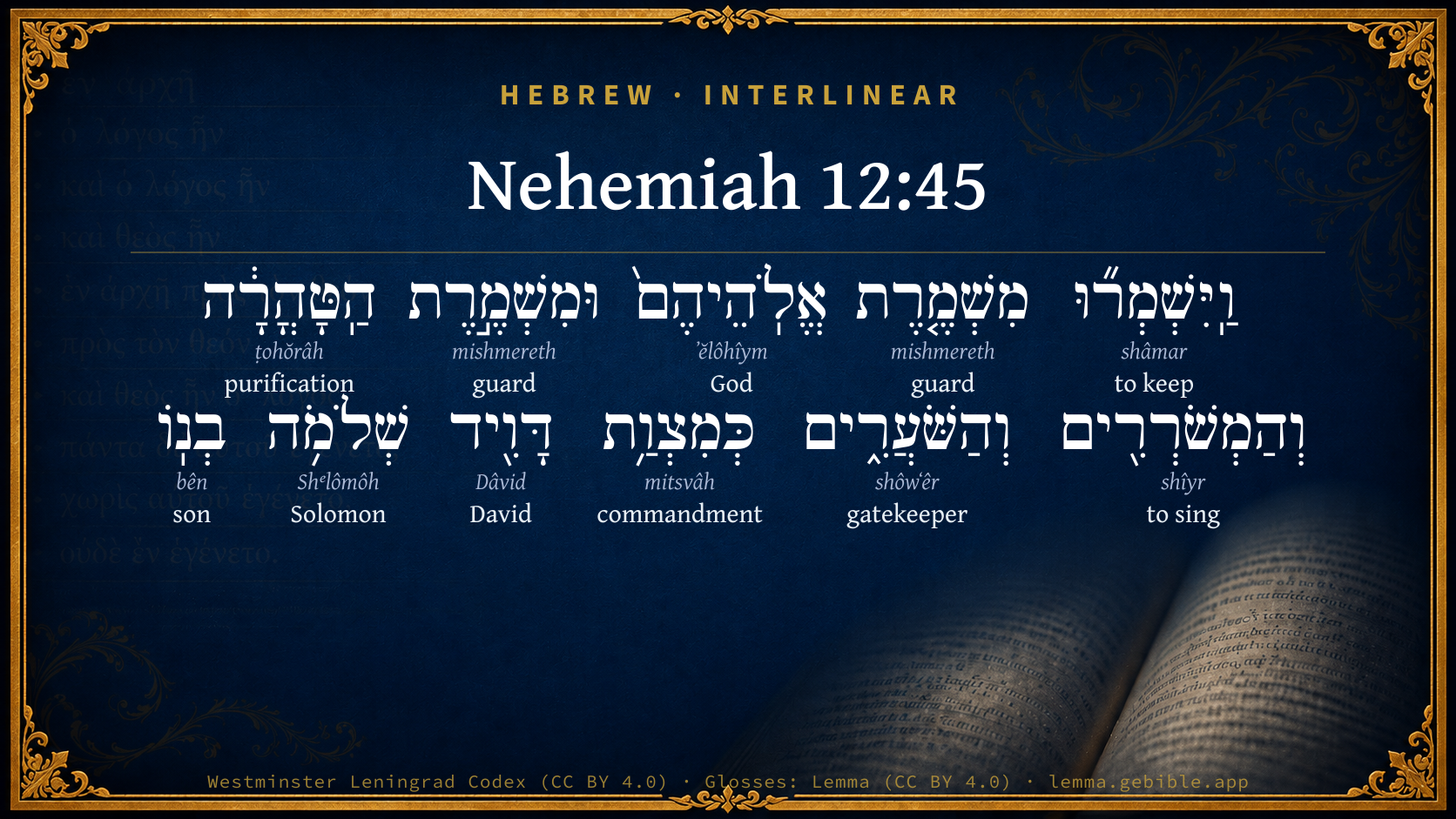
Hebrew (Westminster Leningrad Codex) Nehemiah 12:45 appears in the Hebrew Old Testament. The text above is from the Westminster Leningrad Codex. Each word links to its Strong’s number, a concise gloss, and parsing drawn from the Open Scriptures Hebrew Bible morphology. Click any word for its full Brown-Driver-Briggs (BDB) entry.
Download image
Cite this verse

Nehemiah 12:45 (World English Bible). Public Domain. Lemma interlinear Bible study tool, https://lemma.gebible.app/v/nehemiah/12/45.

Show BibTeX & RIS
BibTeX
RIS
English Translation
They kept the charge of their God, and the charge of the purification, and [so did] the singers and the porters, according to the commandment of David, and of Solomon his son.
World English Bible · Public Domain
Download a study sheet

One document with this verse’s original text, its word-by-word gloss line, the meaning frame, cross-references with their text, attributed commentary, and full source and license credits — printable, and it pastes into notes with its structure intact.

This verse Autodidact and up

Study sheet (.html) Plain text (.txt)

A passage Seminary Student

Up to 50 verses in one chapter. A passage sheet keeps up to 6 commentary sources and 12 cross-references per verse, in the order this page ranks them, and says so on the sheet whenever that leaves anything out. Ask for a single verse and you get the Autodidact verse sheet above.

Everything on this page stays free to read, with no account — the sheet is a download of what is already on screen, not access to it.

Want to remove ads? Support Godless Engineer
Compare translations 3

The same verse in 3 English versions, stacked beneath the original-language interlinear above. Click any original word for its lexicon entry.

Each is an independent rendering of the whole verse — the interlinear is not word-aligned to these translations.

Highlighted words mark where these versions differ — a whole-verse word diff, not a word-by-word alignment.

  • World English Bible Public Domain
    They kept the charge of their God, and the charge of the purification, and [so did] the singers and the porters, according to the commandment of David, and of Solomon his son.
  • King James Version Public Domain
    And both the singers and the porters kept the ward of their God, and the ward of the purification, according to the commandment of David, and of Solomon his son.
  • unfoldingWord Literal Text CC BY-SA 4.0
    And they kept the service watch of their God and the service watch of purification, also the ones who sang and the gatekeepers, according to the commandment of David and Solomon his son.

unfoldingWord Literal Text — © unfoldingWord, licensed CC BY-SA 4.0. Word-aligned USFM3 via Door43 (git.door43.org/unfoldingWord/en_ult).

Versions to compare (up to 4)

3 of 4 selected

Show all 18 translations

Every available English version of this verse, each an independent rendering of the whole verse.

  • World English Bible Public Domain
    They kept the charge of their God, and the charge of the purification, and [so did] the singers and the porters, according to the commandment of David, and of Solomon his son.
  • Berean Standard Bible Public Domain
    They performed the service of their God and the service of purification, along with the singers and gatekeepers, as David and his son Solomon had prescribed.
  • Majority Standard Bible Public Domain
    They performed the service of their God and the service of purification, along with the singers and gatekeepers, as David and his son Solomon had prescribed.
  • King James Version Public Domain
    And both the singers and the porters kept the ward of their God, and the ward of the purification, according to the commandment of David, and of Solomon his son.
  • American Standard Version (1901) Public Domain
    And they kept the charge of their God, and the charge of the purification, and `so did' the singers and the porters, according to the commandment of David, and of Solomon his son.
  • Revised Version (1885) Public Domain
    And they kept the ward of their God, and the ward of the purification, and so did the singers and the porters, according to the commandment of David, and of Solomon his son.
  • Geneva Bible (1599) Public Domain
    And both the singers and the Leuites kept the ward of their God, and the warde of the purification according to the commandement of Dauid, and Salomon his sonne.
  • Douay-Rheims (1899) Public Domain
    For in the days of David and Asaph from the beginning there were chief singers appointed, to praise with canticles, and give thanks to God.
  • Young's Literal Translation Public Domain
    And the singers and the gatekeepers keep the charge of their God, even the charge of the cleansing -- according to the command of David `and' Solomon his son,
  • Literal Standard Version CC BY-SA 4.0
    And the singers and the gatekeepers keep the charge of their God, even the charge of the cleansing—according to the command of David [and] his son Solomon,
  • Unlocked Literal Bible CC BY-SA 4.0
    They performed the service of their God, and the service of purification, and so did the singers and the gatekeepers, in keeping with the command of David and of Solomon his son.
  • unfoldingWord Literal Text CC BY-SA 4.0
    And they kept the service watch of their God and the service watch of purification, also the ones who sang and the gatekeepers, according to the commandment of David and Solomon his son.
  • Darby Bible Public Domain
    And, with the singers and the doorkeepers, they kept the ward of their God, and the ward of the purification, according to the commandment of David [and] of Solomon his son.
  • World Messianic Bible Public Domain
    They performed the duty of their God and the duty of the purification, and so did the singers and the gatekeepers, according to the commandment of David and of Solomon his son.
  • Webster's Bible Public Domain
    And both the singers and the porters kept the ward of their God, and the ward of the purification, according to the commandment of David, and of Solomon his son.
  • Free Bible Version CC BY-SA 4.0
    They were responsible for the worship of their God and for the service of purification, along with the singers and gatekeepers, following the instructions of David and his son Solomon.
  • Bible in Basic English Public Domain
    And they kept the watch of their God, and were responsible for making things clean, and so did the music-makers and the door-keepers, as it was ordered by David and Solomon his son.
  • JPS Tanakh (1917) Public Domain
    And they kept the ward of their God, and the ward of the purification, and so did the singers and the porters, according to the commandment of David, and of Solomon his son.

Literal Standard Version (2020), Covenant Press — licensed CC BY-SA 4.0. Text via the HelloAO Bible API (eBible.org). Unlocked Literal Bible (unfoldingWord) — licensed CC BY-SA 4.0. Text via the HelloAO Bible API (eBible.org). unfoldingWord Literal Text — © unfoldingWord, licensed CC BY-SA 4.0. Word-aligned USFM3 via Door43 (git.door43.org/unfoldingWord/en_ult). Free Bible Version, Dr. Jonathan Gallagher — licensed CC BY-SA 4.0. Text via the HelloAO Bible API (eBible.org).

Word by word

More ways to search: Search by grammar → Find every occurrence → Compare this word →

Practice this passage: Drill this verse → Learn its vocabulary →

הַֽטָּהֳרָ֔ה
ṭohŏrâh
H2893
“the · purification”
Particle, Definite Article + Noun, Common, Both, Singular, Absolute
Part of Speech
Particle + Noun
Type
Common
Gender
Both
Number
Singular
State
Absolute
Full BDB Definition

Origin: from H2892

TWOT: 792c

purifying, cleansing, purification, purity, cleanness - purifying, menstruation - cleansing, purification
  1. וַֽיִּשְׁמְר֞וּ shâmar H8104 “and · to keep” Conjunction + Verb, Qal, Sequential Imperfect, 3rd Person, Masculine, Plural
  2. מִשְׁמֶ֤רֶת mishmereth H4931 “guard of” Noun, Common, Feminine, Singular, Construct
  3. אֱלֹֽהֵיהֶם֙ ʼĕlôhîym H430 “God(s) · their” Noun, Common, Masculine, Plural, Construct + Suffix, Personal, 3rd Person, Masculine, Plural
  4. וּמִשְׁמֶ֣רֶת mishmereth H4931 “and · guard of” Conjunction + Noun, Common, Feminine, Singular, Construct
  5. וְהַמְשֹׁרְרִ֖ים shîyr H7891 “and · the · singing” Conjunction + Particle, Definite Article + Verb, Polel, Participle Active, Masculine, Plural, Absolute
  6. וְהַשֹּׁעֲרִ֑ים shôwʻêr H7778 “and · the · gatekeepers” Conjunction + Particle, Definite Article + Noun, Common, Masculine, Plural, Absolute
  7. כְּמִצְוַ֥ת mitsvâh H4687 “like/as · commandment of” Preposition + Noun, Common, Feminine, Singular, Construct
  8. דָּוִ֖יד Dâvid H1732 “David” Noun, Proper
  9. שְׁלֹמֹ֥ה Shᵉlômôh H8010 “Solomon” Noun, Proper
  10. בְנֽוֹ bên H1121 “son · his” Noun, Common, Masculine, Singular, Construct + Suffix, Personal, 3rd Person, Masculine, Singular

About this verse

These counts appear in no published source. They are computed here, from the morphology-tagged text and Lemma’s own curated glosses. What Lemma adds →

11
words
10
distinct lemmas
Historical
section

Notable vocabulary

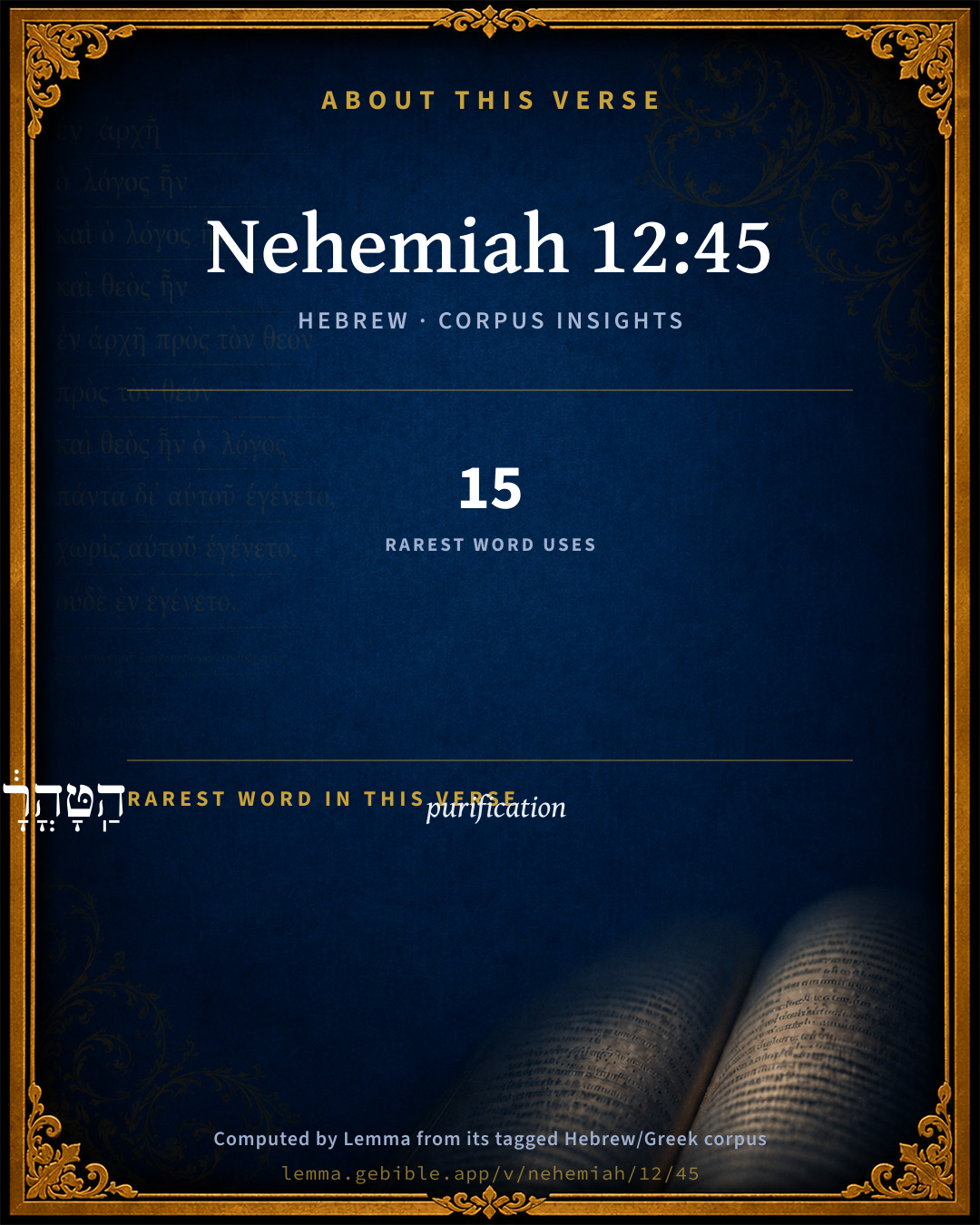
The rarest word here is הַֽטָּהֳרָ֔ה purification H2893 — appearing just 15 times in the whole Hebrew Bible.

Shared distinctive vocabulary

הַֽטָּהֳרָ֔ה purification H2893 occurs in 14 verses of the Hebrew Bible. Also found in:

Grammatical profile

  • 2 verbs
  • 9 nouns

Verb forms

  • וַֽיִּשְׁמְר֞וּ Qal · Sequential Imperfect
  • וְהַמְשֹׁרְרִ֖ים Polel · Participle Active

Repetition

A word recurs within this verse — often emphatic in Hebrew:

  • מִשְׁמֶ֤רֶת guard H4931 ×2

Cross-references

3

Topical passages linked to Nehemiah 12:45 in the Treasury of Scripture Knowledge — connected by theme and wording, ordered by reader-vote popularity; previews shown in the World English Bible.

  • 1 Chronicles 25:1–26 Moreover, David and the captains of the host set apart for the service certain of the sons of Asaph, and of Heman, and of Jeduthun, who should prophesy with harps, with psalteries, and with cymbals: and the number of those who did the work according to their service was:
  • 1 Chronicles 23:28 For their office was to wait on the sons of Aaron for the service of the house of Yahweh, in the courts, and in the chambers, and in the purifying of all holy things, even the work of the service of the house of God;
  • 2 Chronicles 23:6 But let none come into the house of Yahweh, save the priests, and those who minister of the Levites; they shall come in, for they are holy: but all the people shall keep the charge of Yahweh.

Cross-references courtesy of OpenBible.info (CC BY 4.0).

Hebrew and Greek witnesses Masoretic Hebrew ↔ Greek Septuagint

The same verse in the two great witnesses to the Old Testament, shown verse-for-verse.

These are two independent witnesses, not word-aligned to each other, and the Septuagint is shown in lemma (dictionary) form.

Hebrew Nehemiah 12:45 Masoretic · Westminster Leningrad Codex

וַֽיִּשְׁמְר֞וּ מִשְׁמֶ֤רֶת אֱלֹֽהֵיהֶם֙ וּמִשְׁמֶ֣רֶת הַֽטָּהֳרָ֔ה וְהַמְשֹׁרְרִ֖ים וְהַשֹּׁעֲרִ֑ים כְּמִצְוַ֥ת דָּוִ֖יד שְׁלֹמֹ֥ה בְנֽוֹ

They kept the charge of their God, and the charge of the purification, and [so did] the singers and the porters, according to the commandment of David, and of Solomon his son.

World English Bible · Public Domain

Greek LXX Structure differs

The Septuagint has no separate book of Nehemiah. Its Greek text is the second half of Esdras B (2 Esdras), chapters 11–23; Ezra is the first half (1–10).

A verse-for-verse comparison isn’t shown here because the chapters and verses don’t line up. Switch to the LXX edition with the MT / LXX toggle above to read the Greek directly.

On this verse, The Pulpit Commentary discusses the Septuagint’s reading. Read the note in Commentary ↓

Hebrew: Westminster Leningrad Codex (CC BY 4.0). Greek: Septuagint (public domain); English from a public-domain English Septuagint. How the Septuagint differs from the Hebrew →

Commentary

Notes on Nehemiah 12:45 from classic Christian and Jewish commentators (each source and its license shown beneath its notes). The classic Christian expositions comment on the surrounding passage and are grouped to its opening verse, so a note may address several verses; the Jewish commentaries on the Tanakh (Rashi and others) are per-verse, so they appear only where the commentator wrote on this verse.

Lemma curates 59 commentaries, every one of them public domain or Creative Commons licensed, each selected and text-cleaned for this edition rather than reprinted as found. About our sources →

The Biblical Illustrator

Joseph S. Exell

Neh_12:45-47

And both the singers.

Thanks-giving and thanks-living

We have here the effects of the joy that was at the dedication of the wall.

I. The ministers were more careful than they had been of their work. Ii. The people were more careful than they had been of the maintenance of their ministers. The surest way for ministers to recommend themselves to their people, and gain an interest in their affections, is to wait on their ministry, to be humble and industrious, and to mind their business; when these did so, the people thought nothing too much for them to encourage them.

1. Care is here taken for the collecting of their dues.

2. Care is taken that, being gathered in, it might be duly paid out. (Matthew Henry.)

For in the days of David and Asaph of old.

The good old times

I. Nothing is necessarily good because it is old. Hast thou marked the old way which wicked men have trodden? Habit, education, tradition, prejudice, play an important part in history.

II. That which is old is presumptively valuable. Good lasts. Truth is as old as the hills. Application: Prove all things. Despise nothing. The present is a huge borrower from the dead past. (Homiletic Commentary.)

.

The Biblical Illustrator, edited by Joseph S. Exell (c. 1880s–1900s) — public domain. Text from a community e-Sword module.

Joseph Benson's Commentary

Neh 12:45. Both the singers and the porters kept the ward of their God — That ward or charge which God had prescribed them. And, in particular, the charge of purification, of taking care that no unclean person or thing should enter into the house or courts of the Lord. Or, the meaning may be, the singers sung orderly in their courses, as they were appointed, and thereby kept the ward of their God; and the porters kept the ward of the purification, that is, duly observed the orders about it, in preventing the temple from being defiled by any unclean person or thing. According to the commandment of David and of Solomon his son — Who had regulated all things belonging to the duty of these persons.

Joseph Benson's Commentary on the Old and New Testaments (1811–1818) — public domain. Text from a community e-Sword module.

Jamieson, Fausset & Brown

Robert Jamieson, A. R. Fausset & David Brown

the singers and the porters kept . . . the ward of the purification--that is, took care that no unclean person was allowed to enter within the precincts of the sacred building. This was the official duty of the porters (Ch2 23:19), with whom, owing to the pressure of circumstances, it was deemed expedient that the singers should be associated as assistants.

Jamieson, Fausset & Brown — Commentary Critical and Explanatory on the Whole Bible (1871) — public domain (CC PDM 1.0). Text via the HelloAO Bible API.

Ellicott's Commentary for English Readers

(45) Kept the ward.—This should be read differently. The priests and Levites kept the ward of their God, and the ward of purification, and the singers and porters, &c. To “keep the ward” is to observe the regular times and seasons of sacrifice and thanksgiving.

A Bible Commentary for English Readers, edited by Charles John Ellicott (1878–1897) — public domain. Text from a community e-Sword module.

The Cambridge Bible for Schools and Colleges

gen. ed. J. J. S. Perowne

45. And both the singers and the porters kept] R.V. And they kept … and so did the singers and the porters. The verse, according to the rendering of the R.V. states first that the priests and Levites performed the due ceremonial obligations, and then that the same strict conformity to rule was practised by the singers and porters. The verb ‘kept’ has to be supplied in the second clause.

This is preferable to the suggestion that the second clause is one of a different character, = ‘and the singers and the porters were at their post according to the commandment of David’ &c. The ground for this alternative rendering is the supposition that the singers and porters would not be subject to the same laws of purification.

kept the ward of their God, and the ward of the purification] The word rendered ‘ward’ means here ‘that which has to be observed,’ ‘a charge,’ in the same sense in which it occurs in Num_9:23 ‘they kept the charge of the Lord;’ 2Ch_13:11 ‘For we keep the charge of the Lord our God.’ Cf. Gen_26:5.

It is therefore to be distinguished from its more concrete use in Neh_12:9; Neh_12:24; Neh_13:30, where it refers to the ‘posts’ of the Levites.

according to the commandment … and of Solomon his son] The reference is one of a general character to the regulations of the Temple services ascribed by the Chronicler to David (1 Chronicles 23-26) and Solomon (2Ch_8:14).

‘And of Solomon.’ The word ‘and’ must have accidentally dropped out of the Hebrew text, and must be restored.

The Cambridge Bible for Schools and Colleges (gen. ed. J. J. S. Perowne; Cambridge University Press, 1878–1918) — public domain. Text from a community e-Sword module.

Albert Barnes' Notes on the Bible

The ward of the purification - The observances with respect to purification. Compare 1Ch 23:28.

Albert Barnes' Notes on the Bible (1834–1885) — public domain. Text from a community e-Sword/MySword module.

Haydock's Catholic Bible Commentary

Asaph was master of music in the reign of David. (Menochius)

George Leo Haydock (1774–1849), Haydock's Catholic Family Bible and Commentary, 1859 edition — public domain. Excludes Psalms (Douay-Rheims chapter numbering differs from Protestant) and Deuterocanonical books (Catholic canon only).

Matthew Poole's English Annotations

The ward of their God, i.e. that ward, or charge, or business which God had prescribed to them.

And the ward of the purification; and in particular

the charge of purification, i.e. of taking care that no unclean person or thing might enter into the house or courts of the Lord; which care did certainly belong to the porters, as is expressed, 2Ch 23:19, and at this time, and in some sort, as it seems to the singers, who, besides their proper employment,

were also over the business of the house of God, as is affirmed, Neh 11:22; which being a general expression, may well comprehend, if it doth not principally design this, that they should take care to keep the house of God free from all pollution. And possibly as the porters were to take care that no unclean thing might enter there, so if it should through their inadvertency enter in, the singers were to remove it.

Matthew Poole's English Annotations on the Holy Bible (1683–1685) — public domain. Text from a community e-Sword/MySword module.

Whedon's Commentary on the Bible

Daniel D. Whedon

45. Kept the ward of their God — Or, kept the charge of their God; looked after all the sacred interests committed to their oversight and care. Compare Lev_8:35.

The ward of the purification — The charge of “the purifying of all holy things.” 1Ch_23:28. The rooms and vessels of the temple were to be purified, and called for the special appointment of persons for that work.

According to the commandment of David — See 2Ch_8:14; and comp. 1 Chronicles 25-26.

Daniel D. Whedon (gen. ed.), Commentary on the Old and New Testaments (1874–1909) — public domain. Text from a community e-Sword module.

The Pulpit Commentary

This verse is wrongly translated in the A. V. It should be rendered, as in the Vulgate and the Septuagint they (i.e. the priests and Levites) maintained the ward of their God, and the ward of the purification, and the singers, and the porters (i.e. the institutions of singers and porters), according to the ordinance of David and of Solomon his son." Maintaining the ward of their God is serving regularly in the temple at the times appointed; maintaining the ward of the purification is observing the rules for the purifying of the holy things which had been laid down by David. (1Ch_23:28)

The Pulpit Commentary (1880–1919), ed. H.D.M. Spence-Jones & Joseph S. Exell — public domain. Text from a community e-Sword module.

John Wesley's Explanatory Notes

The ward - That ward, or charge, which God had prescribed to them. And in particular the charge of purification, of taking care that no unclean person or thing should enter into the house or courts of the Lord.

John Wesley, Explanatory Notes Upon the Whole Bible (1754–1765) — public domain. Text via the GEBible commentary corpus.

Keil & Delitzsch

C. F. Keil & F. Delitzsch

And they cared for the care of their God, etc.; i.e., they observed all that was to be observed, both with respect to God and with respect to purification, i.e., they faithfully and punctually performed their office. On משׁמרת שׁמר, see rem. on Gen 26:5 and Lev 8:35. "And (so also) the singers and doorkeepers," i.e., they, too, observed the duties incumbent on them. This must be mentally supplied from the beginning of the verse. "According to the commandment of David and of Solomon his son;" comp. Ch2 8:14 and Ch1 24:26. ו must be inserted before שׁלמה, as in the lxx and Vulgate, after the analogy of Ch2 33:7 and Ch2 35:4; for an asyndeton would be here too harsh. As ו is here omitted, so does it also appear superfluously before אסף, Neh 12:46, probably by a clerical error. The verse can be only understood as saying: "for in the days of David, Asaph was of old chief of the singers, and of the songs of praise, and of the thanksgiving unto God." ו before Asaph is here out of place; for to take it as introducing a conclusion: in the days of David, therefore, was Asaph ... seems unnatural. The ו probably came into the text through a reminiscence of Ch2 29:30 and Ch2 35:15. The matter, however, of these passages is consistent with the naming of David and Asaph, while such a co-ordination is unsuitable in the present passage. The Masoretes have indeed attempted to make sense of the words by altering the singular ראשׁ into the plural ראשׁי; but the Keri ראשׁי is nothing more than a worthless conjecture, arising partly from the unsuitableness of ו before אסף, and partly from the consideration that Henan and Ethan were, as well as Asaph, chiefs of bands of singers. Nehemiah, however, was not concerned in this passage about exactness of statement, - the mention of Asaph as chief of the singers being quite sufficient for the purpose of his remark, that from the times of David onward orders of singers had existed. - In Neh 12:47 this subject is concluded by the general statement that all Israel, i.e., the whole community, in the days of Zerubbabel and Nehemiah, gave the portions prescribed in the law for the ministers of the sanctuary, singers, doorkeepers, Levites, and priests. מקדּישׁים, they were sanctifying, i.e., consecrabant. הקדּישׁ, to sanctify, said of the bringing of gifts and dues to the ministers of the sanctuary; comp. Ch1 26:27; Lev 27:14. On the matter itself, comp. Neh 10:38. and Num 18:26-29.

Keil & Delitzsch — Biblical Commentary on the Old Testament (1861–1891) — public domain (CC PDM 1.0). Text via the HelloAO Bible API. (Old Testament only.)

Lesson kit

Teaching starters — assembled from the data on this page, not authored interpretation. Every prompt links to the verse data it draws on. Edit before teaching.

Nehemiah, in the Historical, opens this verse with 11 words (10 distinct Hebrew lemmas). Its most distinctive word is ṭohŏrâh (“purification”). A historical commentator’s framing appears above. Read the whole chapter for the surrounding context.

Discussion questions

  1. How does “purification” (ṭohŏrâh) shape what this verse is saying?
  2. How does Leviticus 12:4, which shares the word «purification», read alongside this verse?
  3. What does the repetition of “guard” (2× in this one verse) do in this verse?
  4. These translations render this verse differently. What is at stake in choosing one wording over another?
  5. «וַֽיִּשְׁמְר֞וּ» is a Qal Sequential Imperfect verb. How does that grammatical form shape the action described?
  6. Compare how The Biblical Illustrator and Joseph Benson's Commentary read this verse. Where do they agree or differ?

Things to notice

Reading settings

Reading text

Shown beneath each verse's original-language words.

Old Testament
Old Testament edition

Read the OT as the Masoretic Hebrew (MT) or the Greek Septuagint (LXX).

English shown for the Greek Septuagint (in the Hebrew ↔ Greek comparison).

Comparing translations? Open the Compare panel on any verse page to stack up to four side by side.