2 Chronicles 1:8

Hebrew (Westminster Leningrad Codex) 2 Chronicles 1:8 appears in the Hebrew Old Testament. The text above is from the Westminster Leningrad Codex. Each word links to its Strong’s number, a concise gloss, and parsing drawn from the Open Scriptures Hebrew Bible morphology. Click any word for its full Brown-Driver-Briggs (BDB) entry.
Download image
Cite this verse

2 Chronicles 1:8 (World English Bible). Public Domain. Lemma interlinear Bible study tool, https://lemma.gebible.app/v/2-chronicles/1/8.

Show BibTeX & RIS
BibTeX
RIS
English Translation
Solomon said to God, You have shown great loving kindness to David my father, and have made me king in his place.
World English Bible · Public Domain
Download a study sheet

One document with this verse’s original text, its word-by-word gloss line, the meaning frame, cross-references with their text, attributed commentary, and full source and license credits — printable, and it pastes into notes with its structure intact.

This verse Autodidact and up

Study sheet (.html) Plain text (.txt)

A passage Seminary Student

Up to 50 verses in one chapter. A passage sheet keeps up to 6 commentary sources and 12 cross-references per verse, in the order this page ranks them, and says so on the sheet whenever that leaves anything out. Ask for a single verse and you get the Autodidact verse sheet above.

Everything on this page stays free to read, with no account — the sheet is a download of what is already on screen, not access to it.

Want to remove ads? Support Godless Engineer
Compare translations 3

The same verse in 3 English versions, stacked beneath the original-language interlinear above. Click any original word for its lexicon entry.

Each is an independent rendering of the whole verse — the interlinear is not word-aligned to these translations.

Highlighted words mark where these versions differ — a whole-verse word diff, not a word-by-word alignment.

  • World English Bible Public Domain
    Solomon said to God, You have shown great loving kindness to David my father, and have made me king in his place.
  • King James Version Public Domain
    And Solomon said unto God, Thou hast showed great mercy unto David my father, and hast made me to reign in his stead.
  • unfoldingWord Literal Text CC BY-SA 4.0
    And Solomon said to God, “You yourself did with David my father great covenant faithfulness and have made me king in his place.

unfoldingWord Literal Text — © unfoldingWord, licensed CC BY-SA 4.0. Word-aligned USFM3 via Door43 (git.door43.org/unfoldingWord/en_ult).

Versions to compare (up to 4)

3 of 4 selected

Show all 18 translations

Every available English version of this verse, each an independent rendering of the whole verse.

  • World English Bible Public Domain
    Solomon said to God, You have shown great loving kindness to David my father, and have made me king in his place.
  • Berean Standard Bible Public Domain
    Solomon replied to God: “You have shown much loving devotion to my father David, and You have made me king in his place.
  • Majority Standard Bible Public Domain
    Solomon replied to God: “You have shown much loving devotion to my father David, and You have made me king in his place.
  • King James Version Public Domain
    And Solomon said unto God, Thou hast showed great mercy unto David my father, and hast made me to reign in his stead.
  • American Standard Version (1901) Public Domain
    And Solomon said unto God, Thou hast showed great lovingkindness unto David my father, and hast made me king in his stead.
  • Revised Version (1885) Public Domain
    And Solomon said unto God, Thou hast shewed great kindness unto David my father, and hast made me king in his stead.
  • Geneva Bible (1599) Public Domain
    And Salomon sayde vnto God, Thou hast shewed great mercy vnto Dauid my father and hast made me to reigne in his stead.
  • Douay-Rheims (1899) Public Domain
    And Solomon said to God: Thou hast shewn great kindness to my father David: and hast made me king in his stead.
  • Young's Literal Translation Public Domain
    And Solomon saith to God, `Thou hast done with David my father great kindness, and hast caused me to reign in his stead.
  • Literal Standard Version CC BY-SA 4.0
    And Solomon says to God, “You have done great kindness with my father David, and have caused me to reign in his stead.
  • Unlocked Literal Bible CC BY-SA 4.0
    Solomon said to God, “You have shown great covenant faithfulness to David my father, and have made me king in his place.
  • unfoldingWord Literal Text CC BY-SA 4.0
    And Solomon said to God, “You yourself did with David my father great covenant faithfulness and have made me king in his place.
  • Darby Bible Public Domain
    And Solomon said to God, Thou hast shewn unto David my father great loving-kindness, and hast made me king in his stead.
  • World Messianic Bible Public Domain
    Solomon said to God, “You have shown great loving kindness to David my father, and have made me king in his place.
  • Webster's Bible Public Domain
    And Solomon said to God, Thou hast shown great mercy to David my father, and hast made me to reign in his stead.
  • Free Bible Version CC BY-SA 4.0
    Solomon responded to God, “You showed trustworthy love without limit to my father David, and you have made me king in his place.
  • Bible in Basic English Public Domain
    And Solomon said to God, Great was your mercy to David my father, and you have made me king in his place.
  • JPS Tanakh (1917) Public Domain
    And Solomon said unto God: 'Thou hast shown great kindness unto David my father, and hast made me king in his stead.

Literal Standard Version (2020), Covenant Press — licensed CC BY-SA 4.0. Text via the HelloAO Bible API (eBible.org). Unlocked Literal Bible (unfoldingWord) — licensed CC BY-SA 4.0. Text via the HelloAO Bible API (eBible.org). unfoldingWord Literal Text — © unfoldingWord, licensed CC BY-SA 4.0. Word-aligned USFM3 via Door43 (git.door43.org/unfoldingWord/en_ult). Free Bible Version, Dr. Jonathan Gallagher — licensed CC BY-SA 4.0. Text via the HelloAO Bible API (eBible.org).

Word by word

More ways to search: Search by grammar → Find every occurrence → Compare this word →

Practice this passage: Drill this verse → Learn its vocabulary →

חֶ֣סֶד
chêçêd
H2617
“kindness”
Noun, Common, Masculine, Singular, Absolute
Part of Speech
Noun
Type
Common
Gender
Masculine
Number
Singular
State
Absolute
Full BDB Definition

Origin: from H2616

TWOT: 698a , 699a

goodness, kindness, faithfulness - a reproach, shame
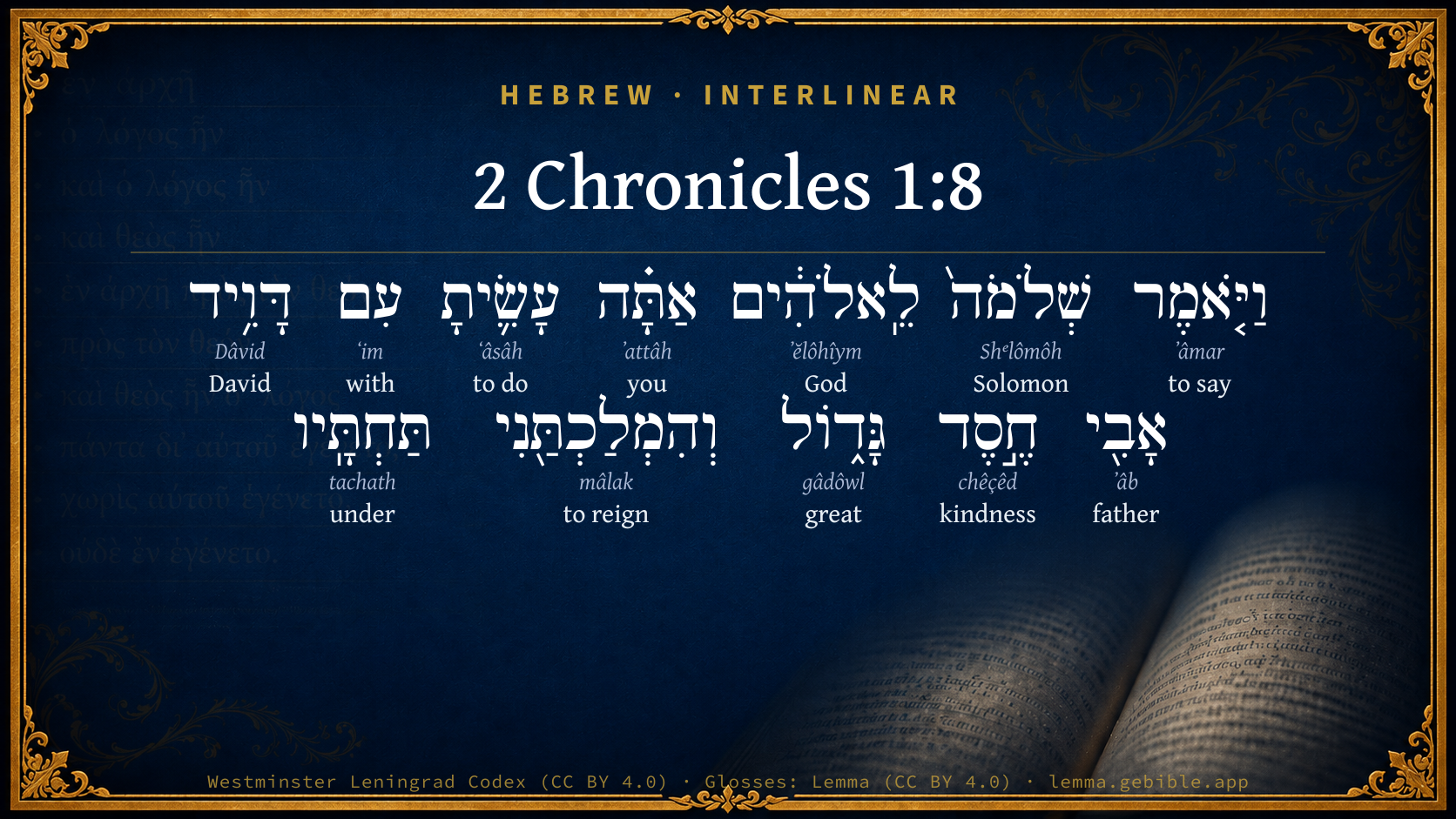
  1. וַיֹּ֤אמֶר ʼâmar H559 “and · to say” Conjunction + Verb, Qal, Sequential Imperfect, 3rd Person, Masculine, Singular
  2. שְׁלֹמֹה֙ Shᵉlômôh H8010 “Solomon” Noun, Proper
  3. לֵֽאלֹהִ֔ים ʼĕlôhîym H430 “to/for · God(s)” Preposition + Noun, Common, Masculine, Plural, Absolute
  4. אַתָּ֗ה ʼattâh H859 “you” Pronoun, Personal, 2nd Person, Masculine, Singular
  5. עָשִׂ֛יתָ ʻâsâh H6213 “to do” Verb, Qal, Perfect, 2nd Person, Masculine, Singular
  6. עִם ʻim H5973 “with” Preposition
  7. דָּוִ֥יד Dâvid H1732 “David” Noun, Proper
  8. אָבִ֖י ʼâb H1 “father · my” Noun, Common, Masculine, Singular, Construct + Suffix, Personal, 1st Person, Common, Singular
  9. גָּד֑וֹל gâdôwl H1419 “great” Adjective, Adjective, Masculine, Singular, Absolute
  10. וְהִמְלַכְתַּ֖נִי mâlak H4427 “and · to reign · me” Conjunction + Verb, Hiphil, Perfect, 2nd Person, Masculine, Singular + Suffix, Personal, 1st Person, Common, Singular
  11. תַּחְתָּֽיו tachath H8478 “under · him” Preposition + Suffix, Personal, 3rd Person, Masculine, Singular

About this verse

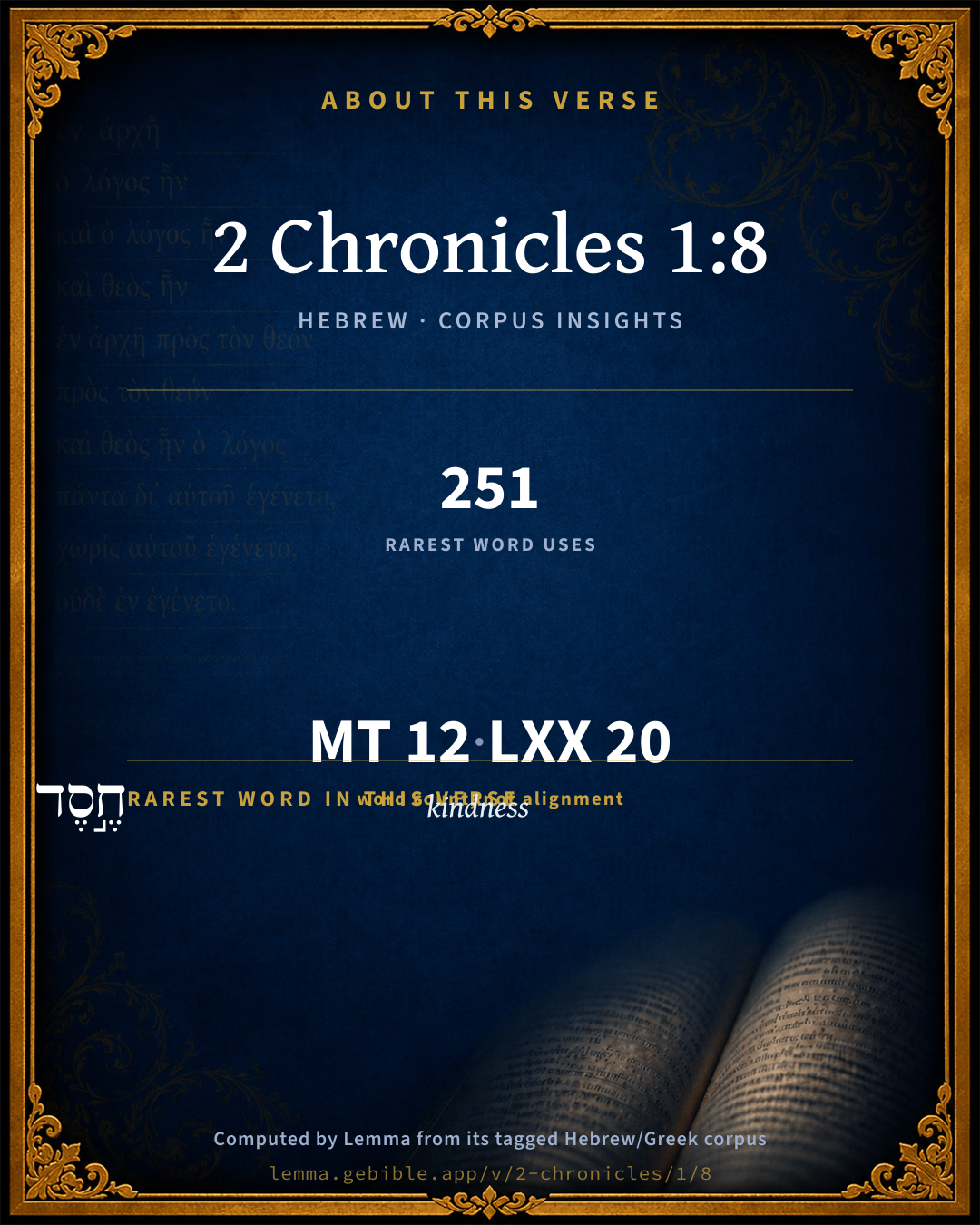
These counts appear in no published source. They are computed here, from the morphology-tagged text and Lemma’s own curated glosses. What Lemma adds →

12
words
12
distinct lemmas
Historical
section

Grammatical profile

  • 3 verbs
  • 5 nouns
  • 1 adjective
  • 1 pronoun
  • 2 prepositions

Verb forms

  • וַיֹּ֤אמֶר Qal · Sequential Imperfect
  • עָשִׂ֛יתָ Qal · Perfect
  • וְהִמְלַכְתַּ֖נִי Hiphil · Perfect

Hebrew & Septuagint length

In English translation the verse runs 22 words from the Hebrew and 22 from the Septuagint (LXX English) — the same length.

A rough comparison of the two English renderings, which tokenize alike — not a word-level alignment.

Word counts can differ between the Hebrew and the Greek without any difference in meaning — e.g. the Hebrew direct-object marker אֵת has no separate Greek word, and Greek often adds the article ὁ.

In the original languages it is 12 Hebrew tokens and 20 Greek tokens — but the two are counted differently (Hebrew bundles its prefixes and suffixes into one token; the Greek is in lemma form), so that isn’t a like-for-like length.

Cross-references

9

Topical passages linked to 2 Chronicles 1:8 in the Treasury of Scripture Knowledge — connected by theme and wording, ordered by reader-vote popularity; previews shown in the World English Bible.

  • 1 Chronicles 28:5 Of all my sons (for Yahweh has given me many sons), he has chosen Solomon my son to sit on the throne of the kingdom of Yahweh over Israel.
  • Isaiah 55:3 Turn your ear, and come to me; hear, and your soul shall live: and I will make an everlasting covenant with you, even the sure mercies of David.
  • 2 Samuel 7:8–9 Now therefore thus shall you tell my servant David, Thus says Yahweh of Hosts, I took you from the sheep pen, from following the sheep, that you should be prince over my people, over Israel;
  • 2 Samuel 12:7–8 Nathan said to David, "You are the man. This is what Yahweh, the God of Israel, says: 'I anointed you king over Israel, and I delivered you out of the hand of Saul.
  • 2 Samuel 22:51–23:1 Great deliverance gives he to his king, Shows loving kindness to his anointed, To David and to his seed, forevermore.
  • 1 Chronicles 29:23 Then Solomon sat on the throne of Yahweh as king instead of David his father, and prospered; and all Israel obeyed him.
  • Psalms 86:13 For your loving kindness is great toward me. You have delivered my soul from the lowest Sheol.
  • Psalms 89:20–28 I have found David, my servant. I have anointed him with my holy oil,
  • Psalms 89:49 Lord, where are your former loving kindnesses, Which you swore to David in your faithfulness?

Cross-references courtesy of OpenBible.info (CC BY 4.0).

Hebrew and Greek witnesses Masoretic Hebrew ↔ Greek Septuagint

The same verse in the two great witnesses to the Old Testament, shown verse-for-verse.

These are two independent witnesses, not word-aligned to each other, and the Septuagint is shown in lemma (dictionary) form.

Hebrew 2 Chronicles 1:8 Masoretic · Westminster Leningrad Codex

וַיֹּ֤אמֶר שְׁלֹמֹה֙ לֵֽאלֹהִ֔ים אַתָּ֗ה עָשִׂ֛יתָ עִם דָּוִ֥יד אָבִ֖י חֶ֣סֶד גָּד֑וֹל וְהִמְלַכְתַּ֖נִי תַּחְתָּֽיו

Solomon said to God, You have shown great loving kindness to David my father, and have made me king in his place.

World English Bible · Public Domain

Greek LXX 2 Chronicles 1:8 Septuagint · lemma form

καί εἶπον σαλωμών πρός ὁ θεός σύ ποιέω μετά δαυίδ ὁ πατήρ ἐγώ ἔλεος μέγας καί βασιλεύω ἐγώ ἀντί αὐτός

And Solomon said to God, You have dealt very mercifully with my father David, and have made me king in his stead.

LXX2012 (modern English Septuagint) · Public Domain

Hebrew: Westminster Leningrad Codex (CC BY 4.0). Greek: Septuagint (public domain); English from LXX2012 (modern English Septuagint) (Public Domain). How the Septuagint differs from the Hebrew →

Commentary

Notes on 2 Chronicles 1:8 from classic Christian and Jewish commentators (each source and its license shown beneath its notes). The classic Christian expositions comment on the surrounding passage and are grouped to its opening verse, so a note may address several verses; the Jewish commentaries on the Tanakh (Rashi and others) are per-verse, so they appear only where the commentator wrote on this verse.

Lemma curates 59 commentaries, every one of them public domain or Creative Commons licensed, each selected and text-cleaned for this edition rather than reprinted as found. About our sources →

Trapp's Complete Commentary

John Trapp

2Ch 1:8 And Solomon said unto God, Thou hast shewed great mercy unto David my father, and hast made me to reign in his stead.

Ver. 8. Thou hast showed, &c.] God must be praised for the kindness he hath showed to our ancestors also. See on 1Ki 3:6.

John Trapp, A Commentary or Exposition upon All the Books of the Old and New Testament (1647–1656) — public domain. Text from a community e-Sword module.

Joseph Benson's Commentary

2Ch 1:8. And hast made me to reign — Give me the spirit of my father David, that Israel may not suffer by the change. The eminence of those that went before us, and the obligation that lies upon us to keep and carry on the good work they were engaged in, should quicken our prayers for wisdom and grace, that we may do the work of God in our day as faithfully as they did in theirs.

Joseph Benson's Commentary on the Old and New Testaments (1811–1818) — public domain. Text from a community e-Sword module.

Ellicott's Commentary for English Readers

(8) Thou hast shewed great mercy unto David.—Literally, Thou, thou hast done great kindness with David. (The regular phrase; comp. Luk_1:72.) From this point the relation here is briefer on the whole than that of Kings. The greater part of the long verse (1Ki_3:6) is omitted, and the variations between the two texts become numerous, though the general sense is the same in each.

And hast made me to reign in his stead.—Comp. 1Ki_3:7; and the similar language of Esarhaddon, king of Assyria (B.C. 681-668): “Ever since Asshur, Samas, Bel, Nebo . . . made me, Esarhaddon, sit securely on the throne of my father” (Cuneiform Inscriptions of Western Asia, 3:15, Colossians 2).

A Bible Commentary for English Readers, edited by Charles John Ellicott (1878–1897) — public domain. Text from a community e-Sword module.

The Cambridge Bible for Schools and Colleges

gen. ed. J. J. S. Perowne

8. mercy] R.V. kindness (as 1Ki_3:6). God shewed David not merely compassion, but also bounty.

made me to reign] R.V. made me king.

The Cambridge Bible for Schools and Colleges (gen. ed. J. J. S. Perowne; Cambridge University Press, 1878–1918) — public domain. Text from a community e-Sword module.

The Pulpit Commentary

Thou hast showed great mercy unto David my father. These also are the exact words found in the parallel place, but they omit the words, "thy servant," before "David," found there. And hast made me to reign in his stead. This concise expression takes the place of two equivalent expressions, found at the end of the sixth and beginning of the seventh verses in the parallel passage, the former of which passages also describes it as "this great kindness," i.e. kindness on the part of God a description very much in harmony with David"s own grateful acknowledgment to God. (1Ki_1:48) Up to this point our present account differs from its parallel in cutting out Solomon"s eulogy of his father ("According as he walked before thee in truth and in righteousness and in uprightness of heart with thee"), and his humbler disparagement of himself ("And I, a little child, know not how to go out or come in").

The Pulpit Commentary (1880–1919), ed. H.D.M. Spence-Jones & Joseph S. Exell — public domain. Text from a community e-Sword module.

John Wesley's Explanatory Notes

To reign, &c. - Give me the spirit of my father David, that Israel may not suffer by the change. The eminency of those that went before us, and the obligation that lies upon us, to keep and carry on the good work they were engaged in, should quicken our prayers for wisdom and grace, that we may do the work of God in our day, as faithful as they did in theirs.

John Wesley, Explanatory Notes Upon the Whole Bible (1754–1765) — public domain. Text via the GEBible commentary corpus.

unfoldingWord translationNotes

Door43 World Missions Community

You have shown great covenant faithfulness to David

The abstract noun "faithfulness" can be stated as "faithfully" or "faithful." AT: "You have greatly and faithfully loved David" or "You have been very faithful to David" (See: Abstract Nouns)

Now

Here the word "Now" is used to draw attention to the important point that follows.

let your promise to David my father be carried out

This can be stated in active form. AT: "please do what you promised to David my father that you would do" (See: Active or Passive)

a people as numerous as the dust of the earth

This simile emphasizes the great number of Israelites. AT: "countless people" or "very many people" (See: Simile)

give me wisdom and knowledge

This can be restated to remove the abstract nouns "wisdom" and "knowledge." AT: "cause me to be wise and to know many things" (See: Abstract Nouns)

who can judge your people, who are so many in number?

Here "judge" means to govern or rule. Solomon uses a question to state that it is impossible to rule over so many people without God's help. AT: "no one can judge all of your countless people without your help." (See: Rhetorical Question)

Because this was in your heart

Here "heart" represents desire. AT: "Because this was your desire" or "Because this is what you wanted" (See: Metonymy)

nor for the life of those who hate you

"nor to be able to defeat those who hate you" or "nor to be able to kill your enemies"

translationWords

covenant faithfulness

king

promise

people group

wise

know

judge

people of God

heart

honor

life

unfoldingWord translationNotes — © Distant Shores Media and the Door43 World Missions Community, licensed CC BY-SA 4.0. Source: git.door43.org/Door43/en_tn.

Lesson kit

Teaching starters — assembled from the data on this page, not authored interpretation. Every prompt links to the verse data it draws on. Edit before teaching.

2 Chronicles, in the Historical, opens this verse with 12 words (12 distinct Hebrew lemmas). Its most distinctive word is chêçêd (“kindness”). A historical commentator’s framing appears above. Read the whole chapter for the surrounding context.

Discussion questions

  1. What does “kindness” (chêçêd) contribute to the verse as a whole?
  2. How does 1 Chronicles 28:5, which shares this passage’s theme, read alongside this verse?
  3. These translations render this verse differently. What is at stake in choosing one wording over another?
  4. «וַיֹּ֤אמֶר» is a Qal Sequential Imperfect verb. How does that grammatical form shape the action described?
  5. Compare how Trapp's Complete Commentary and Joseph Benson's Commentary read this verse. Where do they agree or differ?

Things to notice

Reading settings

Reading text

Shown beneath each verse's original-language words.

Old Testament
Old Testament edition

Read the OT as the Masoretic Hebrew (MT) or the Greek Septuagint (LXX).

English shown for the Greek Septuagint (in the Hebrew ↔ Greek comparison).

Comparing translations? Open the Compare panel on any verse page to stack up to four side by side.