Nehemiah 12:46

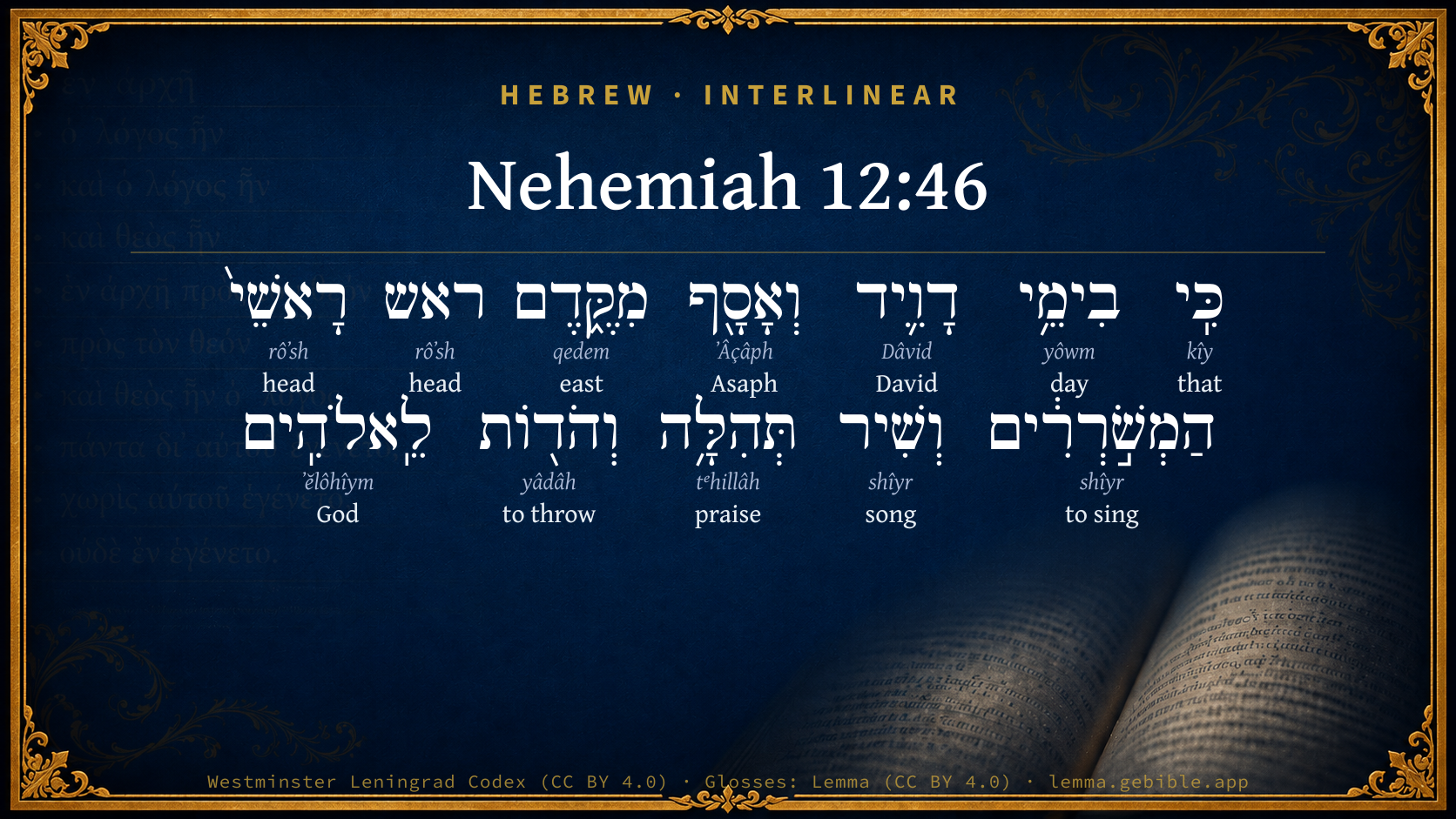
Hebrew (Westminster Leningrad Codex) Nehemiah 12:46 appears in the Hebrew Old Testament. The text above is from the Westminster Leningrad Codex. Each word links to its Strong’s number, a concise gloss, and parsing drawn from the Open Scriptures Hebrew Bible morphology. Click any word for its full Brown-Driver-Briggs (BDB) entry.
Download image
Cite this verse

Nehemiah 12:46 (World English Bible). Public Domain. Lemma interlinear Bible study tool, https://lemma.gebible.app/v/nehemiah/12/46.

Show BibTeX & RIS
BibTeX
RIS
English Translation
For in the days of David and Asaph of old there was a chief of the singers, and songs of praise and thanksgiving to God.
World English Bible · Public Domain
Download a study sheet

One document with this verse’s original text, its word-by-word gloss line, the meaning frame, cross-references with their text, attributed commentary, and full source and license credits — printable, and it pastes into notes with its structure intact.

This verse Autodidact and up

Study sheet (.html) Plain text (.txt)

A passage Seminary Student

Up to 50 verses in one chapter. A passage sheet keeps up to 6 commentary sources and 12 cross-references per verse, in the order this page ranks them, and says so on the sheet whenever that leaves anything out. Ask for a single verse and you get the Autodidact verse sheet above.

Everything on this page stays free to read, with no account — the sheet is a download of what is already on screen, not access to it.

Want to remove ads? Support Godless Engineer
Compare translations 3

The same verse in 3 English versions, stacked beneath the original-language interlinear above. Click any original word for its lexicon entry.

Each is an independent rendering of the whole verse — the interlinear is not word-aligned to these translations.

Highlighted words mark where these versions differ — a whole-verse word diff, not a word-by-word alignment.

  • World English Bible Public Domain
    For in the days of David and Asaph of old there was a chief of the singers, and songs of praise and thanksgiving to God.
  • King James Version Public Domain
    For in the days of David and Asaph of old there were chief of the singers, and songs of praise and thanksgiving unto God.
  • unfoldingWord Literal Text CC BY-SA 4.0
    For in the days of David and Asaph, from ancient time there was a head of the ones who sang, and songs of praise and thanksgiving to God.

unfoldingWord Literal Text — © unfoldingWord, licensed CC BY-SA 4.0. Word-aligned USFM3 via Door43 (git.door43.org/unfoldingWord/en_ult).

Versions to compare (up to 4)

3 of 4 selected

Show all 18 translations

Every available English version of this verse, each an independent rendering of the whole verse.

  • World English Bible Public Domain
    For in the days of David and Asaph of old there was a chief of the singers, and songs of praise and thanksgiving to God.
  • Berean Standard Bible Public Domain
    For long ago, in the days of David and Asaph, there were directors for the singers and for the songs of praise and thanksgiving to God.
  • Majority Standard Bible Public Domain
    For long ago, in the days of David and Asaph, there were directors for the singers and for the songs of praise and thanksgiving to God.
  • King James Version Public Domain
    For in the days of David and Asaph of old there were chief of the singers, and songs of praise and thanksgiving unto God.
  • American Standard Version (1901) Public Domain
    For in the days of David and Asaph of old there was a chief of the singers, and songs of praise and thanksgiving unto God.
  • Revised Version (1885) Public Domain
    For in the days of David and Asaph of old there was a chief of the singers, and songs of praise and thanksgiving unto God.
  • Geneva Bible (1599) Public Domain
    For in the dayes of Dauid and Asaph, of olde were chiefe singers, and songs of praise and thankesgiuing vnto God.
  • Douay-Rheims (1899) Public Domain
    And all Israel, in the days of Zorobabel, and in the days of Nehemias gave portions to the singing men, and to the porters, day by day, and they sanctified the Levites, and the Levites sanctified the sons of Aaron.
  • Young's Literal Translation Public Domain
    for in the days of David and Asaph of old `were' heads of the singers, and a song of praise and thanksgiving to God.
  • Literal Standard Version CC BY-SA 4.0
    for in the days of David and Asaph of old [were] heads of the singers, and a song of praise and thanksgiving to God.
  • Unlocked Literal Bible CC BY-SA 4.0
    For long ago, in the days of David and Asaph, there were directors of singers, and there were songs of praise and thanksgiving to God.
  • unfoldingWord Literal Text CC BY-SA 4.0
    For in the days of David and Asaph, from ancient time there was a head of the ones who sang, and songs of praise and thanksgiving to God.
  • Darby Bible Public Domain
    For of old, in the days of David and Asaph, there were the chiefs of the singers, and songs of praise and thanksgivings to God.
  • World Messianic Bible Public Domain
    For in the days of David and Asaph of old there was a chief of the singers, and songs of praise and thanksgiving to God.
  • Webster's Bible Public Domain
    For in the days of David, and Asaph of old there were chief of the singers, and songs of praise and thanksgiving to God.
  • Free Bible Version CC BY-SA 4.0
    For long ago, back in the time of David and Asaph, directors had been appointed for the singers and for the songs of praise and thanks to God.
  • Bible in Basic English Public Domain
    For in the days of David and Asaph in the past, there was a master of the music, and songs of blessing and praise to God.
  • JPS Tanakh (1917) Public Domain
    For in the days of David and Asaph of old there were chief of the singers, and songs of praise and thanksgiving unto God.

Literal Standard Version (2020), Covenant Press — licensed CC BY-SA 4.0. Text via the HelloAO Bible API (eBible.org). Unlocked Literal Bible (unfoldingWord) — licensed CC BY-SA 4.0. Text via the HelloAO Bible API (eBible.org). unfoldingWord Literal Text — © unfoldingWord, licensed CC BY-SA 4.0. Word-aligned USFM3 via Door43 (git.door43.org/unfoldingWord/en_ult). Free Bible Version, Dr. Jonathan Gallagher — licensed CC BY-SA 4.0. Text via the HelloAO Bible API (eBible.org).

Word by word

More ways to search: Search by grammar → Find every occurrence → Compare this word →

Practice this passage: Drill this verse → Learn its vocabulary →

וְאָסָ֖ף
ʼÂçâph
H623
“and · Asaph”
Conjunction + Noun, Proper
Part of Speech
Conjunction + Noun
Type
Proper
Full BDB Definition

Origin: from H622

TWOT: None

Asaph = "gatherer" - the father of Hezekiah's secretary - a son of Berechiah, chief Levite musician under David - a Persian officer over the royal forest
  1. כִּֽי kîy H3588 “that” Conjunction
  2. בִימֵ֥י yôwm H3117 “in/at · days of” Preposition + Noun, Common, Masculine, Plural, Construct
  3. דָוִ֛יד Dâvid H1732 “David” Noun, Proper
  4. מִקֶּ֑דֶם qedem H6924 “from · east” Preposition + Noun, Common, Masculine, Singular, Absolute
  5. ראש rôʼsh H7218 “head of” Noun, Common, Masculine, Singular, Construct
  6. רָאשֵׁי֙ rôʼsh H7218 “heads of” Noun, Common, Masculine, Plural, Construct
  7. הַמְשֹׁ֣רְרִ֔ים shîyr H7891 “the · singing” Particle, Definite Article + Verb, Polel, Participle Active, Masculine, Plural, Absolute
  8. וְשִׁיר shîyr H7892 “and · song of” Conjunction + Noun, Common, Both, Singular, Construct
  9. תְּהִלָּ֥ה tᵉhillâh H8416 “praise” Noun, Common, Feminine, Singular, Absolute
  10. וְהֹד֖וֹת yâdâh H3034 “and · to throw” Conjunction + Verb, Hiphil, Infinitive Construct
  11. לֵֽאלֹהִֽים ʼĕlôhîym H430 “to/for · God(s)” Preposition + Noun, Common, Masculine, Plural, Absolute

About this verse

These counts appear in no published source. They are computed here, from the morphology-tagged text and Lemma’s own curated glosses. What Lemma adds →

12
words
11
distinct lemmas
Historical
section

Shared distinctive vocabulary

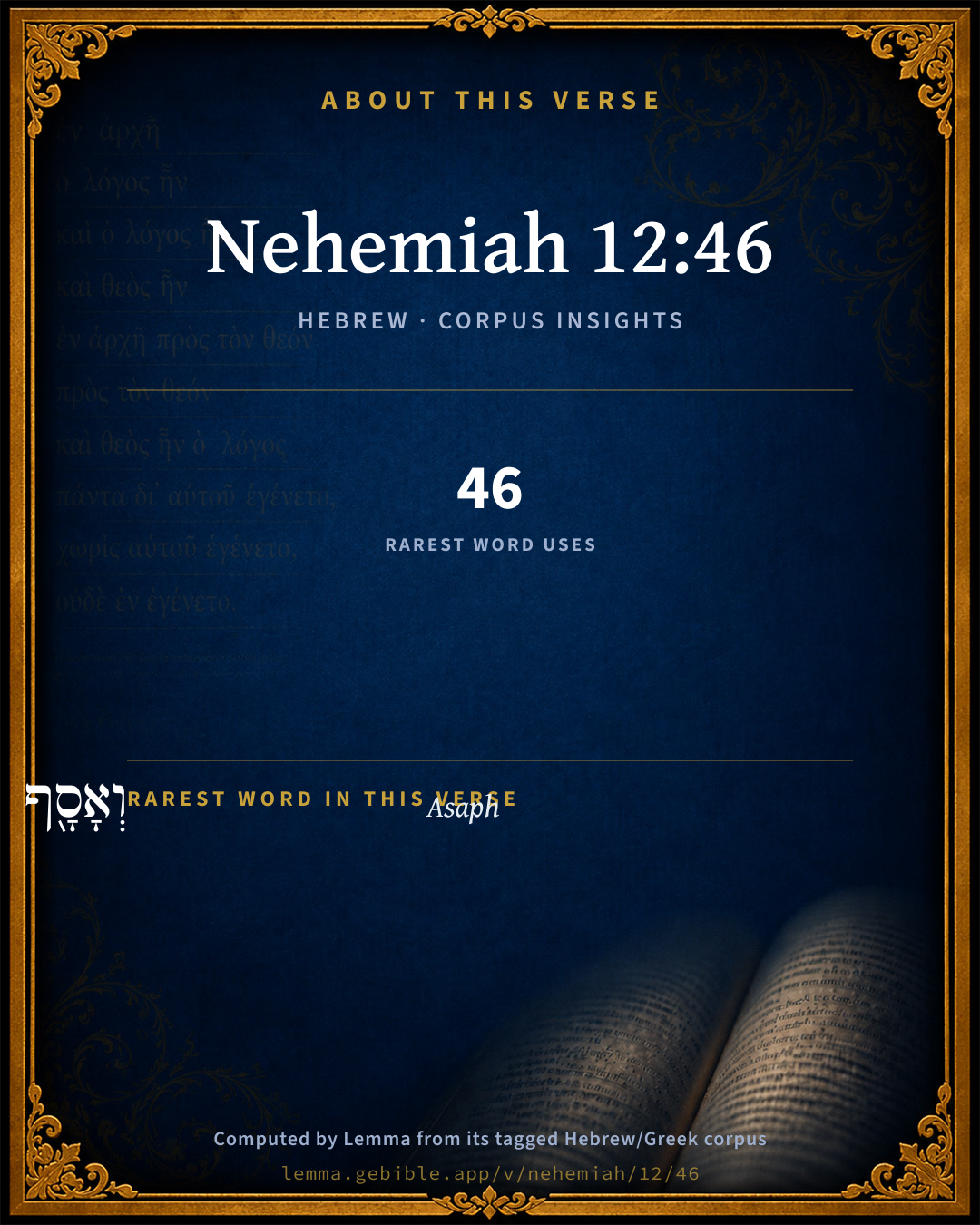
וְאָסָ֖ף Asaph H623 occurs in 41 verses of the Hebrew Bible. Also found in:

Grammatical profile

  • 2 verbs
  • 9 nouns
  • 1 conjunction

Verb forms

  • הַמְשֹׁ֣רְרִ֔ים Polel · Participle Active
  • וְהֹד֖וֹת Hiphil · Infinitive Construct

Repetition

A word recurs within this verse — often emphatic in Hebrew:

Cross-references

4

Topical passages linked to Nehemiah 12:46 in the Treasury of Scripture Knowledge — connected by theme and wording, ordered by reader-vote popularity; previews shown in the World English Bible.

  • 2 Chronicles 29:30 Moreover Hezekiah the king and the princes commanded the Levites to sing praises to Yahweh with the words of David, and of Asaph the seer. They sang praises with gladness, and they bowed their heads and worshiped.
  • 1 Chronicles 25:1–31 Moreover, David and the captains of the host set apart for the service certain of the sons of Asaph, and of Heman, and of Jeduthun, who should prophesy with harps, with psalteries, and with cymbals: and the number of those who did the work according to their service was:
  • Psalms 73:1 Surely God is good to Israel, To those who are pure in heart.
  • Psalms 83:1 God, don't keep silent. Don't keep silent, And don't be still, God.

Cross-references courtesy of OpenBible.info (CC BY 4.0).

Hebrew and Greek witnesses Masoretic Hebrew ↔ Greek Septuagint

The same verse in the two great witnesses to the Old Testament, shown verse-for-verse.

These are two independent witnesses, not word-aligned to each other, and the Septuagint is shown in lemma (dictionary) form.

Hebrew Nehemiah 12:46 Masoretic · Westminster Leningrad Codex

כִּֽי בִימֵ֥י דָוִ֛יד וְאָסָ֖ף מִקֶּ֑דֶם ראש רָאשֵׁי֙ הַמְשֹׁ֣רְרִ֔ים וְשִׁיר תְּהִלָּ֥ה וְהֹד֖וֹת לֵֽאלֹהִֽים

For in the days of David and Asaph of old there was a chief of the singers, and songs of praise and thanksgiving to God.

World English Bible · Public Domain

Greek LXX Structure differs

The Septuagint has no separate book of Nehemiah. Its Greek text is the second half of Esdras B (2 Esdras), chapters 11–23; Ezra is the first half (1–10).

A verse-for-verse comparison isn’t shown here because the chapters and verses don’t line up. Switch to the LXX edition with the MT / LXX toggle above to read the Greek directly.

On this verse, The Cambridge Bible for Schools and Colleges discusses the Septuagint’s reading. Read the note in Commentary ↓

Hebrew: Westminster Leningrad Codex (CC BY 4.0). Greek: Septuagint (public domain); English from a public-domain English Septuagint. How the Septuagint differs from the Hebrew →

Commentary

Notes on Nehemiah 12:46 from classic Christian and Jewish commentators (each source and its license shown beneath its notes). The classic Christian expositions comment on the surrounding passage and are grouped to its opening verse, so a note may address several verses; the Jewish commentaries on the Tanakh (Rashi and others) are per-verse, so they appear only where the commentator wrote on this verse.

Lemma curates 59 commentaries, every one of them public domain or Creative Commons licensed, each selected and text-cleaned for this edition rather than reprinted as found. About our sources →

Joseph Benson's Commentary

Neh 12:46. For in the days of David, &c. — This verse gives the reason why the Levites and the singers performed their duty so accurately; because, from the time of David, who constituted their orders and offices, there were overseers appointed, who presided over them, and were careful both to instruct them in their duty, and keep them to it.

Joseph Benson's Commentary on the Old and New Testaments (1811–1818) — public domain. Text from a community e-Sword module.

Tyndale Open Study Notes

Tyndale Open Resources

12:46 David had given instructions for ordering the music at the Temple (1 Chr 23–26), and he had put Asaph, along with Heman and Jeduthun, in charge of the music (1 Chr 25:2-5).

Tyndale Open Study Notes — © Tyndale Open Resources, licensed CC BY-SA 4.0. Text via the HelloAO Bible API.

Ellicott's Commentary for English Readers

(46) Of old.—Always there is a reverence shown for the old precedents.

A Bible Commentary for English Readers, edited by Charles John Ellicott (1878–1897) — public domain. Text from a community e-Sword module.

The Cambridge Bible for Schools and Colleges

gen. ed. J. J. S. Perowne

46. in the days of David and Asaph of old] This combination of names may be illustrated by other examples in the writings of the Chronicler (2Ch_29:30; 2Ch_35:15).

The LXX. omits the copula between the names, ἐν ἡμέραις Δαυὶδ Ἀσὰφ ἀπʼ ἀρχῆς πρῶτος τῶν ᾀδόντων. This may represent the original reading. If so, it is the mention of David in the previous verse which occasions here the parenthetical statement that in those days the great Asaph was ‘overseer’ of the singers. We should then render ‘in the days of David Asaph was of old chief.’

there were chief] R.V. Marg. ‘Another reading is there were chiefs’. The plural ‘chiefs’ is the reading of the K’ri, which is also found in the Vulgate ‘erant principes constituti cantorum.’ If the reading of the first clause ‘in the days of David and Asaph’ be retained, the plural ‘chiefs’ with the allusion to a general custom, instead of to a particular example, is probably to be preferred. For the position of ‘chief’ of the singers associated with Asaph, see 1Ch_16:5; 1Ch_16:7; 1Ch_25:1-2; 1Ch_25:9.

songs of praise and thanksgiving] In the English versions the punctuation gives the meaning as of a new clause ‘And there were songs of praise’ &c. Others make these words also dependent on ‘chief’ or ‘chiefs.’

There is no corresponding archæological reference to the position of the porters. The Chronicler throughout his work shows a marked preference for the interests of ‘the singers’ as compared with ‘the porters.’

The Cambridge Bible for Schools and Colleges (gen. ed. J. J. S. Perowne; Cambridge University Press, 1878–1918) — public domain. Text from a community e-Sword module.

Haydock's Catholic Bible Commentary

Sanctified. That is, they gave them that which by the law was set aside, and sanctified for their use. (Challoner) --- The Levites paid a tithe to the priests, (chap. x. 38., and Numbers xviii. 26.; Calmet) as the people did to them. (Worthington)

George Leo Haydock (1774–1849), Haydock's Catholic Family Bible and Commentary, 1859 edition — public domain. Excludes Psalms (Douay-Rheims chapter numbering differs from Protestant) and Deuterocanonical books (Catholic canon only).

Matthew Poole's English Annotations

David, and Asaph, and Heman, and Jeduthun, 1Ch 25:1; but Asaph only is mentioned here, as the most eminent and useful in that work.

There were chief of the singers; there were some overseers, whose office it was to see that the singers were fit for and diligent in their work; and therefore they took care of it at this time.

Matthew Poole's English Annotations on the Holy Bible (1683–1685) — public domain. Text from a community e-Sword/MySword module.

Whedon's Commentary on the Bible

Daniel D. Whedon

46. For in the days of David and Asaph — So these Levitical appointments were no new invention of Nehemiah, but a restoration of a usage old as the times of David. The “and” before Asaph seems to be s clerical error. It is better to read, In the days of David Asaph was chief, etc.

Daniel D. Whedon (gen. ed.), Commentary on the Old and New Testaments (1874–1909) — public domain. Text from a community e-Sword module.

The Pulpit Commentary

For in the days of David. This verse is exegetical of the clause in ver. 45, "according to the commandment of David." The writer justifies his reference to that "commandment" by reminding his readers that the whole musical service the singers, themselves, and their "chiefs," together with the "songs of praise" and the "thanksgiving songs had descended to the Jews of his day from David and Asaph.

The Pulpit Commentary (1880–1919), ed. H.D.M. Spence-Jones & Joseph S. Exell — public domain. Text from a community e-Sword module.

unfoldingWord translationNotes

Door43 World Missions Community

there were directors of singers

This sentence tells why the people did what they did in Nehemiah 12:45 and gives us more information about the time when David told people how to worship at the temple.

In the days of Zerubbabel

Zerubbabel was a descendant of King David and one of the governors in the region of Judah.

They set aside the portion

"All Israel set aside the portion"

the descendants of Aaron

the priests in Israel, who descended from Aaron, the brother of Moses

translationWords

David

Asaph

praise

God

Nehemiah

Israel

Levi

descend

Aaron

unfoldingWord translationNotes — © Distant Shores Media and the Door43 World Missions Community, licensed CC BY-SA 4.0. Source: git.door43.org/Door43/en_tn.

Lesson kit

Teaching starters — assembled from the data on this page, not authored interpretation. Every prompt links to the verse data it draws on. Edit before teaching.

Nehemiah, in the Historical, opens this verse with 12 words (11 distinct Hebrew lemmas). Its most distinctive word is ʼÂçâph (“Asaph”). A historical commentator’s framing appears above. Read the whole chapter for the surrounding context.

Discussion questions

  1. The word ʼÂçâph carries the sense “Asaph.” How does it shape the verse?
  2. 2 Kings 18:18 shares the word «Asaph» with this verse. How do the two illuminate each other?
  3. “head” occurs 2× in this one verse. What is the effect of the repetition?
  4. These translations render this verse differently. What is at stake in choosing one wording over another?
  5. The verb «הַמְשֹׁ֣רְרִ֔ים» is Polel Participle Active. How does its form color the action?
  6. Reading how Joseph Benson's Commentary and Tyndale Open Study Notes read this verse, where do the two commentators agree and where do they part?

Things to notice

Reading settings

Reading text

Shown beneath each verse's original-language words.

Old Testament
Old Testament edition

Read the OT as the Masoretic Hebrew (MT) or the Greek Septuagint (LXX).

English shown for the Greek Septuagint (in the Hebrew ↔ Greek comparison).

Comparing translations? Open the Compare panel on any verse page to stack up to four side by side.