
1 Chronicles 29:22

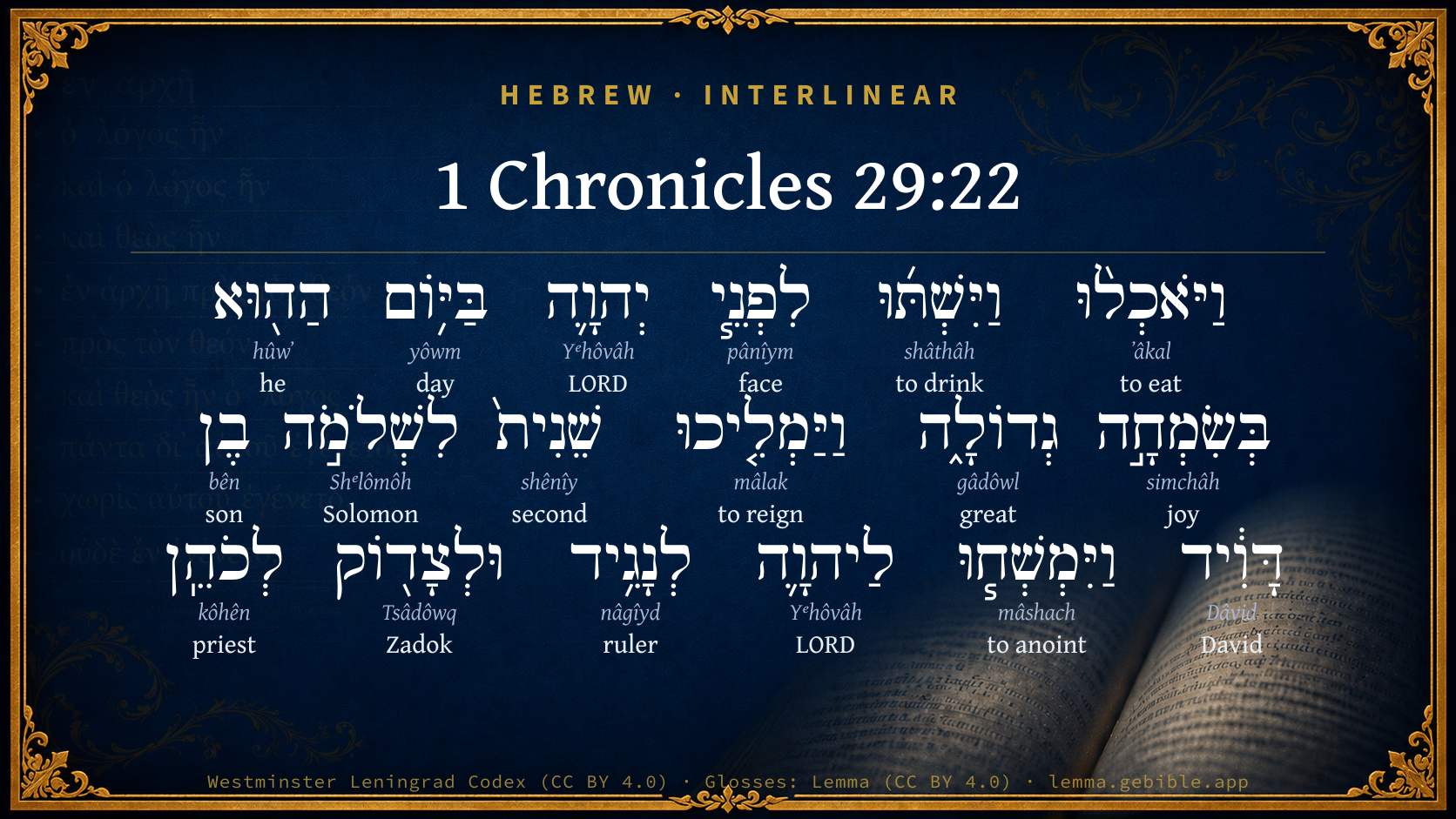
Hebrew (Westminster Leningrad Codex) 1 Chronicles 29:22 appears in the Hebrew Old Testament. The text above is from the Westminster Leningrad Codex. Each word links to its Strong’s number, a concise gloss, and parsing drawn from the Open Scriptures Hebrew Bible morphology. Click any word for its full Brown-Driver-Briggs (BDB) entry.
Download image
Cite this verse

1 Chronicles 29:22 (World English Bible). Public Domain. Lemma interlinear Bible study tool, https://lemma.gebible.app/v/1-chronicles/29/22.

Show BibTeX & RIS
BibTeX
RIS
English Translation
and ate and drink before Yahweh on that day with great gladness. They made Solomon the son of David king the second time, and anointed him to Yahweh to be prince, and Zadok to be priest.
World English Bible · Public Domain
Download a study sheet

One document with this verse’s original text, its word-by-word gloss line, the meaning frame, cross-references with their text, attributed commentary, and full source and license credits — printable, and it pastes into notes with its structure intact.

This verse Autodidact and up

Study sheet (.html) Plain text (.txt)

A passage Seminary Student

Up to 50 verses in one chapter. A passage sheet keeps up to 6 commentary sources and 12 cross-references per verse, in the order this page ranks them, and says so on the sheet whenever that leaves anything out. Ask for a single verse and you get the Autodidact verse sheet above.

Everything on this page stays free to read, with no account — the sheet is a download of what is already on screen, not access to it.

Want to remove ads? Support Godless Engineer
Compare translations 3

The same verse in 3 English versions, stacked beneath the original-language interlinear above. Click any original word for its lexicon entry.

Each is an independent rendering of the whole verse — the interlinear is not word-aligned to these translations.

Highlighted words mark where these versions differ — a whole-verse word diff, not a word-by-word alignment.

  • World English Bible Public Domain
    and ate and drink before Yahweh on that day with great gladness. They made Solomon the son of David king the second time, and anointed him to Yahweh to be prince, and Zadok to be priest.
  • King James Version Public Domain
    And did eat and drink before the LORD on that day with great gladness. And they made Solomon the son of David king the second time, and anointed him unto the LORD to be the chief governor, and Zadok to be priest.
  • unfoldingWord Literal Text CC BY-SA 4.0
    And they ate and drank to the face of Yahweh on that day with great rejoicing. And they made Solomon, the son of David, king a second, and they anointed a leader for Yahweh, and Zadok as priest.

unfoldingWord Literal Text — © unfoldingWord, licensed CC BY-SA 4.0. Word-aligned USFM3 via Door43 (git.door43.org/unfoldingWord/en_ult).

Versions to compare (up to 4)

3 of 4 selected

Show all 18 translations

Every available English version of this verse, each an independent rendering of the whole verse.

  • World English Bible Public Domain
    and ate and drink before Yahweh on that day with great gladness. They made Solomon the son of David king the second time, and anointed him to Yahweh to be prince, and Zadok to be priest.
  • Berean Standard Bible Public Domain
    That day they ate and drank with great joy in the presence of the LORD. Then, for a second time, they designated David’s son Solomon as king, anointing him before the LORD as ruler, and Zadok as the priest.
  • Majority Standard Bible Public Domain
    That day they ate and drank with great joy in the presence of the LORD. Then, for a second time, they designated David’s son Solomon as king, anointing him before the LORD as ruler, and Zadok as the priest.
  • King James Version Public Domain
    And did eat and drink before the LORD on that day with great gladness. And they made Solomon the son of David king the second time, and anointed him unto the LORD to be the chief governor, and Zadok to be priest.
  • American Standard Version (1901) Public Domain
    and did eat and drink before Jehovah on that day with great gladness. And they made Solomon the son of David king the second time, and anointed him unto Jehovah to be prince, and Zadok to be priest.
  • Revised Version (1885) Public Domain
    and did eat and drink before the LORD on that day with great gladness. And they made Solomon the son of David king the second time, and anointed him unto the LORD to be prince, and Zadok to be priest.
  • Geneva Bible (1599) Public Domain
    And they did eate and drinke before the Lord the same day with great ioy, and they made Salomon the sonne of Dauid King the seconde time, and anoynted him prince before the Lord, and Zadok for the hie Priest.
  • Douay-Rheims (1899) Public Domain
    And they ate, and drank before the Lord that day with great joy. And they anointed the second time Solomon the son of David. And they anointed him to the Lord to be prince, end Sadoc to be high priest.
  • Young's Literal Translation Public Domain
    And they eat and drink before Jehovah on that day with great joy, and cause Solomon son of David to reign a second time, and anoint `him' before Jehovah for leader, and Zadok for priest.
  • Literal Standard Version CC BY-SA 4.0
    And they eat and drink before YHWH on that day with great joy, and cause Solomon son of David to reign a second time, and anoint [him] before YHWH for leader, and Zadok for priest.
  • Unlocked Literal Bible CC BY-SA 4.0
    On that day, they ate and drank before Yahweh with great celebration. They made Solomon, David's son, king a second time, and anointed him with Yahweh's authority to be ruler. They also anointed Zadok to be priest.
  • unfoldingWord Literal Text CC BY-SA 4.0
    And they ate and drank to the face of Yahweh on that day with great rejoicing. And they made Solomon, the son of David, king a second, and they anointed a leader for Yahweh, and Zadok as priest.
  • Darby Bible Public Domain
    And they ate and drank before Jehovah on that day with great joy. And they made Solomon the son of David king the second time, and anointed him to Jehovah to be prince, and Zadok to be priest.
  • World Messianic Bible Public Domain
    and ate and drank before the LORD on that day with great gladness. They made Solomon the son of David king the second time, and anointed him before the LORD to be prince, and Zadok to be priest.
  • Webster's Bible Public Domain
    And ate and drank before the LORD on that day with great gladness. And they made Solomon the son of David king the second time, and anointed him to the LORD to be the chief governor, and Zadok to be priest.
  • Free Bible Version CC BY-SA 4.0
    Then they ate and drank in the presence of the Lord with great happiness that day. They made Solomon, the son of David, king for a second time, and they anointed him as ruler for the Lord, and anointed Zadok as priest.
  • Bible in Basic English Public Domain
    And with great joy they made a feast before the Lord that day. And they made Solomon, the son of David, king a second time, putting the holy oil on him to make him holy to the Lord as ruler, and on Zadok as priest.
  • JPS Tanakh (1917) Public Domain
    and did eat and drink before the LORD on that day with great gladness. And they made Solomon the son of David king the second time, and anointed him unto the LORD to be prince, and Zadok to be priest.

Literal Standard Version (2020), Covenant Press — licensed CC BY-SA 4.0. Text via the HelloAO Bible API (eBible.org). Unlocked Literal Bible (unfoldingWord) — licensed CC BY-SA 4.0. Text via the HelloAO Bible API (eBible.org). unfoldingWord Literal Text — © unfoldingWord, licensed CC BY-SA 4.0. Word-aligned USFM3 via Door43 (git.door43.org/unfoldingWord/en_ult). Free Bible Version, Dr. Jonathan Gallagher — licensed CC BY-SA 4.0. Text via the HelloAO Bible API (eBible.org).

Word by word

More ways to search: Search by grammar → Find every occurrence → Compare this word →

Practice this passage: Drill this verse → Learn its vocabulary →

לְנָגִ֥יד
nâgîyd
H5057
“to/for · ruler”
Preposition + Noun, Common, Masculine, Singular, Absolute
Part of Speech
Preposition + Noun
Type
Common
Gender
Masculine
Number
Singular
State
Absolute
Full BDB Definition

Origin: from H5046

TWOT: 1289b

leader, ruler, captain, prince - ruler, prince - prince-overseer - ruler (in other capacities) - princely things
  1. וַיֹּאכְל֨וּ ʼâkal H398 “and · to eat” Conjunction + Verb, Qal, Sequential Imperfect, 3rd Person, Masculine, Plural
  2. וַיִּשְׁתּ֜וּ shâthâh H8354 “and · to drink” Conjunction + Verb, Qal, Sequential Imperfect, 3rd Person, Masculine, Plural
  3. לִפְנֵ֧י pânîym H6440 “to/for · face(s) of” Preposition + Noun, Common, Both, Plural, Construct
  4. יְהוָ֛ה Yᵉhôvâh H3068 “LORD” Noun, Proper
  5. בַּיּ֥וֹם yôwm H3117 “in/at the · day” Preposition, Determined + Noun, Common, Masculine, Singular, Absolute
  6. הַה֖וּא hûwʼ H1931 “the · he” Particle, Definite Article + Pronoun, Personal, 3rd Person, Masculine, Singular
  7. בְּשִׂמְחָ֣ה simchâh H8057 “in/at · joy” Preposition + Noun, Common, Feminine, Singular, Absolute
  8. גְדוֹלָ֑ה gâdôwl H1419 “great” Adjective, Adjective, Feminine, Singular, Absolute
  9. וַיַּמְלִ֤יכוּ mâlak H4427 “and · to reign” Conjunction + Verb, Hiphil, Sequential Imperfect, 3rd Person, Masculine, Plural
  10. שֵׁנִית֙ shênîy H8145 “second” Adjective, Ordinal number, Feminine, Singular, Absolute
  11. לִשְׁלֹמֹ֣ה Shᵉlômôh H8010 “to/for · Solomon” Preposition + Noun, Proper
  12. בֶן bên H1121 “son of” Noun, Common, Masculine, Singular, Construct
  13. דָּוִ֔יד Dâvid H1732 “David” Noun, Proper
  14. וַיִּמְשְׁח֧וּ mâshach H4886 “and · to anoint” Conjunction + Verb, Qal, Sequential Imperfect, 3rd Person, Masculine, Plural
  15. לַיהוָ֛ה Yᵉhôvâh H3068 “to/for · LORD” Preposition + Noun, Proper
  16. וּלְצָד֖וֹק Tsâdôwq H6659 “and · to/for · Zadok” Conjunction + Preposition + Noun, Proper
  17. לְכֹהֵֽן kôhên H3548 “to/for · priest” Preposition + Noun, Common, Masculine, Singular, Absolute

About this verse

These counts appear in no published source. They are computed here, from the morphology-tagged text and Lemma’s own curated glosses. What Lemma adds →

18
words
17
distinct lemmas
Historical
section

Shared distinctive vocabulary

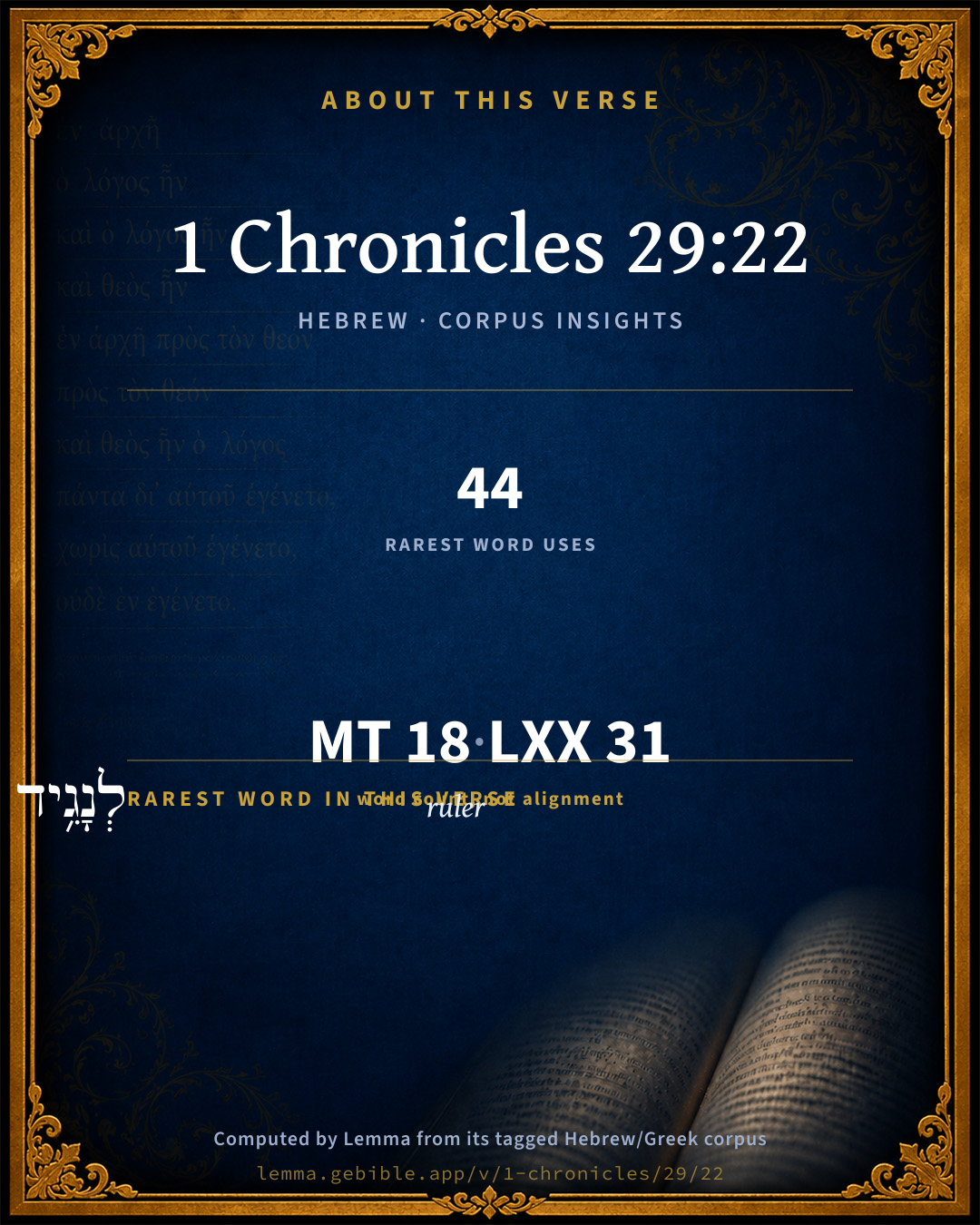
לְנָגִ֥יד ruler H5057 occurs in 44 verses of the Hebrew Bible. Also found in:

Grammatical profile

  • 4 verbs
  • 11 nouns
  • 2 adjectives
  • 1 pronoun

Verb forms

  • וַיֹּאכְל֨וּ Qal · Sequential Imperfect
  • וַיִּשְׁתּ֜וּ Qal · Sequential Imperfect
  • וַיַּמְלִ֤יכוּ Hiphil · Sequential Imperfect
  • וַיִּמְשְׁח֧וּ Qal · Sequential Imperfect

Repetition

A word recurs within this verse — often emphatic in Hebrew:

  • יְהוָ֛ה LORD H3068 ×2

Hebrew & Septuagint length

In English translation the verse runs 36 words from the Hebrew and 35 from the Septuagint (LXX English) — closely comparable.

A rough comparison of the two English renderings, which tokenize alike — not a word-level alignment.

Word counts can differ between the Hebrew and the Greek without any difference in meaning — e.g. the Hebrew direct-object marker אֵת has no separate Greek word, and Greek often adds the article ὁ.

In the original languages it is 18 Hebrew tokens and 31 Greek tokens — but the two are counted differently (Hebrew bundles its prefixes and suffixes into one token; the Greek is in lemma form), so that isn’t a like-for-like length.

Cross-references

15

Topical passages linked to 1 Chronicles 29:22 in the Treasury of Scripture Knowledge — connected by theme and wording, ordered by reader-vote popularity; previews shown in the World English Bible.

  • 1 Kings 2:35 The king put Benaiah the son of Jehoiada in his room over the host; and Zadok the priest did the king put in the room of Abiathar.
  • 1 Chronicles 23:1 Now David was old and full of days; and he made Solomon his son king over Israel.
  • Exodus 24:11 He didn't lay his hand on the nobles of the children of Israel. They saw God, and ate and drank.
  • 1 Kings 1:34–39 and let Zadok the priest and Nathan the prophet anoint him there king over Israel; and blow you the trumpet, and say, [Long] live king Solomon.
  • Deuteronomy 12:7 and there you shall eat before Yahweh your God, and you shall rejoice in all that you put your hand to, you and your households, in which Yahweh your God has blessed you.
  • Deuteronomy 12:11–12 then it shall happen that to the place which Yahweh your God shall choose, to cause his name to dwell there, there shall you bring all that I command you: your burnt offerings, and your sacrifices, your tithes, and the heave-offering of your hand, and all your choice vows which you vow to Yahweh.
  • Deuteronomy 16:14–17 and you shall rejoice in your feast, you, and your son, and your daughter, and your man-servant, and your maid-servant, and the Levite, and the foreigner, and the fatherless, and the widow, who are within your gates.
  • 1 Kings 1:31 Then Bathsheba bowed with her face to the earth, and did obeisance to the king, and said, Let my lord king David live forever.
  • 2 Chronicles 7:10 On the three and twentieth day of the seventh month he sent the people away to their tents, joyful and glad of heart for the goodness that Yahweh had shown to David, and to Solomon, and to Israel his people.
  • Nehemiah 8:12 All the people went their way to eat, and to drink, and to send portions, and to make great mirth, because they had understood the words that were declared to them.
  • Ecclesiastes 2:24 There is nothing better for a man than that he should eat and drink, and make his soul enjoy good in his labor. This also I saw, that it is from the hand of God.
  • Ecclesiastes 3:12–13 I know that there is nothing better for them than to rejoice, and to do good as long as they live.
  • Ecclesiastes 8:15 Then I commended mirth, because a man has no better thing under the sun, than to eat, and to drink, and to be joyful: for that will accompany him in his labor all the days of his life which God has given him under the sun.
  • Ecclesiastes 9:7 Go your way--eat your bread with joy, and drink your wine with a merry heart; for God has already accepted your works.
  • 1 Timothy 6:17–18 Charge those who are rich in this present world that they not be haughty, nor have their hope set on the uncertainty of riches, but on the living God, who richly provides us with everything to enjoy;

Cross-references courtesy of OpenBible.info (CC BY 4.0).

Hebrew and Greek witnesses Masoretic Hebrew ↔ Greek Septuagint

The same verse in the two great witnesses to the Old Testament, shown verse-for-verse.

These are two independent witnesses, not word-aligned to each other, and the Septuagint is shown in lemma (dictionary) form.

Hebrew 1 Chronicles 29:22 Masoretic · Westminster Leningrad Codex

וַיֹּאכְל֨וּ וַיִּשְׁתּ֜וּ לִפְנֵ֧י יְהוָ֛ה בַּיּ֥וֹם הַה֖וּא בְּשִׂמְחָ֣ה גְדוֹלָ֑ה וַיַּמְלִ֤יכוּ שֵׁנִית֙ לִשְׁלֹמֹ֣ה בֶן דָּוִ֔יד וַיִּמְשְׁח֧וּ לַיהוָ֛ה לְנָגִ֥יד וּלְצָד֖וֹק לְכֹהֵֽן

and ate and drink before Yahweh on that day with great gladness. They made Solomon the son of David king the second time, and anointed him to Yahweh to be prince, and Zadok to be priest.

World English Bible · Public Domain

Greek LXX 1 Chronicles 29:22 Septuagint · lemma form

καί ἐσθίω καί πίνω ἐναντίον κύριος ἐν ἐκεῖνος ὁ ἡμέρα μετά χαρά καί βασιλεύω ἐκ δεύτερος ὁ σαλωμών υἱός δαυίδ καί χρίω αὐτός ὁ κύριος εἰς βασιλεύς καί σαδωκ εἰς ἱερωσύνη

And they ate and drank joyfully that day before the Lord: and they made Solomon the son of David king a second time, and anointed him king before the Lord, and Sadoc to the priesthood.

LXX2012 (modern English Septuagint) · Public Domain

Hebrew: Westminster Leningrad Codex (CC BY 4.0). Greek: Septuagint (public domain); English from LXX2012 (modern English Septuagint) (Public Domain). How the Septuagint differs from the Hebrew →

Commentary

Notes on 1 Chronicles 29:22 from classic Christian and Jewish commentators (each source and its license shown beneath its notes). The classic Christian expositions comment on the surrounding passage and are grouped to its opening verse, so a note may address several verses; the Jewish commentaries on the Tanakh (Rashi and others) are per-verse, so they appear only where the commentator wrote on this verse.

Lemma curates 59 commentaries, every one of them public domain or Creative Commons licensed, each selected and text-cleaned for this edition rather than reprinted as found. About our sources →

Trapp's Complete Commentary

John Trapp

1Ch 29:22 And did eat and drink before the LORD on that day with great gladness. And they made Solomon the son of David king the second time, and anointed [him] unto the LORD [to be] the chief governor, and Zadok [to be] priest.

Ver. 22. And did eat and drink before the Lord.] So should we in all our feasts and merry meetings: to feed without fear is a foul fault.

With great gladness.] For they had also that continual feast of a good conscience. {Pro 15:15}

And they made Solomon … king the second time.] For the first time {1Ki 1:38-39} it was done hastily, suddenly, and in a manner tumultuarily, by reason of Adonijah’s sedition; but this here was done with good respite and great solemnity, but whether before or after David’s death is questionable.

And Zadok to be priest.] Abiathar being deposed, and the house of Eli cashiered, as that man of God had foretold. {1Sa 2:27-36}

John Trapp, A Commentary or Exposition upon All the Books of the Old and New Testament (1647–1656) — public domain. Text from a community e-Sword module.

Matthew Poole's English Annotations

Before the Lord, i.e. before the ark, in courts or places as near to it as they conveniently could. Or, as in God’s presence, in a solemn and religious manner, praising God for this great mercy, and begging his blessing upon this great affair.

The second time. This is called the second time in reference to the first time, which was either,

1. When he was made king during Adonijah’s conspiracy, of which see 1Ki 1:34, &c. And so this was done after David’s death, and not upon that day, when this feasting and solemnity lasted, as the words at first view seem to insinuate, this being related in the same verse, and immediately after the relation of the feast. But there are examples of things done at distant times put together in one verse, as Act 7:15, So Jacob went down into Egypt, and died, he, and our fathers, i.e. first he, and afterwards our fathers. So here, They did eat on that day with great gladness, and afterward they made Solomon king the second time. And this opinion seems to be confirmed by the following passages, in which it is related, that at this same time they anointed Zadok to be priest and that Solomon was king instead of David, and that all Israel, and all David’s sons, submitted to him; all which was not done till after David’s death, as may be gathered by comparing this with 1Ki 1; 1Ki 2. Or,

2. In 1Ch 23:1, where it is said that David made Solomon his son king over Israel, i.e. he declared him his successor. And so this second time was during David’s life. And what David had more privately declared, 1Ch 23, he now more solemnly owns in this great and general assembly, in which, by David’s order, and the consent of all that assembly, Solomon was anointed king, i.e. to be king after his father’s death. And this opinion the text seems most to favour. For it is said, And they made Solomon king, &c.: they; who? That must be fetched out of the foregoing words and verses, they who did eat and drink before the Lord on that day with great gladness, as it is here said; and then immediately it follows, and that with a copulative conjunction,

and they made Solomon king, & c., which without violence cannot be pulled away from the foregoing words. And therefore they must be David and

all the congregation, who were then present, 1Ch 29:20, of whom it is said, they sacrificed, &c., 1Ch 29:21, and they did eat, &c., and they made Solomon, &c. The great objection against this opinion is, that they anointed Zadok to be priest at this time, which was not done till after David’s death; for till then Abiathar was not thrust out from being priest, &c., 1Ki 2:26,27. This indeed is a difficulty, but not insoluble. It must be remembered that the high priest had his vicegerent who might officiate in his stead, when he was hindered by sickness or other indispensable occasion; and that there seems to be something more than ordinary in Zadok’s case; for although Abiathar was properly the high priest, yet Zadok seems after a sort to be joined in commission with him, as we see 2Sa 15:29; 19:11; and it is expressly said, Zadok and Abiathar were priests, 2Sa 20:25; 1Ki 4:4. And it may be further considered, that this anointing of Zadok might be occasioned by some miscarriage of Abiathar not recorded in Scripture. Possibly he was unsatisfied with this design of translating the crown to Solomon, and did now secretly favour Adonijah’s person and right, which afterward he did more openly defend; which being known to David by information, might induce him and the princes who favoured Solomon to take this course; which they might the more willingly do, in consideration of that Divine threatening, 1Sa 2:31, &c., of translating the priesthood from Ithamar’s and Eli’s house, of which Abiathar was, to Eleazar’s line, to which it had been promised to perpetuity, Num 25:13, of which line Zadok was. And they might judge this a fit season, or might be directed by God at this time, to execute that threatening to the one, and promise to the other family. And yet this action of theirs in anointing Zadok did not, as I suppose, actually constitute him high priest, but only settled the reversion of it upon him and his line after Abiathar’s death. Even as David’s making Solomon king, 1Ch 23:1, and their anointing

Solomon to be the chief governor here, did not put him into actual possession of the kingdom, but only gave him a right to it in reversion after the present king’s death, as Samuel’s anointing of David, 1Sa 16, had done to David before him. Hence, notwithstanding this anointing, Abiathar continued to exercise his office till Solomon thrust him out, 1Ki 2:27; and even after he was removed from the execution of his office, yet he was reputed the priest till he died, being so called 1Ki 4:4. And this I hope may in some sort resolve that difficulty. For the other arguments, they seem not considerable. For as for what follows, 1Ch 29:23-25. Then Solomon sat on the throne, &c., that indeed seems to belong to the time after David’s death, being sufficiently separated from 1Ch 29:22, and not so knit to the foregoing words as those words, and they made Solomon king, &c., are. And for the particle then, that is confessed by all to be often used at large and indefinitely for about, or after that time. To be the chief governor, i.e. to be king after David’s death. Zadok to be priest; of which the last note but one.

Matthew Poole's English Annotations on the Holy Bible (1683–1685) — public domain. Text from a community e-Sword/MySword module.

Joseph Benson's Commentary

1Ch 29:22. And did eat and drink before the Lord — Before the ark, in the courts or places as near to it as they conveniently could: or, as in God’s presence, in a solemn and religious manner, praising God for this great mercy, and entreating his blessing on this great affair. They made Solomon king the second time — The first time was, when he was made king during Adonijah’s conspiracy, (1Ki 1:34,) on which occasion it was done in great haste, and in the presence of only a few of David’s servants; but now in the presence of all the great men of Israel, the princes of the tribes, the captains of thousands and hundreds. And anointed him to be the chief governor — After the death of David. Perhaps, however, David now resigned the government of the kingdom to him, as he knew he had not long to live. And Zadok to be priest — It must be remembered that the high-priest had his vicegerent who might officiate in his stead. So that this action of theirs, the anointing Zadok, did not actually constitute him high- priest, but only settled the reversion of it upon him and his line after Abiathar’s death; even as David’s making Solomon king, and their anointing Solomon to be the chief governor here, did not put him into actual possession of the kingdom, but only gave him a right to it after the present king’s death: hence, notwithstanding this anointing, Abiathar continued to exercise his office till Solomon thrust him out, 1Ki 2:27.

Joseph Benson's Commentary on the Old and New Testaments (1811–1818) — public domain. Text from a community e-Sword module.

Jamieson, Fausset & Brown

Robert Jamieson, A. R. Fausset & David Brown

before the Lord--either in the immediate vicinity of the ark, or, perhaps, rather in a religious and devout spirit, as partaking of a sacrificial meal.

made Solomon . . . king the second time--in reference to the first time, which was done precipitately on Adonijah's conspiracy (Kg1 1:35).

they . . . anointed . . . Zadok--The statement implies that his appointment met the popular approval. His elevation as sole high priest was on the disgrace of Abiathar, one of Adonijah's accomplices.

Jamieson, Fausset & Brown — Commentary Critical and Explanatory on the Whole Bible (1871) — public domain (CC PDM 1.0). Text via the HelloAO Bible API.

Adam Clarke's Commentary

Verse 22. They made Solomon - king the second time] The first time of his being anointed and proclaimed king was when his brother Adonijah affected the throne; and Zadok, Nathan, and Benaiah anointed and proclaimed him in a hurry, and without pomp. See 1Kg 1:39. Now that all is quiet, and David his father dead, (for he was probably so at the time of the second anointing,) they anointed and proclaimed him afresh, with due ceremonies, sacrifices, c.

To be the chief governor] To be the vicegerent or deputy of Jehovah for God never gave up his right of king in Israel; those called kings were only his lieutenants: hence it is said, 1Ch 29:23, "that Solomon sat on the throne of the Lord as king instead of David his father."

Adam Clarke's Commentary on the Bible (1810–1826) — public domain. Text from a community e-Sword/MySword module.

Ellicott's Commentary for English Readers

(22) And did eat and drink.—And they ate and drank. (Comp. the account of the feasting at David’s coronation, 1Ch_12:39-40.)

And they made Solomon the son of David king the second time.—The first time is briefly noticed in 1Ch_23:1. (Comp. the full account, 1Ki_1:32-40.)

And anointed him unto the Lord to be the chief governor.—And anointed (him; perhaps the suffix has fallen out) for Jehovah as prince (nâgîd, 1Ch_27:16; 1Ki_1:35).

Anointed.—Jdg_9:15; 2Sa_2:4. The expression “for Jehovah” seems to mean, according to His will. (Comp. 1Ch_28:5.) Or perhaps we should render, anointed him as prince, and Zadoh as priest, to Jehovah. The king was Jehovah’s vicegerent, as Zadok was His priest. The theocratic nature of the Israelite monarchy is again insisted upon. (Comp. 1Ch_17:14; 1Ch_28:5.)

And Zadok to be priest.—A remarkable notice, peculiar to the Chronicles. Among other things, it vividly illustrates the almost sovereign dignity of the high priest’s office; it also explains the deposition of Abiathar (comp. 1Ki_1:32; 1Ki_2:26) as having been already contemplated by David.

A Bible Commentary for English Readers, edited by Charles John Ellicott (1878–1897) — public domain. Text from a community e-Sword module.

The Cambridge Bible for Schools and Colleges

gen. ed. J. J. S. Perowne

22. the second time] Cp. 1Ch_23:1. The first time is described in 1Ki_1:39 (Solomon hastily anointed in order to assert his claim to the throne against his brother Adonijah).

to be the chief governor] R.V. to be prince. Cp. 1Ch_5:2, note.

Zadok] One of Solomon’s earliest acts seems to have been to put an end to the double priesthood by deposing Abiathar; cp. 1Ki_2:27; 1Ki_2:35. The Chronicler seems to have this in mind, but he avoids narrating anything so derogatory to the highpriesthood.

The Cambridge Bible for Schools and Colleges (gen. ed. J. J. S. Perowne; Cambridge University Press, 1878–1918) — public domain. Text from a community e-Sword module.

John Gill's Exposition

Then Solomon sat on the throne of the Lord,.... Who had given it to him, and established him on it, and whose vicegerent he was, and over whose people he ruled:

as king instead of David; he was viceroy to him in his life time, and succeeded him at his death, when he had the full power of government:

and prospered; his reign was happy and peaceable:

and all Israel obeyed him; at once; whereas it was some time, even years, before all Israel obeyed David.

John Gill's Exposition of the Whole Bible (1746–1763) — public domain (CC PDM 1.0). Text via the HelloAO Bible API.

Albert Barnes' Notes on the Bible

King the second time - Solomon’s first appointment was at the time of Adonijah’s rebellion (marginal reference). As that appointment was hurried and, comparatively speaking, private, David now thought it best formally to invest Solomon a second time with the sovereignty, in the face of all Israel. For a similar reason a second and public appointment of Zadok alone to the high priest’s office took place. Abiathar was not as yet absolutely thrust out; but it may be doubtful whether he was ever allowed to perform high priestly functions after his rebellion 1Ki 1:7; 1Ki 2:27.

Albert Barnes' Notes on the Bible (1834–1885) — public domain. Text from a community e-Sword/MySword module.

Haydock's Catholic Bible Commentary

The Lord, at Jerusalem, (Menochius) where the ark was then kept. (Haydock) --- Second time: the first had been done with too much precipitation, in consequence of the attempt of Adonias; (3 Kings i. 39.; Tirinus) or this took place after the death of David, that his successor might be invested with full power, (Grotius) and be acknowledged by all. (Haydock) --- Priest. This at least only took place after the death of David, when Abiathar fell into disgrace, 3 Kings ii. 35. Both prince and priest must act by God’s authority; and those who resist them, resist God himself, Romans xiii. 1. (Calmet) --- They are ministers of the Lord. (Haydock)

George Leo Haydock (1774–1849), Haydock's Catholic Family Bible and Commentary, 1859 edition — public domain. Excludes Psalms (Douay-Rheims chapter numbering differs from Protestant) and Deuterocanonical books (Catholic canon only).

Whedon's Commentary on the Bible

Daniel D. Whedon

22. They made Solomon… king the second time — His first enthronement was hurried because of Adonijah’s attempt to usurp the kingdom. See the account in 1Ki_1:5-49.

And Zadok to be priest — Abiathar had been found in conspiracy with Adonijah, (1Ki_1:7,) and was afterward deposed by Solomon. 1Ki_2:26. Thereupon Zadok became sole high priest, (1Ki_2:35,) and it was proper for this great assembly publicly to appoint him to his high office. This assembly was held before Solomon deposed and banished Abiathar, so that we should regard Solomon’s action in the case, as narrated in 1Ki_2:26-27, as the carrying out of the will of the assembly.

Daniel D. Whedon (gen. ed.), Commentary on the Old and New Testaments (1874–1909) — public domain. Text from a community e-Sword module.

The Pulpit Commentary

Evident stress is laid upon the eating and drinking of that day as before the Lord, and upon the anointing of Solomon to the Lord. This latter expression is more forcible than the former. The second time of making Solomon king is explained by 1Ki_1:32-40; 1Ch_23:1. The statement that Zadok was anointed to be priest must probably be understood to describe, either the re-anointing of him (just as "they made Solomon king the second time on an occasion which particularly invited it; or an anointing which had not been before fully performed. This latter is, perhaps, an unlikely supposition; but at the same time, the fact of any previous ceremony of the kind does not happen to be narrated. Zadok had been joint priest with Abiatbar of the line of Ithamar; (1Ch_15:11 2Sa 24 2Sa 29 19:11) but now he was anointed under circumstances of special publicity, and at a crisis of special interest, to supersede Abiathar. who had sided with Adonijah, and who was early to be removed altogether from the sacred office. (1Ki_1:7, 1Ki_1:8, 1Ki_1:32, 1Ki_1:38, 1Ki_1:44, 45 2:26, 27)

Church and state.

When Solomon was anointed to be chief governor, and Zadok to be priest, Israel acknowledged dependence upon God and loyalty to God in the two realms of civil and ecclesiastical life. The Hebrew nation was a theocracy, and however it may now be possible to separate between these two realms, it was not possible the. Without entering into any controversy, we may accept from this text the following suggestions:

I BOTH CIVIL AND ECCLESIASTICAL LIFE ARE FROM GOD. Our Creator has constituted us social beings, and social we are and must be. By this necessity it is established that mutual help and due order and subordination are from God. All attempts to violate these fundamental principles of human nature have issued in disastrous failure.

II THE SAME PERSONS ARE UNITED TO BOTH ORGANIZATIONS ALIKE. A man"s being citizen is not inconsistent with his being a member of a Christian Church. So far from there being any incompatibility between the two relations, they are mutually helpful each to the other.

III IN BOTH RELATIONS MEN NEED REPRESENTATivES, LEADERS, ADMINISTRATORS. As in Israel there was king and priest, so in modern Christian society we not only need sovereigns, presidents, judges, legislators, etc., but we need also bishops, pastors, mode-raters, add officers of various kinds.

IV ORGANIZATIONS AND OFFICIALS, BOTH CIVIL AND ECCLESIASTICAL, ARE INTENDED FOR THE PUBLIC GOOD. The end of such institutions and appointments is to be sought, not in private interests, or emolument, or power, but in the well-being of the body politic.

V CIVIL AND ECCLESIASTICAL POWERS MAY BE HELPFUL TO EACH OTHER. States are bound to protect the Churches in the profession and propagation of religious faith with all possible liberty. And Christian Churches are under a sacred obligation to seek the order, welfare, and peace of the community. The relations between spiritual springs and political mechanism will often involve difficulty, but from the relations themselves there can be no escape, for they are divinely ordained. T.

Vers. 22-30.

David and Solomon: contrast.

made Solomon the son of David king" (ver. 22). "Then Solomon sat on the throne instead of David his father" (ver. 23). "And David died in a good old age. and Solomon his son rejoined in his stead" (ver. 28). We have our thought directed to the respective virtues of the two king, father and son, and the comparative value of their life and reign. In some respects they are open to comparison, but in others to contrast. Both were

(1) kings of united Israel;

(2) servants of Jehovah;

(3) writers of inspired and immortal literature.

But we are more struck with the contrasts than the likenesses between the two. We gather from a survey of their lives and public careers

I THAT THE END AND THE BEGINNING OF A COURSE DO NOT ALWAYS ANSWER TO ONE ANOTHER. Who could have supposed that of the shepherd lad of Bethlehem it would be written, "lie died full of days, riches, and honour" (ver. 28); that a prophet of the Lord would write of "his reign and his might" (vers. 29, 30)? His path was an ascending one: from a shepherd he became a victorious combatant, a leader of a band of men, the king of a tribe, the monarch of the land, the sovereign who raised his country to the fulness of its dominion, and impressed on it the love of the Law of the Lord. Solomon began his course as the chosen heir of the beloved king, "magnified exceedingly in the sight of all Israel," etc. (ver. 25), receiving the subjection of all within the kingdom, from the court to the peasantry (ver. 24); he ended his career with no little disapproval in the hearts of those who lamented his spiritual defection, and with no little alienation on the part of those who groaned under the exactions of his magnificence. Let us regard the lowly as those whom God may have fitted and destined for rank and power; let those who are exalted by birth and circumstance remember that there is a downward as welt as an upward path in estimation and influence.

II THAT BRILLIANCE IS WORTH LITTLE IN COMPARISON WITH SOLID WORTH. David"s reign would compare ill with that of his son in respect of brilliancy. His palaces, his retinue, his table, his exchequer, his navy, the outward grandeurs of his reign, were but slight and insignificant in comparison with those of Solomon. But the contribution of David to the unity, consolidation, religious truth, moral excellency of his people was immeasurably greater than that of his brilliant son. In all that is desirable to look back upon at the end of life or from the "other side the river," David"s work was better and nobler far. Far more to be desired the life that adds to the virtue, godliness, strength, stability of the community than the one which flashes beams of brightness that fade with the passing day. Better far than any amount of "royal majesty" is the influence for good which lives in human hearts when ours are still in death, and which tells on human lives when ours are closed for ever.

III THAT PASSING INCONSISTENCY IS LESS TO BE DREADED THAN CONTINUOUS DECLINE. We still look back with unfeigned regret on the lamentable inconsistencies of David; but these were bitterly repented of, and heartily repudiated by himself, and were forgiven by God. Unmeasurably worse was the steady spiritual decline of Solomon, which took him down from the heights of holiness to the deep and miry places of ungodliness and vice. Best of all, the day wherein the sun shines serenely from morning till evening; but better far the day on which the storm sweeps swiftly by and leaves the heavens clear, than that which begins with a brilliant morning, but passes into a clouded noon, and ends in a starless, drenching night. Strenuously and patiently should we strive against "the one dark hour which brings remorse," for that leaves a long, deep shadow on the path of life; but with still more devout and determined energy must we contend against "the sin that burns into the blood," for it is that which decides our destiny, which "will brand us after of whose fold we be.

IV THAT DIVINE WISDOM IS LOFTIER THAN HUMAN PRUDENCE, and the service of example than that of painful warning.

Solomon"s writings are not without many passages of sacred import, but the strain of them is rather human than Divine. They teach us rather how to adjust ourselves to our human relations than how to abide in the favour and rise to the resemblance of God. But David"s psalms bear the mark of a Divine hand; they breathe throughout the inspiration of God; they take us up to the throne of the heavenly King; they help us toward the possession of his likeness. Solomon, in his most fascinating work (Ecclesiastes), warns his readers from the perilous snare by recounting his own sad experiences. He says to us continually, "Be not as I was; shun the path I trod, that you share not the fate I suffer." But David, in his immortal songs, invites his readers to accompany him along the path of life, to resort with him to the throne of grace; he pours out of a full heart the devotion, gratitude, and sacred joy of which his pages are full, and says for ever to the Church of God, "Walk with me in the way of wisdom, drink with me the waters of life; let us partake, together, the truth which is sweeter than honey and the honeycomb; let us gather, together, the heavenly treasure which will make richer than the fine gold of earth, which will make "rich toward God," even rich for evermore. C.

The Pulpit Commentary (1880–1919), ed. H.D.M. Spence-Jones & Joseph S. Exell — public domain. Text from a community e-Sword module.

John Wesley's Explanatory Notes

The second time - The first time, was when he was made king during Adonijah's conspiracy. And Zadok - It must be remembered that the high-priest had his viceregent who might officiate in his stead. So that this action of theirs, the anointing Zadok, did not, actually constitute him high-priest, but only settled the reversion of it upon him and his line after Abiathar's death; even as David's making Solomon king, and their anointing Solomon to be the chief governor here, did not put him into actual possession of the kingdom, but only gave him a right to it after the present king's death: hence, notwithstanding this anointing, Abiathar continued to exercise his office 'till Solomon thrust him out, 1 Kings ii, 27.

John Wesley, Explanatory Notes Upon the Whole Bible (1754–1765) — public domain. Text via the GEBible commentary corpus.

Keil & Delitzsch

C. F. Keil & F. Delitzsch

Then Solomon sat on the throne of the Lord,.... Who had given it to him, and established him on it, and whose vicegerent he was, and over whose people he ruled:

as king instead of David; he was viceroy to him in his life time, and succeeded him at his death, when he had the full power of government:

and prospered; his reign was happy and peaceable:

and all Israel obeyed him; at once; whereas it was some time, even years, before all Israel obeyed David.

Keil & Delitzsch — Biblical Commentary on the Old Testament (1861–1891) — public domain (CC PDM 1.0). Text via the HelloAO Bible API. (Old Testament only.)

unfoldingWord translationNotes

Door43 World Missions Community

before Yahweh

This is an idiom. AT: "in honor of Yahweh" (See: Idiom)

a second time

This means that they anointed him and declared him as king. The first time is described in 1 Chronicles 23:1.

anointed him with Yahweh's authority to be ruler

To do something with "Yahweh's authority" means to do it on his behalf and with his approval. AT: "anointed him to rule over Israel on Yahweh's behalf" (See: Assumed Knowledge and Implicit Information)

Then Solomon sat on Yahweh's throne as king instead of David his father

Here the throne of Israel is referred to as "Yahweh's throne," to emphasize that the people of Israel are Yahweh's people. Sitting on the throne represents ruling as king. AT: "So Solomon sat on the throne, instead of his father David, as king over Yahweh's people" (See: Metonymy)

translationWords

king

anoint

rule

Zadok

priest

throne

prosper

obey

unfoldingWord translationNotes — © Distant Shores Media and the Door43 World Missions Community, licensed CC BY-SA 4.0. Source: git.door43.org/Door43/en_tn.

Rashi

Rabbi Shlomo Yitzchaki (Rashi)

And they ate and drank, etc. on that day, etc. And if he would say, “and they slaughtered sacrifices to the Lord,” he would interrupt between the sacrifices [i.e., the peace offerings] and the burnt offerings with other matters, and in order not to interrupt, he did not state it immediately, but waited until the end and stated, “... and numerous sacrifices, and they ate and drank before the Lord.” An example of this (Ex. 18:12): “And Jethro, Moses’ father-in-law, took, etc.”

and they crowned Solomon the son of David a second time They had already crowned him once, as is written in I Kings (1:39): “And Zadok the priest took the horn, etc.” It is stated explicitly in Horayot (11b): “The king, the son of a king, is not anointed. Why then did they anoint Solomon? David commanded to anoint him in order to remove [the false idea] from the heart of Adoniah’s supporters to crown him.”

and they anointed [him] to the Lord as ruler - Heb. נָגִיד, from an expression of נְגִידוּ, the Targum for (Ex. 12:21): “pull,” as in (Num. 27:17): “... who will go out before them and who will come in before them and who will lead them out and who will bring them in.”

and Zadok as priest because Ebiathar had anointed Adoniah.

Rashi on the Tanakh — English translations: “The Judaica Press complete Tanach with Rashi, translated by A. J. Rosenberg” (CC BY 4.0); “Pentateuch with Rashi's commentary by M. Rosenbaum and A.M. Silbermann, 1929-1934” (public domain); “The Metsudah Tanach series, Lakewood, N.J” (CC BY 4.0); and “The Book of Joshua, Metsudah Publications, 1997” (CC BY 4.0). Text via Sefaria.

Lesson kit

Teaching starters — assembled from the data on this page, not authored interpretation. Every prompt links to the verse data it draws on. Edit before teaching.

1 Chronicles, in the Historical, opens this verse with 18 words (17 distinct Hebrew lemmas). Its most distinctive word is nâgîyd (“ruler”). A historical commentator’s framing appears above. Read the whole chapter for the surrounding context.

Discussion questions

  1. What does “ruler” (nâgîyd) contribute to the verse as a whole?
  2. 1 Samuel 9:16 shares the word «ruler» with this verse. How do the two illuminate each other?
  3. “LORD” occurs 2× in this one verse. What is the effect of the repetition?
  4. These translations render this verse differently. What is at stake in choosing one wording over another?
  5. The verb «וַיֹּאכְל֨וּ» is Qal Sequential Imperfect. How does its form color the action?
  6. Reading how Trapp's Complete Commentary and Matthew Poole's English Annotations read this verse, where do the two commentators agree and where do they part?

Things to notice

Reading settings

Reading text

Shown beneath each verse's original-language words.

Old Testament
Old Testament edition

Read the OT as the Masoretic Hebrew (MT) or the Greek Septuagint (LXX).

English shown for the Greek Septuagint (in the Hebrew ↔ Greek comparison).

Comparing translations? Open the Compare panel on any verse page to stack up to four side by side.