
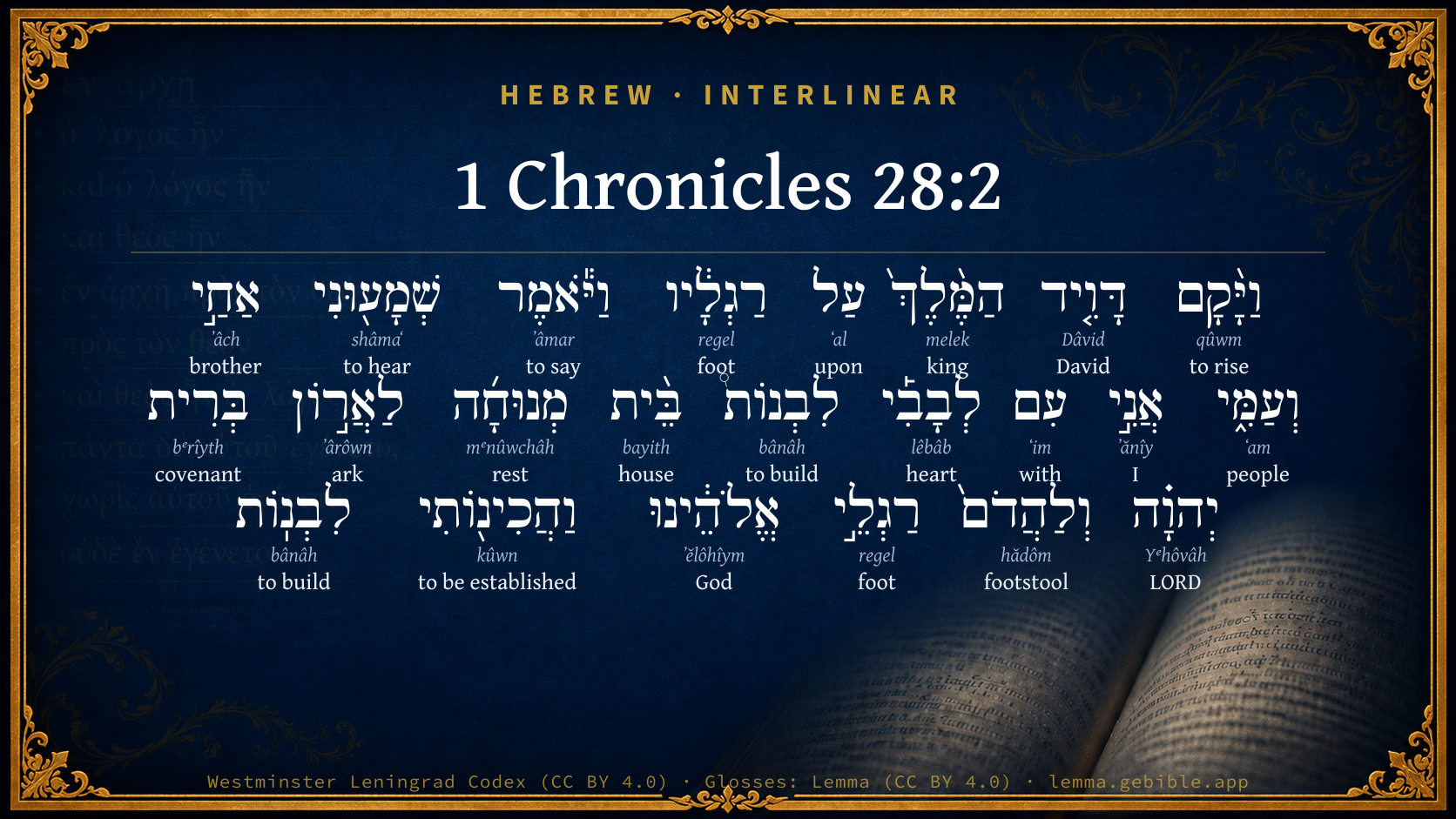
1 Chronicles 28:2

Hebrew (Westminster Leningrad Codex) 1 Chronicles 28:2 appears in the Hebrew Old Testament. The text above is from the Westminster Leningrad Codex. Each word links to its Strong’s number, a concise gloss, and parsing drawn from the Open Scriptures Hebrew Bible morphology. Click any word for its full Brown-Driver-Briggs (BDB) entry.
Download image
Cite this verse

1 Chronicles 28:2 (World English Bible). Public Domain. Lemma interlinear Bible study tool, https://lemma.gebible.app/v/1-chronicles/28/2.

Show BibTeX & RIS
BibTeX
RIS
English Translation
Then David the king stood up on his feet, and said, Hear me, my brothers, and my people: as for me, it was in my heart to build a house of rest for the ark of the covenant of Yahweh, and for the footstool of our God; and I had made ready for the building.
World English Bible · Public Domain
Highlights
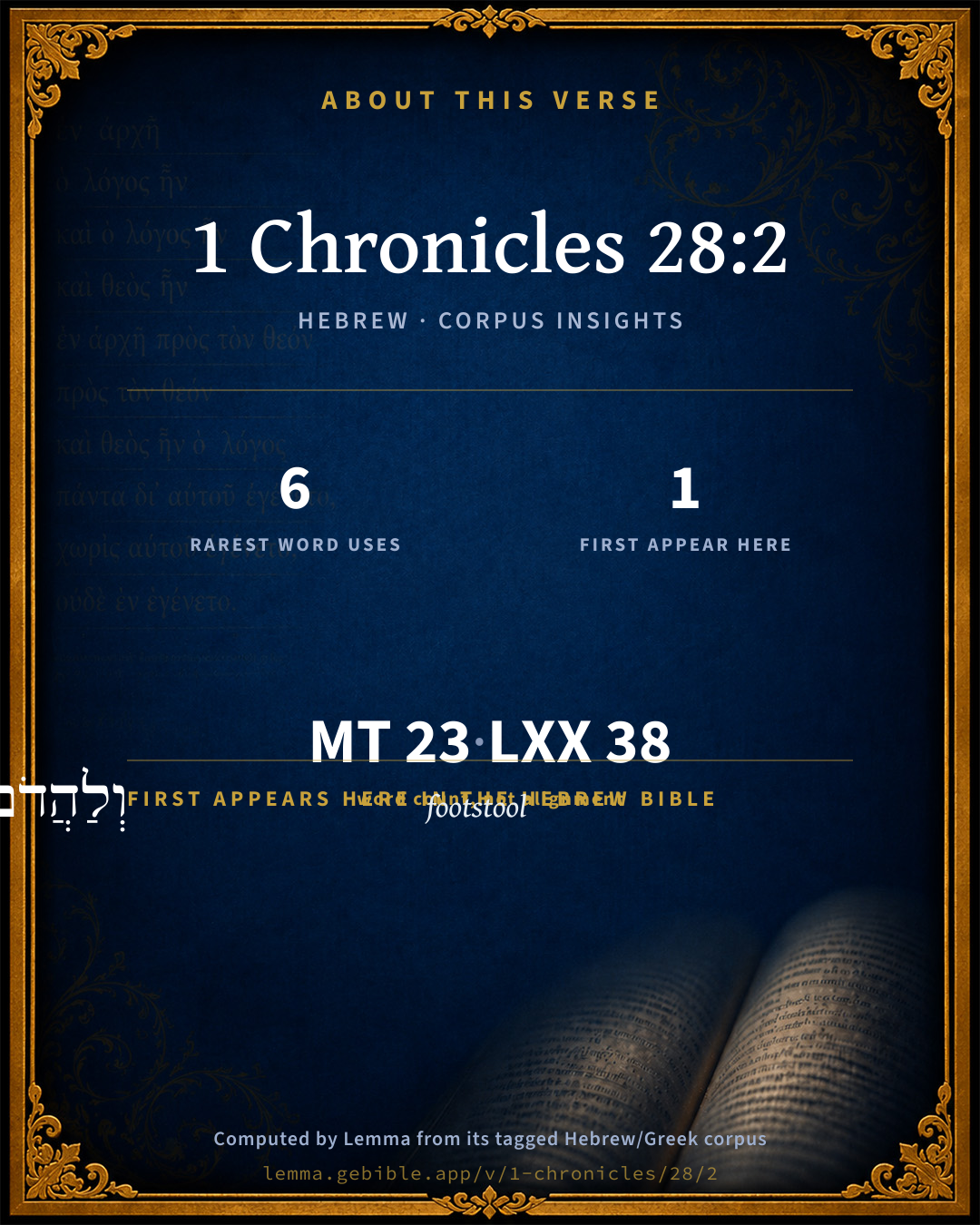
  • 1 first appearance in the Hebrew Bible
Full analysis ↓
Download a study sheet

One document with this verse’s original text, its word-by-word gloss line, the meaning frame, cross-references with their text, attributed commentary, and full source and license credits — printable, and it pastes into notes with its structure intact.

This verse Autodidact and up

Study sheet (.html) Plain text (.txt)

A passage Seminary Student

Up to 50 verses in one chapter. A passage sheet keeps up to 6 commentary sources and 12 cross-references per verse, in the order this page ranks them, and says so on the sheet whenever that leaves anything out. Ask for a single verse and you get the Autodidact verse sheet above.

Everything on this page stays free to read, with no account — the sheet is a download of what is already on screen, not access to it.

Want to remove ads? Support Godless Engineer
Compare translations 3

The same verse in 3 English versions, stacked beneath the original-language interlinear above. Click any original word for its lexicon entry.

Each is an independent rendering of the whole verse — the interlinear is not word-aligned to these translations.

Highlighted words mark where these versions differ — a whole-verse word diff, not a word-by-word alignment.

  • World English Bible Public Domain
    Then David the king stood up on his feet, and said, Hear me, my brothers, and my people: as for me, it was in my heart to build a house of rest for the ark of the covenant of Yahweh, and for the footstool of our God; and I had made ready for the building.
  • King James Version Public Domain
    Then David the king stood up upon his feet, and said, Hear me, my brethren, and my people: As for me, I had in mine heart to build an house of rest for the ark of the covenant of the LORD, and for the footstool of our God, and had made ready for the building:
  • unfoldingWord Literal Text CC BY-SA 4.0
    And David the king rose to his feet, and he said, “Hear me, my brothers and my people. me, with my heart to build a house of rest for the Box of the Covenant of Yahweh and as a footstool of the feet of our God. And I prepared to build.

unfoldingWord Literal Text — © unfoldingWord, licensed CC BY-SA 4.0. Word-aligned USFM3 via Door43 (git.door43.org/unfoldingWord/en_ult).

Versions to compare (up to 4)

3 of 4 selected

Show all 18 translations

Every available English version of this verse, each an independent rendering of the whole verse.

  • World English Bible Public Domain
    Then David the king stood up on his feet, and said, Hear me, my brothers, and my people: as for me, it was in my heart to build a house of rest for the ark of the covenant of Yahweh, and for the footstool of our God; and I had made ready for the building.
  • Berean Standard Bible Public Domain
    Then King David rose to his feet and said, “Listen to me, my brothers and my people. It was in my heart to build a house as a resting place for the ark of the covenant of the LORD and as a footstool for our God. I had made preparations to build it,
  • Majority Standard Bible Public Domain
    Then King David rose to his feet and said, “Listen to me, my brothers and my people. It was in my heart to build a house as a resting place for the ark of the covenant of the LORD and as a footstool for our God. I had made preparations to build it,
  • King James Version Public Domain
    Then David the king stood up upon his feet, and said, Hear me, my brethren, and my people: As for me, I had in mine heart to build an house of rest for the ark of the covenant of the LORD, and for the footstool of our God, and had made ready for the building:
  • American Standard Version (1901) Public Domain
    Then David the king stood up upon his feet, and said, Hear me, my brethren, and my people: as for me, it was in my heart to build a house of rest for the ark of the covenant of Jehovah, and for the footstool of our God; and I had made ready for the building.
  • Revised Version (1885) Public Domain
    Then David the king stood up upon his feet, and said, Hear me, my brethren, and my people: as for me, it was in mine heart to build an house of rest for the ark of the covenant of the LORD, and for the footstool of our God; and I had made ready for the building.
  • Geneva Bible (1599) Public Domain
    And King Dauid stoode vp vpon his feete; and saide, Heare ye me, my brethren and my people: I purposed to haue buylt an house of rest for the Arke of the couenant of the Lord, and for a footestoole of our God, and haue made ready for the building,
  • Douay-Rheims (1899) Public Domain
    And the king rising up, and standing said: Hear me, my brethren and my people: I had a thought to have built a house, in which the ark of the Lord, and the footstool of our God might rest: and I prepared all things for the building.
  • Young's Literal Translation Public Domain
    And David the king riseth on his feet, and saith, `Hear me, my brethren and my people, I -- with my heart -- to build a house of rest for the ark of the covenant of Jehovah, and for the footstool of our God, and I prepared to build,
  • Literal Standard Version CC BY-SA 4.0
    And David the king rises on his feet and says, “Hear me, my brothers and my people, I [had it] with my heart to build a house of rest for the Ark of the Covenant of YHWH, and for the footstool of our God, and I prepared to build,
  • Unlocked Literal Bible CC BY-SA 4.0
    Then David the king rose to his feet and said, “Listen to me, my brothers and my people. It was my intention to build a temple for the ark of the covenant of Yahweh; a footstool for our God, and I have made preparations to build it.
  • unfoldingWord Literal Text CC BY-SA 4.0
    And David the king rose to his feet, and he said, “Hear me, my brothers and my people. me, with my heart to build a house of rest for the Box of the Covenant of Yahweh and as a footstool of the feet of our God. And I prepared to build.
  • Darby Bible Public Domain
    And king David stood up upon his feet, and said, Hear me, my brethren and my people! I had in my heart to build a house of rest for the ark of the covenant of Jehovah and for the footstool of our God, and I have prepared to build.
  • World Messianic Bible Public Domain
    Then David the king stood up on his feet and said, “Hear me, my brothers and my people! As for me, it was in my heart to build a house of rest for the ark of the LORD’s covenant, and for the footstool of our God; and I had prepared for the building.
  • Webster's Bible Public Domain
    Then David the king stood upon his feet, and said, Hear me, my brethren, and my people: As for me, I had in my heart to build a house of rest for the ark of the covenant of the LORD, and for the footstool of our God, and had made ready for the building:
  • Free Bible Version CC BY-SA 4.0
    King David got to his feet and said, “Listen to me, my brothers and my people! I really wanted to build a house as a resting place for the Ark of the Lord's Agreement, as a footstool for our God. So I made plans to build it.
  • Bible in Basic English Public Domain
    Then David the king got up and said, Give ear to me, my brothers and my people; it was my desire to put up a house, a resting-place for the ark of the Lord's agreement, and for the foot-rest of our God; and I had got material ready for the building of it.
  • JPS Tanakh (1917) Public Domain
    Then David the king stood up upon his feet, and said: 'Hear me, my brethren, and my people; as for me, it was in my heart to build a house of rest for the ark of the covenant of the LORD, and for the footstool of our God; and I had made ready for the building.

Literal Standard Version (2020), Covenant Press — licensed CC BY-SA 4.0. Text via the HelloAO Bible API (eBible.org). Unlocked Literal Bible (unfoldingWord) — licensed CC BY-SA 4.0. Text via the HelloAO Bible API (eBible.org). unfoldingWord Literal Text — © unfoldingWord, licensed CC BY-SA 4.0. Word-aligned USFM3 via Door43 (git.door43.org/unfoldingWord/en_ult). Free Bible Version, Dr. Jonathan Gallagher — licensed CC BY-SA 4.0. Text via the HelloAO Bible API (eBible.org).

Word by word

More ways to search: Search by grammar → Find every occurrence → Compare this word →

Practice this passage: Drill this verse → Learn its vocabulary →

וְלַהֲדֹם֙
hădôm
H1916
“and · to/for · footstool of”
Conjunction + Preposition + Noun, Common, Masculine, Singular, Construct
Part of Speech
Conjunction + Preposition + Noun
Type
Common
Gender
Masculine
Number
Singular
State
Construct
Full BDB Definition

Origin: from an unused root meaning to stamp upon

TWOT: 474

stool, footstool
  1. וַיָּ֨קָם qûwm H6965 “and · to rise” Conjunction + Verb, Qal, Sequential Imperfect, 3rd Person, Masculine, Singular
  2. דָּוִ֤יד Dâvid H1732 “David” Noun, Proper
  3. הַמֶּ֨לֶךְ֙ melek H4428 “the · king” Particle, Definite Article + Noun, Common, Masculine, Singular, Absolute
  4. עַל ʻal H5921 “upon” Preposition
  5. רַגְלָ֔יו regel H7272 “feet · his” Noun, Common, Feminine, Dual, Construct + Suffix, Personal, 3rd Person, Masculine, Singular
  6. וַיֹּ֕אמֶר ʼâmar H559 “and · to say” Conjunction + Verb, Qal, Sequential Imperfect, 3rd Person, Masculine, Singular
  7. שְׁמָע֖וּנִי shâmaʻ H8085 “hear · me” Verb, Qal, Imperative, 2nd Person, Masculine, Plural + Suffix, Personal, 1st Person, Common, Singular
  8. אַחַ֣י ʼâch H251 “brothers · my” Noun, Common, Masculine, Plural, Construct + Suffix, Personal, 1st Person, Common, Singular
  9. וְעַמִּ֑י ʻam H5971 “and · people · my” Conjunction + Noun, Common, Masculine, Singular, Construct + Suffix, Personal, 1st Person, Common, Singular
  10. אֲנִ֣י ʼănîy H589 “I” Pronoun, Personal, 1st Person, Common, Singular
  11. עִם ʻim H5973 “with” Preposition
  12. לְבָבִ֡י lêbâb H3824 “heart · my” Noun, Common, Masculine, Singular, Construct + Suffix, Personal, 1st Person, Common, Singular
  13. לִבְנוֹת֩ bânâh H1129 “to build” Preposition + Verb, Qal, Infinitive Construct
  14. בֵּ֨ית bayith H1004 “house of” Noun, Common, Masculine, Singular, Construct
  15. מְנוּחָ֜ה mᵉnûwchâh H4496 “rest” Noun, Common, Both, Singular, Absolute
  16. לַאֲר֣וֹן ʼârôwn H727 “to/for · ark of” Preposition + Noun, Common, Both, Singular, Construct
  17. בְּרִית bᵉrîyth H1285 “covenant of” Noun, Common, Feminine, Singular, Construct
  18. יְהוָ֗ה Yᵉhôvâh H3068 “LORD” Noun, Proper
  19. רַגְלֵ֣י regel H7272 “feet of” Noun, Common, Feminine, Dual, Construct
  20. אֱלֹהֵ֔ינוּ ʼĕlôhîym H430 “God(s) · our” Noun, Common, Masculine, Plural, Construct + Suffix, Personal, 1st Person, Common, Plural
  21. וַהֲכִינ֖וֹתִי kûwn H3559 “and · to be established” Conjunction + Verb, Hiphil, Perfect, 1st Person, Common, Singular
  22. לִבְנֽוֹת bânâh H1129 “to build” Preposition + Verb, Qal, Infinitive Construct

About this verse

These counts appear in no published source. They are computed here, from the morphology-tagged text and Lemma’s own curated glosses. What Lemma adds →

23
words
21
distinct lemmas
Historical
section

Notable vocabulary

The rarest word here is וְלַהֲדֹם֙ footstool H1916 — appearing just 6 times in the whole Hebrew Bible.

First appearance in Scripture

This word makes its first canonical appearance in the Hebrew Bible here:

  • וְלַהֲדֹם֙ footstool H1916

Shared distinctive vocabulary

וְלַהֲדֹם֙ footstool H1916 occurs in 6 verses of the Hebrew Bible. Also found in:

Grammatical profile

  • 6 verbs
  • 14 nouns
  • 1 pronoun
  • 2 prepositions

Verb forms

  • וַיָּ֨קָם Qal · Sequential Imperfect
  • וַיֹּ֕אמֶר Qal · Sequential Imperfect
  • שְׁמָע֖וּנִי Qal · Imperative
  • לִבְנוֹת֩ Qal · Infinitive Construct
  • וַהֲכִינ֖וֹתִי Hiphil · Perfect
  • לִבְנֽוֹת Qal · Infinitive Construct

Repetition

Words recur within this verse — often emphatic in Hebrew:

  • רַגְלָ֔יו foot H7272 ×2
  • לִבְנוֹת֩ to build H1129 ×2

Hebrew & Septuagint length

In English translation the verse runs 55 words from the Hebrew and 55 from the Septuagint (LXX English) — the same length.

A rough comparison of the two English renderings, which tokenize alike — not a word-level alignment.

Word counts can differ between the Hebrew and the Greek without any difference in meaning — e.g. the Hebrew direct-object marker אֵת has no separate Greek word, and Greek often adds the article ὁ.

In the original languages it is 23 Hebrew tokens and 38 Greek tokens — but the two are counted differently (Hebrew bundles its prefixes and suffixes into one token; the Greek is in lemma form), so that isn’t a like-for-like length.

Cross-references

20

Topical passages linked to 1 Chronicles 28:2 in the Treasury of Scripture Knowledge — connected by theme and wording, ordered by reader-vote popularity; previews shown in the World English Bible.

  • Psalms 99:5 Exalt Yahweh our God. Worship at his footstool. He is Holy!
  • Isaiah 66:1 Thus says Yahweh, heaven is my throne, and the earth is my footstool: what manner of house will you build to me? and what place shall be my rest?
  • 1 Chronicles 17:1–2 It happened, when David lived in his house, that David said to Nathan the prophet, Behold, I dwell in a house of cedar, but the ark of the covenant of Yahweh [dwells] under curtains.
  • Lamentations 2:1 How has the Lord covered the daughter of Zion with a cloud in his anger! He has cast down from heaven to the earth the beauty of Israel, And hasn't remembered his footstool in the day of his anger.
  • Genesis 48:2 Someone told Jacob, and said, "Behold, your son Joseph comes to you," and Israel strengthened himself, and sat on the bed.
  • Deuteronomy 17:15 you shall surely set him king over you, whom Yahweh your God shall choose: one from among your brothers shall you set king over you; you may not put a foreigner over you, who is not your brother.
  • Deuteronomy 17:20 that his heart not be lifted up above his brothers, and that he not turn aside from the commandment, to the right hand, or to the left: to the end that he may prolong his days in his kingdom, he and his children, in the midst of Israel.
  • 2 Samuel 7:1–2 It happened, when the king lived in his house, and Yahweh had given him rest from all his enemies round about,
  • 1 Kings 1:47 Moreover the king's servants came to bless our lord king David, saying, Your God make the name of Solomon better than your name, and make his throne greater than your throne: and the king bowed himself on the bed.
  • 1 Kings 8:17–18 Now it was in the heart of David my father to build a house for the name of Yahweh, the God of Israel.
  • 1 Chronicles 6:31 These are they whom David set over the service of song in the house of Yahweh, after that the ark had rest.
  • 1 Chronicles 11:1–3 Then all Israel gathered themselves to David to Hebron, saying, Behold, we are your bone and your flesh.
  • 1 Chronicles 18:7–11 David took the shields of gold that were on the servants of Hadarezer, and brought them to Jerusalem.
  • 1 Chronicles 22:2–5 David commanded to gather together the foreigners who were in the land of Israel; and he set masons to hew worked stones to build the house of God.
  • 1 Chronicles 22:14 Now, behold, in my affliction I have prepared for the house of Yahweh one hundred thousand talents of gold, and one thousand thousand talents of silver, and of brass and iron without weight; for it is in abundance: timber also and stone have I prepared; and you may add to them.
  • Psalms 22:22 I will declare your name to my brothers. In the midst of the assembly, I will praise you.
  • Psalms 132:3–8 "Surely I will not come into the structure of my house, Nor go up into my bed;
  • Psalms 132:14 "This is my resting place forever. Here I will live, for I have desired it.
  • Acts 7:49 'heaven is my throne, And the earth a footstool for my feet. What kind of house will you build me?' says the Lord; 'Or what is the place of my rest?
  • Hebrews 2:11–12 For both he who sanctifies and those who are sanctified are all from one, for which cause he is not ashamed to call them brothers,

Cross-references courtesy of OpenBible.info (CC BY 4.0).

Hebrew and Greek witnesses Masoretic Hebrew ↔ Greek Septuagint

The same verse in the two great witnesses to the Old Testament, shown verse-for-verse.

These are two independent witnesses, not word-aligned to each other, and the Septuagint is shown in lemma (dictionary) form.

Hebrew 1 Chronicles 28:2 Masoretic · Westminster Leningrad Codex

וַיָּ֨קָם דָּוִ֤יד הַמֶּ֨לֶךְ֙ עַל רַגְלָ֔יו וַיֹּ֕אמֶר שְׁמָע֖וּנִי אַחַ֣י וְעַמִּ֑י אֲנִ֣י עִם לְבָבִ֡י לִבְנוֹת֩ בֵּ֨ית מְנוּחָ֜ה לַאֲר֣וֹן בְּרִית יְהוָ֗ה וְלַהֲדֹם֙ רַגְלֵ֣י אֱלֹהֵ֔ינוּ וַהֲכִינ֖וֹתִי לִבְנֽוֹת

Then David the king stood up on his feet, and said, Hear me, my brothers, and my people: as for me, it was in my heart to build a house of rest for the ark of the covenant of Yahweh, and for the footstool of our God; and I had made ready for the building.

World English Bible · Public Domain

Greek LXX 1 Chronicles 28:2 Septuagint · lemma form

καί ἵστημι δαυίδ ἐν μέσος ὁ ἐκκλησία καί εἶπον ἀκούω ἐγώ ἀδελφός καί λαός ἐγώ ἐγώ γίγνομαι ἐπί καρδία οἰκοδομέω οἶκος ἀνάπαυσις ὁ κιβωτός διαθήκη κύριος καί στάσις πούς κύριος ἐγώ καί ἑτοιμάζω ὁ εἰς ὁ κατασκήνωσις ἐπιτήδειος

And David stood in the midst of the assembly, and said, Hear me, my brethren, and my people: it was in my heart to build a house of rest for the ark of the covenant of the Lord, and a place for the feet of our Lord, and I prepared materials suitable for the building:

LXX2012 (modern English Septuagint) · Public Domain

Hebrew: Westminster Leningrad Codex (CC BY 4.0). Greek: Septuagint (public domain); English from LXX2012 (modern English Septuagint) (Public Domain). How the Septuagint differs from the Hebrew →

Commentary

Notes on 1 Chronicles 28:2 from classic Christian and Jewish commentators (each source and its license shown beneath its notes). The classic Christian expositions comment on the surrounding passage and are grouped to its opening verse, so a note may address several verses; the Jewish commentaries on the Tanakh (Rashi and others) are per-verse, so they appear only where the commentator wrote on this verse.

Lemma curates 59 commentaries, every one of them public domain or Creative Commons licensed, each selected and text-cleaned for this edition rather than reprinted as found. About our sources →

Ellicott's Commentary for English Readers

(2) Then David the king stood up upon his feet.—To address the assembly, the king naturally rose from his throne.

Hear me.—Calling attention, as in Gen_23:11-15.

My brethren, and my people.—Comp. 1Sa_30:23; 2Sa_19:12. The words do not so much imply condescension as an acknowledgment of what every one of David’s hearers felt to be true—viz., that all Israel were kin, and David the head of the family.

As for me, I had in mine heart to build.—See 1Ch_22:7-8 and the Notes there. 1Ch_28:2-7 of this chapter are in substance, and partly in expression, identical with 1Ch_22:7-10 (David’s private charge to Solomon).

An house of rest—i.e., a permanent abode instead of a sacred tent, which gave the idea of wandering from place to place, like the nomads of the desert. (Comp. Psa_132:8.)

The footstool of our God.—The so-called mercy-seat, the golden kappôreth suspended over the Ark, on which were the cherubim—the throne of Deity (Psa_99:1).

And had made ready.—Rather, and I made ready, by amassing stores of material (1Ch_22:2-4; 1Ch_22:14-16).

A Bible Commentary for English Readers, edited by Charles John Ellicott (1878–1897) — public domain. Text from a community e-Sword module.

Trapp's Complete Commentary

John Trapp

1Ch 28:2 Then David the king stood up upon his feet, and said, Hear me, my brethren, and my people: [As for me], I [had] in mine heart to build an house of rest for the ark of the covenant of the LORD, and for the footstool of our God, and had made ready for the building:

Ver. 2. Then David the king stood up upon his feet.] To show his reverence to God, as Jdg 3:20, and his good respect to the assembly, which was comitia totius regni, a parliament, wherein he was to be the speaker.

Hear me, my brethren, and my people.] Praemittit exordiolum - not unlike that of Augustus to his soldiers, Audite senem iuvenes, quem iuvenem senes audierunt - wisely insinuating himself into their affections.

As for me, I had in my heart.] See 1Ch 17:1, &o.

And for the foot stool,] i.e., For the ark, which is called God’s footstool, because under the cherubims, where God was said to sit as in a throne. See Psa 99:5; Psa 132:7.

John Trapp, A Commentary or Exposition upon All the Books of the Old and New Testament (1647–1656) — public domain. Text from a community e-Sword module.

Joseph Benson's Commentary

1Ch 28:2. Then the king stood up upon his feet — Out of reverence to God, and respect to this great and honourable assembly. And said, Hear me, my brethren — So he calls the princes and chief rulers, both because they had a share with him, though under him, in the government; and in compliance with the divine command, that the king should not be lifted up above his brethren, Deu 17:20. A house of rest — A place where it might be fixed, and no more removed from place to place, as it had been. For the footstool — A house for the ark is here styled, a house for the footstool of our God. Heaven is his throne: the earth and the most magnificent temples thereon are but his footstool. So much difference is there between the manifestations of his glory, in the upper and in the lower world!

Joseph Benson's Commentary on the Old and New Testaments (1811–1818) — public domain. Text from a community e-Sword module.

Tyndale Open Study Notes

Tyndale Open Resources

28:2-10 The account of David’s first discourse includes a message addressed to his people (28:2-8) and a message to Solomon (28:9-10). The main focus of the address is David’s desire for Solomon to build a Temple. In addition, David addressed two other important themes: God’s selection of Solomon, and the people’s obligation to keep God’s commandments.

28:2 David described the Temple as a place where the Ark of the Lord’s Covenant . . . could rest. The term “rest” describes the conquest of the land and the establishment of peace (e.g., Deut 12:9). In the wilderness, the Ark rested at the end of battle (Num 10:35-36). When David brought the Ark to Jerusalem, the Ark’s “rest” became permanent, as David expressed in a psalm of worship: “Arise, O Lord, and enter your resting place, along with the Ark, the symbol of your power” (Ps 132:8). God had chosen Mount Zion as his resting place.

Tyndale Open Study Notes — © Tyndale Open Resources, licensed CC BY-SA 4.0. Text via the HelloAO Bible API.

Geneva Bible (1599)

Geneva Bible translators

Where the Ark should remain, and remove no more to and fro.

Geneva Bible (1599) marginal notes — public domain. Text via Bolls.life.

Jamieson, Fausset & Brown

Robert Jamieson, A. R. Fausset & David Brown

Hear me, my brethren, and my people--This was the style of address becoming a constitutional king of Israel (Deu 17:20; Sa1 30:23; Sa2 5:1).

I had in mine heart--I proposed, or designed.

to build an house of rest--a solid and permanent temple.

for the footstool of our God--God seated between the cherubim, at the two extremities of the ark, might be said to be enthroned in His glory, and the coverlet of the ark to be His footstool.

and had made ready for the building--The immense treasures which David had amassed and the elaborate preparations he had made, would have been amply sufficient for the erection of the temple of which he presented the model to Solomon.

Jamieson, Fausset & Brown — Commentary Critical and Explanatory on the Whole Bible (1871) — public domain (CC PDM 1.0). Text via the HelloAO Bible API.

Adam Clarke's Commentary

Verse 2. David - stood up upon his feet] He was now very old, and chiefly confined to his bed, (see 1Kg 1:47;) and while he was addressing his son Solomon, he continued on the bed; but when all the principal nobles of his kingdom came before him he received strength to arise and address them, standing on his feet.

Adam Clarke's Commentary on the Bible (1810–1826) — public domain. Text from a community e-Sword/MySword module.

The Cambridge Bible for Schools and Colleges

gen. ed. J. J. S. Perowne

2. stood up upon his feet] Kings sometimes made orations sitting; cp. Act_12:21. Here the king stands to mark the greatness of the occasion.

my brethren] The king is the brother of his subjects; Deu_17:15; Deu_17:20; cp. Psa_45:7.

I had in mine heart] See 1Ch_17:1; 2Sa_7:2.

a house of rest] Cp. 1Ch_17:5; 2Sa_7:6.

the footstool] Cp. Isa_60:13.

and had made ready] R.V. and I had made ready.

The Cambridge Bible for Schools and Colleges (gen. ed. J. J. S. Perowne; Cambridge University Press, 1878–1918) — public domain. Text from a community e-Sword module.

John Gill's Exposition

Then David the king stood up upon his feet,.... Rose from the bed or couch on which he lay, as Kimchi thinks, being somewhat recovered of his paralytic disorder, and being willing to exert himself on this occasion; or he rose up from the seat or throne, on which he before sat, in honour to this august assembly before him, and that he might be the more easily heard; for which reason we are told (r) it was a custom with the ancients even for kings to stand up when they had a number of people about them they spoke to; and if anyone sat it was reckoned a new and strange thing; so Agamemnon, when wounded, did not speak sitting, until he had made an excuse for it:

and said, hear me, my brethren, and my people; having something of moment and importance to say unto them, and which required their diligent attention; and though they were his subjects, he calls them his brethren, being of the same nation and religion, and to show his modesty and humility; in which he was a type of Christ, the King of kings, see Heb 2:11.

as for me, I had it in my heart to build an house of rest for the ark of the covenant of the Lord; where it might abide, and not be removed from place to place; the same he had told Solomon, Ch1 22:7.

and for the footstool of our God; or "even for it", for the ark is meant, which is so called, Psa 99:5 for as the Lord sat between the cherubim over the mercy seat, the lid of the ark, it was, speaking after the manner of men, a footstool to him:

and had made ready for the building; prepared materials for it; see Ch1 22:4.

(r) Eustathius in Homer. Iliald. 1. p. 46. Vid, Iliad. 19. ver. 77, 79.

John Gill's Exposition of the Whole Bible (1746–1763) — public domain (CC PDM 1.0). Text via the HelloAO Bible API.

Albert Barnes' Notes on the Bible

My brethren - David retains the modest phrase of a king not born in the purple, but raised from the ranks of the people (see 1Sa 30:23; 2Sa 19:12). No later Jewish monarch would have thus addressed his subjects.

The footstool of our God - David views the ark as God’s “footstool,” because he was enthroned above it visibly in the Shechinah, or luminous cloud, present from time to time above the mercy seat and between the cherubim (compare the marginal references).

Albert Barnes' Notes on the Bible (1834–1885) — public domain. Text from a community e-Sword/MySword module.

Haydock's Catholic Bible Commentary

Rising up from his bed, on which he lay, on account of his great age and weakness, while he addressed himself to his son; (3 Kings i. 47.; Calmet) or he rose from his throne, to honor this grand assembly. Hebrew, "stood upon his feet." (Haydock) --- Thought. Hebrew, "I, with my heart, thought to," &c. (Calmet) --- And, or which is the footstool. (Haydock) --- The ark is often so called, because God was considered as sitting upon the wings of the cherubim, over it, Psalm xcviii. 1., &c. --- Building. No doubt what David left would have been sufficient. Yet Solomon thought that he could make something still more magnificent.

George Leo Haydock (1774–1849), Haydock's Catholic Family Bible and Commentary, 1859 edition — public domain. Excludes Psalms (Douay-Rheims chapter numbering differs from Protestant) and Deuterocanonical books (Catholic canon only).

Matthew Poole's English Annotations

David stood up; partly out of reverence to God and his word, which was the matter of the following discourse; and partly out of respect to this great and honourable assembly.

My brethren; so he calls the princes and chief rulers, both because they had a share with him, though under him in the government; and in compliance with the Divine command, that the king should not be lifted up above his brethren, Deu 17:20.

An house of rest for the ark; a place where it might be fixed, and no more removed from place to place, as it had been.

And for the footstool; the word and is here put expositively for by the footstool, &c., he means the ark.

Matthew Poole's English Annotations on the Holy Bible (1683–1685) — public domain. Text from a community e-Sword/MySword module.

The Pulpit Commentary

The expression, David the king stood up upon his feet, probably means to emphasize the fact that hitherto, having been in a sitting or recumbent position, owing to his age and infirmity, he now with effort forced himself to stand in the presence of the unusual congregation and in consideration of what he felt was due to the occasion. He had not lost the man and the brother in his official and exalted rank, and, following ancient precedents (Gen_29:4; Jud_1:19:23; 2Sa_19:12) he addresses the congregation as my brethren, and my people. David says he had it in his heart to build a house of rest, i.e. an abiding house (Psa_132:8, Psa_132:14) for the ark of the covenant, instead of the moving one, and for the footstool of our God. By this he means the mercy-seat, to which especial allusion is made ver. 11 (tr,poK"h" tBe). God is often spoken of as "dwelling between the cherubim," and sometimes (Psa_99:1) as sitting between the cherubim," which were over the lid of the ark, called the mercy-seat.

HOMILIES BY R. TUCK Ver. 2.

Old men"s testimony.

The emphatic sentence, "Then David the king stood up upon his feet," brings before us a vivid picture of the aged and infirm king making a great effort, gathering up all his strength, and once again standing up that he might render a last testimony for Jehovah. "Towards the end of David"s life, he was obliged to keep to his chamber, and almost to his bed. In those later and quiet days he seems to have reviewed his long and checkered career, and his last song embodies the thoughts with which he regarded it. That last song (2Sa_23:1-7) is full of mingled regret and hope; over the scenes of his shame he lingers for a moment sadly, but from them he turns to look up to the faithful God, whom he had ever desired to serve, and assured his heart of the permanence of that everlasting covenant, ordered in all things and sure. In those closing words the old prophet-power came back to him, and we wish that such sentiments of humility, trust, and joy in God were the only dying utterances of his that had been preserved for us." The occasion of the effort recorded in our text was a public one: the solemn commendation of Solomon to the people, and closing public instructions for Solomon himself. The subject suggested is the moral influence exerted by the aged godly man, who has behind him the varied experiences of a long and checkered life. The importance of the witness of such a man"s life, and of such a man"s own expression of the results of his life, and of his moods of mind on coming to its close, need to be pointed out, as these may bear on the men of his own age, and as they may bear on the young generation that is growing up to take the place of those who are "passing away." As the treatment of these divisions must directly depend on the feeling and experience of the preacher, we prefer to give only the barest outline, at most suggesting lines along which the development and illustration of each point may run. As far as possible the treatment should be made cheerful and hopeful, the experience of those who see more good than evil in life being preferred.

I THE OLD MAN"S TESTIMONY CONCERNING LIFE. He will say that he has found it other but, on the whole, better than he expected. Contrast the sunny anticipations of the youth with the serious reviews of the aged. A thousand anticipations have never been realized, but more than a thousand good things, of which youth could not have dreamed, have crowned the passing days with beauty and joy. Many an old man speaks brightly of the "good way wherein the Lord his God has led him.

II THE OLD MAN"S TESTIMONY CONCERNING MAN. Looking back, he can to some extent know himself and judge his fellows. This at least the old man has learned. Man imagines and even purposes more than he can ever accomplish, and he lives, works, and dies with scaffoldings all about which were but beginnings of buildings that were never built. He has to shelter in the great hope that God will accept his purposes. And so God will, if the unwrought schemes were no mere sentimental dreams, but resolves as serious as David"s, to build a temple for the Lord his God.

III THE OLD MAN"S TESTIMONY CONCERNING GOD. He says he is the Wonder-worker who always gets his will over man"s. And he is the faithful One, who keeps covenant and fulfils promise, and may be wholly trusted. He says, "I have been young, and now am old, yet have I never seen the righteous forsaken, nor his seed begging bread." The light of the old men"s experience may well brighten and cheer the young men"s toil, and make easier the yoke of those who bear the burden and heat of the day. R.T.

God"s earthly footstool.

Using a striking poetical figure, David speaks of the ark as being "the footstool of our God;" regarding God as enthroned above it in the Shechinah-cloud. The figure is otherwise used in Scripture, in Psa_99:5 Psa_132:7; Isa_66:1; Lam_2:1; Mat_5:35. We must not imagine that the ark contained God, or that in any sense he dwelt in the ark. He came, in the gracious symbol of the bright cloud, above the ark, between the attendant angel-figures, only resting, as one rests his feet on a footstool, upon the lid of the ark. This lid, from another point of view, is regarded as the propitiatory, or mercy-seat. Some idea of an Eastern throne may aid in the proper realization of this figure. Van Lennep says, "Solomon"s throne was" made of ivory, overlaid with the best gold; it had six steps, and the top of the throne was round behind. And there were stays on either side of the place of the seat, and two lions stood beside the stays." It is generally supposed that this description implies a form of chair similar to ours, in which the feet rest upon a stool. There were such chairs in Egypt, and there is a picture of Rameses seated upon a throne, bearing, apparently, a close resemblance to that of Solomon, with the exception of some peculiarly Egyptian emblems. The Assyrian kings also sat upon thrones of this kind. It should, however, be remembered that this mode of sitting has ever been exceptional in the East; and though it cannot be denied that princes sometimes sat in state, after what we call the European mode, yet the analogies of the case favour the supposition that the king"s throne was more commonly in the form of a sofa, or divan, upon which he sat cross-legged." It may be well to point out that, in this figure, we have an instance of anthropomorphic representation, or God s way of graciously aiding our apprehension of himself and of his relations, by speaking of himself, or allowing himself to be spoken of, as if he were a man. What is suggested by such figures, rather than the form of the figure, requires our attention. Three things are suggested by the figure on which we are now dwelling.

I GOD"S FOOTSTOOL IMPLIES THAT GOD IS THERE. Evidently the footstool is in use. David conceives of God as really present, and in his time the "glory-cloud" did rest between the cherubim, and the high priest might even see it on the ark-lid, which is regarded as the footstool. All the interest David felt in building the new temple depended upon his strong assurance that God, as the great King, was "making his abode with them." He wanted the palace to be worthy of the King. Show how this presence of God is now spiritually realized. Our Lord made so much of it in his teaching, even promising that his Father and he would come, and sup with, and dwell with, the open and trusting heart, making it his footstool. Such promises should make us also anxious that the uprising temple of our character and life should be in every way worthy of the indwelling Deity. "Know ye not that ye are the temples of the Holy Ghost, which is in you?

II GOD"S FOOTSTOOL IMPLIES THAT HE IS THERE IN CONDESCENSION. This seems a prominent point in the message sent by Isaiah," Heaven is my throne, the earth is my footstool." We think properly of the footstool as having a lowly office, and so easily regard willingness to put a foot upon it as a condescending act. We cannot think any temple we can build is worthy to be God"s throne. He must condescend to enter our very noblest. And so of the temple of our character and life, it can be no more than his footstool. "Will God in very deed dwell with man on the earth?" It is wonderful grace that he is found willing to rest upon it his foot.

III GOD"S FOOTSTOOL IMPLIES THAT GOD IS NOT LIMITED TO THE PLACE WHERE HIS PRESENCE IS APPREHENDED. His throne is not there. Only his foot is there. We must keep the sublime thought that he is above all things, though he fills all things. Show in what senses God may now be thought of as present in our churches. And earnestly impress the need of keeping up the sense of his non-limitation by any human places or human forms. All earth can at best be but a footstool, which he may touch if he will. R.T.

The Pulpit Commentary (1880–1919), ed. H.D.M. Spence-Jones & Joseph S. Exell — public domain. Text from a community e-Sword module.

John Wesley's Explanatory Notes

Stood - Out of reverence to God and respect to this great and honourable assembly. Brethren - So he calls the princes and chief rulers, both because they had a share with him, though under him in the government; and in compliance with the Divine command, that the king should not be lifted up above his brethren; Deut. xvii, 20. Of rest - A place where it might be fixed, and no more removed from place to place, as it had been. Foot-stool - An house for the ark is here styled an house for the foot-stool of our God. Heaven is his throne: the earth and the most magnificent temples thereon are but his foot-stool. So much difference is there between the manifestations of his glory, in the upper and in the lower world!

John Wesley, Explanatory Notes Upon the Whole Bible (1754–1765) — public domain. Text via the GEBible commentary corpus.

Keil & Delitzsch

C. F. Keil & F. Delitzsch

Then David the king stood up upon his feet,.... Rose from the bed or couch on which he lay, as Kimchi thinks, being somewhat recovered of his paralytic disorder, and being willing to exert himself on this occasion; or he rose up from the seat or throne, on which he before sat, in honour to this august assembly before him, and that he might be the more easily heard; for which reason we are told (r) it was a custom with the ancients even for kings to stand up when they had a number of people about them they spoke to; and if anyone sat it was reckoned a new and strange thing; so Agamemnon, when wounded, did not speak sitting, until he had made an excuse for it:

and said, hear me, my brethren, and my people; having something of moment and importance to say unto them, and which required their diligent attention; and though they were his subjects, he calls them his brethren, being of the same nation and religion, and to show his modesty and humility; in which he was a type of Christ, the King of kings, see Heb 2:11.

as for me, I had it in my heart to build an house of rest for the ark of the covenant of the Lord; where it might abide, and not be removed from place to place; the same he had told Solomon, Ch1 22:7.

and for the footstool of our God; or "even for it", for the ark is meant, which is so called, Psa 99:5 for as the Lord sat between the cherubim over the mercy seat, the lid of the ark, it was, speaking after the manner of men, a footstool to him:

and had made ready for the building; prepared materials for it; see Ch1 22:4.

(r) Eustathius in Homer. Iliald. 1. p. 46. Vid, Iliad. 19. ver. 77, 79.

Keil & Delitzsch — Biblical Commentary on the Old Testament (1861–1891) — public domain (CC PDM 1.0). Text via the HelloAO Bible API. (Old Testament only.)

unfoldingWord translationNotes

Door43 World Missions Community

rose to his feet

This is an idiom. AT: "stood up" (See: Idiom)

my brothers and my people

These two phrases share similar meanings and emphasize that David and the people of Israel are family. (See: Doublet)

the ark of the covenant of Yahweh; a footstool for our God

The second phrase defines the first phrase. The "ark of the covenant" is spoke of as Yahweh's footstool to picture God on his throne, with his feet resting on his footstool, which represents all that is in submission to him. (See: Parallelism and Metaphor)

a temple for my name

Here God refers to himself by his "name." AT: "a temple for me" (See: Metonymy)

a man of war and have shed blood

"a man accustomed to war and have shed blood." Both descriptions emphasize the same thing, namely that David had killed people. (See: Parallelism)

have shed blood

This refers to killing people. AT: "have killed people" (See:Euphemism)

translationWords

brother

people group

temple

ark of the covenant

Yahweh

footstool

God

bloodshed

unfoldingWord translationNotes — © Distant Shores Media and the Door43 World Missions Community, licensed CC BY-SA 4.0. Source: git.door43.org/Door43/en_tn.

Lesson kit

Teaching starters — assembled from the data on this page, not authored interpretation. Every prompt links to the verse data it draws on. Edit before teaching.

1 Chronicles, in the Historical, opens this verse with 23 words (21 distinct Hebrew lemmas). Its most distinctive word is hădôm (“footstool”). A historical commentator’s framing appears above. Read the whole chapter for the surrounding context.

Discussion questions

  1. The word hădôm carries the sense “footstool.” How does it shape the verse?
  2. This is the first place “footstool” appears in Scripture (first appears here). What does its debut here establish?
  3. How does Psalms 99:5, which shares the word «footstool», read alongside this verse?
  4. What does the repetition of “foot” (2× in this one verse) do in this verse?
  5. These translations render this verse differently; the difference is in the English rendering, not the original. What questions does that raise?
  6. «וַיָּ֨קָם» is a Qal Sequential Imperfect verb. How does that grammatical form shape the action described?
  7. Compare how Ellicott's Commentary for English Readers and Trapp's Complete Commentary read this verse. Where do they agree or differ?

Things to notice

Reading settings

Reading text

Shown beneath each verse's original-language words.

Old Testament
Old Testament edition

Read the OT as the Masoretic Hebrew (MT) or the Greek Septuagint (LXX).

English shown for the Greek Septuagint (in the Hebrew ↔ Greek comparison).

Comparing translations? Open the Compare panel on any verse page to stack up to four side by side.