1 Kings 1:31

Hebrew (Westminster Leningrad Codex) 1 Kings 1:31 appears in the Hebrew Old Testament. The text above is from the Westminster Leningrad Codex. Each word links to its Strong’s number, a concise gloss, and parsing drawn from the Open Scriptures Hebrew Bible morphology. Click any word for its full Brown-Driver-Briggs (BDB) entry.
Download image
Cite this verse

1 Kings 1:31 (World English Bible). Public Domain. Lemma interlinear Bible study tool, https://lemma.gebible.app/v/1-kings/1/31.

Show BibTeX & RIS
BibTeX
RIS
English Translation
Then Bathsheba bowed with her face to the earth, and did obeisance to the king, and said, Let my lord king David live forever.
World English Bible · Public Domain
Download a study sheet

One document with this verse’s original text, its word-by-word gloss line, the meaning frame, cross-references with their text, attributed commentary, and full source and license credits — printable, and it pastes into notes with its structure intact.

This verse Autodidact and up

Study sheet (.html) Plain text (.txt)

A passage Seminary Student

Up to 50 verses in one chapter. A passage sheet keeps up to 6 commentary sources and 12 cross-references per verse, in the order this page ranks them, and says so on the sheet whenever that leaves anything out. Ask for a single verse and you get the Autodidact verse sheet above.

Everything on this page stays free to read, with no account — the sheet is a download of what is already on screen, not access to it.

Want to remove ads? Support Godless Engineer
Compare translations 3

The same verse in 3 English versions, stacked beneath the original-language interlinear above. Click any original word for its lexicon entry.

Each is an independent rendering of the whole verse — the interlinear is not word-aligned to these translations.

Highlighted words mark where these versions differ — a whole-verse word diff, not a word-by-word alignment.

  • World English Bible Public Domain
    Then Bathsheba bowed with her face to the earth, and did obeisance to the king, and said, Let my lord king David live forever.
  • King James Version Public Domain
    Then Bathsheba bowed with her face to the earth, and did reverence to the king, and said, Let my lord king David live for ever.
  • unfoldingWord Literal Text CC BY-SA 4.0
    And Bathsheba bowed, nostrils the ground, and she prostrated herself to the king, and she said, “May my lord King David live to forever!”

unfoldingWord Literal Text — © unfoldingWord, licensed CC BY-SA 4.0. Word-aligned USFM3 via Door43 (git.door43.org/unfoldingWord/en_ult).

Versions to compare (up to 4)

3 of 4 selected

Show all 18 translations

Every available English version of this verse, each an independent rendering of the whole verse.

  • World English Bible Public Domain
    Then Bathsheba bowed with her face to the earth, and did obeisance to the king, and said, Let my lord king David live forever.
  • Berean Standard Bible Public Domain
    Bathsheba bowed facedown in homage to the king and said, “May my lord King David live forever!”
  • Majority Standard Bible Public Domain
    Bathsheba bowed facedown in homage to the king and said, “May my lord King David live forever!”
  • King James Version Public Domain
    Then Bathsheba bowed with her face to the earth, and did reverence to the king, and said, Let my lord king David live for ever.
  • American Standard Version (1901) Public Domain
    Then Bath-sheba bowed with her face to the earth, and did obeisance to the king, and said, Let my lord king David live for ever.
  • Revised Version (1885) Public Domain
    Then Bath-sheba bowed with her face to the earth, and did obeisance to the king, and said, Let my lord king David live for ever.
  • Geneva Bible (1599) Public Domain
    Then Bath-sheba bowed her face to the earth, and did reuerence vnto the King, and said, God saue my lord King Dauid for euer.
  • Douay-Rheims (1899) Public Domain
    And Bethsabee bowing with her face to the earth worshipped the king, saying: May my lord David live for ever.
  • Young's Literal Translation Public Domain
    And Bath-Sheba boweth -- face to the earth -- and doth obeisance to the king, and saith, `Let my lord, king David, live to the age.'
  • Literal Standard Version CC BY-SA 4.0
    And Bathsheba bows—face to the earth—and pays respect to the king, and says, “Let my lord, King David, live for all time.”
  • Unlocked Literal Bible CC BY-SA 4.0
    Then Bathsheba bowed with her face to the ground and prostrated herself before the king and said, “May my master King David live forever!”
  • unfoldingWord Literal Text CC BY-SA 4.0
    And Bathsheba bowed, nostrils the ground, and she prostrated herself to the king, and she said, “May my lord King David live to forever!”
  • Darby Bible Public Domain
    And Bathsheba bowed with her face to the earth, and did reverence to the king, and said, Let my lord king David live for ever.
  • World Messianic Bible Public Domain
    Then Bathsheba bowed with her face to the earth and showed respect to the king, and said, “Let my lord King David live forever!”
  • Webster's Bible Public Domain
    Then Bath-sheba bowed with her face to the earth, and did reverence to the king, and said, Let my lord king David live for ever.
  • Free Bible Version CC BY-SA 4.0
    Bathsheba bowed with her face to the ground, honoring the king and said, “May Your Majesty King David live forever.”
  • Bible in Basic English Public Domain
    Then Bath-sheba went down on her face on the earth before the king giving him honour, and said, May my lord King David go on living for ever.
  • JPS Tanakh (1917) Public Domain
    Then Bath-sheba bowed with her face to the earth, and prostrated herself to the king, and said: 'Let my lord king David live for ever.'

Literal Standard Version (2020), Covenant Press — licensed CC BY-SA 4.0. Text via the HelloAO Bible API (eBible.org). Unlocked Literal Bible (unfoldingWord) — licensed CC BY-SA 4.0. Text via the HelloAO Bible API (eBible.org). unfoldingWord Literal Text — © unfoldingWord, licensed CC BY-SA 4.0. Word-aligned USFM3 via Door43 (git.door43.org/unfoldingWord/en_ult). Free Bible Version, Dr. Jonathan Gallagher — licensed CC BY-SA 4.0. Text via the HelloAO Bible API (eBible.org).

Word by word

More ways to search: Search by grammar → Find every occurrence → Compare this word →

Practice this passage: Drill this verse → Learn its vocabulary →

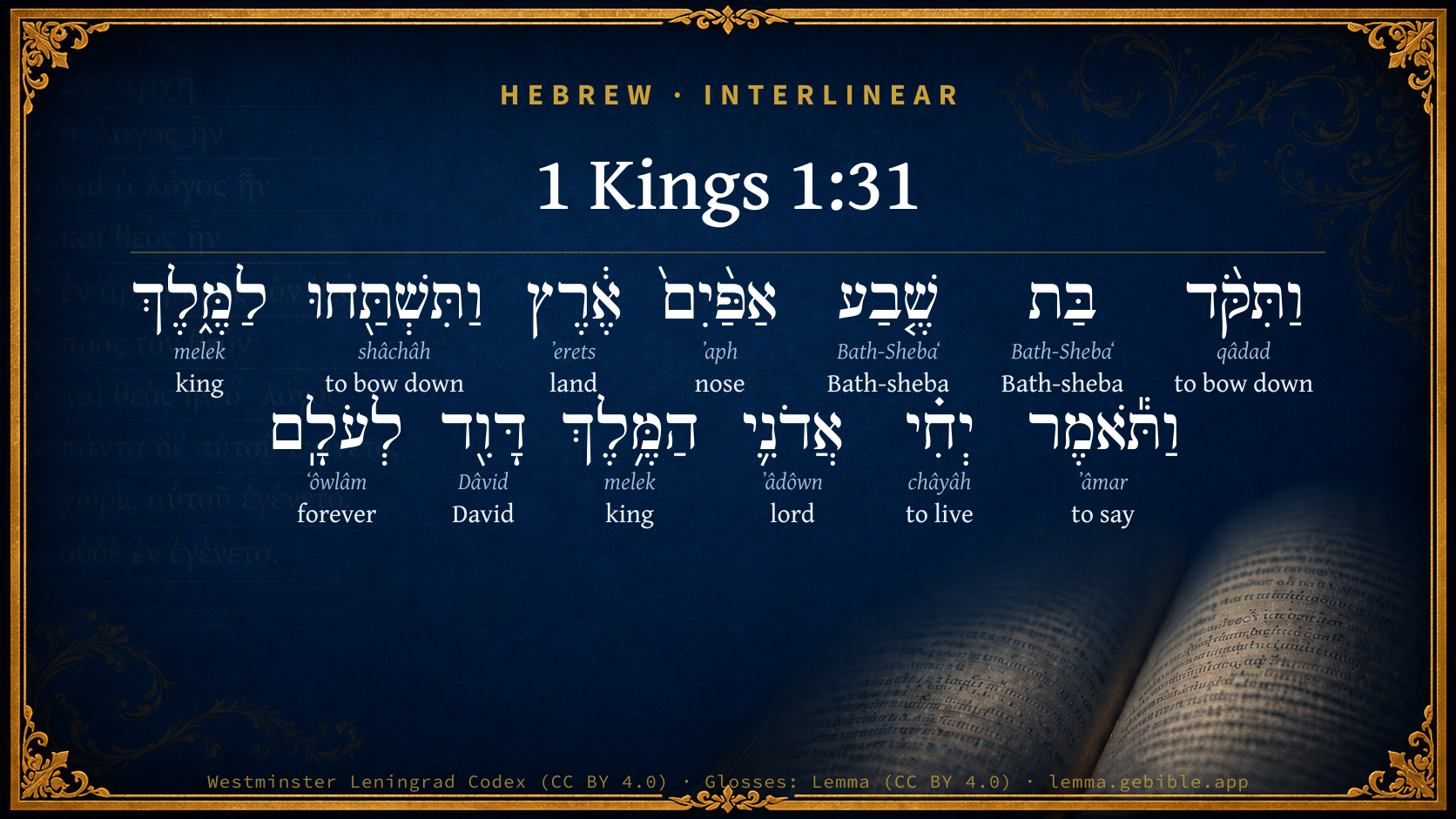
וַתִּקֹּ֨ד
qâdad
H6915
“and · to bow down”
Conjunction + Verb, Qal, Sequential Imperfect, 3rd Person, Feminine, Singular
Part of Speech
Conjunction + Verb
Stem
Qal
Form
Sequential Imperfect
Person
3rd Person
Gender
Feminine
Number
Singular
Full BDB Definition

Origin: a primitive root

TWOT: 1985

(Qal) to bow down
  1. בַּת Bath-Shebaʻ H1339 “Bath-sheba” Noun, Proper
  2. שֶׁ֤בַע Bath-Shebaʻ H1339 “Bath-sheba” Adjective, Cardinal number, Feminine, Singular, Absolute
  3. אַפַּ֨יִם֙ ʼaph H639 “nostrils” Noun, Common, Masculine, Dual, Absolute
  4. אֶ֔רֶץ ʼerets H776 “land” Noun, Common, Both, Singular, Absolute
  5. וַתִּשְׁתַּ֖חוּ shâchâh H7812 “and · to bow down” Conjunction + Verb, Hishtaphel, Sequential Imperfect, 3rd Person, Feminine, Singular
  6. לַמֶּ֑לֶךְ melek H4428 “to/for the · king” Preposition, Determined + Noun, Common, Masculine, Singular, Absolute
  7. וַתֹּ֕אמֶר ʼâmar H559 “and · to say” Conjunction + Verb, Qal, Sequential Imperfect, 3rd Person, Feminine, Singular
  8. יְחִ֗י châyâh H2421 “to live” Verb, Qal, Jussive, 3rd Person, Masculine, Singular
  9. אֲדֹנִ֛י ʼâdôwn H113 “lord · my” Noun, Common, Masculine, Singular, Construct + Suffix, Personal, 1st Person, Common, Singular
  10. הַמֶּ֥לֶךְ melek H4428 “the · king” Particle, Definite Article + Noun, Common, Masculine, Singular, Absolute
  11. דָּוִ֖ד Dâvid H1732 “David” Noun, Proper
  12. לְעֹלָֽם ʻôwlâm H5769 “to/for · forever” Preposition + Noun, Common, Masculine, Singular, Absolute

About this verse

These counts appear in no published source. They are computed here, from the morphology-tagged text and Lemma’s own curated glosses. What Lemma adds →

13
words
11
distinct lemmas
Historical
section

Notable vocabulary

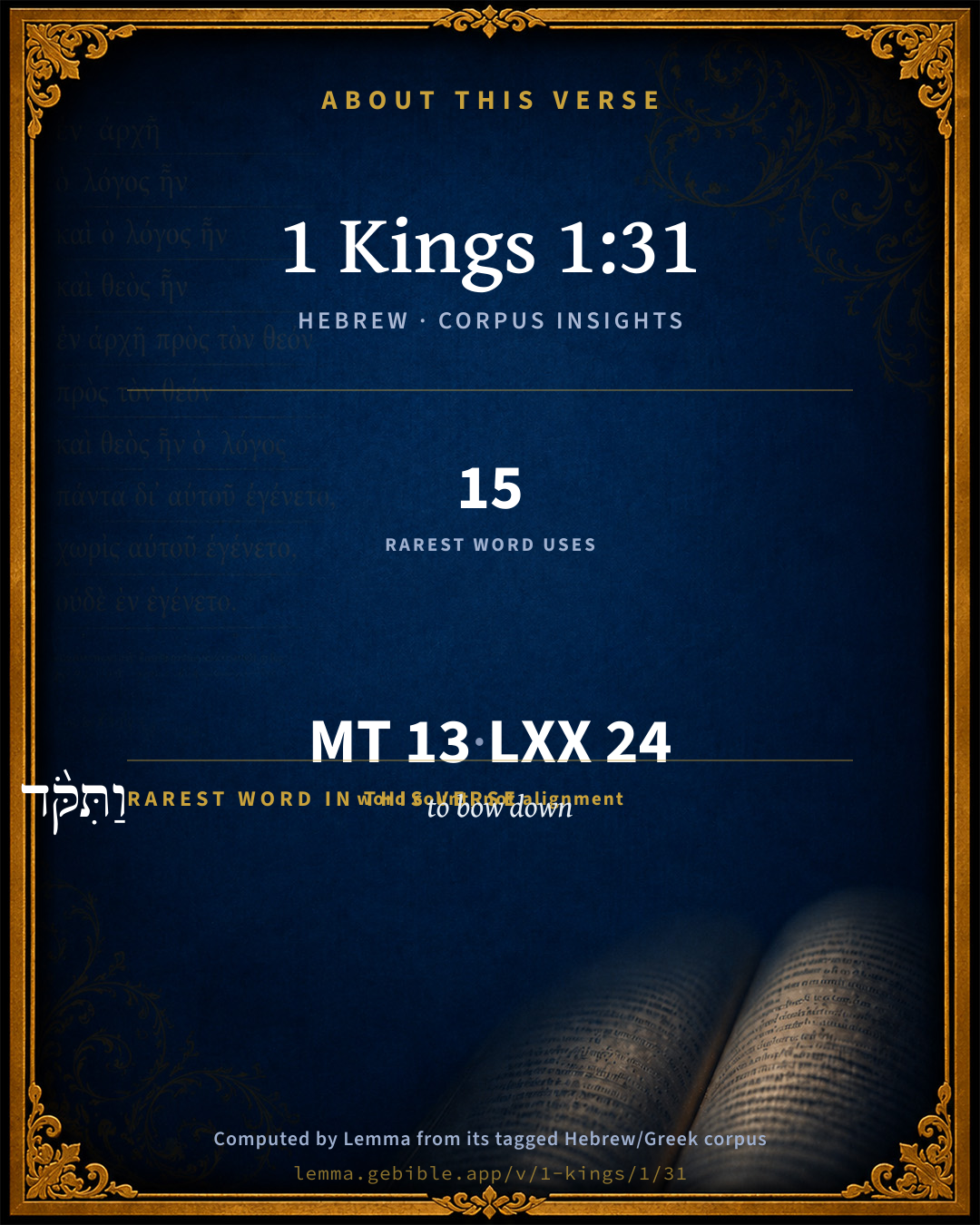
The rarest word here is וַתִּקֹּ֨ד to bow down H6915 — appearing just 15 times in the whole Hebrew Bible.

Shared distinctive vocabulary

וַתִּקֹּ֨ד to bow down H6915 occurs in 15 verses of the Hebrew Bible. Also found in:

Grammatical profile

  • 4 verbs
  • 8 nouns
  • 1 adjective

Verb forms

  • וַתִּקֹּ֨ד Qal · Sequential Imperfect
  • וַתִּשְׁתַּ֖חוּ Hishtaphel · Sequential Imperfect
  • וַתֹּ֕אמֶר Qal · Sequential Imperfect
  • יְחִ֗י Qal · Jussive

Repetition

Words recur within this verse — often emphatic in Hebrew:

  • בַּת Bath-sheba H1339 ×2
  • לַמֶּ֑לֶךְ king H4428 ×2

Hebrew & Septuagint length

In English translation the verse runs 24 words from the Hebrew and 25 from the Septuagint (LXX English) — closely comparable.

A rough comparison of the two English renderings, which tokenize alike — not a word-level alignment.

Word counts can differ between the Hebrew and the Greek without any difference in meaning — e.g. the Hebrew direct-object marker אֵת has no separate Greek word, and Greek often adds the article ὁ.

In the original languages it is 13 Hebrew tokens and 24 Greek tokens — but the two are counted differently (Hebrew bundles its prefixes and suffixes into one token; the Greek is in lemma form), so that isn’t a like-for-like length.

Cross-references

12

Topical passages linked to 1 Kings 1:31 in the Treasury of Scripture Knowledge — connected by theme and wording, ordered by reader-vote popularity; previews shown in the World English Bible.

  • Daniel 2:4 Then spoke the Chaldeans to the king in the Syrian language, O king, live forever: tell your servants the dream, and we will show the interpretation.
  • Daniel 3:9 They answered Nebuchadnezzar the king, O king, live for ever.
  • Daniel 5:10 [Now] the queen by reason of the words of the king and his lords came into the banquet house: the queen spoke and said, O king, live forever; don't let your thoughts trouble you, nor let your face be changed.
  • 2 Samuel 9:6 Mephibosheth, the son of Jonathan, the son of Saul, came to David, and fell on his face, and did obeisance. David said, Mephibosheth. He answered, Behold, your servant!
  • 1 Kings 1:25 For he is gone down this day, and has slain oxen and fatlings and sheep in abundance, and has called all the king's sons, and the captains of the host, and Abiathar the priest; and, behold, they are eating and drinking before him, and say, [Long] live king Adonijah.
  • Nehemiah 2:3 I said to the king, Let the king live forever: why should not my face be sad, when the city, the place of my fathers' tombs, lies waste, and the gates of it are consumed with fire?
  • Esther 3:2 All the king's servants, who were in the king's gate, bowed down, and did reverence to Haman; for the king had so commanded concerning him. But Mordecai didn't bow down, nor did him reverence.
  • Daniel 6:6 Then these presidents and satraps assembled together to the king, and said thus to him, King Darius, live forever.
  • Daniel 6:21 Then said Daniel to the king, O king, live forever.
  • Matthew 21:37 But afterward he sent to them his son, saying, 'They will respect my son.'
  • Hebrews 12:9 Furthermore, we had the fathers of our flesh to chasten us, and we paid them respect. Shall we not much rather be in subjection to the Father of spirits, and live?
  • Ephesians 5:33 Nevertheless each of you must also love his own wife even as himself; and let the wife see that she respects her husband.

Cross-references courtesy of OpenBible.info (CC BY 4.0).

Hebrew and Greek witnesses Masoretic Hebrew ↔ Greek Septuagint

The same verse in the two great witnesses to the Old Testament, shown verse-for-verse.

These are two independent witnesses, not word-aligned to each other, and the Septuagint is shown in lemma (dictionary) form.

Hebrew 1 Kings 1:31 Masoretic · Westminster Leningrad Codex

וַתִּקֹּ֨ד בַּת שֶׁ֤בַע אַפַּ֨יִם֙ אֶ֔רֶץ וַתִּשְׁתַּ֖חוּ לַמֶּ֑לֶךְ וַתֹּ֕אמֶר יְחִ֗י אֲדֹנִ֛י הַמֶּ֥לֶךְ דָּוִ֖ד לְעֹלָֽם

Then Bathsheba bowed with her face to the earth, and did obeisance to the king, and said, Let my lord king David live forever.

World English Bible · Public Domain

Greek LXX 1 Kings 1:31 Septuagint · lemma form

καί κύπτω βηρσαβεε ἐπί πρόσωπον ἐπί ὁ γῆ καί προςκυνέω ὁ βασιλεύς καί εἶπον ζάω ὁ κύριος ἐγώ ὁ βασιλεύς δαυίδ εἰς ὁ αἰών

And Bersabee bowed with her face to the ground, and did obeisance to the king, and said, Let my lord king David live for ever.

LXX2012 (modern English Septuagint) · Public Domain

Hebrew: Westminster Leningrad Codex (CC BY 4.0). Greek: Septuagint (public domain); English from LXX2012 (modern English Septuagint) (Public Domain). How the Septuagint differs from the Hebrew →

Targum (Aramaic paraphrase)

1

The Targum is the ancient Jewish Aramaic paraphrase of the Hebrew Scriptures — an interpretive translation, not the Hebrew text itself. Onkelos (literal) and Pseudo-Jonathan (expansive) render the Torah, and Jonathan the Prophets. Coverage is partial: where no permissively-licensed English translation exists for a verse, only the Aramaic is shown. This is verse-level text, not a word-by-word alignment to the Hebrew.

  1. Targum Jonathan Prophets (Joshua–Malachi)
    וּכְרָעַת בַּת שֶׁבַע עַל אַפָּהָא עַל אַרְעָא וּסְגִידַת לְמַלְכָּא וַאֲמַרַת יִתְקַיֵם רִבּוֹנִי מַלְכָּא דָוִד לַעֲלָם:

    (no public-domain English translation for this verse)

    Targum Jonathan — Aramaic: “Mikraot Gedolot” (public domain). English: “Sefaria Community Translation” (CC0 1.0 (public-domain dedication)); “London "Chaldee Paraphrase," 1871” (public domain). Text via Sefaria.

Commentary

Notes on 1 Kings 1:31 from classic Christian and Jewish commentators (each source and its license shown beneath its notes). The classic Christian expositions comment on the surrounding passage and are grouped to its opening verse, so a note may address several verses; the Jewish commentaries on the Tanakh (Rashi and others) are per-verse, so they appear only where the commentator wrote on this verse.

Lemma curates 59 commentaries, every one of them public domain or Creative Commons licensed, each selected and text-cleaned for this edition rather than reprinted as found. About our sources →

Trapp's Complete Commentary

John Trapp

1Ki 1:31 Then Bathsheba bowed with [her] face to the earth, and did reverence to the king, and said, Let my lord king David live for ever.

Ver. 31. Let my lord king David live for ever,] i.e., Let him live his utmost. Agrippina hastened her husband Claudius the emperor’s death, that her son Nero might succeed: yea, she cried out Occidar, modo imperet. But good Bathsheba was not so hasty.

John Trapp, A Commentary or Exposition upon All the Books of the Old and New Testament (1647–1656) — public domain. Text from a community e-Sword module.

Joseph Benson's Commentary

1Ki 1:31. Let my lord King David live for ever — Though I desire thy oath may be kept, and the right of succession confirmed to my son, yet I am far from thirsting after thy death, and should rather rejoice, if it were possible, for thee to live and enjoy thy crown for ever. There could be no higher expression of love and thankfulness, than to desire never to see Solomon on the throne, if it were possible for David always to enjoy it.

Joseph Benson's Commentary on the Old and New Testaments (1811–1818) — public domain. Text from a community e-Sword module.

Tyndale Open Study Notes

Tyndale Open Resources

1:31-32 David affirmed his pledge by ordering a public display of support by the priestly, prophetic, and military representatives, Zadok, Nathan, and Benaiah.

Tyndale Open Study Notes — © Tyndale Open Resources, licensed CC BY-SA 4.0. Text via the HelloAO Bible API.

The Cambridge Bible for Schools and Colleges

gen. ed. J. J. S. Perowne

31. Let my lord king David live for ever] On this common Oriental hyperbole, compare Dan_2:4; Dan_3:9; Dan_5:10, &c. It was the common Eastern formula. Bath-sheba implied thereby that in her zeal for Solomon’s succession there was no desire for David’s death but only that the promise made to her concerning Solomon should not be broken.

The Cambridge Bible for Schools and Colleges (gen. ed. J. J. S. Perowne; Cambridge University Press, 1878–1918) — public domain. Text from a community e-Sword module.

John Gill's Exposition

Then Bathsheba bowed with her face to the earth, and did reverence to the king,.... Thereby expressing her veneration of him, and thankfulness to him for his favour to her and her son, in fulfilling his promise and oath:

and said, let my lord King David live for ever; which though a common form of salutation of kings, not only in Israel, but in other nations, is not to be considered as a mere compliment, but as expressing the real desires and affection of her heart to the king; signifying hereby that her solicitations on the behalf of her son did not arise from any desire of the king's death; she heartily wished him health to live long and easy; and all her request was, that Solomon her son might succeed him, whenever it pleased God to remove him; or seeing he was now a dying man as it were, her prayer was that his soul might live for ever in happiness in the world to come; so Kimchi interprets it.

John Gill's Exposition of the Whole Bible (1746–1763) — public domain (CC PDM 1.0). Text via the HelloAO Bible API.

Albert Barnes' Notes on the Bible

A lower and humbler obeisance than before 1Ki 1:16. In the Assyrian sculptures ambassadors are represented with their faces actually touching the earth before the feet of the monarch.

Albert Barnes' Notes on the Bible (1834–1885) — public domain. Text from a community e-Sword/MySword module.

Matthew Poole's English Annotations

i.e. For a long time, as that word is oft used, as 1Ki 2:33; Dan 2:4. Though I desire thy oath may be kept, and the right of succession confirmed to my son; yet I am far from thirsting after thy death for his advancement, and should rather rejoice, if it were possible for thee to live and enjoy thy crown for ever.

Matthew Poole's English Annotations on the Holy Bible (1683–1685) — public domain. Text from a community e-Sword/MySword module.

The Pulpit Commentary

Then Bathsheba bowed with her face to the earth, and did reverence to the king see on vers. 16, 23, and said, Let my lord king David live forever. This hyperbolical expression is here only used of a Hebrew monarch. It was constantly addressed to the Babylonian and Persian kings. See Dan_2:4 Dan_3:9 Dan_5:10 Dan_6:21; Neh_2:3.

The Pulpit Commentary (1880–1919), ed. H.D.M. Spence-Jones & Joseph S. Exell — public domain. Text from a community e-Sword module.

John Wesley's Explanatory Notes

Live forever - Though I desire thy oath may be kept, and the right of succession confirmed to my son, yet I am far from thirsting after thy death, and would rather rejoice, if it were possible for thee to live and enjoy the crown forever. 33. My mule - As a token that the royal dignity is transferred upon Solomon, and that by my consent. Gihon - A river near Jerusalem, on the west side. Adonijah was inaugurated on the east side. This place David chose, either, as remote from Adonijah and his company, that so the people might be there without fear of tumults or bloodshed; or, to shew that Solomon was chosen king in opposition to Adonijah: or, because this was a place of great resort, and fit to receive and display that numerous company, which he knew would follow Solomon thither.

John Wesley, Explanatory Notes Upon the Whole Bible (1754–1765) — public domain. Text via the GEBible commentary corpus.

Lesson kit

Teaching starters — assembled from the data on this page, not authored interpretation. Every prompt links to the verse data it draws on. Edit before teaching.

1 Kings, in the Historical, opens this verse with 13 words (11 distinct Hebrew lemmas). Its most distinctive word is qâdad (“to bow down”). A historical commentator’s framing appears above. Read the whole chapter for the surrounding context.

Discussion questions

  1. What does “to bow down” (qâdad) contribute to the verse as a whole?
  2. Genesis 24:26 shares the word «to bow down» with this verse. How do the two illuminate each other?
  3. “Bath-sheba” occurs 2× in this one verse. What is the effect of the repetition?
  4. These translations render this verse differently; the difference is in the English rendering, not the original. What questions does that raise?
  5. The verb «וַתִּקֹּ֨ד» is Qal Sequential Imperfect. How does its form color the action?
  6. Reading how Trapp's Complete Commentary and Joseph Benson's Commentary read this verse, where do the two commentators agree and where do they part?

Things to notice

Reading settings

Reading text

Shown beneath each verse's original-language words.

Old Testament
Old Testament edition

Read the OT as the Masoretic Hebrew (MT) or the Greek Septuagint (LXX).

English shown for the Greek Septuagint (in the Hebrew ↔ Greek comparison).

Comparing translations? Open the Compare panel on any verse page to stack up to four side by side.