
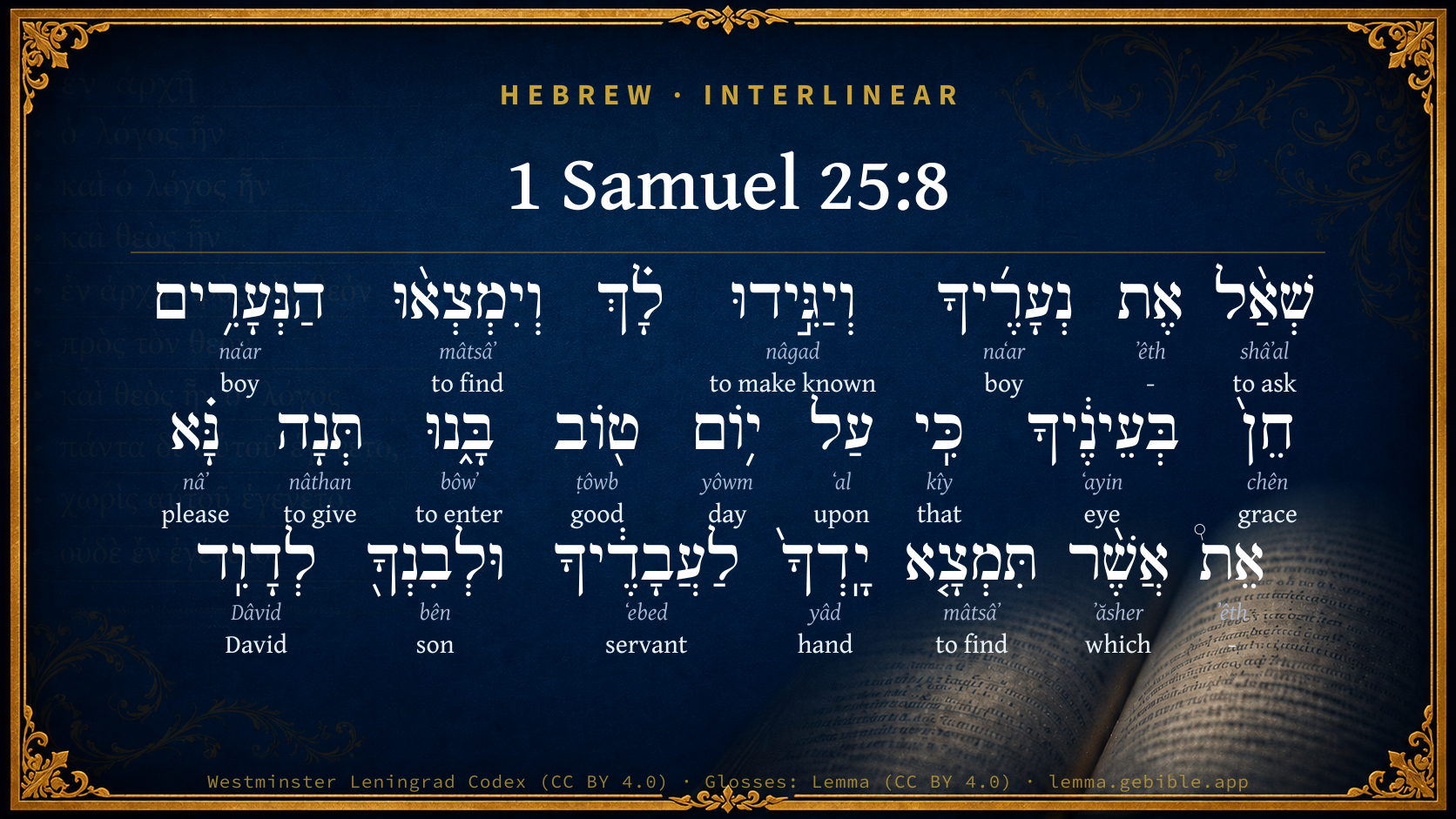
1 Samuel 25:8

Hebrew (Westminster Leningrad Codex) 1 Samuel 25:8 appears in the Hebrew Old Testament. The text above is from the Westminster Leningrad Codex. Each word links to its Strong’s number, a concise gloss, and parsing drawn from the Open Scriptures Hebrew Bible morphology. Click any word for its full Brown-Driver-Briggs (BDB) entry.
Download image
Cite this verse

1 Samuel 25:8 (World English Bible). Public Domain. Lemma interlinear Bible study tool, https://lemma.gebible.app/v/1-samuel/25/8.

Show BibTeX & RIS
BibTeX
RIS
English Translation
Ask your young men, and they will tell you: therefore let the young men find favor in your eyes; for we come in a good day. Please give whatever comes to your hand, to your servants, and to your son David.
World English Bible · Public Domain
Download a study sheet

One document with this verse’s original text, its word-by-word gloss line, the meaning frame, cross-references with their text, attributed commentary, and full source and license credits — printable, and it pastes into notes with its structure intact.

This verse Autodidact and up

Study sheet (.html) Plain text (.txt)

A passage Seminary Student

Up to 50 verses in one chapter. A passage sheet keeps up to 6 commentary sources and 12 cross-references per verse, in the order this page ranks them, and says so on the sheet whenever that leaves anything out. Ask for a single verse and you get the Autodidact verse sheet above.

Everything on this page stays free to read, with no account — the sheet is a download of what is already on screen, not access to it.

Want to remove ads? Support Godless Engineer
Compare translations 3

The same verse in 3 English versions, stacked beneath the original-language interlinear above. Click any original word for its lexicon entry.

Each is an independent rendering of the whole verse — the interlinear is not word-aligned to these translations.

Highlighted words mark where these versions differ — a whole-verse word diff, not a word-by-word alignment.

  • World English Bible Public Domain
    Ask your young men, and they will tell you: therefore let the young men find favor in your eyes; for we come in a good day. Please give whatever comes to your hand, to your servants, and to your son David.
  • King James Version Public Domain
    Ask thy young men, and they will show thee. Wherefore let the young men find favor in thine eyes: for we come in a good day: give, I pray thee, whatsoever cometh to thine hand unto thy servants, and to thy son David.
  • unfoldingWord Literal Text CC BY-SA 4.0
    Ask your young men, and they will declare to you. So let the young men find favor in your eyes, for we have come on a good day. Please give whatever your hand finds to your servants and to your son, to David.’”

unfoldingWord Literal Text — © unfoldingWord, licensed CC BY-SA 4.0. Word-aligned USFM3 via Door43 (git.door43.org/unfoldingWord/en_ult).

Versions to compare (up to 4)

3 of 4 selected

Show all 18 translations

Every available English version of this verse, each an independent rendering of the whole verse.

  • World English Bible Public Domain
    Ask your young men, and they will tell you: therefore let the young men find favor in your eyes; for we come in a good day. Please give whatever comes to your hand, to your servants, and to your son David.
  • Berean Standard Bible Public Domain
    Ask your young men, and they will tell you. So let my young men find favor with you, for we have come on the day of a feast. Please give whatever you can afford to your servants and to your son David.’”
  • Majority Standard Bible Public Domain
    Ask your young men, and they will tell you. So let my young men find favor with you, for we have come on the day of a feast. Please give whatever you can spare to your servants and to your son David.’”
  • King James Version Public Domain
    Ask thy young men, and they will show thee. Wherefore let the young men find favor in thine eyes: for we come in a good day: give, I pray thee, whatsoever cometh to thine hand unto thy servants, and to thy son David.
  • American Standard Version (1901) Public Domain
    Ask thy young men, and they will tell thee: wherefore let the young men find favor in thine eyes; for we come in a good day: give, I pray thee, whatsoever cometh to thy hand, unto thy servants, and to thy son David.
  • Revised Version (1885) Public Domain
    Ask thy young men, and they will tell thee: wherefore let the young men find favour in thine eyes; for we come in a good day: give, I pray thee, whatsoever cometh to thine hand, unto thy servants, and to thy son David.
  • Geneva Bible (1599) Public Domain
    Aske thy seruants and they wil shew thee. Wherefore let these yong men finde fauour in thine eyes: (for we come in a good season) giue, I pray thee, whatsoeuer commeth to thine hand vnto thy seruants, and to thy sonne Dauid.
  • Douay-Rheims (1899) Public Domain
    Ask thy servants, and they will tell thee. Now therefore let thy servants find favour in thy eyes: for we are come in a good day, whatsoever thy hand shall find give to thy servants, and to thy son David.
  • Young's Literal Translation Public Domain
    `Ask thy young men, and they declare to thee, and the young men find grace in thine eyes, for on a good day we have come; give, I pray thee, that which thy hand findeth, to thy servants, and to thy son, to David.'
  • Literal Standard Version CC BY-SA 4.0
    Ask your young men, and they declare [it] to you, and the young men find grace in your eyes, for we have come on a good day; please give that which your hand finds to your servants and to your son, to David.”
  • Unlocked Literal Bible CC BY-SA 4.0
    Ask your young men, and they will tell you. Now let my young men find favor in your eyes, for we have come on a festive day. Please give whatever you have on hand to your servants and to your son David.'”
  • unfoldingWord Literal Text CC BY-SA 4.0
    Ask your young men, and they will declare to you. So let the young men find favor in your eyes, for we have come on a good day. Please give whatever your hand finds to your servants and to your son, to David.’”
  • Darby Bible Public Domain
    Ask thy young men, and they will tell thee. Therefore let the young men find favour in thine eyes; for we come in a good day: give, I pray thee, what thy hand may find to thy servants, and to thy son David.
  • World Messianic Bible Public Domain
    Ask your young men, and they will tell you. Therefore let the young men find favor in your eyes, for we come on a good day. Please give whatever comes to your hand to your servants and to your son David.’”
  • Webster's Bible Public Domain
    Ask thy young men, and they will show thee. Wherefore let the young men find favor in thy eyes: for we come in a good day: give, I pray thee, whatever cometh to thy hand, to thy servants, and to thy son David.
  • Free Bible Version CC BY-SA 4.0
    Check with your men and they'll confirm it. Please be kind to my men, especially since we've come on this day of celebration. Please give whatever food you can to us and to your good friend David.’”
  • Bible in Basic English Public Domain
    If your young men are questioned they will say the same thing. So now, let my young men have grace in your eyes, for we are come at a good time; please give anything you may have by you to your servants and to your son David.
  • JPS Tanakh (1917) Public Domain
    Ask thy young men, and they will tell thee; wherefore let the young men find favour in thine eyes; for we come on a good day; give, I pray thee, whatsoever cometh to thy hand, unto thy servants, and to thy son David.'

Literal Standard Version (2020), Covenant Press — licensed CC BY-SA 4.0. Text via the HelloAO Bible API (eBible.org). Unlocked Literal Bible (unfoldingWord) — licensed CC BY-SA 4.0. Text via the HelloAO Bible API (eBible.org). unfoldingWord Literal Text — © unfoldingWord, licensed CC BY-SA 4.0. Word-aligned USFM3 via Door43 (git.door43.org/unfoldingWord/en_ult). Free Bible Version, Dr. Jonathan Gallagher — licensed CC BY-SA 4.0. Text via the HelloAO Bible API (eBible.org).

Word by word

More ways to search: Search by grammar → Find every occurrence → Compare this word →

Practice this passage: Drill this verse → Learn its vocabulary →

חֵן֙
chên
H2580
“grace”
Noun, Common, Masculine, Singular, Absolute
Part of Speech
Noun
Type
Common
Gender
Masculine
Number
Singular
State
Absolute
Full BDB Definition

Origin: from H2603

TWOT: TWOT- 694a

favour, grace, charm - favour, grace, elegance - favour, acceptance
  1. שְׁאַ֨ל shâʼal H7592 “ask” Verb, Qal, Imperative, 2nd Person, Masculine, Singular
  2. אֶת ʼêth H853 “-” Particle, Direct Object
  3. נְעָרֶ֜יךָ naʻar H5288 “boys · your” Noun, Common, Masculine, Plural, Construct + Suffix, Personal, 2nd Person, Masculine, Singular
  4. וְיַגִּ֣ידוּ nâgad H5046 “and · to make known” Conjunction + Verb, Hiphil, Imperfect, 3rd Person, Masculine, Plural
  5. וְיִמְצְא֨וּ mâtsâʼ H4672 “and · to find” Conjunction + Verb, Qal, Imperfect, 3rd Person, Masculine, Plural
  6. הַנְּעָרִ֥ים naʻar H5288 “the · boys” Particle, Definite Article + Noun, Common, Masculine, Plural, Absolute
  7. בְּעֵינֶ֔יךָ ʻayin H5869 “in/at · eyes · your” Preposition + Noun, Common, Both, Dual, Construct + Suffix, Personal, 2nd Person, Masculine, Singular
  8. כִּֽי kîy H3588 “that” Conjunction
  9. עַל ʻal H5921 “upon” Preposition
  10. י֥וֹם yôwm H3117 “day” Noun, Common, Masculine, Singular, Absolute
  11. ט֖וֹב ṭôwb H2896 “good” Adjective, Adjective, Masculine, Singular, Absolute
  12. בָּ֑נוּ bôwʼ H935 “to enter” Verb, Qal, Perfect, 1st Person, Common, Plural
  13. תְּנָה nâthan H5414 “give” Verb, Qal, Imperative, 2nd Person, Masculine, Singular + Suffix, h
  14. נָּ֗א nâʼ H4994 “please” Particle, Interjection
  15. אֵת֩ ʼêth H853 “-” Particle, Direct Object
  16. אֲשֶׁ֨ר ʼăsher H834 “which” Particle, Relative
  17. תִּמְצָ֤א mâtsâʼ H4672 “to find” Verb, Qal, Imperfect, 3rd Person, Feminine, Singular
  18. יָֽדְךָ֙ yâd H3027 “hand · your” Noun, Common, Both, Singular, Construct + Suffix, Personal, 2nd Person, Masculine, Singular
  19. לַעֲבָדֶ֔יךָ ʻebed H5650 “to/for · servants · your” Preposition + Noun, Common, Masculine, Plural, Construct + Suffix, Personal, 2nd Person, Masculine, Singular
  20. וּלְבִנְךָ֖ bên H1121 “and · to/for · son · your” Conjunction + Preposition + Noun, Common, Masculine, Singular, Construct + Suffix, Personal, 2nd Person, Masculine, Singular
  21. לְדָוִֽד Dâvid H1732 “to/for · David” Preposition + Noun, Proper

About this verse

These counts appear in no published source. They are computed here, from the morphology-tagged text and Lemma’s own curated glosses. What Lemma adds →

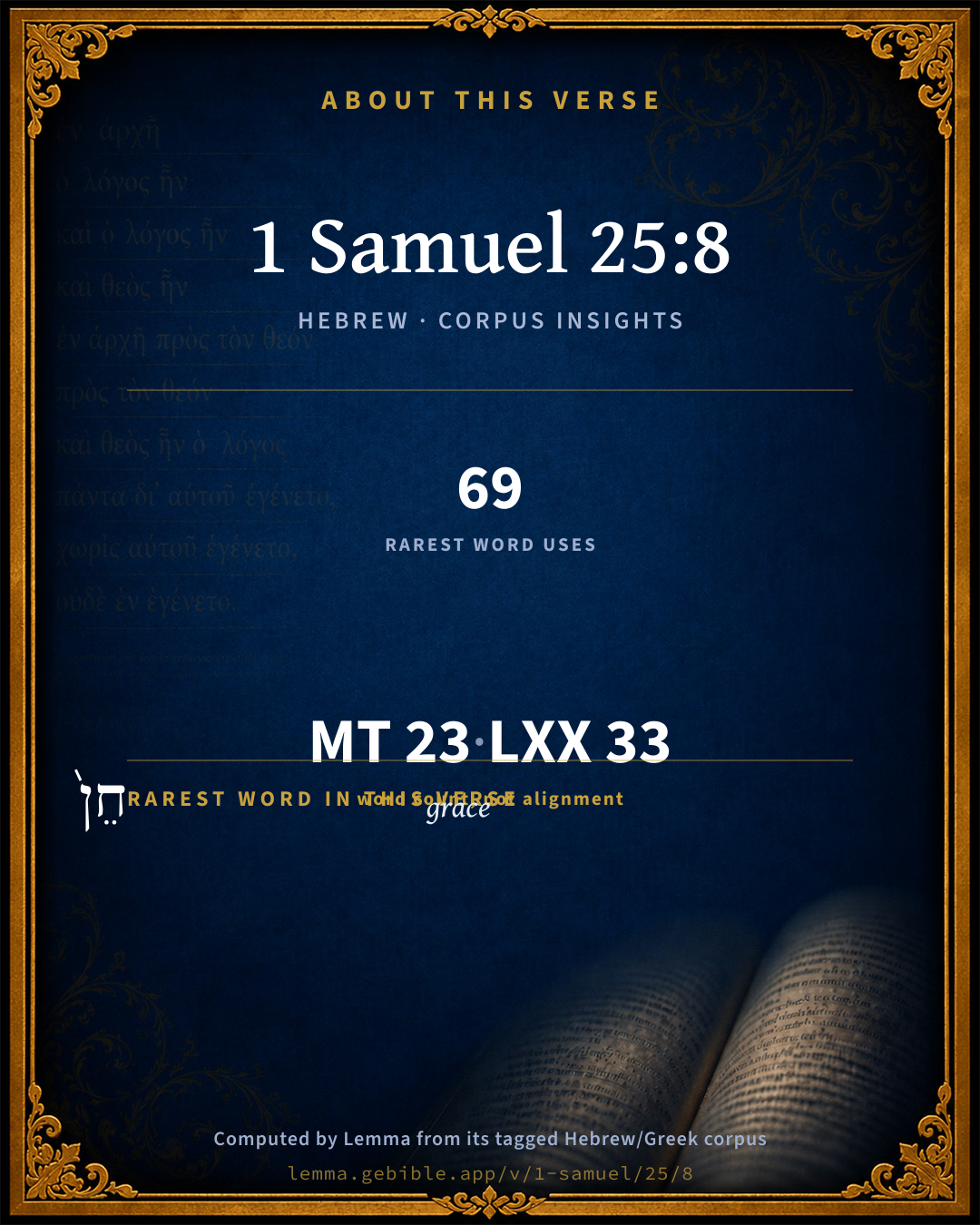
23
words
19
distinct lemmas
Historical
section

Grammatical profile

  • 6 verbs
  • 9 nouns
  • 1 adjective
  • 2 prepositions
  • 1 conjunction
  • 4 particles

Verb forms

  • שְׁאַ֨ל Qal · Imperative
  • וְיַגִּ֣ידוּ Hiphil · Imperfect
  • וְיִמְצְא֨וּ Qal · Imperfect
  • בָּ֑נוּ Qal · Perfect
  • תְּנָה Qal · Imperative
  • תִּמְצָ֤א Qal · Imperfect

Repetition

Words recur within this verse — often emphatic in Hebrew:

  • נְעָרֶ֜יךָ boy H5288 ×2
  • וְיִמְצְא֨וּ to find H4672 ×2

Hebrew & Septuagint length

In English translation the verse runs 41 words from the Hebrew and 38 from the Septuagint (LXX English) — closely comparable.

A rough comparison of the two English renderings, which tokenize alike — not a word-level alignment.

Word counts can differ between the Hebrew and the Greek without any difference in meaning — e.g. the Hebrew direct-object marker אֵת has no separate Greek word, and Greek often adds the article ὁ.

In the original languages it is 23 Hebrew tokens and 33 Greek tokens — but the two are counted differently (Hebrew bundles its prefixes and suffixes into one token; the Greek is in lemma form), so that isn’t a like-for-like length.

Cross-references

8

Topical passages linked to 1 Samuel 25:8 in the Treasury of Scripture Knowledge — connected by theme and wording, ordered by reader-vote popularity; previews shown in the World English Bible.

  • Esther 9:19 Therefore do the Jews of the villages, who dwell in the unwalled towns, make the fourteenth day of the month Adar [a day of] gladness and feasting, and a good day, and of sending portions one to another.
  • Nehemiah 8:10–12 Then he said to them, Go your way, eat the fat, and drink the sweet, and send portions to him for whom nothing is prepared; for this day is holy to our Lord: neither be you grieved; for the joy of Yahweh is your strength.
  • 1 Samuel 3:6 Yahweh called yet again, Samuel. Samuel arose and went to Eli, and said, Here am I; for you called me. He answered, I didn't call, my son; lie down again.
  • 1 Samuel 24:11 Moreover, my father, behold, yes, see the skirt of your robe in my hand; for in that I cut off the skirt of your robe, and didn't kill you, know you and see that there is neither evil nor disobedience in my hand, and I have not sinned against you, though you hunt after my life to take it.
  • Esther 9:22 as the days in which the Jews had rest from their enemies, and the month which was turned to them from sorrow to gladness, and from mourning into a good day; that they should make them days of feasting and gladness, and of sending portions one to another, and gifts to the needy.
  • Ecclesiastes 11:2 Give a portion to seven, yes, even to eight; For you don't know what evil will be on the earth.
  • Luke 11:41 But give for gifts to the needy those things which are within, and behold, all things will be clean to you.
  • Luke 14:12–14 He also said to the one who had invited him, "When you make a dinner or a supper, don't call your friends, nor your brothers, nor your kinsmen, nor rich neighbors, or perhaps they might also return the favor, and pay you back.

Cross-references courtesy of OpenBible.info (CC BY 4.0).

Hebrew and Greek witnesses Masoretic Hebrew ↔ Greek Septuagint

The same verse in the two great witnesses to the Old Testament, shown verse-for-verse.

These are two independent witnesses, not word-aligned to each other, and the Septuagint is shown in lemma (dictionary) form.

Hebrew 1 Samuel 25:8 Masoretic · Westminster Leningrad Codex

שְׁאַ֨ל אֶת נְעָרֶ֜יךָ וְיַגִּ֣ידוּ לָ֗ךְ וְיִמְצְא֨וּ הַנְּעָרִ֥ים חֵן֙ בְּעֵינֶ֔יךָ כִּֽי עַל י֥וֹם ט֖וֹב בָּ֑נוּ תְּנָה נָּ֗א אֵת֩ אֲשֶׁ֨ר תִּמְצָ֤א יָֽדְךָ֙ לַעֲבָדֶ֔יךָ וּלְבִנְךָ֖ לְדָוִֽד

Ask your young men, and they will tell you: therefore let the young men find favor in your eyes; for we come in a good day. Please give whatever comes to your hand, to your servants, and to your son David.

World English Bible · Public Domain

Greek LXX 1 Samuel 25:8 Septuagint · lemma form

ἐρωτάω ὁ παιδάριον σύ καί ἀποἀγγέλλω σύ καί εὑρίσκω ὁ παιδάριον χάρις ἐν ὀφθαλμός σύ ὅτι ἐπί ἡμέρα ἀγαθός ἥκω δίδωμι δή ὅς ἐάν εὑρίσκω ὁ χείρ σύ ὁ υἱός σύ ὁ δαυίδ

Ask your servants, and they will tell you. Let then your servants find grace in your eyes, for we are come on a good day; give we pray you, whatever your hand may find, to your son David.

LXX2012 (modern English Septuagint) · Public Domain

Hebrew: Westminster Leningrad Codex (CC BY 4.0). Greek: Septuagint (public domain); English from LXX2012 (modern English Septuagint) (Public Domain). How the Septuagint differs from the Hebrew →

Targum (Aramaic paraphrase)

1

The Targum is the ancient Jewish Aramaic paraphrase of the Hebrew Scriptures — an interpretive translation, not the Hebrew text itself. Onkelos (literal) and Pseudo-Jonathan (expansive) render the Torah, and Jonathan the Prophets. Coverage is partial: where no permissively-licensed English translation exists for a verse, only the Aramaic is shown. This is verse-level text, not a word-by-word alignment to the Hebrew.

  1. Targum Jonathan Prophets (Joshua–Malachi)
    שְׁאַל יַת עוּלֵמָךְ וִיחַוּן לָךְ וְיִשְׁכְּחוּן עוּלֵימַיָא רַחֲמִין בְּעֵינָךְ אֲרֵי עַל יוֹם טַב אֲתֵינָא הַב כְּעַן יַת דְתַשְׁכַּח יְדָךְ לְעַבְדָךְ וְלִבְרָךְ לְדָוִד:

    (no public-domain English translation for this verse)

    Targum Jonathan — Aramaic: “Mikraot Gedolot” (public domain). English: “Sefaria Community Translation” (CC0 1.0 (public-domain dedication)); “London "Chaldee Paraphrase," 1871” (public domain). Text via Sefaria.

Commentary

Notes on 1 Samuel 25:8 from classic Christian and Jewish commentators (each source and its license shown beneath its notes). The classic Christian expositions comment on the surrounding passage and are grouped to its opening verse, so a note may address several verses; the Jewish commentaries on the Tanakh (Rashi and others) are per-verse, so they appear only where the commentator wrote on this verse.

Lemma curates 59 commentaries, every one of them public domain or Creative Commons licensed, each selected and text-cleaned for this edition rather than reprinted as found. About our sources →

Trapp's Complete Commentary

John Trapp

1Sa 25:8 Ask thy young men, and they will shew thee. Wherefore let the young men find favour in thine eyes: for we come in a good day: give, I pray thee, whatsoever cometh to thine hand unto thy servants, and to thy son David.

Ver. 8. For we come in a good day.] A festival; wherein thou art bound by the law to relieve the necessitous. {Deu 15:7} Hilaria celebras, illorum ergo particulam in nos deriva, nosque tecum exhilara, let us partake of thine exceedings.

Give, I pray thee.] Annonam et alimoniam; we will not be our own carvers, but take thankfully what thou canst well spare us. Thus he omitteth nothing whereby he might insinuate; but this matter was not malleable.

John Trapp, A Commentary or Exposition upon All the Books of the Old and New Testament (1647–1656) — public domain. Text from a community e-Sword module.

Tyndale Open Study Notes

Tyndale Open Resources

25:8 Sheep-shearing time for herdsmen was like harvest time for farmers, a time of celebration and thankfulness for blessings.

Tyndale Open Study Notes — © Tyndale Open Resources, licensed CC BY-SA 4.0. Text via the HelloAO Bible API.

Geneva Bible (1599)

Geneva Bible translators

Whatsoever thou hast ready for us.

Geneva Bible (1599) marginal notes — public domain. Text via Bolls.life.

Adam Clarke's Commentary

Verse 8. Whatsoever cometh to thine hand] As thou art making a great feast for thy servants, and I and my men, as having essentially served thee, would naturally come in for a share were we present; send a portion by my ten young men, for me and my men, that we also may rejoice with you. Certainly this was a very reasonable and a very modest request. This mode of address is not unfrequent among the Hindoos: "O father, fill the belly of thy son; he is in distress."

Adam Clarke's Commentary on the Bible (1810–1826) — public domain. Text from a community e-Sword/MySword module.

The Cambridge Bible for Schools and Colleges

gen. ed. J. J. S. Perowne

8. a good day] A day of festivity and rejoicing. Cp. Est_8:17.

The Cambridge Bible for Schools and Colleges (gen. ed. J. J. S. Perowne; Cambridge University Press, 1878–1918) — public domain. Text from a community e-Sword module.

John Gill's Exposition

Ask thy young men, and they will show thee,.... The shepherds before mentioned, who kept their flocks hard by them:

wherefore let the young men find favour in thine eyes; the ten young men David sent to Nabal:

for we are come in a good day; a day in which Nabal made a feast for his shearers, as was usual then, and still is, see Sa2 13:23; and at such times as persons are generally cheerful and merry, so free and liberal, and as there were plenty of provisions, not only enough for the guests and shearers, but to spare, and there was no need for an increase of expense, it might upon the whole be concluded it was a proper time for David to apply for accommodations for himself and his men:

give, I pray thee, whatsoever cometh to thine hand unto thy servants,

and to thy son David; he did not request anything extraordinary of him, or to put him to any expense, but what was at hand, and he could spare, he prayed him to deliver to the young men he sent, for their use, and the use of other his servants, and particularly David, who styled himself his son, being of the same tribe with Nabal, and Nabal his senior.

John Gill's Exposition of the Whole Bible (1746–1763) — public domain (CC PDM 1.0). Text via the HelloAO Bible API.

Haydock's Catholic Bible Commentary

Good day, set aside for rejoicing, w hen the sheep were shorn, 2 Kings xiii. 24.

George Leo Haydock (1774–1849), Haydock's Catholic Family Bible and Commentary, 1859 edition — public domain. Excludes Psalms (Douay-Rheims chapter numbering differs from Protestant) and Deuterocanonical books (Catholic canon only).

Matthew Poole's English Annotations

In a good day, i.e. in a day of feasting and rejoicing; when men are most cheerful and liberal; when thou mayst relieve us out of thy abundance without damage to thyself; when thou art receiving the mercies of God, and therefore obliged to pity and relieve distressed and indigent persons, Deu 12:12; 14:26,29; 15:7.

Unto thy servants to us who have been and still are ready to serve and guard thee and thine. Or the word servants may be only used as a word of respect, frequently used in Scripture, where inferiors speak to superiors, especially when they be suppliants, and beg some favour.

To thy son; so he calls himself, to show that respect and affection which he bore to Nabal, as being elder and wealthier than himself, and of the same tribe with himself, and a branch of so worthy a family as Nabal’s was.

Matthew Poole's English Annotations on the Holy Bible (1683–1685) — public domain. Text from a community e-Sword/MySword module.

Whedon's Commentary on the Bible

Daniel D. Whedon

8. We come in a good day — A day of festivity and rejoicing. The occasion of sheep-shearing was accompanied with a festal meal, and the owner of the flocks was expected to deal liberally with all who had helped care for his possessions. Compare 2Sa_13:24.

Give I pray thee — “On such a festive occasion near a town or village, even in our own time, an Arab sheik of the neighbouring desert would hardly fail to put in a word, either in person or by message; and his message, both in form and substance, would be only the transcript of that of David.” — Robinson.

Daniel D. Whedon (gen. ed.), Commentary on the Old and New Testaments (1874–1909) — public domain. Text from a community e-Sword module.

John Wesley's Explanatory Notes

A good day - That is, in a day of feasting and rejoicing; when men are most chearful and liberal; when thou mayst relieve us out of thy abundance without damage to thyself; when thou art receiving the mercies of God, and therefore obliged to pity and relieve distressed and indigent persons.

John Wesley, Explanatory Notes Upon the Whole Bible (1754–1765) — public domain. Text via the GEBible commentary corpus.

Rashi

Rabbi Shlomo Yitzchaki (Rashi)

May the youths find. My youths, find favor in your eyes, for the kindness which your servants will tell concerning them.

For we have come on a festive day. Relying on the party and festive day which you have, we have now come to ask. Another explanation is, that this was the eve of Rosh Hashonoh [so they said,] "We are in need of a holiday feast."

Rashi on the Tanakh — English translations: “The Judaica Press complete Tanach with Rashi, translated by A. J. Rosenberg” (CC BY 4.0); “Pentateuch with Rashi's commentary by M. Rosenbaum and A.M. Silbermann, 1929-1934” (public domain); “The Metsudah Tanach series, Lakewood, N.J” (CC BY 4.0); and “The Book of Joshua, Metsudah Publications, 1997” (CC BY 4.0). Text via Sefaria.

Lesson kit

Teaching starters — assembled from the data on this page, not authored interpretation. Every prompt links to the verse data it draws on. Edit before teaching.

1 Samuel, in the Historical, opens this verse with 23 words (19 distinct Hebrew lemmas). Its most distinctive word is chên (“grace”). A historical commentator’s framing appears above. Read the whole chapter for the surrounding context.

Discussion questions

  1. The word chên carries the sense “grace.” How does it shape the verse?
  2. How does Esther 9:19, which shares this passage’s theme, read alongside this verse?
  3. What does the repetition of “boy” (2× in this one verse) do in this verse?
  4. These translations render this verse differently; the difference is in the English rendering, not the original. What questions does that raise?
  5. «שְׁאַ֨ל» is a Qal Imperative verb. How does that grammatical form shape the action described?
  6. Compare how Trapp's Complete Commentary and Tyndale Open Study Notes read this verse. Where do they agree or differ?

Things to notice

Reading settings

Reading text

Shown beneath each verse's original-language words.

Old Testament
Old Testament edition

Read the OT as the Masoretic Hebrew (MT) or the Greek Septuagint (LXX).

English shown for the Greek Septuagint (in the Hebrew ↔ Greek comparison).

Comparing translations? Open the Compare panel on any verse page to stack up to four side by side.