1 Chronicles 17:16

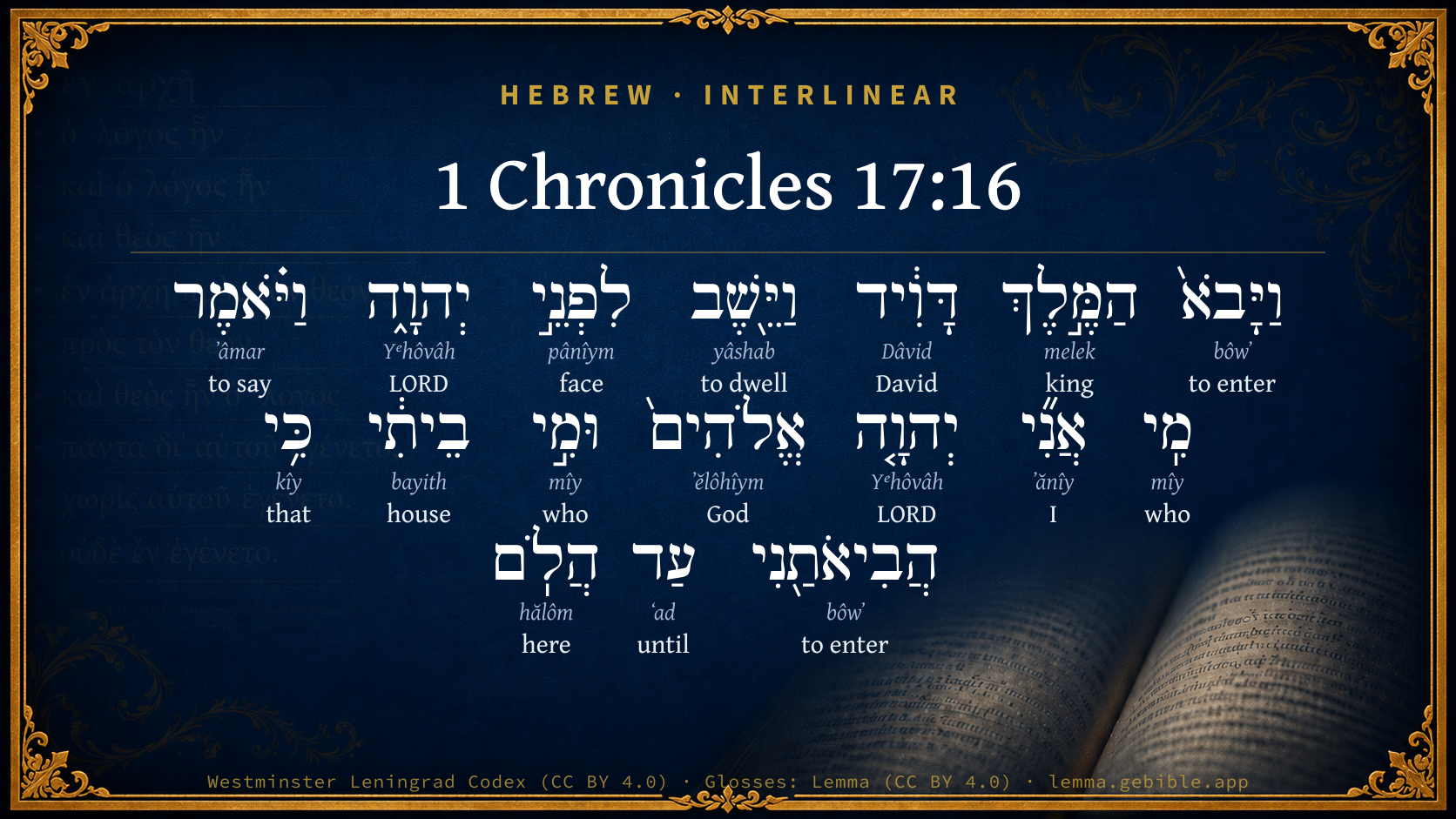
Hebrew (Westminster Leningrad Codex) 1 Chronicles 17:16 appears in the Hebrew Old Testament. The text above is from the Westminster Leningrad Codex. Each word links to its Strong’s number, a concise gloss, and parsing drawn from the Open Scriptures Hebrew Bible morphology. Click any word for its full Brown-Driver-Briggs (BDB) entry.
Download image
Cite this verse

1 Chronicles 17:16 (World English Bible). Public Domain. Lemma interlinear Bible study tool, https://lemma.gebible.app/v/1-chronicles/17/16.

Show BibTeX & RIS
BibTeX
RIS
English Translation
Then David the king went in, and sat before Yahweh; and he said, Who am I, Yahweh God, and what is my house, that you have brought me thus far?
World English Bible · Public Domain
Download a study sheet

One document with this verse’s original text, its word-by-word gloss line, the meaning frame, cross-references with their text, attributed commentary, and full source and license credits — printable, and it pastes into notes with its structure intact.

This verse Autodidact and up

Study sheet (.html) Plain text (.txt)

A passage Seminary Student

Up to 50 verses in one chapter. A passage sheet keeps up to 6 commentary sources and 12 cross-references per verse, in the order this page ranks them, and says so on the sheet whenever that leaves anything out. Ask for a single verse and you get the Autodidact verse sheet above.

Everything on this page stays free to read, with no account — the sheet is a download of what is already on screen, not access to it.

Want to remove ads? Support Godless Engineer
Compare translations 3

The same verse in 3 English versions, stacked beneath the original-language interlinear above. Click any original word for its lexicon entry.

Each is an independent rendering of the whole verse — the interlinear is not word-aligned to these translations.

Highlighted words mark where these versions differ — a whole-verse word diff, not a word-by-word alignment.

  • World English Bible Public Domain
    Then David the king went in, and sat before Yahweh; and he said, Who am I, Yahweh God, and what is my house, that you have brought me thus far?
  • King James Version Public Domain
    And David the king came and sat before the LORD, and said, Who am I, O LORD God, and what is mine house, that thou hast brought me hitherto?
  • unfoldingWord Literal Text CC BY-SA 4.0
    And King David came and sat to the face of Yahweh, and he said, “Who I, Yahweh God, and what my house, that you have brought me to here?

unfoldingWord Literal Text — © unfoldingWord, licensed CC BY-SA 4.0. Word-aligned USFM3 via Door43 (git.door43.org/unfoldingWord/en_ult).

Versions to compare (up to 4)

3 of 4 selected

Show all 18 translations

Every available English version of this verse, each an independent rendering of the whole verse.

  • World English Bible Public Domain
    Then David the king went in, and sat before Yahweh; and he said, Who am I, Yahweh God, and what is my house, that you have brought me thus far?
  • Berean Standard Bible Public Domain
    Then King David went in, sat before the LORD, and said, “Who am I, O LORD God, and what is my house, that You have brought me this far?
  • Majority Standard Bible Public Domain
    Then King David went in, sat before the LORD, and said, “Who am I, O LORD God, and what is my house, that You have brought me this far?
  • King James Version Public Domain
    And David the king came and sat before the LORD, and said, Who am I, O LORD God, and what is mine house, that thou hast brought me hitherto?
  • American Standard Version (1901) Public Domain
    Then David the king went in, and sat before Jehovah; and he said, Who am I, O Jehovah God, and what is my house, that thou hast brought me thus far?
  • Revised Version (1885) Public Domain
    Then David the king went in, and sat before the LORD; and he said, Who am I, O LORD God, and what is my house, that thou hast brought me thus far?
  • Geneva Bible (1599) Public Domain
    And Dauid the King went in and sate before the Lord and said, Who am I, O Lord God, and what is mine house, that thou hast brought me hitherto?
  • Douay-Rheims (1899) Public Domain
    And king David came and sat before the Lord, and said: Who am I, O Lord God, and what is my house, that thou shouldst give such things to me?
  • Young's Literal Translation Public Domain
    And David the king cometh in and sitteth before Jehovah, and saith, `Who `am' I, O Jehovah God, and what my house, that Thou hast brought me hitherto?
  • Literal Standard Version CC BY-SA 4.0
    And David the king comes in and sits before YHWH, and says, “Who [am] I, O YHWH God, and what [is] my house, that You have brought me here?
  • Unlocked Literal Bible CC BY-SA 4.0
    Then David the king went in and sat before Yahweh; he said, “Who am I, Yahweh God, and what is my family, that you have brought me to this point?
  • unfoldingWord Literal Text CC BY-SA 4.0
    And King David came and sat to the face of Yahweh, and he said, “Who I, Yahweh God, and what my house, that you have brought me to here?
  • Darby Bible Public Domain
    And king David went in and sat before Jehovah, and said, Who am I, Jehovah Elohim, and what is my house, that thou hast brought me hitherto?
  • World Messianic Bible Public Domain
    Then David the king went in and sat before the LORD; and he said, “Who am I, LORD God, and what is my house, that you have brought me this far?
  • Webster's Bible Public Domain
    And David the king came and sat before the LORD, and said, Who am I, O LORD God, and what is my house, that thou hast brought me hitherto?
  • Free Bible Version CC BY-SA 4.0
    Then King David went and sat down in the presence of the Lord. He prayed, “Who am I, Lord God, and what is significant about my family, that you have brought me to this place?
  • Bible in Basic English Public Domain
    Then David the king went in and took his seat before the Lord, and said, Who am I, O Lord God, and what is my family, that you have been my guide till now?
  • JPS Tanakh (1917) Public Domain
    Then David the king went in, and sat before the LORD; and he said: 'Who am I, O LORD God, and what is my house, that Thou hast brought me thus far?

Literal Standard Version (2020), Covenant Press — licensed CC BY-SA 4.0. Text via the HelloAO Bible API (eBible.org). Unlocked Literal Bible (unfoldingWord) — licensed CC BY-SA 4.0. Text via the HelloAO Bible API (eBible.org). unfoldingWord Literal Text — © unfoldingWord, licensed CC BY-SA 4.0. Word-aligned USFM3 via Door43 (git.door43.org/unfoldingWord/en_ult). Free Bible Version, Dr. Jonathan Gallagher — licensed CC BY-SA 4.0. Text via the HelloAO Bible API (eBible.org).

Word by word

More ways to search: Search by grammar → Find every occurrence → Compare this word →

Practice this passage: Drill this verse → Learn its vocabulary →

הֲלֹֽם
hălôm
H1988
“here”
Adverb
Part of Speech
Adverb
Full BDB Definition

Origin: from the article [see H1973 ]

TWOT: 503

here, hither
  1. וַיָּבֹא֙ bôwʼ H935 “and · to enter” Conjunction + Verb, Qal, Sequential Imperfect, 3rd Person, Masculine, Singular
  2. הַמֶּ֣לֶךְ melek H4428 “the · king” Particle, Definite Article + Noun, Common, Masculine, Singular, Absolute
  3. דָּוִ֔יד Dâvid H1732 “David” Noun, Proper
  4. וַיֵּ֖שֶׁב yâshab H3427 “and · to dwell” Conjunction + Verb, Qal, Sequential Imperfect, 3rd Person, Masculine, Singular
  5. לִפְנֵ֣י pânîym H6440 “to/for · face(s) of” Preposition + Noun, Common, Both, Plural, Construct
  6. יְהוָ֑ה Yᵉhôvâh H3068 “LORD” Noun, Proper
  7. וַיֹּ֗אמֶר ʼâmar H559 “and · to say” Conjunction + Verb, Qal, Sequential Imperfect, 3rd Person, Masculine, Singular
  8. מִֽי mîy H4310 “who” Particle, Interrogative
  9. אֲנִ֞י ʼănîy H589 “I” Pronoun, Personal, 1st Person, Common, Singular
  10. יְהוָ֤ה Yᵉhôvâh H3068 “LORD” Noun, Proper
  11. אֱלֹהִים֙ ʼĕlôhîym H430 “God(s)” Noun, Common, Masculine, Plural, Absolute
  12. וּמִ֣י mîy H4310 “and · who” Conjunction + Particle, Interrogative
  13. בֵיתִ֔י bayith H1004 “house · my” Noun, Common, Masculine, Singular, Construct + Suffix, Personal, 1st Person, Common, Singular
  14. כִּ֥י kîy H3588 “that” Conjunction
  15. הֲבִיאֹתַ֖נִי bôwʼ H935 “to enter · me” Verb, Hiphil, Perfect, 2nd Person, Masculine, Singular + Suffix, Personal, 1st Person, Common, Singular
  16. עַד ʻad H5704 “until” Preposition

About this verse

These counts appear in no published source. They are computed here, from the morphology-tagged text and Lemma’s own curated glosses. What Lemma adds →

17
words
14
distinct lemmas
Historical
section

Notable vocabulary

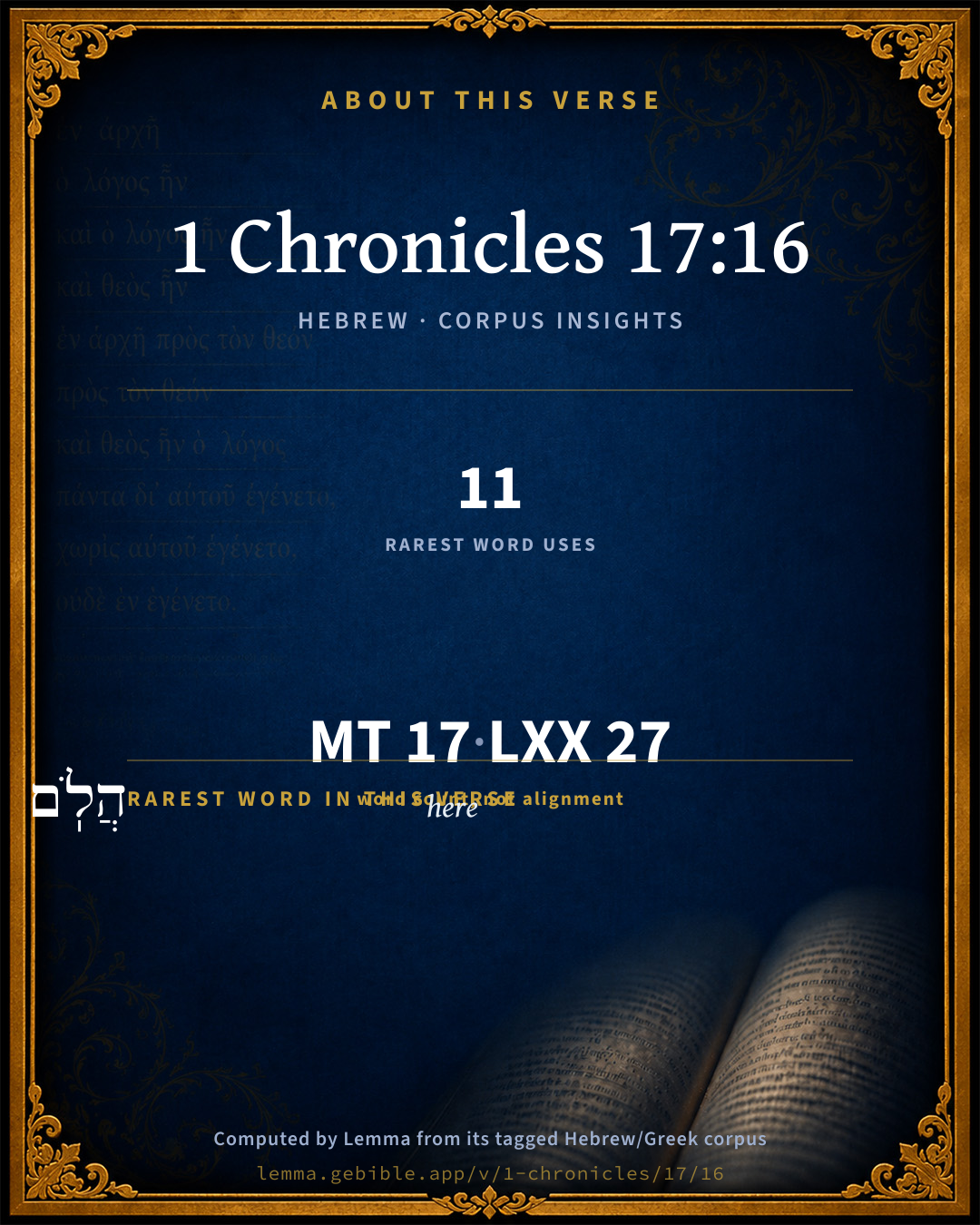
The rarest word here is הֲלֹֽם here H1988 — appearing just 11 times in the whole Hebrew Bible.

Shared distinctive vocabulary

הֲלֹֽם here H1988 occurs in 11 verses of the Hebrew Bible. Also found in:

Grammatical profile

  • 4 verbs
  • 7 nouns
  • 1 pronoun
  • 1 preposition
  • 1 conjunction
  • 1 adverb
  • 2 particles

Verb forms

  • וַיָּבֹא֙ Qal · Sequential Imperfect
  • וַיֵּ֖שֶׁב Qal · Sequential Imperfect
  • וַיֹּ֗אמֶר Qal · Sequential Imperfect
  • הֲבִיאֹתַ֖נִי Hiphil · Perfect

Repetition

Words recur within this verse — often emphatic in Hebrew:

  • וַיָּבֹא֙ to enter H935 ×2
  • יְהוָ֑ה LORD H3068 ×2
  • מִֽי who H4310 ×2

Hebrew & Septuagint length

In English translation the verse runs 30 words from the Hebrew and 29 from the Septuagint (LXX English) — closely comparable.

A rough comparison of the two English renderings, which tokenize alike — not a word-level alignment.

Word counts can differ between the Hebrew and the Greek without any difference in meaning — e.g. the Hebrew direct-object marker אֵת has no separate Greek word, and Greek often adds the article ὁ.

In the original languages it is 17 Hebrew tokens and 27 Greek tokens — but the two are counted differently (Hebrew bundles its prefixes and suffixes into one token; the Greek is in lemma form), so that isn’t a like-for-like length.

Cross-references

11

Topical passages linked to 1 Chronicles 17:16 in the Treasury of Scripture Knowledge — connected by theme and wording, ordered by reader-vote popularity; previews shown in the World English Bible.

  • 2 Samuel 7:18 Then David the king went in, and sat before Yahweh; and he said, Who am I, Lord Yahweh, and what is my house, that you have brought me thus far?
  • Genesis 32:10 I am not worthy of the least of all the loving kindnesses, and of all the truth, which you have shown to your servant; for with just my staff I passed over this Jordan; and now I have become two companies.
  • Ephesians 3:8 To me, the very least of all saints, was this grace given, to preach to the Gentiles the unsearchable riches of Christ,
  • Psalms 144:3 Yahweh, what is man, that you care for him? Or the son of man, that you think of him?
  • 1 Samuel 7:12 Then Samuel took a stone, and set it between Mizpah and Shen, and called the name of it Ebenezer, saying, Hitherto has Yahweh helped us.
  • 1 Samuel 9:21 Saul answered, Am I not a Benjamite, of the smallest of the tribes of Israel? and my family the least of all the families of the tribe of Benjamin? why then speak you to me after this manner?
  • Genesis 48:15–16 He blessed Joseph, and said, "The God before whom my fathers Abraham and Isaac did walk, the God who has fed me all my life long to this day,
  • Judges 6:15 He said to him, Oh, Lord, with which shall I save Israel? behold, my family is the poorest in Manasseh, and I am the least in my father's house.
  • 2 Kings 19:14 Hezekiah received the letter from the hand of the messengers, and read it; and Hezekiah went up to the house of Yahweh, and spread it before Yahweh.
  • Acts 26:22 Having therefore obtained the help that is from God, I stand to this day testifying both to small and great, saying nothing but what the prophets and Moses said would happen,
  • 2 Corinthians 1:10 who delivered us out of so great a death, and does deliver; on whom we have set our hope that he will also still deliver us;

Cross-references courtesy of OpenBible.info (CC BY 4.0).

Hebrew and Greek witnesses Masoretic Hebrew ↔ Greek Septuagint

The same verse in the two great witnesses to the Old Testament, shown verse-for-verse.

These are two independent witnesses, not word-aligned to each other, and the Septuagint is shown in lemma (dictionary) form.

Hebrew 1 Chronicles 17:16 Masoretic · Westminster Leningrad Codex

וַיָּבֹא֙ הַמֶּ֣לֶךְ דָּוִ֔יד וַיֵּ֖שֶׁב לִפְנֵ֣י יְהוָ֑ה וַיֹּ֗אמֶר מִֽי אֲנִ֞י יְהוָ֤ה אֱלֹהִים֙ וּמִ֣י בֵיתִ֔י כִּ֥י הֲבִיאֹתַ֖נִי עַד הֲלֹֽם

Then David the king went in, and sat before Yahweh; and he said, Who am I, Yahweh God, and what is my house, that you have brought me thus far?

World English Bible · Public Domain

Greek LXX 1 Chronicles 17:16 Septuagint · lemma form

καί ἔρχομαι ὁ βασιλεύς δαυίδ καί καταἵζω ἀπέναντι κύριος καί εἶπον τίς εἰμί ἐγώ κύριος ὁ θεός καί τίς ὁ οἶκος ἐγώ ὅτι ἀγαπάω ἐγώ ἕως αἰών

And king David came and sat before the Lord, and said, Who am I, O Lord God? and what is my house, that you have loved me for ever?

LXX2012 (modern English Septuagint) · Public Domain

On this verse, The Cambridge Bible for Schools and Colleges discusses the Septuagint’s reading. Read the note in Commentary ↓

Hebrew: Westminster Leningrad Codex (CC BY 4.0). Greek: Septuagint (public domain); English from LXX2012 (modern English Septuagint) (Public Domain). How the Septuagint differs from the Hebrew →

Commentary

Notes on 1 Chronicles 17:16 from classic Christian and Jewish commentators (each source and its license shown beneath its notes). The classic Christian expositions comment on the surrounding passage and are grouped to its opening verse, so a note may address several verses; the Jewish commentaries on the Tanakh (Rashi and others) are per-verse, so they appear only where the commentator wrote on this verse.

Lemma curates 59 commentaries, every one of them public domain or Creative Commons licensed, each selected and text-cleaned for this edition rather than reprinted as found. About our sources →

Trapp's Complete Commentary

John Trapp

1Ch 17:16 And David the king came and sat before the LORD, and said, Who [am] I, O LORD God, and what [is] mine house, that thou hast brought me hitherto?

Ver. 16. And sat before the Lord.] Or, Abode before the Lord, as the Jewish doctors render it: who hold also that men ought to pray standing: for so, say they, do the holy angels.

John Trapp, A Commentary or Exposition upon All the Books of the Old and New Testament (1647–1656) — public domain. Text from a community e-Sword module.

The Biblical Illustrator

Joseph S. Exell

1Ch_17:16

Who am I, O Lord God, and what is mine house, that Thou hast brought me hitherto?

The greatness of Divine favours

I. They infinitely surpass human desert.

II. They fill all times from remotest past to distant future.

III. They spring from sovereign mercy.

IV. They are beyond all human comprehension. (J. P. Lange.)

The Biblical Illustrator, edited by Joseph S. Exell (c. 1880s–1900s) — public domain. Text from a community e-Sword module.

Joseph Benson's Commentary

1Ch 17:16. Who am I? &c. — We have here David’s solemn address to God, in answer to his gracious message. How humbly does he here abase himself, and acknowledge his own unworthiness! How highly does he advance the name of God, and admire his condescending favour! With what devout affections does he magnify the God of Israel: with what assurance build upon the promise! What an example this of believing, fervent prayer! The Lord enable us all thus to seek him!

Joseph Benson's Commentary on the Old and New Testaments (1811–1818) — public domain. Text from a community e-Sword module.

Geneva Bible (1599)

Geneva Bible translators

He went into the tent where the Ark was, showing what we ought to do when we receive any benefits of the Lord.

Or, remained.

Meaning to this kingly estate.

Geneva Bible (1599) marginal notes — public domain. Text via Bolls.life.

Matthew Henry's Commentary

We have here David's solemn address to God, in answer to the gracious message he had now received from him. By faith he receives the promises, embraces them, and is persuaded of them, as the patriarchs, Heb, Ch1 11:13. How humbly does he here abase himself, and acknowledge his own unworthiness! How highly does he advance the name of God and admire his condescending grace and favour! With what devout affections does he magnify the God of Israel and what a value has he for the Israel of God! With what assurance does he build upon the promise, and with what a lively faith does he put it in suit! What an example is this to us of humble, believing, fervent prayer! The Lord enable us all thus to seek him! These things were largely observed, 2 Sa. 7. We shall therefore here observe only those few expressions in which the prayer, as we find it here, differs from the record of it there, and has something added to it.

I. That which is there expressed by way of question (Is this the manner of men, O Lord God?) is here an acknowledgment: "Thou hast regarded me according to the estate of a man of high degree. Thou hast made me a great man, and then treated me accordingly." God, by the covenant-relations into which he admits believers, the titles he gives them, the favours he bestows on them, and the preparations he has made for them, regards them according to the estate of men of high degree, though they are mean and vile. Having himself distinguished them, he treats them as persons of distinction, according to the quality he has been pleased to put upon them. Some give these words here another reading: "Thou hast looked upon me in the form of a man who art in the highest, the Lord God; or, Thou hast made me to see according to the form of a man the majesty of the Lord God." And so it points at the Messiah; for, as Abraham, so David, saw his day and was glad, saw it by faith, saw it in fashion as a man, the Word made flesh, and yet saw his glory as that of the only-begotten of the Father. And this was that which God spoke concerning his house for a great while to come, the foresight of which affected him more than any thing. And let it not be thought strange that David should speak so plainly of the two natures of Christ who in spirit called him Lord, though he knew he was to be his Son (Psa 110:1), and foresaw him lower than the angels for a little while, but afterwards crowned with glory and honour, Heb 2:6, Heb 2:7.

II. After the words What can David say more unto thee, it is here added, for the honour of they servant? Ch1 17:18. Note, The honour God puts upon his servants, by taking them into covenant and communion with himself, is so great that they need not, they cannot, desire to be more highly honoured. Were they to sit down and wish, they could not speak more for their own honour than the word of God has spoken.

III. It is very observable that what in Samuel is said to be for thy word's sake is here said to be for thy servant's sake, Ch1 17:19. Jesus Christ is both the Word of God (Rev 19:13) and the servant of God (Isa 42:1), and it is for his sake, upon the score of his meditation, that the promises are both made and made good to all believers; it is in him that they are yea and amen. For his sake is all kindness done, for his sake it is made known; to him we owe all this greatness and from him we are to expect all these great things; they are the unsearchable riches of Christ, which, if by faith we see in themselves and see in the hand of the Lord Jesus, we cannot but magnify as great things, the only true greatness, and speak honourably of accordingly.

IV. In Samuel, the Lord of hosts is said to be the God over Israel; here he is said to be the God of Israel, even a God to Israel, Ch1 17:24. His being the God of Israel bespeaks his having the name of their God and so calling himself; his being a God to Israel bespeaks his answering to the name, his filling up the relation, and doing all that to them which might be expected from him. There were those that were called gods of such and such nations, gods of Assyria and Egypt, gods of Hamad and Arpad; but they were no gods to them, for they stood them in no stead at all, were mere ciphers, nothing but a name. But the God of Israel is a God to Israel; all his attributes and perfections redound to their real benefit and advantage. Happy therefore, thrice happy, is the people whose God is Jehovah; for he will be a God to them, a God all-sufficient.

V. The closing words in Samuel are, With thy blessing let the house of thy servant be blessed forever. That is the language of a holy desire. But the closing words here are the language of a most holy faith: For thou blessest, O Lord! and it shall be blessed for ever, Ch1 17:27. 1. He was encouraged to beg a blessing because God had intimated to him that he had blessings in store for him and his family: "Thou blessest, O Lord! and therefore unto thee shall all flesh come for a blessing; unto thee do I come for the blessing promised to me." Promises are intended to direct and excite prayer. Has God said, I will bless? Let our hearts answer, Lord, bless me, 2. He was earnest for the blessing because he believed that those whom God blesses are truly and eternally blessed: Thou blessest, and it shall be blessed. Men can but beg the blessing; it is God that commands it. What he designs he effects; what he promises he performs; saying and doing are not two things with him. Nay, it shall be blessed for ever. His blessings shall not be revoked, cannot be opposed, and the benefits conferred by them are such as will survive time and days. David's prayer concludes as God's promise did (Ch1 17:14) with that which is for ever. God's word looks at things eternal, and so should our desires and hopes.

Matthew Henry's Commentary on the Whole Bible (1708–1710) — public domain (CC PDM 1.0). Text via the HelloAO Bible API.

Jamieson, Fausset & Brown

Robert Jamieson, A. R. Fausset & David Brown

David the king . . . sat before the Lord, and said--(See on Sa2 7:18).

Next: 1 Chronicles Chapter 18

Jamieson, Fausset & Brown — Commentary Critical and Explanatory on the Whole Bible (1871) — public domain (CC PDM 1.0). Text via the HelloAO Bible API.

Adam Clarke's Commentary

Verse 16. And what is mine house, that thou hast brought me hitherto?] I am not of any regal family, and have no natural right to the throne.

Adam Clarke's Commentary on the Bible (1810–1826) — public domain. Text from a community e-Sword/MySword module.

Ellicott's Commentary for English Readers

(16) Sat before the Lord.—In the tent of the Ark.

And said.—Comp. Psalms 18, title.

Who am I.—The longer form of the pronoun I is used in Samuel (’anokhî; here ’anî).

O Lord God.—Heb., Jehovah Elohim. Samuel has “Adonai Jehovah,” which is more original. David addresses God as “my Lord, Jehovah;” just as in 1Ch_17:4; 1Ch_17:7, God speaks of David as “my servant.” (Comp. the frequent style of the Assyrian kings, who speak of their wars as undertaken in the service of the gods their lords.)

Mine house.—My family.

Hitherto.—To this pitch of greatness. With this and the next verse, compare David’s last words (2Sa_23:5).

A Bible Commentary for English Readers, edited by Charles John Ellicott (1878–1897) — public domain. Text from a community e-Sword module.

The Cambridge Bible for Schools and Colleges

gen. ed. J. J. S. Perowne

16. And … came] R.V. Then … went in (as Sam.), i.e. into the tent which he had pitched for the ark; 1Ch_16:1.

sat before the Lord] So LXX. and 2Sa_7:18. The Targ. rightly paraphrases, “and tarried in prayer before Jehovah.” The same use of the verb “sit” to imply continuance is found in the Creeds; in which it is said that Christ “sitteth” on the right hand of the Father.

hitherto] R.V. thus far.

The Cambridge Bible for Schools and Colleges (gen. ed. J. J. S. Perowne; Cambridge University Press, 1878–1918) — public domain. Text from a community e-Sword module.

Matthew Poole's English Annotations

Sat before the Lord; which may note either his gesture, or his continuance there till he had finished this following prayer.

Matthew Poole's English Annotations on the Holy Bible (1683–1685) — public domain. Text from a community e-Sword/MySword module.

The Pulpit Commentary

Vers. 16-27. These verses contain David"s response to the gracious communication which had been made to him, and thanksgivings for the promise made to him as regards his seed. His appreciation of the contents of that promise is expressed in a manner which would seem to indicate that he was not altogether untaught, even then, by the Spirit of some of the deeper significance of the far-reaching promise.

Sat before the Lord; i.e. before the ark. It has surprised many that it should be said that David sat before the Lord, in the act of prayer or devotion. But this was not altogether unusual (1Ki_19:4) in the first place; and then, secondly, it is not quite clear that this is said. Possibly he sat awaiting first some such token as he might know how to construe into the presence of Jehovah, and into his gracious vouchsafing to give him audience, and thereupon he may have altered his attitude. Confessedly, however, the other is the morn natural reading.

Humility.

This chapter is one of peculiar beauty, as exhibiting at once the gracious intentions of the Lord towards one of his servants, and the grateful response of that servant to the condescension and loving-kindness with which he was treated. The spirit of self-abnegation and humility breathing in the language of the text awakens our admiration, and calls for our imitation. We are reminded by these words of

I OUR UNWORTHINESS AND ILL DESERT. "Who am I that thou hast brought me hitherto?" It is an unwonted attitude for many minds. Men are so prone to regard their own fancied excellences, that language of humiliation and contrition is often suspected of insincerity. Yet, in the presence of him who is at once the perfectly holy and the Searcher of hearts, what more appropriate than prostration of soul and acknowledgment of sin?

II GOD"S GRACE AND KINDNESS TO THOSE WHO DEPEND UPON HIM. The Lord exalts the humble and meek. The king acknowledged not only his own utter unworthiness of the distinction accorded to him, but God"s infinite mercy and goodness in his treatment of his servant. "According to thine own heart hast thou done all this greatness." There are in Scripture many beautiful examples of God"s grace to the lowly in heart. Read the song of Hannah, and the Magnificat of Mary the mother of Jesus; and observe how the Lord is acknowledged as the great King who delights to have mercy upon the feeble who yet are faithful, and to put honour upon them, and reveal to them his love and mercy. In fact, revelation abounds with practical proofs of God"s purpose ever to reject the proud, and to favour and exalt the meek, the lowly, and the contrite. It is upon those who sincerely ask, "Who am I?" that the Lord of glory delights to confer the tokens of his approval and favour.

III THE SPECIAL FAVOUR SHOWN TO US BY GOD, WHO DEIGNS TO USE US IT HIS SERVICE ANY KINGDOM. Evidently David felt that the highest honour was put upon him in being allowed to serve Jehovah to be an instrument in his hands for the carrying out of Divine purposes. What dignity and happiness does it give to life, to know that we are commissioned and employed by the King of kings!

PRACTICAL LESSONS.

1. These considerations should enhance our conceptions of God"s gloryand grace. Let us recount his mercies, and acknowledge their Divine source.

2. They should induce us to consecrate afresh to Heaven the nature Heavenhas created, and the powers Heaven has conferred. T.

Vers. 16-18.

Our relation to God.

The attitude which David assumed and the words of devotion he uttered on this occasion are suggestive of the relation in which we stand to our Creator and Redeemer. We gather

I THAT WE CANNOT BE LED TO A BETTER STATE THAN A DEEP SENSE OF OUR NOTHINGNESS AND THE DIVINE GREATNESS. When Nathan had delivered his message David placed himself in the posture of deliberate reflection (ver. 16), and, thus seated, he became possessed of a profound sense of his own unworthiness. "Who am I, O Lord, and what is my house?" etc. (ver. 16). He soon passed on to cherish a deep feeling of God"s supremacy. "O Lord, there is none like thee," etc. (ver. 20). This is a most suitable end to any transaction between our God and ourselves. We are then arriving at the truth, reaching a place of spiritual safety, in an attitude that is most becoming, when we are impressed with our own nothingness and with the absolute greatness of our God and Saviour.

II THAT GOD NOT ONLY CALLS US TO SONSHIP, BUT TREATS US AS HIS CHILDREN. "Thou hast regarded me according to the estate of a man of high degree" (ver. 17). This probably means that, in David"s thought, God had treated him as one who was most exalted, and who might on that ground look for the largest things. At any rate it was true if this be not the exact thought of the obscure passage that God was treating David in a way which corresponded with the exalted position to which he had called him. And this truth has its illustration in the Divine dealing with all his sons. In the gospel we are all called to be the sons of (Joh_1:12; 1Jn_3:2) And having reinstated us in this filial position, our heavenly Father treats us as the reconciled sons and daughters we have become.

1. He confides in us; not laying down a multitude of precepts in detail, butgiving us a few living principles to apply for ourselves.

2. He gives us constant access to his person; whensoever we will we may approach and address him.

3. He chastens rather than punishes us. (Heb_12:5-11)

III THAT GOD HAS CONFERRED ABOUNDING HONOUR ON US IN JESUS CHRIST. David felt that God had put so much honour on him that he did not know how he could ask for more (ver. 18). The utmost desires of his heart were fulfilled. And what more of honour and position could we have asked of God that he has not given us in the gospel of his grace? We are even said to be "kings and priests unto God". (Rev_1:6)

1. We are children of the heavenly Father: "noware we the sons of God.

2. We are heirs of God. (Rom_8:17)

3. We are the friends of Christ. (Joh_15:14, Joh_15:15)

4. We are fellow-labourers with the living God, "workers together with (1Co_3:9; 2Co_6:1; Act_15:4) What could we speak more for the honour of his servants? C.

Vers. 16-27.

David"s prayer.

God"s great and precious promises to David drew forth from his heart this prayer. It is so at all times. The constraining motive of prayer, praise, and thanksgiving is God"s great mercy and wondrous love contained in the "exceeding great and precious promises" to the soul. We see also David"s great humility: "Who am I, and what is mine house?" God"s grace always humbles. We see also how David exalts God another effect of God"s great and precious promises: "O Lord, there is none like thee, neither is there any God to be compared with thee." And all this grace in God is "according to all that we have heard." Every experience of the believer at all times confirms the Divine testimony of God in his Word. He is ready to exclaim as he reads, "It is all true, all of it, and I have found it so." And this God is moreover "the Lord of hosts, the God of Israel and a God to Israel." He is not only the God of his people, but a God to them, to each one. He is all that his name means to each one of his family. And mark David"s closing words. "Let it please thee to bless the house of thy servant, that it may be before thee for ever." This is the end for which we should ask any blessing that we ourselves may be before him, walk before him and live before him. "Walk before me and be thou perfect," was his word to Abraham of old, and still is to each one of his people; and it is only as God"s promises and God"s blessings lead to this that they can be real blessings. W.

The humbling influence of the Divine goodness.

Precisely the position and the attitude of David we cannot with certainty explain. The expression came indicates that he left his palace and crossed over within the tabernacle precincts. But we have no means of knowing whether he sat in the court facing the sacred tent, or whether he was permitted to go within the sacred curtains, and face the entrance to the holy of holies, where the ark was. It is possible that the king may have claimed priestly rights so far as to enter the holy place. His attitude is explained by some knowledge of Oriental customs. "One of the postures by which a person testifies his respect for a superior is by sitting upon his heels, which is considered as a token of great humility." The sitting was really half-sitting and half-kneeling, so as to rest the body upon the heels. The Talmudists say (but apparently only on the authority of this passage) that none may pray sitting except only the kings of the house of David. But we fix attention on the spirit in which David responded to the very gracious message which God sent to him, and in his spirit we find an example well worthy of our imitation. God"s goodness brought home to him a sense of his own unworthiness, and filled him with wonder that he should be made such a monument of mercy. The goodness of God humbles true hearts much more than does his frown. Its right work is to "lead us to repentance." The following points are suggested by this example:

I WITH GOD FAR OFF, MAN MAY GROW PROUD. He can then see nothing but his own doings.

II WITH GOD NEAR, MAN BOWS IN REVERENT AWE, as is seen in Abraham, Moses, Job, Isaiah, and St. John.

III GOD SPEAKING WORDS OF GRACE HUMBLES MAN INTO PENITENCE AND HUMILITY. Gifts are always humbling, because they awaken the sense of desert. So Divine gifts are ever most humbling.

R.T.

The Pulpit Commentary (1880–1919), ed. H.D.M. Spence-Jones & Joseph S. Exell — public domain. Text from a community e-Sword module.

John Wesley's Explanatory Notes

Who am I, &c. - We have here David's solemn address to God, in answer to his gracious message. How humbly does he here abase himself, and acknowledge his own unworthiness! How highly does he advance the name of God, and admire his condescending favour? With what devout affections does he magnify the God of Israel: with what assurance build upon the promise! What an example is this of believing, fervent prayer! The Lord enable us all thus to seek him!

John Wesley, Explanatory Notes Upon the Whole Bible (1754–1765) — public domain. Text via the GEBible commentary corpus.

unfoldingWord translationNotes

Door43 World Missions Community

he said

"David said"

Who am I, Yahweh God, and what is my family, that you have brought me to this point?

David asks this question to express the deep emotion he felt from hearing Yahweh's proclamation. This rhetorical question can be translated as a statement. AT: "My family and I are not worthy of this honor, Yahweh God." (See: Rhetorical Question)

this was a small thing

Something that is not important is described as being small. (See: Idiom)

in your sight

Here sight represents judgment or evaluation. AT: "in your judgment" (See: Metaphor)

your servant's family

Here David refers to himself as "your servant." This can be stated in first person. AT: "my family" (See: First, Second, or Third Person)

for a great while to come

This speaks about time as if it were something that travels and arrives somewhere. AT: "and what will happen to them in the future" (See: Metaphor)

What more can I, David, say to you?

David uses this question to emphasize that he has nothing left to say to Yahweh. AT: "There is nothing more I can say to you." (See: Rhetorical Question)

your servant

Here David refers to himself as "your servant." This can be stated in first person. AT: "me" (See: First, Second, or Third Person)

You have honored your servant. You have given your servant special recognition

These two phrases have similar meanings and are repeated for emphasis. (See: Parallelism)

You have given your servant special recognition

The abstract noun "recognition" can be translated using the verb "recognize." AT: "You have recognized your servant in a special way" (See: Abstract Nouns)

translationWords

Yahweh

God

family

servant

generation

honor

unfoldingWord translationNotes — © Distant Shores Media and the Door43 World Missions Community, licensed CC BY-SA 4.0. Source: git.door43.org/Door43/en_tn.

Rashi

Rabbi Shlomo Yitzchaki (Rashi)

that You have brought me thus far From the sheepcote you brought me to the kingdom.

Rashi on the Tanakh — English translations: “The Judaica Press complete Tanach with Rashi, translated by A. J. Rosenberg” (CC BY 4.0); “Pentateuch with Rashi's commentary by M. Rosenbaum and A.M. Silbermann, 1929-1934” (public domain); “The Metsudah Tanach series, Lakewood, N.J” (CC BY 4.0); and “The Book of Joshua, Metsudah Publications, 1997” (CC BY 4.0). Text via Sefaria.

Lesson kit

Teaching starters — assembled from the data on this page, not authored interpretation. Every prompt links to the verse data it draws on. Edit before teaching.

1 Chronicles, in the Historical, opens this verse with 17 words (14 distinct Hebrew lemmas). Its most distinctive word is hălôm (“here”). A historical commentator’s framing appears above. Read the whole chapter for the surrounding context.

Discussion questions

  1. What does “here” (hălôm) contribute to the verse as a whole?
  2. Genesis 16:13 shares the word «here» with this verse. How do the two illuminate each other?
  3. “to enter” occurs 2× in this one verse. What is the effect of the repetition?
  4. These translations render this verse differently. What is at stake in choosing one wording over another?
  5. The verb «וַיָּבֹא֙» is Qal Sequential Imperfect. How does its form color the action?
  6. Reading how Trapp's Complete Commentary and The Biblical Illustrator read this verse, where do the two commentators agree and where do they part?

Things to notice

Reading settings

Reading text

Shown beneath each verse's original-language words.

Old Testament
Old Testament edition

Read the OT as the Masoretic Hebrew (MT) or the Greek Septuagint (LXX).

English shown for the Greek Septuagint (in the Hebrew ↔ Greek comparison).

Comparing translations? Open the Compare panel on any verse page to stack up to four side by side.